Green shoots in the desert?

Some old timers still blame a December 1988 Barron's article ("Phoenix Descending") for the collapse of the city's real-estate boom. This is fantasy, of course: The market caved in on its own, pulled down by too many hustles, too much overbuilding and the savings and loan scandal driven by local steward Charles H Keating and his pet senators. Now Rupert Murdoch's Dow Jones has tried to make amends with a Wall Street Journal story about Phoenix's "nascent real-estate rebound." Indeed, it "holds lessons for the rest of the country." Another fantasy?

The Journal continues:

Phoenix has found a viable formula. Low prices are igniting demand from first-time buyers and investors who are converting the homes to rentals. The local economy is on the upswing with several big employers like Amazon.com Inc. and Intel Corp. hiring again, which is further increasing demand for housing. And the region is benefiting from a surge of buyers from Canada who are using their favorable exchange rate to scoop up bargains in the desert.

Could this be true? Has long-suffering Phoenix "found a bottom" and is beginning a rebound? As Zhou Enlai may have said when asked about the significance of the French Revolution: It is too soon to say. What it means about the metropolitan area's real competitiveness and future is murkier still.

Mesa stirring?

Downtown_Mesa_Arizona
Something is happening in Mesa. Light rail is being extended three miles along Main Street from Sycamore to Mesa Drive, reaching downtown and putting it within walking distance, on a decent day, of the Arizona Temple. A brewery is coming to Main Street. Pioneer Park might get a botanical garden, pushed by a citizens committee that also proposes extending light-rail to Gateway airport. (Building an inspiring city hall would be nice, too). Officials brought in 50 developers to show off potential downtown sites. Council members actually expressed hesitation about some senior housing projects, worried they would get in the way of efforts to attract market-rate, transit-oriented residential development downtown.

The "city with wide streets and narrow minds" is actually attracting higher education: the A.T. Still University branch offers osteopathic medicine, dentistry and health care; Benedictine University is expected to open a campus downtown. This is on top of the downtown branch of Mesa Community College and ASU Polytechnic. When metro Phoenix saw itself in the running for a new Apple campus, which not surprisingly went to Austin instead, it's no secret the company was looking most at Mesa. The Mesa Arts Center has stopped trying to compete with Phoenix and is doing well with, among other things, community festivals.

Could this be Mesa, Arizona? A city more populous than Cincinnati, Pittsburgh, St. Louis, Minneapolis, etc. with nothing to show for it? Something seems to have changed.

Halftime in Arizona

Note to national and international Rogue readers: As Arizona marks 100 years of statehood this month, you'll have to put up with more than the usual number of AZ- and Phoenix-centric posts.

AzSemiIn 1962, Arizona marked its 50th year as a state. It's a vivid memory for me, although I was but a child. I loved the commemorative seal with the cactus wren, so much more appealing than today's gaudy centennial emblem. Fifty years of statehood was a remarkable event for those still living who had witnessed statehood and lived in Arizona Territory, my grandmother among them. The state in 1962 had barely more than 1 million people, with Phoenix not yet at the half-million mark. Phoenix was becoming a big city with comforts unimagined 50 years before, especially air conditioning. Still, the frontier was close enough to touch, living history was all around and much of the state was still wilderness. Vast empty distances separated the settled areas and those were compact and clear in their purpose.

Prescott, for example, the onetime territorial capital, was an enchanting little town with appealing rough edges. None of today's sprawl existed. It had only recently lost its status as a division point on the Santa Fe Railway between Phoenix and Williams Jct. Mining and ranching were the economy. The highway up Yarnell Hill was notoriously treacherous. Flagstaff was a major railroad town, also depending on sawmills for the logging industry and Arizona State College. The Mogollon Rim was virtually uninhabited, just one of many parts of the state as wild as ever. The state highways were two lanes, taking you to rich history that wasn't across the street from a Wal-Mart. Even in Phoenix, you could see old cowboys, the real thing, living out their last years in the elegantly-designed-but-neglected old apartments that graced the neighborhood between Seventh Avenue and the capitol.

Phoenix 101: Maryvale

Maryvale58
In the late 1950s, my uncle bought a house from John F. Long in Maryvale — and I mean he bought it from John Long himself sitting in a trailer on land that would become Phoenix's first major post-war suburb. My uncle was pretty much Long's target demographic: A veteran of World War II and Korea, young with a family and a good job. Tens of thousands more did the same thing. His house was a sparkling new ranch with an "all electric kitchen" and a pool. Every time we visited, I felt inferior, us living in a down-on-its-heels Spanish period-revival house, built in the 1920s with a gas range, just north of downtown. My mother sniffed that his commute faced the sun coming and going. But how I wanted to live in Maryvale. It was the future. Except it wasn't. Now our old house is restored and valuable in one of the state's most desirable historic districts. Maryvale is a linear slum.

It wasn't supposed to turn out that way. Long named the district after his wife and loved it until he died. He was unapologetic about building affordable starter homes for ex-GIs and his company tried to support Maryvale even as it began an inexorable decline. He took the model of Levittown, the "planned communities" built by William Levitt in the northeast in the last 1940s and 1950s. But Long added his own twists, such as the distinct Phoenix ranch house and abundant pools. Like its model, Maryvale was defined by curvilinear streets with cul-de-sacs and walls, providing a sense of privacy. Sometimes the newness could be jarring: I remember walking with my uncle through cabbage fields — across the street (until these were obliterated by more houses).

State of the Union

Leave it to Jan Brewer to embarrass Arizona on any national stage given her. When President Obama came to visit Intel a day after his State of the Union address, the governor "greeted" him in a memorable photo: Her mouth angrily open and her finger in his face. Way to go, Jan! Wonder how Intel feels about its day in the sun as a high-tech employer that actually invests in America being eclipsed by you? The governor's whining on Fox "News" about Mr. Obama criticizing her book is a laff-riot. First, did she actually write this book or was it produced by the propaganda machine of which Fox is an integral part? Second, if she did write it (or even has her name on it), there's no such thing as bad publicity. Oh, to have the chief executive trash South Phoenix Rules or Deadline Man. I would be smiling — and use it as a blurb in the next editions.

Brewer's behavior no doubt plays well in places such as Gilbert and Chandler and Alabama. Outside the red precincts of reality denial, this is more confirmation of Arizona's nuttiness and National Laughing Stock/Cringe-maker. What would Barry Goldwater say? Brewer tried to claim she only wanted to give him a letter about Arizona's "comeback" (huh?) and invite him to go to the border with her (uh?), but, as the Republic reported: "It was clear from the moment they greeted one another that this would not be a run-of-the-mill encounter between the president and a local official. At one point, she was pointing her finger at him and at another, they were talking at the same time, seemingly over each other. He appeared to walk away from her while they were still talking, and she confirmed that by saying she didn't finish her sentence."

As Harry Truman repeatedly said, in various ways, You may think I'm a son-of-a-bitch, but you will damned well respect the office of president of the United States. That was then, before the party of "values." Now, to other aspects of the State of the Union address:

Sunny delusions

I climbed out of my funk that was half cabin fever from the rare Seattle snow (thank God, I'm downtown and not out in the suburbs) and part brain damage from the GOP debates. So far my nomination for the most under-covered Arizona story of the year goes to the abrupt resignation of Don Cardon as head of the state Commerce Authority. The Phoenix Business Journal carried the story. Then Betty Beard of the Republic wrote something more in depth:

Cardon, 51, said he believes it is a good time to leave because the commerce authority gives the state a good foundation for job recruitment, the Legislature has enacted more laws to help lure businesses and because there is improved cooperation among business and political leaders.

Cardon said he is especially pleased that the state recently attracted Silicon Valley Bank, which plans to build an operations center in Tempe, because it is a major venture-capital firm. All in all, he said, economic development efforts have come together faster than he expected.

Yet the "why" of old-school journalism remains largely unanswered.

Phoenix loses spring training

The Oakland As have accelerated negotiations begun in November with Mesa to move spring training from Phoenix Municipal Stadium to Hohokam Stadium in 2015. The Chicago Cubs, the biggest draw in the Cactus League, are leaving Hohokam for the new Riverview development at Dobson and the Loop 202 in 2014. New Phoenix Mayor Greg Stanton dryly told Channel 12's Brahm Resnik that he had "inherited" the situation — (and these are my words) one of many messes left behind by the lost weekend that was Phil Gordon's second term. Stanton promised to do "anything reasonable" to keep the As, but "we have to be fiscally responsible." Meanwhile, the Milwaukee Brewers' contract at the stadium in Maryvale (to me the most pleasant spring training venue, but one that lacks the splash and comfort of north Scottsdale) expires this year and it's unclear if they will renew.

Spring training in Arizona was once a sweet, simple thing. After World War II, the then New York Giants started play at the old Municipal Stadium, while the Cleveland Indians built Hi Corbett Field in Tucson. In 1951, the Cubs came to the old Rendezvous Park Stadium in Mesa. The teams traveled by train and their arrival at Union Station was always a big event. For years, the Cactus League had eight teams (although they came and went). When I was a child, tickets were cheap, even star players were close and the atmosphere was easy-going and small town. This persists today at some spring training facilities, but it's become big business, and like much else in our society, cities are played off against each other to surrender the most tax dollars to further enrich the already rich.

The question is whether Phoenix should do much, if anything, to keep spring training in the city?

Heywood and Giffords

Heywood and Giffords

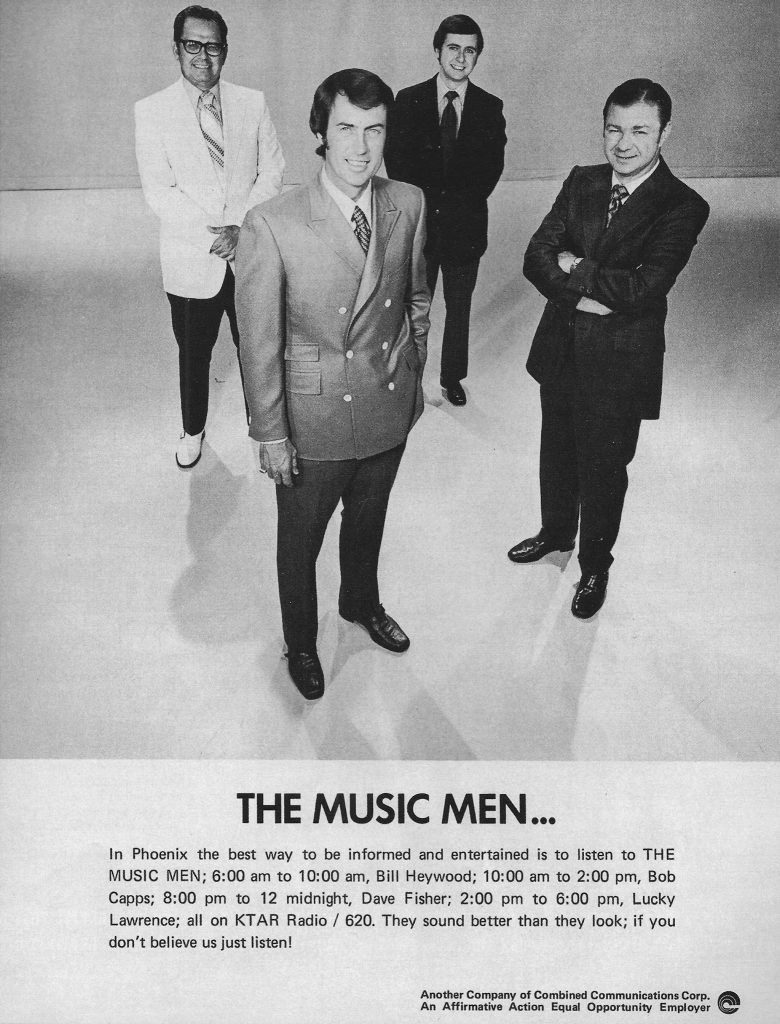
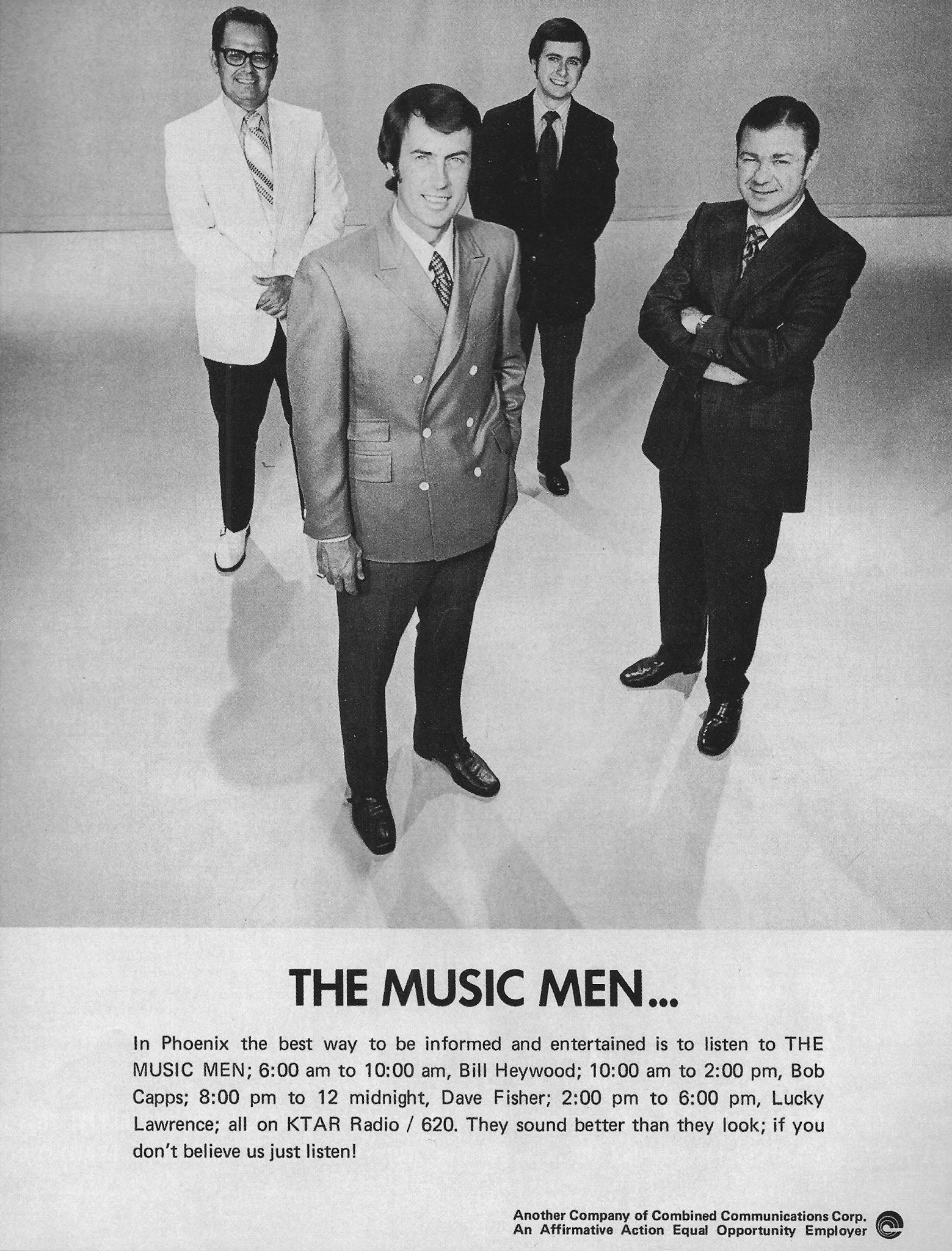
Ad_Music_Men_KTAR_Bill_Heywood_1971
The suicide death of Bill Heywood and his wife, Susan, hit many long-time Phoenicians hard. This is the hour of lead, remembered if outlived, as Emily Dickinson wrote. I heard from so many friends and acquaintances, some of whom hadn't been in touch for years. The Republic did a creditable job telling the story, although it's revealing that the article was closed to comments. Revealing about our age of thugs and haters, not about the Heywoods. I only ran into him twice, long after he had been a giant in radio. But he was a friend to thousands of us, "the bright good morning voice," as Harry Chapin sings in the poignant W.O.L.D.

Long before broadcasting was consolidated, roboticized and ruled by shock-jocks, talk-show screamers or anodyne one-size-fits-all national "easy listening" formulas, local radio was a very big deal in Phoenix. Radio antennas topped the skyline. Jack Williams, who served eight years as governor, started his career in radio. His trademark: "It's another beautiful day in Arizona. Leave us all enjoy it." Barry Goldwater was another radio guy. Older readers can tell those stories, but by the time I came along nobody was bigger than Bill Heywood. He was the morning drive-time man on KOY, historically at 550 on the a.m. dial, the oldest station in Arizona. His voice, as others have said, was velvet. His humor was witty, subtle and gentle. And he spun the popular playlist of the day. His afternoon counterpart, Alan Chilcoat, "sang" the weather. Corporate monopolists such as Clear Channel would never allow such un-focus-group-tested fun today.

Phoenix radio in the 1970s featured "mainstream" rock on KRIZ, KRUX and KUPD. The upstart KDKB played entire albums, was fiercely independent, counter-culture and fighting every Top 40 convention. I recall an easy-listening station but not its letters (KBUZ?); it did have some fairly cool promos, keying off locations in the city and ending with "and you've got the mellow sound of…). Speaking of which, a "mellow rock" station broadcast from the old Ramada downtown, including one of the era's few female jocks. Of course, the stalwarts such as KTAR and KOOL were there, too, as well as a classical station.

America’s racist sheriff

The big news is the release of a report, three years coming, about the racial profiling in the Maricopa County Sheriff's Office. You can download the entire report at AzCentral, Talking Points Memo and many other sites. It confirms what we already know: "America's toughest sheriff" is also America's most racist sheriff. The department has engaged in systemic racial profiling against Hispanics and "brown skinned people." This should be another nail in Joe Arpaio's coffin, but I suspect many of his constituents will merely go "Yaaaay!!"

This is only the tip of a very big iceberg. There's the hundreds of botched sex-crimes investigations, along with the many instances of abuse in the jail system. Honest police officers talk about fumbled investigations by the MCSO, including probable homicides that were tossed off as suicides. Much of the command staff has already been forced out in scandals. Does anyone doubt that the tone for this behavior was set from the top, in other words Arpaio himself? This is a department that runs by a cult of personality. As I asked in a previous post, Why isn't Joe Arpaio in jail? Yet he survives.

To be sure, departments nationwide face such probes. The Seattle Police are the target of a Justice Department investigation into excessive-force complaints. But the MCSO is different, with a longstanding pattern of bad behavior.

Love hurts

A friend passed along a blog essay entitled "Has the Arizona Republic gone rogue?" It goes on to catalogue a variety of "negative" news stories, concluding: "It is time for a leadership change at the Republic; Publisher John Zidich of Fiesta Bowl board fame and his executive editor Randy Lovely need to go.  Let’s get someone in over there who knows and loves Arizona and wants us to become the state we are destined to become. We don’t need a daily rag of negativism and half assed reporting; I can get that from any blog out there.  We deserve better.  The Republic has gone rogue and it needs correcting."

The writer is one Charles Coughlin, who, in addition to sharing the name of the infamous demagogue "radio priest" of the Depression era, is a flack for the Real Estate Industrial Complex, the right and all-things status quo. See, reporting on such as Gov. Jan Brewer's shameful attempt to sack the head of the independent redistricting commission because it didn't skew politics even further to the right is "not loving Arizona." Payback is indeed a bitch. I was run out of the Republic by Zidich and Lovely because the paper could no longer stand the seven years of heat it had taken because my column didn't "love" Arizona enough. (When someone else talked about offering me a job, another big intervened: "Talton hates Arizona.") Now the same thugs are after Lovely and Zidich. (Funny, Father Coughlin doesn't offer his appreciation to the newspaper for unearthing the Fiesta Board scandal, which didn't really involve Zidich aside from his sitting on boards, which publishers should not do.)

Let it be said that the state's largest newspaper soft-pedals most of the pressing issues, from water resources to the economic calamity, climate change, white-right extremism, the depredations of the Badged Ego and thoroughgoing political corruption, much of which traces back to the Real Estate Industrial Complex. It pulls its punches and seeks out "positive news about the community." The editorial page is reliably right wing, with the only columnist being the "Goldwater" Institute's boy, Robert Robb (or William Bill, as he is known here). But even committing real journalism part-time, accidentally or when, well, news happens is enough that heads must roll. Imagine the fantods he would get if the state had some real kick-ass newspapers. Here is Phoenix and Arizona's pathology in a nutshell.

President McCain

Contingency is the great trickster of history. Let's assume that wealthy Republican John Sidney McCain III had picked a serious running mate (say, Florida's popular Gov. Charlie Crist or even Mitt Romney), turned on the fighter-jock charm and not panicked during the financial panic. And won a close 2008 election. What would have happened?

The EPA would have seen its regulatory depredations reined in, especially new rules for greenhouse gases. Indeed, nothing would have been done to address climate change. Science would have been marginalized in policy in favor of the fossil fuels barons and plutocracy. Drill, baby, drill would have gone on in spite of the catastrophic BP oil spill in the Gulf of Mexico. American troops would have been added to Afghanistan and that war expanded, while President George W. Bush's timetable to exit Iraq would have been observed. American quiet wars would have been extended, say, into Yemen, elsewhere in Africa and South America. New military muscle would have been projected against China, say basing Marines in Australia. No effort would have been made to cut military spending that is larger than all other nations combined.

The GOP being the party of the wealthy, the Bush tax cuts would have been extended. And, naturally, Wall Street would have been bailed out of its swindles and made whole on the taxpayers' dime, then sent back to resume its sociopathic behavior. He would have picked a Treasury Secretary and top financial advisers determined to sustain the status quo. McCain's Attorney General would have been a corporate lawyer who would not prosecute a single major bankster, much less the war criminals of the previous administration. At the pleadings of Republican, as well as Democratic, governors, a McCain administration would have spent billions filling the holes in state budgets. Otherwise, his answer to the huge demand hole of the Great Recession would have been more tax cuts and spending largely on highway projects. Corporate profits would reach records, but middle-class Americans would see their prospects further dim.

Oh, wait. All that has happened anyway under the presidency of Barack Obama.

A new day in AZ?

The evil that men do lives after them. — Shakespeare

I don't mean to sun on the parade. I really don't. Nobody is happier to be wrong about Russell Pearce's recall election than me. He becomes the first legislator in Arizona history to be successfully recalled. But what does it mean? In the flush of victory Tuesday night, state Sen. Kyrsten Sinema, who was my legislator when I lived in Willo and is the smartest person at the capitol, tweeted, "Voters sent a message tonight: focus on practical, common sense solutions to our state's challenges. Stop the ultra-partisan nonsense." What does that mean? My common-sense solutions include commuter rail, passenger rail between Phoenix and Tucson (and LA), land-use reform to focus on the existing urban footprints, a serious economic-development strategy, raising the revenue needed to support a populous, urbanized state, funding universities and K-12 education, etc. To much of Arizona, common-sense solutions mean more guns and less taxes.

When I asked Sinema if the election of Jerry Lewis would mean he might be more moderate and work across the aisle, her response was more pragmatic: "We're not sure yet. One must be judged by performance not campaign speeches. Here's hoping Rs moderate instead of 'double down'! ". Indeed.

Pearce may be gone, but the edifice he created lives on: SB 1070, Jan Brewer as governor who's formed a political action committee to "fight against illegal immigration and the new federal health care law nationwide," an extreme state Legislature owned by the NRA and the Real Estate Industrial Complex, and copycat laws nationwide, including the most extreme on in Alabama. Will any of that change with Pearce's recall? Or will he just be back again, running for another office, whether it's the state Senate or Maricopa County Sheriff when the Badged Ego decides to step down. Oh, yeah, in the "new Arizona" on the morning after, Joe Arpaio remains more popular than ever. Jon Kyl is blocking any progress in the "super Congress." Wealthy Republican John Sidney McCain III keeps his incoherent/bought-and-paid for blather. Terry Goddard is still defeated in the governor's race, an election season of madness that turned on the fulcrum of hatred built by Russell Pearce.

The shameless state

Corrected version

I keep waiting for Arizonans to experience their Joseph Welch moment. For those of you too young to remember, Welch was the man who finally, publicly stood up to Sen. Joseph McCarthy. It was another time of national madness, when the alcoholic senator from Wisconsin  was accusing everybody and his brother of being a communist. Finally, in a 1954 hearing, Welch, the chief counsel for the Army, which was being investigated for alleged red penetration, listened to McCarthy smear one of his law partners. Welch said:

Until this moment, Senator, I think I have never really gauged your cruelty or your recklessness. Fred Fisher is a young man who went to the Harvard Law School and came into my firm and is starting what looks to be a brilliant career with us. Little did I dream you could be so reckless and so cruel as to do an injury to that lad. It is true that he will continue to be with Hale and Dorr. It is, I regret to say, equally true that I fear he shall always bear a scar needlessly inflicted by you. If it were in my power to forgive you for your reckless cruelty I would do so. I like to think that I am a gentle man but your forgiveness will have to come from someone other than me.

When McCarthy tried to interrupt, Welch made his famous statement: "Senator, may we not drop this? We know he belonged to the Lawyers Guild. Let us not assassinate this lad further, Senator. You've done enough. Have you no sense of decency, sir? At long last, have you left no sense of decency?" Along with Dwight Eisenhower's quiet but lethal behind the scenes moves in a sane Republican Party, this destroyed Tailgunner Joe. The moment of national insanity snapped like the breaking of an evil spell.

Here and Now and gone

As I reported exclusively last week, KJZZ will soon be ending its weekly local Here and Now with Steve Goldstein. With it goes the only locally produced public affairs radio program in the nation's sixth most populous city. With this move the incredibly narrow media spectrum in Phoenix becomes even more narrow. It's a terrible loss to discourse, journalism and democracy.

Goldstein had me on over the years, even after I was shown the door by the Republic for having the temerity to warn of the housing depression that now lays heavy on the land. He was unfailingly gracious, a class act. But more than that, his program was wide-ranging and fair to a fault, a forum for the Krackpots as well as for the sane elements in the state. He's a talented, intelligent broadcaster who could be a star in any major market. My sources say he'll stay on as a news announcer. One said plans call for "nine-minute daily segments," whatever that means. It can't replace an hour of thoughtful information, give-and-take and smart conversation about Arizona's most pressing issues.

My warning signals went up. Here was a program that couldn't fail to irritate the Real Estate Industrial Complex and the Kookocracy. But one source says its demise is more prosaic: internal politics.