Killer nation

The surprise is not that an American soldier walked off his base and murdered 16 Afghan villagers, including nine children, but that it hasn't happened more often, including in the United States. This is what happens when we keep our armed forces at war for an astounding 10 years. No wonder Gen. George Marshall was so eager to finish the Second World War, fearing that a democracy couldn't survive a war that went past five years. And no wonder Americans who now "support the troops" have historically been wary of a standing army and unimpressed by a chest-full of medals.

This is what happens when our wars have no front lines and no conventional armies as enemies. The war is everywhere and nowhere. Combatants are hidden in a civilian population already tired of our occupation, our disrespect for their customs and religion, and willing to supply information to the enemy. Soldiers in these circumstances learn to despise and dehumanize the ungrateful civilians they are supposed to be protecting. Even conventional wars coarsen nations, destroy young people, encourage atrocities.

This happens when Americans have slipped norms of decency, abandoned books in favor of homicidal video games, dress (and act) like adolescents, joined the military because the union blue-collar jobs they once could count on have moved to Asia, and found themselves defrauded and lied to by every institution in our national life. And guns, guns, guns everywhere.

The asterisk presidency

Now is the time when all good progressives and people with brains are supposed to line up behind President Hoover. After all, where else can we go? The Republican theocrats and plutocrats have made their dangerous irrelevance clear through an endless series of "debates," and Willard Romney still can't close the deal with his own party. Washington Monthly tries to rehabilitate Mr. Obama in an article that contains this paragraph:

Measured in sheer legislative tonnage, what Obama got done in his first two years is stunning. Health care reform. The takeover and turnaround of the auto industry. The biggest economic stimulus in history. Sweeping new regulations of Wall Street. A tough new set of consumer protections on the credit card industry. A vast expansion of national service. Net neutrality. The greatest increase in wilderness protection in fifteen years. A revolutionary reform to student aid. Signing the New START treaty with Russia. The ending of “don’t ask, don’t tell.”

And if you missed it, "he shifted counterterrorism strategies to target Osama bin Laden and then ordered the risky raid that killed him." Another Washington Monthly piece lists the president's top 50 accomplishments. Yet each one requires an asterisk.

The GOP’s last stand?

The idea that a few bankers control a large chunk of the global economy might not seem like news to New York's Occupy Wall Street movement and protesters elsewhere (see photo). But the study, by a trio of complex systems theorists at the Swiss Federal Institute of Technology in Zurich, is the first to go beyond ideology to empirically identify such a network of power. It combines the mathematics long used to model natural systems with comprehensive corporate data to map ownership among the world's transnational corporations (TNCs). "Reality is so complex, we must move away from dogma, whether it's conspiracy theories or free-market," says James Glattfelder. "Our analysis is reality-based." Previous studies have found that a few TNCs own large chunks of the world's economy, but they included only a limited number of companies and omitted indirect ownerships, so could not say how this affected the global economy - whether it made it more or less stable, for instance. The Zurich team can. From Orbis 2007, a database listing 37 million companies and investors worldwide, they pulled out all 43,060 TNCs and the share ownerships linking them. Then they constructed a model of which companies controlled others through shareholding networks, coupled with each company's operating revenues, to map the structure of economic power. The work, to be published in PLoS One, revealed a core of 1318 companies with interlocking ownerships (see image). Each of the 1318 had ties to two or more other companies, and on average they were connected to 20. What's more, although they represented 20 per cent of global operating revenues, the 1318 appeared to collectively own through their shares the majority of the world's large blue chip and manufacturing firms - the "real" economy - representing a further 60 per cent of global revenues. When the team further untangled the web of ownership, it found much of it tracked back to a "super-entity" of 147 even more tightly knit companies - all of their ownership was held by other members of the super-entity - that controlled 40 per cent of the total wealth in the network. "In effect, less than 1 per cent of the companies were able to control 40 per cent of the entire network," says Glattfelder. Most were financial institutions. The top 20 included Barclays Bank, JPMorgan Chase & Co, and The Goldman Sachs Group.

Revolution 2.0

It is starting to dawn on America's press corps that the Arab Spring is not going to usher in Jeffersonian democracy in the Middle East. The upheaval in Egypt, for example, has not led to rule by educated young Arabs, secularism, women's rights and peaceful pluralism. We find the same military control that has marked the country for decades along with the danger of an Islamic state inimical to Western values, as well as to stability in the region. Nineteen Americans face murky criminal charges. And so it goes. A world with way too many unemployed young men, a world facing scarcity, will fall back on the tribal, brutal and nationalistic.

In America, we await breathlessly the next phase of Occupy. Meanwhile, the super PACs and plutocrats continue to have their way. I return to a periodic theme: What happens here? What happens next? Jim Kunstler thinks we are ripe for a "John Brown moment." Some very smart Rogue readers expect big trouble at the Democratic and Republican conventions this year. And there is endless faith placed in Facebook and Twitter as tools to empower the powerless to overthrow the plutocracy.

I am skeptical but persuadable.

The 50.1 percent

Some readers have accused me of not paying proper homage to the Occupy "movement." I risk being seen as "a grumpy old man." What — and not getting The Google and The Twitter while telling stories about the old days of taking the ferry over to Shelbyville and wearing an onion on my belt…which was the style at the time? Okay, I suppose Occupy raised consciousness of the 1 percent of the super-rich and the 99 percent of "the rest of us." Good intentions abound. We know more about pepper spray.

Meanwhile, in the real world where real policy is made, the right marches on. The Susan G. Komen for the Cure pulled its funding to Planned Parenthood for breast-cancer screening. The reason given is that Planned Parenthood is "under investigation." Rep. Cliff Stearns, R-Florida, chairman of the House Energy & Commerce Subcommittee on Oversight and Investigations is auditing Planned Parenthood to see if any public funds were used to pay for abortions. The Komen money, about $680,000, was used exclusively by Planned Parenthood to provide breast screening for the poor and under-insured (and most of the organization's activities are not about abortion). On top of this, Komen recently hired an anti-abortion Georgia Republican politician as a vice president. This is not just about the abortion debate: Many "conservatives" now are opposed to birth control.

The result: A nice bank shot that hurts an organization reviled by the right, makes a loud statement against women's freedom of choice and accessibility to health care, and hurts the poor! Nicely played.

State of the Union

Leave it to Jan Brewer to embarrass Arizona on any national stage given her. When President Obama came to visit Intel a day after his State of the Union address, the governor "greeted" him in a memorable photo: Her mouth angrily open and her finger in his face. Way to go, Jan! Wonder how Intel feels about its day in the sun as a high-tech employer that actually invests in America being eclipsed by you? The governor's whining on Fox "News" about Mr. Obama criticizing her book is a laff-riot. First, did she actually write this book or was it produced by the propaganda machine of which Fox is an integral part? Second, if she did write it (or even has her name on it), there's no such thing as bad publicity. Oh, to have the chief executive trash South Phoenix Rules or Deadline Man. I would be smiling — and use it as a blurb in the next editions.

Brewer's behavior no doubt plays well in places such as Gilbert and Chandler and Alabama. Outside the red precincts of reality denial, this is more confirmation of Arizona's nuttiness and National Laughing Stock/Cringe-maker. What would Barry Goldwater say? Brewer tried to claim she only wanted to give him a letter about Arizona's "comeback" (huh?) and invite him to go to the border with her (uh?), but, as the Republic reported: "It was clear from the moment they greeted one another that this would not be a run-of-the-mill encounter between the president and a local official. At one point, she was pointing her finger at him and at another, they were talking at the same time, seemingly over each other. He appeared to walk away from her while they were still talking, and she confirmed that by saying she didn't finish her sentence."

As Harry Truman repeatedly said, in various ways, You may think I'm a son-of-a-bitch, but you will damned well respect the office of president of the United States. That was then, before the party of "values." Now, to other aspects of the State of the Union address:

Can liberalism be saved?

The only thing that can save America is liberalism. Unfortunately, American liberalism is on its death bed if not in its coffin. Voltaire said, “If you wish to converse with me, define your terms." I'll let John F. Kennedy do it for me:

What do our opponents mean when they apply to us the label “Liberal?” If by “Liberal” they mean, as they want people to believe, someone who is soft in his policies abroad, who is against local government, and who is unconcerned with the taxpayer’s dollar, then the record of this party and its members demonstrate that we are not that kind of “Liberal.” But if by a “Liberal” they mean someone who looks ahead and not behind, someone who welcomes new ideas without rigid reactions, someone who cares about the welfare of the people — their health, their housing, their schools, their jobs, their civil rights, and their civil liberties — someone who believes we can break through the stalemate and suspicions that grip us in our policies abroad, if that is what they mean by a “Liberal,” then I’m proud to say I’m a “Liberal.”

Only liberalism, rightly understood, can stand for the middle class against the plutocracy, for the common good against nihilistic "individualism," for science and pragmatism against theocracy, for fair play against bigoted reaction. Liberalism gave us the greatest, widest wave of prosperity in the history of the world. It broke Jim Crow and let justice roll down like waters. It landed men on the moon. The seminal documents of the republic, the Declaration of Independence and Constitution, are liberal creeds. And today? Ashes. The best that can be said of Barack Obama is that he is the best Republican president since George H.W. Bush, and he is at his core a conservative who Edmund Burke or Bill Buckley would be proud to claim. That he is all that stands, even momentarily, between us and national suicide, is astounding.

President Romney? Part I

You'll see a new In-Depth Report to the right, Campaign 2012. With the help of honorary Front Page Editor Richard Silc, I'll compile the best stories of the substance — not the horse race — of the campaign.

It says much about a changing America to compare Willard Mitt Romney to his father. George Romney grew up amid financial hardships and did not graduate from college. During World War II, he worked to better worker conditions, including those of African-Americans, in Detroit; later, he turned around American Motors, was popular with unions and pursued development of small, innovative cars before their time. As governor of Michigan, George Romney was a moderate Republican, fought for civil rights and against Goldwater extremism — and came very close to being the GOP presidential nominee in 1968, before admitting he had been "brainwashed" by the Pentagon over Vietnam.

Willard Mitt Romney never knew anything but wealth. He holds an MBA and law degree from Harvard. He's never held what most Americans would consider a real job, having worked as a consultant and private equity player, most notably at Bain Capital. Although a moderate governor of Massachusetts, the son has readily embraced the extremism of the right in his quest for the White House.

The father was a leader of an America that made productive things and raised the standard of living of the majority of its citizens. Not only that, he had lived hard times and as an adult brought people together. The son is a leader of an America that makes financial deals, often leading to the looting of the productive wealth and destruction of good jobs it took a century to create. They don't use the words "buy, strip and flip" for nothing in private equity. The son is willing, eager really,  to further drive people apart for his ambitions.

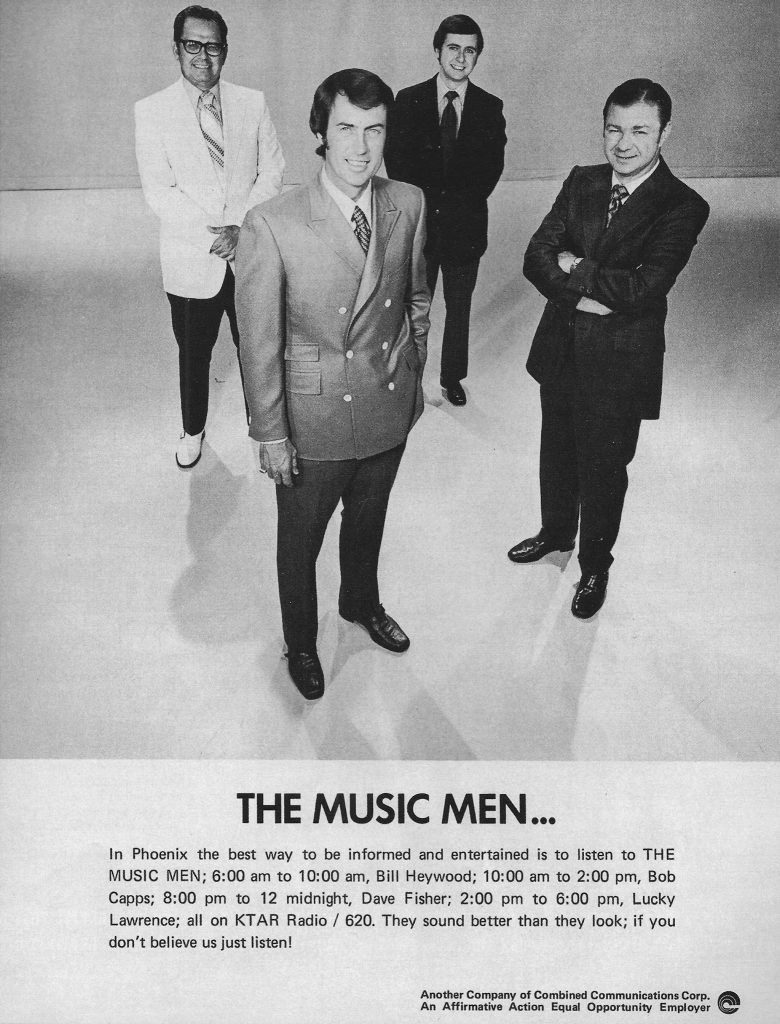
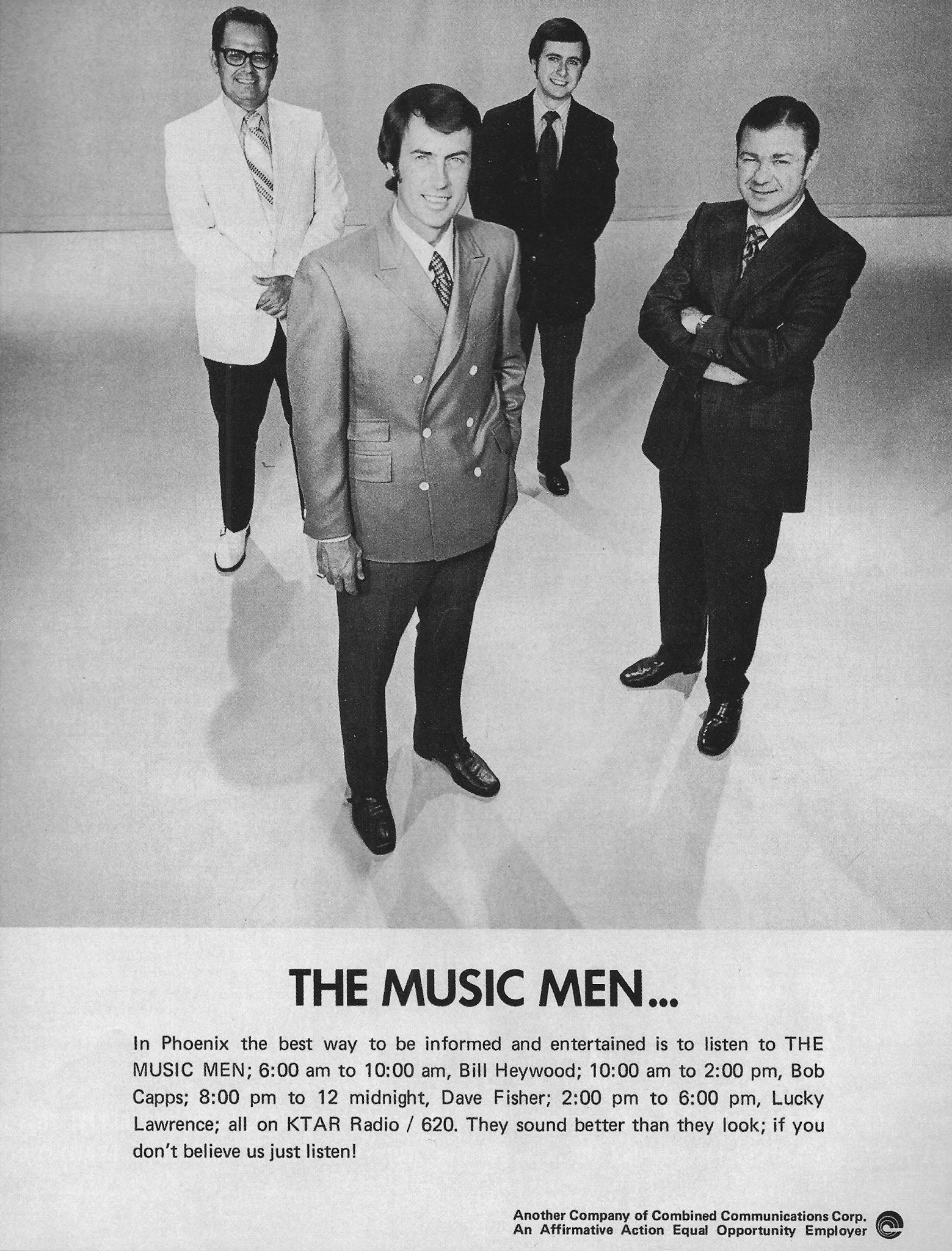
Heywood and Giffords

Heywood and Giffords

Ad_Music_Men_KTAR_Bill_Heywood_1971
The suicide death of Bill Heywood and his wife, Susan, hit many long-time Phoenicians hard. This is the hour of lead, remembered if outlived, as Emily Dickinson wrote. I heard from so many friends and acquaintances, some of whom hadn't been in touch for years. The Republic did a creditable job telling the story, although it's revealing that the article was closed to comments. Revealing about our age of thugs and haters, not about the Heywoods. I only ran into him twice, long after he had been a giant in radio. But he was a friend to thousands of us, "the bright good morning voice," as Harry Chapin sings in the poignant W.O.L.D.

Long before broadcasting was consolidated, roboticized and ruled by shock-jocks, talk-show screamers or anodyne one-size-fits-all national "easy listening" formulas, local radio was a very big deal in Phoenix. Radio antennas topped the skyline. Jack Williams, who served eight years as governor, started his career in radio. His trademark: "It's another beautiful day in Arizona. Leave us all enjoy it." Barry Goldwater was another radio guy. Older readers can tell those stories, but by the time I came along nobody was bigger than Bill Heywood. He was the morning drive-time man on KOY, historically at 550 on the a.m. dial, the oldest station in Arizona. His voice, as others have said, was velvet. His humor was witty, subtle and gentle. And he spun the popular playlist of the day. His afternoon counterpart, Alan Chilcoat, "sang" the weather. Corporate monopolists such as Clear Channel would never allow such un-focus-group-tested fun today.

Phoenix radio in the 1970s featured "mainstream" rock on KRIZ, KRUX and KUPD. The upstart KDKB played entire albums, was fiercely independent, counter-culture and fighting every Top 40 convention. I recall an easy-listening station but not its letters (KBUZ?); it did have some fairly cool promos, keying off locations in the city and ending with "and you've got the mellow sound of…). Speaking of which, a "mellow rock" station broadcast from the old Ramada downtown, including one of the era's few female jocks. Of course, the stalwarts such as KTAR and KOOL were there, too, as well as a classical station.

The American promise

Editor's note: This is an essay I wrote for the Jan. 8th edition of the Seattle Times' Pacific Northwest magazine (it's one of the last metropolitan newspapers to carry its…

The postman

In the 1980s, when in real life we came very close to nuclear war, David Brin wrote a novel called The Postman. His main character lives through the apocalypse and is wandering in the woods of Oregon where he finds an abandoned mail truck. He puts on the postman's coat for warmth and carries a mail sack to a nearby town in hopes of getting food. But they think he is a real mailman, and latch onto him as the embodied hope that the United States survives and is recovering. The book is far superior to the Kevin Costner film. As Wikipedia summarizes, "Despite the post-apocalyptic scenario, and several action sequences, the book is largely about civilization and symbols."

So does it matter if the U.S. Postal Service, facing persistent deficits, private competition and the prevalence of email, intends to kill 120,000 jobs, eliminate Saturday service and shut down 3,600 post offices in smaller towns? I think it matters profoundly, and not least on the level of civilization and symbols.

As MSNBC's Bob Sullivan makes convincingly clear, the Postal Service's alleged financial trouble is largely the result of an accounting swindle from the Bush administration. This is backed up by a report from the Center for Economic and Policy Research. Laying off 120,000 people in the worst labor market since the Depression is nuts, and will fall especially hard on minorities who already face much higher unemployment.

The new isolationism

Back when students were taught American history, they learned about the isolationism into which the nation retreated after World War I. It did not turn out to be splendid. Nobody would accuse us of that now: We're fighting undeclared wars on three continents, maintaining hundreds of military bases in scores of nations, policing the global commons of trade and oil transit with the U.S. Navy, going to great and disadvantageous lengths to manage China's peaceful rise to global power, trying to keep Israel, Iran, North Korea and Pakistan from starting World War III and carrying all the burdens of soft empire.

Yet we have entered an isolationism every bit as dangerous as its predecessor in the 1920s and 1930s. It is an isolationism of the national mind.

How else can one fully explain the vanishing act of climate change from the national discourse? No other event, not even the latest marital/divorce saga of the newest invented celebrity, will more adversely affect life on this planet short of a major nuclear exchange. But the growing costs and enormous future consequences of climate change are absent from our policies and politics. Meanwhile, one of our two major political parties, the Republicans, has been captured by extremism and madness. But the major media, where most Americans get their "news," won't truthfully discuss it. What happens to such a nation?

Hell on wheels

High-speed rail is dead in America. In Slate, Will Oremus does a postmortem that isn't as clueless as most of what one would find in the mainstream media. It makes some points familiar to my readers: The Obama plan wouldn't have been genuine high-speed rail, except in Florida, merely higher-speed; the funds were insufficient and dolled out helter-skelter across the country rather than focusing on corridors likely to bring success, etc. I would add that the Florida HSR was foolish from the get-go, aimed at a suburbianized, car-crazy state, rather than, say, California, the Pacific Northwest or the Northeast Corridor, where train travel is already popular and in demand.

In any event, this is a catastrophe for the nation.

On a general level, it is another sign that America just can't do great things any longer. It's an emphatic indication of the nihilistic paralysis of our politics, with one of our major political parties captured by extremists whose mission is pure destruction. It highlights yet another blow to the commons. It's a lost economic opportunity. High-speed rail would have created tens of thousands of jobs, for operating and not just construction. It had the potential, properly done, to seed new industries here to build the trains. It is exactly the kind of infrastructure spending that would stimulate an economy that as things stand faces years of high unemployment and stagnation. From an environmental standpoint, rail is much less destructive than cars and moves far more people with a small carbon footprint.

Occupy what?

Let's start out with the Arab Spring. Americans know little about the world, especially a place as complicated as the Middle East. This situation has been made worse as news organizations have cut back foreign bureaus and coverage. Thus the uprisings lumped under the Arab Spring have assumed this simplistic narrative: Arabs have risen up against tyrannical regimes and it's a new day of Jeffersonian democracy. This doesn't fit the facts. For example, the military has ruled Egypt pretty much ever since the British pulled out. Deposing Mubarak, whatever the inspiring protests seemed to show, was business as usual. Mubarak came out of the military; the military reasserted control, a fact underscored by the alleged killing of 13 protesters today. The Persian Spring was quickly and bloodily suppressed by Iranian security forces. To make a sweeping generalization, "democracy" in the Middle East will likely be very different than we imagine, leading to regimes that are anti-American, anti-Israel (and the Israelis do themselves no favors here), and installing Islamic law. Juan Cole has the best handle on the region.

Americans hoping for some good naturally make a tie-in with the Occupy movement. The most apt correlation I can see is that the elites still somehow find a way to maintain control, backed by police and the military. Before "Support the Troops," Americans were historically suspicious of a large standing army, and for good reason. With the ubiquitous police violence against Occupy protesters we have seen the militarization of law enforcement that has troubled older cops for some time. Now the oligarchs have the White House, Congress, courts and robocop law enforcement to do their will.

I am over Occupy, a point I first made in a blog post for the Seattle Times, which attracted 120 comments the last time I looked. Some of these points need to be fleshed out.

President McCain

Contingency is the great trickster of history. Let's assume that wealthy Republican John Sidney McCain III had picked a serious running mate (say, Florida's popular Gov. Charlie Crist or even Mitt Romney), turned on the fighter-jock charm and not panicked during the financial panic. And won a close 2008 election. What would have happened?

The EPA would have seen its regulatory depredations reined in, especially new rules for greenhouse gases. Indeed, nothing would have been done to address climate change. Science would have been marginalized in policy in favor of the fossil fuels barons and plutocracy. Drill, baby, drill would have gone on in spite of the catastrophic BP oil spill in the Gulf of Mexico. American troops would have been added to Afghanistan and that war expanded, while President George W. Bush's timetable to exit Iraq would have been observed. American quiet wars would have been extended, say, into Yemen, elsewhere in Africa and South America. New military muscle would have been projected against China, say basing Marines in Australia. No effort would have been made to cut military spending that is larger than all other nations combined.

The GOP being the party of the wealthy, the Bush tax cuts would have been extended. And, naturally, Wall Street would have been bailed out of its swindles and made whole on the taxpayers' dime, then sent back to resume its sociopathic behavior. He would have picked a Treasury Secretary and top financial advisers determined to sustain the status quo. McCain's Attorney General would have been a corporate lawyer who would not prosecute a single major bankster, much less the war criminals of the previous administration. At the pleadings of Republican, as well as Democratic, governors, a McCain administration would have spent billions filling the holes in state budgets. Otherwise, his answer to the huge demand hole of the Great Recession would have been more tax cuts and spending largely on highway projects. Corporate profits would reach records, but middle-class Americans would see their prospects further dim.

Oh, wait. All that has happened anyway under the presidency of Barack Obama.