Where Arizona fits

Where Arizona fits

Ninenations
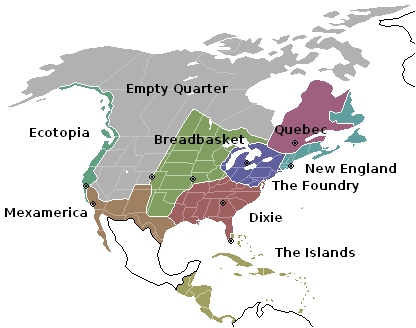
In 1981, Joel Garreau wrote a popular book called The Nine Nations of North America. His conceit was that state lines and even national borders were meaningless in understanding the "true regionalization" of the continent.

Arizona was split between "Meximerica" and "The Empty Quarter," with Phoenix and Tucson lying in the former. Of Meximerica, he wrote, it was "a 'booming place'…characterized by a sense of no limits."

They say that the only limit to growth is the human ability to dream. By the way, does that sound familiar? Where did our President grow up? In Los Angeles and the Southwest. Reagan’s vision of the world was formed by the way this part of the world works.

As for the Empty Quarter, "It is very dry; water is a constant preoccupation; it is very fragile…Very few people live here, and as a result it is politically powerless."

This is the last "colony" of the nine nations. The idea is that we are going to chew this up and spit it out to get us into the next century. But there is one hitch. This is also the place that has the last great stretches of wilderness and quality-one air; so, if we chew this up and spit it out, we can kiss the Rockies goodbye. And of course there is a political context to that too, because there are a lot of people who don’t want to see that wilderness despoiled.

So far, so OK. Except Arizona has little in common with Texas; Phoenix little commonality with Houston or Los Angeles. And the name Meximerica wouldn't get very far with the Kookocracy.

Now a new author wants to reorder things. Colin Woodard, according to the Washington Post, "says North America can be broken neatly into 11 separate nation-states, where dominant cultures explain our voting behaviors and attitudes toward everything from social issues to the role of government."

Assessing the Democracy

The term above was synonymous with the Democratic Party well into the 1930s. Republicans didn't object because they, like many of the Framers, saw "democracy" as the mob, as opposed to our representative form of government.

Tonight's first debate will allow us to take soundings of the Democratic presidential candidates. It will surely be more substantive than the GOP Klown Kar shows. But I don't expect much from the questioners or the mainstream media. For example, the usually excellent McClatchy D.C. bureau produced a set-up story asking such hardball questions as, "Will Clinton be able to articulate a softer side…?"

The last time we elected a candidate people wanted to have a beer with, we got George W. Bush. Warren G. Harding was also a charming fellow.

Meanwhile, the victim/'ism" politics and symbolism that all right-thinking people (in the liberal echo chamber) agree upon will not win a general election.

So, a bit of a reality check.

The president is the chief of one branch of one segment of our federated form of government. Any candidate needs to make the point that she or he can only get so far as long as this broken and radical Republican Party controls the Congress (and most statehouses). None will state this important  truth because it would imply weakness.

Little pieces

Little pieces

Tovrea_Mansion

The interior courtyard of the Tovrea Mansion in happier days. (Steve Weiss photo).

A reader from Michigan wrote, "My wife and I were married at the Tovrea Mansion in 2000 (on today in fact — 6 Oct.). Not the Castle, but the mansion on 46th Street and Van Buren. We went back to see the building last week and found it abandoned, looted, and partially destroyed."

Almost everyone in Phoenix who pays attention knows about the Tovrea Castle and its storied past. The unique building was saved thanks to the city and a preservation effort led by former Mayor John Driggs. Amazingly, a number of loud voices opposed this and wanted the building demolished, the saguaros bladed.

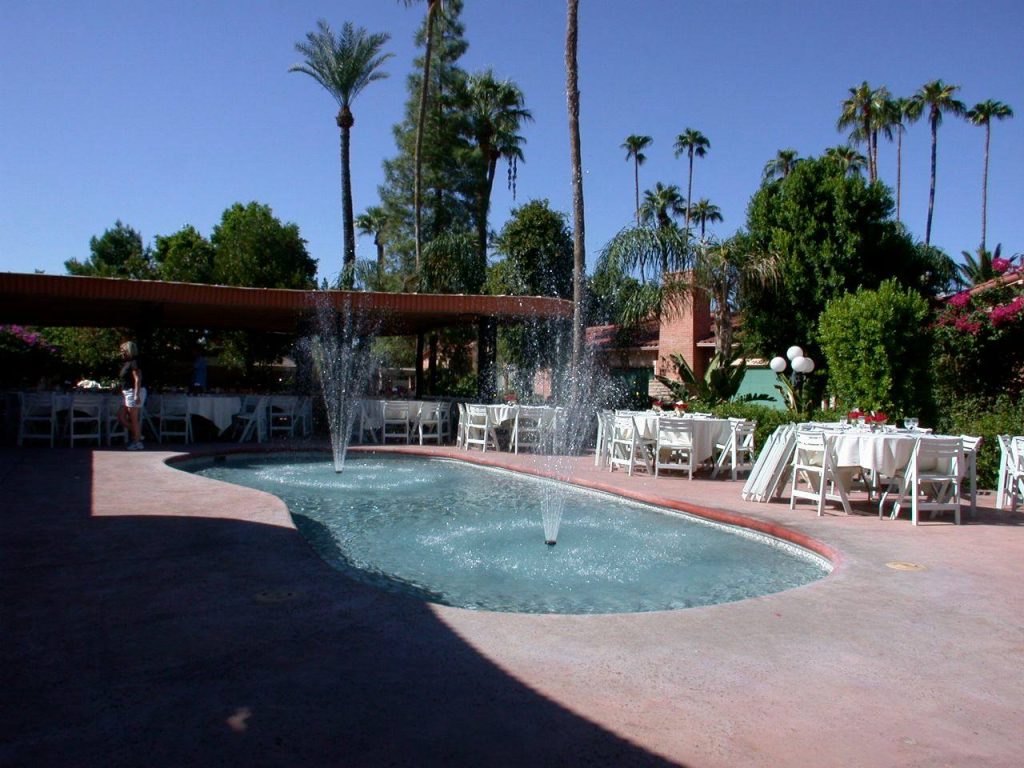
The Tovrea Mansion was not so fortunate. A large ranch house surrounded by tall oleanders and palm trees, it was unknown by most Phoenicians. The pioneer Tovrea family lived there for decades.  By the 2000s, it had been turned into an events center.

Help make Rogue better

Yes, I believe in the old-school, top-down editor approach, but one can still ask. This site offers more than the twice-a-week columns. At the left, The Front Page provides new…
Killers among us

Killers among us

Graffiti_of_boy_with_rifle,_Seattle
Back in the 1960s, the phrase "the sick society" was coined among liberals to assess a collective responsibility for that era's crime, riots, racism, and political assassinations.

It seems quaint now. When a former Marine ascended the 30-story tower at the University of Texas in 1966 and used his sniper skills to shoot 14 people to death, it was a shocking act. There were no SWAT teams then, no militarized police. Such events were almost unheard of. Two Austin police officers and a civilian, armed with revolvers and a rifle, made it out on the roof of the tower and killed the sniper.

Today mass shootings, "rampage killers," are so common they can be mapped. So many have occurred in recent years, they are on spreadsheets. A calendar can be marked up: 274 days, 294 mass shootings.

That's a sick society.

After the latest, at a community college in a small town in Oregon, I struggled to write something beyond my earlier column "Empire of Violence." Vast terrain of the Internet was taken with predictable outrage and horror, but ultimately pretty empty stuff. The most intelligent prescriptive writing came from the New York Times' Nick Kristof, urging us to treat gun violence as a public health issue.

The Russians are coming

The Russians are coming

Tomb_of_the_Unknown_Soldier_in_Alexander_Garden_(1689-02)
I've been reading books about the last days of the Soviet Union, especially David Remnick's magisterial Lenin's Tomb, but also Serhii Plokhiy's The Last Empire, which is particularly insightful about Ukraine's critical role in the breakup.

The more I learn, the more Boris Yeltsin emerges as a giant in the burial of the totalitarian regime and birth of a democracy for the first time in Russia's thousand-year history. The vast importance of the "saint" Andrei Sakharov and the courageous priest Alexander Men. And the smaller Mikhail Gorbachev becomes: naive, overtaken by the reforms he began, ultimately captured by the reactionaries. Yesterday's man.

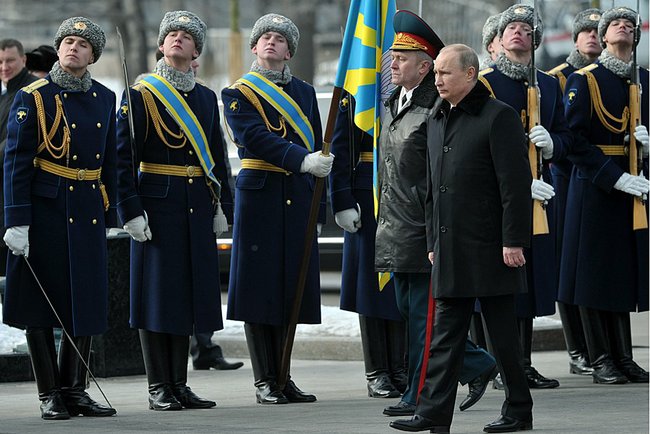
Vladimir Putin, former KGB officer, is no doubt a bad guy. But a new Stalin? Hardly. Stalin murdered at least 30 million people. Indeed, Sakharov believed that the KGB contained the seeds of potential reformers because its agents were more educated and had seen more of the world than the communist nomenklatura.

While brings us to Russia bombing in Syria and the proto-hysterical reaction of the American media. For example, the Washington Post's David Ignatius implies that President Obama has lost Syria to the Russians. As if Syria was ours to lose.

The Westward Ho tragedy

The Westward Ho tragedy

Hotel_Westward_Ho_John_Kennedy_1961
When Carl Hayden stood for his last U.S. Senate term in 1962, he faced a state that had been radically changed by population growth in the late 1950s and early '60s. He was also confronted by a radical Republican challenger in car dealer Evan Mecham who found purchase with many of these newcomers.

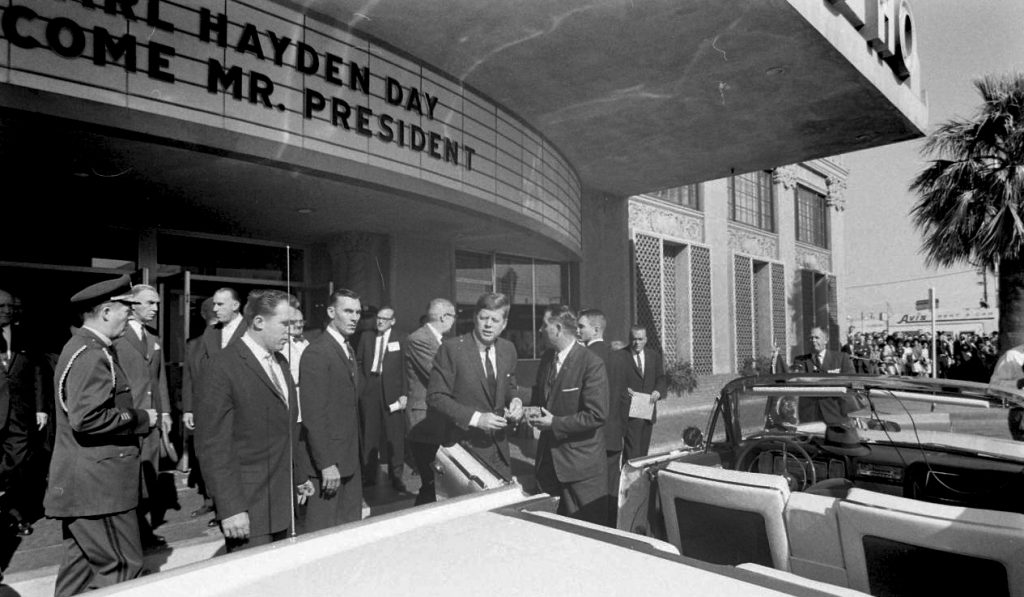
Hayden's crafty aide Roy Elson came up with a "re-introduce Carl Hayden" campaign — even though Hayden had served Arizona in Congress since statehood and was the indispensable man on water, especially the Central Arizona Project. For the showpiece, he angled a Carl Hayden Day featuring President John F. Kennedy and Vice President Lyndon Johnson.

The location was never in question: the Hotel Westward Ho at Central and Fillmore, the premier hostelry of Phoenix since it opened in 1928. The event was a huge success and Hayden won the election.

Within little more than 13 years, with downtown dying, the Westward Ho was a target for demolition. The iconic Luhrs Hotel and others had already met the wrecking ball. The beautiful Hotel Adams had been torn down, replaced by a box containing all the charm of 1970s brutalism. The Ho was saved by making the building into subsidized housing for seniors and the disabled. After falling out of family ownership, the property was repeatedly flipped and eventually sold at a sheriff's auction. Now the owner is using $44 million in a "multifaceted refinancing project" to upgrade the building. And it will continue as elderly housing.

Is this really the best Phoenix can do?

Reality show presidency

Reality show presidency

Donald_Trump_by_Gage_Skidmore_3
The conventional wisdom keeps waiting for Donald Trump's latest outrageous statement to bring him down. So Republicans can nominate someone from the party's "mainstream," say Wisconsin Gov. Scott Walker.

But the latest poll from Fox News has Trump still in the lead, at 26 percent, up a point from last month. Ben Carson has 18 percent. And the rest of the GOP clown car is in single digits.

In the new Quinnipiac poll, Trump leads with 25 percent, down three points from last month. Carson is at 17 percent, followed by Carly Fiorina at 12 percent.

One way of looking at this is that three quarters of those surveyed don't want Trump. But his rivals are cannibalizing each other. Especially on the losing end is Jeb Bush, the supposedly establishment candidate.

Arizona economy update in charts

Arizona economy update in charts

The Great Recession, which hit Arizona hardest than any economic downturn since the Depression, has been over for more than six years.

One big difference: In the Great Depression, Arizona was a huge beneficiary of the New Deal. Another is that it wasn't the epicenter of the calamity. This time it was, with its massive dependence on housing.

This is part of an ongoing update for how the state's economy is performing.

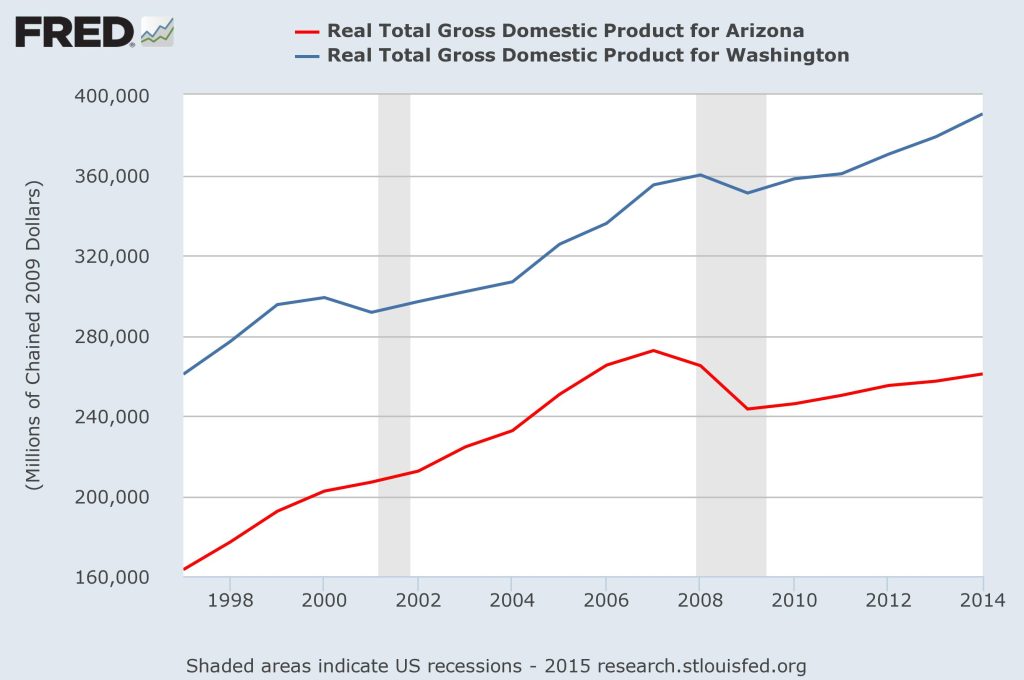
Total gross domestic product adjusted for inflation has still not recovered. It it badly lags Washington, a similarly populous Western state, which has recovered and reached new highs:

AZgdp1

Housing starts, the gold standard of the old economy, continue to struggle. They are around where they stood in the early 1990s, even though population has increased increased significantly:

AZhousing

The workforce is still smaller than before the collapse. It gets worse: ASU's Lee McPheters estimates that 44 percent of the adult population is not working:

AZworkforce

A train to Tucson

A train to Tucson

ICE_1_in_Augsburg-Hochzoll

When I was a boy, the Southern Pacific Railroad operated six trains a day between Phoenix Union Station and Tucson. They were part of the fading American passenger-rail system, once the finest in the world.

The top of the line were the crack Sunset Limited, SP's flagship running between New Orleans and Los Angeles (once it went all the way to San Francisco). Phoenix to Tucson took less than two-and-a-half hours. Then the Golden State Limited, another premier train operated by SP from Los Angeles to Tucumcari, N.M., where it was handed off to the Rock Island for the trip to Chicago. Finally, there was the remains of the Imperial, once a fine train in its own right but by the 1960s a mail train with a single coach.

But the trains were dying, helped along by the Postal Service canceling the vital mail contracts in 1967-68. Amtrak took over a much diminished Sunset — three days a week — and it left Phoenix in the 1990s when the state would not help maintain the northern main line. Phoenix is the largest city in America with no passenger trains.

I mention this history as the Arizona Department of Transportation studies passenger rail between Phoenix and Tucson. It has gotten press. But is it possible?

The first deportation

Led by Donald Trump, Republican presidential candidates are embracing the policy of deporting some 11 million Hispanics in the country illegally.

If implemented, it would be a humanitarian calamity and a stain on the nation. But it wouldn't be the first time "American exceptionalism" took such a cruel turn.

During the Great Depression, some 1 million Mexicans were deported from the United States to Mexico. An estimated 60 percent were American citizens. In 1930, the U.S. population was only 123 million.

The overt intention was to free up more jobs for "Americans" (read Anglos) when unemployment was 25 percent or higher. But it was invariably twined with racism, score settling and ethnic cleansing.

The most definitive scholarly account is found in the book Decade of Betrayal: Mexican Repatriation in the 1930s, by Francisco Balderrama and the late Raymond Rodriguez. They focus heavily on Los Angeles County, where the deportation was active and records were kept.

The degree to which it was carried out in Arizona and Phoenix is less documented. The late historian Bradford Luckingham writes of the intense anti-Mexican sentiment in Phoenix in the 1930s. In a six-month period during 1933, 130 Mexican families were "repatriated" from Phoenix. They received food and clothing from Friendly House, the city's oldest immigrant-assistance charity.

Sinema’s way

Sinema’s way

Kyrsten_Sinema_113th_CongressAt least based on Facebook comments, U.S. Rep. Kyrsten Sinema has finally alienated many liberals for good, based on her vote against President Obama on the Iran nuclear deal.

In a statement defending/ explaining her vote, Sinema slyly says, "I was a principled opponent of the Iraq War and spoke out early against the U.S. invasion." One must wonder if she considers some opponents unprincipled. But the more important fact was that back then she was a recent Green Party candidate for Phoenix City Council.

Since then, she climbed the ladder to the Legislature and then Congress as a Democrat. She frequently alienated the Democratic wing of the Democratic Party, such as when, serving in the state Senate, she called the odious Russell Pearce, "my president." He was president of the Senate, but "my president"?

On the Iran vote, Blog for Arizona commented, "Sinema’s excuses for opposition are on matters entirely outside of the negotiated nuclear agreement, and thus not on the merits of the actual agreement itself. Like every Tea-Publican, Sinema wants total capitulation by Iran, something Iran would never agree to in a negotiation. This is a ridiculous expectation."

Who murdered Don Bolles?

Who murdered Don Bolles?

Bolles_paper
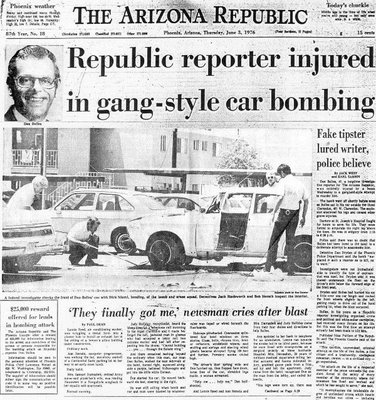
They still meet at the scene of the crime. The breakfasts at the Hotel Clarendon are informal reunions of the lead investigators of the murder of Arizona Republic reporter Don Bolles. The hotel itself, redone in the 2000s, has created a shrine of sorts to Bolles, photographs of the event along a hallway. No longer young men, they still have sharp, vivid memories. If one is fortunate enough to snag an invitation, bringing a reporter's notebook is impossible. It would shut down the conversation.

As difficult as it is for some of us to believe, next June will mark 40 years since the bombing. It remains the most enduring mystery and troubling crime in modern Phoenix history.

I have two minor personal connections. I was on duty that day on the ambulance and, as it turned out, one call rotation away from being there. My partner and I caught an auto accident with injuries, or 962 by the radio codes, at 16th Street and Southern. Next up was an explosion in Midtown. One of my friends took that call and was holding the mortally injured Bolles when he said, "They finally got me… Mafia, Emprise, Adamson… Find Adamson…" That's what she told me later in the squad room. (The excellent Paul Rubin of New Times has slightly different wording in this recollection of the event).

Also, in those days I was living in an apartment at 36th Street and Campbell, one of those classic Phoenix buildings surrounded by citrus trees with a grassy, shady courtyard. My neighbor was a young man named John. I noticed that whenever he came home at night, he would repeatedly circle the block. Over time, he told my mother that he and his mother had been relocated to Phoenix by the FBI after his father had died in a mob bombing in Chicago. The Bolles killing unnerved him. "He had been warned," he said. "They always warn you." Followed by, "I've said too much." He was even more reluctant to come home at night.

Huddled masses

One of the many unhelpful gifts to the republic from the right wing has been to make it virtually impossible to have a sane discussion about immigration.

Thus, Donald Trump's anti-immigrant ravings are resonating with the most extreme "white nationalists." Arizona has offered some of the most odious examples of bigotry, hate and hypocrisy.

But there is — dare I say it? — a "national conversation" to be had.

It has little to do with the Mexican illegal immigrants, although it must be admitted that immigration legal and illegal in the 2000s was the largest wave to hit the United States in history, greater even than the late 19th and early 20th centuries. It carried costs and benefits still being debated.

Nor is my concern about Anglos becoming a minority by 2040 if current trends continue. The automobile, sprawl, oligarchs and their agenda, the "market" degrading everything good to make a quick buck — all this has done more to destroy American civilization than brown people.

The issue is more about the future.

Signs

Signs

AhwatukeeDust

I'm not a scientist, man, as Senator (and presidential candidate) Marco Rubio said. But more than 97 percent of the scientists who actually specialize in climate science agree that climate change is real, heavily human caused, and getting worse faster than expected.

I'm also a witness. Sure, having moved to Phoenix in 1990 now makes you a "pioneer," but my experience goes back a but further.

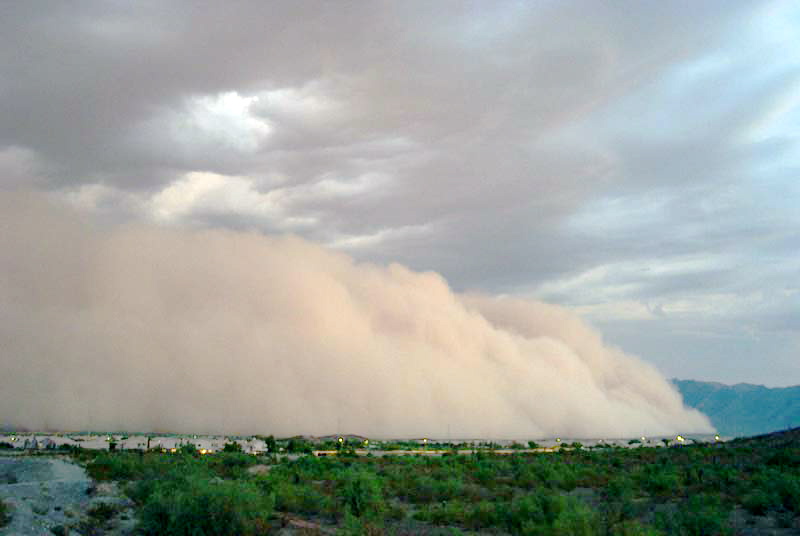
The dust storms that make such good visuals, and popularized as "haboobs," are not new. They, like the monsoon, have been a part of the Phoenix and Sonoran Desert landscape for tens of thousands of years. The same is true of intense rains and floods.

What seems to be different is the severity of monsoon storms that come into the city, especially destructive "microbursts" and tornadic winds.

One hit Midtown a few years ago and mowed down telephone poles along Third Avenue, as well as uprooting trees, including priceless old-growth trees in Encanto Park. The events have increased since then, including a severe storm Monday night. Trees came down all over the metropolitan area.