American Eden

Agriculture is the oldest organized human activity in the Salt River Valley. This is why Phoenix was never a Wild West town like Tombstone or even Prescott. It was never a copper square.
For hundreds of years this sustained the Hohokam, who created the most advanced irrigation civilization in the New World. They built hundreds, perhaps thousands, of miles of canals to bring water from the Salt River to their fields. After the Hohokam left in circumstances that are still debated, the valley lay empty for 400 years. Waiting.
Jack Swilling may get too much credit among the founders of Phoenix. But one thing that's certain is this soldier of fortune immediately grasped the valley's agricultural potential when he arrived after the Civil War to help John Y.T. Smith farm hay for the Army at Fort McDowell.
He saw the Hohokam canals, the seemingly flat ground and rich earth, and knew it was farming country. In some cases, old Hohokam canals were simply cleaned out by the Swilling Irrigating Canal Co. His passion in selling what "Lord" Duppa would aptly name Phoenix attracted men from Wickenburg and Prescott. Swilling's Ditch was built in 1868 from today's 40th Street and ran west beside Van Buren Street.
No other place in the West between the 100th meridian and California and the Pacific Northwest was so hospitable to farming. Three rivers met here and the soil was alluvial and priceless. Unlike the future Dustbowl, with its shallow topsoil and dependency on fickle rainfall, the Salt River Valley alone had almost all the makings of a major agricultural empire.
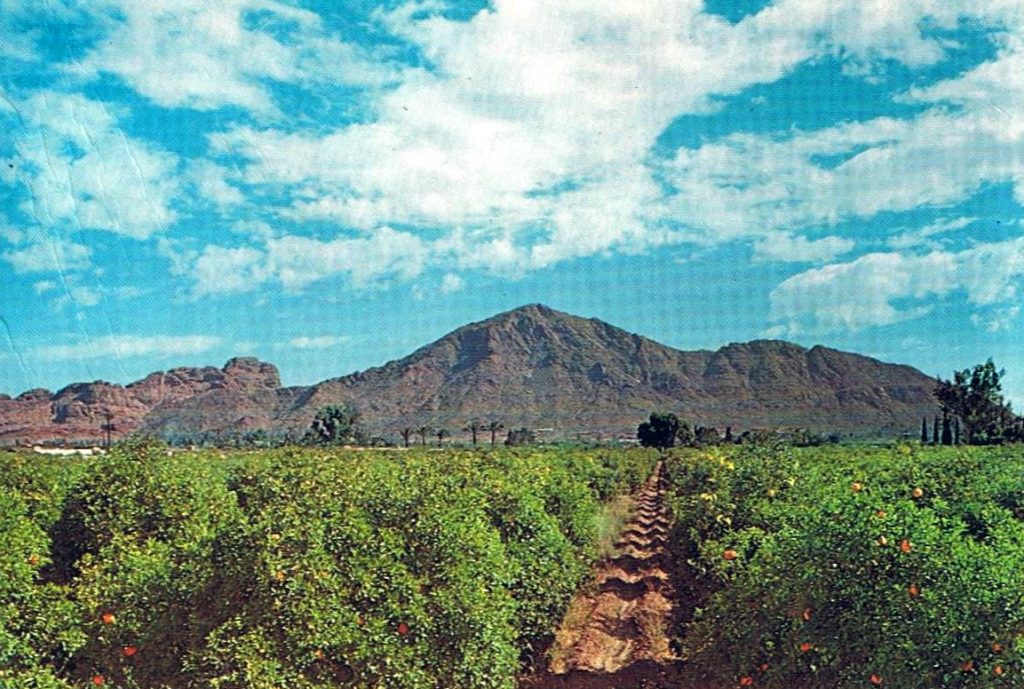
By 1870, 200 Anglo settlers had arrived and laid out the townsite, land was platted from the Gila and Salt River Baseline and Meridian, and more ditches were dug. Wheat and grains were the early crops. Former Union officer William John Murphy led building of the 41-mile Arizona Canal between 1883 and 1885. In the late part of that decade, the Rev. Winfield Scott, an Army chaplain, acquired 640 acres. With his brother George, he planted the first citrus trees, along with growing dates and figs and other tree crops.
Yes, tony Scottsdale is named after this chaplain-farmer. (So is Winfield, Kan.). But other farm villages preceded it: Mesa (1878), Tempe (1879), Glendale (1887) and Peoria (1897).
 38
38