Phoenix recovery? Part I

So desperate is "the Valley" for good economic news that the Information Center published a story on the big circulation day of Sunday quoting the Coincident Economic Activity Index of the St. Louis Fed. It reminds me of the old contest we had when I was a young reporter in San Diego: How few words could you write to alienate a reader (the winner: Otay Water District). In any event, this measure allegedly "shows Arizona's economy probably hit bottom in December." Then it quotes U of A economist Marshall Vest, a very nice man who was utterly wrong about the state's economy in the run-up to the collapse, writing that the national recovery is "proceeding nicely." (!) The story adds, "But Arizona's recovery is lagging behind other parts of the country,
though conditions are looking better." OK, then.

The mandarins of economic knowledge in Arizona, prodded by their masters in the Real Estate Industrial Complex, have been predicting a bottom for more than two years. Now every little blip or sideways shudder is even more urgently flung out with incense and sparklers as a sign of "the bottom," or better yet, "recovery." Most of these yearnings are realized in extremely limited snapshots of real-estate activity, a problem in itself. Even the St. Louis index only looks at four metrics, concerning employment, hours worked, wages and salaries. And for every pebble of "good news" comes a landslide of less "positive" stories. In Forbes' list of "America's Recovery Capitals," even Vegas is given a sense of potential; Phoenix is nowhere. With Business Insider's slide show of "12 Cities Where Home Sellers Are Being Forced to Cut Prices Like Mad," both Mesa and Phoenix make the rogue's gallery.

Boosterism and denial aside, the reality is that Phoenix's economy is not recovering in any meaningful sense of the word. The idle rich did very well in this recession — a historic anomaly — so to the extent that north Scottsdale and Paradise Valley are a B-List destination for these critters part of the year, there's your "good news." Otherwise, the situation is harsh. I do not wish this on Phoenix. I wish it were not so. I wish I were 25 and had a squash player's body. But unless Phoenicians face up to their reality, whether they wish it that way or not, a real recovery will be even longer in coming, narrow in its benefits and short-lived.

The president and the general

Mindful of the saying that a bitching soldier is a happy soldier, I'm hard-pressed to join in the oft hysterical condemnation of Gen. Stanley McChrystal for said bitching by him and his staff in the Rolling Stone article. Many on what passes for the "left" today, having seen that President Obama is neither Lincoln nor FDR, now want him to be Harry Truman and enjoy a MacArthur moment. They forget, or don't know, that Truman's dismissal of the five-star general from command in the Korean War helped make him the most unpopular modern president — before George W. Bush, that is. In addition, Truman had served as an artillery captain in World War I and had little use for top military brass, particularly one with MacArthur's temperament and the intolerable situation in which the general had placed Truman. MacArthur wasn't trash-talking Truman but disobeying direct orders. As Truman said, "I fired him because he wouldn't respect the authority of the
President. I didn't fire him because he was a dumb son of a bitch,
although he was, but that's not against the law for generals. If it
was, half to three-quarters of them would be in jail."

I even admire McChrystal on a certain level. Historically, America often had political senior officers in peacetime, ones good at keeping their civilian masters happy and maintaining the status quo — even if it meant, say, ignoring the meaning of air power or the tank. In wartime, which was not a continuous national endeavor at one time, the political officers were shunted aside for the fighting officers. McChrystal is plainly one of the latter. But what about the Tillman cover-up and the prisoner abuse that happened under his command? Worse, much worse, happened in World War II, the "good war." This is why William Tecumseh Sherman's full quotation should always be at our national shoulder: "I am tired and sick of war. Its glory is all
moonshine. It is only those who have neither fired a shot nor heard the
shrieks and groans of the wounded who cry aloud for blood, for
vengeance, for desolation. War is hell."
These may seem like different times, when our forces are being asked to do impossible tasks driven by incoherent policies. But the brutality of the enterprise remains the same, and its coarsening effect on a democracy, as feared by Woodrow Wilson, is as potent as ever.

Maybe McChrystal's self-immolation in the Stone was a subliminal desire to get the hell out of this chickenshit unit.

And that’s the way it is

I wondered if Barack Obama became a one-term president with his astonishingly vapid Oval Office speech on the Gulf oil disaster. But maybe Mr. Obama has the pulse of the nation better than any of us who wanted real change and the fierce urgency of now. It was grotesquely ironic that a few days after offering the usual presidential platitudes about the need to wean ourselves off oil, he was in Columbus, Ohio, touting his stimulus by dedicating work on a road expansion. It was, he said, the 10,000th road project that the stim has funded.

Around the nation the transit systems that had been dramatically expanding ridership as gasoline prices rose are now starving from state and local fiscal crises. Amtrak, despite the vice-president's supposed love of it, remains a shadow of the passenger rail system it succeeded and a political pawn awaiting further cutbacks and the demand that it "pay for itself." This even though no major transportation network pays for itself, certainly not roads. And this despite evidence that road projects don't even have much of a positive effect on unemployment. High-speed rail? It's being studied, even though other advanced and ambitious nations already have systems and are expanding them. Cincinnati, a lovely central city that has been devastated by freeways and sprawl, can't even
muster the civic sanity to fund a streetcar line. America will continue its dependency on roads and cars — something far beyond our competitors in Europe or China. Why? Because that's the way it it.

We care about the poor birds and fish being killed by the oil spill. But not enough to give up our cars. We live magical thinking: That technology will simply replace the inexpensive light sweet crude that powered the automotive age. Rather like the technology that was supposed to allow BP to drill miles down into the earth to extract the remaining crude in the Gulf of Mexico. Electric cars will be expensive and require minerals from places other than America — many of them unstable — as well as demanding electricity from power plants that will be run on…what? Fossil fuels most likely. Beyond that, the dreams become loopy. Space aliens are not going to drop by and give us magical hydrogen cars. Tar sands are not going to yield inexpensive gasoline. Few seem to understand that the fossil fuel "imputs" into most alternative fuels are greater than the new energy produced; many also have nasty environmental or other unintended consequences. Nowhere is this more true than with any alternative to the big oil hog: automobiles.

Rogue: The user’s guide

In 2008, Rogue Columnist began as my pro-bono work for the readers I left behind at the Arizona Republic. Nobody was offering my brand of analysis and commentary on Phoenix…

Phoenix 101: Myths and lies

Plato's "noble lie" is one of the foundations of his mythical republic. It also handily cements the power of the elites. So it is with our city with the name from mythology. Let's take them on one at a time:

Phoenix is a young city. This is a canard tossed out to explain every shortcoming or difficulty that can't be blamed on "the Mexicans." As in, Phoenix lacks the amenities commensurate with a big city "because it's a young city." Phoenix was founded in the late 1860s and incorporated in 1881. That's 129 years for those readers who were home-schooled or graduated from Arizona charters. It didn't become what would be considered a large American city until the late 1950s; by 1960, it was the nation's 29th largest city. That's a half century to get its act together.

Where Phoenix can legitimately claim it was shortchanged by being a younger city is that it was too small to benefit much from the golden age of American urban design and architecture, including the City Beautiful Movement. And most of what it did have was torn down in careless acts of civic vandalism from the 1960s onward.

Phoenix grew into a city in the automobile age and the ubiquity of the automobile suburb, with all the dolorous consequences that followed once that became the only mode of city "planning." Otherwise, the reliance on the "young city" excuse actually undermines itself on close inspection.

The Arizona syndrome

Arizona Democrats may have thought they were on a roll in recent years, at least in congressional elections. Harry Mitchell beat J.D. Hayworth in a solid red district and Gabrielle Giffords won a swing seat. Much of that was actually anti-Bush, anti-J.D. sentiment. Now Arizona seems poised to rejoin the South and most of the Plains and Intermountain West states as solidly red. My recent sojourn to my home state did nothing to dissuade me from this view. Many Democrats are dispirited. The party lacks the infrastructure of the right — from "think tanks" and big corporate money to endless right-wing talk radio. In a state with a fairly recent past of vigorous two-party competition, the Democrats were largely asleep as the extreme Republican right took control from the ground up, starting with school boards and obscure boards, eventually taking commanding power in the Legislature, by far the most powerful branch of government.

This is a crying shame for Terry Goddard. I heard the meme of "he thinks he deserves to be governor because his old man was." Far from it. Goddard is the most qualified candidate, a smart, open-minded public servant who has earned his way in elective office and actually did the most to attack border crime. The Democrats have a number of excellent candidates for statewide races, including David Lujan, Andrei Cherny and my old colleague and friend John Dougherty. They stand little chance against the vast capacity of the right. Mitchell and Giffords may well go down.

The big weapon against the Dems is, of course, SB 1070, the Jim Crow anti-immigrant bill.

Peak oil and its deniers

UC Berkeley economist Brad DeLong has a running feature on his blog called, "Why, oh why, can't we have a better press corps?" Amen, brother. But even the best newspapers have blind spots, and that has especially unfortunate consequences when those dark zones concern some of the biggest issues of the day. The New York Times is already terrified of climate-change stories and won't plumb seriously into the soft empire we've created and its crushing costs. One of its biggest deficiencies is coverage of energy, especially the oil industry. Hence, we were served a story on Sunday about peak oil that failed to define the term and consigned the people in the story to the survivalist fringe. This from a newspaper that also publishes a deferential story about the retrograde nihilist Rand Paul and shrinks from nailing the tea party for its racist supporters, incoherent positions and — especially — shadow control by big corporate money.

Peak oil doesn't mean "we're about to run out of oil." Even defining it as "demand outstripping supply" is incomplete. Peak oil means the world has reached a point where half of the planet's oil has been burned up (see, "climate change"). The remainder will be increasingly hard to reach and more expensive to refine. America hit its national peak in the early 1970s. The North Sea has passed peak. Several of the world's giant "elephant fields" are near or past peak. This is a simple fact of geology about which there's no disagreement among most experts (the outlier: the oft-quoted and highly-paid-by-industry Daniel Yergin). Peak oil was being used in ads by major oil companies and speeches by their CEOs in the mid-2000s. As with climate change, the debate is over details; in this case, when will peak hit and what will be its effects?

Not for nothing did America fare well in World War II because it was a petro superpower and the world's leading oil exporter. Neither Hitler nor the Japanese Empire had much in the way of oil resources. Hitler failed to make the Caucasus oilfields an immediate priority in his attack on the Soviet Union, a geopolitical example of when cops say, "Thank god for stupid criminals." Now, more than three decades after hitting peak, America still produces oil, especially in Texas, Alaska, California and Louisiana. We're even still one of the world's larger oil producers, but that is way outstripped by our appetite.

Phoenix 101: Scottsdale

Phoenix 101: Scottsdale

RFD

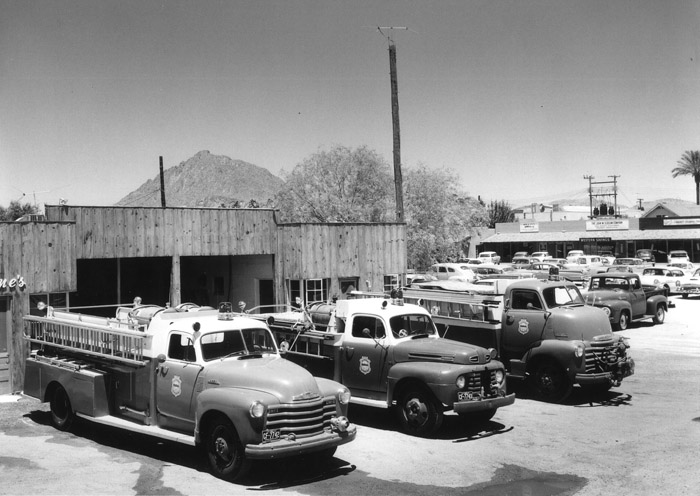
My earliest memory of Scottsdale is what would most intrigue a little boy: The fire station. The Rural Fire Department sat at Second Street and Brown. It had long outgrown its small building, so yellow-painted fire apparatus were parked all around. In the early 1960s, Scottsdale still retained much of its flavor as one of the minor farm towns that surrounded Phoenix. To that had been added "Western-style" storefronts: It was "the West's Most Western Town." With a few blocks on Fifth Avenue, Main and First Avenue, it was a tourist trap. It had a few hotels, such as the Valley Ho and the Sahara, as well as the wooden-sided stadium — continuing the playfully fake frontier theme — and a modest art colony.

We moved from Midtown Phoenix to what is now south Scottsdale in 1970. My mother had been alarmed by an incident at West High where a student had been kicked to death. Despite our modest means, she wanted me to attend the excellent Coronado High. I got to know Scottsdale very well. The neighborhoods around Coronado and Los Arcos mall were still separated from downtown Scottsdale by farm fields and vacant land. Scottsdale Road lacked curbs, gutters or sidewalks. Our house sat a block east of Scottsdale Road; one old, unoccupied house faced on Scottsdale Road across the alley, leaving a spectacular view of the Papago Buttes. It was an alley prowled by the "Refuse Wranglers" city garbage men. Closer to downtown was the YMCA, where I did a stint as a lifeguard, and the Scottsdale Daily Progress building. Then came the new Scottsdale Baptist Hospital and downtown, which still held some small-town retailers such as Lute's Pharmacy.

East of Brown, however, many of the houses were seedy, a few occupied by bikers and drug dealers. City Hall was only being planned. The police were based out of the old schoolhouse. But close to Scottsdale Road and Main Street, local businesses flourished, from Lute's Drugstore to Saba's Western Wear, along with the gas station with the iconic cowboy sign promoting community events. It was still a small town run by a local merchant class. The future giant Fashion Square was a Goldwater's department store. Newer suburbia marched ahead, of course, especially around Saguaro High. But most of Scottsdale ended just north of Camelback, where the horse ranches took over, then breathtaking empty desert. The airport was little more than a former Army airfield with a handful of newer, small buildings. Drinkwater's Liquors, a Circle K and a few other buildings sat at the crossroads with Shea "Boulevard." That was two lanes out to the Beeline Highway. On the way, you could make the long trek through nothing to reach Taliesin West. My friends and I launched model rockets in the desert southwest of Bell and Scottsdale. I got a glimpse of the plans "somebody" had for the place when the Hilton was built in the middle of nowhere on Lincoln Drive and Scottsdale Road; I worked as a bus boy at Paul Shank's, riding my bike every night along that no-shoulders, no sidewalks, no streetlights highway.

Top kill

Our front page editor translates into honest English the typical hate letter that comes to Rogue Columnist:

Dear Mr. Talton: If it wasn’t for
you I’d have an additional 200 percent
equity in my house in my gated community in North Scottsdale. If you
would stop pointing out the minor problems we face in PHX, we could win
the NBA
and my greens fees would be lower.

He adds in his own voice: "We are a
nation of spoiled shits living off of debt and about
40 years past the high water mark of America. The real shame is that it
could all be fixable, but will never be. We live in Scamistan. The U.S. government scamming taxpayers and lenders. CEOs scamming shareholders.
Military
scamming the President. Corporations offloading the real cost of their
fat/salt laden food. BP/Massey Coal on the real cost of energy. Iowa corn farmers on ethanol and water/pesticides killing the Gulf
before BP…. 
People delusional in thinking short term and not long term in fixing
our
problems.  Pols worried about the next election, not the next 20-plus years."

And you think I'm gloomy. To paraphrase Emerson, God offers every mind its choice between truth and American brightsided "optimism." Take which you please — you can never have both. So, tell me, ye brightsiders, what are we to make of the unparalleled, at least in this country, environmental disaster happening off the coast of Louisiana?

Second time around?

If Arizona
was a 'clean slate', how would you do it the second time around?

This challenge, from commenter Rate Crimes, is too tempting to avoid. But it risks being the kind of temptation found in the bars of history at closing time: A pointless counterfactual fling that will end in regret or even worse. No place can be separated from its moment in history, the larger forces at work upon it, the larger-than-life people who mold it, and the masses of people who live there. Arizona and Phoenix were always going to be exactly what they are. Maybe.

Yet here's one imagination exercise: An Arizona with 2 million people, about the population of real-life New Mexico (rather than 6.6 million). Most live in relatively compact versions of Phoenix and Tucson. Every city and town in the state has maintained its distinct identity, look, feel. The larger cities have kept and enhanced key industries while drawing high-value, leading edge sectors proportionate to (or disproportionately favorable to) their population. Housing is a much smaller part of the economy. Smaller places especially have scalable local economies. Multiple universities, federal laboratories and a robust technology cluster are a draw for international talent. Incomes are higher than the national average, as in real-life Washington state or Colorado. Most people are literate and educated, engaged in the community, committed to preserving the environment, part of a vibrant two-party political system that veers to moderation whomever is in power. This outward-looking state is a major trade hub for Mexico and Latin America, comfortable with its Hispanic part, but largely insulated from a huge illegal alien influx by its high-end economy and the cohesion of its cities.

I could get even more specific about Phoenix.

Arizona depression III

I'll wrap up my trip back home with the question that started it: What now?

In numerous conversations with the well-connected and just average 'Zonies, nobody has an answer. "Every time things seem to be improving, we take a step back," said one prominent player. "We have an unerring ability to shoot ourselves in the head." I would add: "And reload." While the state is very different from metro Phoenix in many ways, economically it has become an even less diverse mirror of it, depending on population growth, housing and tourism. The "plan," such as there is one, seems to be hoping the Growth Machine can sputter to life for one more good run. The white-right rhetoric about cutting taxes and regulation to gain business is nonsense: If that were the key, Mississippi and Somalia would be economic giants. The reality: There's no plan B.

In my old haunts, every little triumph is offset by a heartbreak or moronic misstep. Some new restaurants have set up along the light-rail line — wish some productive businesses or headquarters with high-wage jobs would do so. The historic districts continue to hold on, despite scads of "for-sale" signs. ASU downtown seems there to stay, no small accomplishment. Yet the number of empty storefronts is astounding, a sign of the lack of capital coming to the city. The city can't afford to keep up iconic Encanto Park while what was the shady oasis adjacent to the Viad tower has been turned into a horrid faux desert radioactive zone. Every time someone throws down rocks and removes shade trees and grass from the old city, it only increases the heat island and decreases the livability. "We're in a desert!!" No, Mr. or Ms. Transplant, old Phoenix was always an oasis.

Arizona depression II

My favorite hotel, adjacent to the Willo Historic District, is full. Two large conventions are downtown. This was all booked before Arizona passed its Jim Crow anti-immigration law. Now every restaurant owner and person associated with the tourism industry I speak with is terrified about the growing backlash against the state. Many here are outraged about boycott calls. But it's fair game: Without the boycott, Gandhi, King and Chavez would not have had a key weapon against a grave moral injustice. I wish people would boycott by legislative district, while spending money and time in central Phoenix and Tucson, as well as with Hispanic- and progressive-owned local businesses. The rocks come with the farm, and the residents of the state allowed the Kookocracy to run wild, not only with SB 1070 but a host of madness.

Phoenix is in trouble anyway. Mayor Phil Gordon, a good man who loves the city and came into office seven years ago amid such hope, seems adrift. The composition of the city council has changed and for the first time since the reforming Charter Government movement took power six decades ago is becoming politicized. The ability to do the big things accomplished by Skip Rimsza and seen through by Gordon appears gone. Huge swaths of the city look like Dresden after the rubble had been carted away. The largest business, based on signage, remains "Available." Light rail (we built it, you bastards) is a big success; for example, I see many guests at the hotel taking it to restaurants, the convention center or to and from Sky Harbor. Yet the fiscal crisis is causing cuts in frequency, which will hurt ridership. The bus system has already been reduced to service levels seen in small cities.

Arizona depression I

Traveling around Arizona, it's difficult to imagine how the state can turn itself around, even if a majority understood the term. For most, a turnaround would mean a return to 40-percent population growth every decade, more sprawl, more "active adult resort living — with championship golf!," more spec retail development and office "parks" to house the real-estate outfits, mortgage boiler rooms and call centers. The dirty secret is that as an economy, Arizona outside of Phoenix and Tucson is "the Third World," as a prominent booster economist once told me, not for attribution. An overstatement of course, although the Third World also has its gated enclaves of the super-rich and depends heavily on tourism. But among the states, Arizona including Phoenix and Tucson performed dismally on almost any measure of economic well-being except for housing starts and population growth, the latter a mixed indicator that carries huge costs, too. And this was before the Great Recession.

Now tourism is in freefall, even before the Jim Crow anti-immigration law (and a Tea Party 'buycott' is of questionable help considering the bulwark of the "movement," New York Times spin notwithstanding, is economically distressed whites). The exurban and rural sprawl building of the mid-2000s is dead and decomposing. Even tony Sedona is suffering. Another striking fact is how dependent rural Arizona has become on everything from food to gasoline to Wal-Mart Chinese goodies trucked up from Phoenix, even as it has added huge gobs of new people. This region was once the epitome of localization, along with distribution via railroads. Now Flagstaff's rail yard has been ripped out and the two tracks of the BNSF "Transcon" run through alone, heavily ballasted for speedy passage as if this were the middle of nowhere. It's not merely that Arizona produces little now, but that such a layout is highly vulnerable, not least to the future of peak oil and its much higher gasoline prices. The forest looks sick despite the wet winter. Climate change is bad enough, but one wonders whether this miracle of creation can withstand more than 6 million people and their cars in a place far beyond its carrying capacity. Then there's the once-magical Verde Valley, profaned by sprawl around Cottonwood that makes Phoenix look like a model of planning, all sucking water that will be needed by the Salt River Project.

In Phoenix, one of the most arresting aspects of the depression — for the city has never been through anything like this — continues to be the relatively light traffic. I drove from Sky Harbor into midtown, hitting the Papago/Red Mountain/51 merge headed to Seventh Street at 5:45 p.m. on Thursday. Easy motoring. Three years before, it would have been an impossible mess. The air was relatively clear, even though the ozone and other vaporous car-vomited poisons congregate in north Scottsdale and Fountain Hills (awww). Not much looks different. This is the trick Phoenix plays on its residents, although the world is changing fast. Again, I don't see how this place recovers.

Screwed 3.0

Now we enter the next phase of the Great Disruption, where political dysfunction meets unsustainability. The Greek debt crisis is helping prepare the way for American panic about the federal deficit and national debt. These two maladies are a cause célèbre for the Tea Party. The supposedly left-wing media are on board. USA Today headline: "Nation's soaring debt calls for painful choices." Tom Friedman of the New York Times: "After 65 years in which politics in the West was, mostly, about giving
things away to voters, it’s now going to be, mostly, about taking things
away. Goodbye Tooth Fairy politics, hello Root Canal politics." Isn't he cute? I can't wait for the idiot David Brooks to weigh in. (He's already written about how "as
government grew, the anti-government right mobilized. This produced the
Tea Party Movement — a characteristically raw but authentically American
revolt led by members of the yeoman enterprising class…As government became more threatening…" Funny, he means the Obama administration, not the Bush wars, shredding of civil liberties and crony capitalism leading to trillions in federal bailouts, i.e., government growing.) You see, we're just like Greece — a profligate nation that needs to tighten its belt, cut government.

The reality, of course, is very different. Whatever his failings, Bill Clinton showed that seemingly intractable red ink could be turned into surpluses. The present deficit and debt is almost entirely a creation of the Bush tax cuts, the Bush wars and the Bush bailout of Wall Street (for which Sen. Obama voted). The fiscal situation was made more severe by the worst recession since the Great Depression. It's as if FDR fought World War II twice as long, cut rather than raised taxes, and did all this in the worst part of the Depression while using federal money for the banksters rather than the people. It's a wonder the deficit is so low as a percentage of GDP. It is not a cause for hysteria.

But, ah, dear reader, it will be used. "You never want to let a serious crisis to go to waste," said White House tough guy Rahm Emanuel, who is letting the real crises of the Great Disruption do just that. The extreme white-right — the idiot David Brooks' "yeoman enterprising class" — and the plutocracy will use the "crisis" of federal spending to their own ends. And if the effectiveness of their party as the minority in Congress is any indication, wait until they take the House this year from a feckless Democratic Party. And then the Senate and White House. Prepare for Screwed 3.0

Roll over, Gene Pulliam

The Arizona Republic on Sunday published a remarkable front-page editorial concerning the pile of feces into which the state has done a face-plant, otherwise known as its attempt to "address" illegal immigration. It was not remarkable for its placement — old-time newspaper publishers often did page-one opinion pieces, perhaps most famously the Republic's own Eugene C. Pulliam. Rather, this article, pretty as it was with the paper's current obsession with design, proved astonishing in its intellectual shallowness, dishonesty and desperate pretzel-twisting to cast "blame" equally in every direction. And all the while demanding "leaders." Rarely has an institution in the broad land of vapid corporate newspapers made such a gaudy display of its daft cowardliness. One is reminded of Lincoln's line: "It is better to remain silent and be thought a fool than to open one's mouth and remove all doubt."

"Old Man Pulliam," who ran the Republic and Phoenix Gazette for decades, occasionally published — and even wrote, for he was a newspaperman to his marrow — thundering page-one editorials. They were not intended to compete in the Society for News Design. They were sometimes long, always trenchantly and even intellectually argued. I recall one from the late '60s (I believe) that was a fierce jeremiad against rising government bureaucracy. You always knew where his newspaper stood. Pulliam was a man of the right but he would not be allowed into today's Republican Party or corporate journalism club. He was too independent, endorsing LBJ over Barry Goldwater in 1964 and renouncing the idea of a newspaper as merely a business. It is said he wrote a trust to prevent the sale of his beloved papers to the likes of Gannett, but that's another story.

There's no doubt that were he alive today and running the Republic, he and his famed investigative reporters would make short work of Russell Pearce and Joe Arpaio.