
The trouble with Central Avenue is it's not central to anything now." So a real-estate mogul told me in 2001. He was totally bought into endless sprawl at the expense of Phoenix, but he was also wrong. With the metroplex spread from Buckeye to Gold Canyon, Phoenix's most important street is more important and convenient than ever, as has been shown by light rail (WBIYB) and growing infill.
I've written about Central before. But let's take a photo journey, thanks to Brad Hall's collection, the McCulloch Bros. Collection/ASU Archives, and Library of Congress. Click for a larger image.

When it was Center Street, a southward look at Washington in the 1890s. Construction workers are installing water lines.
 Here's a view of the Hotel Adams in 1909. It burned down a year later and was replaced by a "fireproof" hotel.
 The Center Street, the first across the Salt River. Completed in 1910, the 2,120-foot-long span was claimed to be the longest reinforced concrete bridge in the world.
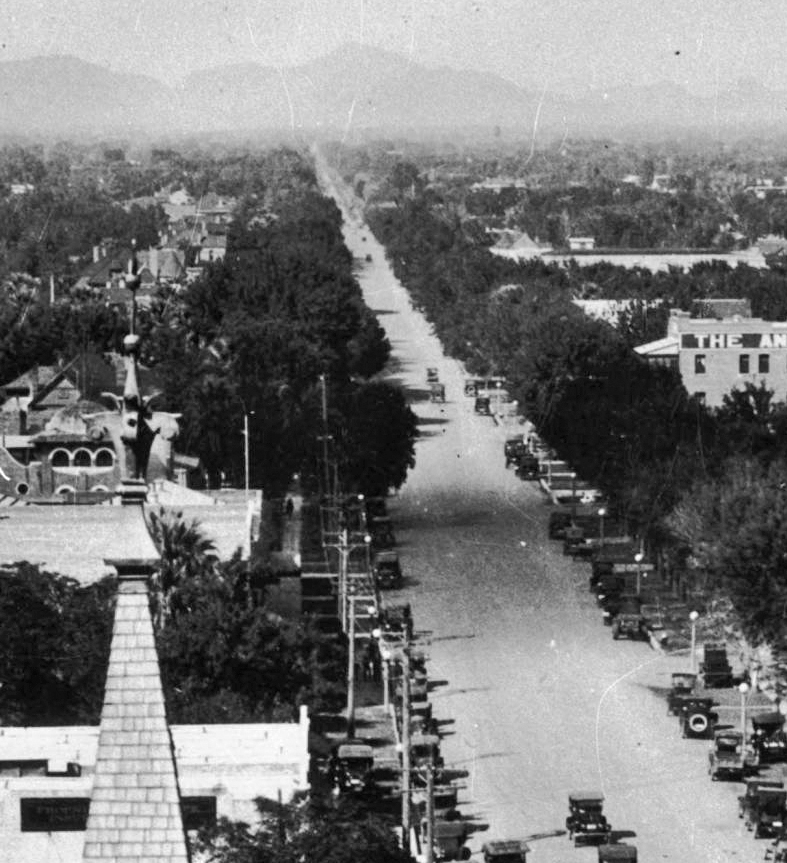 Beneath a lovely shade canopy, here is Central Avenue at Monroe in 1919. It was renamed in 1910.
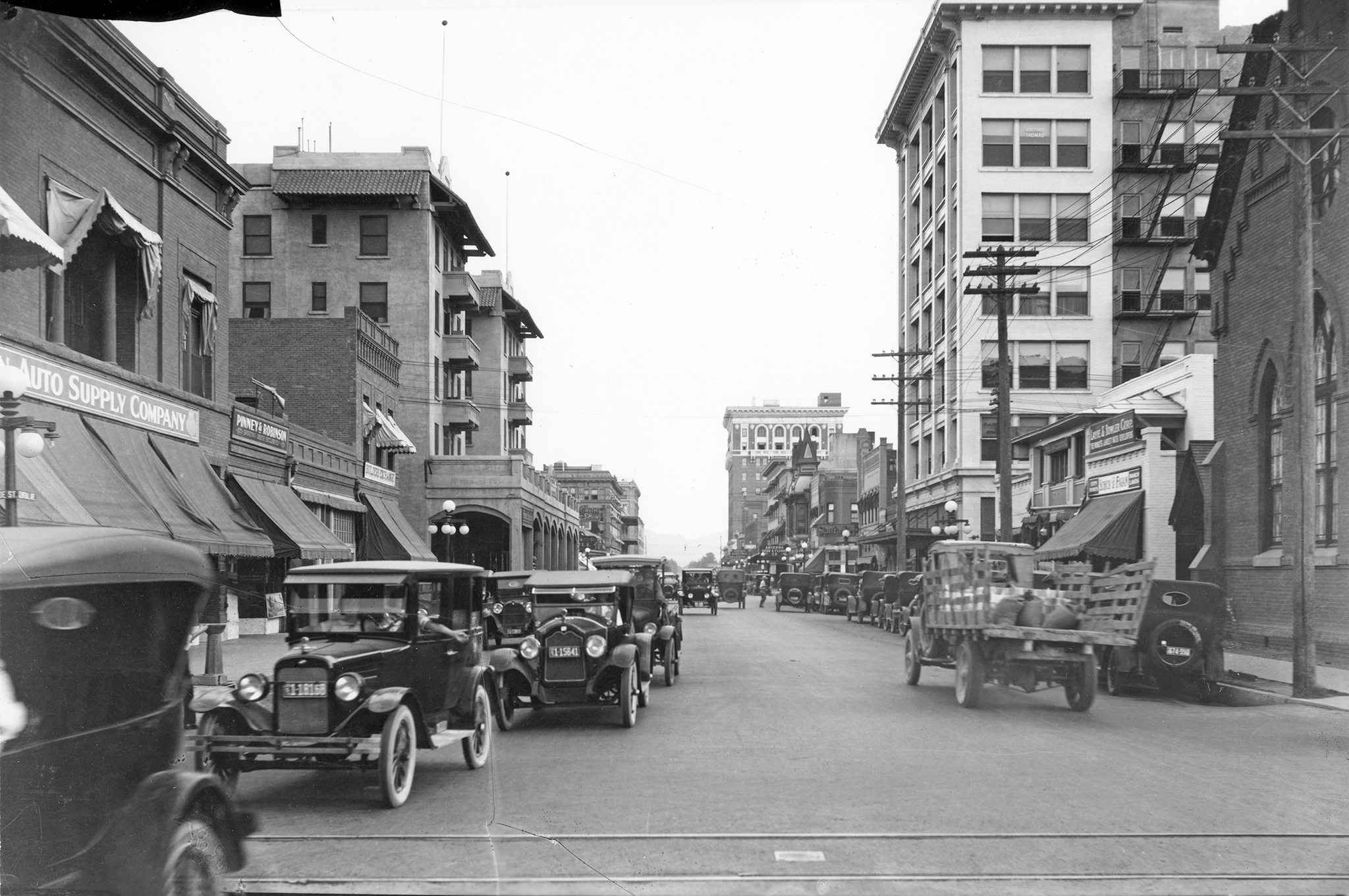 By the 1920s, the avenue changed dramatically. Looking south from Monroe Street are the new Hotel Adams, left, and the Heard and Luhrs buildings on the right, with a streetcar track on Monroe.
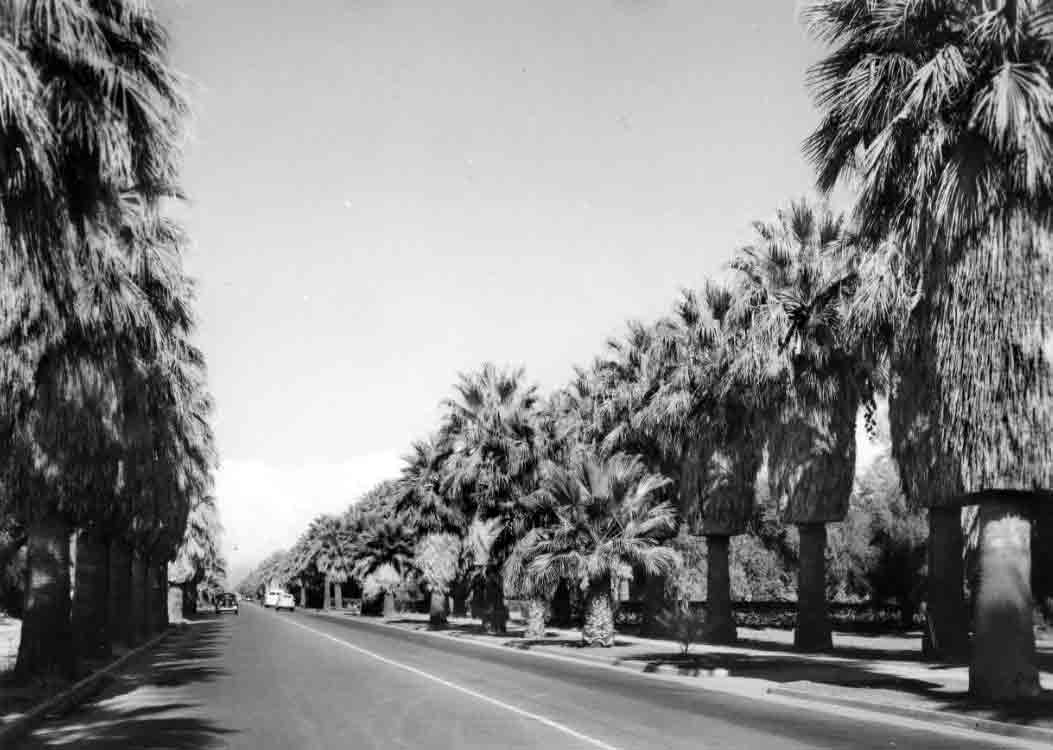 Central looking north from McDowell in the 1930s. Handsome haciendas lined the avenue.
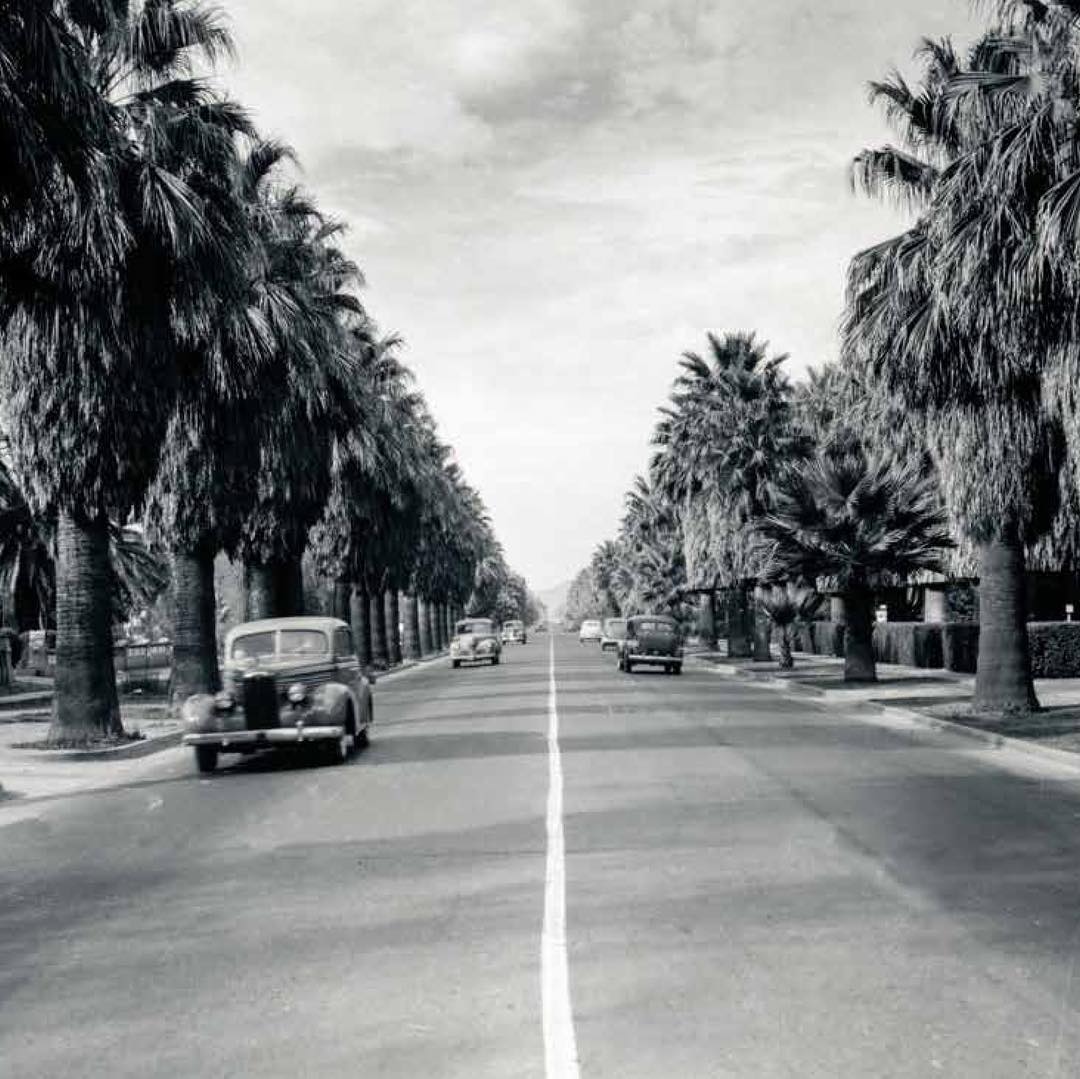
At Palm Lane, looking north.
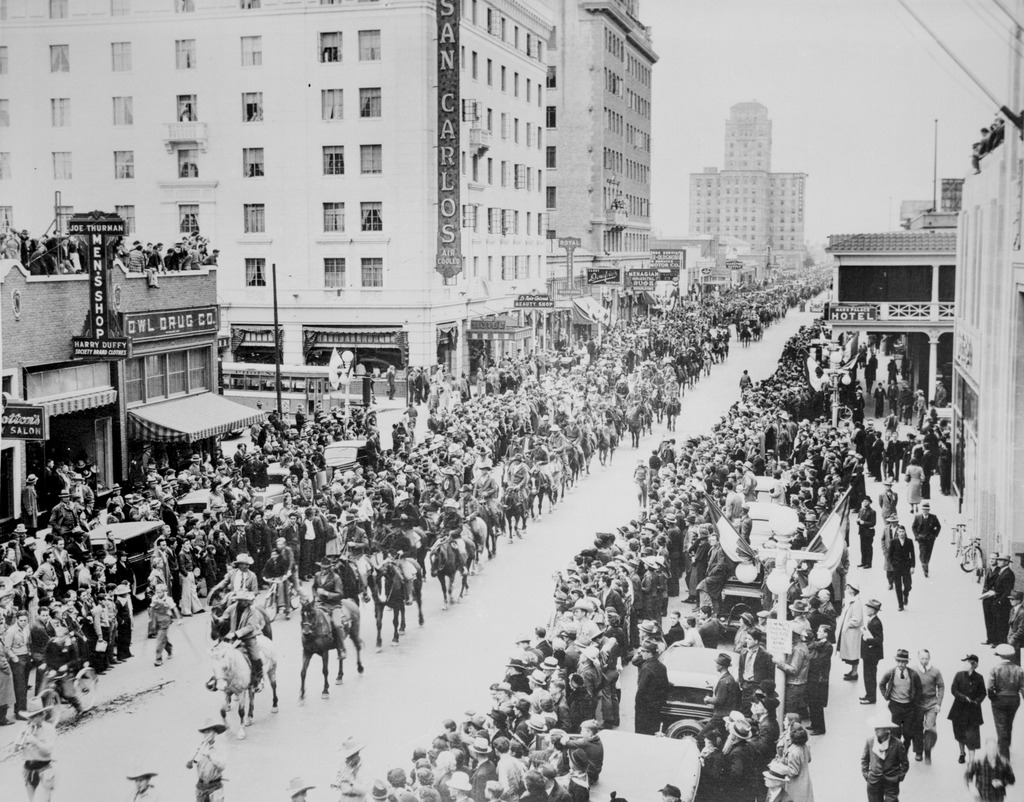 Central was used for most parades. Here's the Rodeo of Rodeos Parade in 1937.
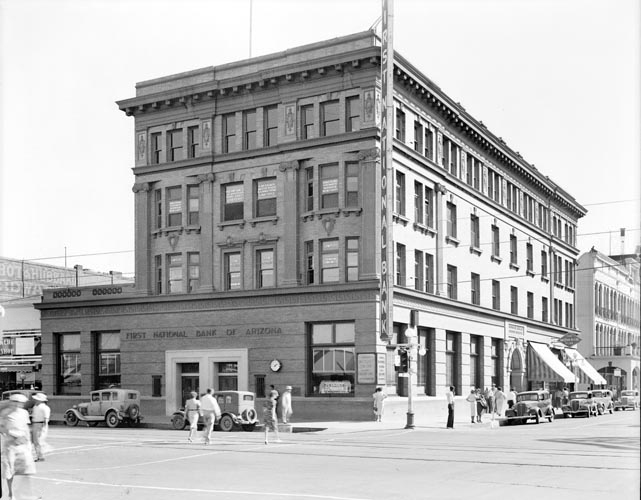 The First National Bank building at Washington and Central and next door the Hotel Luhrs in the 1930s.
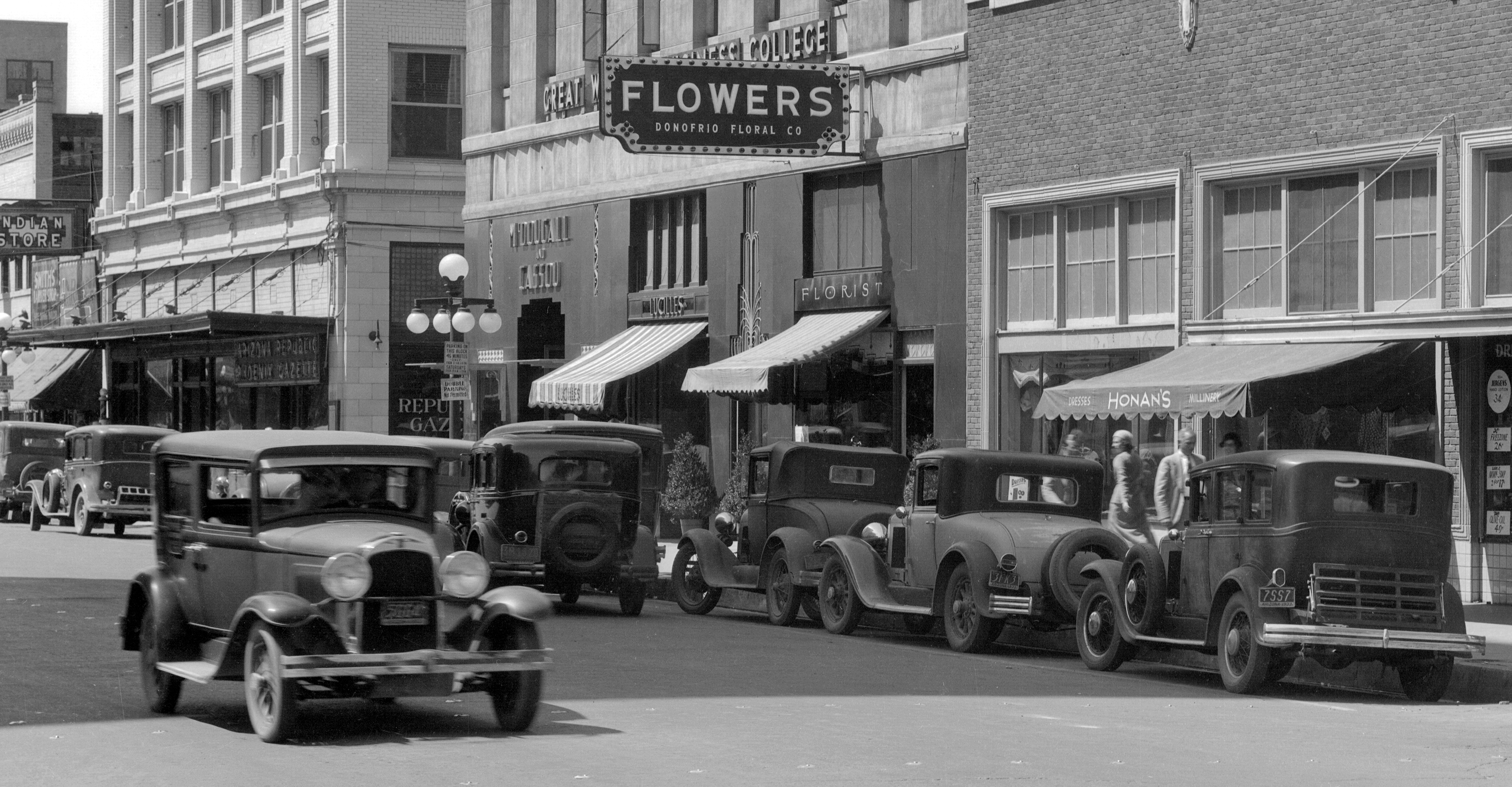
It's 1933 and we're looking south toward the Heard Building, home of the Arizona Republic and Phoenix Gazette. The block also includes Donofrio's Flowers and a business college.
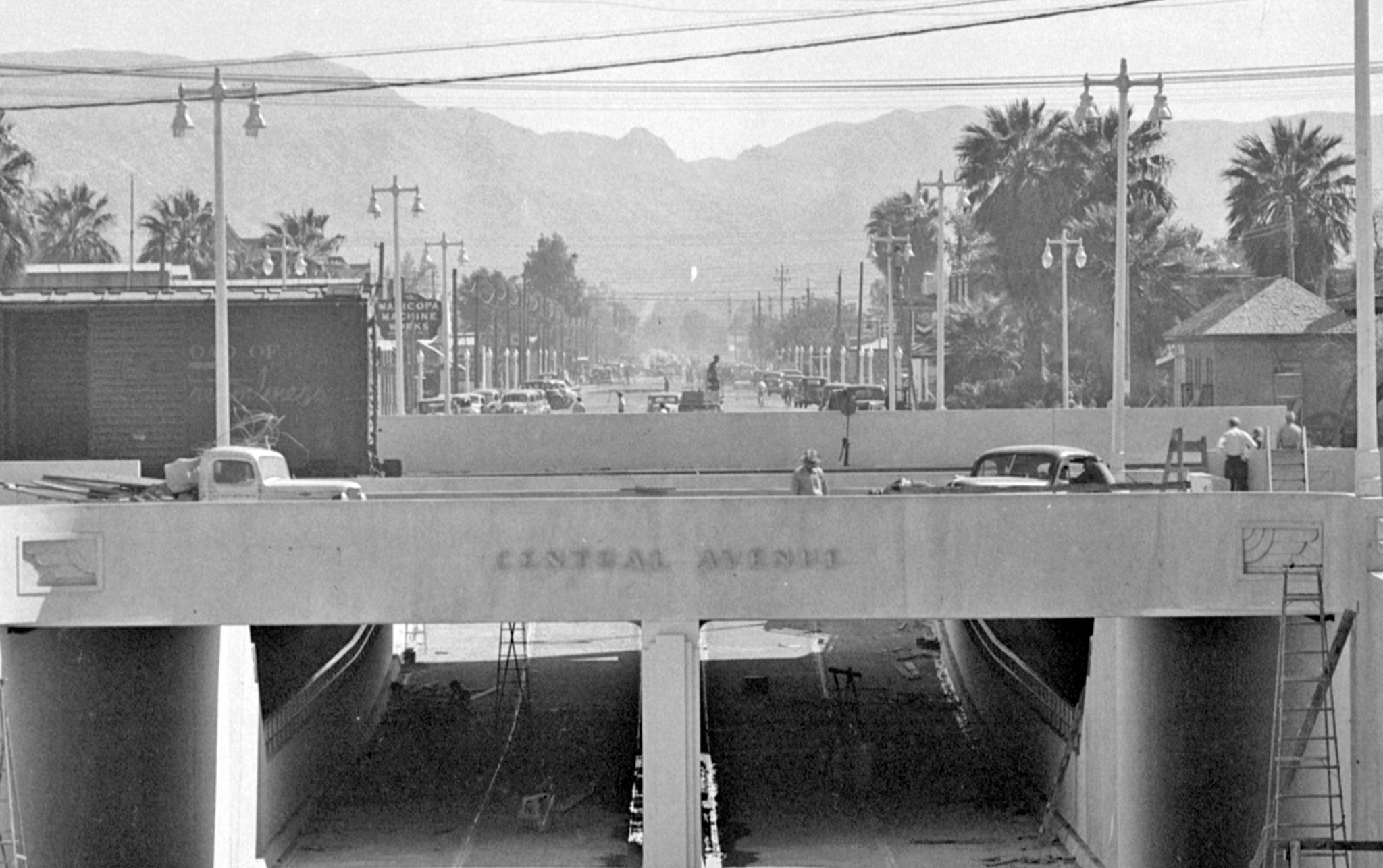 One of the most visible gifts of the New Deal was the Central Avenue underpass. Generations of Phoenicians would honk their horns as they drove beneath the railroad tracks.
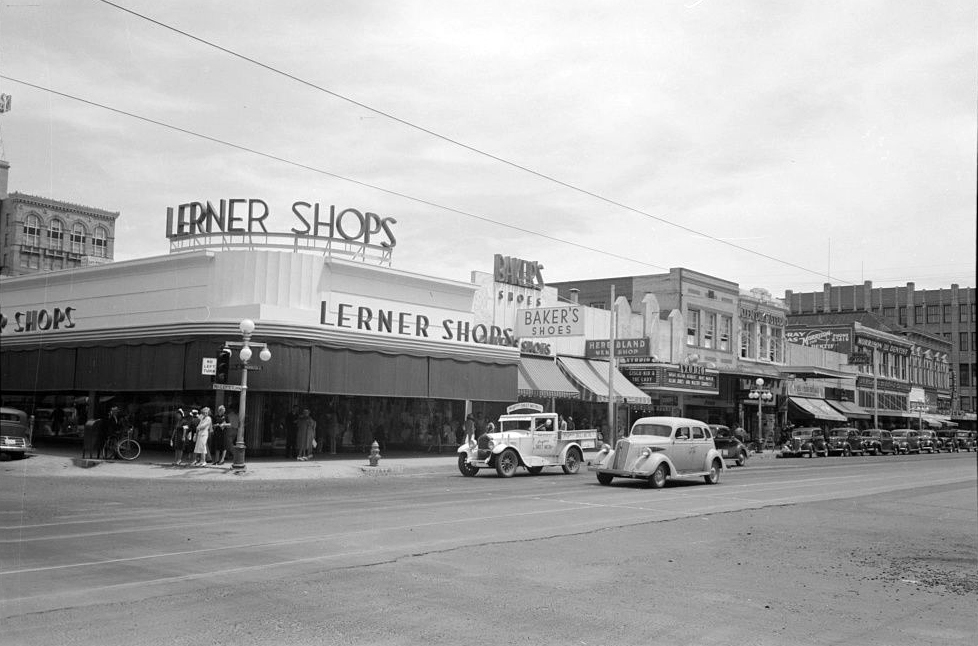 The northeast corner of Central and Washington — we're looking east from Central — in the late 1930s.
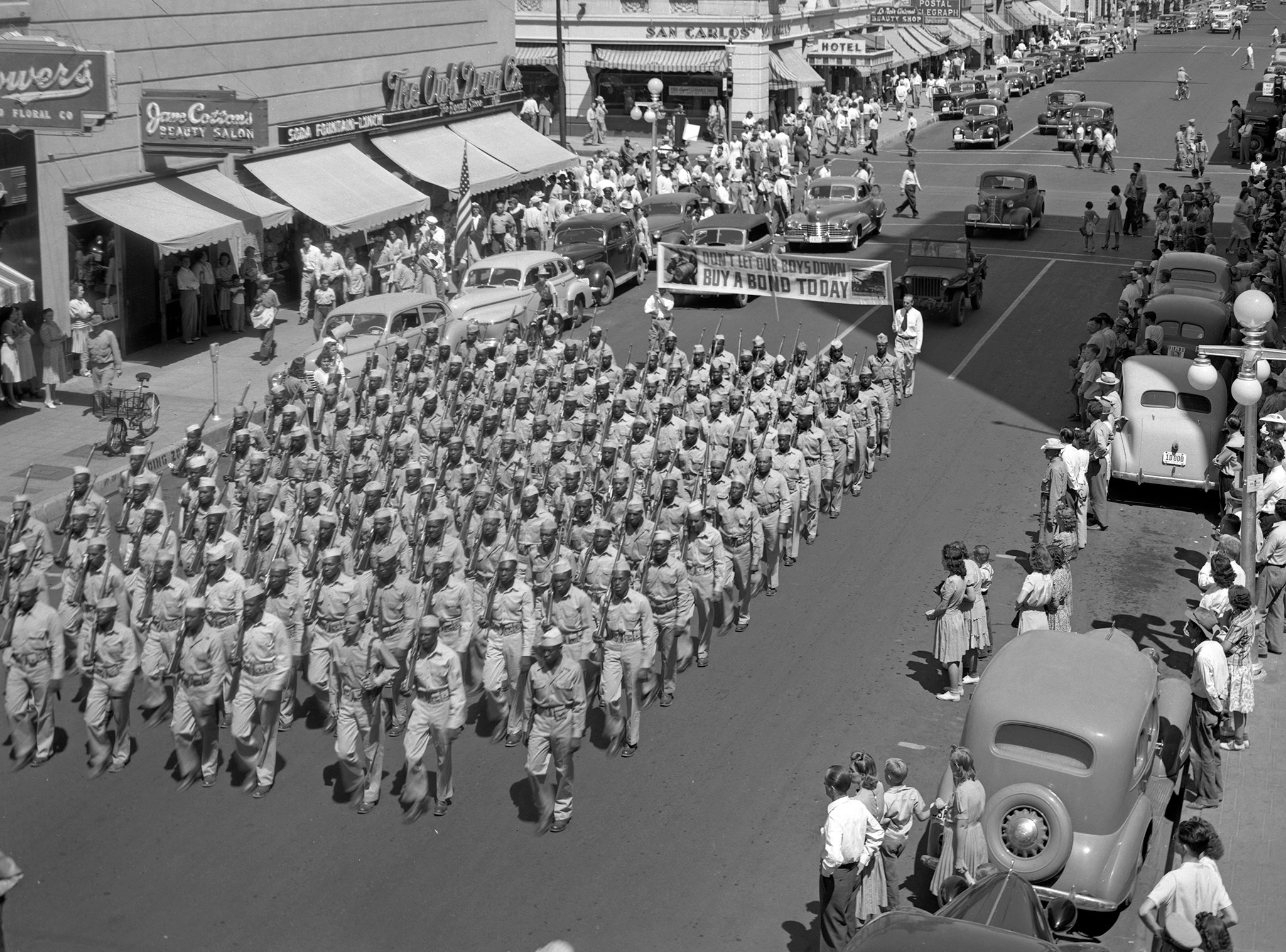 It's 1942 and one of many war bond parades passes the Hotel San Carlos.
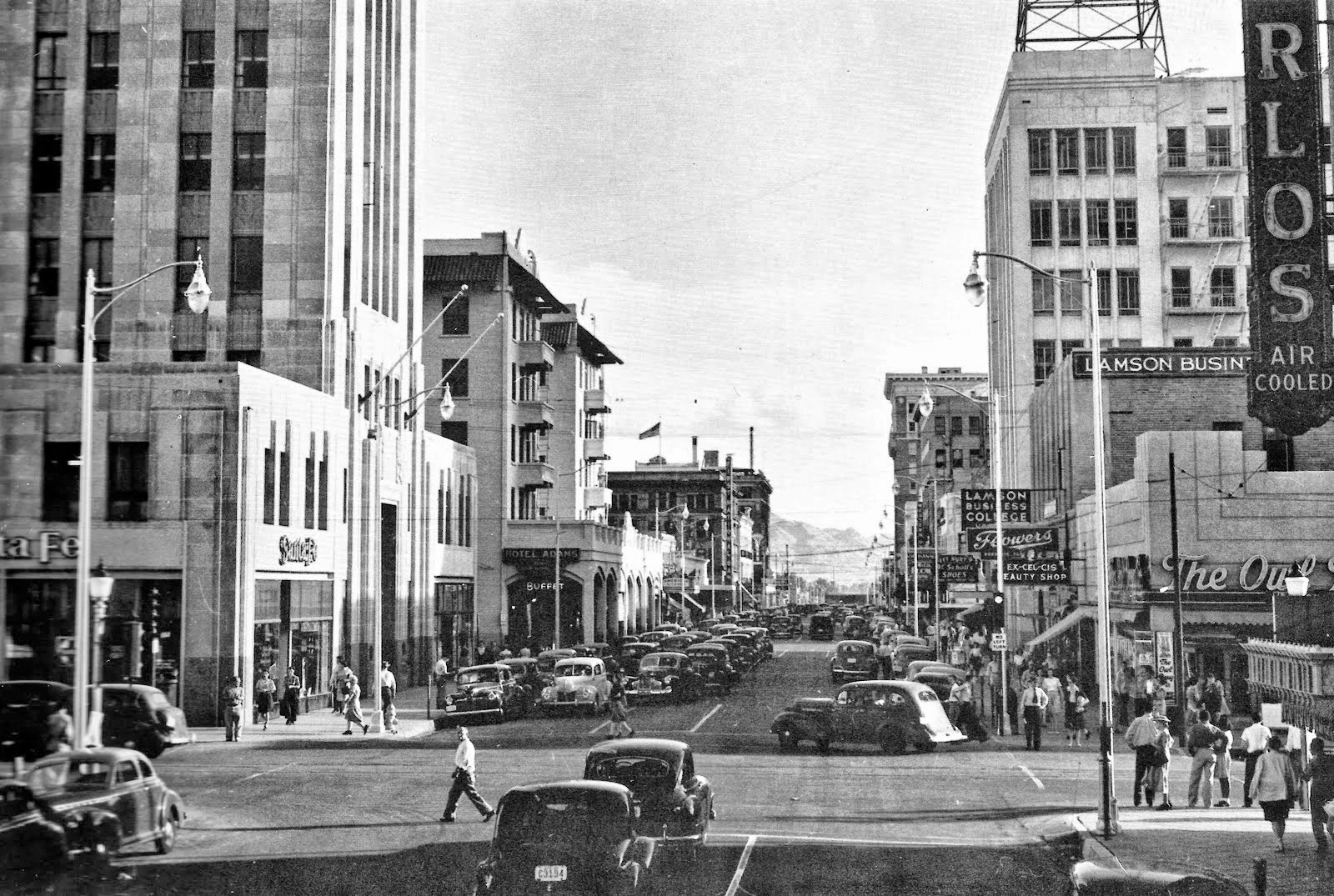
This high-resolution shot shows the Professional Building and Hotel Adams on the left and crystal clear South Mountains in the distance.
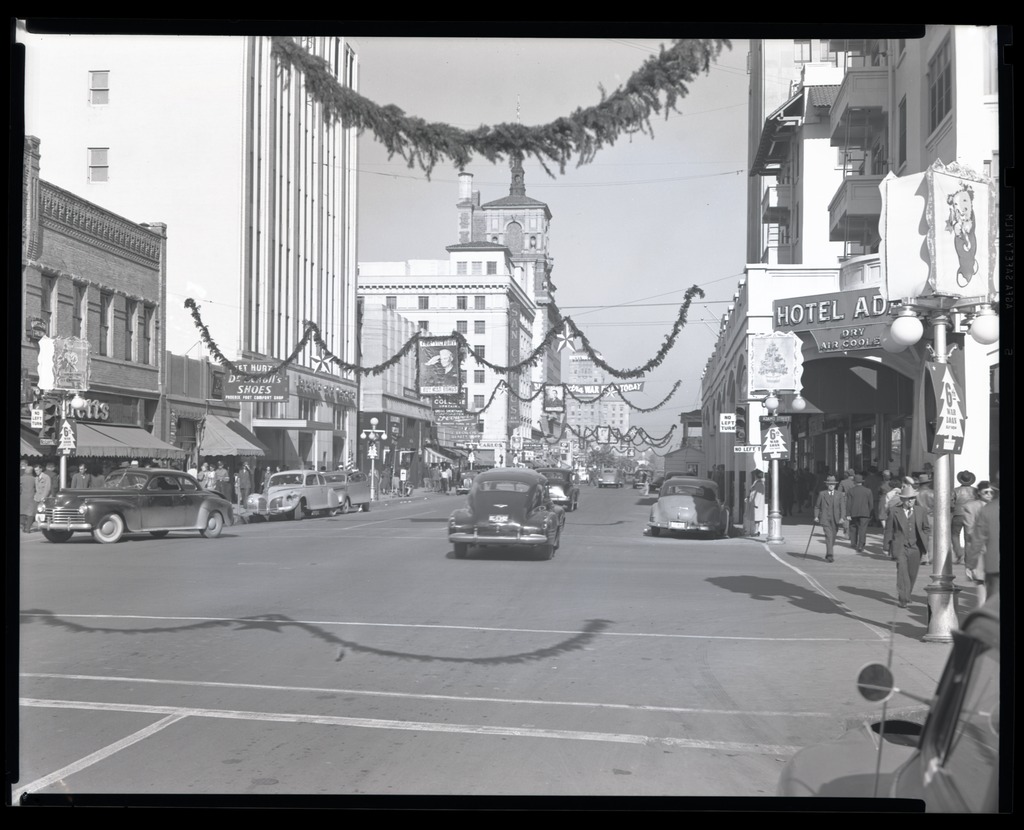 Central is decked out with Christmas decorations in 1944. (McColloch Brothers Collection/ASU archives)
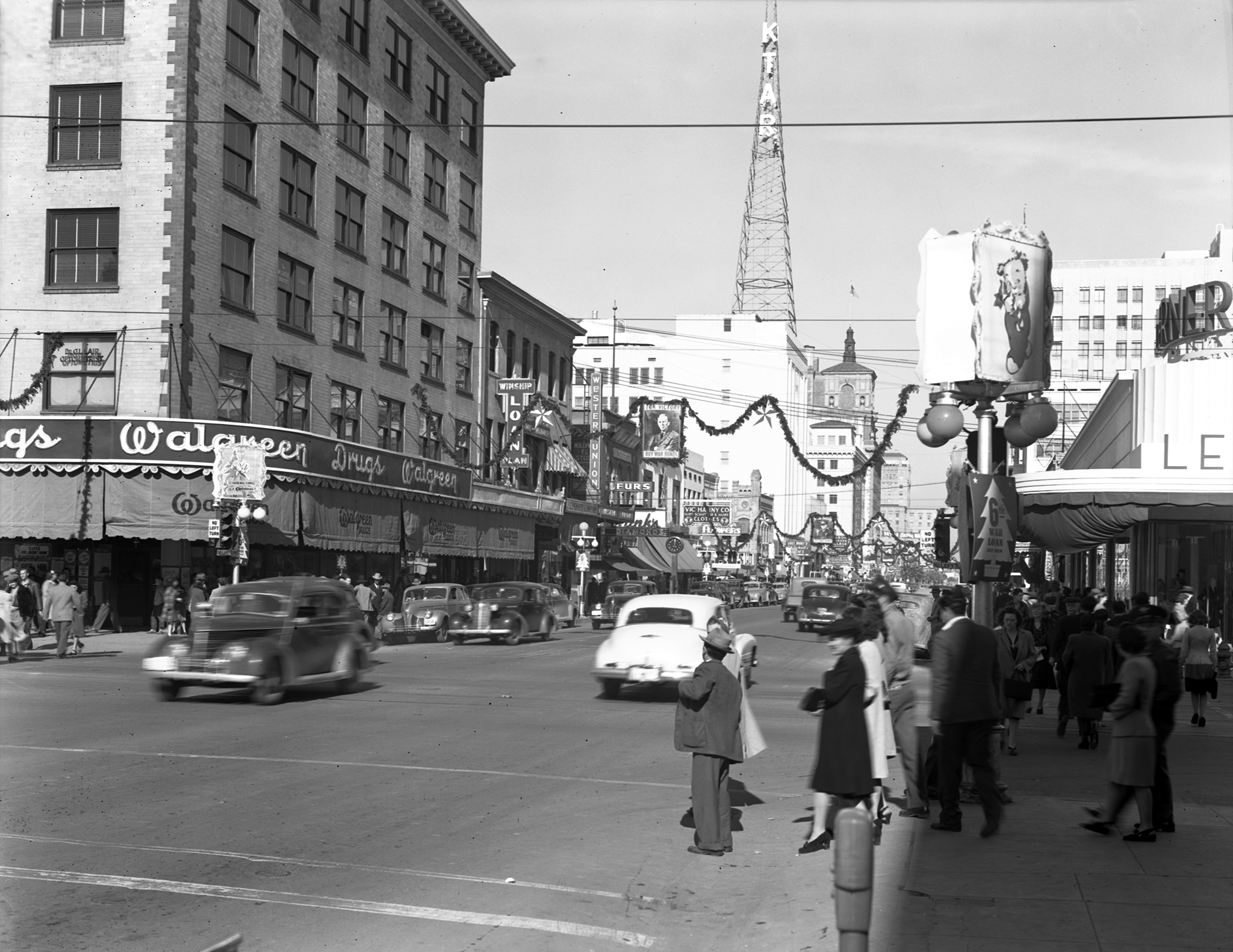 More holiday decorations on Central looking north from Washington in the 1940s.
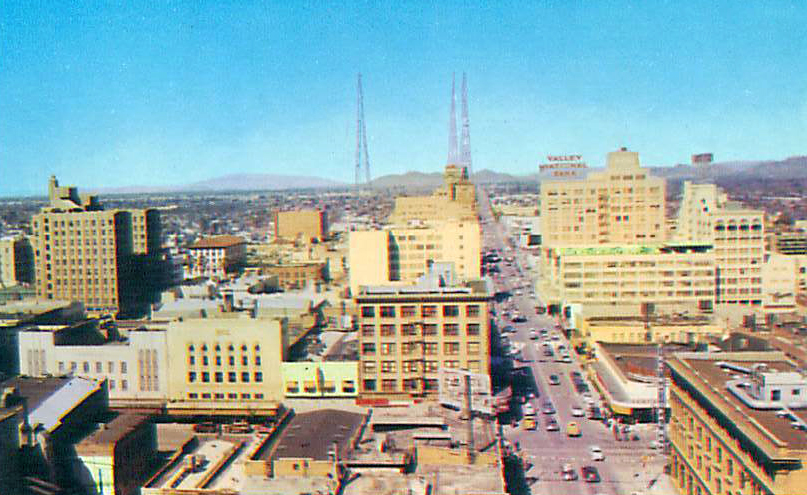 This 1940s overhead shot shows Washington Street, radio towers on the Heard Building and Hotel Westward Ho. On the right are the Hotel Adams and Professional Building with the neon Valley National Bank sign.
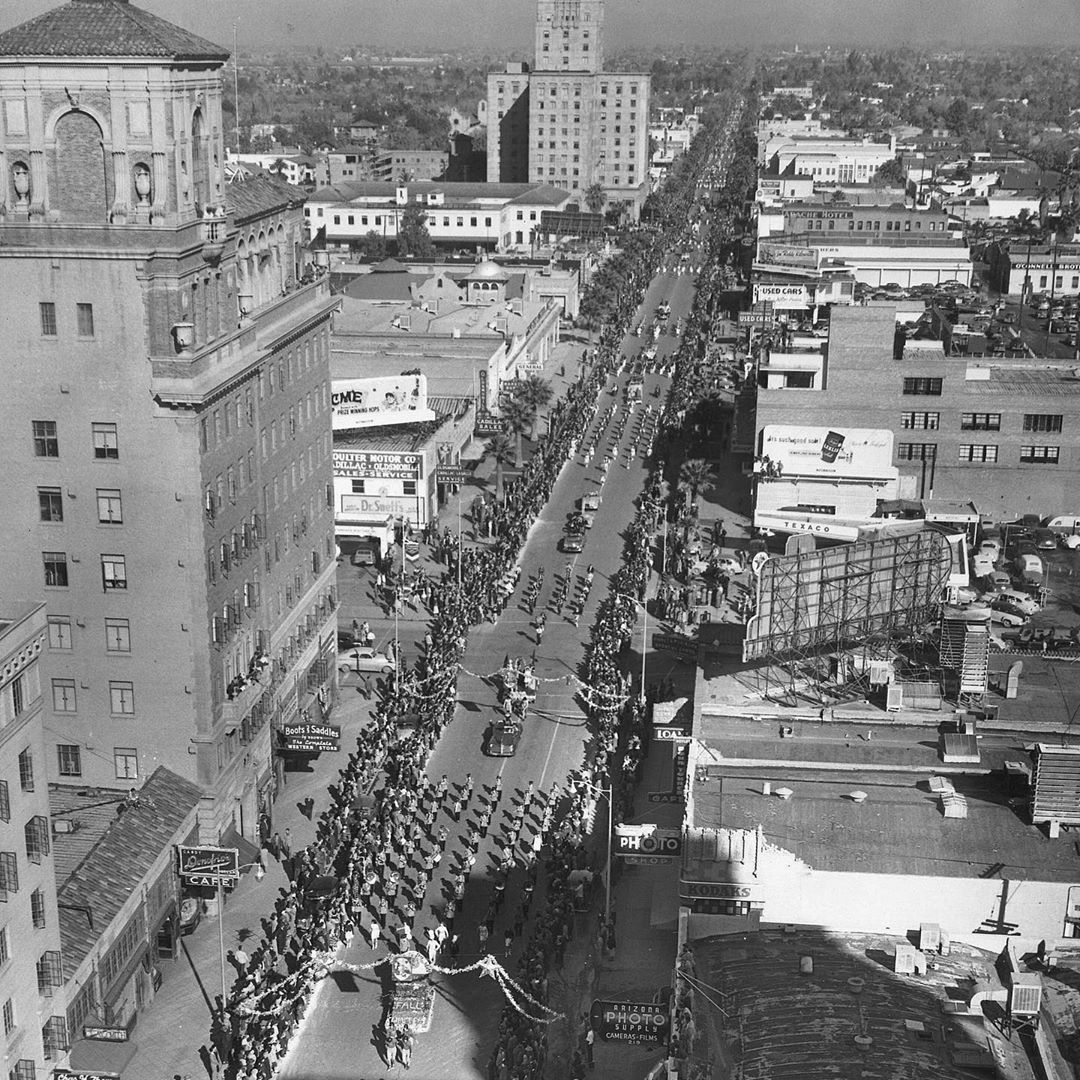 It's the Salad Bowl parade. Phoenix's first post-season college bowl was held in Montgomery Stadium from 1947 to 1955. The name reflected the city's status as a major agricultural center.
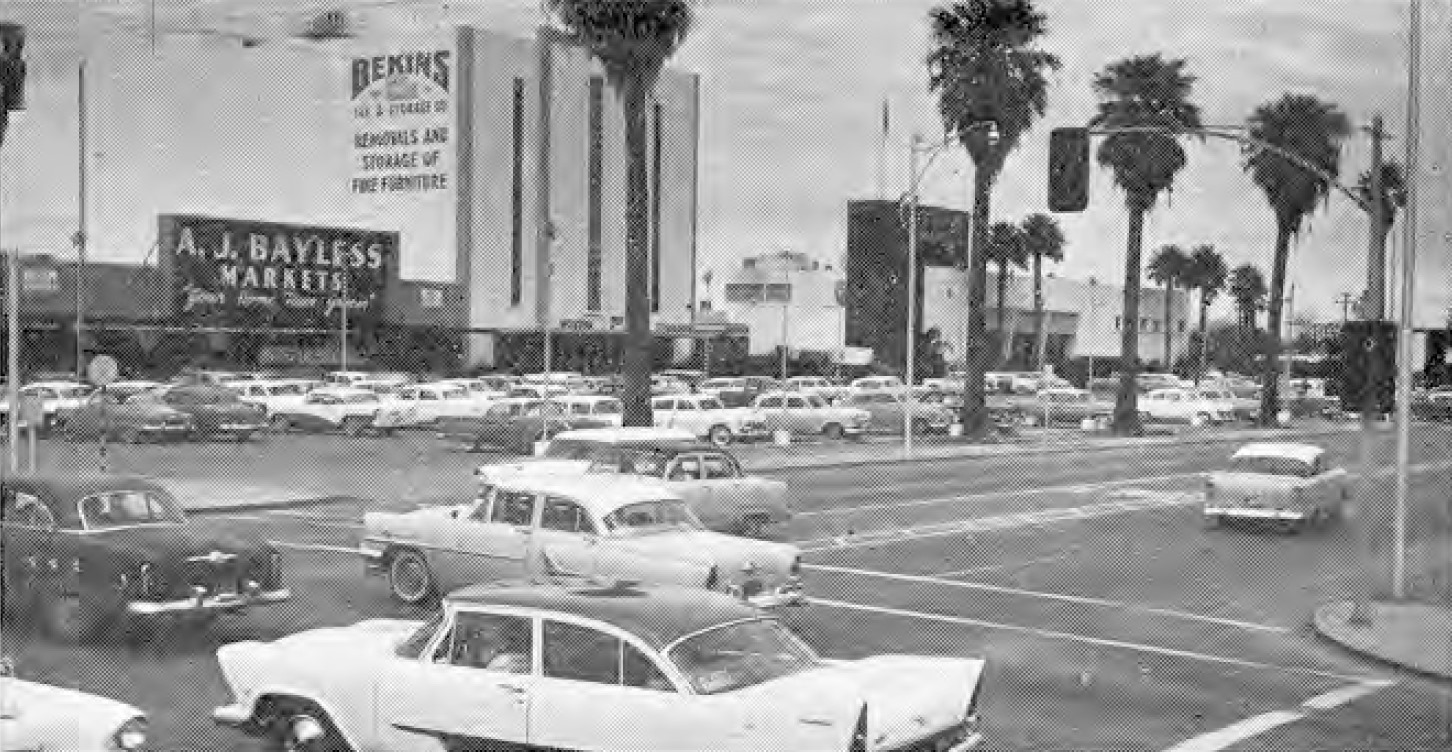 Central saw dramatic changes in the 1950s, including high-rises north of Thomas. Here, in 1957, Indian School is the cross street while A.J. Bayless, Bekins, and the Carnation Dairy and restaurant face Central.
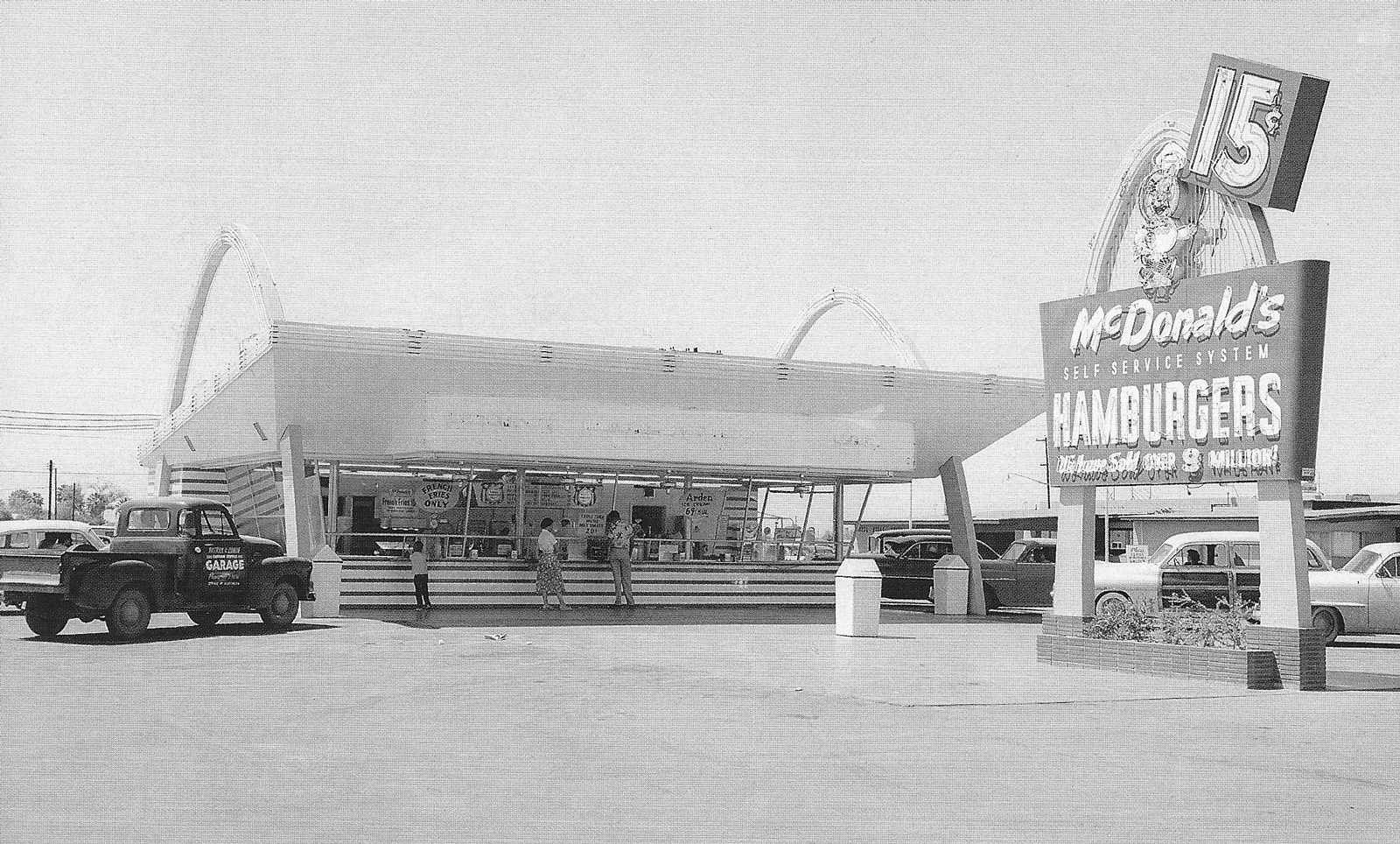 Just south was McDonald's — the first franchise outside of California and the first with golden arches.
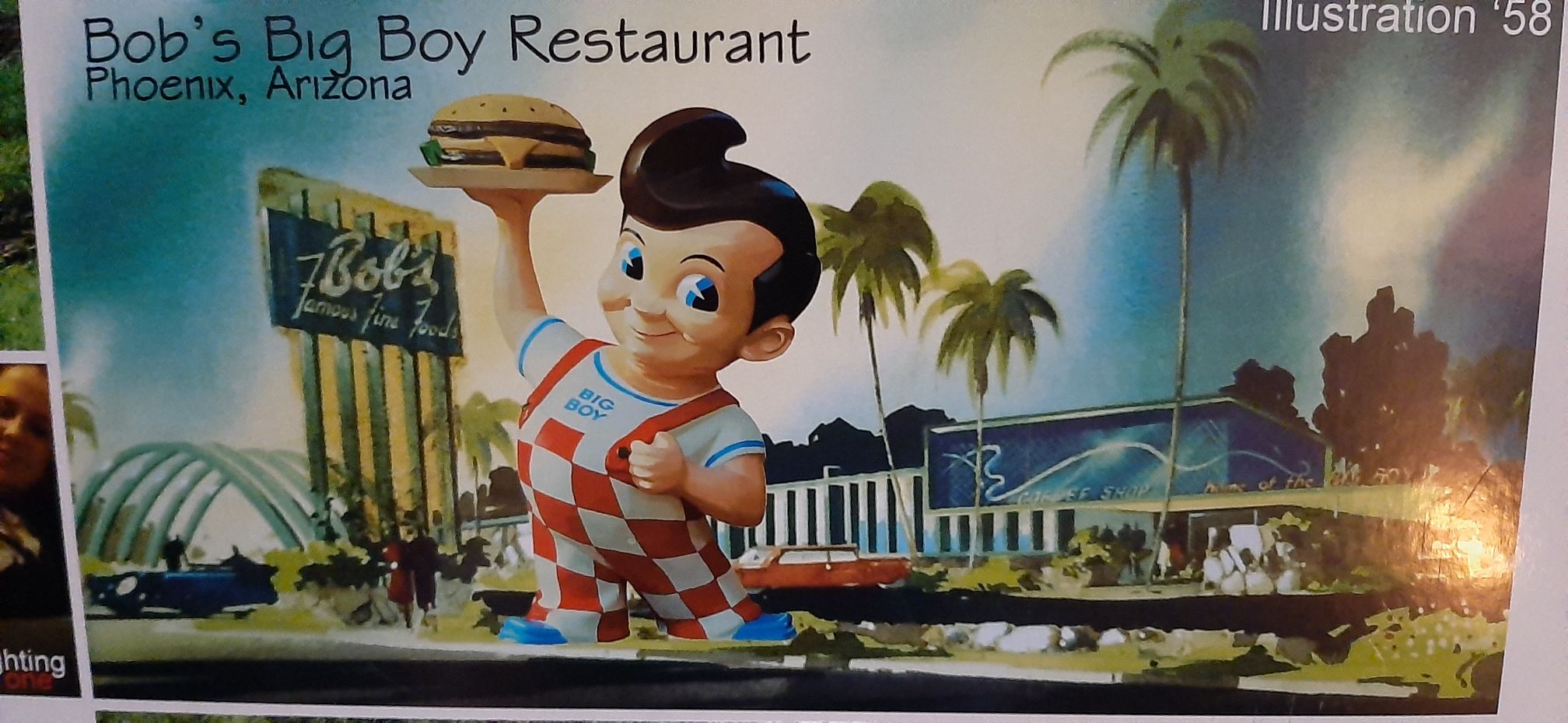 Generations of young Phoenicians cruised Central from McDowell to Camelback. But the hub was Bob's Big Boy restaurant and drive-in at Thomas Road, as seen in this Jim Elson illustration. Cruisin' Central was an important way for teens from different high schools to make connections.
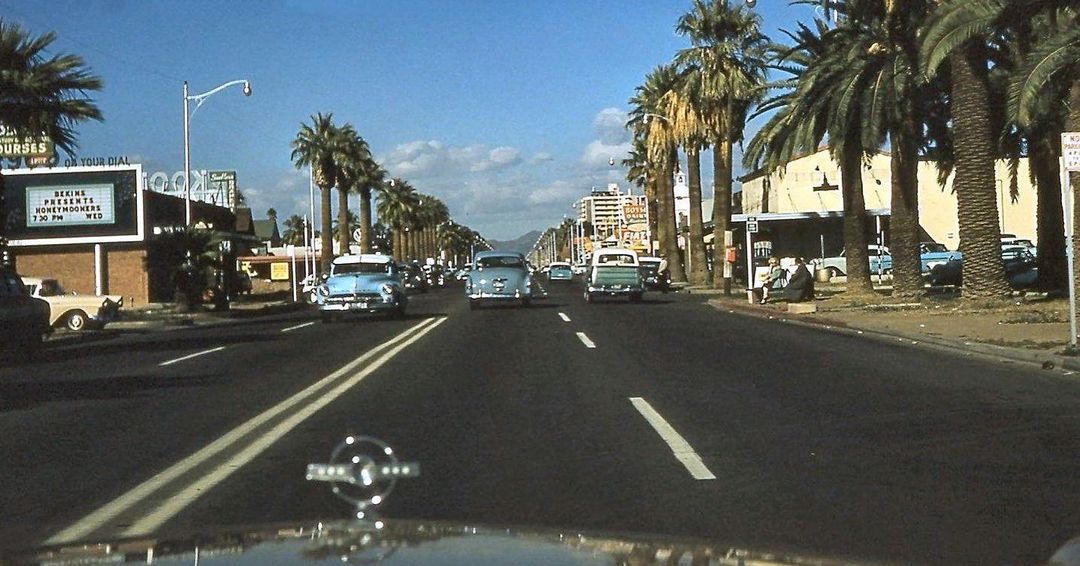
Four-lane Central approaching Culver Street in the late 1950s. The Bayless store where my grandmother "traded" (her words) is on the right and the Social Security office on the left behind the billboard. Del Webb's Phoenix Towers, completed in 1957, is in the distance (Brad Hall collection).
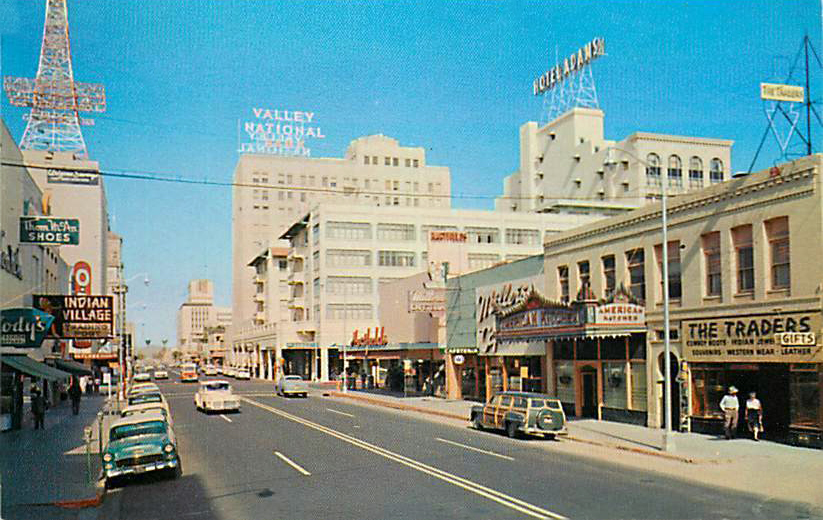 This 1955 view of Central south of Adams Street shows the dense urban fabric of retailers in a variety of architectural styles, lost in the teardowns starting in the 1970s.
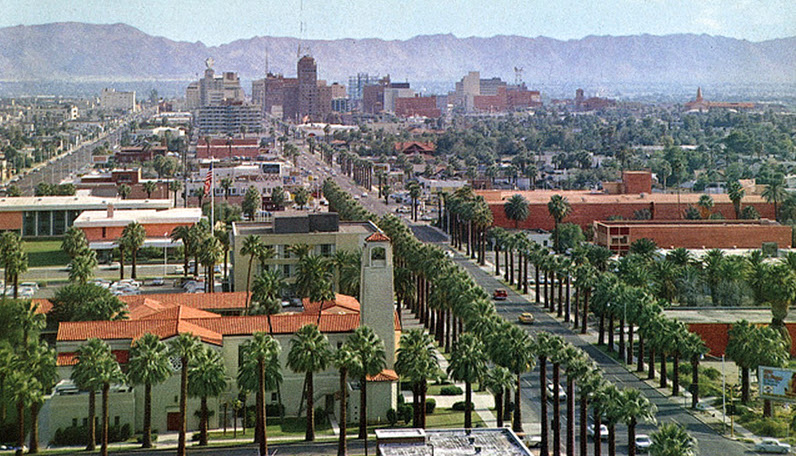 Central looking south from Palm Lane over Central Methodist Church, 1960. My neighborhood.
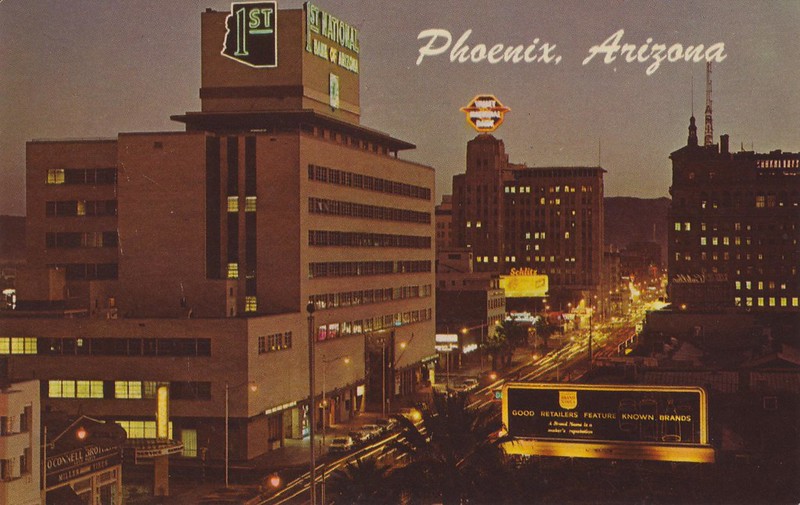 This postcard shows the iconic Valley National Bank sign, rotating in neon. The First National Bank of Arizona Building is now part of ASU's downtown campus.
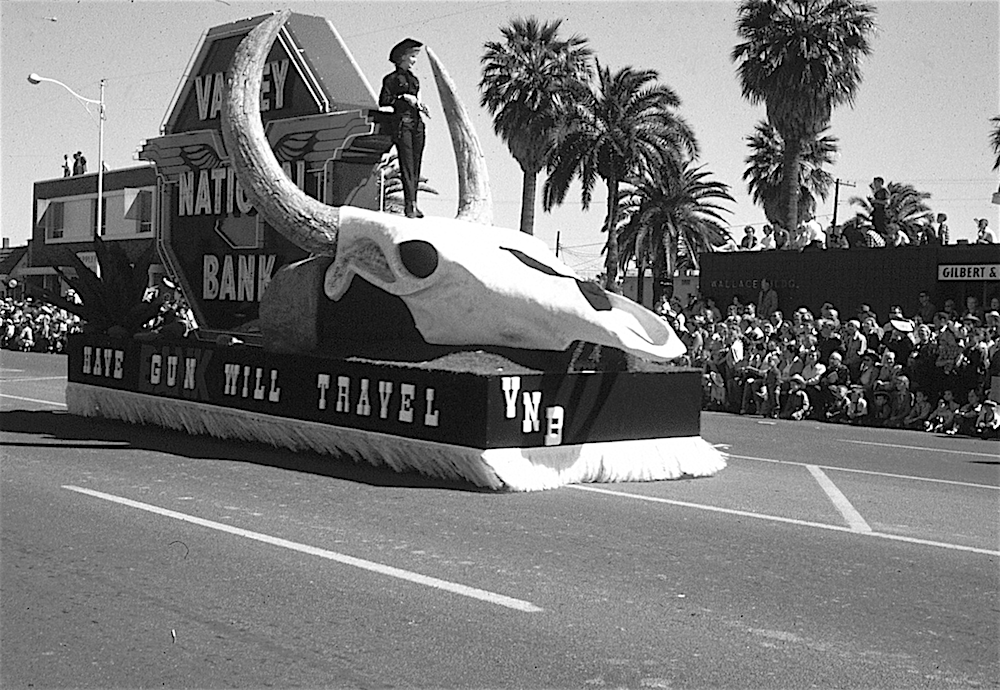 The crowd watches the Valley National Bank float on Central. (Larry Harker photo)
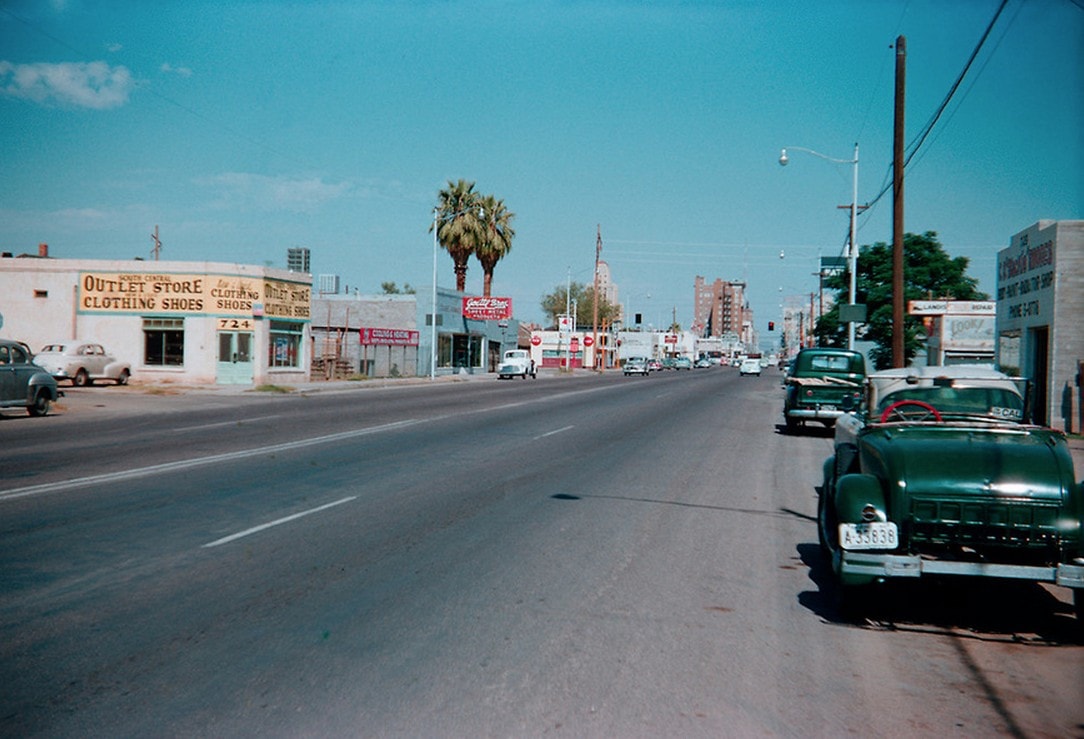 South of the tracks, here's Central and Sherman Street in the 1950s. Nearby is Central Liquidators, famous for its television ads in the '60s.
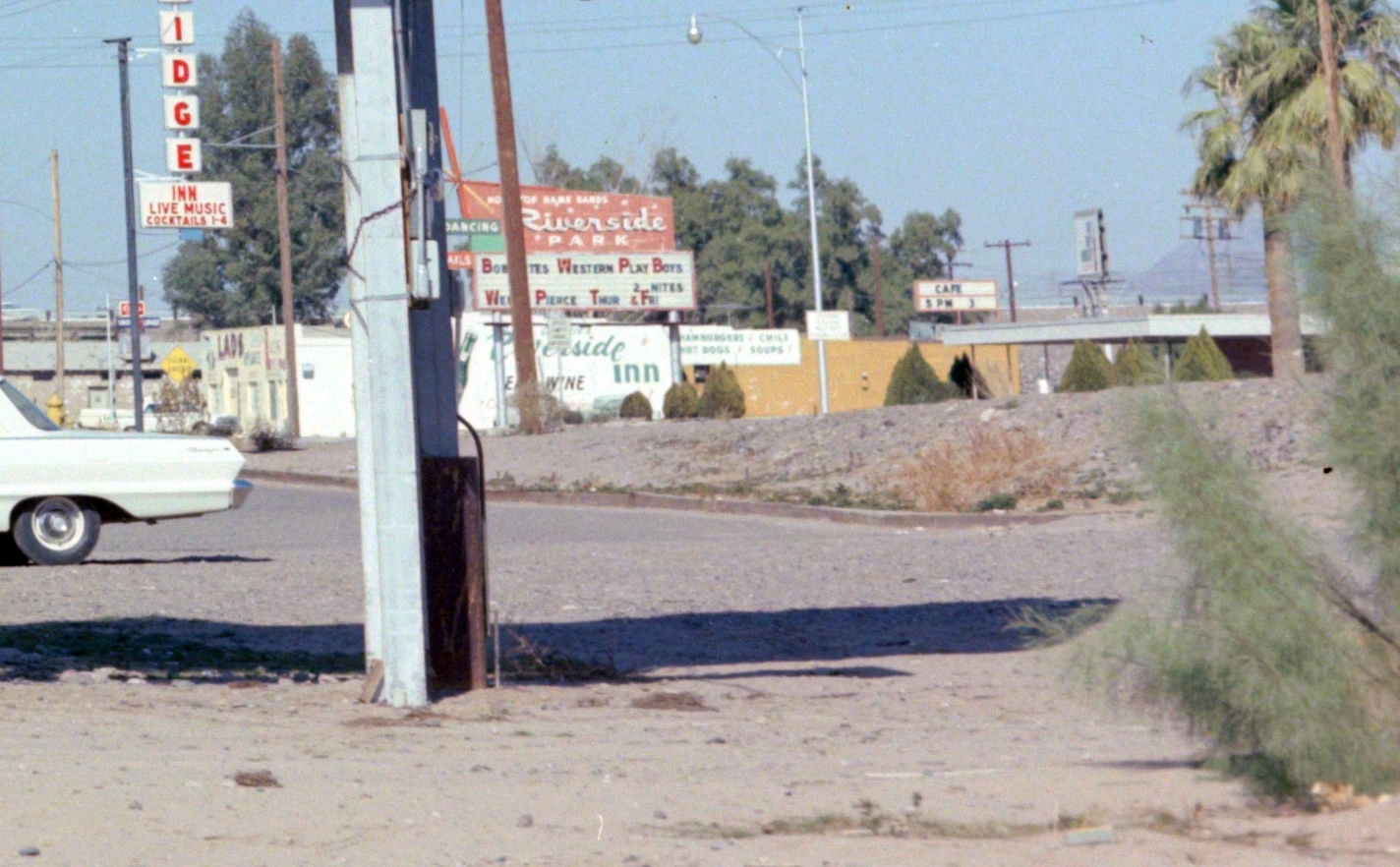
In the 1960s, this shot is just north of the Salt River. Riverside Park, which for decades was the town's amusement park with a large swimming pool and site of July 4th fireworks, is in its last years.
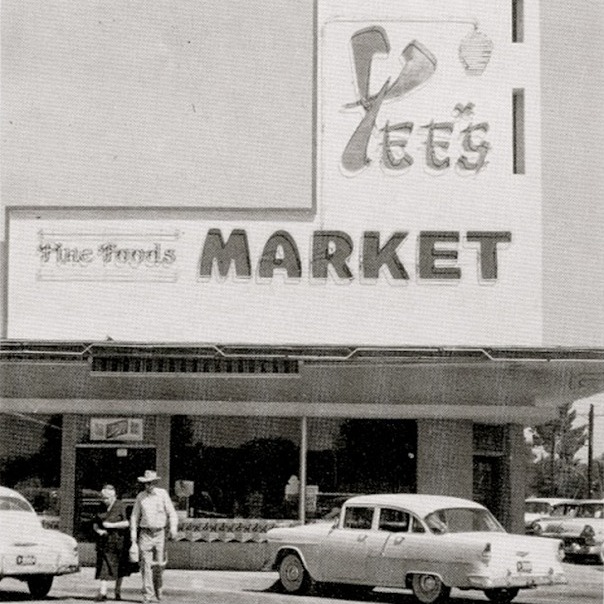
Yee's Market in 1958, located at Central and Southern.
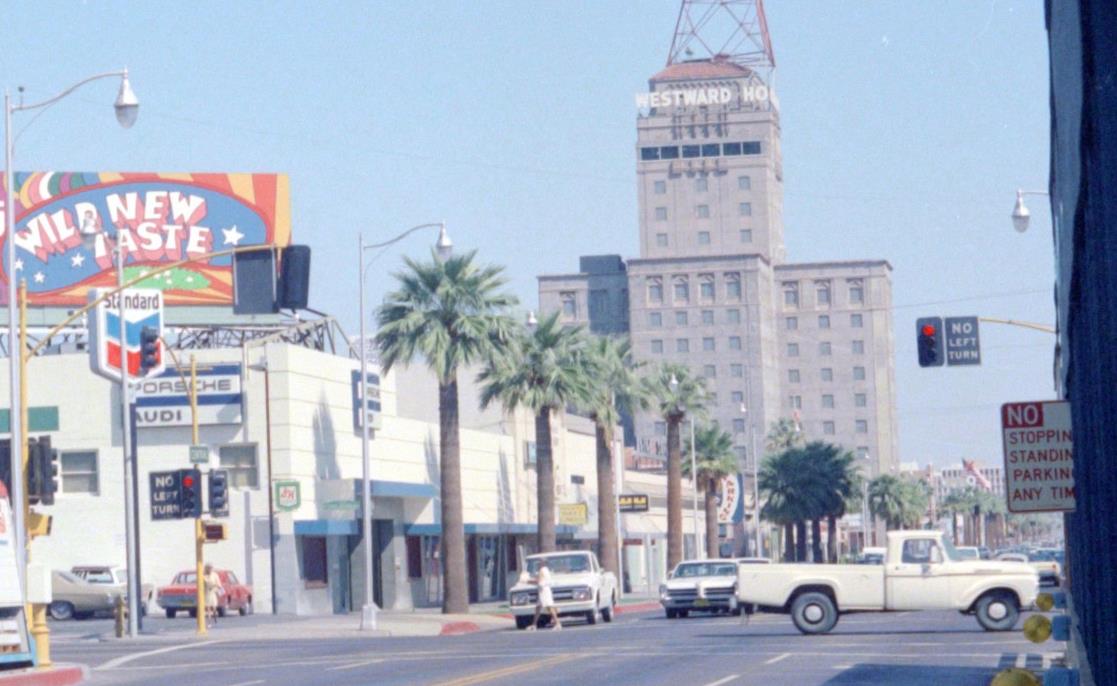 In 1972, the major teardowns that would destroy downtown's urban cohesiveness were only beginning. At Central and Van Buren looking north, the block of businesses including a Porsche-Audi dealership and Western Union is still intact.
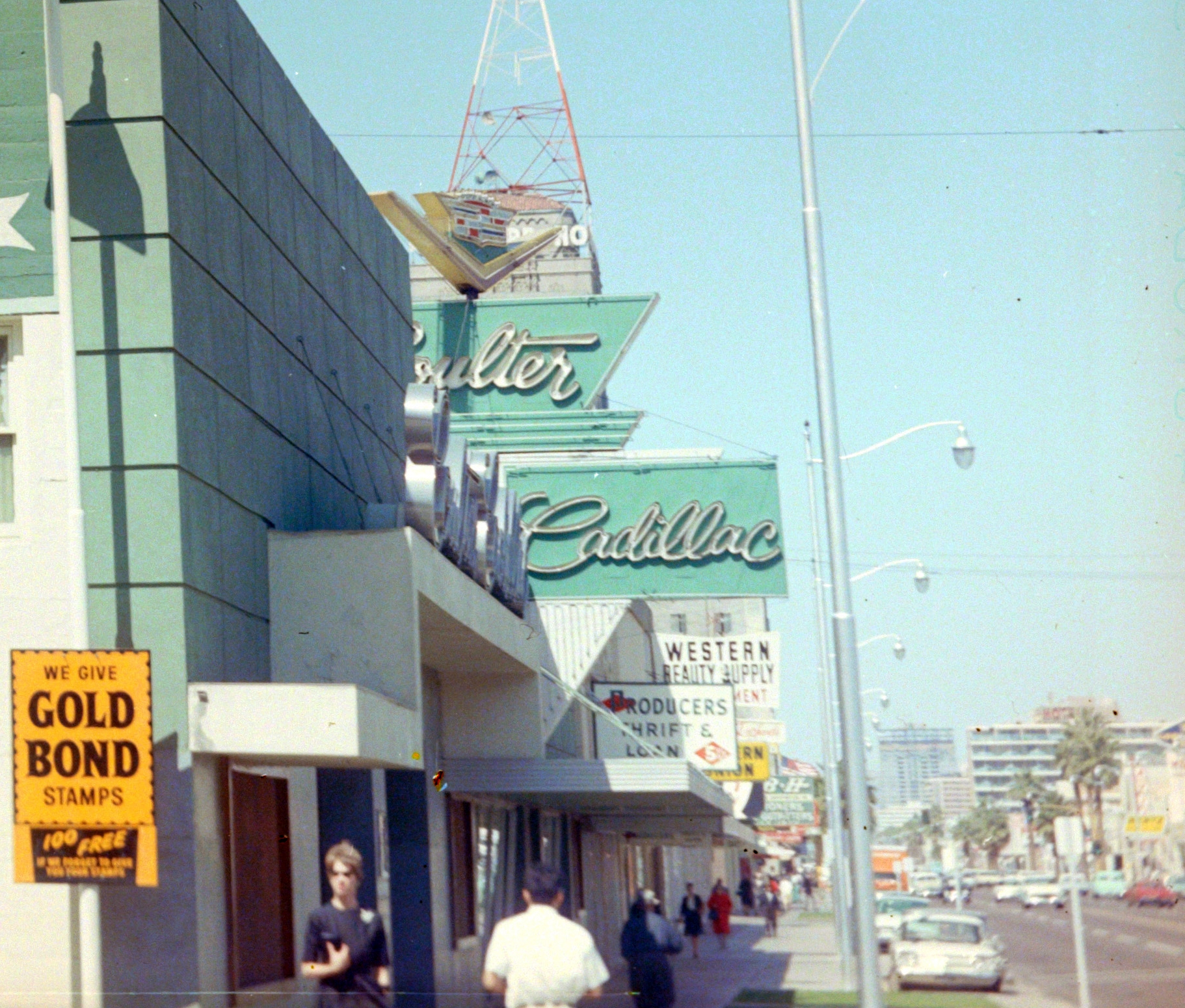
A sidewalk view of the same block when Coulter Cadillac was in the space later occupied by the Porsche-Audi dealership. Most of these buildings were demolished, later becoming the ASU downtown park.
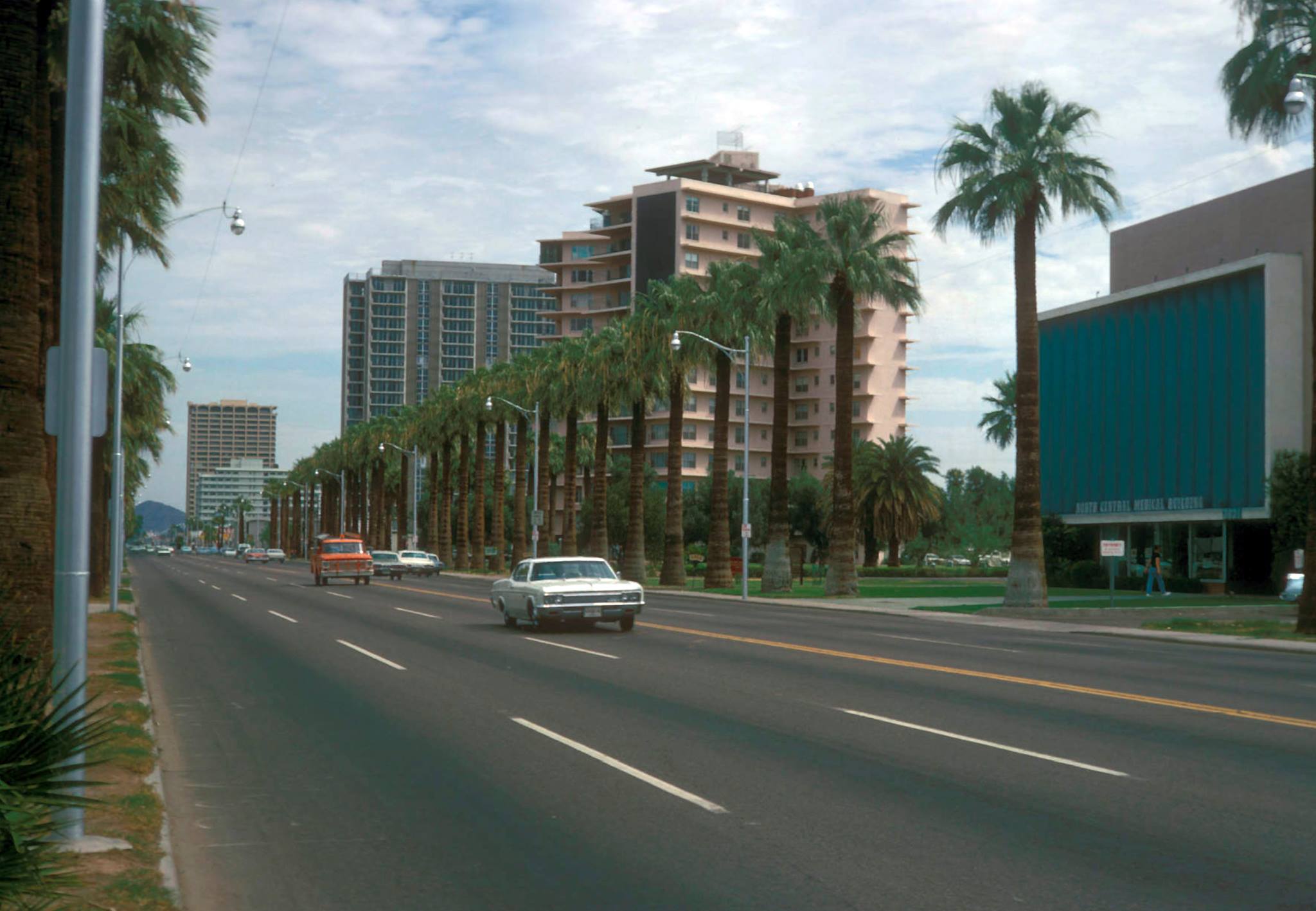 It's 1970 and we're back in Midtown, looking north from Palm Lane. The coral-colored building is Del Webb's 1956 Phoenix Towers co-op. Farther north are the Regency condos, U-Haul corporate headquarters and the tall Mayer building, First Federal Savings.
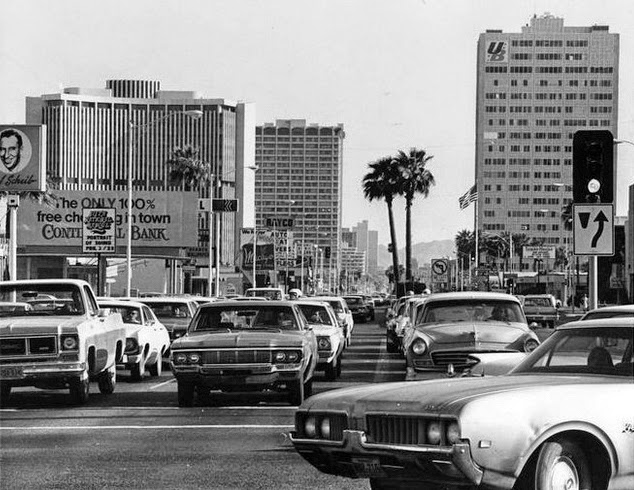 Crowded upper Midtown looking south on Central in 1973.
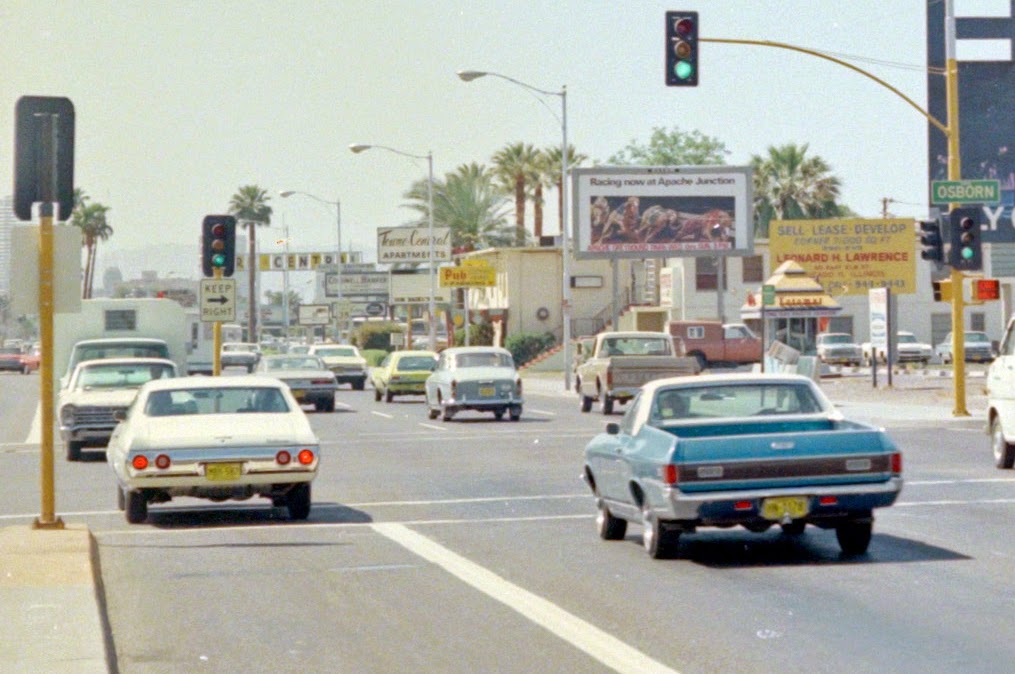 Central and Osborn looking south in the 1970s. Note the Fotomat, Park Central Apartments, and sign for Park Central Mall.
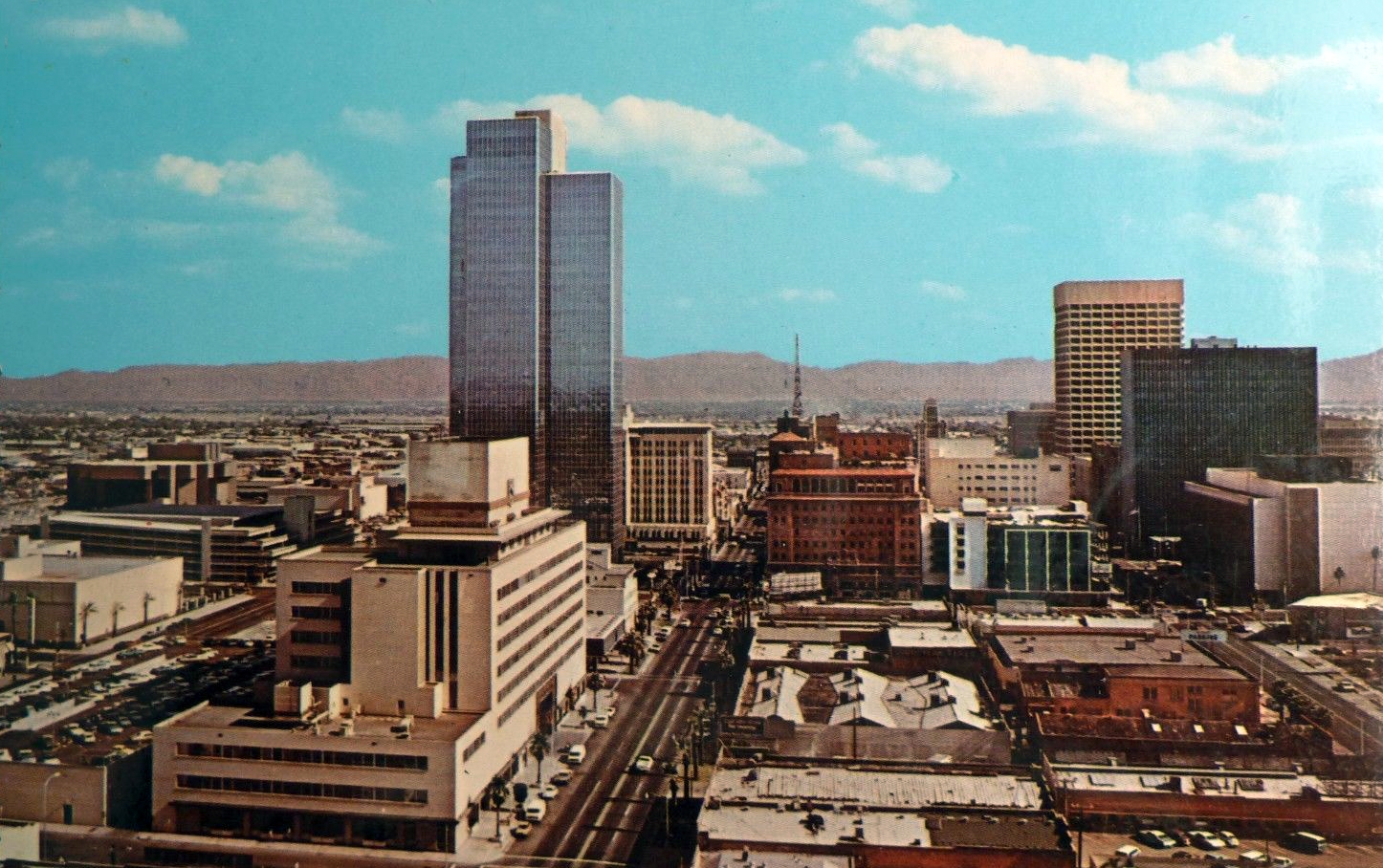
Central looking south into downtown, early 1970s. Valley Center has been completed, still the tallest building in the state, but the stark white Arizona Bank Tower (now US Bank) has yet to be built.
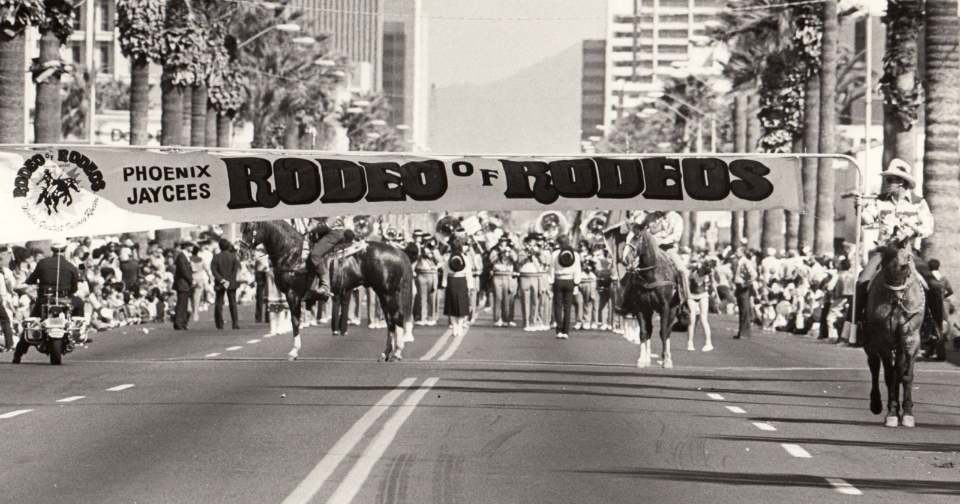 Fast-forward to the 1980s and it's the Rodeo of Rodeos Parade.
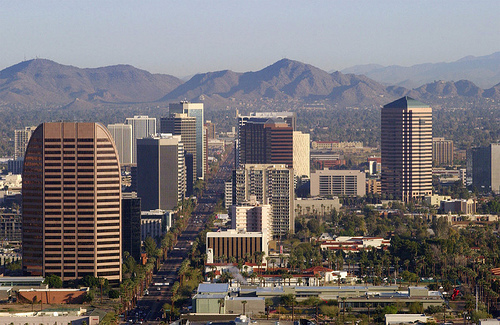
Central running north through Midtown at the turn of the 21st century.
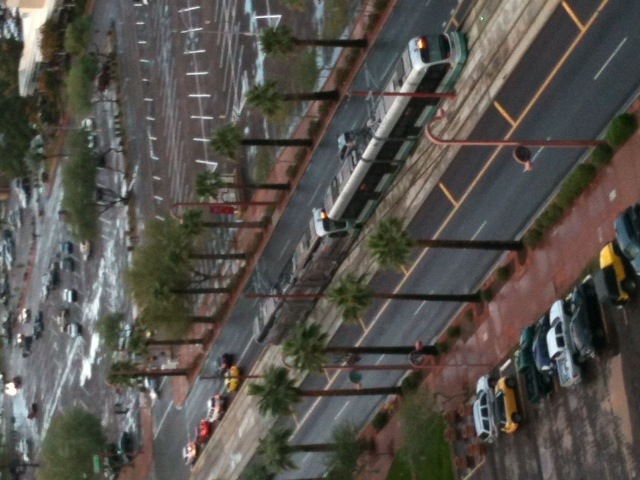 A light-rail train approaches the Osborn station on a rainy day.
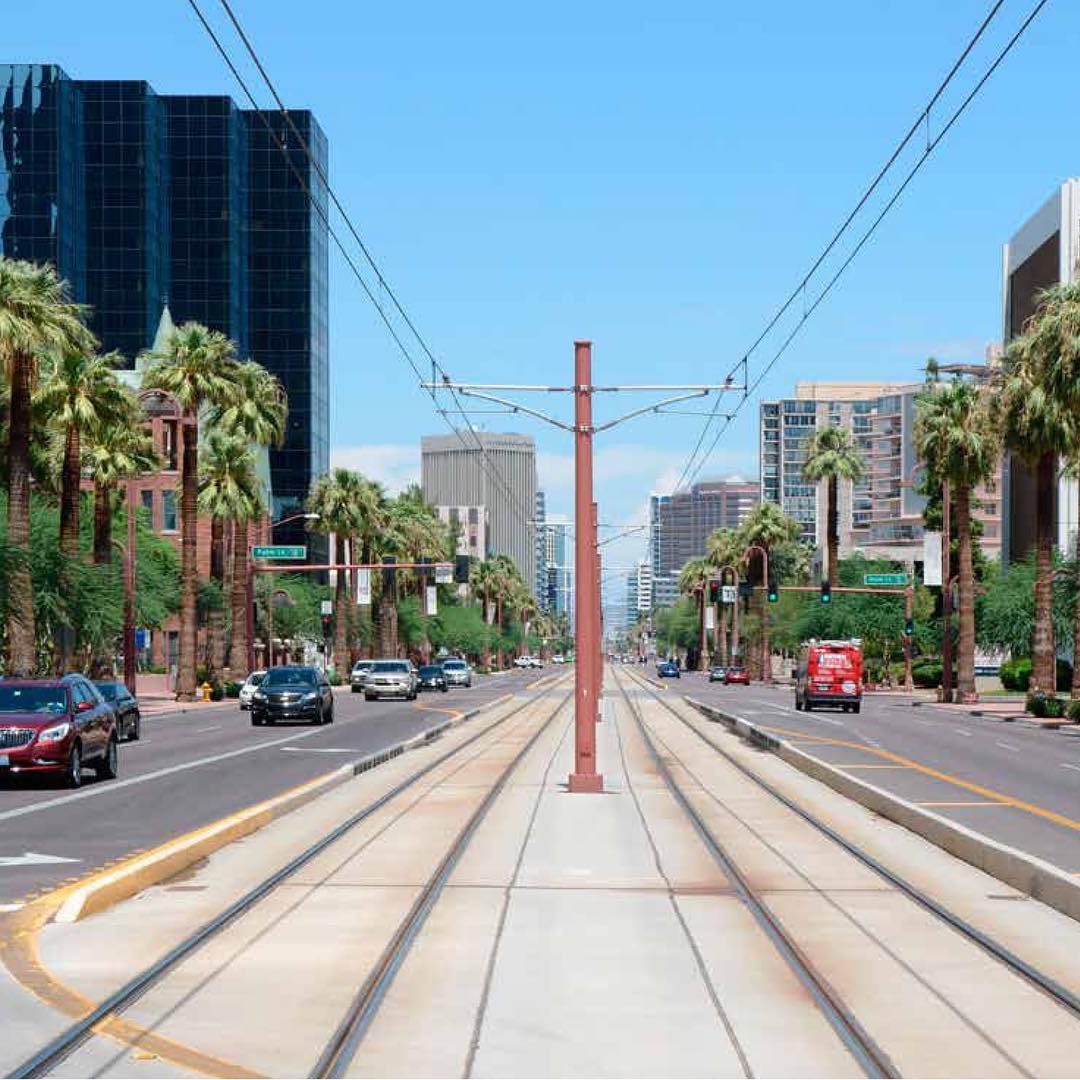
A contemporary shot of Central and Palm Lane from the middle of the light rail tracks.
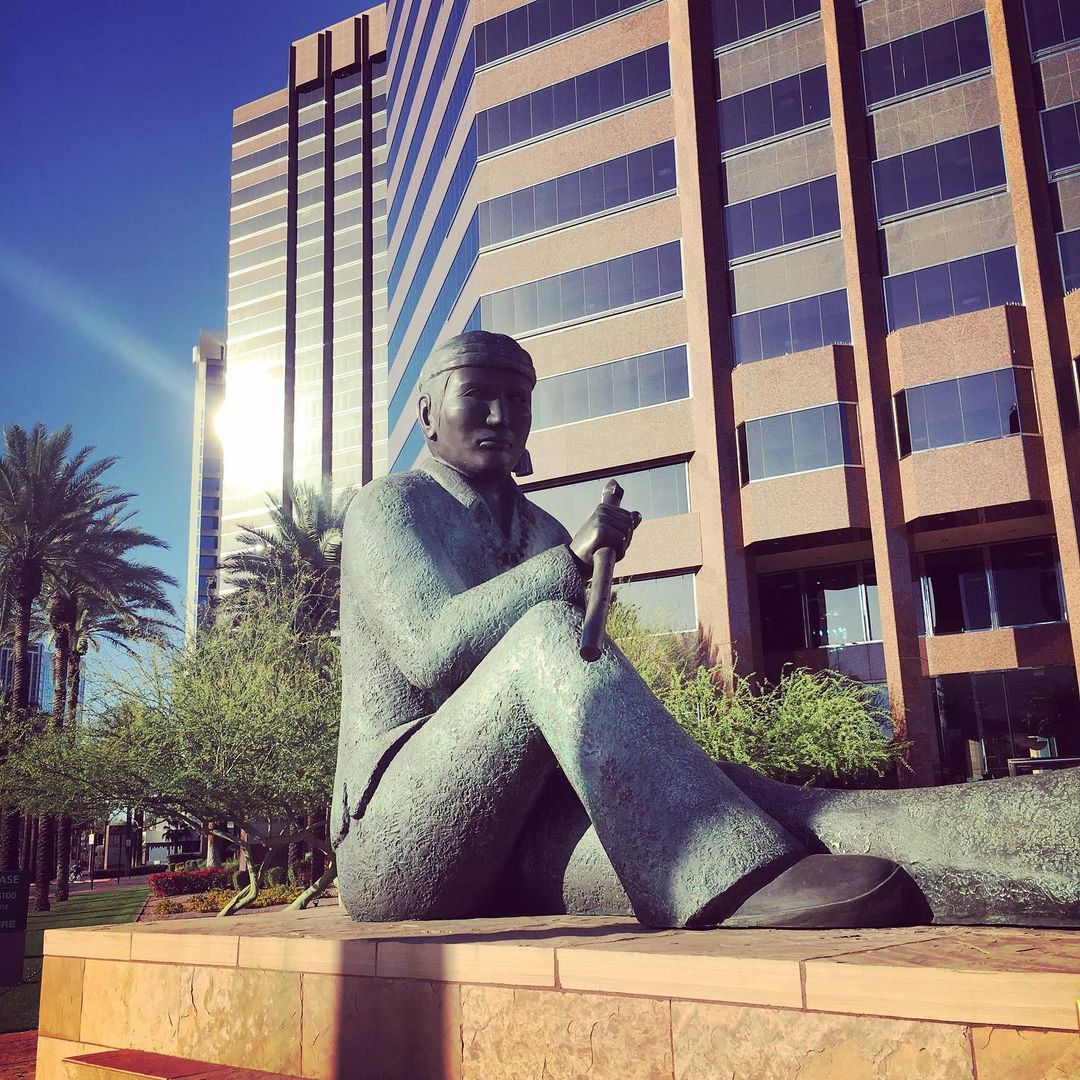
Sculptor David Hyde's Code Talker art outside the Phoenix Plaza towers at Central and Thomas.
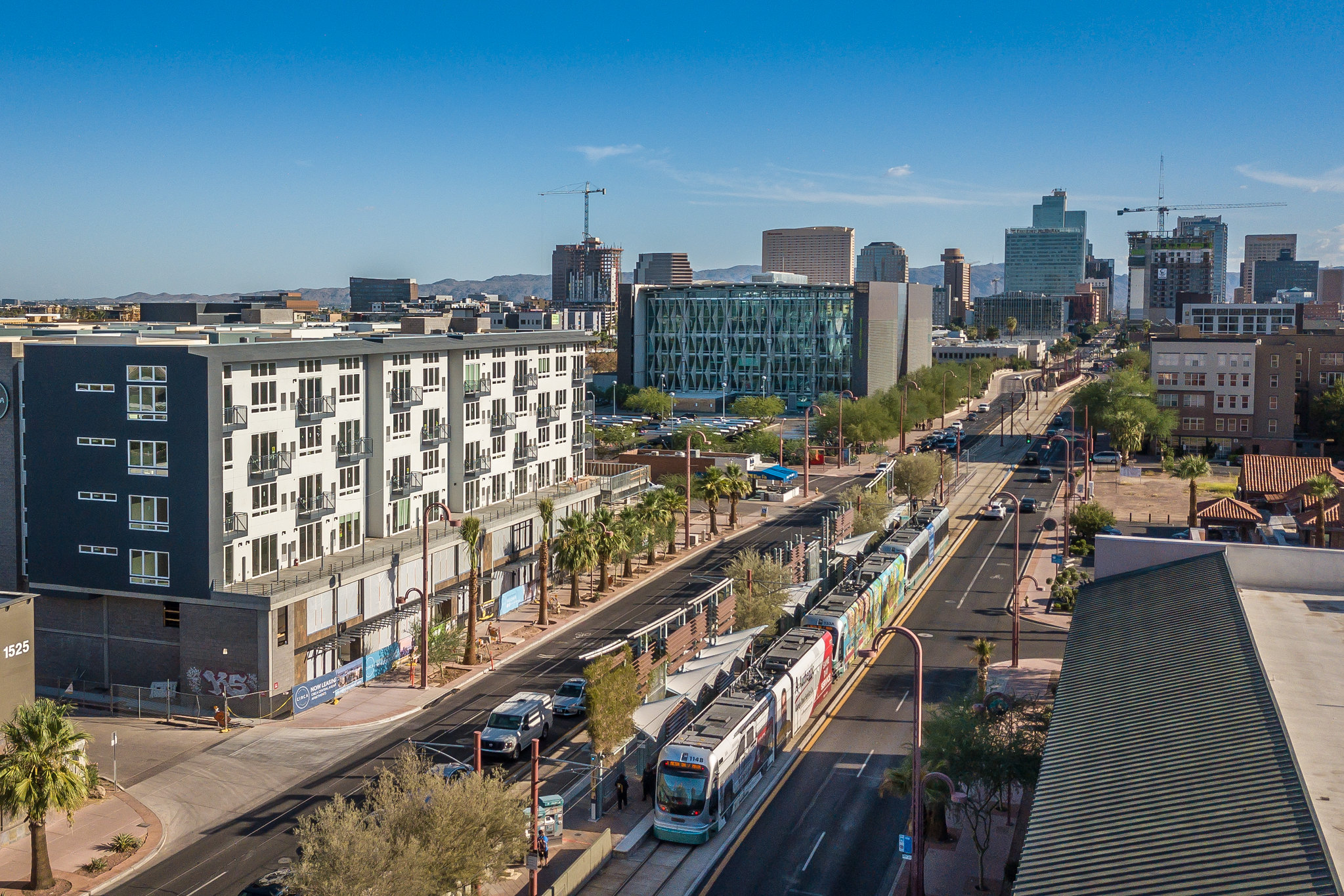 McDowell-Central station with infill in progress, the 2010s.
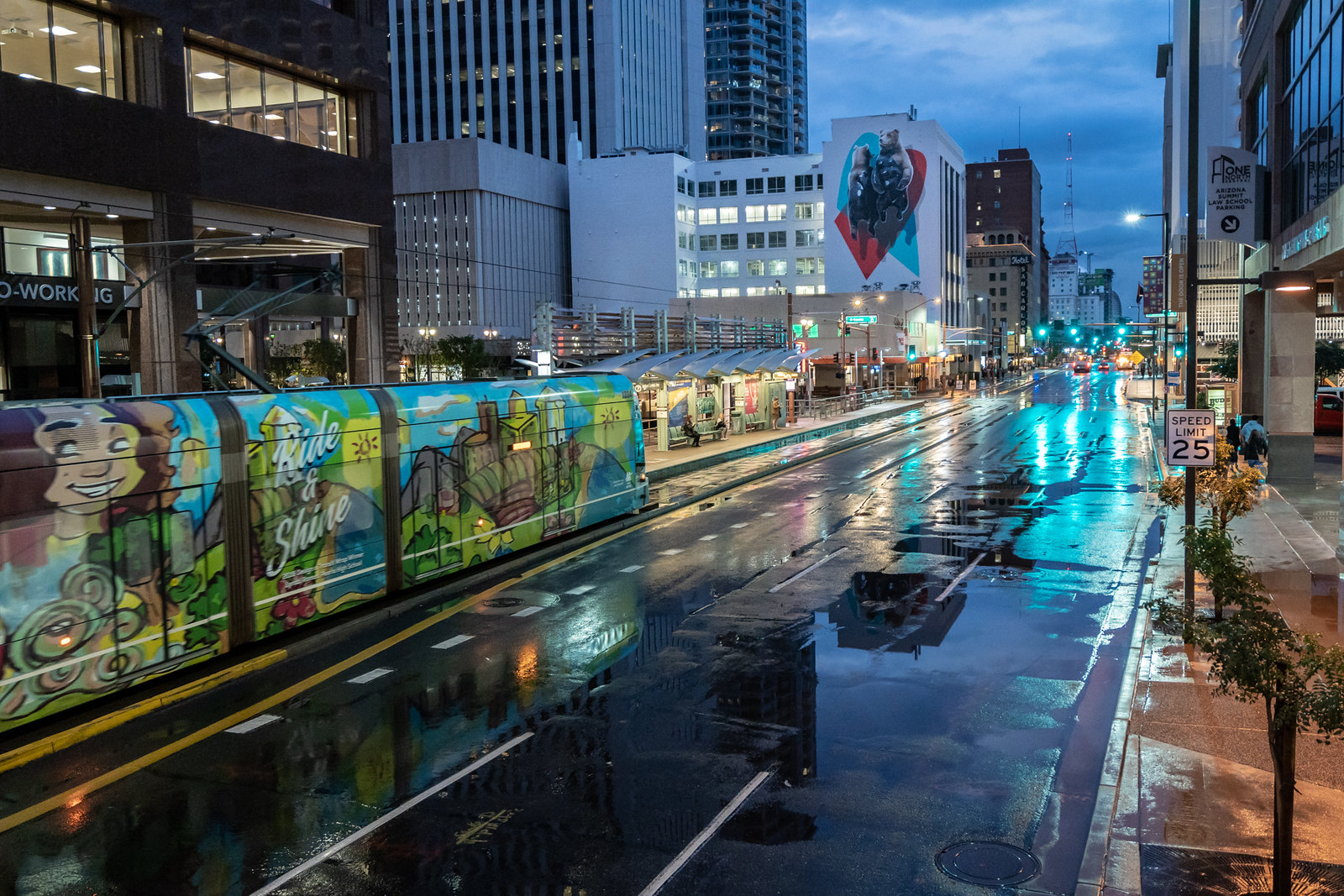 Train heading north. The mural is on the side of the Heard Building.
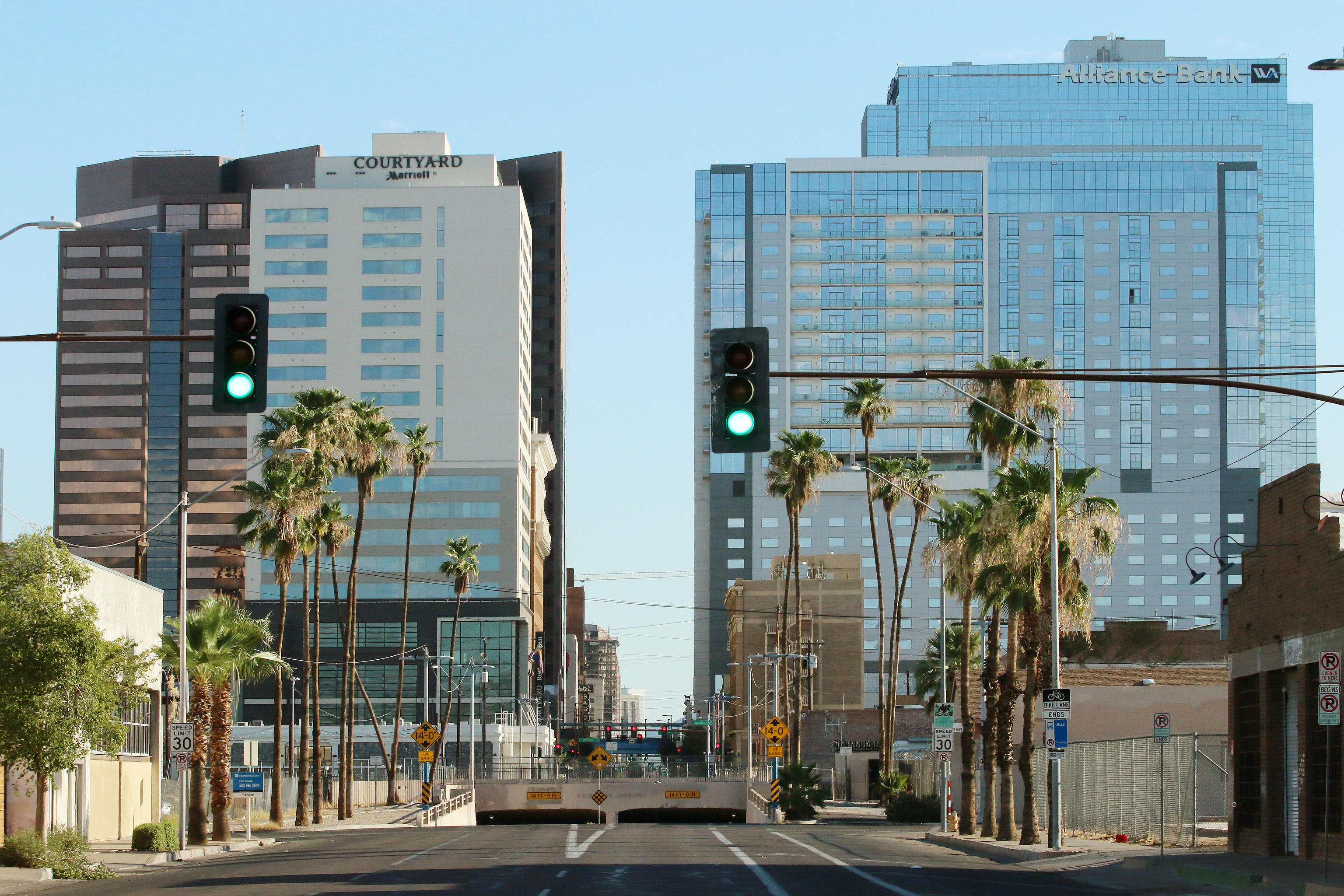 Central and Lincoln looking north into contemporary downtown. The underpass has been narrowed into one lane in each direction.
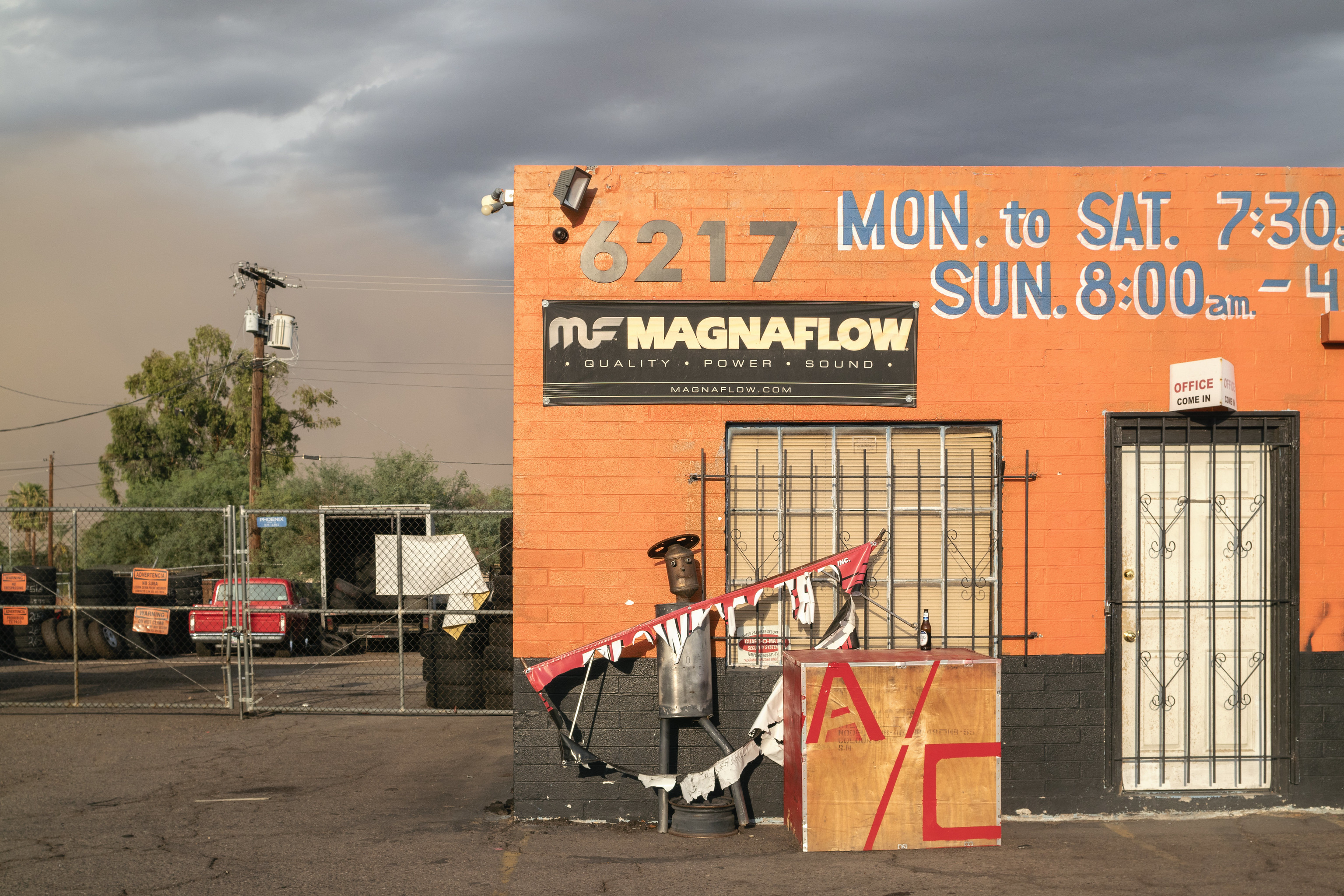 A rare shot of south Central, an auto repair shop a few blocks south of Southern. St. Catherine of Siena Catholic Church is across the street. Until the 1990s, Central took you to the Japanese flower gardens. (Dean Terasaki photo).
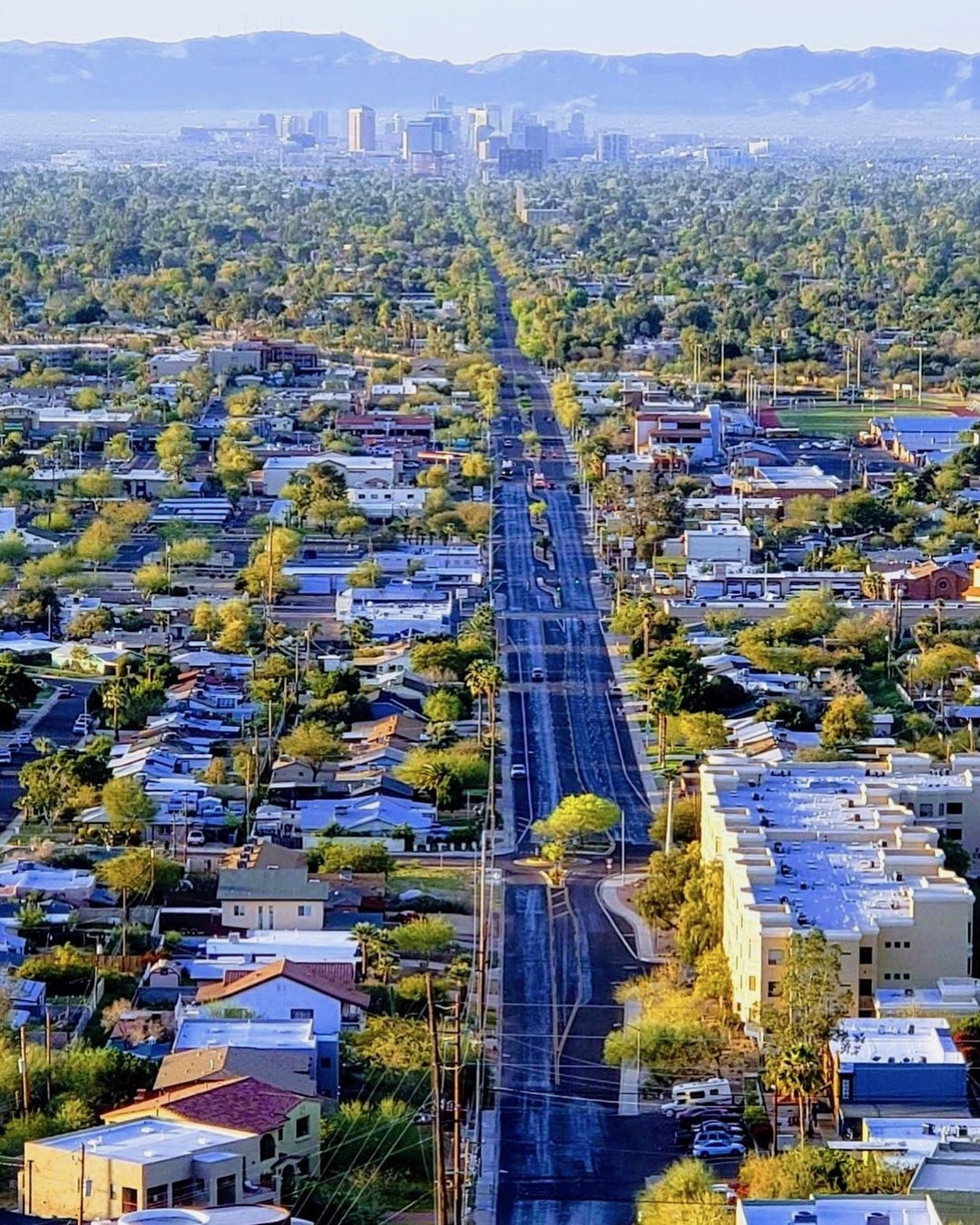
The long view: Central from Sunnyslope to the South Mountains. The city's main north-south street actually continues as a two-lane residential street on the other side of North Mountain.
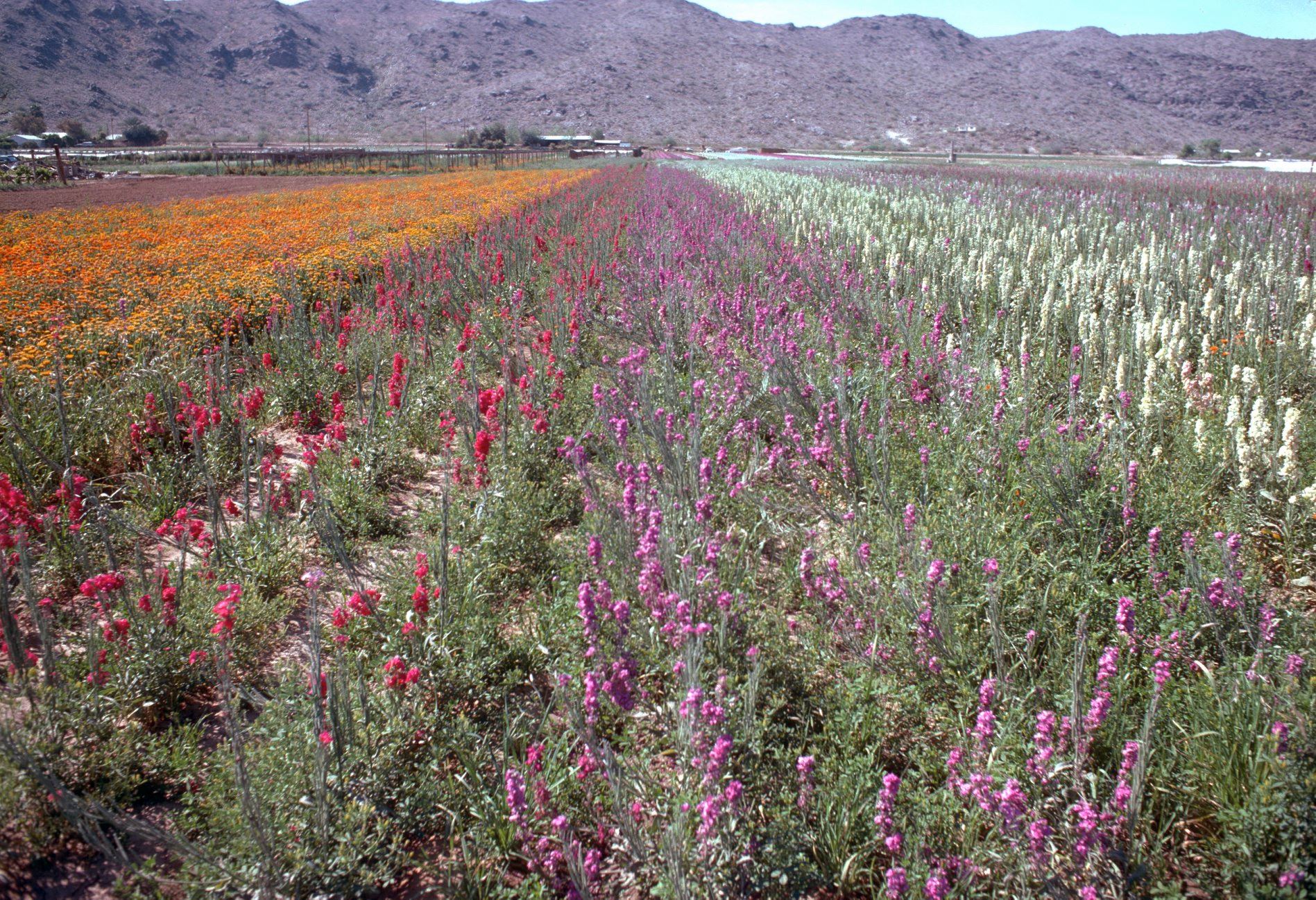
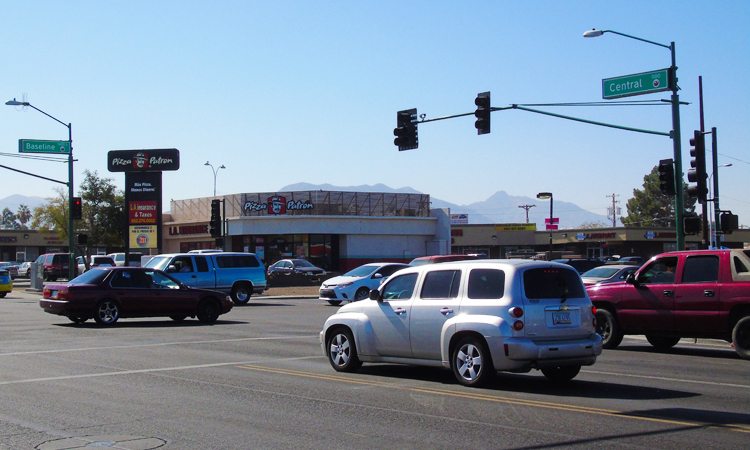
Central once led to the enchanting Japanese flower gardens along Baseline Road. Now it's another bland intersection of wide roads:
———————————————————————————
My book, A Brief History of Phoenix, is available to buy or order at your local independent bookstore, or from Amazon.
Read more Phoenix history in Rogue's Phoenix 101 archive.
Great photos
thank you
Central used to be a great dividing line for interesting generalizations:
East valley – Budweiser country.
West valley – Coors country
East valley – rock and roll
West valley – country and western
East valley – white collar, high school plus additional Ed
West valley – blue collar, GED or high school at most
It’s all blurred now, no more distinct areas.
I always found the beer thing interesting. May have been a sales territory thing.
Thanks Jon, great photos
Way back when I was older than a critter and younger than a crank, in the 50s and 60s, there weren’t prosperous urban cities and struggling small cities, there was a mix of both with similar economic results. Population was more evenly distributed among the cities as was measures of wealth between citizens. One grew up wherever they lived feeling their grasp was nearly equal to their reach. It was the best of times (economically), and those times were a construct of public policies that provided economic incentives to level the playing field for population centers of varying economic strength. Whether this had been brought about by enlightened social planning or resulted from business practices that yielded better revenue growth while incidentally providing increased social opportunities which fosters increased business prospects, is a matter of conjecture. For example:
Fair Trade Laws meant that the Hart Schaefer & Marx suit that sold for $75 in New York had to also sell for $75 in Phoenix (cost of labor and utilities factored in). The Evinrude motor that sold for $175 in Glendale had to sell for $175 in Tempe and wholesale/industrial parts were treated the same way. This created a mercantile class in each city based on establishing distribution points for the various national and regional brands. Adverting was directed by local agencies and legal, accounting and other professional needs were furnished from within the city. Those merchants/distributors sponsored baseball games, funded civic improvements and made sure schools had the requisite teaching aids and qualified teachers. Management jobs within each business created opportunities for ambitious young folk to establish their ‘bones’ in the regional offices before being promoted up the ladder. .
When the merchants needed a loan to start or expand they could go to a local bank that knew them because interstate banking laws kept banks domiciled in states and only state domiciled banks could establish branch offices, the means of gathering assets back then. If a bank wanted to lend money to make money they had to ‘grow’ their deposit base to prosper; one hand washes the other.
Many of the stores fronting on Central Avenue Rogue has displayed were owned and operated by locals. Pride of place was woven in the civic fabric; public buildings served as more than just a structural container, commercial developments revealed the owners commitment to embellishing the overall look of the architectural environment. Think of pride as the animating spirit that drives people to provide more than is expected because that is how things operate in the social faction controlling any town.
The cities and towns that grew and prospered because of those restrictive policies looked ripe for the plucking by organizations operating in larger spheres where they had more resources under their control. Removing barriers to entry would permit firms with large operating bases and economies of scale to overrun the firms operating in smaller economic silos, putting the market into the maws of the bigger fish. When Fair Trade Laws and prohibitions against intestate banking were struck down in state legislatures in the 70s there was no way smaller distributors could compete. By the late 80s the destruction of the social and economic sinews holding communities together was apparent.
There are other public policy changes that certainly contributed to changes in our economic landscape, I mentioned two I happen to be familiar with. My personal business ethos has always been that businesses will maximize profits within the law (most will) because that’s what management is incentivized to do. Counting on benevolent owners to safeguard civic assets is misguided and dangerous. That’s what government, rules and regulations (enforced) are for.
Today I recognize that social media is playing with an unfair advantage against traditional news sources with the same debilitating effect on our social canvass. They are not regulated like publishers even though they certainly are. They have no labor contracts they must honor, they have no regulatory guidelines they must follow and they have no conscience so they are both free and driven to exploit what previous generations worked hard to create. And what unfettered social media has created is a cesspool of misinformation pandering to the lowest common denominator and unravelling what’s left of our cultural heritage; witness the 1st presidential debate.
If people don’t start re-realize how important it is to believe that government can be a force for good and the only way people have to overcome the predations of those that don’t honor the rule of law the current zeitgeist could be the complete unravelling of the America people hold in their imagination. At the moment, things are not looking good.
Very good posting Ed.
How about this for a radical concept.
Banks take in savings and pay 5% interest.
Banks put out loans and charge a fair interest on the loans.
As opposed to the current scheme: Banks get free money and play the national roulette wheel. Money from customers with savings??? Who needs those schmucks?
Excellent commentary Ed.
Thanks
Love these pictures. My memories of Central are mostly are north of Bethany, where the tree canopy remains along the Bridal Path. I’m old enough to remember seeing horses on it. But mostly it was a safe and shady way for my friends and I to ride our bikes to and from Madison Meadows school. I also remember seeing Suns Coach John MacLoed running along it regularly and waving at any cars who honked at him.
Do we know if the palm trees in the 1930s picture are ancestors of the ones that are there today?
Gary S, because the street was widened I doubt today’s are the offspring.
If you can’t see it, it doesn’t exist.I arrived in jan.1966 and love the pix of Phoenix but I remember the legislator who wanted to put giant fans to remove the brown haze that hung over the valley. If they realized that the haze was caused by autos, it wasn’t apparent because by Sunday the haze was gone. Now,people aren’t smart enough to figure out that 90% of the gas they use to put in their tank ends. up In the atmosphere causing “global warming “The laws passed to clean the air have greatly contributed to today’s drought problems.