The ideology of the cancer cell

The ideology of the cancer cell

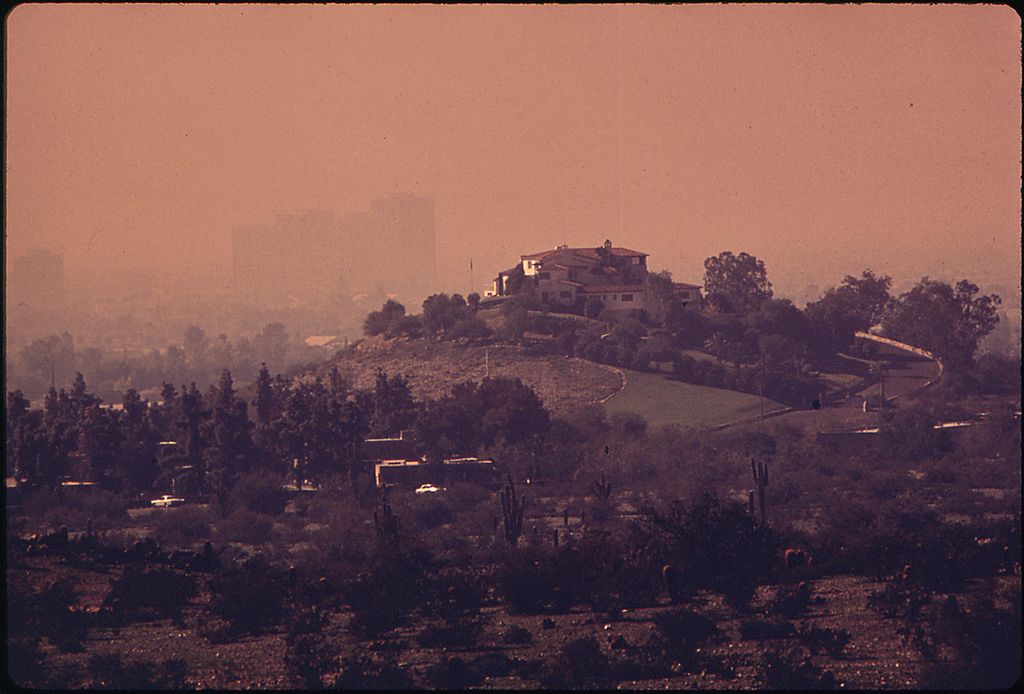
SMOG_OVER_PHOENIX_-_NARA_-_546748
Growth for the sake of growth is the ideology of the cancer cell
— Edward Abbey

The closed-loop belief system of the local-yokels is that as long as Phoenix is adding people, it can't be that bad. End of discussion. Thus, when the Census Bureau announced that Maricopa County was the nation's fastest growing for the year ending July 1, 2016, it set off earth-shaking, sheet-clawing growthgasms. The gain of 81,000 was still below the pre-recession trend line — even accepting the yokel "logic" — but there we have it. Everything's fine!

Phoenix has operated by this hugely subsidized Ponzi scheme for decades and there's no indication anything will change until the roof really falls in.

As in, when overshoot makes it impossibly costly to sustain such a large population in a frying pan. When the Republicans make retirement a pre-New Deal cruelty so that people don't have the means to retire, much less to the hot climes of "the Valley." When the GOP succeeds in cutting so much federal funding that welfare queens such as Phoenix slink to the national homeless shelter. When climate change makes the place unbearable. The recent calamities of the Great Recession, where Phoenix was an epicenter, did nothing to give a moment of clarity. Even an outmigration wouldn't change things. The boat-rockers who advocated a different city and state were long ago run off or silenced.

The life of the Grand Old Party

The life of the Grand Old Party

Doug_Ducey_(30703722086)

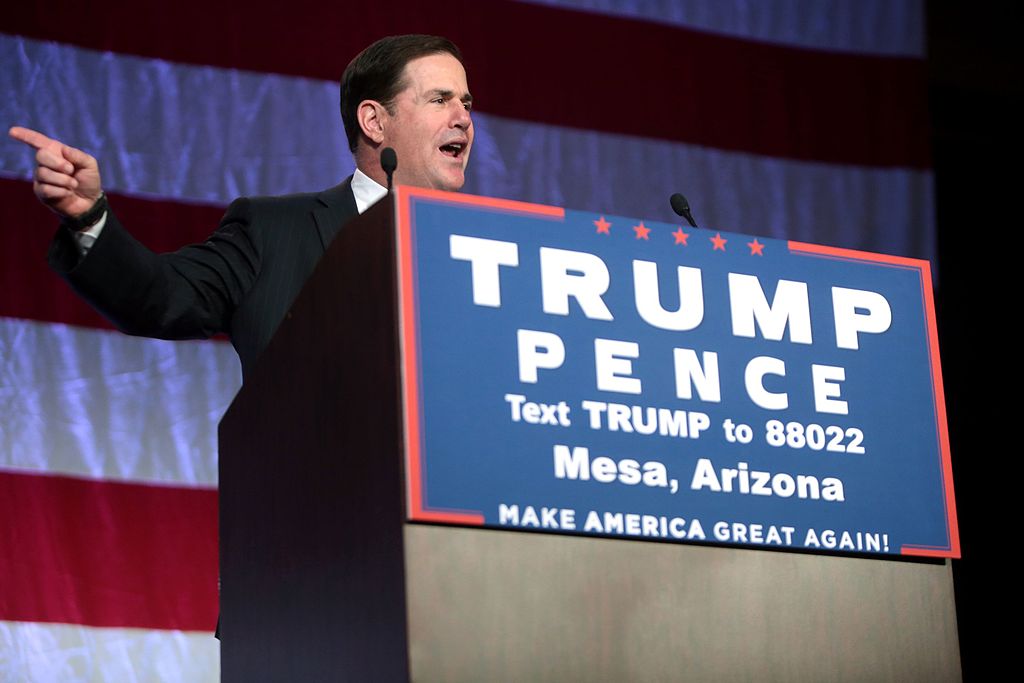
At least a quarter century past his sell-by date as a credible columnist, George Will is still churning it out for the Washington Post syndicate. Recently, he looked down from his unchanging tower and pronounced that the savior for conservatism is…Doug Ducey.

With the Republicans facing at least a temporary but stunning Waterloo in their attempt to take health insurance from 24 million Americans, Will sought a quantum of solace in Goldwater country. He wrote, "Today’s governor, Doug Ducey, is demonstrating the continuing pertinence of the limited-government conservatism with which Sen. Goldwater shaped the modern GOP, after himself being shaped by life in the leave-me-alone spirit of the wide open spaces of near-frontier Arizona."

The column is worth reading if for no other reason than the skill with which Will elides over the facts. Here are a few:

• Arizona is hardly a creation of "the leave-me-alone spirit of the wide open spaces." Instead, it required the U.S. Army to brutally pacify the Apache, Yavapai, and other Indian tribes. Second was federal land grants for railroads. Third was billions of dollars in federal reclamation to turn the Salt River Valley into American Eden and then a place where millions could live in subdivision pods thanks to cheap water and power. Fourth was the New Deal funding that saved Phoenix, especially, and Arizona more broadly from the Great Depression.

Fifth was the Cold War military spending that created the tech economy in Phoenix and Tucson. And don't forget federal flood-control money that allowed developers to lay down tract houses in what would otherwise be flood plains. Oh, and federal home-loan support and the GI Bill, authored by Arizona's Ernest McFarland, were essential for further subsidizing the state's massive post-World War II population influx. 

Good and hard

Good and hard

ThisIsNOTAGiantTurd!WIllustration by Carl Muecke


Democracy is the theory that the common people know what they want, and deserve to get it good and hard.
— H.L. Mencken

Nobody can claim that Donald Trump isn't keeping his campaign promises. After his fashion, of course. He has added so many financiers, billionaire moguls and generals to his swamp that even the most recalcitrant Bernie Bro or Jill Steiner might wish for Hillary. But on the thing that matters most to his voters, white majoritarianism in the form of Muslim bans and the wall, he's delivering. Erasing Obama's legacy — check. Making war on cities with devastating cuts to public investments — check. Rolling back environmental regulations at a time when climate change is growing much worse, cleansing government agencies of competent "elites," and a budget that goes after every GOP bugaboo — check, check, and check.

When 24 million or more Americans — including the vaunted white working class — are deprived of health care, don't count on a midterm backlash. After all, dozens of Republican governors and legislatures refused to set up state ACA exchanges or expand Medicaid and no price was paid. The states got even redder. Trump's continuing discarding of norms, disgracing his office, and the timebomb of his connections with the Kremlin? I doubt any of this will affect his support. And remember, his supporters lie to pollsters, so don't believe his approval ratings. Nothing is too outrageous for them. They don't believe the news. Of course the Kenyan socialist tapped Trump Tower, no matter what the Republican intelligence committee chairmen say.

Trump stands very little chance of returning manufacturing jobs to America. His Commerce Secretary made his fortune in the "rip, strip, and flip" game, destroying companies and jobs. His Labor Secretary has praised robots. The billionaire and financial class he is empowering by cutting taxes and rolling back "burdensome" regulations grows ever richer by screwing working people.

A slew of Republican bills to repeal the New Deal, Great Society, Nixon administration, and the Enlightenment will be signed. Trump's Education Secretary is a charter-school racketeer who is actively hostile to public education. A trade war will result in higher prices at Wal-Mart and lost American jobs. Our standing in the world is already that of a sick joke. No price will be paid. Arizona has proved that, where decades of single-party control has led to disaster. Yet Arizona is redder as a result.

Arizona for everyone

Arizona for everyone

ThisAdministrationRunningFineTunedMachine

Illustration by Carl Muecke

Outside of a few "elitist" blue enclaves, the United States is headed toward resembling the state we find revealed each week by journalists on Rogue's Arizona's Continuing Crisis. Let me count the ways:

• We're now a one-party nation, with the presidency, House, and Senate in the hands of hardcore right-wing Republicans. Soon the courts will be dominated by Federalist Society judges to validate whatever laws the GOP passes.

• We have a businessman as chief executive. Government is not a business and shouldn't be run like one, but here we are. In the case of America, it is fittingly a developer instead of an ice-cream chain CEO. Arizonans only know the language of developers, so this should be familiar ground. So should the lack of competence by a president with absolutely no public-sector experience and his contempt for it.

• Hostility to immigrants and white majoritarianism are driving policy and keeping the all-important base energized.

• The National Rifle Association is making policy with no Democrat in the White House to veto the madness. Hence, Donald Trump reversed a rule preventing gun purchases by the mentally ill. Can guns in bars and a national concealed-carry "right" be far behind?

Phoenix’s historic streetcars

Phoenix’s historic streetcars

Streetcars_1945
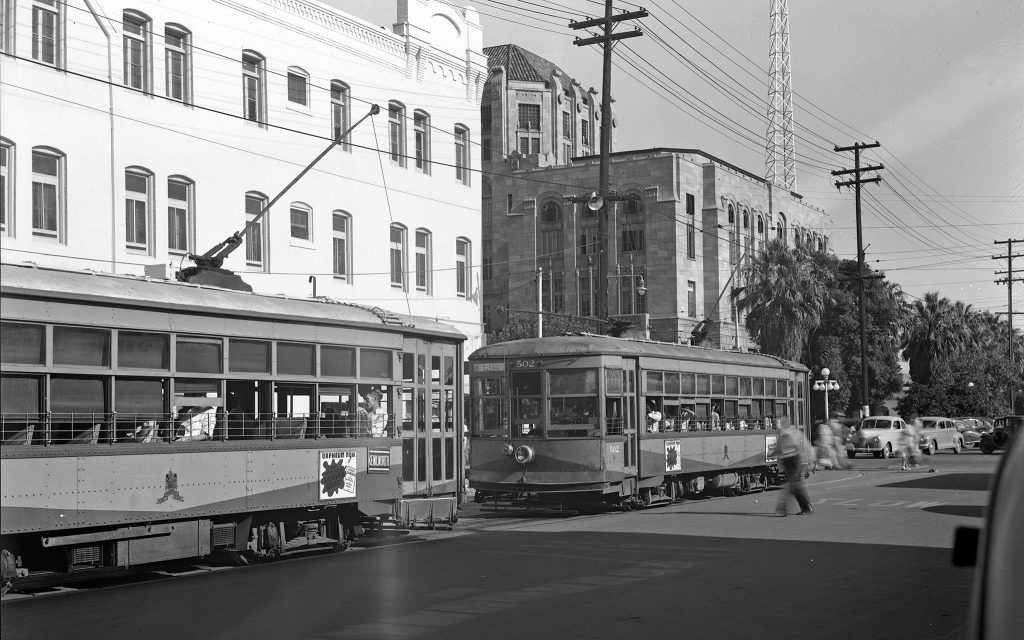
Moses Hazeltine Sherman was a teacher from Vermont who made his way to Arizona Territory in 1874. While teaching, he also made money in land and mining. Later, he would move to Los Angeles and become a millionaire. But before that, he and M.E. Collins founded the Phoenix Street Railway in 1887.

Originally the streetcars were pulled by mules. But electric cars took over in 1893. The new Territorial capital had a little more than 3,000 people. By 1925, the system boasted nearly 34 miles of track on six lines. It had two major spines. One ran west to the Capitol and on to 22nd Avenue, and east to the State Hospital along Washington Street. The other operated north and south from downtown to the Phoenix Indian School.

A long addition ran east from the Indian School to 12th Street, then cut north and west, eventually terminating in Glendale. Other routes went to the Fairgrounds; north through the new Kenilworth district to Encanto Boulevard, and over to the east side ending at 10th Street and Sheridan. Most of the streetcar lines ran down the middle of the streets.

Through the middle of the 20th century, most American cities and large towns had extensive streetcar networks. Numerous electrified interurban railways were also build, competing with the steam railroads of the time. They carried freight in addition to passengers on larger cars. The largest system was in Los Angeles, the Pacific Electric, known for its iconic red cars. Owned by the Southern Pacific Railroad, it operated more than a thousand miles of track in the LA basin.

Whither the Democrats?

The Wall Street Journal had a story today about Bernie Sanders supporters winning numerous state-level party positions as Democrats search for a way out of their deep wilderness. This might have major consequences as the party selects a national chairman on Saturday.

“It is absolutely imperative that we see a major transformation of the Democratic Party,” Mr. Sanders said in an interview with the newspaper last week. The party has “to do what has to be done in this country, to bring new energy, new blood.”

I find it interesting that Bernie Sanders, who carried so much damaging-and-false right-wing water against Hillary Clinton in the primary, is so interested in the Democratic Party. He didn't even become a Democrat until late 2015. At least Barry Goldwater, who took over the GOP in 1964 and began its long journey into today's hardcore extreme right organization, was a lifelong Republican.

The simplistic state of play has the Sanders-Elizabeth Warren "populist" wing of the party against the "old guard," denigrated as "corporate Dems" by the insurgents. In reality, the situation is far more complex and I don't see an easy way forward.

Despite President Obama winning two national elections, the Democrats lost hundreds of seats in state legislatures and ultimately both houses of Congress. As FiveThirtyEight reports, "At the beginning of Obama’s term, Democrats controlled 59 percent of state legislatures, while now they control only 31 percent, the lowest percentage for the party since the turn of the 20th century. They held 29 governor’s offices and now have only 16, the party’s lowest number since 1920."

White majoritarianism

White majoritarianism

Naturalization_Ceremony_(27617091841)
Budweiser's "Born the Hard Way" advertisement during the Super Bowl won plaudits for putting today's anti-immigrant sentiment under a harsh light. But it was a stretch. In reality, the white Anglo-Saxon America of the 19th century was generally welcoming of Germans. They were Christian, often Protestant, hard working. Which is not to say the migration was without troubles.

For example, especially after the failed revolutions of 1848, German immigrants transformed Cincinnati. They congregated in the dense neighborhood north of the Miami-Erie Canal. The city's English and Scots-Irish majority sniffed, "There are a lot of Germans over the Rhine," meaning the canal. And the district, still one of America's architectural treasures, gained its name. The Germans brought great beer and helped make Cincinnati a magnificent music city. Before World War I, Cincinnati had many German-language newspapers — these, and much of the German culture, were victims of wartime xenophobia. Later, the German families moved to the west side. Even today, Interstate 75 is called the Sauerkraut Curtain, dividing old German from old English Cincinnati. The Germans assimilated and became some of the city's leading citizens. Samuel Adams beer is based on a recipe from co-founder Jim Koch's great-grandfather.

The Irish were reviled in many cities in the same century. They went on to become among the most American of Americans, producing two presidents. The largest mass lynching in American history was carried out in 1891 against 11 Italian immigrants in New Orleans. Italians, too, assimilated, and became a distinguished (and sometimes, with the Mafia, notorious) part of America. In the early 21st century, the governor of Arizona, most prominent businessman in Phoenix and, ironically, anti-immigrant sheriff of Maricopa County were all Italian-Americans (many of Phoenix's most important earlier leaders were of Jewish extraction). So it went for scores of different ethnic and religious groups who came here. Native fear, discrimination and even atrocities, assimilation and acceptance. America is a credal nation, not an ethnic one. And we have been stronger for it.

Overshoot

Overshoot

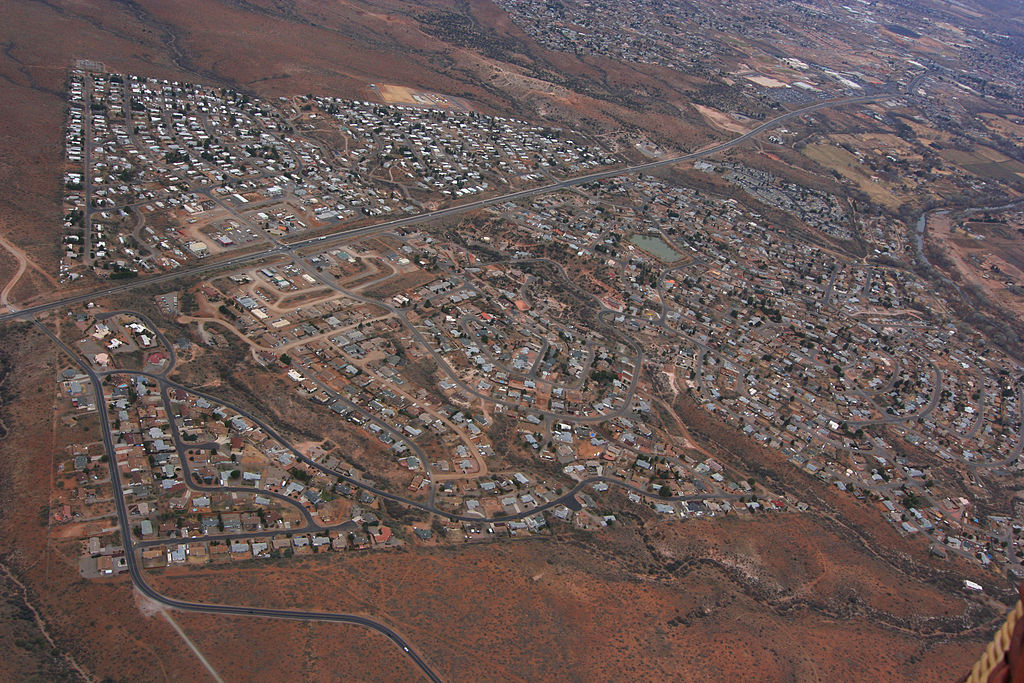
VerdeVillageExurban sprawl in the Verde Valley, which competes for water resources with the Salt River Project.

"Growth for the sake of growth is the ideology of the cancer cell" — Edward Abbey
I was reading an Arizona Republic story about the state seeking ways to "prop up" Lake Mead to "forestall painful and chaotic shortages for at least a few years." The number that sat me back was that Arizona draws 40 percent of its water from the Colorado River.

For an old-timer like me this is an astounding statistic. In 1960, Arizona took very little water from the river. Greater Phoenix, which constituted 50 percent of the state's population, received all its water from the dams and reservoirs on the Salt and Verde rivers. The rest of the state was heavily dependent on ground water, the pumping of which was already a longstanding problem, with a few other renewable river sources. But the entire state held 1.3 million people — less than the population of today's city of Phoenix.

What nobody wants to discuss is when does Arizona hit population overshoot? With more than 6.8 million people, a population that places it in the ranks of such states as Massachusetts and Washington, one could argue it already has. This is particularly true considering the combination of an over-subscribed Colorado and the growing stress of climate change.

It's virtually a forbidden topic. Even after the housing collapse, Arizona's economy remains a one-trick pony dependent on adding more people, building more sprawl, creating a Sun Corridor from Benson to Flagstaff. The local-yokel boosters mounted up to attack Andrew Ross' superbly researched and well argued book, Bird on Fire: Lessons From the World's Least Sustainable City, precisely because he crossed the line. He asked the existential questions about the vast Ponzi scheme. I did the same as a Republic columnist, despite being warned from the most powerful levels: Don't write about water. I did and I was out.

The Cold Civil War

The Cold Civil War

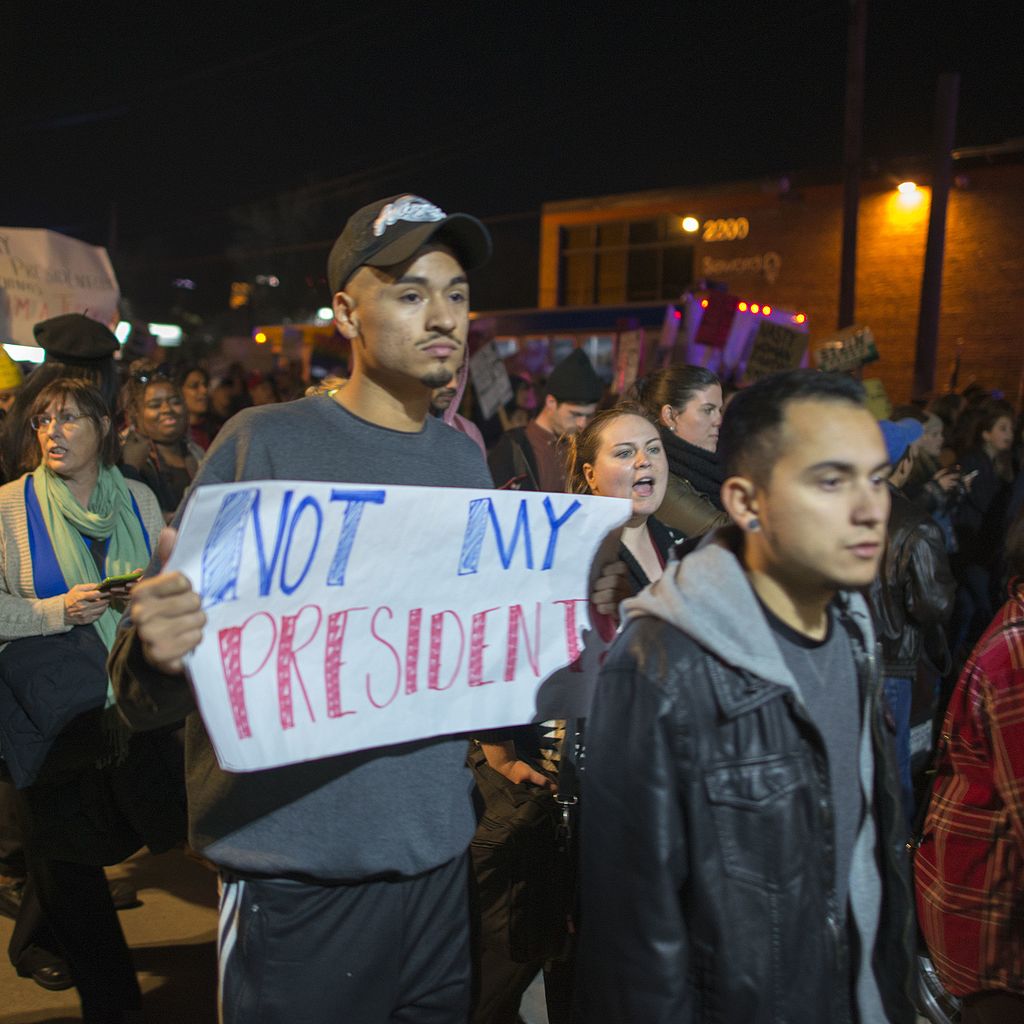
Anti-trump
Here's a question for readers and friends who served in the military, particularly those who worked with nukes (I know you're there). Can a president order a nuclear strike with no intermediating checks in the National Command Authority?

Everywhere else in the military where nuclear weapons are involved, the "two man rule" applies, from authenticating an Emergency War Order and turning launch keys to even being in the vicinity of warheads and delivery systems. I always thought this applied at the top, where the ironically nicknamed "Mad Dog" Mattis would have to authenticate the so-called Gold Codes along with the president. Mattis is the most rational person in the administration. And yet, people have told me this is wrong: Donald Trump can give the launch order on his own. How about it? With the Martin Bormann/Joseph Goebbels clone Steve Bannon now a member of the National Security Council and an unhinged president, this inquiry takes on a certain…urgency.

The progressives have their marches — many thousands in city centers and airports over the weekend — and they believe they are mighty. Farhad Manjoo, the savvy technology columnist for the New York Times, appears to agree:

We’re witnessing the stirrings of a national popular movement aimed at defeating the policies of Mr. Trump. It is a movement without official leaders. In fact, to a noteworthy degree, the formal apparatus of the Democratic Party has been nearly absent from the uprisings. Unlike the Tea Party and the white-supremacist “alt-right,” the new movement has no name. Call it the alt-left, or, if you want to really drive Mr. Trump up the wall, the alt-majority.

Or call it nothing. Though nameless and decentralized, the movement isn’t chaotic. Because it was hatched on social networks and is dispatched by mobile phones, it appears to be organizationally sophisticated and ferociously savvy about conquering the media.

I'm not so sure. Crowd psychology is a funny thing and it can lead to magical thinking. Some have been mentioning 1968, as if that year of famous civil unrest ushered in a new progressive era. Quite the contrary happened, as the American liberal consensus was shattered and conservatives ("law and order") triumphed. Now I am suspicious of the progressive echo chamber on social media and in "the streets."

There's good reason to be. Donald Trump was elected by nearly 63 million votes. Although this was less by a record margin than the tally Hillary Clinton received, it's difficult to believe many of these Trump voters have buyer's remorse. He is doing exactly what he promised, and fast. I suspect they dig it, to use 1968 slang. It's what they voted for. But they are easy to ignore because they don't hold massive street demonstrations and they don't dominate social media. They just vote. And this has left us with the Republicans in charge of both the White House and Congress, 25 statehouses in entirety (including Arizona), and soon the federal courts. The ramifications of this fact are beyond enumeration.

Jack August, an appreciation

Jack August, an appreciation

Jack_August

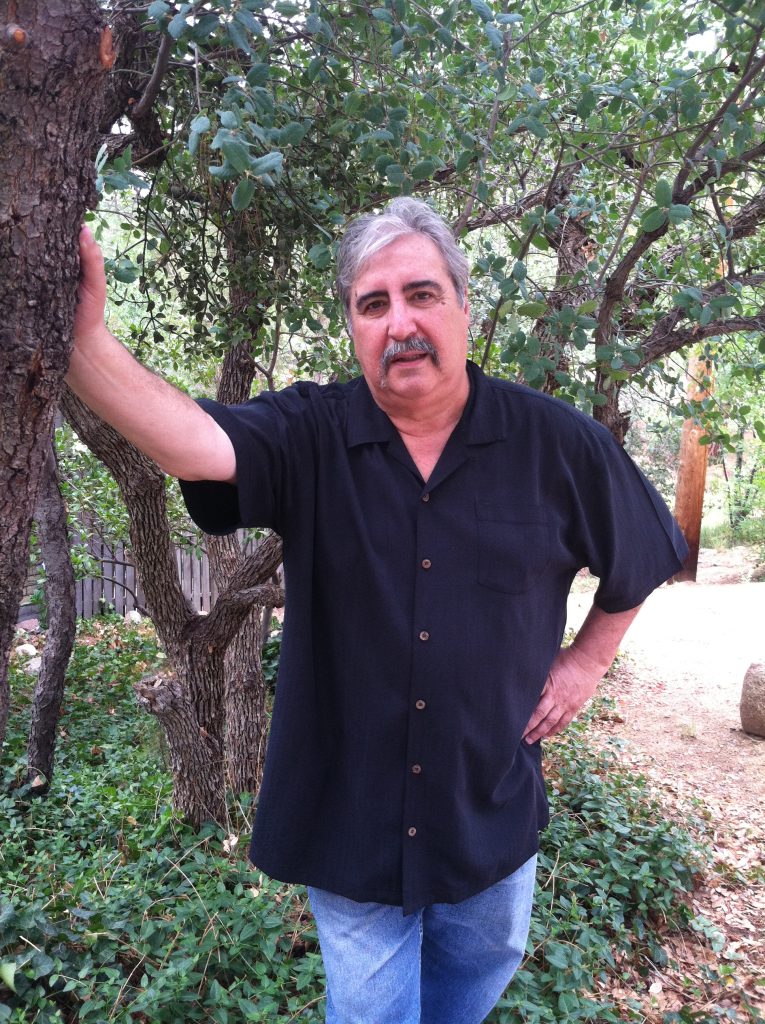
Historian Jack August in the Arizona wilderness he so loved (Photographer unknown).

When I was a popular columnist at the Arizona Republic, it felt as if everyone outside of the Kookocracy (I coined the term), including many of the most prominent people in Phoenix, became my friend. "I never thought I'd read this in the Republic!" they would say about my writing, truth-telling about the Ponzi-scheme economy, the crash to come, the lost beauty, policy blunders, and Phoenix's forgotten and ignored past. "Don't worry, you'll have a place with us" if you get fired, some promised. I was not fooled.

When the pressure became too much and the Republic kicked me out as a columnist, they almost all melted away. Instantly. Like drops of water on a high-summer sidewalk. I was not only dropped but shunned. Later, some would resurface if they needed something, but that's human nature not friendship. I can count the genuine friends who stuck with me on two hands. Jack August stuck. He was that kind of man. Crisis reveals character.

His death at age 63 is a staggering loss for Arizona, for all who knew him. He was a towering figure as a historian of a state that suppresses its past, where so many newcomers keep the home of their heart in the Midwest and crow, "There's no history here." He was an irreplaceable counterweight to these toxins. He was a mensch who gave full measure to the term "a gentleman and a scholar."

I first ran across Jack long before, in an appropriate way, pulling one of his books out of the shelves at Flagstaff's sadly lost McGaugh's bookstore and newsstand downtown. This was on a visit, showing my girlfriend my home state with no expectation I would ever live here again. A title caught my eye, Vision in the Desert, by Jack L. August Jr. The book chronicled Carl Hayden's leading role in the long fight for the Central Arizona Project. Susan bought it for me and I read it on the plane as we crossed the country.

My mother had spent a decade working on the Arizona v. California lawsuit and the CAP, mostly for the Arizona Interstate Stream Commission but also for the lead attorneys, Mark Wilmer and Charlie Reed. I knew my water history. One of my dreams was to write a history of Arizona's fight for the Colorado River, especially the outsized personalities, back stories, and intense days-and-nights of work fueled by uppers and booze as David took down Goliath. Vision was impressive and I wondered: Who is this Jack August?

Innovation district

Innovation district

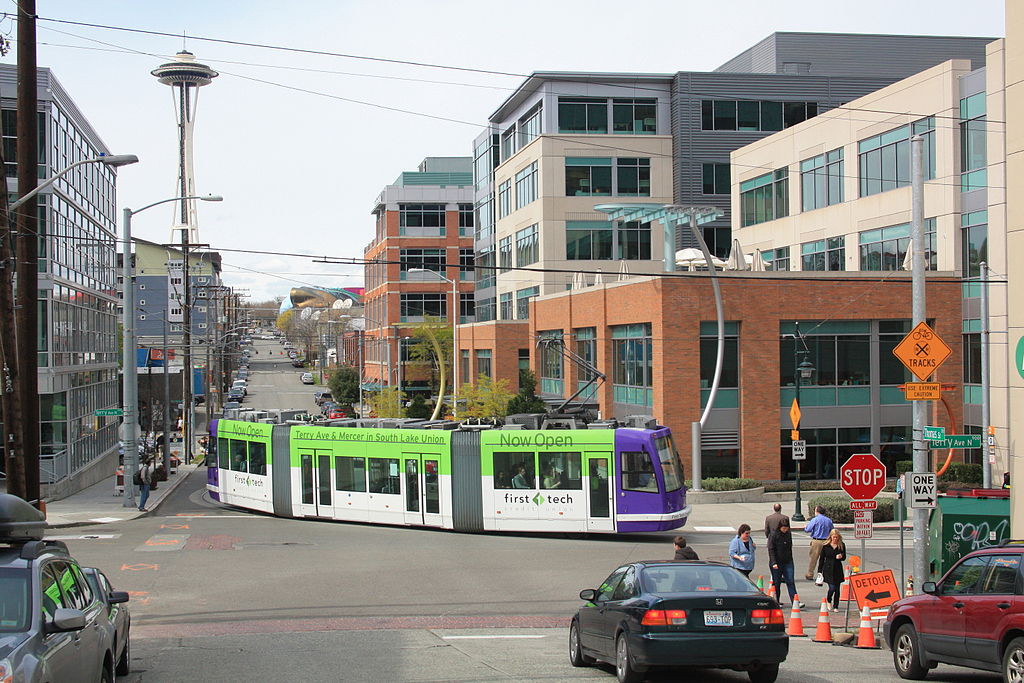
SLU
The City of Phoenix has smartly engaged Mary Jo Waits to help craft an innovation district plan for downtown. For newcomers, Waits was the driving force behind the Morrison Institute's most consequential reports in the late 1990s and 2000s, especially 2001's Five Shoes Waiting to Drop. It was prophetic. So was her warning that Arizona would become the "Appalachia of the 21st century" if it didn't change course. I collaborated with her in the "meds and eds" strategy to build off TGen, and later did some work for her when she was at the Pew Center on the States. The city could not have chosen a better, more knowledgeable and visionary person.

She asked me to write a case study on the innovation district in South Lake Union, adjacent to downtown Seattle. So this is what follows, with some parting observations for Phoenix.

When I first started coming to Seattle in the early 1990s, the South Lake Union neighborhood was a run-down collection of low-rise commercial buildings and the remnants of industrial structures from when it was laced with railroad tracks. This was once a gritty maritime district — logging, ship repair, canneries — around the south edge of the lake, which was connected to Puget Sound by the ship canal.

Aside from having the headquarters of the Seattle Times, SLU as it became known, had little to recommend it. The area had been wounded in the 1960s when Interstate 5 was rammed through, tearing it apart from Capitol Hill. And blocks of car dealerships, parking lots, and the occasional seedy bar separated it from the downtown core.

In the early 1990s, Seattle Times columnist John Hinterberger suggested turning part of SLU into a large central park, something the city's core lacked since voters had rejected a visionary 1911 civic plan. The 60-acre "civic lawn" would be framed by high-tech companies, condos, and restaurants. The Seattle Commons attracted widespread business support, including from Microsoft co-founder Paul Allen, who was accumulating property there. But the famous "Seattle Process" intervened. Many feared it was a giveaway to Allen. Voters rejected the Commons in 1995 and 1996.

The New Confederate Congress

The New Confederate Congress

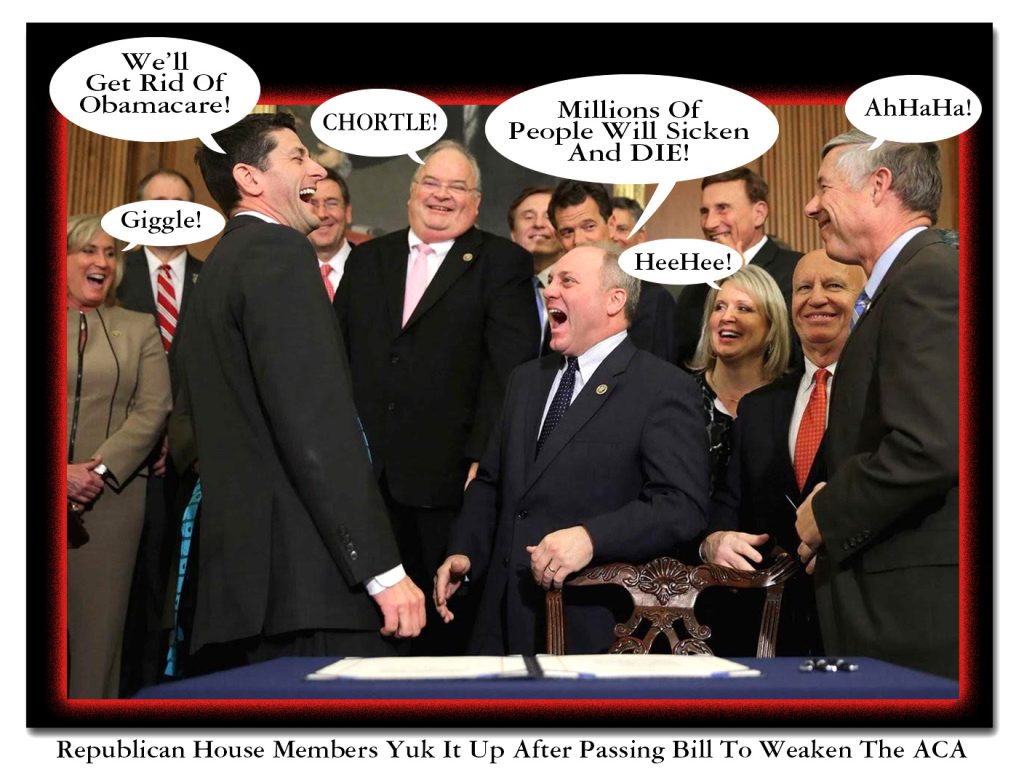
RepukeHouseYuksItUpW(Illustration by Carl Muecke, click for a larger image)

The framers of the Constitution put three roadblocks in place to prevent a demagogue from assuming or discharging the office of President. One, the Electoral College, has already fallen. The courts, packed with Republican-appointed judges and Supreme Court mini-me Scalias, will also fail to stop the descent into an authoritarian kleptocracy.

That leaves the Congress. Unfortunately for the future of the republic, this Congress is, if anything, a greater threat than the showman-stooge-traitor Donald J. Trump.

Under Republican control, it waged a scorched-earth campaign to undercut President Obama at every juncture. His well-qualified, centrist nominee to the high court was blocked for nearly a year, an unprecedented act. Efforts to build infrastructure and create jobs, to fill the hole in demand caused by the Great Recession, were victims of needless "austerity." Republicans threatened to default on U.S. debt, one of their many hostage-takings to ensure that they "broke him," in the pungent words of former South Carolina Sen. Jim DeMint (now head of the premier right-wing "think tank," the Heritage Foundation).

Now, even though Hillary Clinton won the popular vote and more people voted for Democrats than Republicans, this minority has total control of the national government. They represent the New Confederacy in our Cold Civil War. The beneficiaries of the vicious backlash to a black president. And they intend to use this power to the fullest.

Transition

Transition

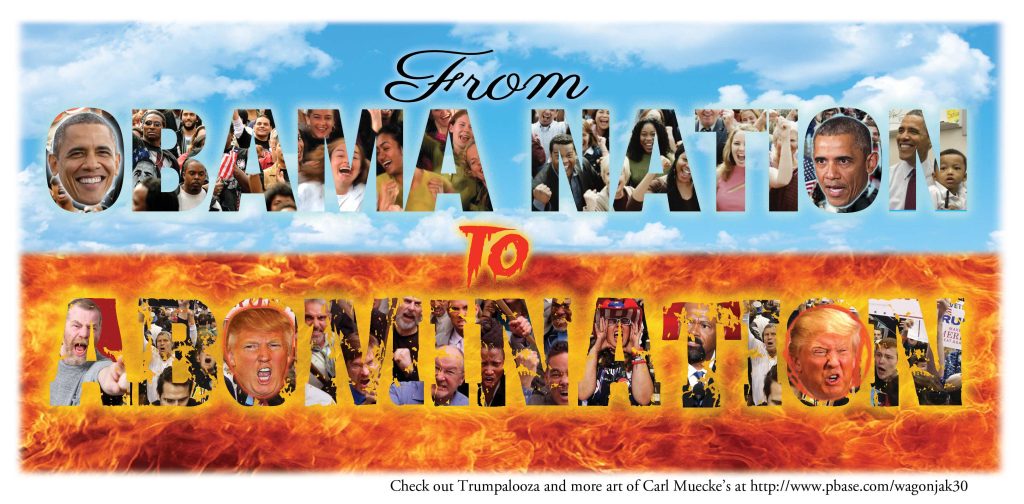
Obama-Nation-to-AbominationW (1)Illustration by Carl Muecke.

In the near future, I will examine the Obama presidency. But one thing is certain: For the past eight years, I have slept well knowing this fine, scandal-free man was in the White House. No Drama Obama. History will be very kind to him. He may well be remembered as the last president of the United States.

Now we're headed into an ominous "experiment."

Donald Trump enters the White House with less legitimacy than any president in history. His opponent, Hillary Clinton, won the popular vote by the largest margin ever (tying Obama in 2012). Trump's approval rating is the lowest for an incoming chief executive in history. His Electoral College victory will forever be tainted by the tilting of the election in his favor by Russian intelligence, FBI Director James Comey, and media malpractice — manically overplaying fake Clinton scandals while downplaying or ignoring Trump's massive real scandals and conflicts of interest. And never forget voter suppression. This was the first presidential election after the Supreme Court gutted the Voting Rights Act.

Nevertheless, Trump and the Republicans are claiming a mandate to undertake a massive shift in our nation's life and trajectory. Taking health care away from 30 million Americans — at least half of whom are in the vaunted white working class — is Job No. 1. But the damage won't stop there.

The Republicans are hot to cut taxes on the rich and eviscerate "entitlements" (read the earned benefits of Social Security and Medicare). To roll back regulations protecting the environment and holding back the looting from anti-competitive mergers, too big to fail banks, and the oligarchs. The latter, along with a proto-junta of generals, stuff his cabinet nominees. If we only see America turned into a banana republic kleptocracy, we'll be lucky.