Shoveling sunshine

Shoveling sunshine

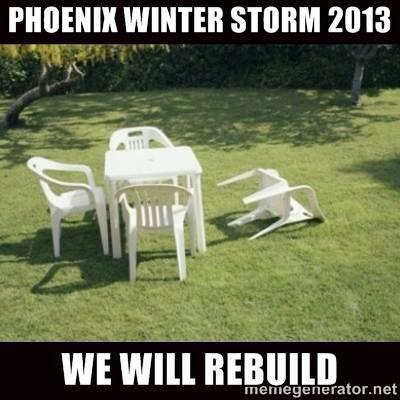
1528724_804269299588337_992679122_nThe image to the right was making the rounds on Facebook over the weekend. I can take a joke. Hahaha. On a more serious note, the state Tourism Office spent $200,000 on advertising in Chicago reminding residents that they can "warm up in AZ." If this brings in some visitors with money to spend, good on them. Like it or not, tourism is one of Arizona's most important industries — and also a source of mostly low-paid jobs.

On the other hand, if it brings more people to stay, it is a calamity. Arizona needs about 4 million fewer Midwesterners. And the ones — Anglo, older, Republican — that come will merely reinforce the reactionary politics of the state, a la "the Big Sort."

Arizona's experience has made me deeply suspicious of people who move places for the weather or of states that promote sunshine as their prime asset.

The global city

What is it? Does it matter if you live and work in one? I try to answer some of these questions in my cover story for Pacific Northwest magazine. Phoenicians:…

Suicide for dummies

I suppose it's the season. Stories are abounding about the economic comeback of 2014, a new era of bipartisanship and, because it's cold in winter, that global warming isn't happening.

Little, if any, of this is real.

Instead, let's tap into the abiding paranoia that motivates Americans. It is a dangerous world. We have enemies, foreign and — especially — domestic.

What if someone wanted to destroy America. Really bring it to its knees. Impoverish its citizens, shred its Constitution, ruin its most important institutions, force it to retreat from the world and leave it with a future where a United States of America became impossible to sustain.

How would one go about it?

The growth god fails

The latest Census data for state population was released this week, going up to July 1. Arizona remains the third most populous state in the West — an astounding fact for those of us who grew up in a small, frontier state — and that is not good news for boosters that expected it to reach No. 2 behind California.

Worse for the growth machine, the annual increase was only 1.15 percent. Growth from 2010 through July 2013 was somewhat better, a cumulative 3.4 percent.

But this is not the population increases upon which the business plans of so much of Arizona businesses are predicated. In the 1990s, the state grew by 40 percent. In the 2000s, shattered by the housing depression, population still grew by 24.6 percent. The annual growth of 2012-2013 will not get the state anywhere near that number in 2020.

In the decade of the Great Depression, Arizona's population increased by only 14.6 percent. The lesser depression of today may promise more of the same. The nation grew only 0.71 percent in the most recent year, the slowest growth since the Depression.

Even Texas, rich in energy, corporate centers, major universities, federal dollars and a good relationship with Mexico grew by 1.5 percent.

Questions for Arizona in 2014

So many myths, so little time or brain cells. I suppose that is why malign falsehoods carry us forward. The latest was a story I read where a UofA professor is having a loud growthgasm over Arizona's spectacular income growth and how 2014 will be even better.

I don't mean to be unfair or pick on people, but when these ideas enter the public square through the most powerful media outlets they reinforce the "everything's fine" lie that keeps Arizona backward.

To be sure, "staying positive" on the party line is a good way to keep one's job. I am proof of what happens to dissidents.

About income: Unless something radical has changed, Arizona is an underperformer and will remain so. The snapshots of "growth" are statistical noise caused by the large population churn. A certain right-wing columnist has ridden this for years to say, in essence, "Arizona does not suck, Talton!" — even though reality is quite different.

Where we stand

In 2013, realization of the growing inequality and narrowing opportunity that is America almost crowded out the Kardashians, Honey Boo-Boo and Duck Dynasty from the national "conversation."

Eminences sought to explain. Among them was Larry Summers, who wrote that stagnation might be the "new normal." That takes some brass, as his former boss Bill Clinton would say, considering that Summers and his mentor, Bob Rubin, did so much to create this mess.

Tyler Cowen, the libertarian economist It Guy of the moment, writes in his book Average is Over and in a Time magazine essay that the middle class is pretty much toast. A radical hollowing out will leave some at the top and most in the bottom (which doesn't mean they can't be happy).

With some worthy exceptions (Brad DeLong, Paul Krugman, et al), our thinkers tell us we are powerless against the forces that have been reshaping America.

This is nonsense.

Double down

Double down

One must give the Real Estate Industrial Complex credit for chutzpah. It will not go down with a whimper, but with a bang. And many fires.

Or rather, Arizona. The elites behind the growth machine will be long gone, safely behind their gates and walls in more hospitable climes.

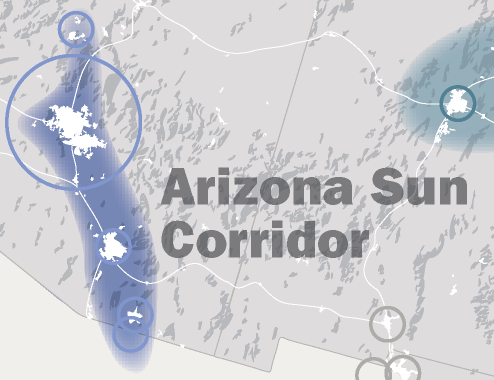
Arizona_Sun_Coridor_megaregionI am reminded of this after reading a report that three subdivisions comprising 4,500 tract houses are "in the pipeline" in Flagstaff.

Situated in what was once the largest virgin ponderosa pine forest on the planet, now a slowly dying tinderbox thanks to climate change, Flagstaff was once a real town. It depended on the Santa Fe Railway, Kaibab Lumber Industries and other sawmills, and the college. The town was safely separated from the forest primeval.

Now the railroad merely passes through, the switching yard being removed. There's a mall and Super Wal-Mart. Subdivisions have been rammed into the trees. Aside from NAU and a few other employers, Flag is one more real estate hustle to be played until it gives out. Or burns down.

WWBIYB, to south Phoenix

WWBIYB, to south Phoenix

LRT1Considering the divisions within Phoenix City Council, it is significant that light rail to south Phoenix passed this week by 8-to-1. The five-mile route would mostly be along Central to Baseline Road.

For newcomers to this blog, WBIYB is shorthand for "We Built It, You Bastards." It is my response to the thugs, trolls and hysteriacs that opposed light rail in Phoenix. We built it, the world didn't come to an end, and it is a great success. Light rail is the most hopeful achievement so far for Phoenix to have a quality future.

Now light rail connects to the Sky Train at Sky Harbor. New lines are moving ahead, deeper into Mesa, extensions north and west, and now to south Phoenix. We Will Built It, You Bastards.

Here's an important adjustment that's needed: Run the new line over to Third Avenue and south to Lincoln and then back to First Avenue/Central. That way it can connect with future commuter trains and Phoenix-Tucson rail passenger service that should use a restored Union Station as their hub. It won't cost much more and the benefit will be exponential.

We Will Build It, You Bastards. But the time line is too long — up to a decade. And with Republican austerity ruling in D.C., one hopes the essential federal money will be available. God knows, we subsidize roads and freeways way too much, with enormous damage to the environment. Phoenix should fast-track this.

The fire next time

The fire next time

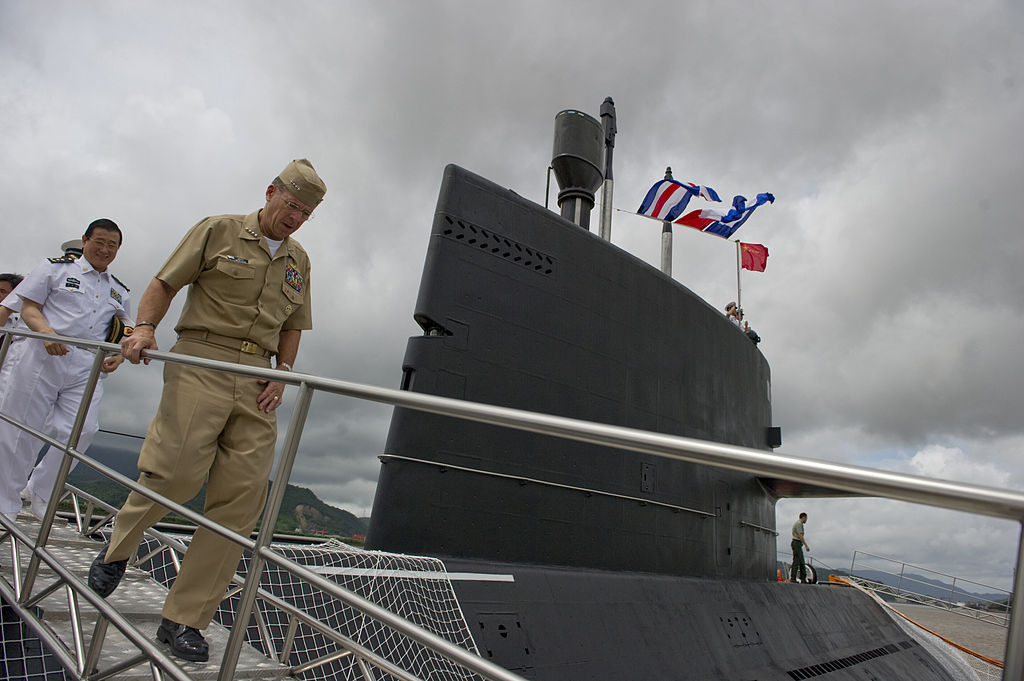
1024px-Mike_Mullen_departs_the_Chinese_Navy_submarine_Yuan_at_the_Zhoushan_Naval_BaseU.S. Admiral Mike Mullen after a visit aboard a Chinese submarine.

History doesn't repeat itself, but it does rhyme. — Mark Twain

As we approach the anniversary of World War I, we face another situation of an unprecedented globalized economy, with nations knitted together by trade, a long period of peace among the major powers ensured by a dominant imperial naval power trying to manage the rise of an ambitious, aggressive continental power.

Then, it was Great Britain working to "contain" Germany. As for the degree to which the world was connected, under the ideal that nations that traded together didn't go to war with each other, here is John Maynard Keynes:

The inhabitant of London could order by telephone, sipping his morning tea in bed, the various products of the whole earth, in such quantity as he might see fit, and reasonably expect their early delivery upon his doorstep; he could at the same moment and by the same means adventure his wealth in the natural resources and new enterprises of any quarter of the world, and share, without exertion or even trouble, in their prospective fruits and advantages; or he could decide to couple the security of his fortunes with the good faith of the townspeople of any substantial municipality in any continent that fancy or information might recommend.

He could secure forthwith, if he wished it, cheap and comfortable means of transit to any country or climate without passport or other formality, could despatch his servant to the neighboring office of a bank for such supply of the precious metals as might seem convenient, and could then proceed abroad to foreign quarters, without knowledge of their religion, language, or customs, bearing coined wealth upon his person, and would consider himself greatly aggrieved and much surprised at the least interference.

Enemies of the good enough

Enemies of the good enough

In and near downtown Phoenix, three developments are worth examining.

2_Aerial-1900

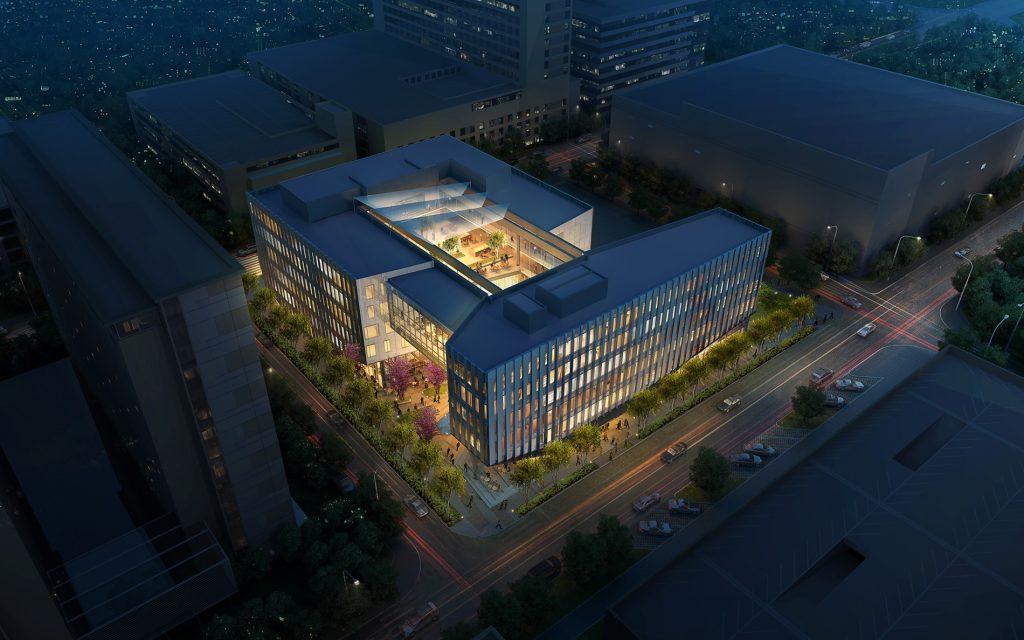
Renderings have been made public of the proposed Sandra Day O'Connor College of Law building for the downtown ASU campus (above and below). Someone told me it requires "seven variances" in the city code. And this code has given us a lovely cityscape? For god's sake build it, before somebody — ASU, the regents — changes his mind.

1_NW Corner-1900

Would I have preferred a Mission-revival or other human-scale style to get away from the deadening modernism that makes downtown less interesting? Sure. Has the design been improved from its original rollout in response to community feedback. Yes, to some extent. But the perfect shouldn't be the enemy of the good. And bringing the law school downtown will be a substantial coup. Now people need to demand that the block have real shade trees (and grass!), not palo verde skeletons and gravel.

The building would go on the block between First Street and Second Street, Taylor and Polk, the site of the old Ramada Inn (Sahara). There is still bad blood with preservationists that ASU demolished this mid-century building rather than opting for reuse.

• Then we face the question of what is "good enough" or a good start. Many have been wondering how the city would use land it bought in and near the Evans-Churchill neighborhood just north of downtown since most of it was assembled for the abortive Cardinals stadium.

Now we have an indication, and it is disappointing to risk understatement.

Phoenix in the fifties

Phoenix in the fifties

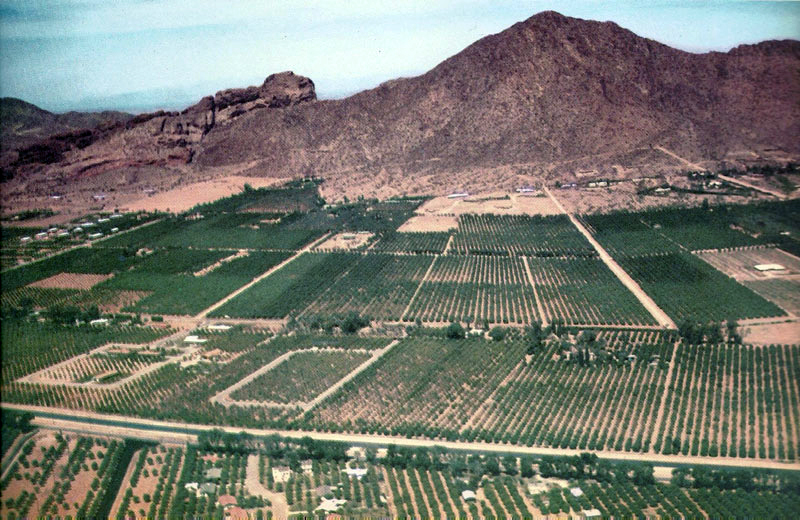
Camelback_Mountain_1956Ask almost anyone who recalls Phoenix during this time and the fifties were indeed nifty. For most, it was the best time to have lived here.

This was also among the city's most sweeping eras of change. It saw the emergence of many of the trends that later turned unfortunate or worse. Below the gleam of Eisenhower peace and prosperity, much of the town was troubled.

To begin, however, it is easy to see why these years are remembered with fondness, and not merely with lazy nostalgia.

The fifties were the last decade when much of the city's life revolved around such sweet, small-town reveries as the Masque of the Yellow Moon, held annually at Phoenix Union High School's giant Montgomery Stadium. Although the Jaycees Rodeo of Rodeos would soldier on into the 1990s, it reached its pinnacle then, too. School let out for the rodeo parade day. Phoenix was not far removed from its roots of planting and cowboying.

They were the last time when some of the larger canals were still lined with trees, doubling as widely patronized swimming holes, and water-skiing behind cars was winked at by the Salt River Project. When most of the Project's footprint was citrus groves, the Japanese flower gardens and fields, not subdivisions. When this enchanting oasis was sheltered by shade and green, and beyond it was largely pristine desert and High Country. When mining, cattle and logging were the industries in the sparsely populated state.

Phoenix was the city. Every other town in the Salt River Valley was small and separated from Phoenix by groves, fields and desert.

No wonder the overnight lows were ten degrees lower than now and summers were shorter and less severe.

When conservatism was smart

Yes. Such a time existed. It was National Review founder William F. Buckley Jr.'s lifetime project to change the know-nothing reaction of American conservatism into something intelligent, discerning, evolving and…

Suffer the children

The latest scandal involving Arizona's Child Protective Services agency involves thousands of abuse and neglect reports that were not investigated.

I don't have much to add to the able reporting of Mary Jo Pitzl and Mary K. Reinhart at the Arizona Republic. This includes a year-long series.

Not much to add, but a little context.

This is what happens when you spend decades cutting the state budget, even as population and need grows, as part of worshipping the god of small gub'ment.

State spending as a percent of personal income in Arizona fell from 5 percent in fiscal 1994 to 3.5 percent for fiscal 2014. CPS has been underfunded for decades as the state added huge population, especially in vulnerable groups.

The starting salary for a caseworker is a little more than $33,000 — and he or she get to be vilified as a public employee, never mind the crushing case load.

So when you read or hear of failures such as Child Protective Services, just remember: Your tax cuts at work.

What killed liberalism

What killed liberalism

RFK_and_MLK_together

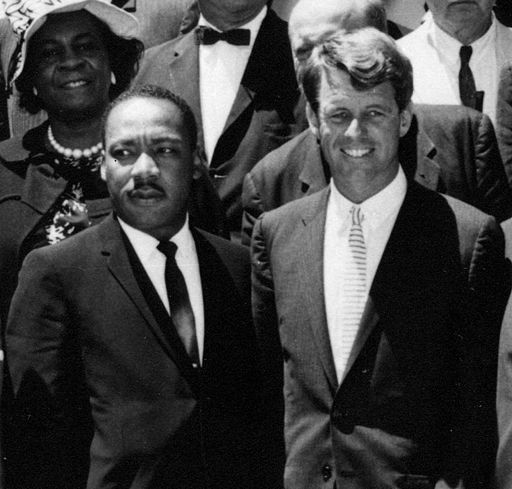
The Rev. Dr. Martin Luther King Jr. and Sen. Robert Kennedy, circa 1967.

Writing earlier this week on the 50th anniversary of the assassination of John F. Kennedy, I stated, "The Vietnam War killed liberalism. Bobby (Kennedy) might have avoided that fate."

The comments on the column are superb, so go back and read them if you can. But Emil rightly called me out for such doing an intellectual Jackson Pollock with such a broad brush.

So let me clarify.

Today, most Americans don't even know what "liberalism" means in this context. For examples, right-wingers are all for "neo-liberalism" in the economy, but rush to the barricades at the whiff of liberalism in politics. Liberals themselves have moved to the century-old term "progressive."

JFK identified my liberalism well:

What do our opponents mean when they apply to us the label "Liberal?" If by "Liberal" they mean, as they want people to believe, someone who is soft in his policies abroad, who is against local government, and who is unconcerned with the taxpayer's dollar, then the record of this party and its members demonstrate that we are not that kind of "Liberal."

But if by a "Liberal" they mean someone who looks ahead and not behind, someone who welcomes new ideas without rigid reactions, someone who cares about the welfare of the people — their health, their housing, their schools, their jobs, their civil rights, and their civil liberties — someone who believes we can break through the stalemate and suspicions that grip us in our policies abroad, if that is what they mean by a "Liberal," then I'm proud to say I'm a "Liberal."

JFK

JFK

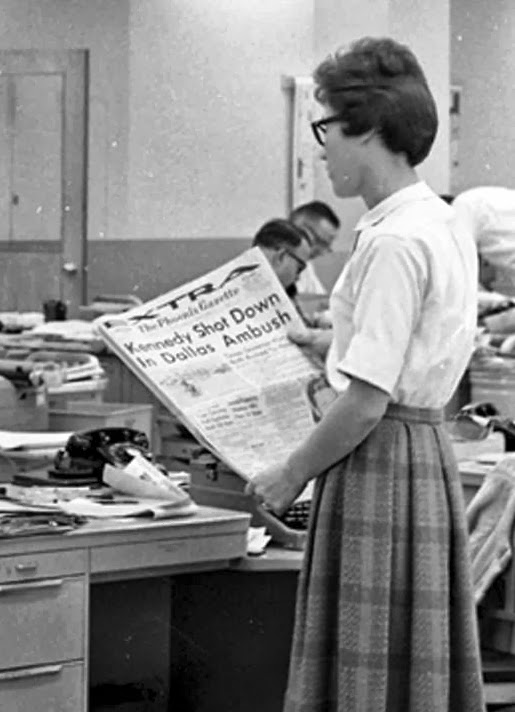
Phoenix_Gazette_headline_Nov_1963I am young to have a Jack Kennedy memory, but I do. It was November 1961, and the new president came to Phoenix to celebrate Carl Hayden Day at a VIP event at the Westward Ho Hotel.

This was when downtown Phoenix was the center of commerce and power in the Southwest and the Westward Ho was a swanky hotel. When Carl Hayden, as president pro tem of the U.S. Senate, was third in the line of presidential succession.

Hayden looked old. He had been in Congress since statehood and was the single most important figure in the legislative fight for the Central Arizona Project. But, according to his biographer Jack August Jr., Hayden was as formidable as ever. The joke that Ol' Carl was embalmed and aide Roy Elson raised his hand on votes was just a joke.

Back to JFK. I was in my mother's office on the sixth floor of the Greater Arizona Savings Building (nee Heard Building), where the Arizona Interstate Stream Commission was headquartered. I joined the lawyers and engineers at the window to watch the presidential motorcade come up Central.