In Arizona, Tucson shouldered the most dangerous part of the nuclear standoff between the United States and the Soviet Union. Some seventeen Titan II intercontinental ballistic missiles ringed the Old Pueblo from 1963 to 1982 in blast-hardened silos (one still exists as a museum near Sahuarita).
The silos wouldn't have been enough to protect the ICBMs from the many incoming nuclear warheads targeted by the USSR, especially as the Soviets gained parity with the United States in missiles and warheads. So facing a launch warning, a president would have had minutes to get the Titan IIs, which carried the largest U.S. warheads, airborne. Tucson would have been engulfed in a firestorm of hydrogen bombs. The motto of the Strategic Air Command, on display at the gates of bases such as Davis-Monthan, was "Peace is Our Profession."
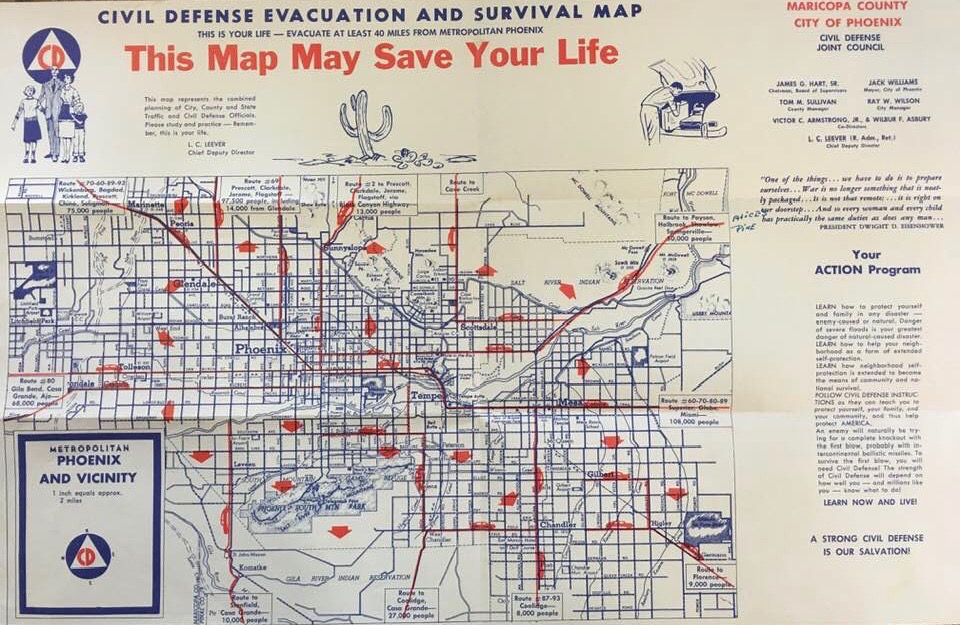
Still, Phoenix was an important secondary target during much of the Cold War. In addition to two Air Force bases used primarily for fighter-jet training (Luke and Williams), the city had a relatively large set of valuable aerospace and technology plants, plus research operations. It was the state capital. And, had "the balloon gone up" in such a way that city-for-city targeting happened, Phoenix was a major population center. It was highly vulnerable. As one of my mother's water engineer friends said, "Bomb the dams and it's all over." The evacuation plans drawn up by Civil Defense for American cities in the 1950s wouldn't have worked: Where would you send half a million souls in an isolated place largely surrounded by desert?
Even in a limited nuclear exchange, Phoenix would have been vulnerable to fallout. It was badly lacking in fallout shelter space (I remember seeing a report in the early 1970s that, as I recall, claimed space for about 100,000 when the metro area held six or seven times that number). Still, the ubiquitous shelter signs were everywhere downtown: The round older ones in red-white-and-blue with CD (Civil Defense) emblazoned on them, the more spare "Fallout Shelter" black-and-gold rectangles from the '60s. (One of the old ones was on a lamp post near First Watch downtown well into the 2000s; I hope somebody preserves it).
These were mostly basements of office buildings, stocked with food and water by the feds, meant to protect against radioactive fallout. I remember one in the utility tunnels under Coronado High School; when I went down there in the '70s, the food, water and geiger counters were all neatly packed, a decade old. Yet these were not blast shelters. Few Phoenix houses had even basements. Few Phoenicians dug their own shelters.

 34
34