The reruns of August

As others have noted, the 'ground zero mosque' hysteria, whipped up by the white-right and the corporate media, is this year's version of 'death panels' and other nonsense that sandbagged Democrats last August. What's remarkable is that the party keeps falling for it. A party so cowardly doesn't deserve to remain in "power," if you can call their recent run being in power — a minority of lockstep Republicans have managed to block most meaningful legislation. A party so stupid doesn't deserve to survive, when it could run on the rhetoric of Harry Truman or FDR or its few contemporary real Democrats (Rep. Alan Grayson, Sen. Bernie Sanders et al). But it won't. That it could fall for the same play over and over, again and again. The president has given a few good speeches, including this one in Seattle earlier this week. Unfortunately, the Obama magic has fallen into a credibility gap with an administration run by Wall Street and Clintonites.

I know all this is true. I just hate to consign our nation to more of the same right-wing governance. On and on until…what? Perhaps the Democrats must go the way of the Whigs. Yet an America that has lost its lead in college degrees — lost the ability to value education and thinking in the age of Sarah Palin and suburban arrogant-ignorance — won't embrace a progressive agenda. Will it? We may never know because the major media outlets are themselves either compromised or terrified. Rupert Murdoch, owner of Fox "News" and the Wall Street Journal, is openly giving money to the Republicans as well as tilting coverage. This is just the opening salvo in corporate money that will gain even more control over our government thanks to the "conservative" Supreme Court. (Do the Democrats think it was wise, say, to have two presidential nominees in 16 years from Massachusetts?)

Yet this is neither 1994 nor even 1988, when Michael Dukakis was punked by the late Lee Atwater, the political daddy of Karl Rove. The list of differences would be long and almost all are alarming and risky. The most immediate and volatile is unemployment. America has never seen a jobs crisis like this since the Great Depression — and then we were still the world's largest creditor nation and enjoyed the most powerful industrial base. Now we have at least 16 percent real unemployment and no prospect of recouping those lost jobs. Indeed, highly profitable companies are cutting jobs, freezing wages and, in one high-profile case, demanding pay cuts. In any other time, this would be the making of social and political strife. Don't assume that flat-screen TVs and Wal-Marts will keep the peace forever.

Phoenix 101: The economy

Phoenix 101: The economy

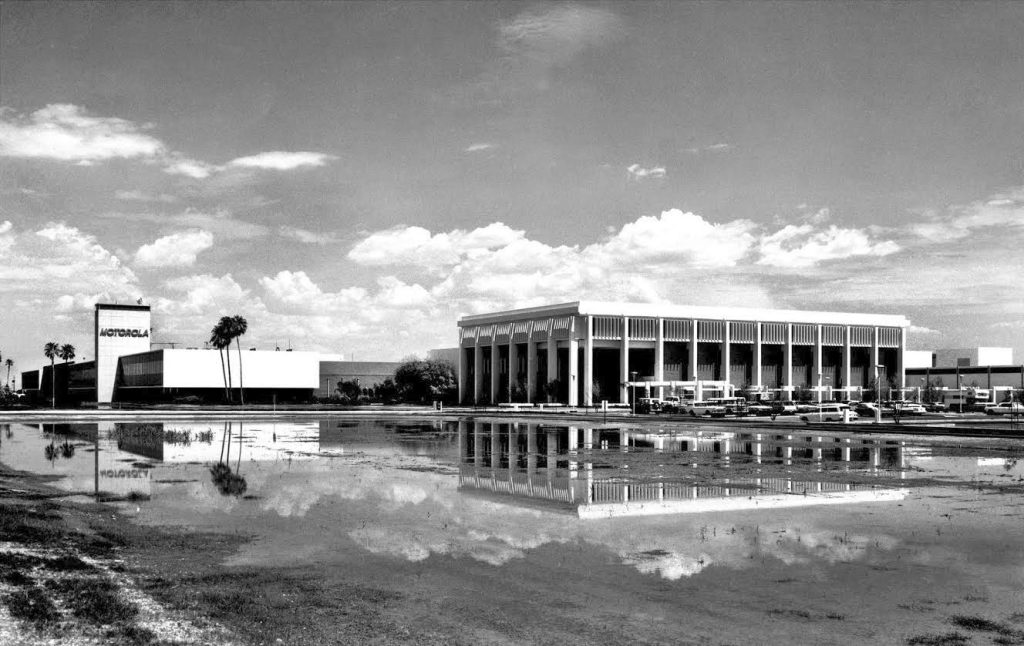
Motorola_52nd_St_McDowell_1960s
Motorola was once the backbone of technology industries recruited to Phoenix in the late 1940s and 1950s. Above is the 52nd Street and McDowell plant circa 1965.

How did Phoenix get in this mess? A mess where the economy is in an outright depression after outperforming much of the nation, by some measures, for decades. A mess where its grades in quality economic circumstances are among the worst in America, and where it may be America's fifth most populous city and 13th largest metropolitan area but underperforms its peers by an embarrassing gap.

It took a lot of work.

When I was growing up, people talked about the Four Cs of Arizona's economy: Copper, cotton, cattle and citrus. The fifth C of climate — I don't recall that, and it may have been added later to justify the machinations of the Growth Machine, although to be sure, "health" and tourism were Phoenix selling points for most of the 20th century.

For much of the territory and state's history, climate was a decided negative. In any event, even the "Cs" was an over-simplification, leaving out railroads, a wider array of mineral extraction, other agricultural sectors and the condition of the state. Arizona was a frontier state, isolated, with an unforgiving landscape and sparse population. Even in 1950, the population of the entire state was 750,000. In today's language, its carrying costs were low, its sustainability high. But as an economic player, it was dwarfed by most other states.

By the late 1950s, Flagstaff had timber and the Santa Fe Railway. Globe and the mining districts lived off copper, where Arizona was a world-class supplier. The copper industry paid 22 percent of the state tax load and provided thousands of good jobs, albeit with the downside of control by eastern capitalists. Other minerals hubs were mostly played out, often leaving ghost towns. One exception was Prescott, the onetime state capital, which was a division point on the railroad. Tucson was a major rail center on the Southern Pacific and a military base. Cattle ranches proliferated; this industry was valued at $200 million in 1962 (about $1.4 billion in today's dollars). But most of the state was wilderness. The exception, mid-century, was Phoenix.

The big breakup

So how will it go down, this mess we're in? Dysfunctional empires can last a long time (Byzantium) or not (the Soviet Union). We've been more violently divided, in 1861, and yet the nation survived, albeit with more than 600,000 killed. America suffered worse governance and severe big-business malfeasance in the decades after the Civil War, but the damage was limited by the decentralization of cohesive small towns, farms and close families, the opportunity of the frontier, rising living standards and finally was reversed by the rise of the Progressive movement. The nation saw worse unemployment and economic collapse once before in modern times, but finally the federal government led by Franklin Roosevelt responded with vigor and effectiveness. And yes, a big war helped. We were mired in Vietnam and finally gave up and still America sailed on, passing two centuries.

Times now are tough and alarmist sentiments are easy. We can always muddle through, can't we? One observer has written glibly about how we'll add another 100 million people in suburban bliss. Most Americans can't imagine a future that's not pretty much like the recent past, maybe with a few wind turbines and solar panels added. Still, I can't think of a moment in history quite like what we now face.

The stock market is swooning again. One reason is sobering enough: Fear of slower growth in China, which has taken the spot held by America for a century, as the nation expected to lead the world out of recession. But the market has been in a secular bear for a decade. The real American economy is a wreck in its fundamentals — something very different from the crises listed above. Before, we were always an economic powerhouse, a petro superpower, and each generation was guaranteed a better standard of living than its parents. No more. Another banking crisis is very possible, as is a new bubble in Treasury bonds. We make so little here now that we can't undo the huge imbalances of debt. The Ponzi scheme has collapsed. Long-term unemployment is a human tragedy and political nitroglycerin. What of the commons has survived the Reagan Revolution is now falling apart. We're mired in two wars that are only the most obvious pieces of untenable military overstretch.

And we know some things. We know the Democrats are unwilling to put together an effective progressive agenda and sell it to America. How could they when so much of the government is now controlled by corporate interests? We know Wall Street and the big banks have gotten away with it, and they will be cooking up new trouble for the economy and expecting the taxpayers to once again pay for their swindles gone wrong. Addressing climate change, building 21st century transit and rail systems, retrofitting suburbia for a peak-oil future, rebuilding our educational, research and manufacturing dominance — nope. Confronted with historic discontinuity and unsustainablity, our course will remain unchanged. The solutions are there — we refuse to undertake them. The confluence of business, political and even cultural interests and forces will make it so. The elites, even in the media, are well paid, live in fine cities and are educated in the conventional wisdom. They are paid to not get it. We know all this.

So, how's it going to go down?

Growing up in old Phoenix

Growing up in old Phoenix

Central_Palm_Lane_looking_south_Central_United_Methodist_Church_1960s

I grew up in a small town. Its name was Phoenix, and even though it had 439,170 people by the time I was four years old, in 1960, it still seemed like a place I could wrap my arms around and carry with me, just like the little towns in the movies. We lived near Cypress Street and Third Avenue, about a mile from the border of downtown. The houses faced the street, many had porches, the lawns were lush, the shade inviting.

My friends and I stashed fallen oranges and rolled them out into the rush-hour traffic on Third and Fifth — back then, before the Willo Soviet tried to wall off this neighborhood, these streets had three lanes each and carried substantial traffic twice a day, people going to and from work downtown. The oranges were also useful in friendly alley fights; more serious conflict escalated from dirt clods to rocks. Oh, we also ate them, because everyone had citrus trees in their yards and it was a quick drive out to the groves, where boxes of oranges could be purchased at roadside stands surrounded by the lavish bounty of the Salt River Valley. Some days we lay under the trees at Paperboys' Island, a pocket park at Third and Holly, and just stared into the cobalt sky, dreaming the dreams of young boys.

By the time I was eight, I was mobile and free, within limits. Specifically, I could ride my bike from Thomas to Roosevelt and Third Street to Fifteenth Avenue. It was an amazing landscape for a child. The library, art museum and Heard Museum were there. Soda fountains proliferated at drug stores, from the Rexall on Roosevelt and Third Avenue to Ryan-Evans at Seventh and McDowell to shops on Central. Every gas station had a drinking fountain with cold water, an essential for young desert rats. The firefighters at the old Station 4 on First Street and Moreland, as well as the Encanto/Seventh Ave. station indulged us. We bugged the people at Channel 12 and Channel 5 (Wallace & Ladmo's home!) for old reels of commercials — the apex of our ubiquitous trash picking. Encanto Park was a favorite hangout; it was where I decided I wasn't cut out to be a fisherman, but that didn't stop me from endless fishing journeys to the lagoons. The lovely moderne Palms Theater at Central and Virginia offered movies if we didn't want to hitch a ride downtown.

This part of the city was dense then with businesses. This was long before entire blocks were bulldozed or turned into dead space by parking garages. The buildings on the northeast and southeast corners of Seventh Avenue and McDowell, for example, were chock-full of small businesses. So was today's mostly empty Gold Spot — I got my hair cut there by Otis Kenilworth. Downtown was still the busiest shopping district in the state, followed by Park Central mall — both bracketing our neighborhood. I wasn't as fortunate as someone born a few years younger to sample the old city, but it was still pretty intact in the early and mid-1960s.

The big Valley Bank sign turned atop the art deco tower and other neon signaled downtown. Among the downtown landmarks was the Hotel Westward Ho, with its famed Thunderbird Room, where presidents stayed well into the 1960s. The skyscrapers going up along Central seemed signs of progress, not incoherent planning. I watched so many of them being built. My grandmother and I took the bus to shop downtown or at Park Central. This daughter of the frontier "traded," as she put it, at the small A.J. Bayless store at Central and Moreland. Just west were the shady median parks along Moreland and Portland, two of the few City Beautiful Movement touches Phoenix received. The parkways were lined by lushly landscaped apartment buildings. Every day, we drove downtown at 5 p.m. to pick up my mother at the Greater Arizona Savings Building, where the Interstate Stream Commission had its offices. It was amazing to see the crowds on the streets, just like a big city.

None dare call it class war

In the fever swamps of the white-right, the conversation is about whether President Obama is a socialist, a fascist or a communist — as if they even knew what these critters are. The more on-point provocative question is whether the rich hate the American middle class and have declared war on it.

I know, I know: This is going way over the top, Talton. The crisis enveloping average Americans has been building for decades and comes from complex sources, not a conspiracy, for goodness sake. The capital markets may produce some destructive results, but it's not part of a master plan devised over cigars and cognac in the VIP suite at the Oval Room. True enough. And there are some inspiring examples of some wealthy people giving to worthy causes. This is a complex issue, which makes it beyond the talk radio- and television-addled masses. Still, it must be addressed. It doesn't take a conspiracy to create a community of interests that produces a similar result. Phoenix and Arizona are a textbook example with the Real Estate Industrial Complex.

Somebody pushed for questionable trade agreements, job offshoring, union busting, monopolistic industrial concentration, the shredding of pensions and benefits, a financialized economy, deregulation, big government welfare for corporations and the lowest taxes on the rich in generations. Somebody continued to expand these policies even after their destructiveness was well known. Somebody profited hugely. Now, with the Great Recession, the long and growing estrangement between the elites and the rest of us has snapped. Corporate America sits on $1.8 trillion cash while millions face years of unemployment and most see years of wage stagnation. Two Americas, indeed.

What happens in Arizona…

Harper's magazine is doing some of the best journalism in America today. Fortunately or unfortunately, most of it is behind a pay wall. And because it is aimed at America's declining number of educated, intelligent readers, its overall influence is sadly open to question. This is not the mass-market Harper's of the 1870s that brought down Boss Tweed through the savage and wildly popular illustrations of Thomas Nast, nor does it have an American population that is largely literate. Still, Ken Silverstein's " Tea Party in the Sonora: For the Future of GOP Governance, Look to Arizona," was flattering: A magazine-length summary of many themes long examined on this modest blog. Arizona's breakout bout of crazy has caused numerous competent national journalists to parachute in, to try to explain the damned place. The New York Times and LA Times have been especially diligent. Yet they barely scratch the surface before gratefully departing Sky Harbor.

The New York Times, for example, had an arresting front-page photo of the bodies stacked in the Pima County morgue, bodies of illegal immigrants who have died just so far this summer crossing the desert. Yeah, the ones putting guns to our heads and forcing us to hire them at the lowest possible wages and with no protections while they pay taxes to every level of our government. I'd love to see that photo on page one of the Arizona Republic.

I can guarantee you that Eugene C. Pulliam's Republic would at least have run out of office the odious Joe Arpaio. The sheriff is held in contempt by every real law-enforcement officer I talk to, and old timers still refer to him as "Nickel-Bag Joe," for his strutting but ineffective, small-time busts when he was with the Bureau of Narcotics and Dangerous Drugs (then DEA). Alas, except for New Times, the media, local and national, merely play their parts in the Badged Ego's theater. Even the media criticism of Arpaio miss the larger areas demanding inquiry. Oh, for a press corps with more skepticism. Or one that would stick around awhile and really dig…

Tax cuts: What went wrong

Zonie readers will have to forgive me. I've reached a point where Arizona's cruelty, narrow-mindedness, magical thinking and self-destructive policies are … boring. I promise to snap out of this fugue state next week.

John Boehner already is measuring new draperies for the speaker's office and Republicans seem confident of at least retaking the House, if not the whole enchilada in 2010 and then 2012. Their policy prescriptions haven't changed: military adventurism, deregulation, slashing and blocking important domestic investments — now justified by the deficit they ran up — and, especially, tax cuts. Nothing is more Reaganesque than cutting taxes.

According to Republicans, this accomplishes two goods: It raises more tax revenue for the government because it lures capital from shelters into productive uses, and, it encourages more capital formation that creates jobs. Everybody wins. George H.W. Bush derided the first part as "voodoo economics" and Paul Krugman wrote a most convincing takedown in 2003. Even so, tax cutting has been American governing orthodoxy for 30 years. Just the possibility of letting the George W. Bush tax cuts expire or returning to the estate tax that has been in place for nearly a century provokes apoplexy.

The second part of the tax-cut argument had more resonance. Even I once believed that if you really wanted to stick it to the rich, reduce their rates enough to make it impossible for them not to want to invest. Some of that is bad history, of course. The American economy did very well with Eisenhower's 90-percent range top bracket for the wealthiest, and the greatest boom of the 20th century and first surpluses in decades came after Bill Clinton slightly raised taxes. But the final blow to the tax-cut argument came under George W. Bush, as taxes were slashed on the rich, major corporations got away with paying no taxes and the estate tax was whittled to nothing. Yet the Bush years saw a net gain of a mere 1 million jobs, wages stagnated and income inequality hit levels not seen since at least the 1920s. What went wrong?

Doomsday Machine II

While a breathless nation watched natural redhead Lindsay Lohan try to adjust to jail and the most prestigious organ of the American press prominently lamented the failure to regulate Froot Loops, your world and the world for your children and grandchildren changed last week. Reported grudgingly if at all in most of "the media": The death of legislation that would even begin to address climate change. Others have commented on the shameful retreat by the Democratic Congress and White House, and even Tom Friedman had a good column. It included the pungent observation:

We’ve basically decided to keep pumping greenhouse gases into Mother
Nature’s operating system and take our chances that the results will be
benign — even though a vast majority of scientists warn that this will
not be so. Fasten your seat belts. As the environmentalist Rob Watson
likes to say: “Mother Nature is just chemistry, biology and physics.
That’s all she is.” You cannot sweet-talk her. You cannot spin her. You
cannot tell her that the oil companies say climate change is a hoax. No,
Mother Nature is going to do whatever chemistry, biology and physics
dictate, and “Mother Nature always bats last, and she always bats
1.000,” says Watson. Do not mess with Mother Nature. But that is just
what we’re doing.

I'd like to explore the future we're making by our own choice.

Atlas mugged

I've been on a mission for several years to right the wrong done to Charles Erwin Wilson, the president of General Motors from 1941 to 1953. He later served as Defense Secretary under President Eisenhower, a man with a keen interest in the well-being of the military. You know Engine Charlie: He's the one who said, "What's good for General Motors is good for America." The very epitome of the selfish, imperious chief executive. Except he didn't actually say it. His real words were, "for years I thought what was good for the country was good for General Motors and vice versa." In other words, the interests of big business couldn't be divorced from the well-being of the nation. This represented the best ethos of our business leadership when America stood at its zenith.

James Cash Penney, founder of the department store chain, operated not by exotic swindles cooked up by his Ivy League MBAs, but by the golden rule. The vinegary head of National Cash Register, John Henry Patterson, turned his factories into boat-building plants to save residents of Dayton during the 1913 great flood. Henry Ford, crackpot and anti-Semite though he became, established his business on this foundation: "I will build a car for the great multitude. It will be large
enough for the family, but small enough for the individual to run and
care for. It will be constructed of the best materials, by the best men
to be hired, after the simplest designs that modern engineering can
devise. But it will be so low in price that no man making a good salary
will be unable to own one." In doing so, especially paying good salaries, he made one of the seminal steps to create the modern middle class. Ford also said, "A business absolutely devoted to service will have only one worry about profits. They will be embarrassingly large."

Now we have a different breed of cat running our largest companies. Their model is not J.C. Penney or even Henry Ford, but Jack Welch and the moguls of Wal-Mart. And they may be on a mission to sabotage the chief executive of the United States.

Water and Arizona’s future

 “There is no lack of water here, unless you try to establish a city where no city should be.” — Edward Abbey

Asked to write about Arizona and water, I fear I will disappoint. My take is now too idiosyncratic, too impossible for the state's residents to even contemplate or for the economic and political elites to allow. Still, a reader asks; I'll deliver and at least start a conversation/argument.

In its particulars, Arizona's water issues are complicated, making them inaccessible to a population with lower levels of education and civic involvement, as well as little connection to the state's history. They did not, as I did, grow up with water — my mother working as part of the effort to win the Central Arizona Project. In general, Arizona's water issues are stark and simple: The state can't sustain double-digit percentage population increases every decade, particularly in subdivisions apart from historic urban footprints. This statement is anathema to the Real Estate Industrial Complex and what passes for an "economy" that Arizonans keep looking to resuscitate. But wait… In reality, Arizona probably doesn't have the water to support its current population for long. Beyond these basics, it's all over but the shouting.

Here's what I don't trust: The state Department of Water Resources or its active water management areas. The risks of compromise to water rules by the development elite is too great, exacerbated by continued under-funding of state government. And the 100-year supply "rule" for new development? Even if it's enforced what does it mean? One thing it does, because water is divorced from land-use regulations, is to cause a land rush to lock up aquifers that have taken eons to create — all to provide the illusion of security so another "master planned community" can expand out beyond the White Tanks. Meanwhile, much of the state lacks even this suspect oversight. Mojave County, notorious for its lack of water, was a hotspot for wildcat exurban sprawl before the housing collapse.

What is to be done?

So this is where we stand: The financial doomsday machine, equal parts the creation of feral greed and deregulation, has been saved by taxpayers and IOUs on our future living standards. With its billions to lobby, it has avoided the prosecutions and re-regulation that followed the laissez-faire-caused crash of 1929. So it continues to gamble with dangerous play money called derivatives and other financial "innovations." Billions more from big business ensure corporate control of a broken government. All of these entities live to send jobs offshore or engage in job-killing mergers, as industries become more consolidated than at any time since the Robber Baron Age. Income inequality has returned to that era, too. And for the first time in history, most of the next generation will see worse prospects than those of their parents.

Twenty-six million workers are unemployed or forced into part-time jobs when they want full-time positions. Five unemployed workers are chasing every available job, and yet the Republican minority, aided by Sen. Ben Nelson of the populous state of Nebraska, continue to deny an extension of jobless aid. Schools, transit, parks, libraries and assistance to the most vulnerable are crumbling. For the first time in a century, the world does not look to the United States to lead the world to recovery. Instead, Asia powers ahead while this shadowy thing called "the markets" holds guns to the heads of Western governments, with elite commentators saying all the public foundations that make an advanced civilization must be ruthlessly slashed. Who are these "markets"? And how do we explain that the zenith of American might was built on much higher taxes for the wealthy and corporations, as well as capital markets that raised money for productive, job-creating businesses? Meanwhile, America is bogged down in endless wars, making more enemies through our military adventures and appetite for oil. Oh, oil. The Gulf of Mexico is perhaps irretrievably damaged by a BP spill that has fallen off the front page. Expect more such events.

After all this, voters seem poised to return control of the House of Representatives, and perhaps the Senate, to the Republicans, the party that wrecked America. Speaker Boehner. It will mean the end of President Obama, a man who somehow has managed to squander America's best and perhaps last chance to right itself. The genuine hope and relief of January 2009 is long gone. In its place is a sentiment I heard from many as the Bush years dragged on — including, in private conversations, from people of national prominence. Their words were always the same: "For the first time in my life, I am afraid for my country."

Will SB 1070 help or hurt?

On Sunday, the Information Center published a 573-word story, accompanied by many graphic and break-out doo-dads, asking: "Will SB 1070 help or hurt the economy." The lede: "Arizona's new immigration law will likely affect a sizable swath of the state's economy, but experts are uncertain whether it will bring overall economic gains or end up scarring the state with losses." I know one thing: These kind of shallow stories are among the many self-inflicted wounds killing journalism. Oh, I forgot, Gannett doesn't do journalism, it is an "information broker."

An old hand once told me, "Immigration isn't the most difficult dilemma facing America. It's worse." It is a result of Americans' insatiable addiction to cheap labor. But it is part of a far more complex set of phenomena involving a Third World nation bordering the First World superpower; globalization's destruction of Mexico's peasant economy; mass migrations on a scale never before seen on an overpopulated planet; corporate greed amid a worldwide glut of labor, and billions of poor living without hope but primed for instability and extremism. The topic deserves at least the kind of sophisticated work done early last decade by The Arizona Republic with the "Dying to Work" series.

The overwhelming evidence is that SB 1070 will be a net economic loser for a state already in a depression. The most comprehensive national work on the public costs of illegals vs. their output for the economy has been done by UCLA's Raul Hinojosa. The verdict: The aliens are a net positive. Nowhere is this more true than Arizona. The anti-immigrant bill is already dearly costing the crucial tourism industry from boycotts. Its explicit political extremism will deter capital formation and investments by quality corporations. To the extent that it causes an exodus of illegal immigrants, it will further erode the tax base, for those aliens pay a disproportionate share of their incomes to Arizona's regressive tax system. Most will stay, even deeper in the shadows and out of the mainstream, adding to the state's lost human capital and talent. Most important is this: No low-wage, easily exploitable migrant labor force, no Growth Machine.

What is the ‘free market’?

A new poll on Talking Points Memo finds that 55 percent of likely voters believe President Obama is a "socialist." That's rich on a couple of levels. First, if Mr. Obama were a real social democrat we'd have universal, single-payer health care, a major program to rebuild our nationwide rail system, superior public schools and affordable or free (real) universities, a comprehensive social-safety net and an appropriate tax on the rich and corporations. That we don't says the president is a Clintonian corporatist at best, and millions who voted for change are disappointed and not likely voters. The second laff riot is that these morons polled don't even know what socialism is — and yet, as Arizona can teach the nation — morons vote, feverishly.

"Economic freedom" is code for…what exactly? A selfish nation of dolts that thinks roads and sewage plants are made by elves in the middle of the night, and thus the dolts shouldn't have to pay taxes? Never mind that America pays some of the lowest tax rates in the industrialized world, most major corporations pay none, and we suffer infrastructure, competitive, social and state budget crises as a result. Does it mean you should be allowed to build a toxic waste dump in your backyard — even though you would be the first to report your neighbor's unauthorized paint scheme to the homeowners' association? Economic freedom is the gibberish of the uneducated, the selfish, and aggrieved, all indoctrinated by the ubiquitous Fox "News" and white-right talk radio. Yet it is the phrase of the moment and people mouth it, along with their gun lust, theocracy and hatred of "the other" like 1930s Germans saying "Kinder, Kuche und Kirche!" or "Drang nach Osten!"

As a "socialist," taking away our "economic freedom," Mr. Obama shows his hatred for that sacred American concept, "the Free Market." What does that mean? In the elegant world of theory, it implies that given maximum freedom, human action in the marketplace will produce superior results to any kind of command economy or "industrial policy." Price signals tell producers what customers want and employees where the jobs are. Competition keeps new ideas, products and services coming. The "invisible hand" — Adam Smith uses the phrase only once, and narrowly, in The Wealth of Nations — presides over this mysteriously and effectively but…well, you don't mess with the hand. The theory has been relentlessly pushed down and dumbed down over 30 years so that perhaps a majority believe it as an article of faith. Or better. C.S. Lewis wrote of Christianity something to the effect that "it's just screwy sounding enough to be true." Free market church-goers have a completely closed-loop "proven reality."

This time is different

Anyone who thinks our economy and the rest of America is in a familiar cycle, with perhaps different music and new electronic gadgets, hasn't been paying attention. Unfortunately this includes much of the media and the economic experts they choose to quote. It's like 1981-82. Well, no, even though in severity that event was the worst up to that point since the 1930s. Jobs were shed in this recession at a faster and deeper rate than since statistics began to be kept in the late 1940s, and by this time after the start of the 1981 downturn we had regained virtually all the lost jobs. Now we have nearly 26 million unemployed or underemployed (temps who want full-time work) Americans. Thanks to Republicans in Congress, 2 million have lost their unemployment insurance. In any event, that was a Fed-caused recession to defeat inflation, and the underlying American economy was strong and diverse, with the middle class at its zenith and Wall Street a dowdy joint tasked with raising capital for real productive, job-creating enterprises. None of that is true in this disaster.

It's like the Great Depression. That was an economic collapse fueled by financial speculation and fraud, high leverage, laissez-faire, and extreme income inequality, too. Unfortunately, there the parallels end. America was the world's largest creditor nation, manufacturing exporter and oil producer/exporter, with state-of-the-art factories and a skilled workforce just waiting for an upturn. Government was much smaller at the start of the Depression, allowing FDR plenty of room to experiment; he was not weighed down in the 1930s by two endless colonial conflicts and defense spending greater than all other nations combined. The bad was worse: Unemployment was estimated at 25 percent; poverty was much more widespread; the country was still heavily rural and small-town. And, importantly, the "old order" that brought on the crash was discredited and, for the next several decades, shut out of political power.

It's just a normal business cycle being made worse by government. When people say this, they don't mean that the government has made inadequate and poorly targeted stimulus or helped prop up the Wall Street casino prepping us for another panic. They mean Obama is a "socialist/fascist/communist" and America needs to let the "free market" rule, while slashing "wasteful" government spending. This would be dark comedy if it were not fervently believed by so many voters. It is most definitely not any kind of business cycle we've seen. But this dangerous minority may well get their way come November — they're already getting much of it, with painful consequences.

Phoenix recovery? Part II

The data and just driving around town make it clear that the Phoenix economy is not recovering. That the news snippets and economic forecasts desperately trying to spin things otherwise are almost exclusively focused on real estate is telling. Metro Phoenix so narrowed its economy that it was America's last big factory town, building houses. When this unsustainable game of risk crashed, the region was devastated. But like a dying rattler, it is still snapping its fangs, wildly hanging onto the hope that the Growth Machine can be started up again. It's always worked in the past! This is the forlorn cry of so many caught in past depressions and economic turning points. Buffalo… Youngstown…Detroit…

The old housing economy is not returning. The one based on large-scale output of tract houses built by national builders on a foundation of liar loans, high leverage and vast government subsidies for the suburban or exurban "American dream." Now that dream is a nightmare. The nation is much poorer after the Great Recession, yet the imbalances and high debt remain. Incomes and living standards for average people are in deep trouble. Millions of houses remain to be sold, with many more in the private "shadow inventory" as well as in the toxic "assets" taken off the hands of the banks by the Federal Reserve. Nowhere do these realities operate with more ruinous consequences than Phoenix. Any "new normal" will provide little relief for a regional economy whose business plans were based on an unsustainable profligacy of building and population increases. That little blip that might mean "the bottom" or "stabilization." So?

What's astonishing is the lack of realistic or imaginative thinking on the part of what passes for Arizona leaders faced with this harsh future. Or faced with the mounting evidence of how distorting, costly and damaging to the earnings of average people the real-estate monster had become. Metro Phoenix has never been so dependent on real estate, yet no one seriously wants to break the jones. To understand the future of discontinuity. Pinal County, a national ground zero of exurban crisis, sees only one way out: More sprawl. In fact, Pinal should be returning to agriculture as fast as it can; Arizona needs the exports to a growing Asia, as well as the capacity to feed itself in a high-cost energy future. But the self-destructive hits just keep coming: