Encanto Park in old Phoenix

Encanto Park in old Phoenix

Encanto_Park_Phoenix_Corporate_Center_Mayer_Central_Plaza_1960s(1)

A city such as Cincinnati built great parks, from the showpiece Eden Park, home to the Cincinnati Playhouse, Cincinnati Art Museum, Kron Conservatory and Mirror Lake Fountain, to the exquisitely designed Ault Park near the tony Mount Lookout and Hyde Park neighborhoods. Eastsiders who won't venture beyond the "Sauerkraut Curtain" may not even know about Mt. Echo Park, one of my favorites with its awesome views of downtown and the Ohio River.

The Queen City of the West had the good fortune to come of age in the golden age of park design and have the wealth to pull it off. Phoenix, a modest farm town at this time, built only one: Encanto. That makes it all the more a civic treasure. This Saturday Encanto Park will celebrate its 75th anniversary.

I write this not to take away from the city's achievement with desert parks, especially South Mountain Park and Papago Park. But they are what they are, often stunning preserves of the Sonoran Desert for hardy hikers and, more often, drivers.

Encanto was different, built as an oasis of shade and grass and City Beautiful Movement design, meant for people, picnics and strolling. Now more than ever, you can feel the instant cooling of the park and golf courses when you drive south of Thomas on 15th Avenue on a summer night. It's not like the Midwest — for that kind of lush greenery, look to Cincinnati. It lacks the size and resources that Los Angeles could put into Griffith Park. Encanto, inspired by San Diego's grand Balboa Park, is its own enchanted feat. It is a capsule of old Phoenix, a magical refutation of those who say "Phoenix has no soul."

Republic of delusion

Thanksgiving week rolls around with the national conversation more about the Pilgrims' conversion from "socialism" than any of the real and present dangers facing America. A measure of our mass delusion can be found in Phoenix, where Greg Vogel of the Real Estate Industrial Complex was talking about "the Valley" growing from 4 million to 8 million people over the next 35 years. This was not a conversation from 2006 but from last week. Just where the 1) water; 2) the people; 3) the capital will come from in post-crash/climate change America he doesn't say. His only concession to the current unpleasantness is to move the timetable to 35 years instead of the old 20. Ain't gonna happen. The old growth machine is broken and "the Valley" still can't imagine a Plan B.

(I put "the Valley" in quotes for several reasons. For one thing, it's a moronic-anodyne concession to the suburbs when Phoenix is a beautiful name for a city, and other real cities use their names to encompass suburbia, e.g. Chicago. Also, the metro area long ago spilled out of the real Salt River Valley, e.g. Cave Creek is not in that valley, nor is Maricopa. And "the Valley of the Sun" is a dated tourist slogan that will assume ever more sinister connotations with climate change).

In any event, Phoenix is hardly alone. The International Energy Agency's new annual report concedes that conventional oil production peaked in 2006. This little bit of news that will change everything about our lives and national security in the years ahead received barely a mention in major news outlets. Bristol Palin (remember when women had attractive names like Susan, Linda and Kathy?) on Dancing with the Stars was deemed more important.

Tom and Mike

When Michael Ratner passed away this week, Phoenix lost one of its true heroes. He bought the revived Tom's Tavern downtown in 1992 and never stopped fighting to keep this landmark going. Tom's played a big part in my personal history: It's a setting in many of the David Mapstone books, and Mike played host to the launch party of my first mystery, Concrete Desert. For years, he had my books for sale at the tavern. On our columnist lunches, E. J. Montini, Richard Ruelas and I sometimes went to Tom's. Tippling happened.

Tom's was one of my hangouts, and Mike always wanted to know how I was doing, even when I paid visits after being thrown out of Phoenix. He was that kind of man, caring about others, not one to dwell on his battle with cancer. He'd sit me at the "governor's table" or the "mayor's table," then join me to talk. Mike was a worrier. Tom's always seemed on the edge, even with its history and location at the foot of the Renaissance Towers close to city and county government. He hung on through light rail construction, creating events for symphony and other event-goers. The Great Recession was another storm to weather.  He lovingly preserved history, from the portraits of past and current leaders to mementos of the tavern's rich past, in a town that has no use for it.

He transcended the era of John Teets, Jerry Colangelo and other bigs who had the vision and means to work for a great city. In his modest way, he was one of the last stewards standing. A great restaurant operator, he could have made big money in Scottsdale or the other 'burbs. He chose to make his stand in the heart of the city.

Phil for Phoenix

Amid the wreckage and inertia that now define the nation's fifth (soon to be sixth?) most populous city, it's difficult to recall the near euphoria that greeted the inauguration of Phil Gordon as mayor. It was 2004, the metro area was booming, at least in real estate, and here in Phoenix, finally, was somebody who "got it." He got city, as opposed to suburbia. He got economic development, especially for the central core. He got the urgent need to diversify the economy. For "ADHD Phil," even his early speeches soared with a grand vision for Phoenix. A great city. A great mayor.

Alas, it was not to be.

If any historian cares to write about Phoenix's collapse, about how it became "the Hispanic Detroit" as the north Scottsdalers say, the mayoralty of Phil Gordon will be an essential chapter.

Phoenix 101: Midwesterners

The comments section has been busy with musings about the Midwest migration to Arizona and the degree to which it is to blame for the disaster facing the state and Phoenix. I've offered my assessment in previous posts (it's a great deal to blame).

That doesn't mean every midwesterner is at fault, much less that I hate the Midwest. I spent nearly a decade there, in southwest Ohio, and hold it warmly in my heart. I saw it at its best and lately I've seen it at its worst. But no discussion of Phoenix is complete without assessing this huge tide of immigrants and the things they carried.

The first Anglo settlers of Phoenix were a ragtag group of tough adventurers, everybody from "Lord" Darrell Duppa, namer of Phoenix, who was born in England (maybe France), to the father of Tempe, Charles Trumbull Hayden, a Yankee who had worked the Santa Fe trail. The Mormons settled Mesa.

But Southerners and former Confederates were arguably in the early majority, personified by founder Jack Swilling, CSA. This gave the town a peculiar Southern-Western character that persisted into the early 1960s. My family came from Indian Territory and before that the pre-Civil War Texas frontier. Midwesterners arrived in more numbers with the completion of the Santa Fe Railway and its direct connection from Chicago. Among them was Dwight Bancroft Heard, who bought the Arizona Republican in 1912. He was a major landowner and farmer, and was the driving force behind the region's cotton industry. Along with his wife, Maie Bartlett Heard, he founded the Heard Museum.

Other midwesterners of note: Kansan Eugene C. Pulliam, who built a publishing empire including the renamed Arizona Republic. Lawyer Frank Snell was from Kansas City. (His partner Mark Wilmer, the star litigator who won Arizona v. California before the Supreme Court, came from Wisconsin by way of Texas.)

Another former Chicagoan was Walter Bimson who built Valley National Bank into a powerhouse. Heard, Pulliam, Snell and Bimson were city builders. The latter three, for example, in the late 1940s and 1950s, recruited the high tech industries whose fumes the metro area still runs on. All loved Phoenix. It was their home. In every way they connected the health of the city to that of their companies.

Nihilism triumphant

"And for you Democrats looking for some silver lining…I got nothing" — Election-night tweet

Well, that was over in a flash. Our liberal, even socialist-curious, president. Our far-left Congress. And perhaps they reached too far, too fast. After all, President Obama chose as his top economic advisers Nobel laureates Joseph Stiglitz and Paul Krugman, as well as former Fed Chairman Paul Volcker. Inheriting the bank bailout from George W. Bush, he imposed a stringent windfall profits tax on Wall Street which he used to help foreclosed house-owners. Wall Street felt the iron hand of liberalism, with a new Glass-Steagall, big enough to even turn the shadow banking system from speculation into investing in job-creating productive industries. Mr. Obama's Attorney General perp walked dozens of leading banksters. And the stimulus: Instead of wasting it in tax cuts, as some advocated, it was more than $1 trillion aimed at cutting-edge infrastructure, including rebuilding our passenger train system and high-speed rail, not being thrown away on highways. Where did the money come from for this socialist reign of terror? Higher taxes on the richest, making corporations actually pay taxes, and winding down the vast national security/empire economy. We were well on our way to retrofitting suburbia for a high-cost energy future, addressing climate change, moving away from foreign oil. And in doing so, creating millions of high-paid jobs. And many union ones, for these ruthless bastards immediately pushed through the Employee Free Choice Act. No wonder, the forces of reaction reacted…

Of course none of that happened. The quick lessons of the election: 1) When an ignorant, afraid electorate, seeing its living standards fall, must choose between bought-off Republican-lite Dems and real bought-off Republicans, they will choose the latter. 2) Except for the bluest states and most farcical candidates, money buys elections and the liberals can't outspend what John Judis calls "the party of reactionary insurrection." 3) The quiet coup has been completed. 4) The Democratic Party may not be dead, but it should be. 5) Most voters have no memory of a government that works well and fights for average people, and that bodes ill for liberalism. 6) Did it matter that the president is black? To many Americans, it did, and negatively. 7) Arizona is toast.

The magical thinking election

A few last thoughts as we head into what might be a historic election.

In Arizona, the state's largest newspaper wrote an especially tortured endorsement for Gov. Jan Brewer. The "reasoning" of the Arizona Republic is that Brewer is best positioned to help the state's ailing economy (!). And that she can work with dominant Republicans in the Legislature (!).  Of course the latter is true because she will go along with the Kooks. The former is insanity, for Brewer doesn't understand the first thing about economic development. If sunshine, low taxes and "light regulation" were the keys to prosperity, then Arizona would be Hong Kong. So she promises more of the same, especially failure to understand the housing boom isn't coming back. This endorsement is all about appeasing the white-right advertisers and readers in the suburbs, especially the East Valley. Brewer is an idiot, and the stories are legion (e.g., being the first governor in memory to skip out after a very brief appearance at Governor's Arts Awards dinner). A more cogent endorsement came for Terry Goddard from the Arizona Daily Star.

It's said that statewide elections are decided in Pima County. Not this time, alas. If Raul Grijalva is in trouble, then the Arizona Democratic Party is kaput. As with the nation, the red states will become redder; so much for angry Tea Partiers and theocrats voting to "throw out the bums" who caused the disaster. They are the stooges, the useful idiots, of the corporate elite pulling the strings for a "permanent Republican majority."

Another shot to the foot

The great question as Arizona seems headed into its next phase of destruction is: How could they vote for Jan Brewer? How could they vote for the same bunch of Kooks in the Legislature, with the same policies, that have already caused so much damage in the Grand Canyon State? It is a thundering question for the nation, as well. How could so many people be willing to return to power the party and philosophy that gave is the Lost Decade of the Bush years (stagnant stock market, falling living standards, record income inequality, rising deficit and the greatest economic crash since the Great Depression)?

For Arizona, the answers seem painfully obvious: The long incubation of right-wing philosophy seeded by Barry Goldwater but returned in a whirlwind of nihilism, hatred and God-guns-gays gasbaggery that Barry would despise. The Big Sort that has drawn like-minded people there in a surprising cluster for such a populous state (Washington, of similar population, is much more diverse politically). The fierce political activism and reliability of the neo-Birchers, paranoiacs, racists, proto-fascists and Mormons that decides elections where turnout it low. The civic detachment of a state where many residents don't consider it "home" and resort-apathy is rampant. The "What's the Matter With Kansas" mentality of working-class whites consistently voting against their economic interests. And the campesino mindset of the Mexican-American population that doesn't vote, even though its very existence is threatened by the Kookocracy.

But Jan Brewer? Is this the level of idiocy to which my home state has sunk? Roman Hruska, a forgotten Nebraska senator, defended a Nixon Supreme Court nominee by saying, "Even if he were mediocre, there are a lot of mediocre judges and people and lawyers. They are entitled to a little representation, aren't they, and a little chance? We can't have all Brandeises, Frankfurters and Cardozos." I suppose the idiots of Arizona deserve the representation of Jan Brewer. And she came along at the right time: When  the white-right was ginning up its anti-immigrant hysteria.

Kenilworth at 90

Kenilworth at 90

I was asked to speak at the 90th birthday of Kenilworth School, my alma mater, on Oct. 23rd. Obligations keep me from attending, but this is what I would say:

Ten years ago I had the great fortune of speaking at the 80th birthday of Kenilworth School. I had come a long way from a child for whom this school held so many good memories, but also one for whom it held anxieties and fears, an average student except in reading, one who was poor in athletics, a target of bullies, who watched the clock on the wall in every classroom waiting for each school day to end, who quailed in terror when we were herded into the auditorium and made to lean against the walls and cover our heads as protection against Soviet missiles.

Ten years ago I had returned to a Phoenix spread across 1,500 square miles. A huge freeway cut its way beside Kenilworth. “Master planned communities” were where many people chose to live, even as they complained that Phoenix had no soul and no history. Natives were hard to find among the huge Midwestern influx. The temperature had risen 10 degrees and the summers were hotter and longer. Downtown and north Central had been denuded of retail and jobs. And yet Kenilworth School still stood. My message then was how Kenilworth and everyone who loved it — lawyer Fred Rosenfeld and other alums maintained an association to help the school — had kept faith. Here was Phoenix’s soul and history.

It’s morning (after) in Glendale

News item: Glendale is stuck figuring out, in a shifting economic landscape, how to deal with roughly $500 million in borrowing for the sports district. By the time Glendale pays interest over three decades, the city will have spent close to $1 billion.

The common cover story, bought into by the Republic, goes like this: "Glendale had been on track to stunningly remake itself into a sports mecca with four major sports: hockey, baseball, basketball and football. Then the economy collapsed." In fact, Glendale epitomizes everything nearly wrong with metro Phoenix economic development. It was not so much a victim of the Great Recession as it invited a reckoning no matter that happened to the national economy. That's why, aside from its dark comedic value, this disaster is worth dwelling upon.

This was once one of the sweet and distinct farm towns of the Salt River Valley. It depended on a diverse array of crops grown in the surrounding fields, which were then packed in town and loaded on the Santa Fe Railway for shipment back east (a passenger train stopped daily, too). Other businesses supported the ag sector with supplies and equipment. The railroad itself had a large icing dock in the days before mechanical refrigerator cars. Nearly every retailer was local. The population was about 15,700 in 1960. This was the most scalable and sustainable it would ever be. Then it was absorbed by the Growth Machine and became just another Phoenix suburb with all the attendant drawbacks.

Aliens among us

Among the weirdness of Phoenix, here's one that stood out. I went down to Union Station on one of regular pilgrimages, to this building that represented so much of the city that's gone yet I still love. When they finally find a way to tear it down, I'll be gone for good. Outside the nearby immense Maricopa County jail complex, uniformed correctional officers and deputies stood smoking. Down the street, work was continuing on the new courts building, yet another dreadful dehumanizing edifice plopped into the public square. It was shift change and workers were walking to their cars past Sheriff Joe's men. The laborers were all Hispanic, all speaking Spanish, all passing without a care. The coppers didn't even glance at them.

How many were really citizens or legal migrants? Did it even matter? I saw this all over Phoenix. Whatever fear or outmigration the Jim Crow anti-immigrant SB-1070 provoked, Hispanics are everywhere and everywhere working. It reinforced my belief that the law is more about voter suppression and keeping them in their place than any cry for help because Washington failed to "secure the border." Even with the migration of millions of Midwesterners, Phoenix can't escape its heritage as a Southern town, especially with segregation. And on the other side of the tracks remains the huge underclass that keeps the low-wage economy going. It wouldn't surprise me if the 2010 Census showed the city with close to a Hispanic majority.

Most work hard and play by the rules. Some want to earn money and return to Mexico. Most want to be Americans. To be sure, they face virulent bigotry not unlike that endured by the Irish and Italians before them. Unfortunately, Phoenix is a poor melting pot. It lacks the economy with the rungs in the ladder to allow most to rise. The education system is among the worst in America, including the joke of the "charter school movement." And yet the man who has presided over not only its continuing miserable performance but a worsening is on his way to a new public office. Meet the new Attorney General, Tom Horne.

Arizona still life

The facts about Phoenix and Arizona are so numbingly, depressingly undeniable that I will offer a more impressionist view of the month I've spent there. What infuses everything is the heat. September was virtually impossibly to enjoy because of the constant drumbeat of 105 degrees or higher. Most people here have no memory of the time when the city started to cool down in September, just as they have no memory of the agriculture, shade trees, irrigation canals and much smaller urban footprint that made that cooling possible. So they either slog along, or brag with a bit too much frantic insistence that they don't have to tolerate Ohio winters. I hear people say moronic things like, "There are nine nice months and three hot months." Maybe in 1965 — Now it's more like five nice months and seven of varying degrees of unpleasantness.

The follies continue at the government of one of the most populous counties in America, a county desperately in need of good government and urban solutions yet won't find them. There's a sense that the entire edifice will soon collapse in the face of federal investigations if not the vengeance of a righteous God. At Phoenix City Hall, meanwhile, absence is the biggest presence. Phil Gordon, who began his two terms as mayor amid so much optimism, is barely visible. City council has descended into a paralyzing partisanship. The economy of the entire metro area remains in a depression, and who really gives a rat's ass if the rich in north Scottsdale are still rich? As a result, every municipal government remains in crisis and can only cut back what were inadequate services even in "flush times."

The hysterical turbocharge from the Jim Crow anti-immigrant SB 1070 has dissipated but not before making the idiot Jan Brewer's election a near certainty. Those debate gaffes that amused America? That's her. And the Arizona GOP. And the Arizonans who will vote them back into office yet again. An electorate of long pauses and no thoughts. All the years of Republican governance here, the low taxes and bare regulation — the state's fiscal situation is a disaster and the economy is a joke. No matter.

The road ahead

Something about gated properties, lookalike subdivisions of lookalike tract houses, endless motoring and, especially, the heat, puts many Arizonans in the walking-talking equivalent of a persistent vegetative state. Nothing really seems to change. Nuts run the Legislature — our version of the Beverly Hillbillies. Sheriff Joe provides more entertainment. Freeways and shopping malls are the center of activity. Scottsdale is rich. Downtown Phoenix is still largely dead. ASU is big and can't win football games. The Mexicans are all right, as long as we don't have to see 'em or pay for 'em. Keep my taxes low. I moved here to be left alone. Even the worst recession in the state's modern history has done little to change the overall sense: Nothing much changes here.

This is, of course, nonsense. The world is changing fast and I can think of no place in America less prepared for it. Even Arizona is changing.

The Great Recession has temporarily frozen advantages and disadvantages; places have what they brought to the dance. Thus, with a talented, high-wage workforce, diverse economy and focus on tech, biomedical sectors and Asian trade, Seattle is doing pretty well. Houston and Oklahoma City have oil. Many smaller places with stable, real economies, places that didn't overbuild — you see them on the endless lists of "cities with jobs," etc. — are holding up. The industrial Midwest keeps losing jobs. Phoenix, so dependent on the housing Ponzi scheme, has little to pull itself out of a deep ditch. But this sense of stasis is temporary.

Phoenix 101: The economy

Phoenix 101: The economy

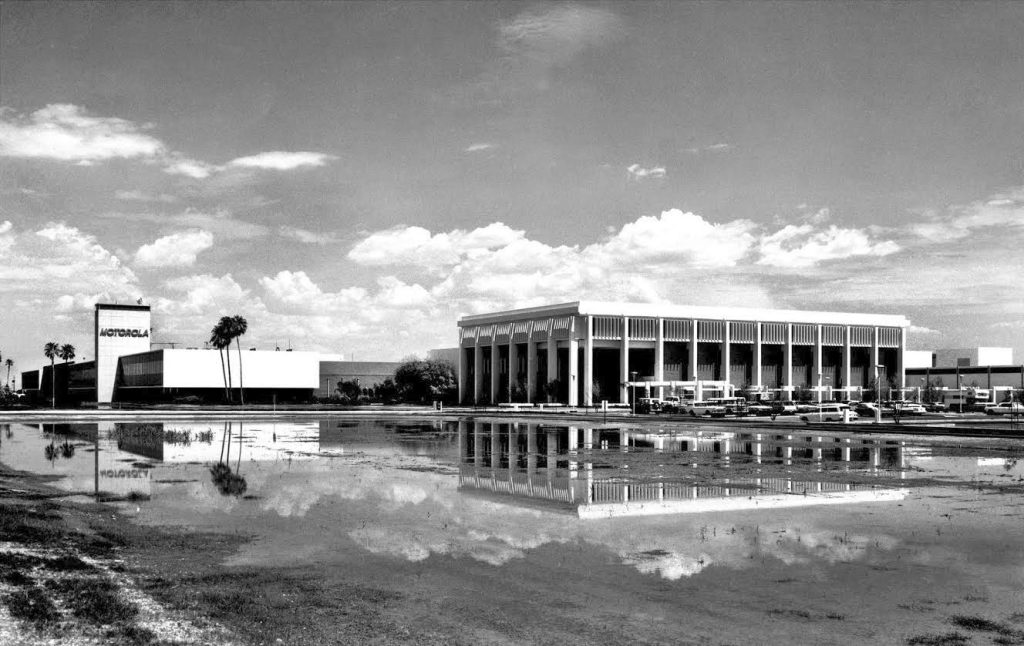
Motorola_52nd_St_McDowell_1960s
Motorola was once the backbone of technology industries recruited to Phoenix in the late 1940s and 1950s. Above is the 52nd Street and McDowell plant circa 1965.

How did Phoenix get in this mess? A mess where the economy is in an outright depression after outperforming much of the nation, by some measures, for decades. A mess where its grades in quality economic circumstances are among the worst in America, and where it may be America's fifth most populous city and 13th largest metropolitan area but underperforms its peers by an embarrassing gap.

It took a lot of work.

When I was growing up, people talked about the Four Cs of Arizona's economy: Copper, cotton, cattle and citrus. The fifth C of climate — I don't recall that, and it may have been added later to justify the machinations of the Growth Machine, although to be sure, "health" and tourism were Phoenix selling points for most of the 20th century.

For much of the territory and state's history, climate was a decided negative. In any event, even the "Cs" was an over-simplification, leaving out railroads, a wider array of mineral extraction, other agricultural sectors and the condition of the state. Arizona was a frontier state, isolated, with an unforgiving landscape and sparse population. Even in 1950, the population of the entire state was 750,000. In today's language, its carrying costs were low, its sustainability high. But as an economic player, it was dwarfed by most other states.

By the late 1950s, Flagstaff had timber and the Santa Fe Railway. Globe and the mining districts lived off copper, where Arizona was a world-class supplier. The copper industry paid 22 percent of the state tax load and provided thousands of good jobs, albeit with the downside of control by eastern capitalists. Other minerals hubs were mostly played out, often leaving ghost towns. One exception was Prescott, the onetime state capital, which was a division point on the railroad. Tucson was a major rail center on the Southern Pacific and a military base. Cattle ranches proliferated; this industry was valued at $200 million in 1962 (about $1.4 billion in today's dollars). But most of the state was wilderness. The exception, mid-century, was Phoenix.

Growing up in old Phoenix

Growing up in old Phoenix

Central_Palm_Lane_looking_south_Central_United_Methodist_Church_1960s

I grew up in a small town. Its name was Phoenix, and even though it had 439,170 people by the time I was four years old, in 1960, it still seemed like a place I could wrap my arms around and carry with me, just like the little towns in the movies. We lived near Cypress Street and Third Avenue, about a mile from the border of downtown. The houses faced the street, many had porches, the lawns were lush, the shade inviting.

My friends and I stashed fallen oranges and rolled them out into the rush-hour traffic on Third and Fifth — back then, before the Willo Soviet tried to wall off this neighborhood, these streets had three lanes each and carried substantial traffic twice a day, people going to and from work downtown. The oranges were also useful in friendly alley fights; more serious conflict escalated from dirt clods to rocks. Oh, we also ate them, because everyone had citrus trees in their yards and it was a quick drive out to the groves, where boxes of oranges could be purchased at roadside stands surrounded by the lavish bounty of the Salt River Valley. Some days we lay under the trees at Paperboys' Island, a pocket park at Third and Holly, and just stared into the cobalt sky, dreaming the dreams of young boys.

By the time I was eight, I was mobile and free, within limits. Specifically, I could ride my bike from Thomas to Roosevelt and Third Street to Fifteenth Avenue. It was an amazing landscape for a child. The library, art museum and Heard Museum were there. Soda fountains proliferated at drug stores, from the Rexall on Roosevelt and Third Avenue to Ryan-Evans at Seventh and McDowell to shops on Central. Every gas station had a drinking fountain with cold water, an essential for young desert rats. The firefighters at the old Station 4 on First Street and Moreland, as well as the Encanto/Seventh Ave. station indulged us. We bugged the people at Channel 12 and Channel 5 (Wallace & Ladmo's home!) for old reels of commercials — the apex of our ubiquitous trash picking. Encanto Park was a favorite hangout; it was where I decided I wasn't cut out to be a fisherman, but that didn't stop me from endless fishing journeys to the lagoons. The lovely moderne Palms Theater at Central and Virginia offered movies if we didn't want to hitch a ride downtown.

This part of the city was dense then with businesses. This was long before entire blocks were bulldozed or turned into dead space by parking garages. The buildings on the northeast and southeast corners of Seventh Avenue and McDowell, for example, were chock-full of small businesses. So was today's mostly empty Gold Spot — I got my hair cut there by Otis Kenilworth. Downtown was still the busiest shopping district in the state, followed by Park Central mall — both bracketing our neighborhood. I wasn't as fortunate as someone born a few years younger to sample the old city, but it was still pretty intact in the early and mid-1960s.

The big Valley Bank sign turned atop the art deco tower and other neon signaled downtown. Among the downtown landmarks was the Hotel Westward Ho, with its famed Thunderbird Room, where presidents stayed well into the 1960s. The skyscrapers going up along Central seemed signs of progress, not incoherent planning. I watched so many of them being built. My grandmother and I took the bus to shop downtown or at Park Central. This daughter of the frontier "traded," as she put it, at the small A.J. Bayless store at Central and Moreland. Just west were the shady median parks along Moreland and Portland, two of the few City Beautiful Movement touches Phoenix received. The parkways were lined by lushly landscaped apartment buildings. Every day, we drove downtown at 5 p.m. to pick up my mother at the Greater Arizona Savings Building, where the Interstate Stream Commission had its offices. It was amazing to see the crowds on the streets, just like a big city.