Phoenix 101: The East Valley

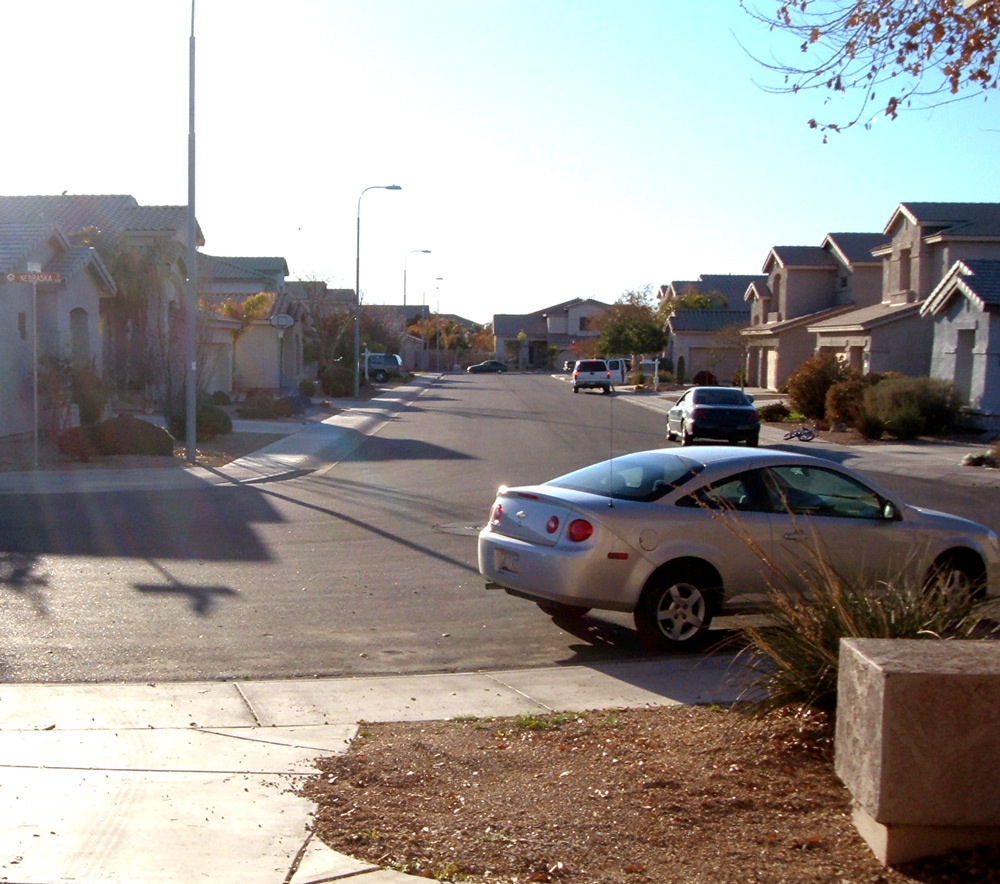
A subdivision in Chandler.
Of all the many delusional linguistic constructs in metro Phoenix meant to sell real estate and sustain the unsustainable (think, "The Sun Corridor," "the North Valley," etc.), only the East Valley has the most substance to it. Such was not always the case.
In 1960, when Phoenix's population was 439,170, Mesa clocked in at a mere 33,772. Tempe was a little college town. Scottsdale a small artist's colony/former farm town with "Western" touristy schlock. Chandler was a stop on the railroad for the San Marcos Hotel. The remainder were tiny agricultural villages. All were separated by miles of fields, groves, and history.
Mesa, for example, was distinctive for its settlement by Mormon pioneers. Tempe was the home of the normal school turned Arizona State College and just renamed a university. All the real towns supported separate newspapers. Mesa and Tempe had their own street-grid numbering systems. Guadalupe was its own unique enclave, first settled by Yaqui Indians fleeing the Mexican Revolution and was the most culturally Mexican place in the Salt River Valley.
The common denominators: Economies based on agriculture, the Southern Pacific Railroad, and (with the exception of Scottsdale) being south of the Salt River and thus part of the coalition that fought against Phoenix and north-bank farmers for water rights and allocations before and after the Newlands Act. Power in the area resided with the big growers and prosperous businessmen of Mesa, all members of the Church of Jesus Christ of Latter-day Saints.
By the late 1970s, the landscape was changing fast. Phoenix, Scottsdale, Tempe and Mesa had grown together. The Superstition Freeway was being slowly built east from I-10, reaching Dobson Road around 1977, disrupting and slowly killing the rich cluster of local businesses that lined old U.S. 60 along Mill Avenue, Apache Boulevard and Main Street.
Mesa's population was closing in on 150,000, and it was annexing miles of retiree trailer courts that ran along Main toward the Pinal County line. Samaritan Health Services, the forerunner of Banner Health, opened a new hospital, Desert Samaritan, near the new freeway. ASU had grown to be a large university and Tempe extended south with The Lakes. The first subdivisions of something called Ahwatukee were being finished. From the rise of I-10 at Baseline, the view east glittered like a jewel at night. Still, miles of citrus groves ran east of central Mesa, centered around Val Vista.
Almost everything south of central Mesa and Tempe was still agriculture. Chandler was a small town and Gilbert little more than a crossroads. Williams Air Force Base was in operation and far from everything, linked by the ubiquitous two-lane concrete roads lined on each side by irrigation ditches.
The next two decades would see startling change, and the evolution into a true separate identity within the Phoenix metropolitan area.
 45
45