Is perpetual war inevitable?

Is perpetual war inevitable?

US_Navy_Aircraft_Carrier_USS_John_C_Stennis_MOD_45153514
In an otherwise interesting essay entitled, "The Price of Perpetual War," we find this perplexing paragraph:

The United States did not choose this era of perpetual war. It is the price of living in a world where, for the first time, terrorist groups and malevolent individuals can reach the United States and wreak havoc from virtually any corner of the world. That threat was literally brought home by al Qaeda on 9/11 and reinforced all too recently by the terror attacks in Paris, Brussels, and San Bernardino.

Does anyone believe this is so? Alas, millions of Americans. But to make a quick list…

…We chose to give a blank check to Saudi Arabia to run one of the world's most repressive regimes while spreading extremist war-on-the-infidels Islam throughout the Middle East and beyond. One doesn't have to subscribe to conspiracy theories to acknowledge that Osama bin Laden and 15 of the 19 hijackers on 9/11 were Saudi citizens. And what has our kowtowing to the kingdom given us? The House of Saud's oil, to fuel our "non-negotiable" (and already heavily subsidized) car-based sprawl lifestyle. Most oil needs to stay in the ground if we are to avoid destroying the planet even more — and between "making different arrangements" and domestic oil, we don't need OPEC anymore. …

…We chose an even closer connection to Israel, Riyadh's quiet ally, whether this was in America's national interest or not. And with the oppressive and increasingly extremist regime of Benjamin Netanyahu is it increasingly not. Indeed, increasing Jewish settlements on Palestinian land and injustices against the Palestinian people committed by Israel blow back on the United States, which has long ago lost its credibility as an honest broker in the Middle East. It has inflamed Islamic and Arabic anger against us. And for what? To please the powerful donors of AIPAC and older Jewish voters in the swing state of Florida?…

The unraveling

Matt Taibbi's column entitled "RIP, GOP: How Trump is Killing the Republican Party" is a compelling, entertaining read. He writes:

After 9/11, it felt like the Republicans would reign in America for a thousand years. Only a year ago, this was still a party that appeared to be on the rise nationally, having gained 13 Senate seats, 69 House seats, 11 governorships and 913 state legislative seats during the Obama presidency.

Now the party was effectively dead as a modern political force, doomed to go the way of the Whigs or the Free-Soilers.

But I'm not sure his argument here ultimately holds up. Nor does his premise that the Republican base has finally awoken from its trance, realized they have been sold down the river by the GOP, and are finally ready to "fight for their economic lives," if even with the incoherent [real-estate developer].

My sense of the base is that its rage is driven by that (Black) Man in the White House, people of color allegedly getting free things they don't deserve, Hispanics illegal and legal, SOCIALISM, and the usual culture war tropes from guns to, now, transgender bathrooms. And come November, every Republican from David Brooks and Paul Ryan to the red suburban precincts of Phoenix will dutifully cast their ballots for [the real-estate developer].

Jane Jacobs is dead. Long live Jane Jacobs.

Jane Jacobs is dead. Long live Jane Jacobs.

Jane_Jacobs
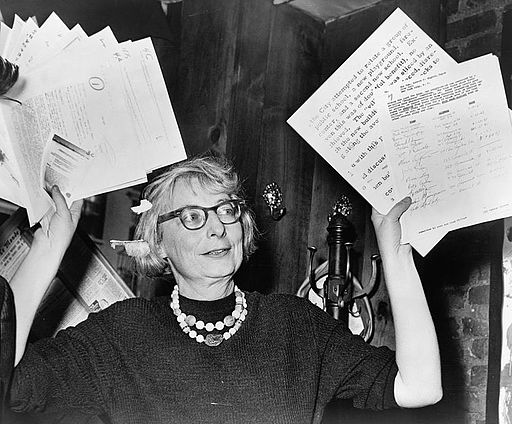
May 4th marked the centennial of the birth of seminal urbanist Jane Jacobs. It has been marked by numerous articles. Some of the better ones are here, here,  here, and, for a contemporary piece of revisionist iconoclasm, here. The latter aside, Jacobs remains an important figure, perhaps the most influential voice, in explaining the value of cities, how they really worked, and the damage of the planning elite. She begins her most famous work, The Death and Life of Great American Cities, bluntly: "This book is an attack on current city planning and rebuilding."

Written in 1961, the book was the first major refutation of the ideas that had brought urban renewal, dead housing projects, dull suburbia. Her great nemesis was Robert Moses, the powerful city planner and master builder of mid-century New York City. His hubris and the damage he did to New York are masterfully plumbed in Robert Caro's The Power Broker. Entire neighborhoods were bulldozed to make way for his freeways and his influence spread nationwide. She led the crusade that stopped Moses' Lower Manhattan Expressway, which would have gutted Geenwich Village, SoHo, and Little Italy. At one point in the battle, she was accused of inciting a riot (talk about the Resistance).

Jacobs was not an ideologue. To her, ideology was poison, offering "pre-fabricated answers" that adherents always fall back on. Instead, she was an observer of cities, a chronicler of what worked and what didn't.

Not once is Phoenix mentioned in Jacobs' first book, even though it was a big city by 1961. Still, I suspect she would have found much to like in the old Phoenix, where there was a "ballet of the streets" downtown and much of the city was focused on use by people instead of automobiles. This was before the freeways, before the teardowns. If she were alive today (she died in 2006), Phoenix would represent every horror she could imaging befalling a city. The Papago Freeway inner loop is classic Robert Moses vandalism. Her critique would include a lack of safety, for she documented how much more crime occurred in "thinned out" Los Angeles than in dense New York.

The heat is on

The heat is on

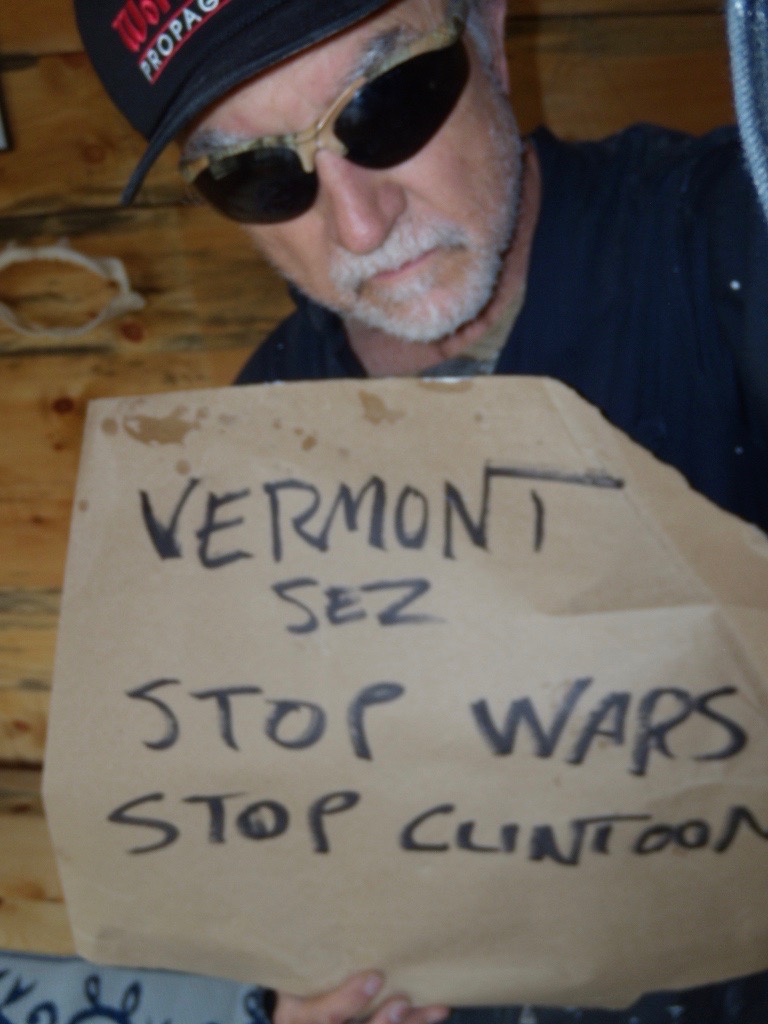
DSCN2911As you can see, our Front Page Editor is not shy about his opinions as we head into the general election race. I don't share them but he takes a better photo than your humble columnist. He also represents a not insubstantial portion of Bernie-struck progressives. Now that [the real-estate developer] has made his nomination virtually inevitable, I do have a few observations.

1. It's amusing seeing the pearl-clutching, "how could we have been so wrong?" musings of the pundit class. See the New York Times' Nate Cohn here. If you want further laughs, there's always Thomas Friedman, sans taxi driver. As someone rightly tweeted, "@tomfriedman wrong on every single thing he writes, every day of his life, & it will not in any way jeopardize him."

Even a simple, small-town boy from Phoenix could tell that Trump was formidable from the get-go. He is a reality TV star in Moronistan. He doesn't give a damn about "conservative" dogma, but knows how to push just the right buttons with the real conservative base in today's America. He was facing nullities as opponents. Time magazine anointed Marco Rubio as "the Republican savior," among a host of covers crowning Chris Christie, Rand Paul et al. As commenter Concern Troll would say, "lol lol."

2. Neither "conservatism" nor the Republican Party are dead. They have merely taken off their human suits, shucked off the last of William F. Buckley intellectual respectability, seen their Gingrich Revolutionaries tote each other to the guillotine, and found their true north in [the real-estate developer].

There was not, as George Wallace would say, a dime's bit of difference between the creepy Ted Cruz and the pleasant John Kasich. All were in thrall of the nostrums of The Party That Wrecked America. The Party of Lincoln and TR, even a mass American political party, had been dying for some time. But don't be under any delusions.

The same political savants now predicting mass defections are wrong. When they get to the polling place, they will vote for [the real-estate developer]. Unlike the most fervent backers of Sen. Sanders, they know there's a huuuuge! difference between him and Hillary. More significantly, they will continue to vote Republican down-ticket. This will especially matter if Democratic fratricide continues.

Stop making sense

Stop making sense

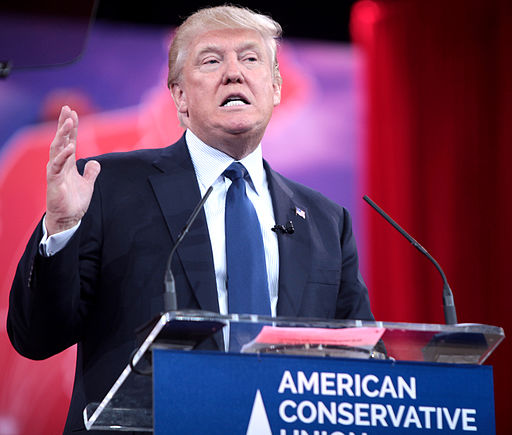
Donald_Trump_by_Gage_Skidmore_3_(cropped)[The real-estate developer] gave a "serious foreign policy speech" this week and it actually had much to recommend it. To be sure, it had contradictions. He channeled John Quincy Adams when he said that under his administration, "The world must know that we do not go abroad in search of enemies, that we are always happy when old enemies become friends, and when old friends become allies." He savagely critiqued the Cheney Doctrine. Thoughtful people would be unsettled by "America First," because that echoes the isolationism of Charles Lindbergh. And while he challenged free-rider allies to do more, he said, "We’re going to finally have a coherent foreign policy based upon American interests, and the shared interests of our allies." Perhaps the key word is shared. Because many interests of our allies, especially Benjamin Netanyahu's Israel, do not serve our national interest.

But overall, it was a serious and compelling address, one to make the foreign policy elites squirm. Things such as this make him a very dangerous opponent for the Democrats in the fall.

He has already found the sweet spot for Republican voters, a combination of economic nationalism and xenophobia on Muslims and Mexicans. Most average conservative voters don't really care about the dogma peddled by Ted Cruz and the right-wing elites. Jim Kunstler is willing to write what is forbidden in liberal circles but widely felt elsewhere:

In terms of sheer persona on persona, Trump is not much better (than Hillary Clinton), a walking hood ornament on the faltering beater car that America has become. But at least he recognizes that the beater beneath him needs a complete overhaul, even if he can barely cobble up a coherent list of particulars, or name the mechanics who might be able to fix the damn thing. And, of course, a broad swathe of Americans whose lives have also come to resemble beater cars are very sympathetic to the impulses Trump radiates.

For example, I happen to agree that the nation needs to act on immigration, both on the problem of illegal immigrants and on limiting the quotas of legally admitted newcomers. The Left, sunk in its sentimental sob stories of “dreamers,” and its nostalgia for the Ellis Island romance of 1904, can’t conceive of any reason why the nation might benefit from, at least, a time-out on invitations. The idea undermines their world-saving fantasies. In my little corner of America, the computer chip factory run by Global Foundries (owned by the Emirate of Dubai) has just laid off the majority of its homegrown American technical labor force and replaced them with foreign technicians on H1B visas, thus creating x-number of new Trump voters among the laid-off, and rightfully so, I think.

The number of foreign-born Americans is at a record, higher than even the enormous wave of immigrants from the 1890s to 1920, after which the nation implemented just such a time-out.

Carolina on our minds

Carolina on our minds

IMG_0372 (1)

A restroom sign at Safeco Field in progressive Seattle. You won't find this in Red America.

Living on the ring of fire, I think of earthquakes, try to prepare for them. The U.S. Geological Survey explains their cause, “The tectonic plates are always slowly moving, but they get stuck at their edges due to friction. When the stress on the edge overcomes the friction, there is an earthquake that releases energy…”

Our whole country consists of tectonic plates that have been stressing against each other for decades, ready to let loose The Big One.

The last time we were this divided was the eve of the Civil War. This time, the sectionalism remains — it has even grown — but there’s little chance of secession. So we will grind on until some event precipitates the big break.

I think of this watching the controversy over North Carolina's House Bill 2, otherwise known as the “bathroom bill.”

The Republican governor, Pat McCrory, was Charlotte’s mayor when I was business editor of the Charlotte Observer. I knew him as a not-very-useful source. He was good looking, one lapel shy of being an empty suit, no Rhodes Scholar.

Questions for nominee Sanders

Questions for nominee Sanders

Bern
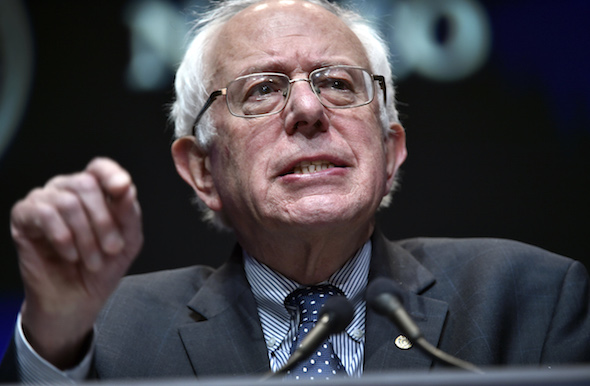
Outside the social media echo chamber of #FeelTheBern, Sen. Sanders is even less competitive than he appears in the race for delegates. But the willingness to burn down the party if he doesn't get what he wants, something discussed in an earlier column, has become even more apparent.

Earlier this week, Sanders said Hillary Clinton is not qualified to be president. Also that she is willing to destroy the party to attain her ambitions. Her response was appropriate. He also lied about Clinton saying the same about him. By the end of the week, he walked back the assertion but the damage was done. A quarter of Sanders supporters said they would not support Clinton if she is the nominee, compared with 14 percent of Clinton backers if Bernie is the standard bearer.

So, assuming Sanders wins the nomination, I have a few questions. These are serious inquires and I hope they will draw out equally serious responses in the comments section.

1. After the vicious campaign against Hillary Clinton, which involved recycling Republican attack points as well as questioning her integrity, intelligence, and fitness for office (and ascribing the worst possible motives to her supporters), how does the Sanders campaign plan to unify the Democratic Party for the general election?

2. Does the Sanders campaign realize that the United States is closely divided between red and blue — the Cold Civil War — with an edge to the Republicans because of their control of statehouses and increasing voter suppression measures? What is the general election strategy to reach 50.01 percent and win the Electoral College?

3. A "political revolution" is not a political program unless you are advocating bloodshed and extra-constitutional means. Sanders has raised no money for down-ticket Democrats and has been coy as to whether he will at all. So what's the plan to assemble a House and Senate solidly controlled by lawmakers who would actually pass the bills to create Sanders' social democracy?

Voter suppression

Arizona has become a bellwether in recent years. Before the Tea Party, well funded by Republican oligarchs, surprised Democrats in the 2010 elections, Arizona had led the way with the passage of SB 1070 and crazy, racist political movements. The result was a takeover of all statewide offices by right-wing extremists.

Now we have the disaster of the primary election, where voters were forced to wait for hours in lines. The number of polling places in Maricopa County was cut from 200 in 2012 to only 60. These closures fell heaviest in poor and minority areas. Details are contained in the Arizona's Continuing Crisis news vertical on this site.

Elvia Diaz of the Arizona Republic correctly writes that this was not a bureaucratic mistake by County Recorder Helen Purcell but "a well-orchestrated plan to keep … Latinos from voting." Purcell had a green light when Arizona was among the states exempted from long-standing federal oversight after Republicans dismantled the Voting Rights Act:

Advocates and academics have documented concrete examples of discrimination against minority voters since statehood to the March 22 Republican and Democratic presidential preference elections. Those in power have adeptly used cultural and language barriers as a weapon. For instance, in the early 1900s, Arizona enacted its first English literacy test.

“The literacy test was enacted to limit ‘the ignorant Mexican vote’ … As recently as the 1960s, registrars applied the test to reduce the ability of Blacks, Indians and Hispanics to register to vote,” according to historian David R. Berman.

If you think about it, little has changed throughout Arizona’s history. Conservatives have incessantly targeted minorities and typically intensify their efforts during economic recessions or political turmoil.

Indeed, future Chief Justice of the United States William Rehnquist participated in Operation Eagle Eye, a voter suppression tactic aimed at minorities in south Phoenix in the 1960s. Remember, Arizona was long as much a Southern as a Western state. So its inclusion in Justice Department oversight of voting was well deserved.

Bern down the house

I thank readers for keeping traffic and comments going while I was juggling tasks this week. The debate on the previous post concerning the Democratic primary is quite remarkable and worth reading. At the risk of alienating some of you, I come down squarely with Soleri regarding Sanders.

I use the clause "at the risk…" because this battle has turned amazingly ugly. Friendships will be lost over Sanders vs. Clinton. Despite being a Democrat only since 2015, the senator from Vermont has the potential to burn the party to the ground if he doesn't get his way — or, because he probably wouldn't pull a Ralph Nader, his supporters do.

The invective hurled at Hillary from social media to my in-box is so over-the-top as to make me wonder, what's going on here? Clinton and Sanders debates have been far more elevated and reality-based than the GOP klown kar. But the Hillary hatred is astonishing. She is never mistaken, or disagreed with, or made some head-scratching bad judgment calls — she is evil, despicable, a "war bitch"… you get the idea. That she was leading the effort to achieve single-payer health coverage when Sanders had only been in Congress for two years merely gets her more contempt from this crowd. The vast right-wing infrastructure has spent nearly 25 years trying to destroy her, mostly with lies. How sad if they get the final inches across the goal line from putative Democrats.

When I drove more often, I used to listen to Sanders on Thom Hartmann's progressive radio show. His views were bracing appraisals of our national situation, especially regarding Wall Street, inequality, and fair play — basically his stump speeches of today. He was preaching to the crowd. Now the crowd is much bigger. Yet he never seemed presidential material.

The reckoning

The reckoning

Donald_Trump_-_Caricature_(18058245844)
Let's deal with [the real-estate developer] first.

Many on the left see him as the second coming of Adolf Hitler. Despite Godwin's Law, Jim Kunstler wrote, "As for [the real-estate developer], he remains what I said at the campaign’s outset: worse than Hitler, lacking the brains, charm, and savoir faire of the Ol’ Fuhrer, and with his darkness even more plainly visible."

Google [the real-estate developer] and Hitler, and you got 5.6 million results as of today.

In an interview, New Left warhorse Noam Chomsky gave a more nuanced but still Weimar-y assessment of the reasons behind [the real-estate developer's] surprising strength:

Fear, along with the breakdown of society during the neoliberal period. People feel isolated, helpless, victim of powerful forces that they do not understand and cannot influence. It’s interesting to compare the situation in the ‘30s, which I’m old enough to remember. Objectively, poverty and suffering were far greater. But even among poor working people and the unemployed, there was a sense of hope that is lacking now, in large part because of the growth of a militant labor movement and also the existence of political organizations outside the mainstream.

But let's calm down for a moment and note a few important differences.

The Republican ‘mainstream’

The Republican ‘mainstream’

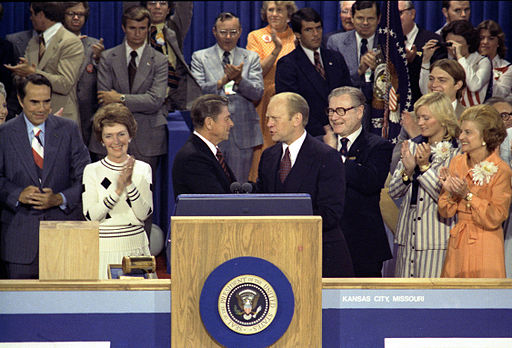
512px-1976_Republican_National_Convention

A truly mass party: The 1976 Republican Convention shows the triumphant centrist Gerald Ford over the conservative Ronald Reagan. Liberal Nelson Rockefeller, Ford's vice president, is to his right. Next to him is Ford's daughter, Susan.

The media have constructed a narrative for their campaign horse race stories, the ones all about the positioning of candidates and little about real issues. It goes something like this: The Republican "establishment," apparently represented by the likes of Ohio Gov. John Kasich and Florida Sen. Marco Rubio, is contending with an "insurgency" from Ted Cruz and especially Donald Trump.

Things are so dire that the idiot David Brooks, who traveled to the sprawl abortion of Verrado in the mid-2000s and saw "the future" rather than the dangerous housing bubble, to write a column (kinda) missing President Obama.

This, of course, is nonsense from a cowed national media.

The "moderate" Kasich is obsessed with a balanced budget achieved by cutting federal spending, attacking women's reproductive rights and charter schools. At least he said climate change is real — once. His ambition has him back denying mainstream science and he opposes EPA regulation of carbon emissions.

Kasich cut more than $84 million from Ohio's public schools. He removed a modest amount of state funding that had been slated for the Cincinnati streetcar and deep-sixed Ohio's plans for high-speed rail. Ohio boasted some of the finest public universities in the nation, including "public ivies" Miami University and Ohio University. Kasich threatened to "take an ax" to them if they didn't cut costs and raise tuition.

As a presidential candidate, he says he wants to keep Medicaid expansion, but favors "repealing and replacing" the rest of Obamacare (with what is murky). He wants to cut taxes and reduce union bargaining power. He wants "boots on the ground" to fight the Islamic State.

The trouble with Hillary

The trouble with Hillary

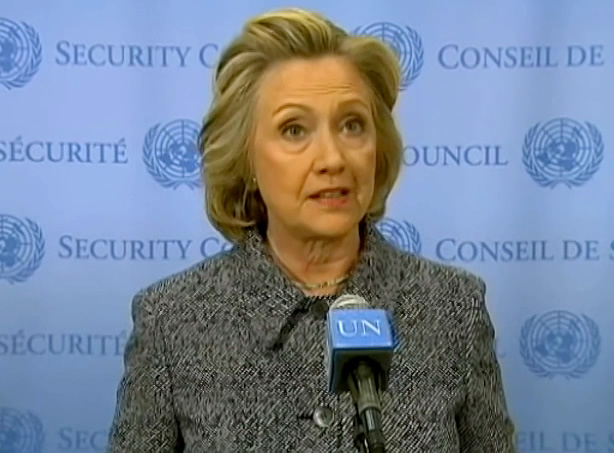
2015_03_10_Hillary_Clinton_by_Voice_of_America_(cropped_to_collar)The trouble with Hillary Clinton was painfully captured in a New Hampshire town hall, carried on CNN and moderated by Anderson Cooper, Wednesday night. I'll let Chris Cillizza of the Washington Post take it from here:

For 59 minutes of it, she was excellent — empathetic, engaged and decidedly human. But, then there was that other minute — really just four words — that Clinton is likely to be haunted by for some time to come.

"That’s what they offered," Clinton said in response to Cooper's question about her decision to accept $675,000 in speaking fees from Goldman Sachs in the period between serving as secretary of state and her decision to formally enter the 2016 presidential race.

Clinton is both seemingly caught by surprise and annoyed by the question all at once. Neither of those is a good reaction to what Cooper is asking. Both together make for a uniquely bad response.

Here's the thing: I'm not sure there is a great answer, politically speaking, for Clinton on the question of her acceptance of huge speaking fees from all sorts of groups — from colleges and universities to investment banks. She took the money because these groups were willing to pay it. And who wouldn't do the same thing in her shoes?

The problem is that you can't say that if you are the front-running candidate for the Democratic nomination, a front-runner facing a more-serious-than-expected challenge from a populist liberal who has made your ties to Wall Street a centerpiece of his campaign.

And that's just part of the trouble with Hillary Clinton.

Bernie’s Goldwater moment?

Bernie’s Goldwater moment?

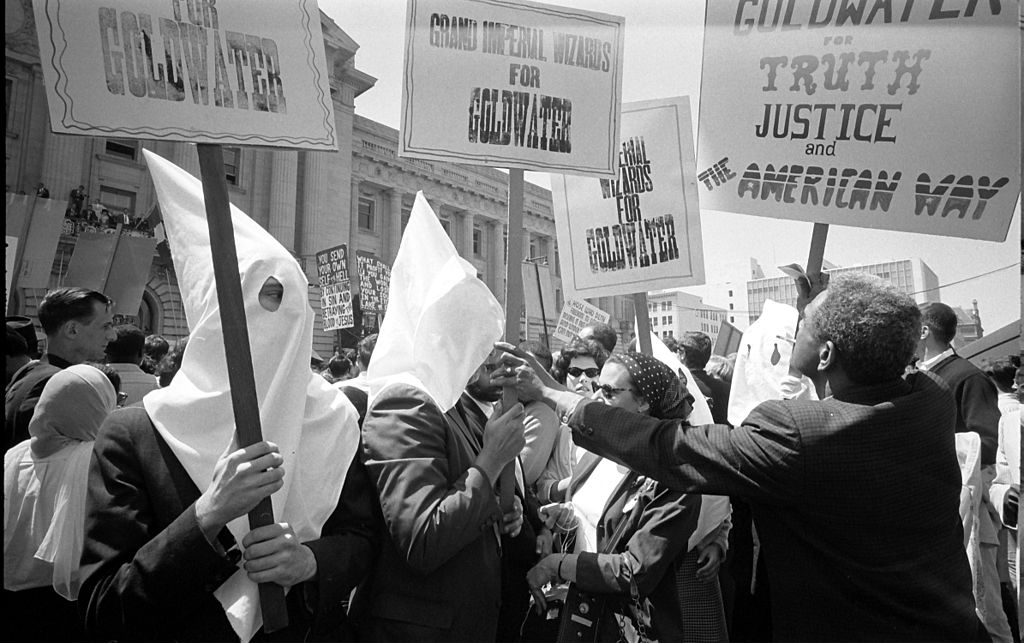
1024px-Goldwater1964SanFranciscoKKK
As every student of American politics knows, Arizona Sen. Barry Goldwater led a conservative insurgency that captured the Republican Party in 1964.

The GOP was a mass political party then, with liberals, centrists, and conservatives — the latter had been defeated and marginalized since 1932. The 1952 nomination fight loss of Sen. Robert Taft, "Mr. Republican," to the centrist Dwight Eisenhower had been especially embittering to the right.

The party was controlled by the generally liberal Eastern establishment. But in the 1964 national convention, its leading candidate, New York Gov. Nelson Rockefeller, was smashed by the Goldwater machine at the Cow Palace in San Francisco.

The department store heir embraced the reactionary right's agenda to roll back the New Deal and confront the Soviet Union much more aggressively. Goldwater opposed federal civil rights legislation, a stance he later came to regret but it attracted Southern whites. He didn't want to run against the ghost of the recently martyred John F. Kennedy (who, when alive, had worried about a Goldwater challenge). But he felt it was his duty to the party and his conservative principles.

Goldwater-Reagan_in_1964Of course Goldwater went down in one of the worst drubbings in the history of presidential elections. He carried only six states: Arizona (despite Eugene C. Pulliam endorsing LBJ) but more significantly for the future four states in the Deep South and South Carolina. Of equal significance was the visible support of actor Ronald Reagan, especially his famous "Time for Choosing" speech on the eve of the election. It made Reagan a political star and Goldwater's heir presumptive.

We can wonder what Barry and Dutch would think of Donald Trump, Ted Cruz, et al, and I have speculated that both would now be seen as "too liberal" to win a GOP school-board election. But the fact is that they built today's white, extreme-right Republican Party and everything it has brought to our national politics, life, and future. Much of Reagan's 1964 speech echoes eerily into our present.

Which brings us to Sen. Bernie Sanders.

The bitter taste in Flint

The bitter taste in Flint

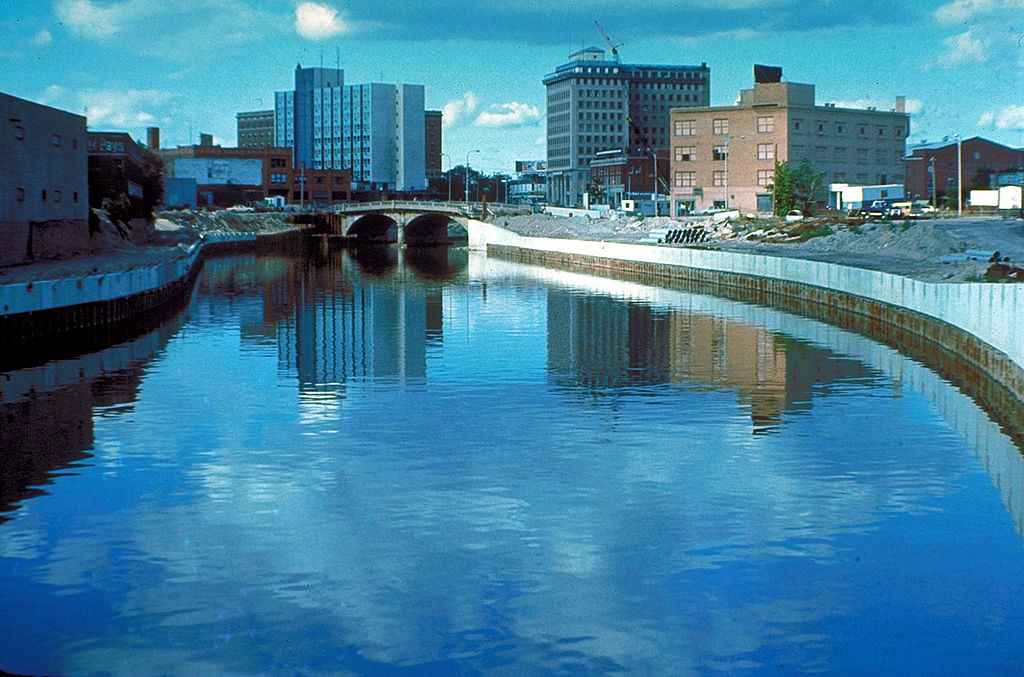
1024px-Flint_River_in_Flint_MIchigan
Although wealthy Republican Rick Snyder, the governor of Michigan, personally apologized for the catastrophe in Flint, he emphasized this, "Government failed you — federal, state and local leaders — by breaking the trust you place in us."

Well, no.

As Juan Cole made clear, Flint's water from Lake Huron has been fine under the city's elected government. But "Snyder staged a coup in Flint and appointed a city caretaker,or Emergency Manager, one Ed Kurtz, depriving the citizens of their voting rights. And Snyder’s appointee decided that a little money could be saved by switching the city’s water source from the Detroit Water and Sewage Dept. to the local Flint River. DWSD complained bitterly about Kurtz setting the two cities against one another."

As emails from the governor's staff also make clear, the crisis was dismissed by his top aides as unmerited complaints from antagonists in the majority black, Democratic city. In an echo of the GOP anti-science mentality, a pediatrician's study of lead in the water and its hazards was blown off as "data." Data, as we know, has a left-wing bias.

Behold, government run like a business.

When Ducey met Cali

When Ducey met Cali

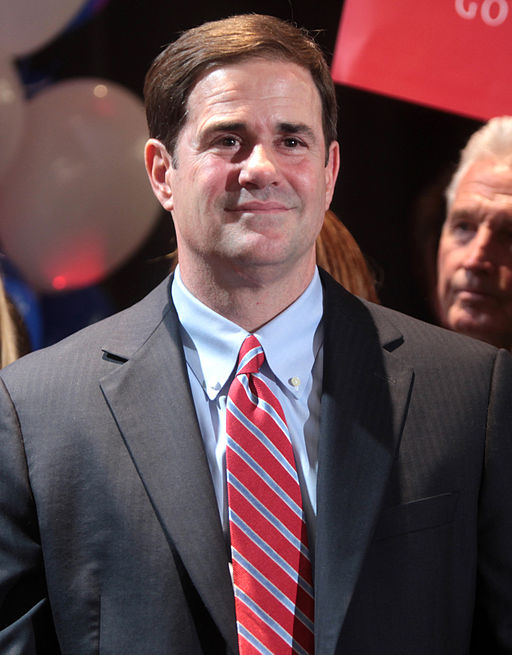
Doug_DuceyHe opened the door, so let's walk through.

He being wealthy Republican Douglas A. Roscoe Jr., aka "Doug Ducey," the governor of Arizona. In his State of the State address, he made a special point of contrasting Arizona's supposedly booming economy vs. the alleged economic disaster of the Golden State. As in, "So the goal is simple – to grow our economy, to take full advantage of our geography to better address the needs of businesses fleeing California and other states on the decline, and to ensure job creators who are already here, stay and thrive."

Let's look at the facts.

In November, the most recent month for which statistics are available, California's unemployment rate was 5.7 percent. Arizona's was 6 percent.

As of 2014, the most recent year available, Californians enjoyed a per capita personal income of $50,109; Arizonans struggled with $37,895. Median household income was $60,487 in California vs. $49,254 in Arizona. These are the "job creators," citizens with the incomes to spend and invest.

California has added 2 million new jobs over the past six years to reach a new record high. So much for companies "fleeing." Indeed, it is one of the most robust states for company formation and startups.

Arizona's gross domestic product is still below its pre-recession peak and stumbled along with 1.4 percent growth in 2014. California's GDP is at new record highs and grew more than 2.5 percent annually.