ISIS and us

President Obama has chosen to continue endless war. Imagine if we had spent the $3 trillion to $6 trillion already down the drain in Iraq and Afghanistan on America.

We could have built high-speed rail, bolstered our fading research dollars, seeded 21st century industries to address climate change and energy sustainability. But, no. Military Keynesianism is part of our industrial policy.

Do you feel safer than on Sept. 11, 2001? I don't.

The media played their role in scaring the hell out of the American people. They didn't mention the issues of overpopulation and climate change helping drive the destabilization, much less how we ran through Pottery Barn with a sledgehammer.

These adventures are profitable for the Military Industrial Complex and the neo-con echo chamber. For the common good, not so much. Our economy, marked by financial hustles and new electronic distractions, is a mess. This will affect our ability to win the next real war, where real national interests are at stake.

Floods in old Phoenix

Floods in old Phoenix

 JRowe_Rothrock_Tempe_Bridge_1891flood_SM
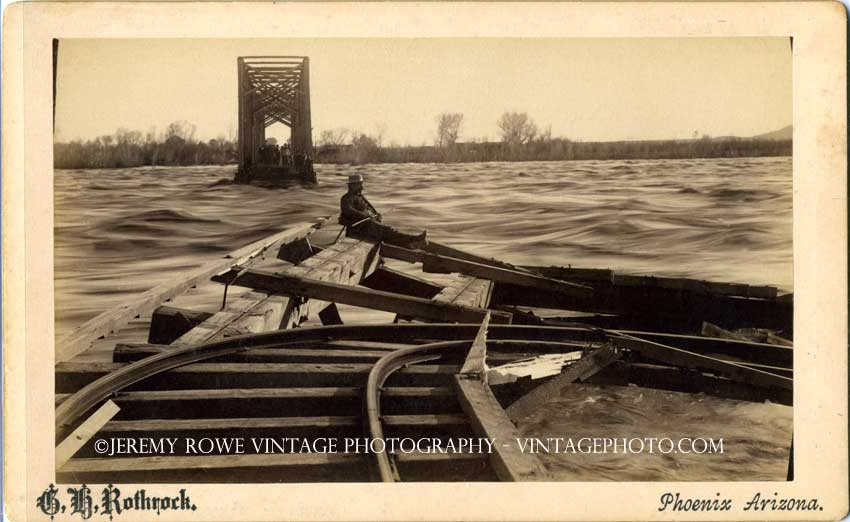
The rampaging Salt River destroyed the railroad bridge at Tempe in 1891, the river's worst flood on record.

Downpours in Phoenix often flood social media. The combination of so many new residents because of the metropolitan area's extreme population churn, sprawl built out in flood plains and the on-the-cheap engineering of freeways makes many believe this is a shocking and rare event. In fact, flooding is commonplace in Phoenix.

As a child in 1965, my mother took me to see the Salt River running wild over its banks. The snowpack was especially heavy that year and as it melted it filled the lakes northwest of the city, causing the Salt River Project to release water from its dams. My grandmother told stories about the floods in the early 1900s, including two that destroyed the Southern Pacific bridge just north of downtown Tempe. In one case, a passenger car was hanging over the edge. "You might not see this again in your lifetime," my mother said.

In high school in south Scottsdale, Indian Bend Wash flooded regularly, dividing the town in half and disrupting classes. The city built bridges but neglected to raise the approaches, so the wash merely went around them. It took years to engineer decent bridges and create the green belt along the Indian Bend.

The 1980 flood (one of ten that hit between 1967 and that year) cut off Tempe, Mesa and Chandler. Amtrak ran a special train (the Hattie B., named after first lady Hattie Babbitt) from those cities to Union Station. Ominously, officials worried Stewart Mountain Dam might fail. And when I returned in the 2000s, the Salt ran rampant again.

Plan B

Plan B

Cairo_conference

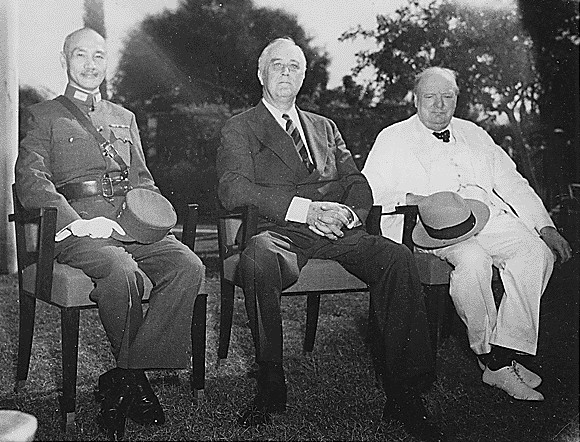
Present at the Creation: Chiang Kai-shek, FDR and Churchill at the Cairo Conference during World War II.

President Romney wants a "mighty" military. President Putin might be willing to fight a nuclear war to take down American "hegemony." President Xi is asserting a Chinese regional hegemony that writes its own international law. The brutality of ISIS is making Presidents Assad and Saddam Hussein look like pillars of stability by comparison. Americans, or at least the D.C. elites, claiming to value straight talk recoiled — quelle horreur! quelle gaffe! — when President Obama said "We don't have a strategy yet" regarding ISIS.

Better, I suppose they are saying, to further wreck the country with more of the Bush/Cheney fire, aim, ready. As the tour d'horizon above shows, these are unquiet times, made more so for those who know what happened 100 years ago.

As social critic Jim Kunstler says, we're not the world's hall monitor. On the other hand, Pax America, for all its fumbles and stains, has ensured the longest period without a general war since the 19th century. This was no accident.

Most American leaders of the 1940s, Franklin Roosevelt foremost among them, believed Hitler rose to unleash the most destructive war in history because of American isolationism. Both in idealism and realpolitik, FDR hoped that a United Nations anchored by the five victorious allied powers would prevent a recurrence. (He had the foresight to insist that China be included in the Security Council). But it would be anchored by American power.

Stalin wrecked the hopes for the former, but the latter prevented a hot World War III. Our might was always based foremost on having the world's top economy, its gains widely shared, the greatest middle class in history, the commons…and relatively high tax rates.

While I was away

John Sperling passed on. I am mindful of Horace's de mortuis nil nisi bonum, but Sperling was a public figure of consequence, deserving an assessment. In keeping with the life he led, Sperling died in the Bay Area, not the city whose name he took for his empire of for-profit education.

The New York Times wrote, "A survivor of childhood illness, learning disability, poverty and physical abuse, he earned a doctorate from the University of Cambridge; a liberal former union organizer, he spent years battling government regulation; a longtime professor who did not enter business until his 50s, he became a spectacularly successful capitalist."

The University of Phoenix made him fabulously wealthy. His net worth in 2002 was $1.1 billion and he spent 20 years on the Forbes 400 list of richest Americans. With the troubles of parent company Apollo and its stock drop, he was below a billion in 2013.

He reveled in being quirky, combative and rebellious, especially against the education establishment and the government. And yet the GI Bill — authored by Arizona Sen. Ernest McFarland — allowed Sperling to get his bachelor's degree from Reed College in Portland, Ore. Federal student loans turned what would have once been considered a "business college" into a mighty profit engine.

Among the individuals who wrecked the commons, Sperling is right up there. Privatizing profits, socializing losses, the cost and quality of an education at the University of Phoenix and other for-profit schools deeply questionable.

Childen and guns

The thing about most guns is that they kick, something especially true of shotguns and automatic weapons. When the firearm discharges, the explosion in the chamber and subsequent chain of events and physics to send the bullet or shot at, say, 1,200 feet per second or faster, causes the barrel to rise. In the case of a shotgun, it also sends the stock back against the shooter — in some cases hard enough to knock him down.

I learned this as a child in the West. I learned it the right way, with competent, demanding adults and on properly prepared and supervised ranges.

For example, the first time I ever fired an automatic rifle was when I was nine years old. Yes, the same age as the girl who accidentally killed her "instructor" at an Arizona "shooting range" when an Uzi kicked up and out of control.

In my case, some essentials were different. For example, I had been taught basic gun-handling at an early age. Never take a firearm without making sure it is unloaded; with an automatic or semi-auto, that means not just dropping the magazine (not a "clip" unless it's an M-1 rifle) but also clearing the chamber. Never point a gun at someone "unless you intend to shoot them," said my mother the crack shot. Never traverse a barrel in someone's direction as you are handling the weapon. Even if you know the gun is unloaded. You always "police your brass" after shooting.

The economics of Ferguson

Rogue's note: This originally appeared Friday as my online column in the Seattle Times.

While the world is watching Ferguson, Mo., it is useful to examine how this inner-ring suburb is emblematic of many unfortunate economic trends in America. In 2010, the town was more than 67 percent African-American, a demographic particularly hit hard not only by the Great Recession but by disruptions with a longer arc.

The homeownership rate in Ferguson was almost 10 percentage points lower than the state's as of 2012. Median household income of $37,517 compared with Missouri's $47,333 (Seattle: $63,470). Twenty-two percent of the population was below the federal poverty level vs. 15 percent statewide. This despite the world headquarters for Emerson Electric being nearby.

As of July, the national unemployment rate for African-Americans was 12.2 percent. For those aged 16 to 19, it was a staggering 36.8 percent (a year earlier, it had been 42.9 percent). For whites, the comparable numbers in July 2014 were 5.6 percent and 18.9 percent.

AUGUST SABBATICAL: Barring major war or an outbreak of good sense in Arizona, I must leave you to focus on the new David Mapstone Mystery. I'm pretty good at multi-tasking,…
Arizona economy update

Arizona economy update

Even the local media are admitting that Phoenix is back in a housing slump. I mean no disrespect to hard-working Arizona journalists. But let's face it, the Real Estate Industrial Complex controls the conversation, withholds or doles out ad dollars and can, ahem, ensure that offending columnists are run off. So when the local media admit to a problem involving this sacred cow, head for the bomb shelter.

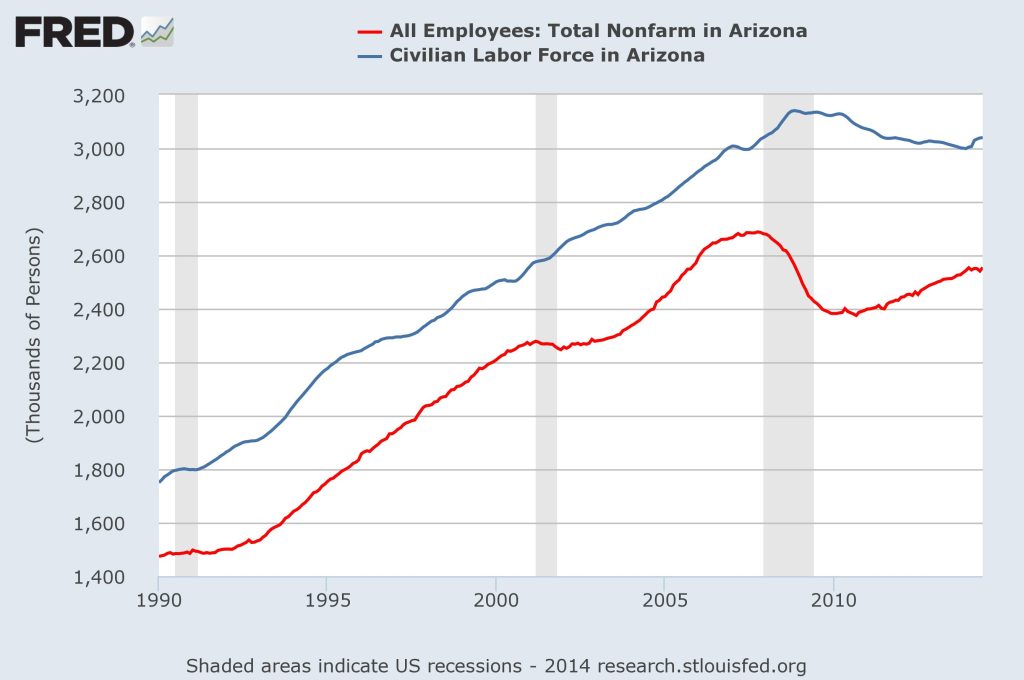
More about housing (yawn) later. The most arresting data come from a new report by the federal Bureau of Economic Analysis. Arizona's per-capita personal expenditures, adjusted for inflation, were virtually flat in 2012 compared to 2000.

And this is "consumer spending" kept afloat with massive debt considering that most wages have been stagnant or falling, and the typical American household saw a 36-percent decline in its wealth between 2003 and 2013.

Other mid-year observations:

Fewer people are working than before the Great Recession, and the available labor force has fallen…

LABORfredgraph

The preservation police

The preservation police

Whether through absent-mindedness or a Kookish desire to obliterate the memory of FDR, the state came very close to tearing down the 1938 administration building at the Arizona State Fairgrounds built by the WPA. The loose-knit community of preservationists — the preservation police, as one called it — went into action and the building was saved.

It's exhausting work done by average people. Phoenix lacks a wealthy steward such as Paul Allen, who saved and restored Seattle's magnificent Union Station and Cinerama. Phoenix lacks a widespread preservation ethic, too. There have been successes, such as saving the Frank Lloyd Wright house. And crushing failures, such as Robert Sarver's demolition of two territorial-era hotels to make…a surface parking lot.

Precisely because of these things, because Phoenix does have a fascinating history worth protecting even if it lacked the abundant good bones of older big cities — this makes the battle so important. Cities with enchanting old buildings and streetscapes also attract the creative class and urban-oriented tech workers and startups.

Our losses are profound. Here are a few of the ones most worth mourning:

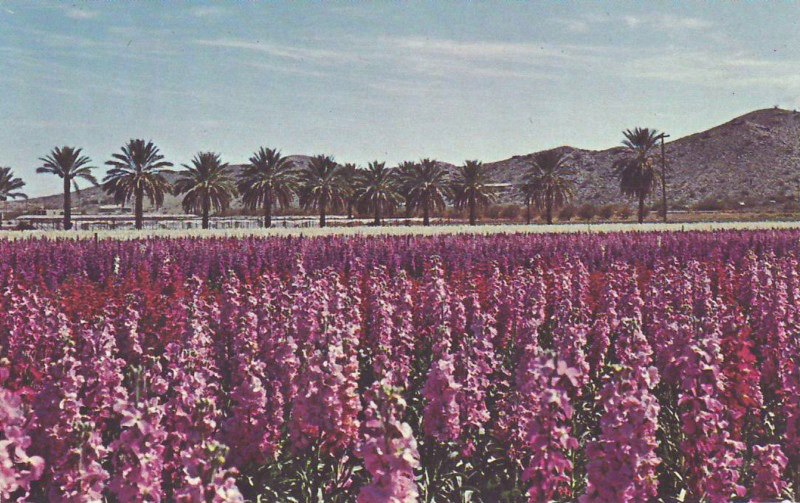
1. The Japanese flower gardens along Baseline Road.

Japanese_Gardens
2. The Fox Theater, torn down in 1975 by City Hall vandals to make way for a municipal bus depot.

FoxTheater

Fox_theater_stairway_1940s

Fox_theater_interior_Fox_Theater_11_S_1st_St_1930s

Borderline personality disorder

Here's the way the media see things. "House Republican Flailing Over Border Bill Drags On," from Daily Kos. "House GOP Abandons Border Crisis Bill Amid Conservative Opposition," from Talking Points Memo. The New York Times writes:

Many Republicans worried that leaving for the break without passing any border legislation would be damaging to them politically in the midterm elections, and vowed to stay as long as was necessary to reach a compromise within their own ranks.

The House may pass some kind of bill, but the meme, among some smart journalists, rests on some questionable assumptions.

One, that Republicans want to make a constructive response to the "border crisis" of the moment. Two, that the GOP is terrified that it must address this and other immigration issues or lose the future to changing demographics. Thus, failure to "do something" is a Republican defeat. Three, that there is a split within the Republican Party that has any real meaning.

I addressed the third point in a previous post. Today, I want to explore the first two assumptions.

No justice. No peace.

Having been unsuccessful in persuading Arizona to exit from the freeway to ruin, let me turn my attention to a more promising arena: the Israeli-Palestinian conflict.

This tweet neatly encapsulates the tenor of the debate:

My intention is not to wade too deeply into the history of this epic tragedy. Others can do it with more authority and/or brio. For example, Juan Cole:

The United States as a great Power is facing a large number of challenges in the Muslim world, and Israel’s Gaza campaign is endangering both American diplomacy there and the very security of the U.S. Given the series of setbacks for the US in the Middle East, in Iraq, Syria, Afghanistan and Egypt, Israeli PM Binyamin Netanyahu could scarcely have chosen a worst time to kill hundreds of Palestinian civilians in the full light of world media.

And James Howard Kunstler:

Israel has all the proof it needs that world opinion will never consider its right to exist important. The Obama White House, and a lot of the U.S. News Media, portray the Hamas-Israel conflict as something like an amateur soccer match, with the uneven score (40-odd Israeli soldiers killed versus 1000-plus Palestinians, mostly civilians) showing that the contest is unfair, that Israel has “gone too far,” that they have entered the same moral zone as Hitler, Stalin, and Pol Pot, carrying out a “genocide.”

Of course, this is a real hot war, not a diversity training exercise, or a self-esteem course, or any sort of the kindergarten psychotherapy that has come to form the basis of American thought and policy. And a vicious world opinion uses America’s own moral fecklessness the way Hamas uses women and babies to shield its rocket installations.

Instead, my intention is to set the table for discussion, debate and reflection by Rogue's smart commenters with some admittedly broad-brush observations.

The 1:57 to Florence

The 1:57 to Florence

Joseph Wood III was declared fully sedated ay 1:57 p.m. in the death chamber in Florence. But because of incompetence or a bad execution drug cocktail, he wasn't pronounced dead until 3:49 p.m.

This event has brought more of the kind of national news coverage to Arizona that can only enhance its reputation as a cruel and hapless place to the talented, compassionate and those who make decisions about where to deploy capital. A sampling is here. Even John McCain, who would know, called it "torture."

On the other hand, probably a majority of Arizonans would share the comment of someone from Phoenix on Facebook: "I saw nothing wrong with it…he did NOT suffer…just slept longer." When challenged, he added, "I hope the bastard rots in hell!!!" According to the Pew Research Center, 55 percent of Americans favored the death penalty in 2013, down from a high of 78 percent in the 1980s.

Wood was convicted in 1991 for the murder of his ex-girlfriend Debra Dietz and her father, Eugene. He also pointed the gun at police, who shot him.

Stuck

Stuck

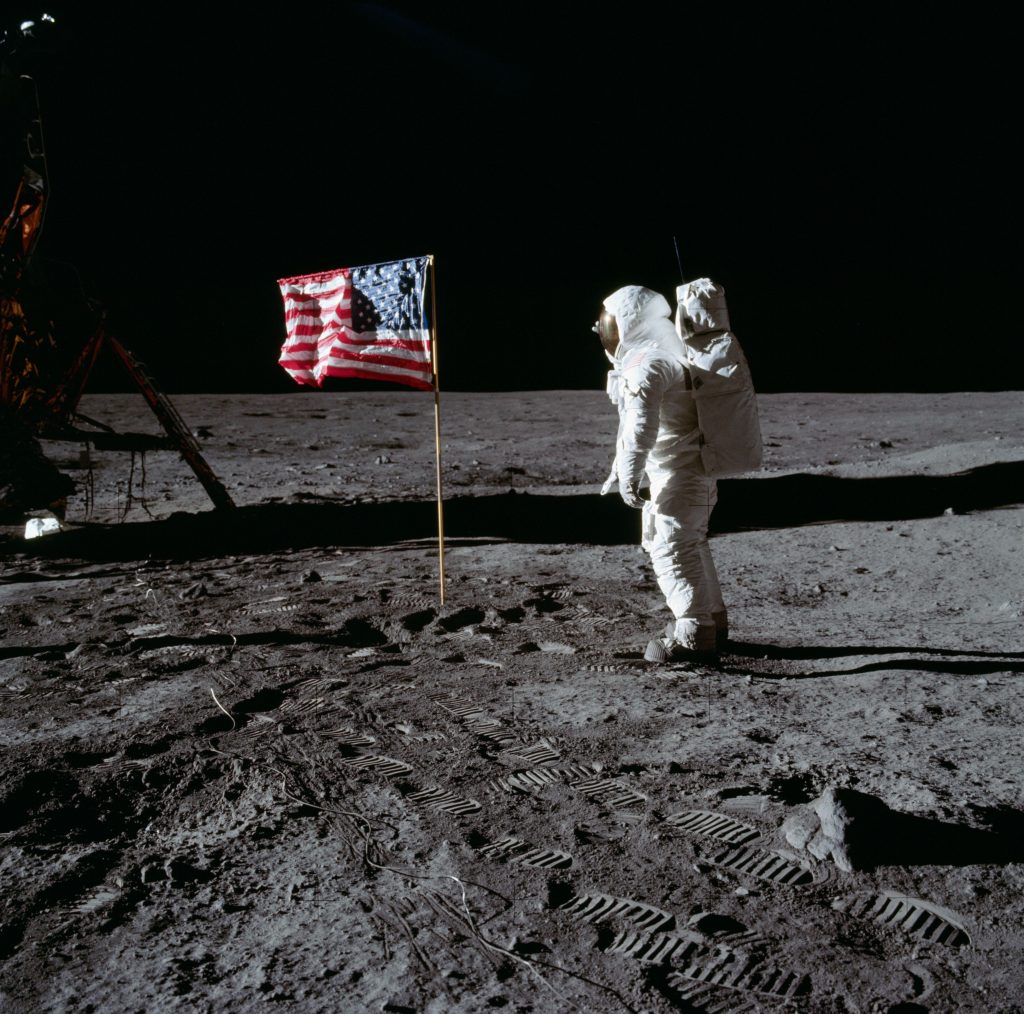
AldrinThis is the 45th anniversary of Apollo 11, the first manned moon landing. It marked the greatest achievement yet of a burst of federal funding of science begun under President Dwight Eisenhower. The 50th year since college students from the north went to Mississippi for Freedom Summer. Fifty years ago the Civil Rights Act of 1964 was passed. President Lyndon Johnson fought a war in Vietnam, misbegotten though it was, while declaring war in poverty. Soon, we will mark the half century since passage of the Voting Rights Act. In 1963, the Clean Air Act was approved, followed in 1972 by the Clean Water Act. In 1970, President Richard Nixon established the Environmental Protection Agency to enforce these laws.

What was the nation that did these things?

A few things stand out. It was a nation with the greatest middle class in history, the greatest industrial base the world had ever known, which made things — often with union hands, and even when not benefiting from the advances for working people ensured by organized labor. That nation believed in science and progress. It was run by two mass political parties encompassing conservatives, liberals and centrists. Taxes were high on the rich and progressive. Productivity was widely shared.

That nation is gone.

What’s downtown Phoenix, what’s not

What’s downtown Phoenix, what’s not

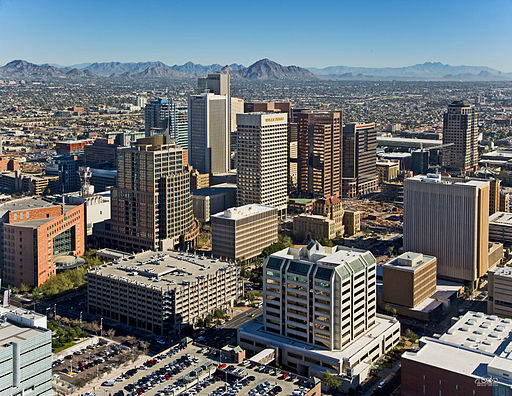
This is downtown — pre CityScape (photographer unknown):

512px-Downtown_Phoenix_Aerial_Looking_Northeast

Downtown 2020

Above is downtown 2020 (photographer unknown).

This isn't downtown (it's Midtown):

Phoenix-skyline

This isn't downtown, either. It's 24th Street and Camelback (photographer unknown):

Esplanade_Place_October_6_2013_Phoenix_Arizona_2816x2112

I wouldn't dare move to Chicago and claim that Hyde Park is the Loop. Nor could I say Hawthorne is downtown Minneapolis. Cincinnatians would quickly set me straight if I said Over the Rhine is downtown — downtown begins at Central Parkway. The natives in all these cities wouldn't let me get away with it. Nor would the transplants who felt a convert's zeal to protect the geographical integrity of their cities.

Yet people in "the Valley" (Silicon? Red River — of the north or of the south? San Joaquin? San Fernando? Of the Jolly Ho Ho Ho Green Giant?), many of them from these very cities, get away with this transgression every day in Phoenix.

Downtown Phoenix runs from Seventh Avenue to Seventh Street, and from the railroad tracks to Fillmore, or perhaps Roosevelt. It includes the original townsite and some additions. City Hall's definition taking the northern boundary to McDowell is ahistorical.

The water questions

The water questions

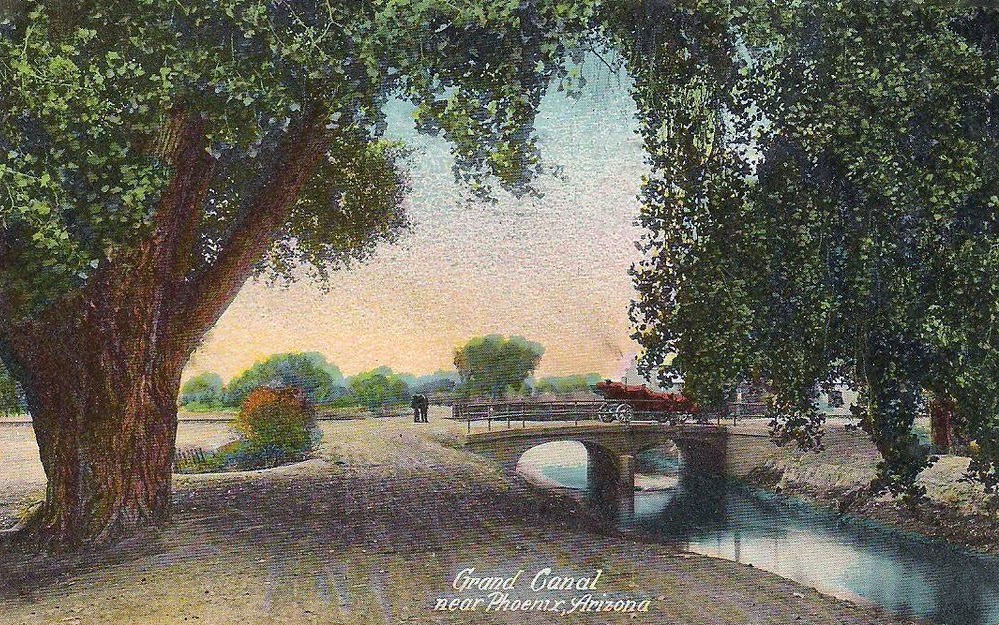
Grand_Canal_1915Phoenix's Grand Canal in 1915. Arizona's population: about 250,000.

I have been hesitant to pass along recent stories about water. Some examples, "Arizona Cities Could Face Cutbacks in Water From Colorado River," from the New York Times; "Phoenix May Not Survive Climate Change" on Salon; "America is Running Out of Water," from Vice; "Arizona May Be California's Future" on Slate, and this Tucson Weekly examination of the situation in the Old Pueblo.

Oh, and from Smithsonian (!): "Arizona Could Be Out of Water in Six Years."

Water in Arizona is a highly complex issue. It risks being spun as "everything's fine!" by the boosters, lied about by real-estate hustlers and their stooges, or oversimplified as "Phoenix is about to run out of water!" by outside observers. So let me tiptoe in with a reminder of this Phoenix 101 primer, and then…

Some things we know:

1. As with so much else, Arizona is not Phoenix. Even the farthest-flung reaches of the metropolitan area are not the old city. In other words, each part of the state has distinct water issues.

2. Phoenix is not Death Valley with subdivisions. In fact, the Salt River Valley, sitting in and near the confluence of multiple rivers, is the most abundantly watered place in the Southwest. The Sonoran Desert is the planet's wettest desert. This is why the Phoenix area has attracted irrigation civilizations going back perhaps 3,000 years. Phoenix is a natural oasis.

3. Thanks to this and the billions of federal dollars spent on reclamation projects in the first half of the 20th century, the core of Phoenix is blessed with nearby renewable water supplies. The dams and lakes of the Salt River Project delivered 767,445 acre feet to the project's footprint in 2012 and held nearly 1.5 million acre feet in the reservoirs in fiscal 2013. This water comes from snowmelt in the east-central Arizona mountains.