Statehood and its world

They couldn't pick a better time as that in life / It ain't too early and it ain't too late / Startin' as a farmer with a brand new wife / Soon be livin' in a brand-new state / Brand new state!

OK, I stole that from the musical Oklahoma!, about the 46th state, which entered the union in 1907. But the sentiments applied no less to the 48th, Arizona, the Baby State, the Frontier State, the Valentine State. At least for the Anglo settlers and not a few Mexican-Americans, especially in Tucson, statehood was a grand achievement, a validation of the efforts to build a new civilization in a wilderness. The government had declared the frontier closed in 1890, but it was very much alive in Arizona. The only photograph of my great-grandmother shows a grizzled, sun-baked woman standing outside an adobe hovel, my family's first home here. Air conditioning was decades away. She survived a Comanche attack as a baby — was scalped and wore a wig the rest of her life — when federal troops were withdrawn from the Texas frontier during the Civil War. In the 1890s, the family came to Arizona Territory. Plenty of heart and plenty of hope, indeed.

Many have been writing about the difficult path to statehood. I will only add that one big but largely forgotten impediment is that Arizona would come in as a Democratic state. Thus, it's no surprise that the Republicans who dominated Washington for decades after the Civil War would be loathe to give the opposition two new Senate seats and another in the House, along with Democratic electors in the Electoral College. Not only that, but allow statehood for a bunch of former Confederates and Southern sympathizers (Arizona Territory had a delegate to the Confederate Congress). And that's just what happened, with Henry Fountain Ashurst, Marcus Aurelius Smith and Carl Hayden beginning Democratic control of the state that would continue pretty much uncontested for 40 years. At his worst, Ashurst made Ben Quayle look like Pericles — he opposed a National Park for Grand Canyon, for example. Yet he also said, "When I come back to Arizona, you never ask me questions about such (international) policies; instead, you ask me, 'What about my pension?' or 'What about that job for my sons?' " Hayden, of course, went on to become one of the greats.

Things about Arizona

It's centennial week in Arizona, and the local media are doing their part. On Sunday, the Arizona Republic had a clever front-page display of wishes for the next hundred years from readers. My favorite was that Arizona enters the 21st century before it's over. Another asked for less conservative politics (good luck with that). The paper is trying very hard and doing good work. Inside were some quick hits by state worthies on what you should know about Arizona. They were relentlessly upbeat, as is a requirement for being viable here as a worthy: "The good people of Arizona have always had grit"; "We defy a stereotype as some might see existing in Maine, Texas or California"; "We are an iconoclastic bunch"; "It's a fantastic state with an early history that is just special," and, from Gov. Jan Brewer, "There is nothing that can't be accomplished here." Draw your own conclusions.

As usual, the rest is left to homey. "Every dirty job that comes along…," as Clint Eastwood growls in the original and best Dirty Harry film. So what are some things you need to know about Arizona? It's one of this blog's missions, but I'll try to put it into short Gannett-ese (sorry, my crack graphics/design team is off):

1. Arizona is not metropolitan Phoenix. Even though Phoenix-like mass-produced sprawl housing and shopping strips have spread statewide, most of Arizona has very different history, topography, cultures and socio-economic challenges from the big concrete blob in the center of the state.

The capitol

The capitol

Capitol_1960s
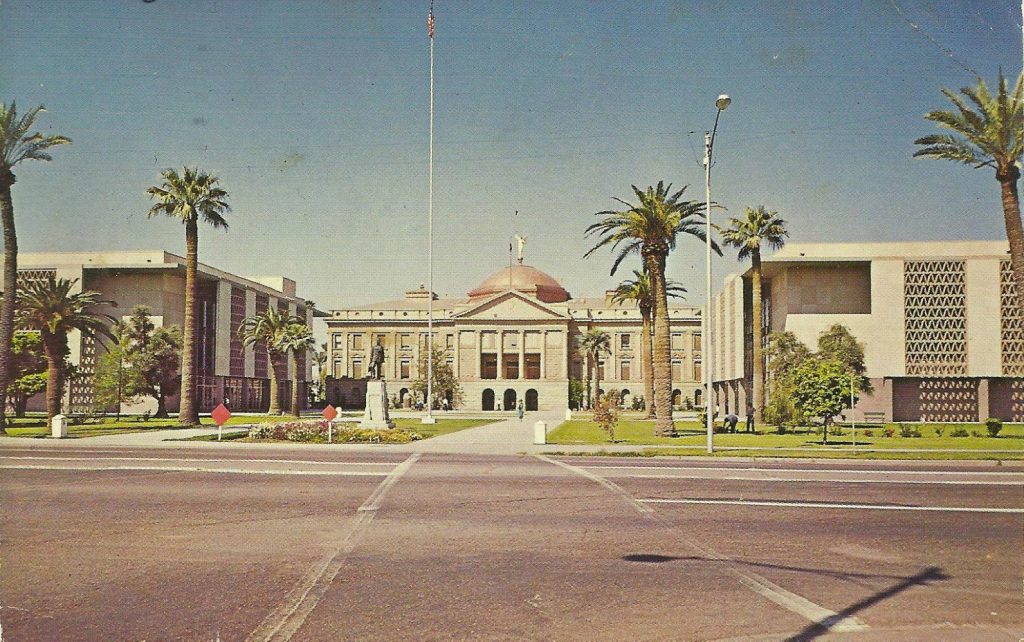
The Capitol and legislative chambers in the 1960s, before the erection of the brutalist Executive Office Tower.

Channel 12's Brahm Resnik asked me to nominate the three most significant Arizona political events since statehood. It's a bit like wanting a cinephile to name only three favorite movies. I settled for 1) statehood, which was not a given when it happened; 2) The congressional delegation's ultimately successful decades-long pursuit of Colorado River water, and 3) SB 1070, which is a bright red marker for the hotbed of intolerance, ignorance, extremism and backwardness into which the state has descended. Other events could contend, such as Barry Goldwater's 1952 narrow victory over Sen. Ernest McFarland, marking the birth of the Republican Party's ascendancy.

One of the most telling political stories, however, doesn't concern politicians or elections, at least not directly. It's about the old capitol building. The copper-domed structure was actually built as the territorial capitol and completed in 1901. The architect was James Riely Gordon, who designed many court houses in Texas, as well as a grand one for Bergen County, N.J. Gordon set aside his usual Romanesque Revival style to create a territorial capitol made from native materials. It was originally intended to be much grander, but the territory cut back funding. Additions made in 1918 and 1938 preserved the Gordon design.

President Kennedy (perhaps apocryphally) quipped that it was the ugliest state capitol in America. This was certainly not true: The Alaska capitol resembles an insurance company office; the Ohio statehouse with its forever-incomplete dome defines homeliness and lack of proportion, and North Carolina's looks like the court house for a small, poor county. The only saving grace for New Mexico's building is that it is in Santa Fe. To me, the old Arizona capitol always held a certain modest grace, particularly when I was growing up and it dominated the vista at the foot of Washington Street. But it's also true, odd and perhaps telling that Montana, which still doesn't have 1 million people, has a much bigger, grander capitol. And otherwise poor, conservative states such as West Virginia, Arkansas and Mississippi boast majestically beautiful statehouses.

Halftime in Arizona

Note to national and international Rogue readers: As Arizona marks 100 years of statehood this month, you'll have to put up with more than the usual number of AZ- and Phoenix-centric posts.

AzSemiIn 1962, Arizona marked its 50th year as a state. It's a vivid memory for me, although I was but a child. I loved the commemorative seal with the cactus wren, so much more appealing than today's gaudy centennial emblem. Fifty years of statehood was a remarkable event for those still living who had witnessed statehood and lived in Arizona Territory, my grandmother among them. The state in 1962 had barely more than 1 million people, with Phoenix not yet at the half-million mark. Phoenix was becoming a big city with comforts unimagined 50 years before, especially air conditioning. Still, the frontier was close enough to touch, living history was all around and much of the state was still wilderness. Vast empty distances separated the settled areas and those were compact and clear in their purpose.

Prescott, for example, the onetime territorial capital, was an enchanting little town with appealing rough edges. None of today's sprawl existed. It had only recently lost its status as a division point on the Santa Fe Railway between Phoenix and Williams Jct. Mining and ranching were the economy. The highway up Yarnell Hill was notoriously treacherous. Flagstaff was a major railroad town, also depending on sawmills for the logging industry and Arizona State College. The Mogollon Rim was virtually uninhabited, just one of many parts of the state as wild as ever. The state highways were two lanes, taking you to rich history that wasn't across the street from a Wal-Mart. Even in Phoenix, you could see old cowboys, the real thing, living out their last years in the elegantly-designed-but-neglected old apartments that graced the neighborhood between Seventh Avenue and the capitol.

The 50.1 percent

Some readers have accused me of not paying proper homage to the Occupy "movement." I risk being seen as "a grumpy old man." What — and not getting The Google and The Twitter while telling stories about the old days of taking the ferry over to Shelbyville and wearing an onion on my belt…which was the style at the time? Okay, I suppose Occupy raised consciousness of the 1 percent of the super-rich and the 99 percent of "the rest of us." Good intentions abound. We know more about pepper spray.

Meanwhile, in the real world where real policy is made, the right marches on. The Susan G. Komen for the Cure pulled its funding to Planned Parenthood for breast-cancer screening. The reason given is that Planned Parenthood is "under investigation." Rep. Cliff Stearns, R-Florida, chairman of the House Energy & Commerce Subcommittee on Oversight and Investigations is auditing Planned Parenthood to see if any public funds were used to pay for abortions. The Komen money, about $680,000, was used exclusively by Planned Parenthood to provide breast screening for the poor and under-insured (and most of the organization's activities are not about abortion). On top of this, Komen recently hired an anti-abortion Georgia Republican politician as a vice president. This is not just about the abortion debate: Many "conservatives" now are opposed to birth control.

The result: A nice bank shot that hurts an organization reviled by the right, makes a loud statement against women's freedom of choice and accessibility to health care, and hurts the poor! Nicely played.

Phoenix 101: Maryvale

Maryvale58
In the late 1950s, my uncle bought a house from John F. Long in Maryvale — and I mean he bought it from John Long himself sitting in a trailer on land that would become Phoenix's first major post-war suburb. My uncle was pretty much Long's target demographic: A veteran of World War II and Korea, young with a family and a good job. Tens of thousands more did the same thing. His house was a sparkling new ranch with an "all electric kitchen" and a pool. Every time we visited, I felt inferior, us living in a down-on-its-heels Spanish period-revival house, built in the 1920s with a gas range, just north of downtown. My mother sniffed that his commute faced the sun coming and going. But how I wanted to live in Maryvale. It was the future. Except it wasn't. Now our old house is restored and valuable in one of the state's most desirable historic districts. Maryvale is a linear slum.

It wasn't supposed to turn out that way. Long named the district after his wife and loved it until he died. He was unapologetic about building affordable starter homes for ex-GIs and his company tried to support Maryvale even as it began an inexorable decline. He took the model of Levittown, the "planned communities" built by William Levitt in the northeast in the last 1940s and 1950s. But Long added his own twists, such as the distinct Phoenix ranch house and abundant pools. Like its model, Maryvale was defined by curvilinear streets with cul-de-sacs and walls, providing a sense of privacy. Sometimes the newness could be jarring: I remember walking with my uncle through cabbage fields — across the street (until these were obliterated by more houses).

Housekeeping

Some commenters are having occasional trouble getting their stuff posted. They write it, submit it, and it just disappears. I have removed every "safety" to posting possible, so you'll rarely…

State of the Union

Leave it to Jan Brewer to embarrass Arizona on any national stage given her. When President Obama came to visit Intel a day after his State of the Union address, the governor "greeted" him in a memorable photo: Her mouth angrily open and her finger in his face. Way to go, Jan! Wonder how Intel feels about its day in the sun as a high-tech employer that actually invests in America being eclipsed by you? The governor's whining on Fox "News" about Mr. Obama criticizing her book is a laff-riot. First, did she actually write this book or was it produced by the propaganda machine of which Fox is an integral part? Second, if she did write it (or even has her name on it), there's no such thing as bad publicity. Oh, to have the chief executive trash South Phoenix Rules or Deadline Man. I would be smiling — and use it as a blurb in the next editions.

Brewer's behavior no doubt plays well in places such as Gilbert and Chandler and Alabama. Outside the red precincts of reality denial, this is more confirmation of Arizona's nuttiness and National Laughing Stock/Cringe-maker. What would Barry Goldwater say? Brewer tried to claim she only wanted to give him a letter about Arizona's "comeback" (huh?) and invite him to go to the border with her (uh?), but, as the Republic reported: "It was clear from the moment they greeted one another that this would not be a run-of-the-mill encounter between the president and a local official. At one point, she was pointing her finger at him and at another, they were talking at the same time, seemingly over each other. He appeared to walk away from her while they were still talking, and she confirmed that by saying she didn't finish her sentence."

As Harry Truman repeatedly said, in various ways, You may think I'm a son-of-a-bitch, but you will damned well respect the office of president of the United States. That was then, before the party of "values." Now, to other aspects of the State of the Union address:

Can liberalism be saved?

The only thing that can save America is liberalism. Unfortunately, American liberalism is on its death bed if not in its coffin. Voltaire said, “If you wish to converse with me, define your terms." I'll let John F. Kennedy do it for me:

What do our opponents mean when they apply to us the label “Liberal?” If by “Liberal” they mean, as they want people to believe, someone who is soft in his policies abroad, who is against local government, and who is unconcerned with the taxpayer’s dollar, then the record of this party and its members demonstrate that we are not that kind of “Liberal.” But if by a “Liberal” they mean someone who looks ahead and not behind, someone who welcomes new ideas without rigid reactions, someone who cares about the welfare of the people — their health, their housing, their schools, their jobs, their civil rights, and their civil liberties — someone who believes we can break through the stalemate and suspicions that grip us in our policies abroad, if that is what they mean by a “Liberal,” then I’m proud to say I’m a “Liberal.”

Only liberalism, rightly understood, can stand for the middle class against the plutocracy, for the common good against nihilistic "individualism," for science and pragmatism against theocracy, for fair play against bigoted reaction. Liberalism gave us the greatest, widest wave of prosperity in the history of the world. It broke Jim Crow and let justice roll down like waters. It landed men on the moon. The seminal documents of the republic, the Declaration of Independence and Constitution, are liberal creeds. And today? Ashes. The best that can be said of Barack Obama is that he is the best Republican president since George H.W. Bush, and he is at his core a conservative who Edmund Burke or Bill Buckley would be proud to claim. That he is all that stands, even momentarily, between us and national suicide, is astounding.

Sunny delusions

I climbed out of my funk that was half cabin fever from the rare Seattle snow (thank God, I'm downtown and not out in the suburbs) and part brain damage from the GOP debates. So far my nomination for the most under-covered Arizona story of the year goes to the abrupt resignation of Don Cardon as head of the state Commerce Authority. The Phoenix Business Journal carried the story. Then Betty Beard of the Republic wrote something more in depth:

Cardon, 51, said he believes it is a good time to leave because the commerce authority gives the state a good foundation for job recruitment, the Legislature has enacted more laws to help lure businesses and because there is improved cooperation among business and political leaders.

Cardon said he is especially pleased that the state recently attracted Silicon Valley Bank, which plans to build an operations center in Tempe, because it is a major venture-capital firm. All in all, he said, economic development efforts have come together faster than he expected.

Yet the "why" of old-school journalism remains largely unanswered.

Phoenix loses spring training

The Oakland As have accelerated negotiations begun in November with Mesa to move spring training from Phoenix Municipal Stadium to Hohokam Stadium in 2015. The Chicago Cubs, the biggest draw in the Cactus League, are leaving Hohokam for the new Riverview development at Dobson and the Loop 202 in 2014. New Phoenix Mayor Greg Stanton dryly told Channel 12's Brahm Resnik that he had "inherited" the situation — (and these are my words) one of many messes left behind by the lost weekend that was Phil Gordon's second term. Stanton promised to do "anything reasonable" to keep the As, but "we have to be fiscally responsible." Meanwhile, the Milwaukee Brewers' contract at the stadium in Maryvale (to me the most pleasant spring training venue, but one that lacks the splash and comfort of north Scottsdale) expires this year and it's unclear if they will renew.

Spring training in Arizona was once a sweet, simple thing. After World War II, the then New York Giants started play at the old Municipal Stadium, while the Cleveland Indians built Hi Corbett Field in Tucson. In 1951, the Cubs came to the old Rendezvous Park Stadium in Mesa. The teams traveled by train and their arrival at Union Station was always a big event. For years, the Cactus League had eight teams (although they came and went). When I was a child, tickets were cheap, even star players were close and the atmosphere was easy-going and small town. This persists today at some spring training facilities, but it's become big business, and like much else in our society, cities are played off against each other to surrender the most tax dollars to further enrich the already rich.

The question is whether Phoenix should do much, if anything, to keep spring training in the city?

President Romney? Part I

You'll see a new In-Depth Report to the right, Campaign 2012. With the help of honorary Front Page Editor Richard Silc, I'll compile the best stories of the substance — not the horse race — of the campaign.

It says much about a changing America to compare Willard Mitt Romney to his father. George Romney grew up amid financial hardships and did not graduate from college. During World War II, he worked to better worker conditions, including those of African-Americans, in Detroit; later, he turned around American Motors, was popular with unions and pursued development of small, innovative cars before their time. As governor of Michigan, George Romney was a moderate Republican, fought for civil rights and against Goldwater extremism — and came very close to being the GOP presidential nominee in 1968, before admitting he had been "brainwashed" by the Pentagon over Vietnam.

Willard Mitt Romney never knew anything but wealth. He holds an MBA and law degree from Harvard. He's never held what most Americans would consider a real job, having worked as a consultant and private equity player, most notably at Bain Capital. Although a moderate governor of Massachusetts, the son has readily embraced the extremism of the right in his quest for the White House.

The father was a leader of an America that made productive things and raised the standard of living of the majority of its citizens. Not only that, he had lived hard times and as an adult brought people together. The son is a leader of an America that makes financial deals, often leading to the looting of the productive wealth and destruction of good jobs it took a century to create. They don't use the words "buy, strip and flip" for nothing in private equity. The son is willing, eager really,  to further drive people apart for his ambitions.

A win for the good guy(s)

Steve Goldstein sent out this email: You recently received an e-mail from me--or from a friend who forwarded it to you--about the future of KJZZ's Here and Now, which I've…
Heywood and Giffords

Heywood and Giffords

Ad_Music_Men_KTAR_Bill_Heywood_1971
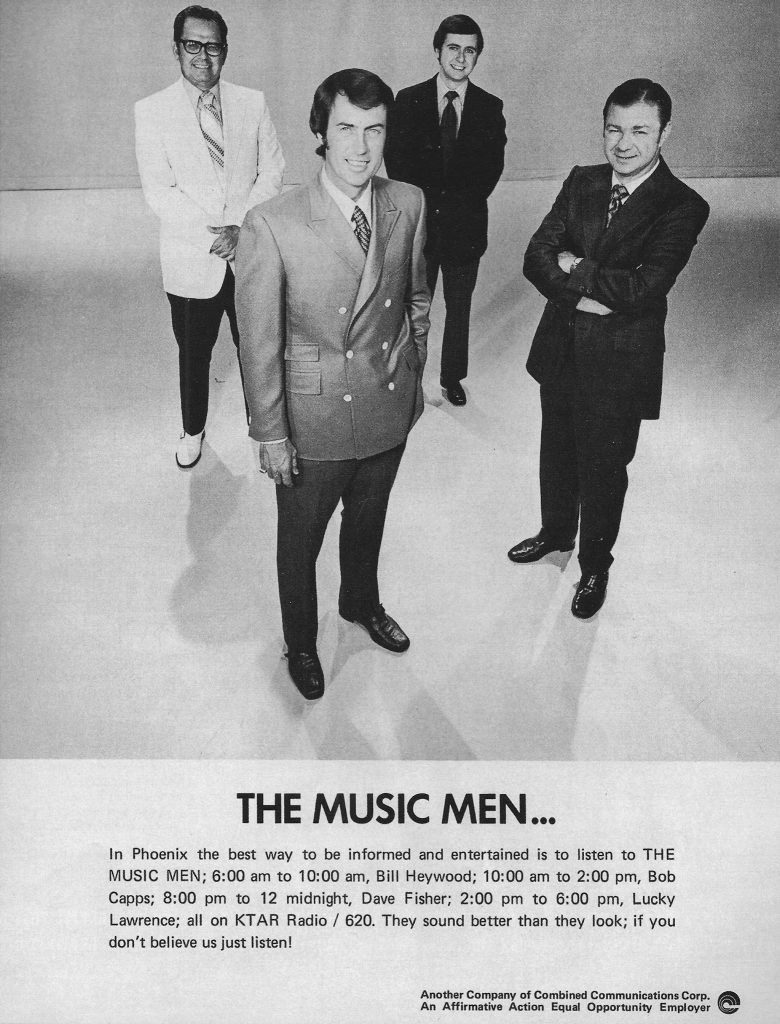
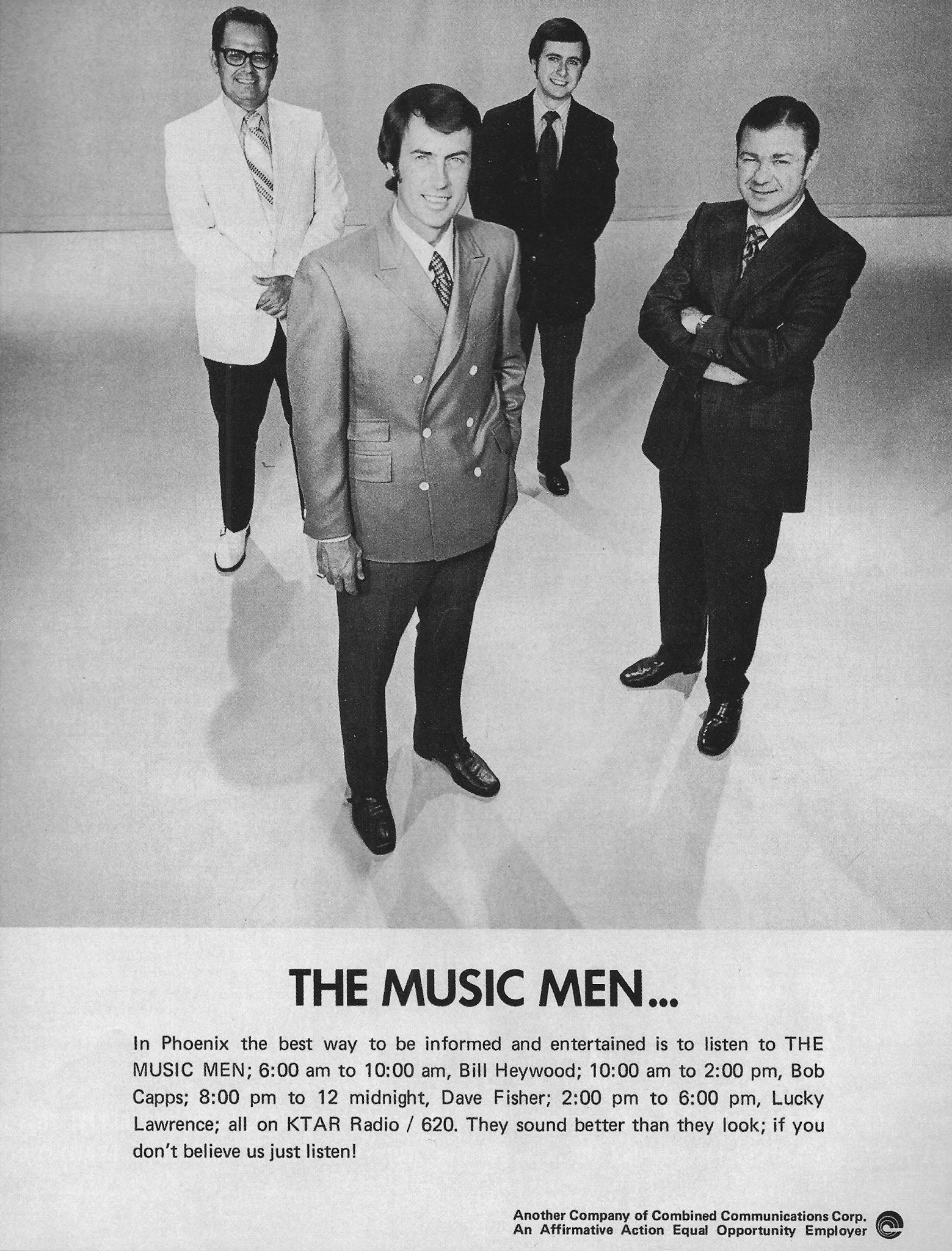
The suicide death of Bill Heywood and his wife, Susan, hit many long-time Phoenicians hard. This is the hour of lead, remembered if outlived, as Emily Dickinson wrote. I heard from so many friends and acquaintances, some of whom hadn't been in touch for years. The Republic did a creditable job telling the story, although it's revealing that the article was closed to comments. Revealing about our age of thugs and haters, not about the Heywoods. I only ran into him twice, long after he had been a giant in radio. But he was a friend to thousands of us, "the bright good morning voice," as Harry Chapin sings in the poignant W.O.L.D.

Long before broadcasting was consolidated, roboticized and ruled by shock-jocks, talk-show screamers or anodyne one-size-fits-all national "easy listening" formulas, local radio was a very big deal in Phoenix. Radio antennas topped the skyline. Jack Williams, who served eight years as governor, started his career in radio. His trademark: "It's another beautiful day in Arizona. Leave us all enjoy it." Barry Goldwater was another radio guy. Older readers can tell those stories, but by the time I came along nobody was bigger than Bill Heywood. He was the morning drive-time man on KOY, historically at 550 on the a.m. dial, the oldest station in Arizona. His voice, as others have said, was velvet. His humor was witty, subtle and gentle. And he spun the popular playlist of the day. His afternoon counterpart, Alan Chilcoat, "sang" the weather. Corporate monopolists such as Clear Channel would never allow such un-focus-group-tested fun today.

Phoenix radio in the 1970s featured "mainstream" rock on KRIZ, KRUX and KUPD. The upstart KDKB played entire albums, was fiercely independent, counter-culture and fighting every Top 40 convention. I recall an easy-listening station but not its letters (KBUZ?); it did have some fairly cool promos, keying off locations in the city and ending with "and you've got the mellow sound of…). Speaking of which, a "mellow rock" station broadcast from the old Ramada downtown, including one of the era's few female jocks. Of course, the stalwarts such as KTAR and KOOL were there, too, as well as a classical station.

The American promise

Editor's note: This is an essay I wrote for the Jan. 8th edition of the Seattle Times' Pacific Northwest magazine (it's one of the last metropolitan newspapers to carry its…