The postman

In the 1980s, when in real life we came very close to nuclear war, David Brin wrote a novel called The Postman. His main character lives through the apocalypse and is wandering in the woods of Oregon where he finds an abandoned mail truck. He puts on the postman's coat for warmth and carries a mail sack to a nearby town in hopes of getting food. But they think he is a real mailman, and latch onto him as the embodied hope that the United States survives and is recovering. The book is far superior to the Kevin Costner film. As Wikipedia summarizes, "Despite the post-apocalyptic scenario, and several action sequences, the book is largely about civilization and symbols."

So does it matter if the U.S. Postal Service, facing persistent deficits, private competition and the prevalence of email, intends to kill 120,000 jobs, eliminate Saturday service and shut down 3,600 post offices in smaller towns? I think it matters profoundly, and not least on the level of civilization and symbols.

As MSNBC's Bob Sullivan makes convincingly clear, the Postal Service's alleged financial trouble is largely the result of an accounting swindle from the Bush administration. This is backed up by a report from the Center for Economic and Policy Research. Laying off 120,000 people in the worst labor market since the Depression is nuts, and will fall especially hard on minorities who already face much higher unemployment.

The new isolationism

Back when students were taught American history, they learned about the isolationism into which the nation retreated after World War I. It did not turn out to be splendid. Nobody would accuse us of that now: We're fighting undeclared wars on three continents, maintaining hundreds of military bases in scores of nations, policing the global commons of trade and oil transit with the U.S. Navy, going to great and disadvantageous lengths to manage China's peaceful rise to global power, trying to keep Israel, Iran, North Korea and Pakistan from starting World War III and carrying all the burdens of soft empire.

Yet we have entered an isolationism every bit as dangerous as its predecessor in the 1920s and 1930s. It is an isolationism of the national mind.

How else can one fully explain the vanishing act of climate change from the national discourse? No other event, not even the latest marital/divorce saga of the newest invented celebrity, will more adversely affect life on this planet short of a major nuclear exchange. But the growing costs and enormous future consequences of climate change are absent from our policies and politics. Meanwhile, one of our two major political parties, the Republicans, has been captured by extremism and madness. But the major media, where most Americans get their "news," won't truthfully discuss it. What happens to such a nation?

Thank you

Rogue Columnist will mark its fourth anniversary next week, a veteran run in the blogosphere. I write and produce this blog because it offers analysis and commentary, especially for my…

Central Avenue Part 2

Phoenix1

Midtown, including the Viad Tower, left, after the big boom.

The first defining event of today's Central Avenue was the real-estate boom of the late 1980s and early 1990s. With land from Fillmore Street to Camelback Road upzoned for skyscrapers and money flowing from the deregulated savings and loan industry, the city was remade by a huge real-estate boom. Stuck with the disjointed set of highrises outside the old central business district, the city tried to put planners lipstick on the pig in the 1970s by christening the area from the railroad tracks to Camelback and Seventh Avenue to Seventh Street as the Central Corridor. As I wrote in the previous post, the visionaries of the 1960s and 1970s imagined Central would become Phoenix's version of Wilshire Boulevard. That never happened. Phoenix lacked the economy, assets and ambition of Los Angeles. But it gave a big try in the '80s and '90s.

These were the years that saw the rise of the Dial Tower at Central and Palm Lane. It was the new headquarters of the old Greyhound Corp. and remains, with its distinct deodorant container shape and copper skin the only truly arresting skyscraper on Central. Two bank highrises were built just south of Osborn, along with a little World Trade Center-style tower at Virginia, displacing the Palms Theater, and a few midrises. USWest anchored one of two skyscrapers erected on the northeast corner of Central and Thomas, where the iconic Bob's Big Boy, beloved of cruisers, stood. But this was nothing compared with what was planned. Back in the 1960s, the idea of a monorail running down Central was floated. It was revived in the '80s as part of a developer's plan to build, north of Indian School, the tallest building in the country with the monorail connecting the mammoth skyscraper to Sky Harbor.

Central Avenue in old Phoenix

Central Avenue in old Phoenix

Central_ave_phoenix_AZ

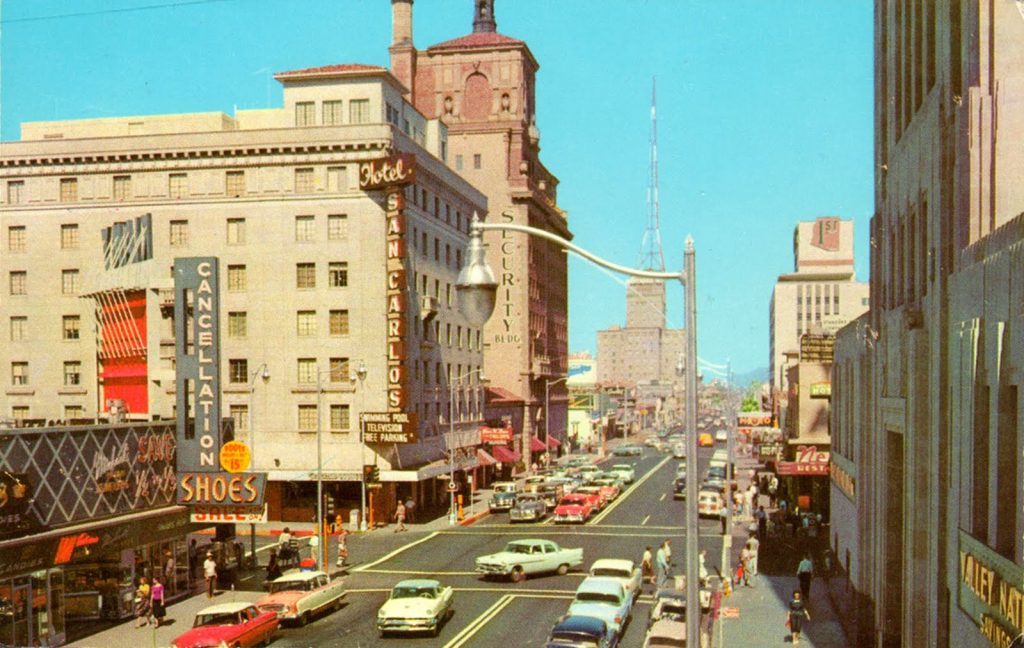
Central and Monroe, around the year I was born (1956)

"The trouble with Central is that it isn't central to anything any more." So spoke a major leasing executive in 2000, over a breakfast I had been dragooned into to get my mind right about what had happened to my hometown. He was wrong. Central Avenue does much more than demarcate street numbers from east to west. It lies at the heart of a far-flung Valley metroplex. Central — original Center Street, renamed in 1910 — is the touchstone of Phoenix's history, with more stories than a hundred blog posts could tell. It remains the most interesting street in the city. And it will be the critical marker for a quality future, if the metropolitan area stands a chance of attaining one.

In the old city, Central connected the discrete parts that made Phoenix whole. Starting at South Mountain Park, the largest municipal park in the world, it crossed two-lane Baseline Road. In both directions spread out the enchanting Japanese Flower Gardens. Ahead were bands of farmland, pastures and citrus groves as it descended to the Salt River, with the skyline and far mountains arms-length clear in the distance.

After going through the tiny south Phoenix business district, you crossed one of two bridges over the river (Mill Avenue being the other). The 1911 Center Street Bridge ran 3,000 feet across the Salt River, included electric lamps, and was one of the town's proudest achievements. Before heading downtown, Central ran through neighborhoods and commercial strips.

For years, the colorful Central Liquidators was among the businesses south of the tracks. In the early days, both the Southern Pacific and Santa Fe railroads sited their depots on Central, before moving to the new Union Station at Fourth Avenue in the 1920s. Depression public works built an underpass that for decades held four very tight lanes. Before the overpasses at Seventh avenue and street, this was the only sure way under what were then busy rail lines. Everybody honked when they drove through the concrete tunnel.

Phoenix rising?

By Emil Pulsifer, Guest Rogue

Rogue Columnist readers may be surprised to learn than reading Robert Robb, editorial columnist of the Arizona Republic, is a guilty pleasure of mine. As often as I disagree with him, his arguments have a specious plausibility and level of detail that makes them worth refuting. I always learn a lot about a subject in deconstructing one of his columns — though not usually from Robb himself.

His column of December 7th, "Phoenix-area Recovery Better Than You Think" is a case in point. Not only does it elaborate Robb's longstanding thesis that "Phoenix doesn't have an economy dependent on real estate," it also argues that Phoenix's post-recession economy is doing better than that of most big cities.

This is astonishing. Even local-booster superstars like developer/economist Elliott Pollack, whose firm "currently serves as the economic department for Maricopa County" according to his company bio, and who also wrote the "Blue Chip Economic Forecast" for Phoenix appearing at ASU's W.P. Carey School of Business website, admits that "…the local economy cannot have much of a recovery without a significant increase in construction activity." Either Robb is a genius or else he's standing on his head.

America’s racist sheriff

The big news is the release of a report, three years coming, about the racial profiling in the Maricopa County Sheriff's Office. You can download the entire report at AzCentral, Talking Points Memo and many other sites. It confirms what we already know: "America's toughest sheriff" is also America's most racist sheriff. The department has engaged in systemic racial profiling against Hispanics and "brown skinned people." This should be another nail in Joe Arpaio's coffin, but I suspect many of his constituents will merely go "Yaaaay!!"

This is only the tip of a very big iceberg. There's the hundreds of botched sex-crimes investigations, along with the many instances of abuse in the jail system. Honest police officers talk about fumbled investigations by the MCSO, including probable homicides that were tossed off as suicides. Much of the command staff has already been forced out in scandals. Does anyone doubt that the tone for this behavior was set from the top, in other words Arpaio himself? This is a department that runs by a cult of personality. As I asked in a previous post, Why isn't Joe Arpaio in jail? Yet he survives.

To be sure, departments nationwide face such probes. The Seattle Police are the target of a Justice Department investigation into excessive-force complaints. But the MCSO is different, with a longstanding pattern of bad behavior.

Hell on wheels

High-speed rail is dead in America. In Slate, Will Oremus does a postmortem that isn't as clueless as most of what one would find in the mainstream media. It makes some points familiar to my readers: The Obama plan wouldn't have been genuine high-speed rail, except in Florida, merely higher-speed; the funds were insufficient and dolled out helter-skelter across the country rather than focusing on corridors likely to bring success, etc. I would add that the Florida HSR was foolish from the get-go, aimed at a suburbianized, car-crazy state, rather than, say, California, the Pacific Northwest or the Northeast Corridor, where train travel is already popular and in demand.

In any event, this is a catastrophe for the nation.

On a general level, it is another sign that America just can't do great things any longer. It's an emphatic indication of the nihilistic paralysis of our politics, with one of our major political parties captured by extremists whose mission is pure destruction. It highlights yet another blow to the commons. It's a lost economic opportunity. High-speed rail would have created tens of thousands of jobs, for operating and not just construction. It had the potential, properly done, to seed new industries here to build the trains. It is exactly the kind of infrastructure spending that would stimulate an economy that as things stand faces years of high unemployment and stagnation. From an environmental standpoint, rail is much less destructive than cars and moves far more people with a small carbon footprint.

Phoenix 101: Wallace and Ladmo

Wallace_and_ladmo

Lad Kwiatkowski, Pat McMahon and Bill Thompson.

I went to the Muppets movie over the weekend. It was all right. I never watched Sesame Street and the heyday of the Muppets television show was when I didn't even own a TV. In any event, I am a lost demographic to such benign stuff. I grew up in Phoenix, where we had Wallace and Ladmo.

Most children watched a clown show in their cities and towns. Not us. We were brought up on the very adult humor of the Wallace show, which ran from 1954 to 1989 on KPHO. The names changed, from It's Wallace? to Wallace & Company to the Wallace and Ladmo Show. What didn't change was the show's biting humor, satire and irony, along with classic slapstick and cartoons. For the rest of our lives all we could do was feel sorry for the children who were stunted by clown shows.

The regular cast featured Bill Thompson as Wallace, Lad Kwiatkowski as Ladmo and my friend Pat McMahon. Wallace, or Wall-Boy as Ladmo called him, was the host and butt of much humor. Ladmo was the everyman or everykid, full of fun and mischief. McMahon played a host of characters, many of which gave the show its bite. Among them was Gerald the brat, the nephew of the TV station's general manager; Aunt Maud, the doddering, bad driver old coot from Sun City; biker Bobby Joe Trouble; Captain Super, a parody of assorted super heroes, and Boffo the Clown, who hated children.

Love hurts

A friend passed along a blog essay entitled "Has the Arizona Republic gone rogue?" It goes on to catalogue a variety of "negative" news stories, concluding: "It is time for a leadership change at the Republic; Publisher John Zidich of Fiesta Bowl board fame and his executive editor Randy Lovely need to go.  Let’s get someone in over there who knows and loves Arizona and wants us to become the state we are destined to become. We don’t need a daily rag of negativism and half assed reporting; I can get that from any blog out there.  We deserve better.  The Republic has gone rogue and it needs correcting."

The writer is one Charles Coughlin, who, in addition to sharing the name of the infamous demagogue "radio priest" of the Depression era, is a flack for the Real Estate Industrial Complex, the right and all-things status quo. See, reporting on such as Gov. Jan Brewer's shameful attempt to sack the head of the independent redistricting commission because it didn't skew politics even further to the right is "not loving Arizona." Payback is indeed a bitch. I was run out of the Republic by Zidich and Lovely because the paper could no longer stand the seven years of heat it had taken because my column didn't "love" Arizona enough. (When someone else talked about offering me a job, another big intervened: "Talton hates Arizona.") Now the same thugs are after Lovely and Zidich. (Funny, Father Coughlin doesn't offer his appreciation to the newspaper for unearthing the Fiesta Board scandal, which didn't really involve Zidich aside from his sitting on boards, which publishers should not do.)

Let it be said that the state's largest newspaper soft-pedals most of the pressing issues, from water resources to the economic calamity, climate change, white-right extremism, the depredations of the Badged Ego and thoroughgoing political corruption, much of which traces back to the Real Estate Industrial Complex. It pulls its punches and seeks out "positive news about the community." The editorial page is reliably right wing, with the only columnist being the "Goldwater" Institute's boy, Robert Robb (or William Bill, as he is known here). But even committing real journalism part-time, accidentally or when, well, news happens is enough that heads must roll. Imagine the fantods he would get if the state had some real kick-ass newspapers. Here is Phoenix and Arizona's pathology in a nutshell.

Mayor Stanton

I'll admit to being an optimist who worries. Surely Wes Gullett, tool of the right wing extremists, couldn't win the Phoenix mayor's race… Yet, Phoenix and Arizona have fallen into too many tragic improbabilities for me to count and things had been taking a severe downbound course lately. In the end, a record turnout put Greg Stanton emphatically in office. Thank God. This is unalloyed "positive news," for those of you who think I have no bright side. Stanton could be a transformative mayor at a time when the city most needs one.

Now, to the serious stuff. Most of the issues that dominated the campaign and the media's attention are small ball. Phoenix is a well-run big city, with a few exceptions such as the Jack Harris-type backscratching. All of these can be addressed with a functioning  City Council. The one that requires reflection is water rates. The older parts of Phoenix need no further push to let shade trees die and throw down gravel. Indeed, they need an incentive to keep the oases that are critical protection against the heat island. In addition, city staff should roll back their demand for gravel and palo verdes on nearly every city property. This is only adding to the unlivability of Phoenix. A discussion on the investment of water for shade oases is critical.

Stanton's biggest challenge, as he well knows from his days on City Council, will be building majorities for the critical policies he wants enacted. Phoenix's mayor is more powerful than any of his peers in the state, but the city remains (foolishly, to my mind) a council-manager form of government. The mayor is "just one vote," as an intelligent, ambitious councilman told me years ago. Stanton is well-suited to the task: Amiable, emotionally intelligent, willing to listen, politically street smart and wearing hig policy wonkishness lightly. But without a majority, he'll get nowhere. It may shift from issue to issue, but it is the mayor's majority that Skip Rimsza wielded with such effectiveness. It will be interesting to see if Mayor Stanton has a "Councilman Stanton," an effective do-the-right-thing ally on big stuff. This was a role that Stanton played on the biosciences campus and ASU downtown to Mayor Phil Gordon, even though their overall relationship was always a wary one.

Occupy what?

Let's start out with the Arab Spring. Americans know little about the world, especially a place as complicated as the Middle East. This situation has been made worse as news organizations have cut back foreign bureaus and coverage. Thus the uprisings lumped under the Arab Spring have assumed this simplistic narrative: Arabs have risen up against tyrannical regimes and it's a new day of Jeffersonian democracy. This doesn't fit the facts. For example, the military has ruled Egypt pretty much ever since the British pulled out. Deposing Mubarak, whatever the inspiring protests seemed to show, was business as usual. Mubarak came out of the military; the military reasserted control, a fact underscored by the alleged killing of 13 protesters today. The Persian Spring was quickly and bloodily suppressed by Iranian security forces. To make a sweeping generalization, "democracy" in the Middle East will likely be very different than we imagine, leading to regimes that are anti-American, anti-Israel (and the Israelis do themselves no favors here), and installing Islamic law. Juan Cole has the best handle on the region.

Americans hoping for some good naturally make a tie-in with the Occupy movement. The most apt correlation I can see is that the elites still somehow find a way to maintain control, backed by police and the military. Before "Support the Troops," Americans were historically suspicious of a large standing army, and for good reason. With the ubiquitous police violence against Occupy protesters we have seen the militarization of law enforcement that has troubled older cops for some time. Now the oligarchs have the White House, Congress, courts and robocop law enforcement to do their will.

I am over Occupy, a point I first made in a blog post for the Seattle Times, which attracted 120 comments the last time I looked. Some of these points need to be fleshed out.

President McCain

Contingency is the great trickster of history. Let's assume that wealthy Republican John Sidney McCain III had picked a serious running mate (say, Florida's popular Gov. Charlie Crist or even Mitt Romney), turned on the fighter-jock charm and not panicked during the financial panic. And won a close 2008 election. What would have happened?

The EPA would have seen its regulatory depredations reined in, especially new rules for greenhouse gases. Indeed, nothing would have been done to address climate change. Science would have been marginalized in policy in favor of the fossil fuels barons and plutocracy. Drill, baby, drill would have gone on in spite of the catastrophic BP oil spill in the Gulf of Mexico. American troops would have been added to Afghanistan and that war expanded, while President George W. Bush's timetable to exit Iraq would have been observed. American quiet wars would have been extended, say, into Yemen, elsewhere in Africa and South America. New military muscle would have been projected against China, say basing Marines in Australia. No effort would have been made to cut military spending that is larger than all other nations combined.

The GOP being the party of the wealthy, the Bush tax cuts would have been extended. And, naturally, Wall Street would have been bailed out of its swindles and made whole on the taxpayers' dime, then sent back to resume its sociopathic behavior. He would have picked a Treasury Secretary and top financial advisers determined to sustain the status quo. McCain's Attorney General would have been a corporate lawyer who would not prosecute a single major bankster, much less the war criminals of the previous administration. At the pleadings of Republican, as well as Democratic, governors, a McCain administration would have spent billions filling the holes in state budgets. Otherwise, his answer to the huge demand hole of the Great Recession would have been more tax cuts and spending largely on highway projects. Corporate profits would reach records, but middle-class Americans would see their prospects further dim.

Oh, wait. All that has happened anyway under the presidency of Barack Obama.

Crisis of legitimacy

The best takedown I've read so far of the Joe Paterno/Penn State crime comes from Jim Kunstler. He ends with something I have pondered more than once: "Every new day that dawns lately gives further proof that we are a wicked people who deserve to be punished." As someone who grew up on the razzle-dazzle years of Frank Kush's Sun Devils, playing in the disrespected Western Athletic Conference and having teams such as Penn State, Michigan and Ohio State get all the attention, I never bought into the deification of Paterno. But who would have thought the fall would come from this. Child rape, a cover-up that lasted for years and more rotting shoes left to drop. As I wrote about Bishop O'Brien, he of the hit-and-run should-have-been vehicular homicide, crisis reveals character. The revelations continue to redefine disillusionment.

The study of history makes one wary of claiming something new or unprecedented. Monsters have always roamed in our midst. But the rotting corruption in nearly every important national institution is unlike anything I've come across in our history. In the American exceptionalism argument, I tend to come down on the side of exceptionalism, but today what makes us extraordinary is our criminality, ignorance and decadence. D.H. Lawrence wrote, "The essential American soul is hard, isolate, stoic and a killer." Maybe so. But it was once capable of grand and good things, especially through the collective institutions it built. No more.

Look anywhere. The Air Force can't be trusted to handle the remains of dead soldiers brought home, from wars our leaders lied us into and maintain and expand for the profit of defense contractors, as well as to lock up oil supplies because they won't come clean with us about future scarcity. The Great Recession is a product of corruption taken to stratospheric levels.