Light rail to Union Station

Light rail to Union Station

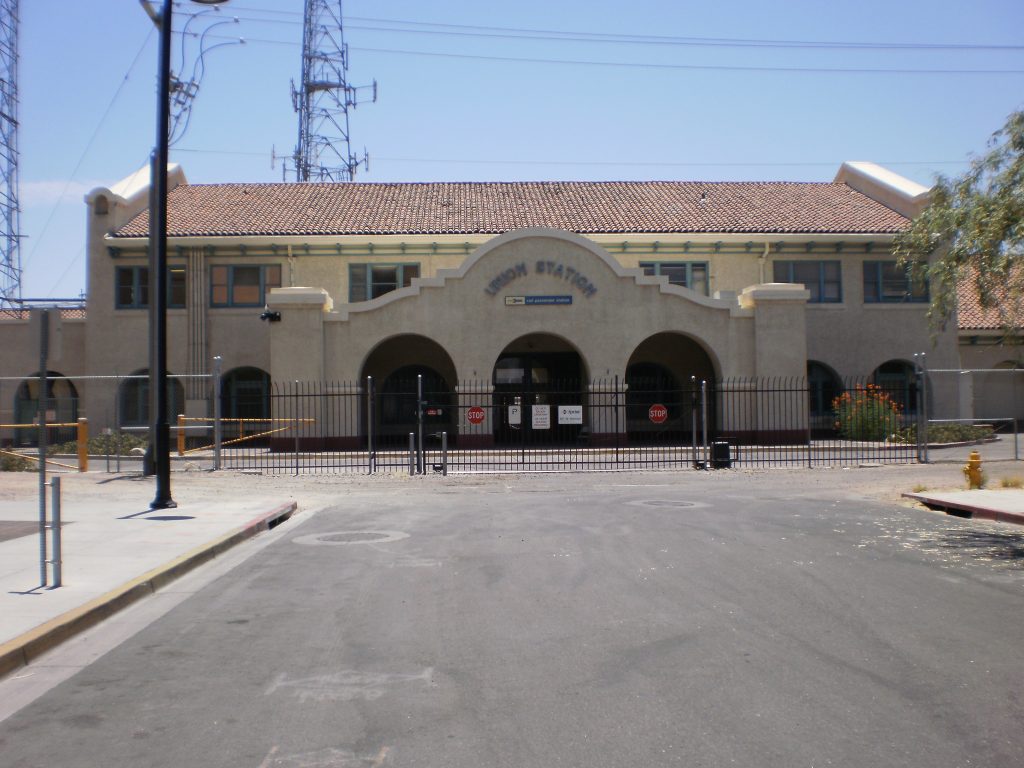
PhoenixTrainStation

"Roads? Where we're going we don't need roads."

The South Central line is one of the most promising additions to the Phoenix light-rail system (WBIYB). City Council has approved a plan to fast-track the five-mile extension to Baseline Road by 2023. But a crucial piece of the project isn't on the table, and as far as I know nobody is discussing it.

This line needs a slight rerouting: It needs to jog over the Third Avenue on Washington, then run south to Lincoln Street before moving back to Central for the journey south. This would provide two big benefits, one immediate and the other long term.

By shifting west, it would pick up large numbers of riders at the government centers of the city and county. But the big enchilada is that the line would pass just to the east of Union Station, which was Phoenix's intercity passenger rail depot until the 1990s.

Light rail might need a tunnel under the current Union Pacific line, but it would be worth it. The payoff would be connecting light rail with a reborn Union Station as the hub for a region-wide commuter train system as well as the return of Amtrak to Tucson and Los Angeles.

If Phoenix fails to do this, it will be a blunder to be regretted for decades to come.

Rogue changes

I've had a difficult time coming to terms with the fact that I'm not as fast as I used to be. Part of it is me, and part the deluge…
Is perpetual war inevitable?

Is perpetual war inevitable?

US_Navy_Aircraft_Carrier_USS_John_C_Stennis_MOD_45153514
In an otherwise interesting essay entitled, "The Price of Perpetual War," we find this perplexing paragraph:

The United States did not choose this era of perpetual war. It is the price of living in a world where, for the first time, terrorist groups and malevolent individuals can reach the United States and wreak havoc from virtually any corner of the world. That threat was literally brought home by al Qaeda on 9/11 and reinforced all too recently by the terror attacks in Paris, Brussels, and San Bernardino.

Does anyone believe this is so? Alas, millions of Americans. But to make a quick list…

…We chose to give a blank check to Saudi Arabia to run one of the world's most repressive regimes while spreading extremist war-on-the-infidels Islam throughout the Middle East and beyond. One doesn't have to subscribe to conspiracy theories to acknowledge that Osama bin Laden and 15 of the 19 hijackers on 9/11 were Saudi citizens. And what has our kowtowing to the kingdom given us? The House of Saud's oil, to fuel our "non-negotiable" (and already heavily subsidized) car-based sprawl lifestyle. Most oil needs to stay in the ground if we are to avoid destroying the planet even more — and between "making different arrangements" and domestic oil, we don't need OPEC anymore. …

…We chose an even closer connection to Israel, Riyadh's quiet ally, whether this was in America's national interest or not. And with the oppressive and increasingly extremist regime of Benjamin Netanyahu is it increasingly not. Indeed, increasing Jewish settlements on Palestinian land and injustices against the Palestinian people committed by Israel blow back on the United States, which has long ago lost its credibility as an honest broker in the Middle East. It has inflamed Islamic and Arabic anger against us. And for what? To please the powerful donors of AIPAC and older Jewish voters in the swing state of Florida?…

Bolles: a players guide

Bolles: a players guide

Bolles_paper


"They finally got me…Mafia, Emprise, Adamson…find John Adamson…"
— Don Bolles

On June 2, 1976, a bomb detonated under the car of Arizona Republic reporter Don Bolles in Midtown Phoenix. He survived an agonizing 11 days before he died. A recent article by Bolles' colleague John Winters lays out the basics. I've written about the case before here, as well as the Phoenix underworld. The closest assassins went to prison. Yet full justice was never served. The real puppetmasters got away with it. Many in high positions wanted it to go away.

But what exactly was it? The case has been extensively covered over the years, from the Arizona Project of Investigative Reporters and Editors (IRE) and contemporary, dogged reporting, by Republic and Phoenix Gazette reporters, including Al Sitter, Paul Dean, and Charles Kelly. New Times ran the IRE series and kept digging over the following decades, especially with Jana Bommersbach, John Dougherty, Tom Fitzpatrick and Paul Rubin. The Republic continues with retrospectives. Don Devereux, who worked for the Scottsdale Progress, still writes a blog about the case. A fascinating new book by Dave Wagner, an R&G city editor, The Politics of Murder: Organized Crime in Barry Goldwater's Arizona, makes an important contribution.

With so much having been written, so many characters and theories, one danger is becoming lost in a house of mirrors. The Bolles case would be the ultimate test of a mystery writer, were he foolish enough to try to make it into popular crime fiction. That's because in real life, the case was complex and shaded. It involved journalism and supposition, not all of the latter ultimately true. Carl Bernstein said that good journalism is the best available truth at that moment. But journalists write on history's leading edge and history is an argument without end. Law enforcement continues to debate the case, too. Files were lost or misplaced, perhaps deliberately. Among them, Phoenix Police file No. 851. In addition to the missing file, index cards for the files were also removed from the records room. Did it contain inconvenient information about Adamson, Emprise and Kemper Marley? Or more? Self-serving narratives, hidden agendas, and bad memories further blur the trail. Many questions remain. 

So my modest attempt for the 40th anniversary of the bombing is a list of the actual major players and their connection with the most notorious assassination of a reporter on American soil:

John Adamson: Don Bolles left his post covering the state Legislature to meet Adamson at the Clarendon House Hotel on June 2nd. Adamson promised a juicy tip on a land fraud involving Barry Goldwater, Harry Rosenzweig, Sam Steiger, and Kemper Marley. In reality, while Bolles waited for him in the lobby, Adamson planted the dynamite device under the driver's side of Bolles' new Datsun 710. After giving up on the meeting, Bolles returned to the parking lot, started his car, and pulled out when the bomb went off.

Usually portrayed as a small-time but menacing hood, Adamson hung out on the Central Avenue bars and the dog track. But he actually had worked his way up to being chief enforcer for land-fraud kingpin Ned Warren and had been retained by associates of Barry Goldwater for dirty business in a Navajo power struggle. He also worked as a confidential informant for someone in the Phoenix Police. Bolles identified Adamson in his famous last words. In exchange for cooperation, Adamson was given a 20-year sentence. When convictions from his testimony were thrown out, prosecutors charged him with first-degree murder. This conviction didn't stick. So after serving 20 years, Adamson entered federal witness protection, then voluntarily left it, dying in 2002. Some retired cops and journalists suspect that Adamson protected the true source of the death warrant on Bolles. In a jailhouse interview with Bommersbach and Rubin, Adamson said chillingly, "I didn't kill him for a story he'd written. I killed him for a story he was going to write."

Phoenix in the forties

Phoenix in the forties

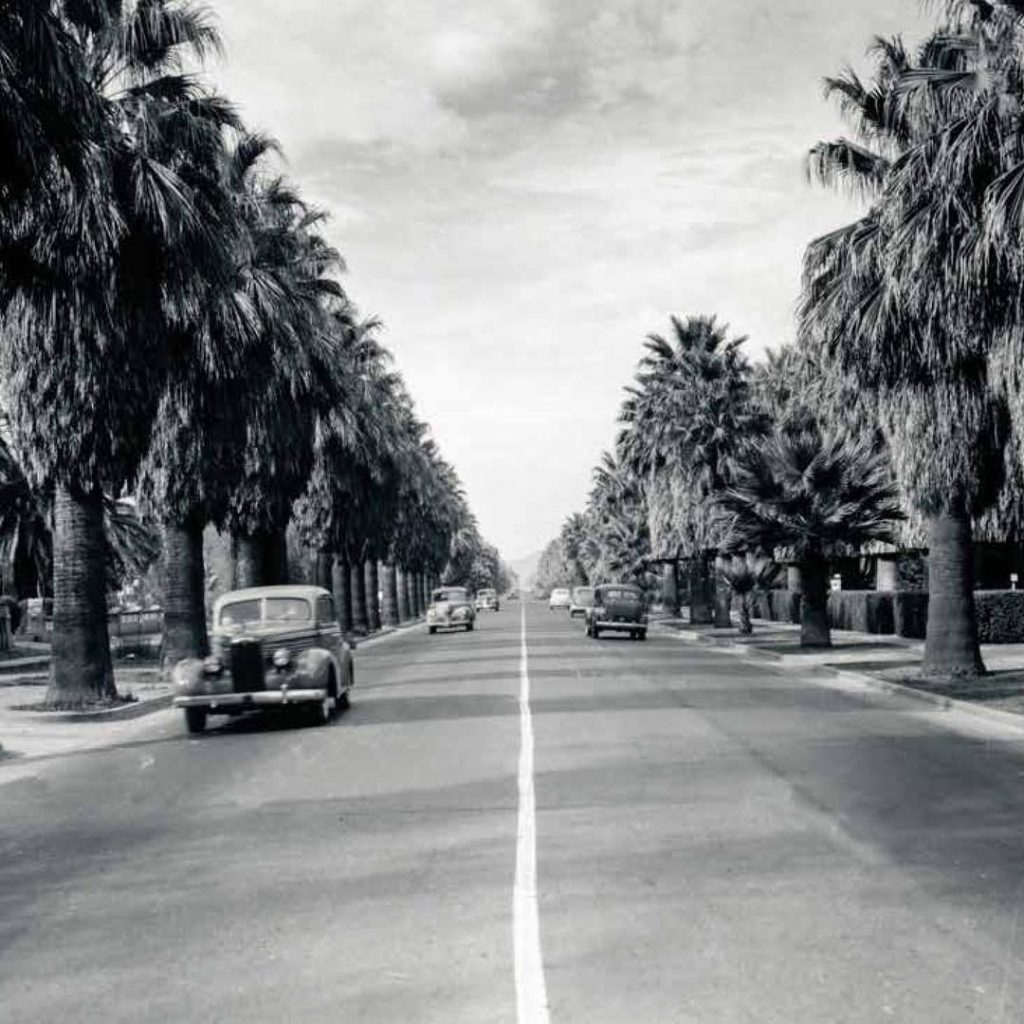
Central Avenue 1940s
In 1941, Arthur Horton, a professor at Arizona State Teachers College, the precursor of ASU, published a remarkable Survey of Phoenix and the Valley of the Sun. What makes it still valuable is that it provides us with the most authoritative examination of Phoenix in that decade, or at any time until perhaps the 1960s.

The exhaustive report is also helpful in understanding a decade that meant far more than American involvement in World War II and its effects on Phoenix (which I wrote about here). That lasted less than four years out of 10. Much more was going on.

The decade began with a strong local economy, almost entirely thanks to the New Deal’s enormous largesse toward Phoenix and Arizona. The stimulus spending worked and helped pull Phoenix out of the Great Depression. By 1940, Americans were doing better and traveling, including visiting the mostly new resorts including the Arizona Biltmore, Camelback Inn, Jokake Inn, Adobe House, Ingleside Inn, Wigwam Guest Ranch and San Marcos at Chandler, as well as Phoenix’s premier hotels. The “Valley of the Sun” tourist promotion launched by the Chamber of Commerce and the railroads was paying off. To be sure, not everyone was doing better: 10,000 in the county (population 186,000) were on relief.

Agriculture remained the mainstay of the Salt River Valley’s economy. According to Horton, Arizona had 1.1 million grapefruit trees, 625,000 orange trees; 17,000 lemon trees; 5,000 tangerine trees, and 2,675 lime trees. Most of these were in the American Eden in and around Phoenix.

The unraveling

Matt Taibbi's column entitled "RIP, GOP: How Trump is Killing the Republican Party" is a compelling, entertaining read. He writes:

After 9/11, it felt like the Republicans would reign in America for a thousand years. Only a year ago, this was still a party that appeared to be on the rise nationally, having gained 13 Senate seats, 69 House seats, 11 governorships and 913 state legislative seats during the Obama presidency.

Now the party was effectively dead as a modern political force, doomed to go the way of the Whigs or the Free-Soilers.

But I'm not sure his argument here ultimately holds up. Nor does his premise that the Republican base has finally awoken from its trance, realized they have been sold down the river by the GOP, and are finally ready to "fight for their economic lives," if even with the incoherent [real-estate developer].

My sense of the base is that its rage is driven by that (Black) Man in the White House, people of color allegedly getting free things they don't deserve, Hispanics illegal and legal, SOCIALISM, and the usual culture war tropes from guns to, now, transgender bathrooms. And come November, every Republican from David Brooks and Paul Ryan to the red suburban precincts of Phoenix will dutifully cast their ballots for [the real-estate developer].

Phoenix Confidential: the dog track underworld

Phoenix Confidential: the dog track underworld

Greyhound_Park_40th_St_Washingon_1950s
With Arizona ending live greyhound racing, it's the end of an era long coming. Where the state once had five tracks, the only one left was in poor Tucson, which couldn't even keep a slice of Spring Training. The track in Phoenix closed to live racing in 2009. Changing tastes, animal activists and, especially, the proliferation of tribal casinos did in the pastime.

But once upon a time, it was a big deal. Before Phoenix Greyhound Park became a swap meet and was painted, like so much of the town, brown, it was one of the city's premier entertainment attractions. The golden age was from the 1950s through the 1970s. Opening in 1954, Phoenix Greyhound Park at 40th Street and Washington was a neon-lit palace where middle-class couples and compulsive gamblers mixed with the city's elite — and members of its extensive population of mobsters. Betting was legal. And a pre-video-device audience thrilled to dogs racing chasing a mechanical "lure" around the track. The park promised glamor, excitement, and was highly advertised ("there goes the rabbit, rabbit, rabbit!").

The extent of organized crime's penetration of dog racing in Phoenix remains an important, and controversial, element of the mystery of the 1976 assassination of Arizona Republic reporter Don Bolles. After the blast and before he passed out, first responders heard Bolles say (a version of) "they finally got me…Adamson, Emprise, Mafia…find John Adamson…" Emprise was a sports conglomerate headquartered in Buffalo, N.Y. and controlled by the Jacobs family. It held a controlling interest in Arizona dog tracks.

Emprise was found to be associated with organized crime figures and convicted in Los Angeles of racketeering in 1972. The allegations involved taking a hidden interest in a Las Vegas casino to skim the profits. In Phoenix, Emprise had been a target of Bolles' investigative reporting and focus of a crackdown by the state Racing Commission in the early 1970s. Even so, the state allowed the company to keep its concessions, including at Phoenix Greyhound Park. Emprise's Phoenix partner was the Funk family And it had friendly ties to Kemper Marley, the powerful land-and-booze baron always lurking at the edge of the Bolles murder.

Jane Jacobs is dead. Long live Jane Jacobs.

Jane Jacobs is dead. Long live Jane Jacobs.

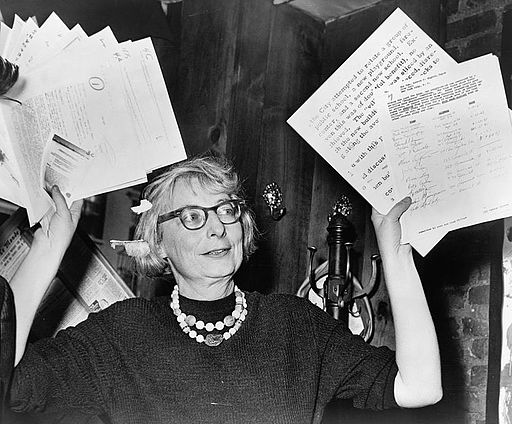
Jane_Jacobs
May 4th marked the centennial of the birth of seminal urbanist Jane Jacobs. It has been marked by numerous articles. Some of the better ones are here, here,  here, and, for a contemporary piece of revisionist iconoclasm, here. The latter aside, Jacobs remains an important figure, perhaps the most influential voice, in explaining the value of cities, how they really worked, and the damage of the planning elite. She begins her most famous work, The Death and Life of Great American Cities, bluntly: "This book is an attack on current city planning and rebuilding."

Written in 1961, the book was the first major refutation of the ideas that had brought urban renewal, dead housing projects, dull suburbia. Her great nemesis was Robert Moses, the powerful city planner and master builder of mid-century New York City. His hubris and the damage he did to New York are masterfully plumbed in Robert Caro's The Power Broker. Entire neighborhoods were bulldozed to make way for his freeways and his influence spread nationwide. She led the crusade that stopped Moses' Lower Manhattan Expressway, which would have gutted Geenwich Village, SoHo, and Little Italy. At one point in the battle, she was accused of inciting a riot (talk about the Resistance).

Jacobs was not an ideologue. To her, ideology was poison, offering "pre-fabricated answers" that adherents always fall back on. Instead, she was an observer of cities, a chronicler of what worked and what didn't.

Not once is Phoenix mentioned in Jacobs' first book, even though it was a big city by 1961. Still, I suspect she would have found much to like in the old Phoenix, where there was a "ballet of the streets" downtown and much of the city was focused on use by people instead of automobiles. This was before the freeways, before the teardowns. If she were alive today (she died in 2006), Phoenix would represent every horror she could imaging befalling a city. The Papago Freeway inner loop is classic Robert Moses vandalism. Her critique would include a lack of safety, for she documented how much more crime occurred in "thinned out" Los Angeles than in dense New York.

Next on the chopping block: Macayo’s Central

Next on the chopping block: Macayo’s Central

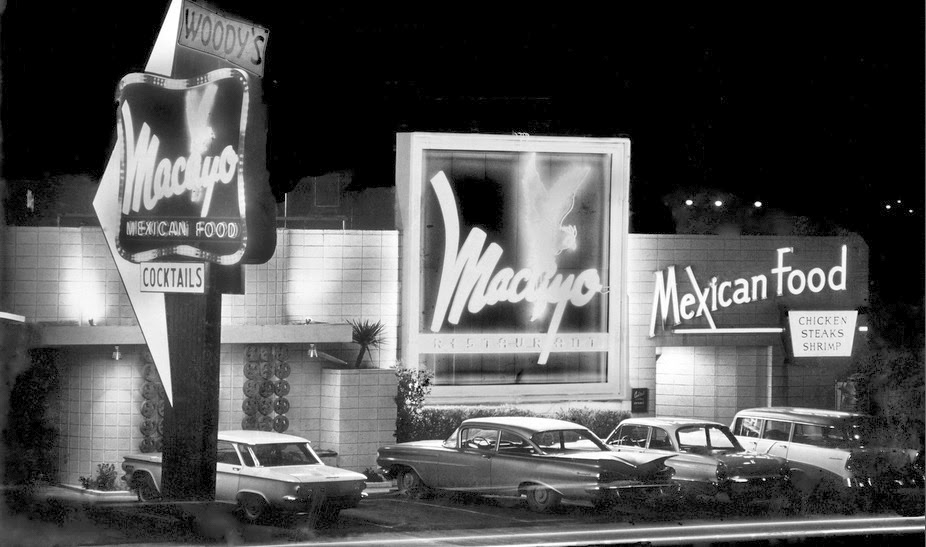
Woodys_Macayo_4001_N_Central_1960s
With Circles partially demolished and tagged and being held hostage by the developer comes news of another Central Avenue icon facing the bulldozer. 

The Macayo's restaurant that has stood for decades at Central and Indianola is facing demolition. In its place would be some 225 "residential units" in 65-foot building (this being Phoenix, of course, that is a big maybe). The developer is requesting a zoning change to "walkable urban."

One astounding thing is that "walkable urban" would require "only" 256 parking spaces (!). But the developer wants 369. "Free" parking is never free and Phoenix has way too much of it. Real urbanism would take down the number of spaces substantially. But, hey, WBIYB and the project (if it really happens) would be on light rail.

The really good news is that Macayo's intends to move to the south and stay in business.

The heat is on

The heat is on

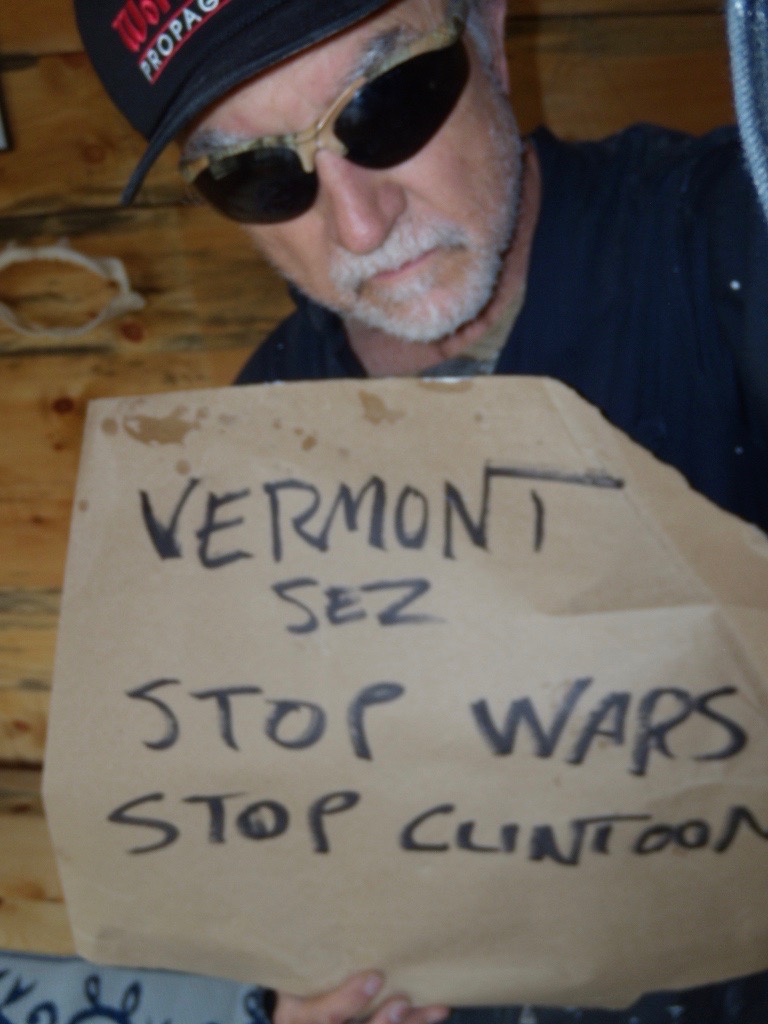
DSCN2911As you can see, our Front Page Editor is not shy about his opinions as we head into the general election race. I don't share them but he takes a better photo than your humble columnist. He also represents a not insubstantial portion of Bernie-struck progressives. Now that [the real-estate developer] has made his nomination virtually inevitable, I do have a few observations.

1. It's amusing seeing the pearl-clutching, "how could we have been so wrong?" musings of the pundit class. See the New York Times' Nate Cohn here. If you want further laughs, there's always Thomas Friedman, sans taxi driver. As someone rightly tweeted, "@tomfriedman wrong on every single thing he writes, every day of his life, & it will not in any way jeopardize him."

Even a simple, small-town boy from Phoenix could tell that Trump was formidable from the get-go. He is a reality TV star in Moronistan. He doesn't give a damn about "conservative" dogma, but knows how to push just the right buttons with the real conservative base in today's America. He was facing nullities as opponents. Time magazine anointed Marco Rubio as "the Republican savior," among a host of covers crowning Chris Christie, Rand Paul et al. As commenter Concern Troll would say, "lol lol."

2. Neither "conservatism" nor the Republican Party are dead. They have merely taken off their human suits, shucked off the last of William F. Buckley intellectual respectability, seen their Gingrich Revolutionaries tote each other to the guillotine, and found their true north in [the real-estate developer].

There was not, as George Wallace would say, a dime's bit of difference between the creepy Ted Cruz and the pleasant John Kasich. All were in thrall of the nostrums of The Party That Wrecked America. The Party of Lincoln and TR, even a mass American political party, had been dying for some time. But don't be under any delusions.

The same political savants now predicting mass defections are wrong. When they get to the polling place, they will vote for [the real-estate developer]. Unlike the most fervent backers of Sen. Sanders, they know there's a huuuuge! difference between him and Hillary. More significantly, they will continue to vote Republican down-ticket. This will especially matter if Democratic fratricide continues.

What’s in a name?

What’s in a name?

GoodSam_1940s
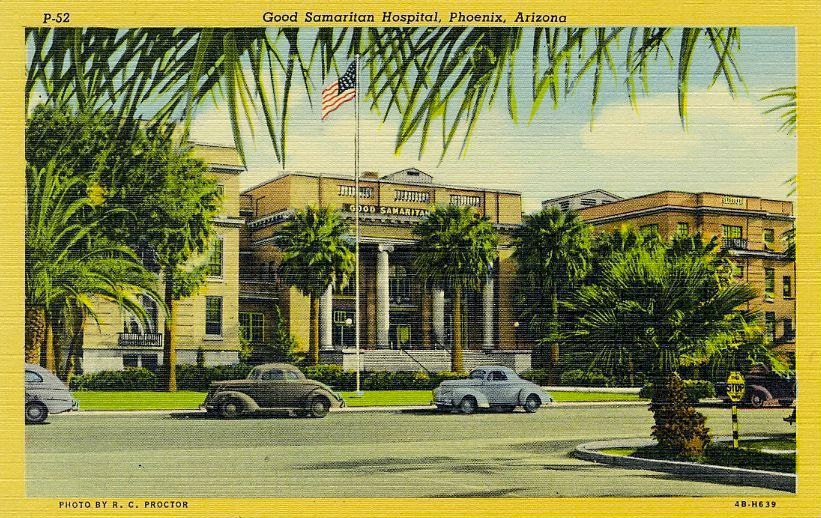
I don't want to be too hard on Banner Health considering the outfit placed its headquarters in a Midtown skyscraper. But a year after it changed the nearly century-old name of Good Samaritan Hospital to Banner-University Medical Center Phoenix, I am still thinking, huh?

There's no university there on east McDowell. Indeed, it was Banner and CEO Peter Fine that torpedoed plans to relocate the county hospital to a new building on the Phoenix Biomedical Campus, with the medical and nursing schools, where the "bench-to-bedside" vision of T-Gen's Jeff Trent could have been realized. This action in the 2000s showed Banner at its very worst.

The "university" part comes from Banner's $1 billion takeover of the University of Arizona's medical center and a satellite clinic in Tucson. More about that in a moment. 

To be sure, names change. The old Scottsdale Baptist Hospital changed its affiliation and became Scottsdale Memorial Hospital in the 1970s. It was where I trained to be a paramedic. When I returned in 2000, it was something called Scottsdale Healthcare Osborn, sounding more like a doctor's office than a hospital, much less a Level 1 trauma center. Now it's HonorHealth Scottsdale Osborn Medical Center (how much did some consultant get paid to slam the two words together?).

St. Joe's has somehow kept its original, historic name even if it was excommunicated by the bishop, so to speak. Smaller St. Luke's is still there, too, under control of the unfortunately named IASIS Healthcare (when acronyms go bad!). John C. Lincoln Hospital also has the HonorHealth mashup in front of its name but at least kept its identity.

Stop making sense

Stop making sense

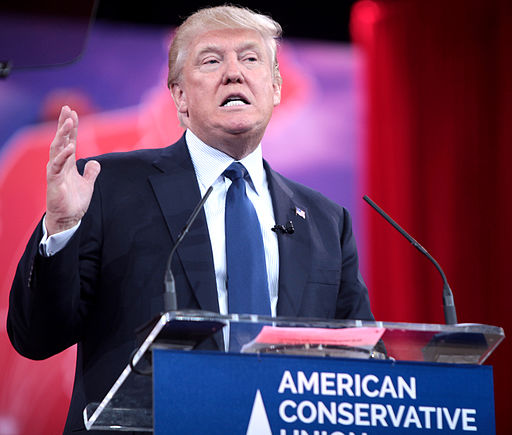
Donald_Trump_by_Gage_Skidmore_3_(cropped)[The real-estate developer] gave a "serious foreign policy speech" this week and it actually had much to recommend it. To be sure, it had contradictions. He channeled John Quincy Adams when he said that under his administration, "The world must know that we do not go abroad in search of enemies, that we are always happy when old enemies become friends, and when old friends become allies." He savagely critiqued the Cheney Doctrine. Thoughtful people would be unsettled by "America First," because that echoes the isolationism of Charles Lindbergh. And while he challenged free-rider allies to do more, he said, "We’re going to finally have a coherent foreign policy based upon American interests, and the shared interests of our allies." Perhaps the key word is shared. Because many interests of our allies, especially Benjamin Netanyahu's Israel, do not serve our national interest.

But overall, it was a serious and compelling address, one to make the foreign policy elites squirm. Things such as this make him a very dangerous opponent for the Democrats in the fall.

He has already found the sweet spot for Republican voters, a combination of economic nationalism and xenophobia on Muslims and Mexicans. Most average conservative voters don't really care about the dogma peddled by Ted Cruz and the right-wing elites. Jim Kunstler is willing to write what is forbidden in liberal circles but widely felt elsewhere:

In terms of sheer persona on persona, Trump is not much better (than Hillary Clinton), a walking hood ornament on the faltering beater car that America has become. But at least he recognizes that the beater beneath him needs a complete overhaul, even if he can barely cobble up a coherent list of particulars, or name the mechanics who might be able to fix the damn thing. And, of course, a broad swathe of Americans whose lives have also come to resemble beater cars are very sympathetic to the impulses Trump radiates.

For example, I happen to agree that the nation needs to act on immigration, both on the problem of illegal immigrants and on limiting the quotas of legally admitted newcomers. The Left, sunk in its sentimental sob stories of “dreamers,” and its nostalgia for the Ellis Island romance of 1904, can’t conceive of any reason why the nation might benefit from, at least, a time-out on invitations. The idea undermines their world-saving fantasies. In my little corner of America, the computer chip factory run by Global Foundries (owned by the Emirate of Dubai) has just laid off the majority of its homegrown American technical labor force and replaced them with foreign technicians on H1B visas, thus creating x-number of new Trump voters among the laid-off, and rightfully so, I think.

The number of foreign-born Americans is at a record, higher than even the enormous wave of immigrants from the 1890s to 1920, after which the nation implemented just such a time-out.

The Circles jerks

The Circles jerks

Stewart_Motor_Co_Studebaker_800_N_Central_1950s

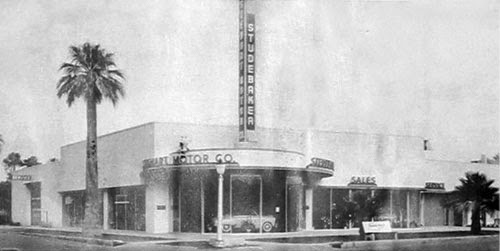
Stewart Motor Co., the Studebaker dealership, in the 1950s.

I knew they would do it, only when and whom the "they" would be. After Circles Records closed in 2010, I worried every time I passed the empty building. The only surprise was the speed with which much of the cherished former Stewart Motor/Circles Records, built in 1947, was demolished.

Aspirant Development, a unit of Scottsdale-based Empire Group, says it wants to build apartments on the site at Central and McKinley. It bought the parcel for $2.65 million. The company had even scheduled a meeting with the Roosevelt Action Association neighborhood groups on the Monday when…ooops!…two-thirds (or less) of the streamline moderne structure was torn down.

In a way, it's a salutary development that there was enough outrage to stop the tear-down and cause Aspirant to hire the ubiquitous Jason and Jordan Rose to handle damage control. Mayor Greg Stanton had this to say on Facebook:

I am angry that in the middle of negotiating a plan to save the iconic Stewart Motor Company building, the developer began demolition. After my office participated in discussions between the developer and neighborhood leaders, I was confident that a resolution would be found. However, sadly, it appears that the developer was acting in bad faith.

BACKGROUND:

The City’s Community and Economic Development Department was in the middle of discussions with the developer, Empire Group. Some of the agreed terms of the discussion stated that the developer would not demolish or remove any portion of the existing building on the Site prior to submitting for construction permits. Empire has plans to build a 19-story apartment building on the 1.24-acre site.

If only such consciousness had been around when hundreds of irreplaceable buildings were bulldozed in the 1980s and 1990s. Yet even now, the unofficial Preservation Police can't be everywhere at once, particularly when so much of the deck is stacked against them.

The developer even apologized. But here's the rub: Aspirant appears to be holding the remains — basically the facade — hostage in order to secure a tax break from the city. Something like a 25-year moratorium on property taxes. In exchange, it would build the 19-story apartment tower with pieces of the old building incorporated into a boring new glass lookalike design. After the developer's behavior, this will be a tough sell to Council.

Stanton’s dilemma

Stanton’s dilemma

Talking_Stick_Resort_Arena
Phoenix Mayor Greg Stanton gave a fine State of the City speech this week (you can watch it here). One could quibble with his "Not even a decade after the Great Recession shook us to our knees, Phoenix has emerged stronger and more resilient than ever before with an economy that is breaking free from the chains of the boom-then-bust cycle." Phoenix has far under-performed its peer cities in this recovery. But Stanton is an upbeat guy and Phoenicians have a hard time with reality.

He deserves credit for the courage to call out the Kookocracy's war on cities.

Now, the hard stuff. Outside the prepared remarks, the mayor supports building a new arena to be shared by the Suns and Coyotes, with at least some taxpayer money involved. The Arizona Republic reported, "Phoenix already has a permanent tourism tax on hotel and motel stays and car rentals. It is in the process of selling the city-owned Sheraton hotel and the Translational Genomics Research Institute building downtown, projects supported by the tourism tax. By getting those buildings off its books, the city could potentially free up revenue to help pay for a new stadium."

Not surprisingly, this produced its share of criticism. For example, E.J. Montini columnized about rich team owners asking for welfare:

So, politely as possible, I would suggest that all of us collectively send a little note to these guys:

"Dear Suns, Coyotes (and Diamondbacks),

"Build your own damn sports complex.

"Respectfully,

"Phoenix."

Carolina on our minds

Carolina on our minds

IMG_0372 (1)

A restroom sign at Safeco Field in progressive Seattle. You won't find this in Red America.

Living on the ring of fire, I think of earthquakes, try to prepare for them. The U.S. Geological Survey explains their cause, “The tectonic plates are always slowly moving, but they get stuck at their edges due to friction. When the stress on the edge overcomes the friction, there is an earthquake that releases energy…”

Our whole country consists of tectonic plates that have been stressing against each other for decades, ready to let loose The Big One.

The last time we were this divided was the eve of the Civil War. This time, the sectionalism remains — it has even grown — but there’s little chance of secession. So we will grind on until some event precipitates the big break.

I think of this watching the controversy over North Carolina's House Bill 2, otherwise known as the “bathroom bill.”

The Republican governor, Pat McCrory, was Charlotte’s mayor when I was business editor of the Charlotte Observer. I knew him as a not-very-useful source. He was good looking, one lapel shy of being an empty suit, no Rhodes Scholar.