McCain of Arizona

The last time I saw John McCain in Phoenix he was stalking out of Arizona Center into the surface parking lot that used to stand behind the Arizona Republic building and I was on my way to see a movie at the AMC cinemas. He nodded. I said, "Senator." He stalked on. A good fifty feet behind were Cindy and a couple of his children. It was so shocking to see McCain in Arizona, much less downtown, that it made me momentarily take stock. Then I realized he was not supporting the central city — his local office, after all, is near 24th Street and Camelback. This was one of the few places where he could see a movie and not be bothered by constituents.

Wealthy Republican John Sidney McCain III has been on my mind after his vicious attacks on his former colleague, Chuck Hagel,  during the latter's confirmation hearing to be Secretary of Defense. Juan Cole wrote the hearing "was painful to watch because it displayed the tomfoolery, pretense, self-righteous know-nothingism, and embarrassing lack of contact with reality that dominate the landscape of America’s broken democracy. It was like watching a Nebraska ordinary Joe set upon by circus freaks– a phalanx of moral midgets, stalking cat-men, vicious lobster boys and
ethical werewolves." Foremost among them was McCain.

Much was written about how the two had been friends and were fellow Vietnam vets. In reality, I doubt McCain has any friends in the Senate, including his fawning pet Lindsey Graham. And Hagel was a mere ground-pounder, an Army sergeant. McCain was an admiral's son, an elite Naval Aviator.

Role models

I didn't start this. An article in the Phoenix Business Journal is headlined, "Why Phoenix should be looking up to Seattle, not Austin." Behind it is the legitimate concern, written about here often, how the city is not attracting anywhere near its share of young, educated and high-skilled talent. In addition, as the article states, "The Texas capital beat out the Valley for a $300 million Apple Inc. campus last year, and General Motors is also placing a new technology center there." Naturally, it contains the obligatory, "Arizona has plenty of positive attributes in its corner: cost of living, proximity to California, business costs and nice winters."

Here are a few reasons why Phoenix can't be Seattle: No major headquarters of global corporations and non-profits; no world-class clusters in aviation and software; no civic stewards who invest heavily in the city, nurture its cultural assets and lead its continuous reinvention; no 24/7 downtown with hundreds of stores, restaurants, Pike Place Market, flagship Nordstrom, etc., and little critical mass in a dense, lively, cool center city. No diversified economy or University of Washington. No reputation for tolerance, progressive politics and long history of attracting world talent, whether for airplanes, software, biotech, world health or game development. We've covered some of this before.

Austin is sprawly, hot and has poor transit. Alas, here are a few reasons why Phoenix can't be Austin: It's not the capital of a state that puts attracting business, good jobs and huge amounts of federal money ahead of crazy ideology and revels in its power. No University of Texas. No world-famous music scene in a relatively dense quarter of downtown and tolerant "Keep Austin Weird" liberalism in the middle of a red state. No oil money. No history of largesse from LBJ (would President McCain have done anything for Phoenix? No.). No first-rate technology cluster, built up over many years, attracting top talent to the headquarters, R&D centers and labs of scores of well-known corporations.

Immigration dreamland

A cabal that includes Sens. McCain and Flake, nominally of Arizona, has proposed "sweeping bipartisan immigration reform" in the Senate. The move for Republicans is as obvious as it is cynical: After President Obama carried 71 percent of the Hispanic vote, party bosses suddenly want to make nice with brown people.

This is an easy pivot for wealthy Republican John Sidney McCain III, who in political life has rarely let anything get in the way of his ambition. The aptly named Flake will do as told. But what about all the Anglos from the Midwest and true-red Kooks who actually believed all the heads-cut-off, reconquista Mexi-peril hysteria that has been firehosed across the Arizona public square for years? Tuning in on AzCentral, I read such comments as, "Pretty bad when our own government rewards people for breaking the law"; "Great, another amnesty for criminals"; "I'm really against them braking (sic) the laws of our country -then being rewarded"; "I fought for this great country and I am dismayed that the liberals are
trying to run it into the ground with political correctness"; "if they can't work hear (sic) or get welfare they won't come here"; "Round up the people using said documents and deport them."

Actually, the comments are way tamer than I expected, but the site is more difficult for trolls to take over than it once was. You get the point. "WHAT PART OF ILLEGAL DON'T YOU UNDERSTAND?!?!?!"

Arizona’s children

For years, the state's Child Protective Services has been an easy whipping post for the media. It's gub'ment, after all, which every right-thinking person should oppose, and gub'ment "never does anything right." It's safer to go after CPS than, say, the environmental depredations and political influence/corruption of the Real Estate Industrial Complex. CPS = bad is such a backbeat that one is tempted to not even pay attention.

Still, I saw a story on the agency's most recent report — more reports of child abuse and neglect than ever, but an increase after three years in foster homes — and became curious. The first thing to seem odd is that the Kooks have buried CPS in the Department of Economic Security. Yeah, the unemployment agency. Washington state's child-welfare agency is part of a cabinet-level Department of Social and Health Services. In Colorado, it's in the Department of Human Services. But I suppose this is the "streamlining" of government by the Kooks. Yet the obvious implication is that child welfare is not that important; the agency head is conveniently removed from the governor — unless something goes wrong.

CPS has been more than buried. It has endured years of budget cuts even as population grew and, after the housing depression, the need for social services to working-poor families increased. Some $300 million was cut from these programs over four years by a Legislature not just facing revenue shortfalls, but ideologically opposed to government assistance to the needy. Not surprisingly, children needing foster care rose dramatically. Huge new cuts were being readied last month.

Hidden dragon

Hidden dragon

Shanghai
Part of the Shanghai skyline.

By Emil Pulsifer, Guest Rogue

Those who fail to learn from history are doomed to repeat it.

Before China became the leading developing nation, there were the Asian
Tigers: Hong Kong, Singapore, South Korea and Taiwan. In the late 1990s
a financial crisis gripped Southeast Asia that threatened to spread
into a global financial meltdown.

In many significant respects, the parallels with China are eerily
disturbing. While it is true that there are important, fundamental
differences which preclude an exact replay, there have been other
developments since that time, such as growth in the derivatives
market and the securitization of debt which have the potential to spread
financial contagion. Leverage is a fearsome thing, and risk
predictions are notoriously unreliable and often consider only the
initial stages: we have only to look at the recent example of the Great
Recession, in which a small but very sick portion of the U.S. housing
market spread to the national housing market and thence, via securitized
and bundled loans, to the global financial system.

Dreams and nightmares

A reader writes, "I'd like your take on the enduring value of MLK's contributions because
I don't think they're fully understood or appreciated. Falling on
inauguration day is (to me) poetic."

Yes, the second inauguration of our first African-American president is falling on Martin Luther King Jr. Day. Most Americans, even black Americans, know little of King or the civil rights era. A better understanding can be gained by reading all three volumes of Taylor Branch's magisterial examination of America in the King years. And reading King's collected speeches and writings. Otherwise, this holiday remains a proxy for feel-good idiocy based on a few lines of the "dream speech," a magnificent piece of rhetoric but one that barely grazes the surface of the man and his message.

King was not alone in killing Jim Crow and achieving basic rights for all Americans in the 1960s. Students and sharecroppers seeking to register blacks or integrate buses and lunch counters were bludgeoned and sometimes killed by racist Southern cops and white mobs. Among the survivors is Rep. John Lewis, who was a young organizer for the Student Nonviolent Coordinating Committee and one of the Freedom Riders. Every American should know the names of such giants as Thurgood Marshall, James Farmer, Roy Wilkins, Fred Shuttlesworth, A. Phillip Randolph, Ralph Abernathy and Whitney Young. The little girls who died in the 1963 Birmingham church bombing. Lyndon Johnson, willing to lose the South to the Democratic Party (for a generation, he thought) in order to push through civil-rights legislation. All of these and more are the shoulders on which President Obama stands. But King, probably rightly, looms largest in the collective memory. Or at least a version of King.

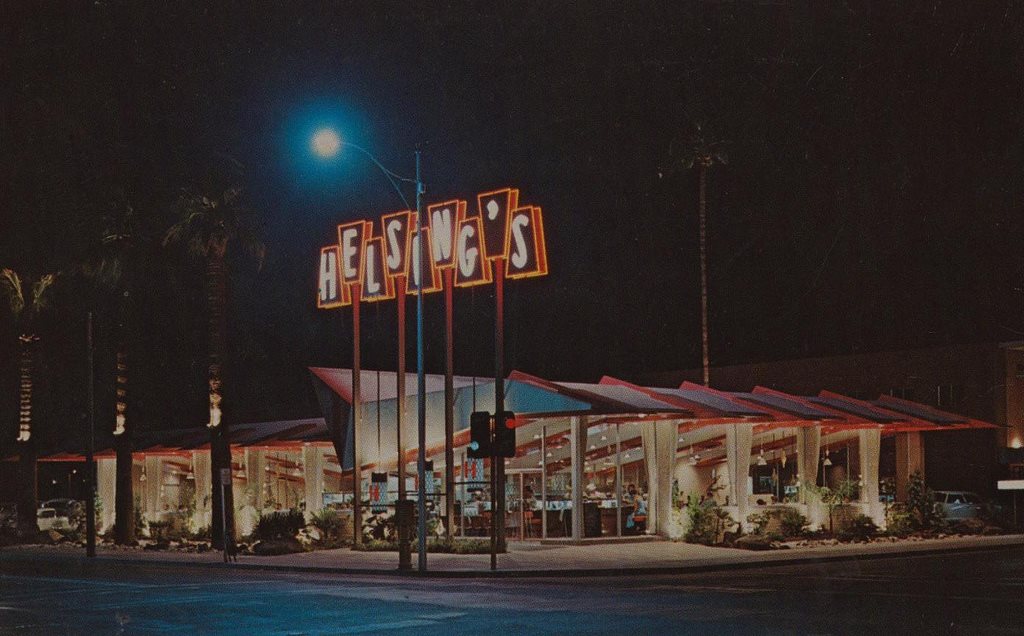
Old Phoenix at night

Old Phoenix at night

Helsings
Helsing's Restaurant, designed by architect John Sing Tang, at Central and Osborn.

Coffee_shop_24_Hr_Central_Van_Buren_1970sThe other night an Arizona Republic reporter tweeted desperately for a 24-hour coffee shop in downtown Phoenix. He was out of luck (somebody suggested a donut shop around 24th Street and Thomas, a common lack of understanding about where downtown Phoenix is located; the closest place was the IHop on Central in Midtown). This was not always the case. One (left) was located at Central and Van Buren, near the Trailways and Greyhound bus depots, with a lighted billboard on the roof. It survived until around 1970, when it was torn down for Valley Center, now the Chase Tower.

Across the street, on the northeast corner, was Jay's Coffee Shop, also 24 hours. After it was torn down in the '70s, the resulting surface parking lot was vacant for decades. Yet another favorite was the Busy Bee on Washington Street, one of the many Greek-owned establishments, which lasted until being bulldozed for Patriot's Square. These were not hipster hangouts with free wifi, but the old-fashioned coffee-shops-as-restaurants.

Beyond downtown proper, a number of center city late-night and 24-hour establishments were hopping well into the late 1970s. These included two Helsing's on Central, Village Inn at Seventh Street and Monte Vista, Shaefer's on McDowell at Seventh Street, and Denny's at Van Buren and Seventh Avenue. A bit farther west was Brookshire's at 16th Street and McDowell. They were life-savers when I worked on the ambulance and we might not get dinner until three a.m.

Bob's Big Boy anchored the corner of Central and Thomas and was the magnet for participants of weekend cruising on Central. Other popular chains were Hobo Joe's (with the hoho statue out front), Googies and Sambo's (a Sambo's building on McDowell across from the Phoenix Art Museum still stands, most recently a Thai restaurant). Helsing's and some of the others were works of art, but none still stand, unlike a few of their preserved sisters in Los Angeles.

Old Phoenix was not an all-night town. Which is not to say it wasn't a late-night town.

How far will they go?

Humans are cooking the planet into a nightmare out of a science-fiction movie. Nearly four years after the end of the Great Recession, America faces a permanent unemployment crisis, declining middle class, backward infrastructure and the prospect of years of anemic growth. The rich are more powerful than ever, with a historic share of national wealth; the same is true for the multinational corporations — but the wealth is not trickling down. Amidst these self-inflicted troubles, the Republican-controlled House is refusing to pay bills it has already approved. This is the essence of the debt-ceiling standoff. The House appears willing to flirt with, or even bring on default to get its way.

That way would be major steps to repeal the New Deal, Great Society and the domestic programs of the "Commie Dick" Nixon administration. Especially in their NRA-approved gun sights are Social Security and Medicare.

Such is the hostage-taking before which President Obama always bends. This time he claims he won't…blah, blah, blah. But a powerful block of Congress even discussing default is serious; this political dysfunction helped bring on the credit downgrades in 2011. Enjoy this relative stock rally while you've got it. As the debt-ceiling date draws closer, in February, markets will be turbulent. An actual default, which by its very nature would be disorderly, means worldwide chaos and potential depression. It would take the world's leading economy, and a government whose currency and Treasury bonds are the safest in the world, and flush it down the toilet.

DEAR READERS: I'm afraid the week has gotten away from me. Apologies. I will get back to two posts next week. In the meantime, browse the archives.

Arizona bio, part I

Someone important asked me to write about the biosciences in Phoenix and Arizona as the effort marks its tenth anniversary. This is fitting because I vividly remember the day I was called to the office of then Phoenix Mayor Skip Rimsza where he laid out the opportunity that the city had to lure star researcher Jeff Trent and the International Genomics Consortium. As a columnist for the Arizona Republic, I wrote dozens of articles to explain and advocate for this unique chance to leapfrog out of an economy that had become dangerously dependent on housing and population growth, and was falling behind on almost every measure of economic and social well-being. One column was an open letter to Dr. Trent — both of us are natives and this was from the heart — that he later told me played a big role in his decision to come home and establish T-Gen.

With Mary Jo Waits, then of the Morrison Institute, I worked to develop a "meds and eds" strategy to leverage biosciences and education; government, non-profits and eventually for-profit organizations, to create a major bio hub. As Waits repeatedly said, what if we could lay claim to the cure for cancer being discovered in downtown Phoenix? I mention my role for the sake of those who constantly yowl that I "hate Arizona," do nothing constructive, am a "quitter" or some guy in Seattle who spends his time picking on Phoenix.

The Flinn Foundation led the development of a strong strategic roadmap, as well as providing $50 million in funding. Gov. Janet Napolitano was supportive and the Legislature was dragged aboard a statewide push including leaders in Tucson and Flagstaff, as well as the Gila River Indian Community. At City Hall, Deputy City Manager Sheryl Sculley marshaled the bureaucracy to assemble land for the venture on the old Phoenix Union High School campus and oversee its redeployment. More land north was available for expansion; it had been set aside for the abortive attempt to win the NFL stadium that instead went to a cotton field west of Glendale. New ASU President Michael Crow instantly grasped the potential and soon the U of A was planning a medical school on the site. When ground was broken for the T-Gen building, even then Rep. J.D. Hayworth, hater of all things gub'ment, showed up to bask in what appeared to be a moment of history on par with the CAP. Hard as it is to believe now, it was a time of breathtaking hope.

The new center

Have you taken the Pew Research Center's "political typology" quiz? It's fascinating and frightening.

Among the twenty questions, I answered in the affirmative such ones as "Government regulation of business is necessary to protect the public interest"; "The growing number of newcomers from other countries strengthens American society"; "Relying too much on military force to defeat terrorism creates hatred that leads to more terrorism," and "Hard work and determination are no guarantee of success for most people."

In answering yes to questions about too much power being concentrated in in the hands of a few large companies and corporations making too much profit, I am simply responding to well-known facts about consolidation, concentration and record profits as a percent of GDP while per-capita GDP remains below pre-crash levels. How else should one respond? A few of the questions are too simplistic, forcing answers about highly complex issues. Faced with one, I picked a strong military as the best way to ensure peace. Religion is a very important part of my life; I said so.

My results: I'm a "solid liberal" — along with 14 percent of the public.

World-class city

Sackcloth was donned and teeth were gnashed on Facebook with the news that Taz Loomans was decamping from Phoenix for Portland. Loomans described herself as "an architect, a writer and an advocate for sustainable building
practices and community-oriented design in Phoenix. I love living in
Central Phoenix and taking part in the coming of age of this city." She was one of the people who gave hope to the Resistance. Now, however, she writes:

During this emotionally turbulent year, I have had the privilege to
travel quite a bit. In fact, as I write this, I am in the Bay Area on a
new years trip. I visited some world class cities this year such as Barcelona, Chicago, Portland New York and now San Francisco.

These trips have also changed me and the way I look at the world. Whereas before I was happy to help build Phoenix into a world-class city, I now want to find out what it feels like to live
in a world-class city. Before, I wanted to help bring bike lanes, urban
gardens, community and walkability to Phoenix. Now I want to live a
life where those things are a part of the culture and are woven into the
fabric of the city. In my travels, particularly this year, I’ve found
that there are quite a few places in the country, and no doubt in the
world, where this is true.

I’m moving not so much because I’ve lost faith in Phoenix, but rather
because different things are important to me as I go through a personal
evolution…But it’s still a tough place to build on previous progress and get to
the next level. The city’s penchant to tear down old buildings and build
new ones in their place is a perfect metaphor to how Phoenix always
seems to be starting from scratch (apropos, perhaps, because of it’s
name), and just can’t seem to build enough sustained momentum to become a
world class city.

The continuing crisis

I have been hesitant to write about the so-called fiscal cliff for many reasons. It's an over-covered topic, leaving readers in a zombie trance, even if most of the stories shed little real light. I subscribe to the Abba Eban doctrine: "When all else fails, men turn to reason." And the less elegant: Surely, they couldn't be this stupid. But it looks as if one of two things will happen: Either we're going off the cliff/curb/ramp, or President Obama will sell out the middle class safety net to get a deal.

The Bush tax cuts on the rich need to expire. In that word, "expire," we have the answer. They were sold with an expiration date, once already extended. The cuts did not perform as advertised. The Bush years, even at their best, produced the worst job creation and growth in modern American history. Inequality grew as the rich, following the rentier model, used their money to gamble in the $600 trillion derivatives market and other casinos, rather than investing in productive, job creating enterprises. Frankly, taxes elsewhere need to go up. Americans are the least-taxed among advanced nations. And we need carbon taxes and taxes on transactions, i.e. gambling by the Wall Street Boyz.

The sequester part of the cliff/curb/ramp is an artificial creation that grew out of the 2011 budget standoff, to put a gun to negotiators to reach a debt/deficit reduction deal. It could be repealed by Congress in a day. But it won't, so serious, "automatic" reductions will start on January 1. The Congressional Budget Office has warned this will cause a recession