The Sprawl Needle

Once again, it's left to homey to sun on the parade. People will once again conclude that I "hate Arizona."

Novawest, a "boutique real estate developer," has rolled out, let's call it an aspiration, to build a 420-foot-tall observation tower in downtown Phoenix. It is being likened to the Space Needle in Seattle, which marked its 50th anniversary in 2012. More about that in a moment. The developer has no financing. It has completed no project in Arizona. "But Novawest leaders are optimistic." The renderings — and I understand this is to be an open-air affair? — looked really hot, and I don't mean sexy. If every rendering proposed for downtown and the Central Corridor had been built, central Phoenix would resemble a five-mile slice of Manhattan. But let's give Novawest the benefit of a dreamer's doubt and get down to cases. [Jim Kunstler does, after his fashion, naming it the January Eyesore of the Month].

First, the Phoenix skyline is abysmally dull aside from the Viad Tower. But the combined power of the People's Republic of Sky Harbor and lack of capital, headquarters and civic leaders with means has thwarted anything better. Want some visionary skyscrapers? Go see my friend Will Bruder, architect of the central library. He's got some designs that would vault Phoenix's skyline to world prominence. But, again: Capital, headquarters, civic leaders with means. Without that combination, great civic acts are difficult. For example, Viad was built by the old Dial Corp. as a signature world headquarters and a gift to its city. Dial is gone as an independent headquarters, just another office in Scottsdale.

Republicans in retreat?

Since the election, the meme has been that a defeated Republican Party must change or face becoming a permanent minority, a regional party in a changed America. But that's not how it looks in real life. The most substantive legislative victory since November has been the passage of legislation making Michigan a "right to work" state, a staggering Republican victory in a state where the modern labor movement was born.

Meanwhile, the "fiscal cliff" negotiations go on without end, with President Obama almost pleading that he has gone "at least halfway" to give House Republicans "a fair deal." That doesn't sound like the victorious leader of a party of the future. If the election was about anything substantive, it repudiated efforts to roll back Social Security and Medicare, endorsed "nation building at home" and affirmed that taxes on the rich must go up. Why should Mr. Obama go anywhere near halfway, for in doing so he once again betrays the values of those who elected him.

The Republican position on maintaining the Military-Industrial Complex at all costs perseveres unless we are fortunate enough to go off the fiscal cliff. Meanwhile, the president left Susan Rice twisting in the wind amid the despicable character assassination by wealthy Republican Sen. John Sidney McCain III, R-Fox News. McCain, who lost the 2008 presidential election badly, will apparently determine who serves in Mr. Obama's cabinet.

Empire of violence

The essential American soul is hard, isolate, stoic, and a killer. It has never yet melted. — D.H. Lawrence

I was raised in Western gun culture. From an early age, I was taught gun safety, including an NRA safe hunter course in the eighth grade at Kenilworth School. My friends and I would go target shooting in such places as the then-empty desert around Pinnacle Peak. My scoutmaster showed me how to fire my first semi-automatic rifle. As important as the shooting was always checking to make sure a gun was unloaded, knowing that if you dropped the magazine (not a "clip," unless it was an M-1 Garand rifle), a round might still be in the chamber. Where was the barrel pointing? How to cross a fence safely. How to carry a shotgun (breach open).

"Don't point a gun at someone unless you intend to shoot them," my mother said. In addition to being a concert pianist, she was an expert shot and would not have hesitated had we been at risk. She did not like handguns. To her mind, a handgun could be too accessible while one was still angry. Through all this ran a thread of deep seriousness: A firearm was deadly, must be treated with respect and care, and its watchful possession was a sign of adult maturity. Needless to say, this culture existed in a West with many fewer people than live there today. Still, I own guns. I like them. If I had the money, I would buy more. I'm not a hunter like my uncle and grandfather. But I do like target shooting.

In the 1960s, liberal sociologists explained rising crime as the outgrowth of "the sick society." Then it included racism and lack of economic opportunity for minorities and many lower-class Americans. But that society was healthy compared with today's. These endless cavalcades of mass shootings — taking place while overall violent crime is falling — are telling us something important. I don't claim to know all the answers, but I have some suspicions.

Phoenix rail: Next steps

PhxLRT2

Newer readers to this blog might wonder why the parenthetical "WBIYB" is always inserted after the first reference to Phoenix light rail. It stands for: We Built It, You Bastards. A reminder of the hysterical, ignorant and too often thuggish opposition to a transportation technology that had proved successful around the country. I received death threats and demands that I be fired for columnizing in favor of light rail at the Arizona Republic. Well, you bastards, we built it and it is a big success, aside from the distortions that suppress transit-oriented development. Such a big success that Mesa (!) is building the line deeper into the city — and you can thank former Mayor Keno Hawker for having the foresight to persuade his colleagues to help fund one mile into the city; otherwise, Mesa would have been cut off from a system it now embraces.

It's a tough slog. The Legislature and governor are hostile to anything but freeways. The great crash slowed funding from Prop. 400 to a trickle, and even then most of it was going to build transportation infrastructure appropriate to the 1960s rather than today, including the misbegotten Loop 303 and South Mountain Freeway. While these will enrich a few connected developers, they are engines of sprawl, congestion, pollution and expansion of the heat island. Most Phoenicians can't imagine a lifestyle that doesn't revolve around long single-occupancy car trips.

Even so, the 20-mile starter line is expanding not only into downtown Mesa but also toward Metrocenter mall. An ambitious new line is being prepared to run west from downtown to a park-and-ride at 79th Avenue and Interstate 10. The West Line/Capitol Line is widely misunderstood in the media, but it would be an important step to creating a much more robust light-rail system.

Holiday books

I spend all day in front of a computer screen. The last thing I want to do for pleasure is read on a Kindle or Nook. Joe Queenan nicely encapsulates the love of books in a Wall Street Journal article: "No matter what they may tell themselves, book lovers do not read primarily to obtain information or to while away the time. They read to escape to a more exciting, more rewarding world. A world where they do not hate their jobs, their spouses, their governments, their lives. A world where women do not constantly say things like 'Have a good one!' and 'Sounds like a plan!' A world where men do not wear belted shorts…" But however you enjoy reading, here's a relatively short list of books to buy for friends or ask Santa for.

One fad in historiography is that the Red Army primarily won World War II. Rick Atkinson is having none of it in his majestic Liberation Trilogy about the U.S. Army in Europe. An Army at Dawn and The Day of Battle are the two completed works and they are the finest military history I've read in recent years. This is the way history should be written, the way that has been beaten our of three generations of professional historians. To give the Red Army its due, check out Thunder in the East by Evan Mawdsley and Ivan's War by Catherine Merridale. A terrific read about World War II in the Pacific is Evan Thomas' Sea of Thunder, about the greatest naval battle in history.

We're coming up on the centennial of the conflict that changed everything, World War I. The must-read here is Paul Fussell's The Great War and Modern Memory. Fussell, a World War II American combat infantryman, focuses on the British troops in the trenches of the Western Front and the things they carried, especially the literary influences that reached into the lowest ranks. This is one book every educated person should read: Deeply learned, highly moving, surprising and written with the attitude, as Fussell said, of "a pissed-off infantryman." Two others are both seminal and thrilling: Dreadnought and Castles of Steel by Robert Massie, about the battleship arms race and war.

Phoenix in the sixties

Phoenix in the sixties

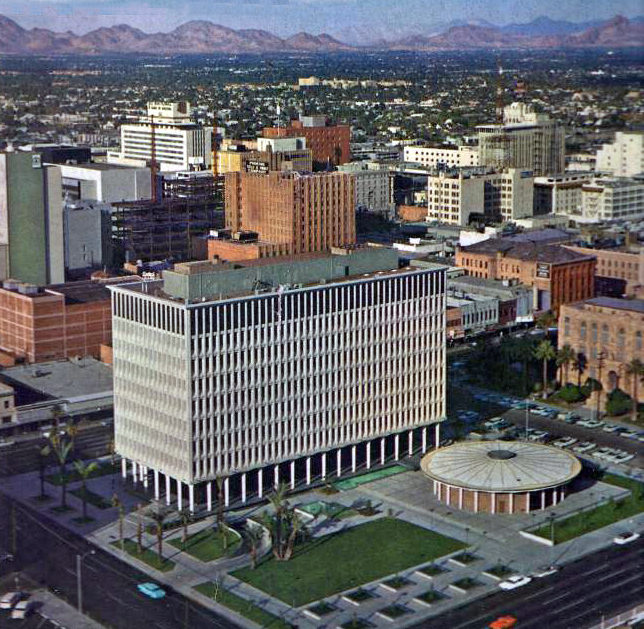
Municipal_Building_1964
Downtown in the mid-1960s, with the new Municipal Building, forefront, and the iconic rotating Valley National Bank sign in the upper right.

Decades are arbitrary things. One could make the case that "the sixties" in Phoenix ran from the late 1950s through the early 1970s. In any case, it was a most consequential time, arguably the decade when Phoenix set the pattern for what it would become, for better and for worse. In the 1960 Census, Phoenix's population was 439,170, making it the 29th largest city in America and 187 square miles within the city limits.

This was a startling jump from ten years before, ranked 99th with 106,818 people within 17.1 square miles. Phoenix had quickly become a big city, but unlike most others: single-story, spread out, car-dependent and populated by few natives. It had decisively surpassed El Paso as the dominant city of the Southwest. Yet, as it remains today, its power was like that of a small town.

Nineteen-sixty saw the unveiling of the Wilbur Smith & Associates freeway plan. Although its closest big-city neighbor was Los Angeles, Phoenix had only one baby freeway, Black Canyon. Over the decade, this would curve into the Maricopa Freeway but otherwise the Smith plan was mired in controversy. Phoenicians didn't want to become another LA. The Valley Beautiful Citizens Council worried that freeways would destroy an already ailing downtown. A hundred-foot high Papago Freeway with "helicoils" provoked more opposition. In the end, almost all of the 1960 plan was adopted. But surface streets carried most traffic during this era.

Downtown retail was slowly dying, as was the dense corridor on McDowell between 12th Street and 18th Street called "the Miracle Mile." This included the lush, stately Good Samaritan Hospital campus, replaced 20 years later by the brutal spaceship building that remains today. Malls were flourishing, including Park Central, Tower Plaza, Thomas Mall and Chris-Town, named after farmer Chris Harri on whose land it was built. Many of the downtown merchant princes were dead or ailing. Others, notably Goldwater's (sold to Associated Dry Goods in 1963), moved to the malls.

Permanent war

When Osama bin Laden launched the 9/11 attacks, he hoped to provoke an American overreaction that would bleed us to death with unending, futile military adventures and alienate the Muslim world from the thrashing giant. He dreamed of bringing out our worst.

Mission accomplished.

One of the fascinating aspects of the so-called fiscal cliff "negotiations" — as well as the presidential campaign — is the hysteria surrounding reduced or even stable military spending. We have become such a garrison state, and an economy so dependent on war, that we can't even imagine another reality. Or at least our elites and a large number in the media can't.

Thinking about water

Arizona_cap_canal
The Central Arizona Project canal snakes through the desert.

The Arizona Republic's Shaun McKinnon did a fine job of using the breach in the CAP canal to provide a primer on the system and some of its challenges (here, here and here). This blog has written extensively on water and Arizona, but while a few people are paying attention, let me make a few essential points:

• The Colorado River is over-subscribed. There are, as the water geeks say, too many straws sucking from the river. When the Colorado River Compact was first sealed in 1922 (with Arizona disputing the allotments, chiefly because it believed it was due more because the Gila and its in-state tributaries flow into the Colorado), the Southwest was largely unpopulated and even Los Angeles' population in the most recent Census was less than 600,000. The river was to be "tamed" for reclamation. Nobody ever imagined Las Vegas, a tiny stop on the Union Pacific Railroad, would become a major metropolis. Critically, the river levels used to make the allotments were around 500-year highs. Now there's simply not enough water to go around. The Upper Basin states, especially the state of Colorado, always felt defrauded by the deal and the subsequent settlement of Arizona v. California. They will be much more jealous of their water resources now. Mexico was shortchanged, as well, with catastrophic destruction of the Colorado delta resulting.

• Climate change will transform all assumptions about water in the Southwest, especially its effect on snowmelt, both in the Rockies feeding the Colorado River, and the Arizona mountains whose snow charges the lakes of the Salt River Project. There will be less water and higher temperatures. We have no historical roadmap for what this will mean, especially because, as Ed Abbey would say, one has established a city where no city should be.

Open thread

I'm working on revisions to the manuscript of the new David Mapstone Mystery, The Night Detectives. So I leave things in your capable hands.

Reader feedback, please

I'm having lunch today with Rogue's honorary Page One Editor, so it seems timely to ask what you appreciate on this humble blog, both post topics and the aggregation pages.…

Parking lot city

Parking lot

"We like our parking lots!" lawyer and Real Estate Industrial Complex apologist Grady Gammage said a few years ago when the two of us were speaking at an event on the future of Phoenix. And how. I've read that some 43 percent of the city of Phoenix alone is empty land. It would be interesting to know how much of the city is surface parking lots.

I remember when Kenilworth School was surrounded by grass and majestic palm trees. It lost part of that to the monstrous Papago Freeway. More was taken away by parking lots. The consequences are even more telling at North High School. At one time, North boasted a beautiful campus with shade and trees — it was the probably the most attractive campus in the state. By the time I got back in 2000, most of it had been paved over. Similarly, the old city-county building, where my fictional detective David Mapstone has his office, was once an oasis of shade trees and grass. Those were ripped out for "authentic" dirt and palo verdes, and recently the parking lot on the south end of the 1929 building was…expanded.

More than aesthetics are involved. Surface parking lots are a big cause of local warming, which has increased nighttime temperatures some 10 degrees in my lifetime, causing the summers to be hotter and last longer, and turning normal monsoon storms into violent affairs when they collide with the heat being released by all these square miles of asphalt and concrete. The lots destroy the fabric of the city and make walkability and convenience much more problematic. Many sit atop former farmland, which will really matter in a future of food shortages. Take a drive, ride light rail (WBIYB) or pull up Google Earth and look at all the parking lots in Phoenix. Interestingly, most of them are largely empty most of the time.

Arizona merry-go-round

I was supposed to be on KJZZ's Here and Now with Steve Goldstein on Wednesday but we were pre-empted by POTUS. So let me run through a few Arizona observations:

As of Wednesday, the state was still counting ballots. If this were happening in a banana republic, it would be one thing…but in a supposedly advanced nation? This affront to democracy is not mere incompetence but a huge opportunity for mischief — not the virtually nonexistent vote fraud the GOP claims, but official vote suppression and disenfranchisement of "those people." Once upon a time, the Secretary of State's office was a sleepy but efficient place, presided over forever by Wes Bolin and his assistant, Rose Mofford. It has become increasingly politicized, especially in 2004 when Jan Brewer was both Secretary of State, overseeing the election, and head of the state's Bush-Cheney campaign. Ken Bennett is no less an ambitious political animal. This is a scandal crying for investigative reporting and reform. Also, how could you re-elect Joe Arpaio? No wonder Gov. Fright Mask is musing on another term.

• • •

For the first time, Arizona has no Democratic statewide officeholder. This is a profound change from what had been a majority Democrat state when I was little to a competitive state for both parties for many years. One-party rule is never healthy, but it is particularly bad when the One Party denies facts and reality. The Big Sort is at work — even progressives who read this blog talk about their plans to leave. So is the outsized organization and leverage of the LDS with no counterweights in the Latino community or elsewhere (Arizona once was a big union state, yes). The Sinema congressional win is fine, but her campaign was hardly progressive. Unless widespread Hispanic voter suppression took place and Carmona stages a win, this election confirms the worst. Arizona is a solid member of the New Confederacy.

Larry Beaupre, an appreciation

I was heartbroken to hear of the passing of my friend, Larry Beaupre, too young, at the age of 68. He was still working, running a newspaper, serving the public trust. I would have expected no less. We have lost one of America's great journalists and newsroom leaders.

What now?

America didn't commit national suicide in the presidential election. Rogue readers are well aware of my frustrations with President Obama. But there was no choice but to support him against a crazy Republican Party. Wealthy Republican financier Willard Milton "Mitt" Romney may have been the most dangerous candidate fielded by a major party in modern American history. Never before would we have had to wait until after the election to find out what he really stood for, besides his own ambition. He couldn't even be forthcoming about his faith, the most important thing in his life. The refusal to release tax returns was only the tip of a Titanic-sinking iceberg. What was clear: He had spent recent years wooing the Tea Party extremists, theocrats, Randians, racists and homophobes. And unlike with Reagan, they would bring their "revolution" to "take their country back," and with Paul Ryan and others had a very specific agenda. As I say, it would have been suicide.

Now we will see if the president can finally steel himself to the battles that face us. The "fiscal cliff" will be an early marker. He was elected by people who want to see tax rates on the rich revert to Clinton-era levels, if not higher. They do not want to see the safety net further shredded to fix the dreaded deficit — not when we've been spending about a trillion a year on all the facets of the national security state and big companies pay no taxes even as they ship jobs overseas. If Obama caves to a "compromise" framed by the right, this will be another four years of weakness and slow erosion of the commons, the middle class, and American competitiveness.

Watch also to see whom he names as Treasury Secretary to replace Tim Geithner. If he chooses the odious Erskine Bowles, he of the sell-out Bowles-Simpson Commission, we will see more power flow to the oligarchs. Bowles is a corporate shill and member in good standing of the Rubin wing of the Democratic Party, which has been panting to "reform entitlements." Translation: Betray Social Security and Medicare for the middle class. Also, watch out for Peter Orszag, former Obama budget director and now at, natch, Citigroup.

Note to readers: I will leave up the Campaign 2012 link under In Depth Reports for the rest of the week and then retire it. So get the URLs of…