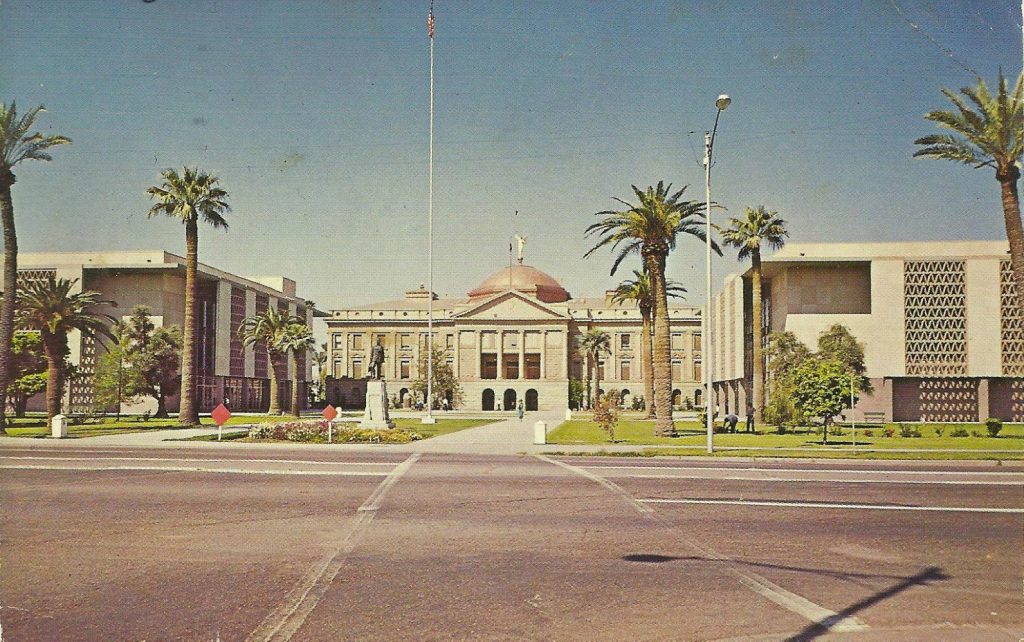
Statehood and its world
They couldn't pick a better time as that in life / It ain't too early and it ain't too late / Startin' as a farmer with a brand new wife / Soon be livin' in a brand-new state / Brand new state!
OK, I stole that from the musical Oklahoma!, about the 46th state, which entered the union in 1907. But the sentiments applied no less to the 48th, Arizona, the Baby State, the Frontier State, the Valentine State. At least for the Anglo settlers and not a few Mexican-Americans, especially in Tucson, statehood was a grand achievement, a validation of the efforts to build a new civilization in a wilderness. The government had declared the frontier closed in 1890, but it was very much alive in Arizona. The only photograph of my great-grandmother shows a grizzled, sun-baked woman standing outside an adobe hovel, my family's first home here. Air conditioning was decades away. She survived a Comanche attack as a baby — was scalped and wore a wig the rest of her life — when federal troops were withdrawn from the Texas frontier during the Civil War. In the 1890s, the family came to Arizona Territory. Plenty of heart and plenty of hope, indeed.
Many have been writing about the difficult path to statehood. I will only add that one big but largely forgotten impediment is that Arizona would come in as a Democratic state. Thus, it's no surprise that the Republicans who dominated Washington for decades after the Civil War would be loathe to give the opposition two new Senate seats and another in the House, along with Democratic electors in the Electoral College. Not only that, but allow statehood for a bunch of former Confederates and Southern sympathizers (Arizona Territory had a delegate to the Confederate Congress). And that's just what happened, with Henry Fountain Ashurst, Marcus Aurelius Smith and Carl Hayden beginning Democratic control of the state that would continue pretty much uncontested for 40 years. At his worst, Ashurst made Ben Quayle look like Pericles — he opposed a National Park for Grand Canyon, for example. Yet he also said, "When I come back to Arizona, you never ask me questions about such (international) policies; instead, you ask me, 'What about my pension?' or 'What about that job for my sons?' " Hayden, of course, went on to become one of the greats.
 23
23