Opportunity costs I

The Navy has its heart set on building 55 littoral combat ships. So far, each is costing around $700 million. That's about half the annual federal subsidy for all of Amtrak. For one ship. And although it looks "like Darth Vader on the sea," as the New York Times put it, one doesn't have to be an amateur naval historian, although I am, to see this craft could be sunk by the ghost of Billy Mitchell flying a 1920s bomber. This is another deeply troubled defense program, plagued by cost over-runs and likely not just to disappoint but actually put our security at risk. Imagine how we could be using this money, or the trillions we're spending for wars in Afghanistan or Iraq — and there, as Everett Dirksen would say, we're talking real money. Such an exercise lets us better understand the opportunity costs of the course we're pursuing into decline.

One important effort should be retrofitting suburbia for a high-cost energy future, which is inevitable no matter how much we frack or use the dirty oil from our good friends to the north. Of course, most of American suburbia was built for the car. Eighty percent of everything ever built in America has been built since World War II. Place-making and civic design were lost. Massive, cheap, look-alike construction, laid down on an industrial scale, has continued and metastasized, bigger and uglier, decade by decade. All this was heavily and stealthily subsidized by taxpayers and federal policy,  encouraged by a brief moment in history when gasoline was cheap and America was less populous. Jim Kunstler rightly calls it "the greatest misallocation of resources in the history of the world." Now it's a built environment whose time has come and gone. Exurbia is done. Much of the rest of suburbia will face ever-greater stresses.

Could some of it be saved and improved? Yes.

Ethnik studees

Jon Stewart did a priceless takedown Monday of the Kookocracy's war against the Mexican-American ethnic studies program in Tucson. Al Madrigal went to the Old Pueblo, where school board member Michael Hicks (happily? cluelessly?) sat down for an interview with the world's most famous parody/news show. He talked about his concern with "a lot of the radical ideas" of the program.

Had Hicks attended a class? "Why even go, why even go?" this GOPer from central casting said. "I base my thoughts on hearsay from others…" Yes, this is more of Arizona earning publicity one can't buy, further cementing the Crazy State's reputation. But it's also important to know that the Kooks succeeded. The ethnic studies program is gone — Tucson was under threat of a $15 million penalty from the state — although one for African-Americans continues.

The Kooks would have more standing if the Arizona they have now run for years didn't consistently rank at or near the bottom in per-student funding (and it's not Utah, with a homogeneous, heavily LDS population). That funding keeps declining. Education Week's Quality Counts survey ranked Arizona 8th from the worst nationwide in a variety of measures. All this has happened on their watch. Their solution is to get one of their many shills to explain it away. Nor has the state's "achievement" in being a leader in charter schools made things better. Quite the contrary, although public money has been used to privatize profits for the politically connected charter racket. The biggest victims: Hispanic students in ignored, under-funded districts.

His Waterloo

"If we're able to stop Obama on this (health care), it will be his Waterloo. It will break him." — Jim DeMint, R-South Carolina

You didn't think the best Supreme Court that money can buy was going to let Obamacare go into law, did you? From the questions asked of lawyers and the dismal performance of President Hoover's Solicitor General, it doesn't seem likely. Now the question is not merely whether the court will strike down the individual mandate but also use this as a springboard to go after more, beginning with Medicaid. Roberts, Scalia, Alito and Thomas have waited their careers for this moment. Anthony Kennedy is a Reagan appointee. The Federalist Society and the entire right-wing infrastructure have built themselves for it. Now we will get another lesson in why it has been a calamity to have 30 years of mostly Republican presidents packing the federal judiciary. Activist judges? You ain't seen nothing yet.

The so-called Affordable Care Act has been a trainwreck from the beginning. Mr. Obama didn't make it a centerpiece of his campaign, so he had no mandate to do it. Most Americans don't understand it. Like the Dodd-Frank financial "re-regulation" legislation, it is compromised to appease the plutocrats, in this case the insurance industry. About the only clear benefit I can parse is the prohibition against denying coverage to those with pre-existing conditions.

Worse, he wasted a precious year on "health care reform" that should have been spent in very obvious and effective measures to save an economy in free fall (and loudly claim credit). To address the worst domestic crisis since the Great Depression and reset the economy for a prosperous, sustainable future. "Never let a crisis go to waste," my ass. Instead, Mr. Obama chose health care. Here his constant template was revealed, alternately passive and ineffective, helped along by a spineless Democratic majority in Congress. The result: The triumph of the Tea Party in the 2010 election shellacking. He would rather be a good one-term president than a mediocre two-termer? Were he not running against Willard Romney, he would be consigned to the Jimmy Carter dustbin — and he might yet be, for the Republican, whose health-care program in Massachusetts became Obamacare, has unlimited money.

Our appetites

There are many possible explanations for why Americans pay so much more. It could be that we’re sicker. Or that we go to the doctor more frequently. But health researchers have largely discarded these theories. As Gerard Anderson, Uwe Reinhardt, Peter Hussey and Varduhi Petrosyan put it in the title of their influential 2003 study on international health-care costs, "it’s the prices, stupid." As it’s difficult to get good data on prices, that paper blamed prices largely by eliminating the other possible culprits. They authors considered, for instance, the idea that Americans were simply using more health-care services, but on close inspection, found that Americans don’t see the doctor more often or stay longer in the hospital than residents of other countries. Quite the opposite, actually. We spend less time in the hospital than Germans and see the doctor less often than the Canadians. "The United States spends more on health care than any of the other OECD countries spend, without providing more services than the other countries do," they concluded. "This suggests that the difference in spending is mostly attributable to higher prices of goods and services." On Friday, the International Federation of Health Plans — a global insurance trade association that includes more than 100 insurers in 25 countries — released more direct evidence. It surveyed its members on the prices paid for 23 medical services and products in different countries, asking after everything from a routine doctor’s visit to a dose of Lipitor to coronary bypass surgery. And in 22 of 23 cases, Americans are paying higher prices than residents of other developed countries. Usually, we’re paying quite a bit more. The exception is cataract surgery, which appears to be costlier in Switzerland, though cheaper everywhere else. https://www.washingtonpost.com/blogs/ezra-klein/post/why-an-mri-costs-1080-in-america-and-280-in-france/2011/08/25/gIQAVHztoR_blog.html?tid=pm_pop

State of extremism

Arizona may not be competitive in much — cheap housing and hot weather come to mind. But it seems determined to "out-crazy" other states in its rock-ribbed, doubled-down reactionary politics. Almost every day comes a story that speaks to the core concerns of today's right wing. For example, Joe Arpaio, High Sheriff for Life, is "investigating" the "fraud" of President Obama's birth certificate, claiming it is a cover-up "ten times worse than Watergate." Can Arizonans hear America laughing?

Other issues are not so funny. The assassination attempt on Rep, Gabrielle Giffords, inspired by the climate of hate, remains a huge stain. The Legislature long ago went from, let us say, liberalizing the laws affecting firearms to encouraging situations where firearm violence is inevitable. Salon, internationally read, has begun an entire archive devoted to Arizona and the entries are not sunny! Scottsdale! or championship golf! Among the headlines: "How Breitbart and Arizona seized on 'critical race theory' " and  "Arizona's vicious war on workers." The New York Times specifically established a Phoenix bureau to cover Arizona crazy when the anti-immigrant, Jim Crow, voter-suppression SB 1070 debate was emerging. From Daily Kos : "Arizona out-crazies other contraception bills. Use birth control, get fired." Talking Points Memo reports on the violent neo-Nazi groups congregating in the state.

This is not an image problem. It is a reality problem, no matter the many Arizonans who are not crazy or extreme. In a state that already ranks so low on virtually any measure of social or economic well-being, it is a bright red "DO NOT COME HERE" alert, whether to companies deciding where to make quality investments or talented, educated people choosing their home.

Killer nation

The surprise is not that an American soldier walked off his base and murdered 16 Afghan villagers, including nine children, but that it hasn't happened more often, including in the United States. This is what happens when we keep our armed forces at war for an astounding 10 years. No wonder Gen. George Marshall was so eager to finish the Second World War, fearing that a democracy couldn't survive a war that went past five years. And no wonder Americans who now "support the troops" have historically been wary of a standing army and unimpressed by a chest-full of medals.

This is what happens when our wars have no front lines and no conventional armies as enemies. The war is everywhere and nowhere. Combatants are hidden in a civilian population already tired of our occupation, our disrespect for their customs and religion, and willing to supply information to the enemy. Soldiers in these circumstances learn to despise and dehumanize the ungrateful civilians they are supposed to be protecting. Even conventional wars coarsen nations, destroy young people, encourage atrocities.

This happens when Americans have slipped norms of decency, abandoned books in favor of homicidal video games, dress (and act) like adolescents, joined the military because the union blue-collar jobs they once could count on have moved to Asia, and found themselves defrauded and lied to by every institution in our national life. And guns, guns, guns everywhere.

Green shoots in the desert?

Some old timers still blame a December 1988 Barron's article ("Phoenix Descending") for the collapse of the city's real-estate boom. This is fantasy, of course: The market caved in on its own, pulled down by too many hustles, too much overbuilding and the savings and loan scandal driven by local steward Charles H Keating and his pet senators. Now Rupert Murdoch's Dow Jones has tried to make amends with a Wall Street Journal story about Phoenix's "nascent real-estate rebound." Indeed, it "holds lessons for the rest of the country." Another fantasy?

The Journal continues:

Phoenix has found a viable formula. Low prices are igniting demand from first-time buyers and investors who are converting the homes to rentals. The local economy is on the upswing with several big employers like Amazon.com Inc. and Intel Corp. hiring again, which is further increasing demand for housing. And the region is benefiting from a surge of buyers from Canada who are using their favorable exchange rate to scoop up bargains in the desert.

Could this be true? Has long-suffering Phoenix "found a bottom" and is beginning a rebound? As Zhou Enlai may have said when asked about the significance of the French Revolution: It is too soon to say. What it means about the metropolitan area's real competitiveness and future is murkier still.

Mesa stirring?

Downtown_Mesa_Arizona
Something is happening in Mesa. Light rail is being extended three miles along Main Street from Sycamore to Mesa Drive, reaching downtown and putting it within walking distance, on a decent day, of the Arizona Temple. A brewery is coming to Main Street. Pioneer Park might get a botanical garden, pushed by a citizens committee that also proposes extending light-rail to Gateway airport. (Building an inspiring city hall would be nice, too). Officials brought in 50 developers to show off potential downtown sites. Council members actually expressed hesitation about some senior housing projects, worried they would get in the way of efforts to attract market-rate, transit-oriented residential development downtown.

The "city with wide streets and narrow minds" is actually attracting higher education: the A.T. Still University branch offers osteopathic medicine, dentistry and health care; Benedictine University is expected to open a campus downtown. This is on top of the downtown branch of Mesa Community College and ASU Polytechnic. When metro Phoenix saw itself in the running for a new Apple campus, which not surprisingly went to Austin instead, it's no secret the company was looking most at Mesa. The Mesa Arts Center has stopped trying to compete with Phoenix and is doing well with, among other things, community festivals.

Could this be Mesa, Arizona? A city more populous than Cincinnati, Pittsburgh, St. Louis, Minneapolis, etc. with nothing to show for it? Something seems to have changed.

The asterisk presidency

Now is the time when all good progressives and people with brains are supposed to line up behind President Hoover. After all, where else can we go? The Republican theocrats and plutocrats have made their dangerous irrelevance clear through an endless series of "debates," and Willard Romney still can't close the deal with his own party. Washington Monthly tries to rehabilitate Mr. Obama in an article that contains this paragraph:

Measured in sheer legislative tonnage, what Obama got done in his first two years is stunning. Health care reform. The takeover and turnaround of the auto industry. The biggest economic stimulus in history. Sweeping new regulations of Wall Street. A tough new set of consumer protections on the credit card industry. A vast expansion of national service. Net neutrality. The greatest increase in wilderness protection in fifteen years. A revolutionary reform to student aid. Signing the New START treaty with Russia. The ending of “don’t ask, don’t tell.”

And if you missed it, "he shifted counterterrorism strategies to target Osama bin Laden and then ordered the risky raid that killed him." Another Washington Monthly piece lists the president's top 50 accomplishments. Yet each one requires an asterisk.

Phoenix 101: Pinal County

Phoenix 101: Pinal County

738px-Coolidge_Arizona

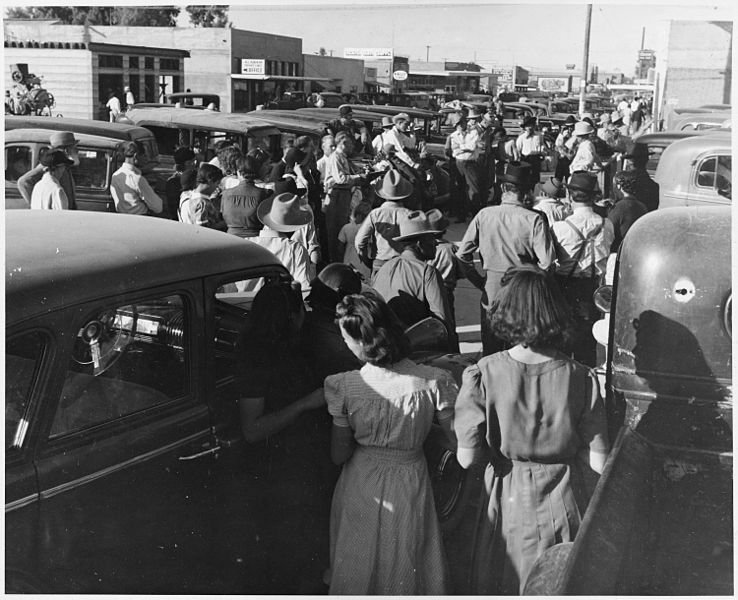
Dorothea Lange captures Coolidge on cotton harvest day, during the Depression.

Pinal County today is known for many things, mostly appalling. It was mauled by the housing crash of the Great Recession, a "bedroom community" to Phoenix with cheap, shoddy tract houses and miserable commutes, the place whose lack of planning or sense of decency allowed subdivisions to profane one of the most glorious mountains in the West. This lack of any respect extends to consenting to a Super Wal-Mart right next to the Casa Grande Ruins National Monument. Pinal boasts one of the ugliest drives in America, on Interstate 10 between Phoenix and Tucson.

And, of course, it was where Paul Babeu was sheriff. Babeu was disgraced, not because of his department's racial profiling, whoppers about beheadings, anti-immigrant hysteria or allegations that Babeu threatened to have his Mexican ex-lover deported. No, this once rising star in the Arizona Republican Party was forced to admit he's gay, torpedoing his hopes of being elected to Congress.

Yet these 5,365 square miles — five times the size of Rhode Island — contain so much Arizona history. Personal history, too: I attended kindergarten in Coolidge. We lived there for a year, for reasons too complicated to deserve a detour, but ultimately coming down to Arizona's fight against California for Colorado River water — what else?

The GOP’s last stand?

The idea that a few bankers control a large chunk of the global economy might not seem like news to New York's Occupy Wall Street movement and protesters elsewhere (see photo). But the study, by a trio of complex systems theorists at the Swiss Federal Institute of Technology in Zurich, is the first to go beyond ideology to empirically identify such a network of power. It combines the mathematics long used to model natural systems with comprehensive corporate data to map ownership among the world's transnational corporations (TNCs). "Reality is so complex, we must move away from dogma, whether it's conspiracy theories or free-market," says James Glattfelder. "Our analysis is reality-based." Previous studies have found that a few TNCs own large chunks of the world's economy, but they included only a limited number of companies and omitted indirect ownerships, so could not say how this affected the global economy - whether it made it more or less stable, for instance. The Zurich team can. From Orbis 2007, a database listing 37 million companies and investors worldwide, they pulled out all 43,060 TNCs and the share ownerships linking them. Then they constructed a model of which companies controlled others through shareholding networks, coupled with each company's operating revenues, to map the structure of economic power. The work, to be published in PLoS One, revealed a core of 1318 companies with interlocking ownerships (see image). Each of the 1318 had ties to two or more other companies, and on average they were connected to 20. What's more, although they represented 20 per cent of global operating revenues, the 1318 appeared to collectively own through their shares the majority of the world's large blue chip and manufacturing firms - the "real" economy - representing a further 60 per cent of global revenues. When the team further untangled the web of ownership, it found much of it tracked back to a "super-entity" of 147 even more tightly knit companies - all of their ownership was held by other members of the super-entity - that controlled 40 per cent of the total wealth in the network. "In effect, less than 1 per cent of the companies were able to control 40 per cent of the entire network," says Glattfelder. Most were financial institutions. The top 20 included Barclays Bank, JPMorgan Chase & Co, and The Goldman Sachs Group.

The exit interview

The urbanist Yuri Artibise left Phoenix last year, returning to Vancouver. It's part of a continuing brain drain, although to be sure such assets as ASU continue to bring in new creatives. I don't know where the tally stands, but I fear Phoenix continues to lose more than it attracts. Architect Taz Loomans recently conducted an interesting "exit interview" with Artibise. It made me realize that it's been five years since I got the first inkling that the Arizona Republic would take away my column, which would eventuate in me leaving town. So I thought I'd use Loomans' questions as a test for myself.

What do you miss most about Phoenix? My good friends. (I tried to select one "most"; for more, see my additions in the comments section).

What did Phoenix have that Seattle doesn’t? It is the repository of so much of my history, so many of my hopes. My mother and grandmother, long dead, are so alive on the streets of Willo, Roosevelt and Storey. The church where I was baptised is still going, as is my grade school, still in its inspiring, grand building, and enchanting Encanto Park. Union Station, where I spent countless hours as a child watching trains and dreaming of far-away places. The streets I worked as a paramedic, learning too much too young. The different mountain vistas that always orient me. Phoenix is the home of my heart, a place so mangled, mismanaged, raped and pillaged, but still worth fighting for. No matter how long I am gone, when I return I can drive the streets and walk the neighborhoods as if I had never left. The ghosts of the Hohokam still speak to me on winter nights when the cold wind blows from the High Country and the peculiar acoustics of the valley mingle train whistles and voices of the beloved dead.

Phoenix update

Back from a week in Phoenix, some observations:

1. The place still gives off the quality of a fallen souffle. Sure, a few projects are getting press out in some of the more affluent suburbs, but the utter collapse of four years ago still lingers. It's not for lack of trying by the Usual Suspects: Bottom has been hit, a turnaround is only (xx) years away, cheap land and sunshine will continue to be the basis of the economy, blah, blah, blah. But the old growth machine will not sputter back to life for one more run (with championship golf!). Too many crapola tract houses, too much debt, too few well-paying jobs, no speculative bubble driven by liar loans and securitized mortgages sold on a historic scale. What's Plan B? There is none.

2. A lack of seriousness pervades the state. Phoenix Mayor Greg Stanton tweets, "In Phoenix, we have a full commitment to sustainability: Sky Harbor Airport Dedicates Solar Power System." Space does not allow us to fully deconstruct these 104 characters, but we can make a start. Sky Harbor is a red giant of concrete and air pollution, contributing mightily to the heat island and dirty, unhealthy sky, and this is somehow redeemed by a "solar power system" that will power…the airport? No, the linked news story says it generates "enough to handle half the power needs of the rental car center, east economy parking lots and toll booths." Oh. (A real reporter might want to know if this includes generating electricity for the rental car center air conditioning, too, which seems unlikely, and how long the solar operation will have to run before it "repays" the fossil-fuel inputs it required and may still require).

Revolution 2.0

It is starting to dawn on America's press corps that the Arab Spring is not going to usher in Jeffersonian democracy in the Middle East. The upheaval in Egypt, for example, has not led to rule by educated young Arabs, secularism, women's rights and peaceful pluralism. We find the same military control that has marked the country for decades along with the danger of an Islamic state inimical to Western values, as well as to stability in the region. Nineteen Americans face murky criminal charges. And so it goes. A world with way too many unemployed young men, a world facing scarcity, will fall back on the tribal, brutal and nationalistic.

In America, we await breathlessly the next phase of Occupy. Meanwhile, the super PACs and plutocrats continue to have their way. I return to a periodic theme: What happens here? What happens next? Jim Kunstler thinks we are ripe for a "John Brown moment." Some very smart Rogue readers expect big trouble at the Democratic and Republican conventions this year. And there is endless faith placed in Facebook and Twitter as tools to empower the powerless to overthrow the plutocracy.

I am skeptical but persuadable.