‘Ich bin ein Kook’

One must wonder what Arizona Gov. Jan Brewer's main constituency thinks about her junket to SOCIALIST Europe, to Germany and to France, whose new president is nominally a SOCIALIST. One must wonder what the Germans and French think of Brewer, the head of an American state that continues to up the bar not just on craziness (See Bennett, Ken) but violent craziness. Gun deaths in Arizona now exceed automobile fatalities. The extremism was loud enough to call for a New York Times essay from Timothy Egan: "We interrupt reality to bring you Arizona…"

According to the newspapers, Brewer's trade mission "includes leaders of the Arizona Commerce Authority and Arizona Office of Tourism." Just who these mammals are — as in, name names — is unclear. (The Republic's Yvonne Wingett Sanchez got at least a partial list of the entourage, but the governor's office declined to give the budget). The purpose of the trip is also murky. Stories mention that the EU imported $770 million in Arizona products in 2011. Germany is the state's sixth-largest trade partner, France No. 10. These are meaningless numbers because Arizona exports are distorted by the huge footprint of Intel semiconductors and, to a lesser degree, Boeing and Raytheon defense products. Arizona is not a conscious player in the export world.

As for tourism — forget it. Germans who want American sun go to Miami. Unless the state could lure or underwrite direct flights to Germany and France, it will never be a big player in this field.

Memorial Day

The origin of Memorial Day was the commemoration of Union deaths after the Civil War, a conflict that cost between 618,000 and 700,000 lives in a nation with a population of less than 32 million. The South had its Confederate Memorial Day, still marked in some states of the old CSA. As this warrior republic, crusader nation has racked up more wars, Memorial Day has added these deaths to the holiday.

Newspapers will again run photos of small flags planted in front of the tooth-like marble gravestones of the war dead. But if ever there was an argument for a "sunset provision" to holidays, Memorial Day is it. Even the deaths of ordinary civilians are observed. Commercialized, trivialized and a venue for cheap patriotism, Memorial Day has been drained of its somber meaning. For most Americans, it is just another day off, another long weekend, the start of summer.

The disconnect is worse than ever. We've been through a decade of war and everybody "supports the troops." But our wars are fought by a professional military whose values are, in both good and dangerous ways, cut off from the mainstream of the country. The ideal of the citizen soldier is gone. This way went Rome.

Upping the crazy stakes

Your humble columnist at this "comparatively low-traffic site" is back from a week in Phoenix. I must admit 60 degrees in Seattle is more pleasant than the 108 degrees when I flew out of Sky Harbor — including that big, twisty scream-inducing bump on the 737 as we tried to climb out of the heat.

I spent most of my time in tolerant, diverse central Phoenix. But outside that bubble, the forces of Peak Crazy kept trying to extract ever more madness. Secretary of State Ken Bennett kept Arizona as a national laughing stock (at least among the "liberal elites," read sane people) by pledging to make Hawaii come clean about the president's birth certificate. The Washington Post, read by people who make decisions about deploying capital and quality assets, thought Arizona's witlessness worthy of an editorial. Hawaii, a state for those of you who were home-schooled in the East Valley, turned the tables and is forcing Bennett to prove his bona fides to even ask. The mockery of Arizona's No. 2 elected official continues. But this did not prevent Sheriff Arpaio — who should be in jail — from sending a "threats unit" deputy to investigate in the Aloha State — something to please the "Valley" blue-hairs who vote. Where is Steve McGarrett when we need him? Bennett's antics are more than an embarrassment, more than pandering. He is the official who will preside over the elections. The secretary of state should not be a partisan office (but Jan Brewer used it just that way in 2004, also chairing the Bush re-election campaign in Arizona).

The "information center" has run off the majority of its best, most experienced journalists. One still there is Dennis Wagner, who reported what should be a national blockbuster on Sunday about the Pinal County Sheriff's Office stockpiling surplus military equipment and selling it off to private parties. This is no Babeu boo-boo, but a story that raises troubling questions about how the Military Industrial Complex is infiltrating law enforcement, with the added and sadly typical Arizona corruption thrown in.

Climate, trains, downtown

Historically, May was when the temperature in Phoenix crept up to 100. Almost all week, it's been around 105 for the high. "Climate change is a hoax," as they say. The past 12 months were the warmest ever recorded, yet there is no debate, no discussion, least of all in a city likely to be heavily affected, Two days of hot wind cleared out the smoke from the wildfires, leaving only the usual smog. Better than nothing. At a book signing Tuesday night at the Arizona Biltmore, several people came up to say how much they depend on Rogue Columnist to speak truth to power, reality to the Kookocracy. It's something for me to keep in mind if some think I am just shouting the same old stuff with tiresome certitude.

Light rail seems to be doing well every time I ride it — and I depend on it (WBIYB). I can't speak for the line from Camelback to Chris Town, but otherwise it's packed-to-busy. It's curious at stations to see signs that identify trains going to Tempe and Mesa, or 19th and Montebello, but never downtown Phoenix. If you get on light rail at the Sky Harbor stop, you'd never know which way was the city center. Not smart. Tempe is trying to build a streetcar — a good sign. Otherwise, transit policy is a hash. Buses have been gutted (Your Tax Cuts at Work).

I'm not sure I understand the so-called West Link line. Is it really intended to go to Tolleson? If so, this shows how the region still doesn't get rail. Heavy commuter rail should be a priority to all the outlying suburbs, with a hub at Union Station, where passengers could connect with buses and eventually a light-rail spur as was done in San Jose. Commuter trains would provide fast service to Glendale, Peoria, Tolleson, Goodyear, Buckeye, Chandler, Gilbert, etc. The rail right-of-way is there and would require public money to expand capacity, as well as negotiations with the private railroads. But this has been done successfully around the country.

Something’s burning

Coming into Phoenix Monday, we flew very near the Gladiator fire, an awesome and disturbing sight from the air. It reminded me of Boy Scout camping in the Crown King…

Book time

With the publication of my new mystery, Powers of Arrest: A Cincinnati Casebook, I'm taking a few days off for signings. Some will be in Phoenix, so check this schedule.…

‘Rebound’

Foreclosures_1
A recent story in the Arizona Republic inspired a good deal of commentary on the thread of the last post. I'm going to hang it out there, make a few comments and let you go to town (or suburb). It starts, "The rebound of metro Phoenix's new-home market continues to build." Then:

New-home permits were up 61 percent in the region during March, according to the latest Phoenix Housing Market Letter. The increase is more staggering than the actual numbers, but still it signals "evidence of a new-housing rebound," according the report's publishers, RL Brown and Greg Burger. In March, there were 1,036 single-family permits issued. It was the first month in a while in which home-building permits topped 1,000.

Last year in March, there were 645 single-family permits issued across the Phoenix area. Overall, homebuilding — one of the region's biggest economic drivers — was up 74 percent during the first quarter of this year compared with 2011. Here's an even more positive number for the new-home market: Builders reported a spec inventory of only 383 houses during the first part of April.

The fight of our lives

We miss the core issue: liberalism itself isn't strong enough to force them to our side and interests. Where are our armies? Where? We're in the fight of our lives with a well-meaning if irresolute leader in Obama… But he is, for better or worse, the only leader we have. — Soleri

What is this election about? Government that is not broken but "fixed" by moneyed interests to their benefit and the destruction of the public good? Shocking income inequality with average Americans left ever further behind? The American promise of a good job and economic mobility for those who, in Bill Clinton's words, "work hard and play by the rules"? Arresting the continuous expansion of the Military-Industrial Complex and stopping America's endless wars, and with them the huge opportunity costs to the nation?

It is about all those things and much more. At its core, this election actually is about what kind of nation we will be. This is often a phrase tossed out by candidates between whom, as George Wallace would say, "there's not a dime's worth of difference." Or used in times of relative peace and prosperity when the stakes are less. Not this time. So, no, we didn't pick this fight, especially not baby boomers of a certain age who can remember another America, flawed and troubled but on the right path. But we're in it. We're in the fight of our lives.

Tucson drifts

What's the biggest danger facing Arizona's second city? According to Roger Yohem, writing in Inside Tucson Business, it is that the Old Pueblo will become Portland-ized:

Many of Portland’s traits infatuate Tucson’s bureaucrat copycats. To start with the obvious, Portland has a modern streetcar system that serves downtown. The real cost of Portland’s trolleys, infrastructure and tracks can be hard to gauge since much of it was taxpayer subsidized through government grants and tax gimmicks. But based on various public records, the consensus puts the initial cost at $25 million per mile. For $200 million, Tucson’s streetcar system will cost $50 million per mile. When subsidized by taxpayers, perhaps every city is entitled to pricey public transit.

I have no idea who this mammal is, but he perfectly encapsulates the retrograde ignorance that holds Arizona back. And he is an example of the endless streetcar hysteria that has enveloped the city since it began work on a (sit down, now) 3.9-mile line scheduled to open in 2013. Oh, the socialism! The Islamo-fascist-madness!

Ambulance days

Ambulance days

Ambulance_Medic79

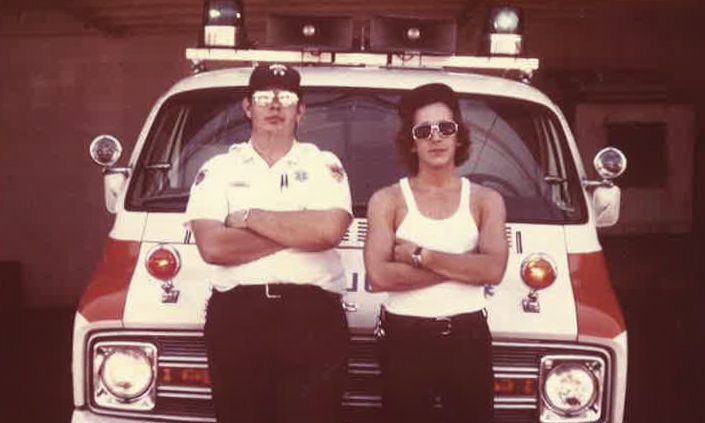
The author, left, and partner Russ Covert with Medic 79 at the downtown Phoenix ambulance station in the "hellish" July of 1976

In 1974, two months shy of 18 years old, I became the youngest registered emergency medical technician in Arizona. I started as a dispatcher at Kord's Ambulance, which had the distinction of being owned by a relative of Linda Ronstadt. Soon, however, I was gravitating to the Kord's operation in Scottsdale, where my Coronado High friend Marc Terrill was working.

There, under the leadership of the legendary Chuck West, the company had established the first advanced life support unit in the Southwest. It was a sea change from the throw-and-go days of ambulance drivers. This ambulance was equipped with IVs, EKG, telemetry, defibrillator, intubation gear, drugs — all the items seen on a modern rescue rig. An RN accompanied the two EMTs, who were trained as paramedics in a program at the old Scottsdale Memorial Hospital under Dr. Bert McDowell.

From riding along and attending classes on my days off, I wrangled a transfer to Scottsdale in the fall. I was one of "Chuck's boys" (two female medics were there, too, a major breakthrough). The ambulance itself was revolutionary: Life-saving treatments could be begun at the scene.

My early time was very difficult. The old guard was dominated by former combat medics (precursors of civilian physician assistants) who had served in Vietnam: Men who had performed surgery after rappelling into hot landing zones and no doubt they were PTSD'd to the moon. Unlike today, they had no use for the young person in their midst.

They were tough, demanding, unmindful of, and quite contemptuous of, what is now called "my self-esteem." So I had to earn it. I learned more from them in a short period of time than I ever have in my life, in any of my callings. From not even being sure of hearing a blood pressure while the siren was wailing, I learned to start IVs, intubate, triage, do CPR right, everything. I finally merited their respect. It remains one of the most thrilling accomplishments of my life, and makes me feel sad for young people today who are tossed into over-their-head jobs because they are cheap and never given proper seasoning or mentoring, whether rough or gentle.

They taught me a useful phrase and behavior from "the 'Nam" that has served me well: Run frosty.

Our China syndrome

By Emil Pulsifer, Guest Rogue

To the extent that money spent by American consumers on Chinese imports pays the wages and salaries of foreign workers, underwrites the profits of foreign companies, and increases demand for foreign goods, it does not pay the wages and salaries of American workers, it reduces the profits of domestically operating companies, and it decreases demand for American goods.

Though subsidizing Chinese export industries creates a Chinese consumer class, which may subsequently purchase American goods, and creates a Chinese mercantile class, which may purchase American equipment as manufacturing, mining, or transport tools, as long as America is running a large trade deficit, it is in effect spending dollars to get pennies back. These are dollars (net of pennies) that, if spent on American goods and/or services, would increase domestic demand, thereby increasing hiring; and by decreasing unemployment, would increase competition among American companies for American workers, thereby bidding up wages and salaries and improving the standard of living of American households. This in turn further increases demand to American businesses, and we have the "virtuous circle."

Stanton in the Valley

I want to expand on comments I made to Steve Goldstein's Here and Now on KJZZ Wednesday about Phoenix Mayor Greg Stanton making a trip to Silicon Valley and the Bay Area to recruit businesses.

Foremost, this is a great start, something I've been advocating for more than a decade. The future to diversifying the Phoenix economy lies in California and Asia, not in Dubai. That the trip is so public is a bit puzzling; real success will come from years of quietly cultivating contacts. Phoenix needs to open offices in Southern and Northern California to recruit companies. I was also disheartened that Barry Broome of the Greater Phoenix Economic Council invited himself along. GPEC must please the suburbs at least as much as the city, and given the preference of the leasing boyz for suburbia, the organization is incapable of addressing the city's needs, particularly for jobs and capital investment in the central city.

Now, a reality check. Phoenix is not going to attract headquarters from Silicon Valley. You can't touch a fixer-up cottage in Palo Alto for less than $1.5 million and it doesn't make the economy skip a step. Workers would rather commute from Modesto than move to Chandler. This is the world's foremost technology cluster, and it happened because of all the things Phoenix lacks: World-class universities, trillions of dollars in government investment, an exceptionally high number of college graduates, attracting vast amounts of capital and a large entrepreneurial class focused on anything but real estate. It has a real downtown, in San Francisco. It is diverse and tolerant. There is no Santa Clara County Sheriff Joe. A real cluster is not a couple of semiconductor fabs in the suburbs. Phoenix can no more be "a mini-Silicon Valley" than the downtown Phoenix Public Market, and I love it, can be a mini-Pike Place Market. Cisco is not going to move from the Valley to "the Valley."

Cruel and usual

We know Amnesty International as an organization known for spotlighting human rights abuses in Third World places. You know, places such as Sudan, Syria and Arizona. A new report criticizes the state's prison system for conditions that "fall below international standards for humane treatment." Among the findings:

More than 2,900 prisoners are held in Arizona’s highest security maximum custody facilities, the majority in the SMUs at ASPC-Eyman. Most are confined alone in windowless cells for 22 to 24 hours a day in conditions of reduced sensory stimulation, with little access to natural light and no work, educational or rehabilitation programs. Prisoners exercise alone in small, enclosed yards and, apart from a minority who have a cell-mate, have no association with other prisoners. Many prisoners spend years in such conditions; some serve out their sentences in solitary confinement before being released directly into the community.

Among those held in these conditions are the mentally ill and children as young as 14. State officials refused to meet with Amnesty International representatives. Although the Arizona Republic carried a story, it will soon be forgotten. Newspapers don't crusade any more, which would require day after day of stories that dig into the conditions, the human pain and who is responsible. Anyway, who really cares about these people? As my character Sheriff Peralta says to the bleeding heart Mapstone, "The thing about the criminal justice system is that it's full of criminals." Out at the mega-churches and the stakes of Arizona, one is taught that Baby Jesus is there for the prosperous and the members of your tribe. Not, say, thieves hanging on crosses.

What we won’t discuss

I was tied up Thursday with my Sunday column for the Seattle Times. It was a good thing; otherwise, my head might have exploded. All the oxygen in the mediasphere was taken up by a "Democratic strategist" named Hilary Rosen, who said of Ann Romney on CNN, "Guess what, his wife has actually never worked a day in her life. She’s never really dealt with the kinds of economic issues that a majority of the women in this country are facing in terms of how do we feed our kids, how do we send them to school and how do we — why do we worry about their future?" Vast condemnation ensued, ending with Rosen apologising. This wasn't just taking up space on Twitter or new-media sites, but the New York Times and Los Angeles Times, among others. A blogger for The Nation argued why Rosen was correct. I can't even imagine the wall-to-wall coverage on the boob tube.

As Evan McMorris-Santaro blogged at Talking Points Memo, "Welcome to the next seven months."

So if it wasn't already obvious, there are certain things that won't be discussed in Campaign 2012. The perhaps-failed launch of a proto-ICBM by nuclear-armed North Korea got short shrift Thursday. It may eventually be used as a cudgel against President Obama, but not today. Look over there — it's Hilary Rosen! Iran is pursuing both nuclear arms and long-range delivery systems, or not. Will we dig deep on this issue in the public square, including how Israel is driving American foreign policy not to our best interests? Don't count on it.

Michael Crow

Michael Crow

Michael Crow
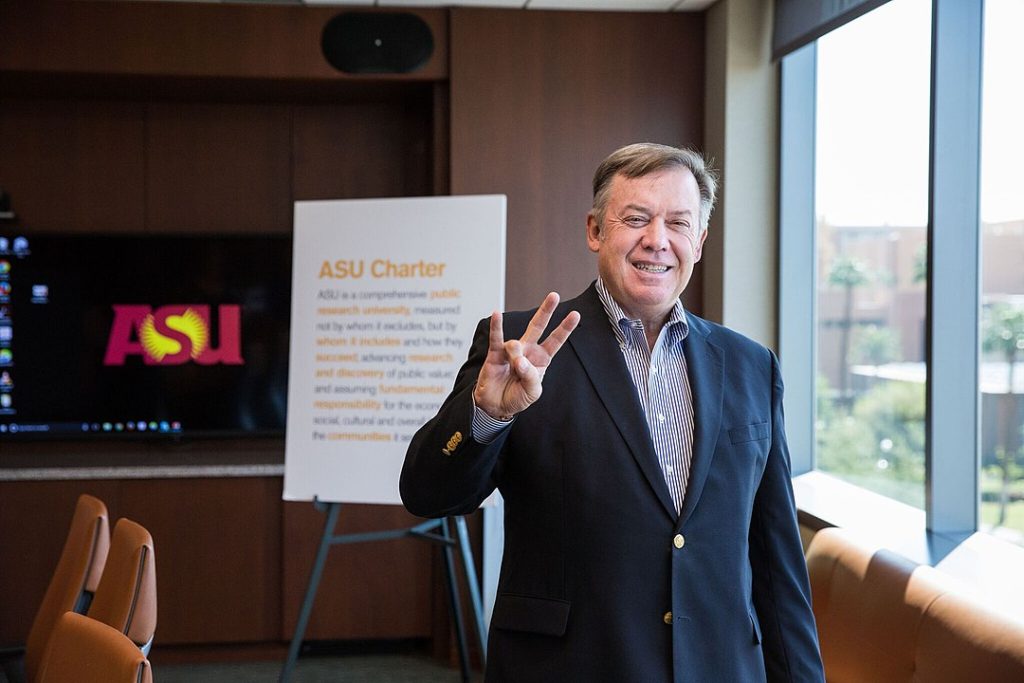
When Michael Crow became president of Arizona State University in July 2002, the watch began almost immediately: How quickly would he use ASU as a springboard to a bigger and better job? It hasn't happened.

Crow said he had a ten-year plan for "the new American university" and he has been as good as his word. Crow was one of the three people that progressive Arizonans vested their faith in during those hopeful years.

Janet Napolitano played defense against the Kookocracy, but abandoned the governor's office to become President Obama's Secretary of Homeland Security with little left behind as a legacy. Phoenix Mayor Phil Gordon suffered a lost weekend of a second term, badly downgrading any assessment of the man in full.

I always thought it was a sign of Arizona's unhealthy lack of private-sector stewards that all three stars were on the public payroll, but such was the case. Only Crow, to many the least likely, stuck and kept faith.

Crow was dealt a bad hand, if a very good salary: The Legislature had been cutting general-fund appropriations to the universities since the 1980s and was virulently anti-education. The state constitution mandated that ASU, especially, take virtually every qualified in-state student without giving it the means to pay for this obligation.

The university had grown into a gargantuan thing. It had few friends at the capitol as opposed to, say, the University of Texas at Austin, Texas A&M and the University of North Carolina at Chapel Hill. Yet even Crow's critics must admit he played this hand masterfully. It wasn't long after his arrival that the UofA, which always considered itself "the university," was enviously muttering, "We wish we had a Michael Crow."

The vision of a New American University was buttressed around finding new revenue. I learned this early, when Crow asked me how ASU could be of more help in illuminating the economy. I sent him a list of some 30 indicators that were not tracked in the echo chamber of population growth and construction permits. This ended up in the economics department where the mandate was to produce it, and find a way to sell it.