Childen and guns

The thing about most guns is that they kick, something especially true of shotguns and automatic weapons. When the firearm discharges, the explosion in the chamber and subsequent chain of events and physics to send the bullet or shot at, say, 1,200 feet per second or faster, causes the barrel to rise. In the case of a shotgun, it also sends the stock back against the shooter — in some cases hard enough to knock him down.

I learned this as a child in the West. I learned it the right way, with competent, demanding adults and on properly prepared and supervised ranges.

For example, the first time I ever fired an automatic rifle was when I was nine years old. Yes, the same age as the girl who accidentally killed her "instructor" at an Arizona "shooting range" when an Uzi kicked up and out of control.

In my case, some essentials were different. For example, I had been taught basic gun-handling at an early age. Never take a firearm without making sure it is unloaded; with an automatic or semi-auto, that means not just dropping the magazine (not a "clip" unless it's an M-1 rifle) but also clearing the chamber. Never point a gun at someone "unless you intend to shoot them," said my mother the crack shot. Never traverse a barrel in someone's direction as you are handling the weapon. Even if you know the gun is unloaded. You always "police your brass" after shooting.

Arizona economy update

Arizona economy update

Even the local media are admitting that Phoenix is back in a housing slump. I mean no disrespect to hard-working Arizona journalists. But let's face it, the Real Estate Industrial Complex controls the conversation, withholds or doles out ad dollars and can, ahem, ensure that offending columnists are run off. So when the local media admit to a problem involving this sacred cow, head for the bomb shelter.

More about housing (yawn) later. The most arresting data come from a new report by the federal Bureau of Economic Analysis. Arizona's per-capita personal expenditures, adjusted for inflation, were virtually flat in 2012 compared to 2000.

And this is "consumer spending" kept afloat with massive debt considering that most wages have been stagnant or falling, and the typical American household saw a 36-percent decline in its wealth between 2003 and 2013.

Other mid-year observations:

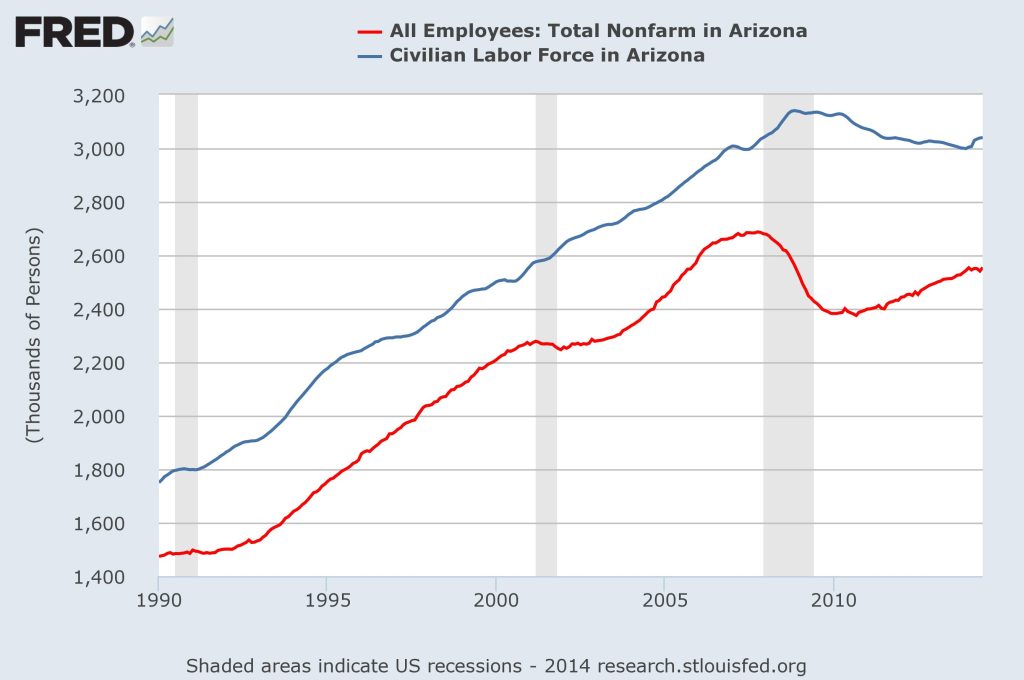
Fewer people are working than before the Great Recession, and the available labor force has fallen…

LABORfredgraph

The preservation police

The preservation police

Whether through absent-mindedness or a Kookish desire to obliterate the memory of FDR, the state came very close to tearing down the 1938 administration building at the Arizona State Fairgrounds built by the WPA. The loose-knit community of preservationists — the preservation police, as one called it — went into action and the building was saved.

It's exhausting work done by average people. Phoenix lacks a wealthy steward such as Paul Allen, who saved and restored Seattle's magnificent Union Station and Cinerama. Phoenix lacks a widespread preservation ethic, too. There have been successes, such as saving the Frank Lloyd Wright house. And crushing failures, such as Robert Sarver's demolition of two territorial-era hotels to make…a surface parking lot.

Precisely because of these things, because Phoenix does have a fascinating history worth protecting even if it lacked the abundant good bones of older big cities — this makes the battle so important. Cities with enchanting old buildings and streetscapes also attract the creative class and urban-oriented tech workers and startups.

Our losses are profound. Here are a few of the ones most worth mourning:

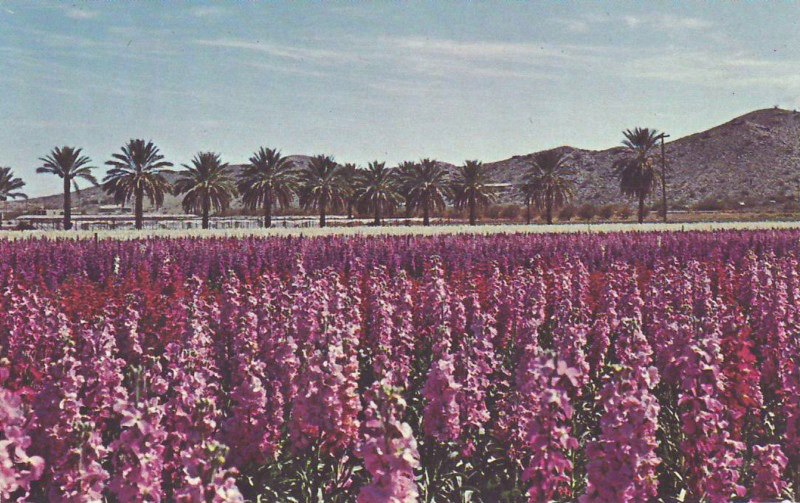
1. The Japanese flower gardens along Baseline Road.

Japanese_Gardens
2. The Fox Theater, torn down in 1975 by City Hall vandals to make way for a municipal bus depot.

FoxTheater

Fox_theater_stairway_1940s

Fox_theater_interior_Fox_Theater_11_S_1st_St_1930s

What’s downtown Phoenix, what’s not

What’s downtown Phoenix, what’s not

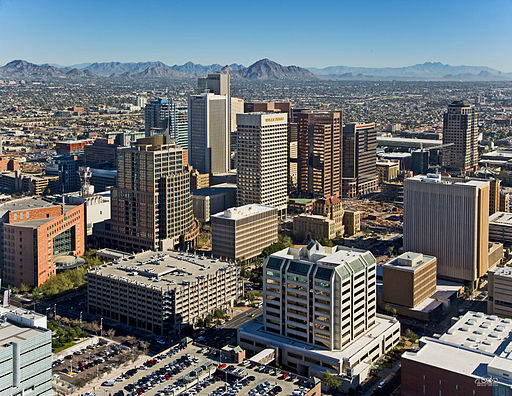
This is downtown — pre CityScape (photographer unknown):

512px-Downtown_Phoenix_Aerial_Looking_Northeast

Downtown 2020

Above is downtown 2020 (photographer unknown).

This isn't downtown (it's Midtown):

Phoenix-skyline

This isn't downtown, either. It's 24th Street and Camelback (photographer unknown):

Esplanade_Place_October_6_2013_Phoenix_Arizona_2816x2112

I wouldn't dare move to Chicago and claim that Hyde Park is the Loop. Nor could I say Hawthorne is downtown Minneapolis. Cincinnatians would quickly set me straight if I said Over the Rhine is downtown — downtown begins at Central Parkway. The natives in all these cities wouldn't let me get away with it. Nor would the transplants who felt a convert's zeal to protect the geographical integrity of their cities.

Yet people in "the Valley" (Silicon? Red River — of the north or of the south? San Joaquin? San Fernando? Of the Jolly Ho Ho Ho Green Giant?), many of them from these very cities, get away with this transgression every day in Phoenix.

Downtown Phoenix runs from Seventh Avenue to Seventh Street, and from the railroad tracks to Fillmore, or perhaps Roosevelt. It includes the original townsite and some additions. City Hall's definition taking the northern boundary to McDowell is ahistorical.

The water questions

The water questions

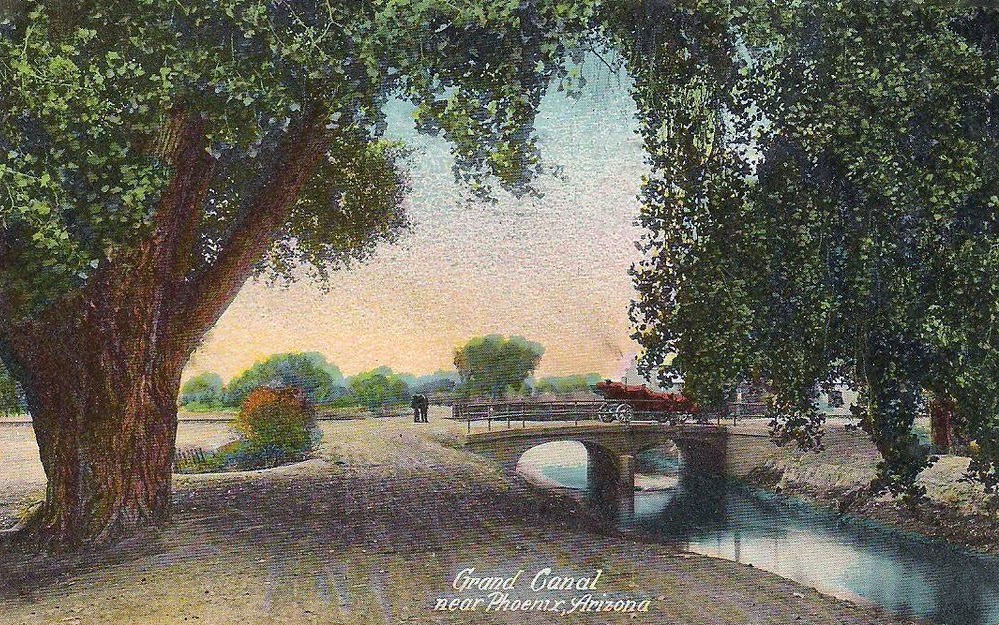
Grand_Canal_1915Phoenix's Grand Canal in 1915. Arizona's population: about 250,000.

I have been hesitant to pass along recent stories about water. Some examples, "Arizona Cities Could Face Cutbacks in Water From Colorado River," from the New York Times; "Phoenix May Not Survive Climate Change" on Salon; "America is Running Out of Water," from Vice; "Arizona May Be California's Future" on Slate, and this Tucson Weekly examination of the situation in the Old Pueblo.

Oh, and from Smithsonian (!): "Arizona Could Be Out of Water in Six Years."

Water in Arizona is a highly complex issue. It risks being spun as "everything's fine!" by the boosters, lied about by real-estate hustlers and their stooges, or oversimplified as "Phoenix is about to run out of water!" by outside observers. So let me tiptoe in with a reminder of this Phoenix 101 primer, and then…

Some things we know:

1. As with so much else, Arizona is not Phoenix. Even the farthest-flung reaches of the metropolitan area are not the old city. In other words, each part of the state has distinct water issues.

2. Phoenix is not Death Valley with subdivisions. In fact, the Salt River Valley, sitting in and near the confluence of multiple rivers, is the most abundantly watered place in the Southwest. The Sonoran Desert is the planet's wettest desert. This is why the Phoenix area has attracted irrigation civilizations going back perhaps 3,000 years. Phoenix is a natural oasis.

3. Thanks to this and the billions of federal dollars spent on reclamation projects in the first half of the 20th century, the core of Phoenix is blessed with nearby renewable water supplies. The dams and lakes of the Salt River Project delivered 767,445 acre feet to the project's footprint in 2012 and held nearly 1.5 million acre feet in the reservoirs in fiscal 2013. This water comes from snowmelt in the east-central Arizona mountains.

The Southern poverty bloc

The Southern poverty bloc

Original

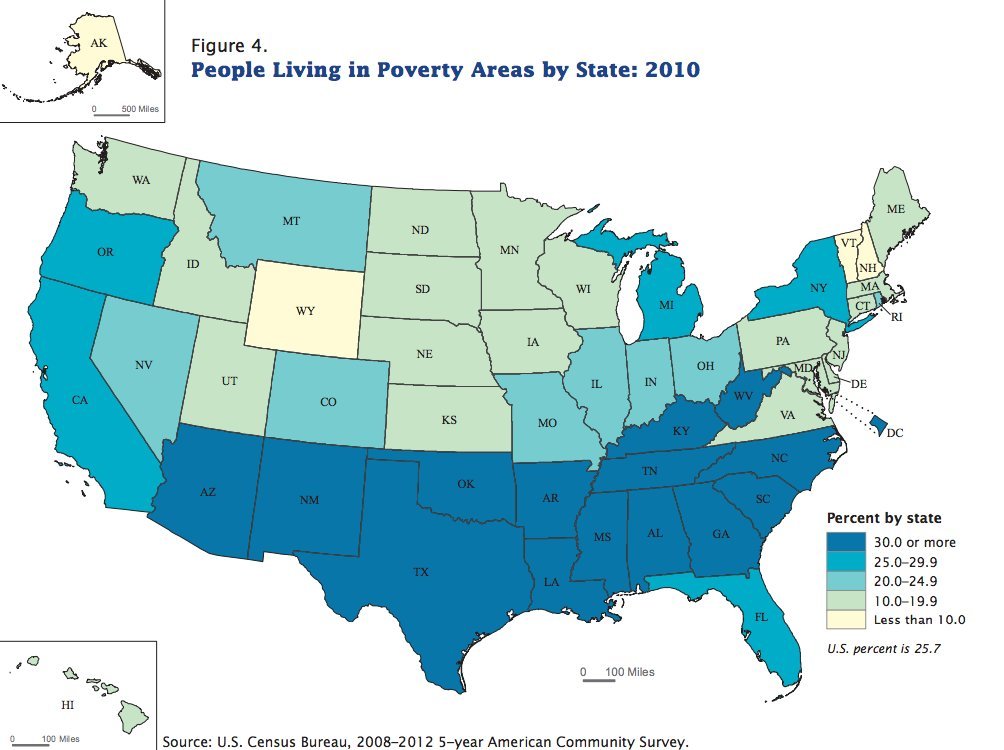
I'm not sure if the cottage industry of explaining away Arizona's reality is on vacation in cooler climes or will scramble to attack this telling map that went with a story headlined: "The South is Essentially a Solid, Grim Bloc of Poverty."

Arizona Territory sent a delegate to the Confederate Congress throughout the War Between the States, so the apple doesn't fall very far from the tree.

Seriously, the data come from a new report by the Census Bureau of people living in "concentrated poverty areas." It digs down to the Census tract level, finding that more than 2 million Arizonans, or 33 percent, lived in tracts with highly concentrated poverty. That compares with 1.2 million, or 24 percent, in 2000. The comparable national averages were 25.7 percent and 18.1 percent respectively.

These areas have "higher crime rates, poor housing conditions, and fewer job opportunities." They breed a feedback loop of poverty.

It's easy to blame much or all of this on the Great Recession. Arizona's dependence on the housing sector left it in a virtual depression after the collapse. There's some truth to this, but the problems go much deeper.

The Yarnell silence

A year has passed since a fire in exurban Yarnell fire killed 19 firefighters, the deadliest wildfire toll in American history, even worse than Mann Gulch or Storm King Mountain.

Some fine reporting has been done, especially by the great investigative journalist John Dougherty, as well as from the Arizona Republic. Unfortunately, reportage of event has lacked the nationwide heft it deserves. There has been no Norman Maclean to immortalize it. Newspapers don't crusade any more.

The accountability I demanded when I wrote about Yarnell a year ago in one of Rogue's most popular columns has been conspicuously lacking. Clearly tactical mistakes — even inexcusable rookie blunders — were made. But what was learned? Only one weak bill emerged from the Legislature: clear vegetation, if you wish.

The murder of ‘Star’ Johnson

The murder of ‘Star’ Johnson

PPD_1940s

In this circa 1942 photo of the force, "Star" Johnson is in the middle of three black officers in the fourth row. To his right is his partner, Joe Davis. On the left is Joe Island. In uniform in the second row, behind and to the right of the man in suit and fedora, is Detective "Frenchy" Navarre.

Earlier this year when a Phoenix Police detective was killed in a shootout, the Arizona Republic ran a sidebar listing all the officers killed in the line of duty. The information came from a list kept by the police department. The trouble is that the list is incomplete. It omits the in-the-line-of-duty murder of David Lee "Star" Johnson in 1944.

He was killed by another cop.

I've told an abbreviated version of this event in another column, how it was a searing experience for a small but ambitious city. I've even used elements of it in my fiction. In this column, I want to tell the entire story based on the best research available. This true tale involves corruption, racism, betrayal and revenge in young Phoenix. It also is a powerful reminder that PPD should officially honor Johnson as an officer lost in the line of duty.

Walkable Phoenix

Walkable Phoenix

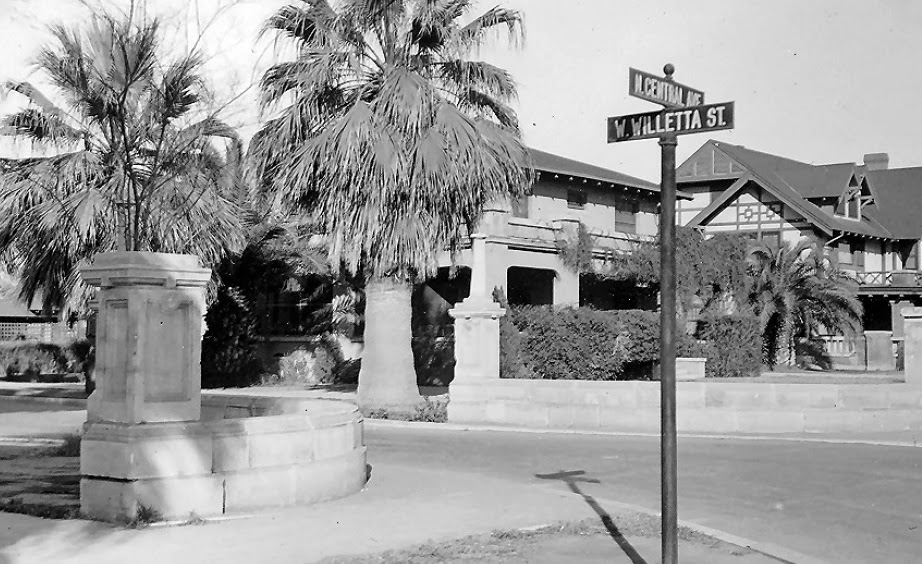
Central_Avenue_Willetta_1917

This beautiful scene in central Phoenix is from 1917. It makes you want to step into the picture and stroll. Not bad for a small, isolated city in a brand new state. More about that later. Alas, today the same location is a blighted vacant lot south of two once-graceful houses that have been turned into the Old Spaghetti Factory, the lawns replaced by asphalt.

I write because of an article in one of the online nooks of Fast Company headlined, "Phoenix is Pulling Off an Urban Miracle: Transforming into a Walkable City." Read and decide for yourself. On Facebook, someone said it came off like a press release. The kindest interpretation is that it represents an aspiration. To make it real, a little history might help.

Although Phoenix's growth is closely connected to the automobile age, the city was actually once highly walkable.

Let's define our terms. By "walkable," I don't mean you can drive your car to a canal bank or a desert "preserve" and hike. Not even the enchantingly shady, last time I checked, Murphy's Bridle Path. I mean the arrangements I enjoy in Seattle, where almost everything — shopping, restaurants, grocery stores, culture, health care, transportation hubs — is a quick walk or bus/bike ride away. One doesn't need a car.

Prior to the mid-1950s, when sprawl took off and never looked back, Phoenix offered such a "lifestyle." For anyone who grew up in the actual town prior to World War II, it was taken for granted.

Even the G-men…

Even the G-men…

Dear Diary,

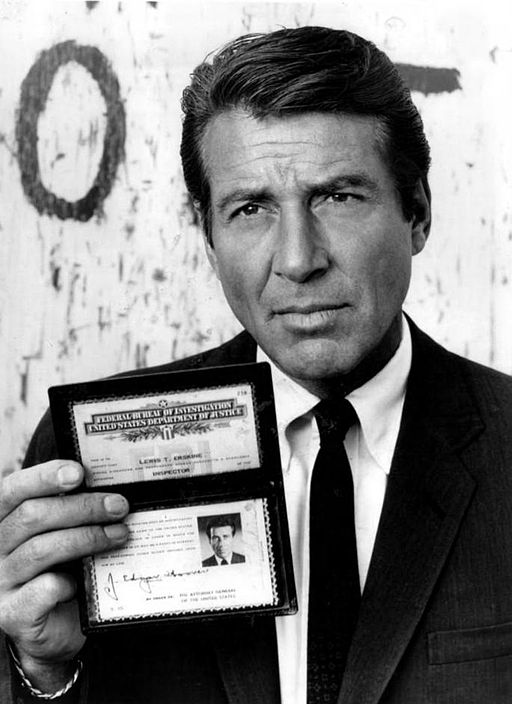
Efrem_Zimbalist_Jr._Lewis_Erskine_displays_FBI_credentials_1969It seems that I cannot escape the toxic blob that Phoenix has become even when working on the new David Mapstone Mystery. I learn that the FBI's Phoenix Field Office decamped its Midtown fortress in 2010 for leased offices at Seventh Street and Deer Valley Road.

The FBI has a long history in Midtown, once being located on the second floor of a modest office still standing on the northeast corner of Third Avenue and Osborn. Back in the hardly innocent 1960s, it was labeled with "FBI" right on the outside wall. By the time I returned in the 2000s, the bureau was in a hulking, anonymous and heavily guarded midrise around Second Street and Indianola, with a motor pool a block away. If you tried to stop your car on the street to drink the Diet Coke you had purchased from the (now closed) nearby McDonald's, a uniformed federal officer appeared and told you to move on, no questions answered.

Now it is in a 210,202 square foot building built and owned by the Ryan Cos., meant to be home to the field office "for the next 20 years." News reports tell me the building won a LEED Silver design award, which shows the moronic/mendacious nature of these greenwash labels. The office is about 17 miles away from the most common destination for the feds, the Sandra Day "I Gave You The Presidency of George W. Bush" O'Connor Federal Courthouse downtown. It is located far from the urban footprint. How can this possibly be considered a green building?

Snake removal

I've noticed that one of the most common calls on the metro Phoenix fire incident log, at least in the spring, is "snake removal." All these calls that I saw, requiring the response of an engine company or other fire apparatus, originated in north Scottsdale.

Facebook friends will have to be patient because some of this repeats posts I made there. But the response was enough that I thought it would be worth putting on Rogue. Also, this site maintained by Phoenix Fire, is not nearly as complete or entertaining as Seattle Fire's Real Time 911. In addition, Phoenix has a shockingly high number of 962s (auto accident with injuries) and 962s involving pedestrians and bicycles.

Back to the snakes.

This is territory where my buddies and I in high school would hike to seek out good (and safe) places for target shooting. It was completely empty of people and houses, breathtakingly beautiful Sonoran Desert with all manner of plant and animal life. We never imagined it would be otherwise.

From training as far back as Cub Scouts, we knew to tramp heavy — so the snake would be forewarned and slide out of the way — not to reach under bushes or into holes (hello, newcomers), avoid the terrain snakes like, pause to listen and how to react to the distinctive sound of a rattler. Being heavily armed, including with a varmint gun, helped, too. But the desert was always approached with respect. It could kill you.

Phoenix rocks

Phoenix rocks

Photo
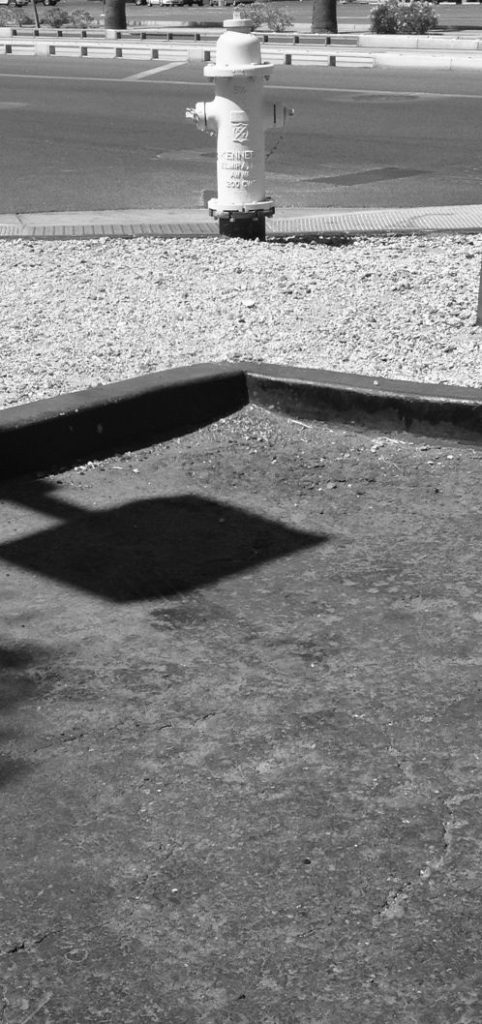
Ansel Adams' iconic "Noon and Hydrant," showcasing the natural splendor of the Salt River Valley.

Five rivers and several significant creeks converge in or near the Salt River Valley, making it the site of the most abundant water in the Southwest, an oasis going back thousands of years. But let's not kid ourselves. "We live in a desert" after all, the Midwesterners constantly lecture us. So it is right and proper that Phoenix increasingly reflects this reality.

Our young city was established in 1993, when Jack Swilling discovered one of the ancient Hohokam concrete "ground skins" dating from the eleventh century. He swept it off and for years it was called "Swilling's Sidewalk." Others learned that the prehistoric dwellers had built hundreds of miles of sidewalks, surface parking lots, wide roads and — everywhere — thrown down small gravel. From the site of what today is called Pueblo Grande Estates Gated Community, archaeologists unearthed huge caches of red roof tiles, which they believe the Indians used to barter with other tribes.

Darrell Duppa, who claimed to have been a investment-banker lord from the City of London, wanted to call this enchanting place Phoenix. It seemed right: Like the bird of mythology, the city had been reborn on the ashes of its predecessor. Settlers from the nearby village of Table (the original name "Mesa" sounded too Mexican) objected. So people settled for calling their frontier town "the Valley."

Arizona’s economy in charts

Arizona’s economy in charts

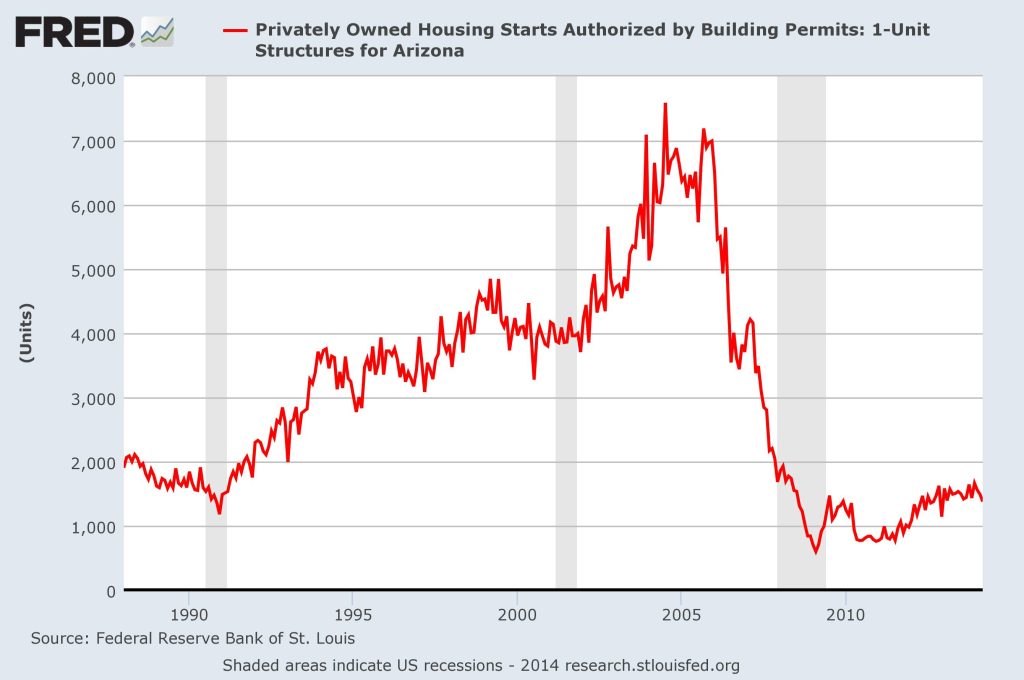
Despite all the hype, the housing depression continues, with building permits barely above levels of the 1990 recession…

HousingStarts

…Growth in housing prices has bounced back somewhat, measured quarterly in year-over-year. But much of it is driven by speculators buying up rental properties and securitizing them. As you can see, it's way out of line with historic norms and raises affordability issues for average Arizonans, as well as a host of other potential problems

HousingPrices

Phoenix in the thirties

Phoenix in the thirties

Lange_Homeless1930s

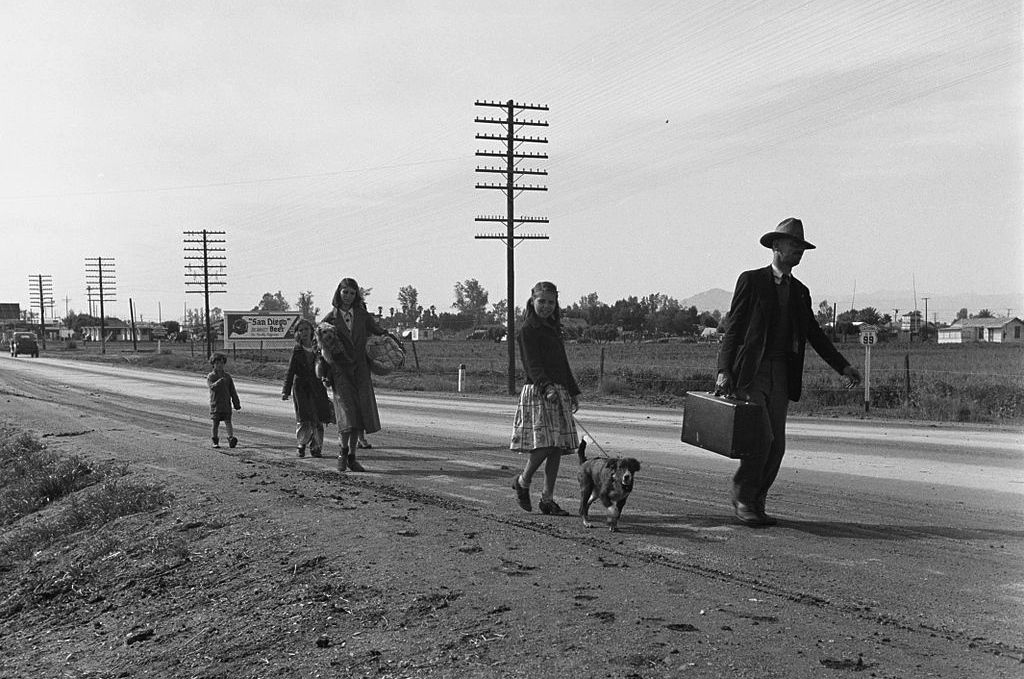
Dorothea Lange photographed this homeless family nearly Brawley, Calif., in 1939. They had been picking cotton in Phoenix but moved on when the work ran out. They hope for relief in California.

The Great Depression did not bypass our little oasis city. Even if, as historian Bradford Luckingham writes, the city's newspapers paid little attention to the 1929 crash and most Phoenicians, like most Americans, didn't own stock, the hard times soon arrived.

The severe contraction from 1930 through 1933 claimed two of the city's six banks and two of its five building-and-loan associations. Another, Valley Bank, was on the edge of failure. Depositors were wiped out in these pre-FDIC days. Arizona's big Three Cs of copper, cattle and cotton were decimated as demand collapsed. Twelve theaters closed in Phoenix. The state actually lost population in the early 1930s. The average income of American households fell by 40 percent from 1929 and 1932.

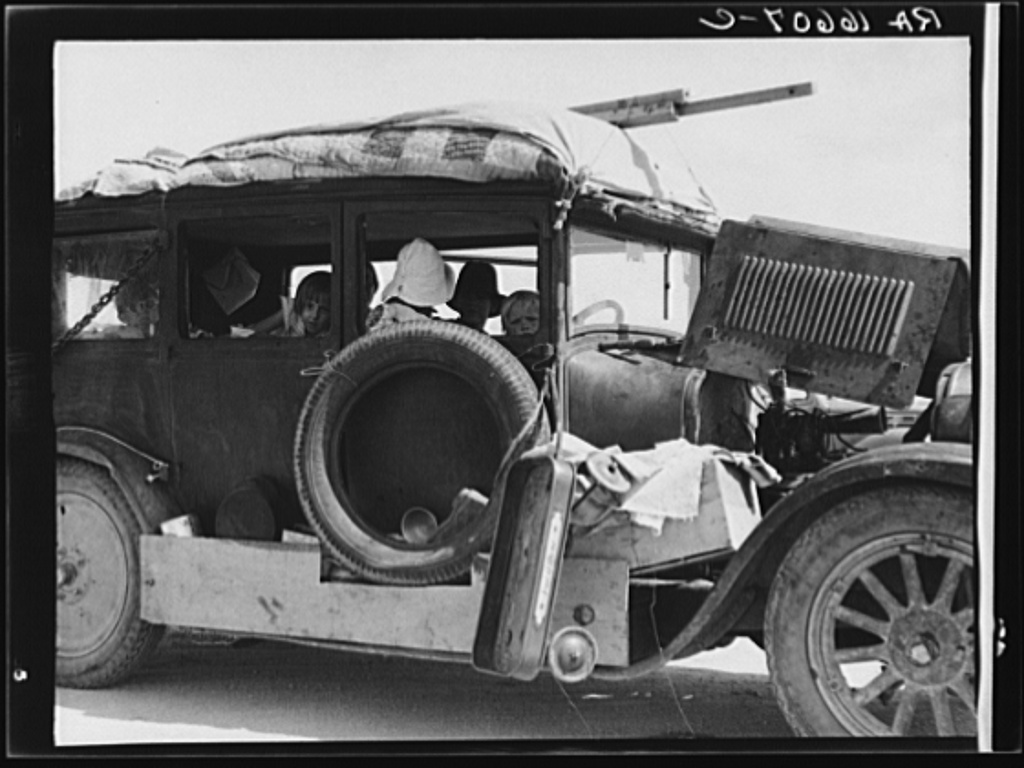
8b31908vIn Phoenix, unemployment grew while businesses closed and relief organizations were overwhelmed. My grandmother told stories about Okies and Texans arriving in jalopies, sometimes on foot or as hobos on freight trains. Victims of the Dust Bowl came by the thousands to the Salt River Valley, not, as in Grapes of Wrath, going as far as California (something confirmed by Philip VanderMeer in his insightful Desert Visions and the Making of Phoenix).

So don't believe it if you hear the shorthand that "Phoenix barely felt the Depression." Much less that its economic recovery came because of the "rugged individualism" of Phoenicians. For the second time in its young life, Phoenix was rescued by the federal government.

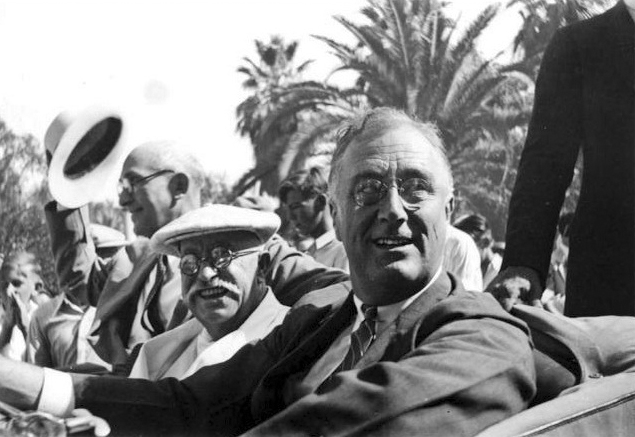
Franklin_Roosevelt_George_WP_Hunt_Carl_Hayden_1932The Great Depression was the overarching story of Phoenix in the 1930s. And the New Deal not only saved the city and state much suffering, but arguably had greater effect because of their small populations and economic composition. Arizona voted overwhelmingly for FDR, who is shown campaigning in Phoenix in 1931. He is at the wheel of the car as always, with Sen. Carl Hayden and Gov. George W.P. Hunt beside him. It proved a good bet.

Ballinger’s masterpiece

Ballinger’s masterpiece

Jim Ballinger 2007When the pink-and-white Civic Center opened at Central and McDowell in 1950, it included a "little theater" but the art museum didn't come along for another nine years. Both were considered small confections to the main course: the public library. Things were not much different in 1974, when a young University of Kansas graduate named Jim Ballinger joined the museum's staff as curator of collections.

That the Phoenix Art Museum today enjoys national stature and draws prestigious international exhibitions — and has grown to take up most of the former Civic Center block — is mostly because of Ballinger, who announced Thursday that he will retire after 40 years with PAM. He became director in 1982. No other single figure has done more for the city's cultural landscape — to create, grow and sustain one — than Ballinger.

The reader should know that Ballinger and I are friends. We also were neighbors on Holly Street in Willo. But he first sought me out when I started as a columnist at the Arizona Republic, writing on such issues as the city and state's economic narrowness, lack of civic engagement, poor educational outcomes and difficulty in retaining talent. In our first conversation, he showed his incisive grasp of how such challenges would affect the future viability of cultural institutions.