Shoveling sunshine

Shoveling sunshine

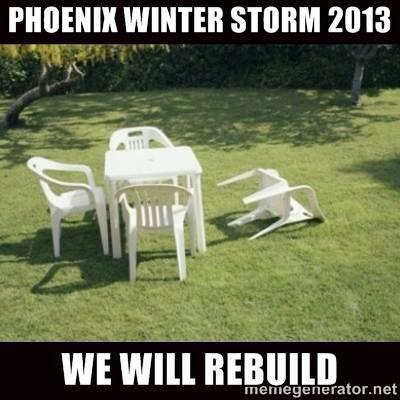
1528724_804269299588337_992679122_nThe image to the right was making the rounds on Facebook over the weekend. I can take a joke. Hahaha. On a more serious note, the state Tourism Office spent $200,000 on advertising in Chicago reminding residents that they can "warm up in AZ." If this brings in some visitors with money to spend, good on them. Like it or not, tourism is one of Arizona's most important industries — and also a source of mostly low-paid jobs.

On the other hand, if it brings more people to stay, it is a calamity. Arizona needs about 4 million fewer Midwesterners. And the ones — Anglo, older, Republican — that come will merely reinforce the reactionary politics of the state, a la "the Big Sort."

Arizona's experience has made me deeply suspicious of people who move places for the weather or of states that promote sunshine as their prime asset.

The global city

What is it? Does it matter if you live and work in one? I try to answer some of these questions in my cover story for Pacific Northwest magazine. Phoenicians:…

The growth god fails

The latest Census data for state population was released this week, going up to July 1. Arizona remains the third most populous state in the West — an astounding fact for those of us who grew up in a small, frontier state — and that is not good news for boosters that expected it to reach No. 2 behind California.

Worse for the growth machine, the annual increase was only 1.15 percent. Growth from 2010 through July 2013 was somewhat better, a cumulative 3.4 percent.

But this is not the population increases upon which the business plans of so much of Arizona businesses are predicated. In the 1990s, the state grew by 40 percent. In the 2000s, shattered by the housing depression, population still grew by 24.6 percent. The annual growth of 2012-2013 will not get the state anywhere near that number in 2020.

In the decade of the Great Depression, Arizona's population increased by only 14.6 percent. The lesser depression of today may promise more of the same. The nation grew only 0.71 percent in the most recent year, the slowest growth since the Depression.

Even Texas, rich in energy, corporate centers, major universities, federal dollars and a good relationship with Mexico grew by 1.5 percent.

Questions for Arizona in 2014

So many myths, so little time or brain cells. I suppose that is why malign falsehoods carry us forward. The latest was a story I read where a UofA professor is having a loud growthgasm over Arizona's spectacular income growth and how 2014 will be even better.

I don't mean to be unfair or pick on people, but when these ideas enter the public square through the most powerful media outlets they reinforce the "everything's fine" lie that keeps Arizona backward.

To be sure, "staying positive" on the party line is a good way to keep one's job. I am proof of what happens to dissidents.

About income: Unless something radical has changed, Arizona is an underperformer and will remain so. The snapshots of "growth" are statistical noise caused by the large population churn. A certain right-wing columnist has ridden this for years to say, in essence, "Arizona does not suck, Talton!" — even though reality is quite different.

Double down

Double down

One must give the Real Estate Industrial Complex credit for chutzpah. It will not go down with a whimper, but with a bang. And many fires.

Or rather, Arizona. The elites behind the growth machine will be long gone, safely behind their gates and walls in more hospitable climes.

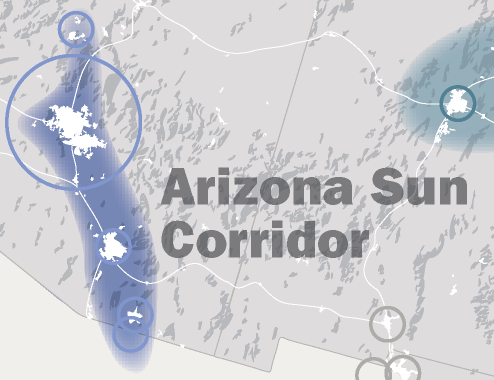
Arizona_Sun_Coridor_megaregionI am reminded of this after reading a report that three subdivisions comprising 4,500 tract houses are "in the pipeline" in Flagstaff.

Situated in what was once the largest virgin ponderosa pine forest on the planet, now a slowly dying tinderbox thanks to climate change, Flagstaff was once a real town. It depended on the Santa Fe Railway, Kaibab Lumber Industries and other sawmills, and the college. The town was safely separated from the forest primeval.

Now the railroad merely passes through, the switching yard being removed. There's a mall and Super Wal-Mart. Subdivisions have been rammed into the trees. Aside from NAU and a few other employers, Flag is one more real estate hustle to be played until it gives out. Or burns down.

WWBIYB, to south Phoenix

WWBIYB, to south Phoenix

LRT1Considering the divisions within Phoenix City Council, it is significant that light rail to south Phoenix passed this week by 8-to-1. The five-mile route would mostly be along Central to Baseline Road.

For newcomers to this blog, WBIYB is shorthand for "We Built It, You Bastards." It is my response to the thugs, trolls and hysteriacs that opposed light rail in Phoenix. We built it, the world didn't come to an end, and it is a great success. Light rail is the most hopeful achievement so far for Phoenix to have a quality future.

Now light rail connects to the Sky Train at Sky Harbor. New lines are moving ahead, deeper into Mesa, extensions north and west, and now to south Phoenix. We Will Built It, You Bastards.

Here's an important adjustment that's needed: Run the new line over to Third Avenue and south to Lincoln and then back to First Avenue/Central. That way it can connect with future commuter trains and Phoenix-Tucson rail passenger service that should use a restored Union Station as their hub. It won't cost much more and the benefit will be exponential.

We Will Build It, You Bastards. But the time line is too long — up to a decade. And with Republican austerity ruling in D.C., one hopes the essential federal money will be available. God knows, we subsidize roads and freeways way too much, with enormous damage to the environment. Phoenix should fast-track this.

Enemies of the good enough

Enemies of the good enough

In and near downtown Phoenix, three developments are worth examining.

2_Aerial-1900

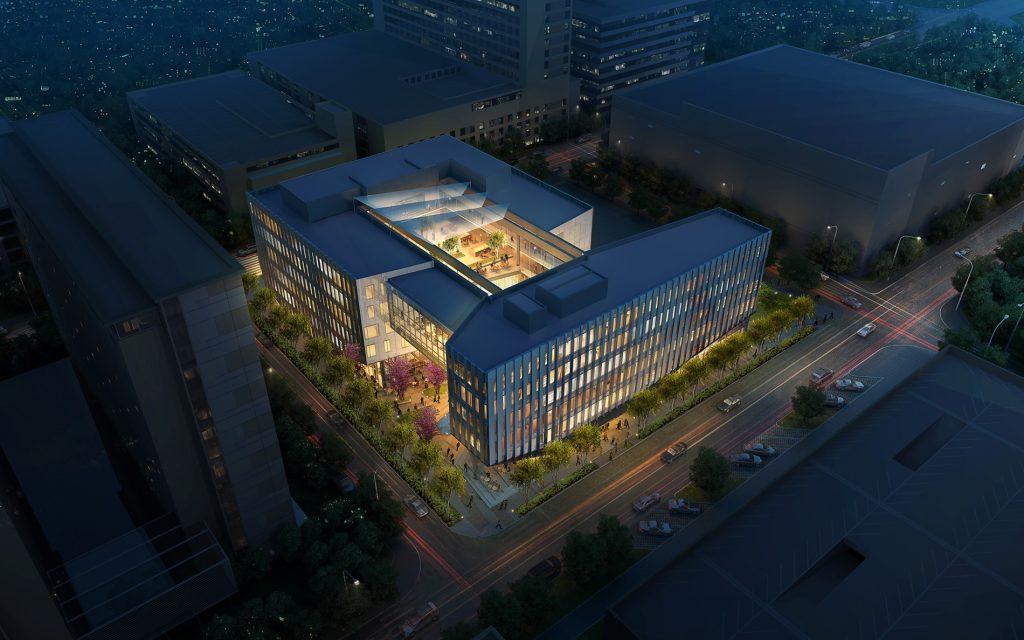
Renderings have been made public of the proposed Sandra Day O'Connor College of Law building for the downtown ASU campus (above and below). Someone told me it requires "seven variances" in the city code. And this code has given us a lovely cityscape? For god's sake build it, before somebody — ASU, the regents — changes his mind.

1_NW Corner-1900

Would I have preferred a Mission-revival or other human-scale style to get away from the deadening modernism that makes downtown less interesting? Sure. Has the design been improved from its original rollout in response to community feedback. Yes, to some extent. But the perfect shouldn't be the enemy of the good. And bringing the law school downtown will be a substantial coup. Now people need to demand that the block have real shade trees (and grass!), not palo verde skeletons and gravel.

The building would go on the block between First Street and Second Street, Taylor and Polk, the site of the old Ramada Inn (Sahara). There is still bad blood with preservationists that ASU demolished this mid-century building rather than opting for reuse.

• Then we face the question of what is "good enough" or a good start. Many have been wondering how the city would use land it bought in and near the Evans-Churchill neighborhood just north of downtown since most of it was assembled for the abortive Cardinals stadium.

Now we have an indication, and it is disappointing to risk understatement.

Phoenix in the fifties

Phoenix in the fifties

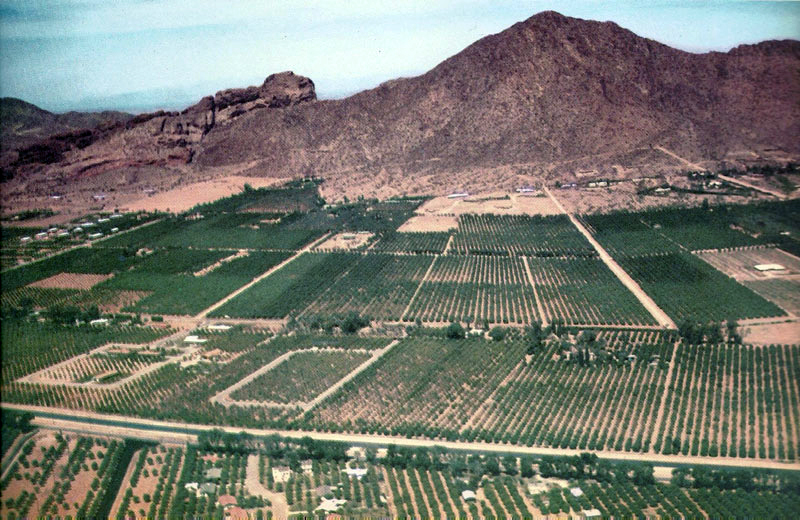
Camelback_Mountain_1956Ask almost anyone who recalls Phoenix during this time and the fifties were indeed nifty. For most, it was the best time to have lived here.

This was also among the city's most sweeping eras of change. It saw the emergence of many of the trends that later turned unfortunate or worse. Below the gleam of Eisenhower peace and prosperity, much of the town was troubled.

To begin, however, it is easy to see why these years are remembered with fondness, and not merely with lazy nostalgia.

The fifties were the last decade when much of the city's life revolved around such sweet, small-town reveries as the Masque of the Yellow Moon, held annually at Phoenix Union High School's giant Montgomery Stadium. Although the Jaycees Rodeo of Rodeos would soldier on into the 1990s, it reached its pinnacle then, too. School let out for the rodeo parade day. Phoenix was not far removed from its roots of planting and cowboying.

They were the last time when some of the larger canals were still lined with trees, doubling as widely patronized swimming holes, and water-skiing behind cars was winked at by the Salt River Project. When most of the Project's footprint was citrus groves, the Japanese flower gardens and fields, not subdivisions. When this enchanting oasis was sheltered by shade and green, and beyond it was largely pristine desert and High Country. When mining, cattle and logging were the industries in the sparsely populated state.

Phoenix was the city. Every other town in the Salt River Valley was small and separated from Phoenix by groves, fields and desert.

No wonder the overnight lows were ten degrees lower than now and summers were shorter and less severe.

Suffer the children

The latest scandal involving Arizona's Child Protective Services agency involves thousands of abuse and neglect reports that were not investigated.

I don't have much to add to the able reporting of Mary Jo Pitzl and Mary K. Reinhart at the Arizona Republic. This includes a year-long series.

Not much to add, but a little context.

This is what happens when you spend decades cutting the state budget, even as population and need grows, as part of worshipping the god of small gub'ment.

State spending as a percent of personal income in Arizona fell from 5 percent in fiscal 1994 to 3.5 percent for fiscal 2014. CPS has been underfunded for decades as the state added huge population, especially in vulnerable groups.

The starting salary for a caseworker is a little more than $33,000 — and he or she get to be vilified as a public employee, never mind the crushing case load.

So when you read or hear of failures such as Child Protective Services, just remember: Your tax cuts at work.

Mesa rising

Mesa rising

Mayor_smith1

Mesa Mayor Scott Smith, right, with federal officials at the new Able Engineering facility, announcing an Obama administration initiative to boost manufacturing.

Mesa has landed an Apple factory and 2,000 jobs (provided the Gilbert school board goes along with the tax incentives), the latest in a series of triumphs as Phoenix falls into eclipse and the big issues are "pension spiking" and the "food tax."

Is "the city of wide streets and narrow minds" finally starting to punch at its weight?

Unlike most of the "boombergs" that have encircled Phoenix despite the aggressive annexation intended to prevent just that, Mesa always had a special identity. Settled by Mormons, Mesa had a distinctive set of small-businesses and agriculture-based industries and was surrounded by miles of citrus groves.

This began to change in the 1970s when the Superstition Freeway, as it built east, killed Main Street shops. Worse, the city inflicted a series of wounds on itself even as it notched huge population growth.

District 4

[UPDATE: As of 9:30 p.m. MST Tuesday, Pastor held a 498 vote lead over Johnson and counting may continue until Friday]

The race for Phoenix City Council District 4 might seem like small ball for this blog, but it tells us much about where Phoenix stands and where it is going.

One candidate is Laura Pastor, daughter of Rep. Ed Pastor, without whose efforts we would not have a popular light-rail system (WBIYB*). The other is Justin Johnson, son of former Mayor Paul Johnson. (Another race pits Kate Widland Gallego against the Rev. Warren Stewart, but for simplicity's sake, I will focus on District 4).

The contest has been distinguished by mudslinging, with Pastor, for example, being compared with Paris Hilton — and a remarkable lack of substance.

Phoenix 101: What went wrong

Phoenix 101: What went wrong

If you think "everything's fine" or that Phoenix has no troubles that aren't common to other cities, this is not your post. Spoiler alert: Everything is not fine.

City_of_phoenix_logoWe discuss problems and challenges, as well as intelligent responses, frequently in this space. A previous column sought to debunk the excuses, myths and lies about the place. But reading the comments on the most recent post made me wonder: Is Phoenix uniquely troubled? If so, how and why?

Sprawl doesn't explain it. What Kunstler calls "cartoon architecture" has befouled the nation from sea to sea. Good civic design was lost everywhere. The best cities in the country are surrounded by soul-killing suburbs, office "parks," malls, shopping strips, parking lagoons and laced up with freeways.

Car culture, per se, isn't the answer, either. Oklahoma City ranks lowest in non-vehicle commuting, yet the entire metro has long backed a levy that has impressively rebuilt downtown. Freeway-mad Dallas also boasts the nation's largest light-rail system.

The First Street challenge

The First Street challenge

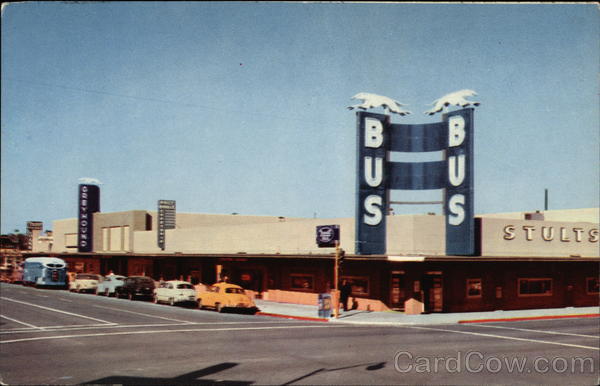
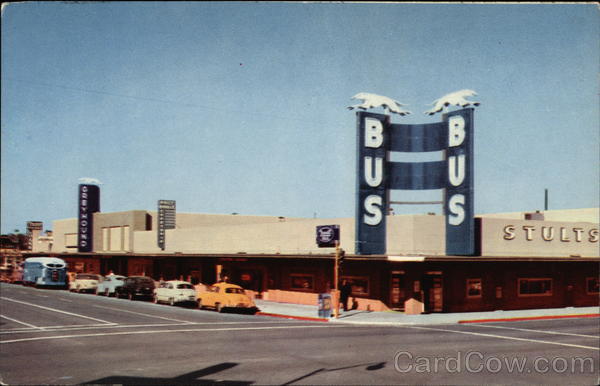
GrayhouseDepot  The Greyhound bus depot at First Street and Van Buren, one of the many destinations along First Street in old Phoenix.

It's nice to read that the city of Phoenix is spending $560,000 on a facelift for First Street, including "street improvements, decorative sidewalks, new trees and pedestrian-friendly upgrades."

Unfortunately, my first reaction is that City Hall is about 50 years too late.

Into the 1960s, First Street, like much of downtown, was a thriving commercial avenue. Essential to this was affordable space for shops and a streetscape that meant every few feet you landed at the door to another business.

Let me give you an example. In 1956, between Washington and Monroe streets, two blocks, First was home to Russell Stover Candies, David's Shoes, Goldwater's, Hanny's, Dorris Hayman, Montgomery Ward, Porter Mercantile, Barney's Garage, Cole Home Supply, Morris Athletic Supply, Richards Dean Jewelery, Tony's Shoe Shop, The Normandie Hotel, Thompson's Indian Shop and Phoenix Stamp and Coin. All in two blocks.

That delightful commercial density was killed by "improvements" since then: Brutalist parking structures, hulking hotels that open onto other streets, teardowns and the Valley Center (Chase Tower) skyscraper. These destroyed literally scores of human-scale buildings and helped run retail out of downtown.

The Friday saloon

[Saturday update] "12News" tweeted "Arpaio says crime sweep leads to 22 arrests." My first reaction: Why are journalists, even television journalists, still taking dictation from this publicity-mad sheriff who has…

The Friday saloon

Several readers have asked me to comment on the Arizona Republic closing its East Valley bureaus and leaving the reporters as "mobile reporters" to work from wherever they can find…