Bringing forth fruit

Bringing forth fruit

Rainbow 4
I first met Kit Danley in 2001 when she asked me to visit Neighborhood Ministries at its new home, hard against the railroad yards on Fillmore Street west of 19th Avenue.

It was a place that held fond memories for me. As a child, I had spent many hours train watching at the nearby Mobest Yard of the Santa Fe Railway. In those days, Fillmore ran through to 19th Avenue, and this end of the yard featured a cleaning facility for passenger cars (when Phoenix had passenger trains) and the locomotive turntable. South was the busy and (to my young eyes) imposing Valley Feed and Seed, where railcars were switched against the warehouse for loading and unloading.

Valley Feed and Seed looked very different in 2001: abandoned, decomposing, the grounds full of debris, silos that once provided seeds for this great agricultural valley now empty, eight acres of sadness. It was a graveyard that extended to Van Buren Street. Fillmore had been closed to a cul-de-sac when the yard was moved south (to lessen the train delays on McDowell). The surrounding area was known for crime now, not commerce.

But this was the site that Neighborhood Ministries had purchased in 1998 for an ambitious campus that would increase its outreach to the poor. By the time of my first visit, the organization had raised $2.2 million to begin renovations.

Kit_DanleyI liked Danley immediately. She was a near-native, went to Scottsdale High (I went to Coronado), and had chosen to make a stand in the wounded heart of Phoenix, founding Neighborhood Ministries in 1982. She was the polar opposite of the city of the short hustle, the state where hate was peddled for political profit.

And she would be frustrated that I appear to be making this column about her (it's not; read on). Like her spiritual forebear in Phoenix, Father Emmett McLoughlin, she felt called by Christ to minister here to the least and the lost, to the stranger and the wanderer, and find Christ in them.

Growthgasm! (No faking)

According to today's news from the Census Bureau, metro Phoenix added 84,980 people from July 2013 to July 2014. This makes Phoenix No. 6 among the 10th largest metro gainers numerically. Maricopa County ranked second among counties nationally with a gain of 74,000.

Neither metropolitan area nor county clocked in leading percentage growth, which can be misleading anyway (No. 1 was fracking capitals in North Dakota). Although it is worth noting that they did at times during the 1990s and early 2000s.

So what are we to make of this besides in-migration is finally starting to accelerate after a sharp drop during the Late Unpleasantness? Sun Belt regions generally led in population growth, so Phoenix fits within this trend as the economy gains strength under our Socialist Kenyan Dictator (Did I mention that he's black?).

Here are a few thoughts:

Foreigner

The biggest kick in the head on this trip back home came when I drove past Kenilworth School, where I went from first through eighth grade. Other alumni include Senators Barry Goldwater and Paul Fannin.

When I was there in the 1960s, the stately building was surrounded by grass and trees (watered by flood irrigation), including the mature palms that lined Third Avenue. Teachers could park on the streets, although a number of them walked because they lived nearby. The houses were all landscaped with lawns, trees, flowers, and hedges. In addition to making the neighborhood attractive and walkable, this helped cool it. We went back to school without air conditioning in September.

Kenilworth avoided aggressive attempts to demolish it when the unnecessary Papago Freeway inner loop was rammed through the neighborhood in the 1980s. It also survived the curving of Third Avenue, which destroyed the grid designed to give the neighborhood a pleasing aspect. And the mammoth widening of Seventh Avenue to feed the freeway.

Now a bunch of rocks have been thrown down in front of the school. A driveway and even larger parking lot have been added where the grassy playground once stood. Where we would lie on the cool ground, watch jet contrails, and dream the dreams of youth. The dissonance is painful. The classical revival building set amid all this ugliness is similar to a diamond lying in a pile of manure.

The trouble is that I am one of the few people who would even notice. Like Carson McCullers, "I must go home periodically to renew my sense of horror." But I am increasingly a foreigner here.

Getting by in Phoenix

In the summer of 1976, the owner of Phoenix Ambulance became convinced that I was the leader of a secret, impending unionization drive among the EMTs (I wasn't, but good idea). By August, he had forced me out and made sure I couldn't get a job at another ambulance firm.

He also fought me over unemployment benefits. For a month, until a hearing amazingly went my way, I was worse than broke. I began applying for food stamps but the process was so demeaning that I stopped. Things got so bad that I had to get food from St. Vincent de Paul.

I applied for 50 jobs — nothing. I was 19 years old, very highly trained in one field and had been well paid for my age. Nobody was going to hire me at Jack in the Box at minimum wage. The local economy was still slow; the 1974-75 recession had arrived late. The classified advertisements were an exercise in futility (although I did apply to be a projectionist at an adult theater — I often think of my X-rated career that might have been).

Eventually, I found work at another ambulance company, finished college, left Phoenix, had other career callings (and came back home and was kicked out). Ever since I have given money to St. Vincent de Paul (and St. Mary's Food Bank). The point is that I know how hard things can be in Phoenix.

It is true for many more people today.

Driving Phoenix history

Driving Phoenix history

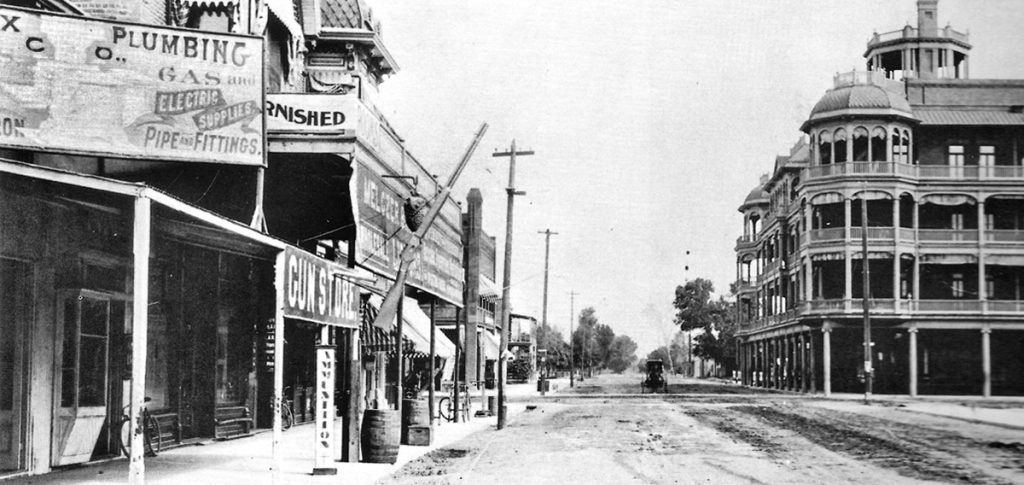
CentralAdams1909Central Avenue and Adams Street in 1909. The original Hotel Adams, later lost to fire, is to the right. Before it was Central, the main drag of Phoenix was Center Street.

Even with light rail (WBIYB), most Phoenicians spend vast amounts of time in their cars. But you can't avoid history, if you're paying attention.

Most people know the east-west grid of the original city has streets named after presidents, from Grant to the south to Roosevelt at the north (named after Theodore). The least deserving president is James Buchanan but there he is, right by the railroad tracks.

With so many streets in 1,500-square-miles of urban space, there's also plenty of asphalt to give faux Spanish names, or the names of developer's wives and daughters (Cheryl, Susan, Linda, Pamela, Sharon, Cindy, etc.). But the next time you're racing along in your SUV, consider:

McDowell Road, which was the wagon road to Fort McDowell, the supplying of hay to the cavalry being one of early Phoenix's raisons d'etre. Irwin McDowell was in command of union forced defeated at First Bull Run in the Civil War.

Thomas Road was named after William Thomas, a rancher and Maricopa County recorder at the turn of the 20th century.

Earll Drive takes its name from E.A. Earll, who platted the Earll Place homes. The origin of nearby Cheery Lynn is unknown (at least to me).

Osborn Road does not honor the state's seventh governor, Sidney Preston Osborn, who served from 1941 to 1948. Instead, it was named after homesteader John Preston Osborn, Sidney Osborn's grandfather.

School’s out completely

Whatever the final numbers, the outlook for education in Arizona is grim. Blame the Kookocracy. Blame the governor, wealthy Republican Douglas A. Roscoe Jr. aka "Doug Ducey." Or credit them. A majority of Arizonans voted them in.

Education Week's respected Quality Counts report ranks Arizona 47th overall. The state has been down in the basement with Mississippi in per-pupil funding for years. By no measure has funding kept up with student population or dealt with inequalities among districts.

Similarly, higher education has received ever-decreasing portions of the state general fund. The slash-and-burn cuts that are imposed every few years are never restored.

The new regime intends to double down: at least $104 million in cuts to universities, elimination of all state support for the largest community college districts, and, despite a claim of increasing K-12 funding, a serious reduction there because the promises aren't in real dollars. Including inflation, the actual spending on K-12 will be a 13.5 percent reduction from 2005-2006.

Now, my mother said, "If you can't say something nice about a person, become a newspaper columnist." In that spirit, I can't even credit the Kooks with originality. They are merely playing out a national strategy being enacted in every state capitol where Republicans hold sway.

Even so, Arizona has suffered so many decades of such vandalism, the consequences will be more severe. Real lives will be affected, opportunities to escape poverty and climb the ladder of opportunity smothered. The damage won't stop there.

Who is Diane Douglas?

Who is Diane Douglas?

History repeats itself, first as tragedy, second as farce. — Karl Marx

DianeDouglasNobody seems to be admitting to voting for Diane Douglas as Arizona Superintendent of Public Instruction. But of the 36.42 percent of registered voters who cast a ballot, a majority backed Douglas over her opponent, David Garcia. Douglas had no experience beyond a controversial stint on the Peoria school board. Garcia is a professor of education, former teacher and Army veteran.

But there you have it.

Garcia, nationally respected, ran on a solid platform of improving Arizona schools, which consistently rank at or near the bottom nationally. Douglas, rhetorically challenged, ran against what she saw as the evils of Common Core, which particularly resonates with white suburbia.

It surely helped Douglas that Garcia had a Hispanic surname. It helped her most of all that she had an R attached to her name. For the majority of state voters, no matter the self-identified "independents," are Yellow Dog Republicans. In other words, you could run a yellow dog as a Republican and they would vote for it over the most qualified Democrat.

I write all this as prologue for the latest, but far from last, Douglas stepping-in-it event. She fired two state Board of Education staff members for the Thought Crime of being allegedly "liberal." My doubt about that was confirmed when the governor, wealthy Republican Douglas A. Roscoe Jr. aka "Doug Ducey," reinstated the pair.

You can read the hilarity here, as well as her clumsy climb-down. But what did voters expect?

Phoenix 101: The weather

Phoenix 101: The weather

Ad_Phoenix_Everything_under_the_Sun_1954
This is the time of year when we see smug pieces in Phoenix media trumpeting the fine weather and making fun of the blizzard or snow in the Midwest or Northeast.

It's an old con going back a century or more — although it was typically the subject of advertising (as seen in the above promotion from the 1950s) rather than of "news" stories.

How can I be so cynical as to call it a con? Two reasons.

First, America had a long tradition of the West being misrepresented as the land of milk and honey by railroads and land barons. In most cases, the reality was disappointing, sometimes disastrously so. In reality, the land was unforgiving, "civilization" was primitive, fraud and lawlessness were common, and many immigrants were ruined.

Second, Phoenix historically had about seven decent-to-nice months and five hellish ones. I say "historically" because that ratio is starting to invert, about which more later. But many snowy places have five rough months and seven that range from livable to quite pleasant. Summer in Minnesota is lovely. So it the Phoenix braggadocio about its "superior" weather has always baffled me.

It is true that many people seek the sun almost pathologically, like the doomed space crew in the 2007 film Sunshine. "You don't have to shovel sunshine!" is a motto that resonates, at least with the 4 million people who seem to be willing to put up with almost anything in Phoenix as long as they get hot weather. I admit my blind spot: As a Phoenician, nothing makes me more depressed than endless sunny days.

Sue Clark-Johnson, an appreciation

Sue Clark-Johnson, an appreciation

SCAs a young paramedic, I learned early on that we all hang by the slenderest thread. That thread snapped suddenly Wednesday for Sue Clark-Johnson, publisher of the Arizona Republic from 2000 through 2005.

She was 67, and although I had heard she had been hospitalized, the news came as a shock. The fifties and sixties are not the new thirties.

As a business editor and columnist, I have always had close relationships with publishers. Unlike other people in the newsroom, a business editor supervises the coverage of the publisher's peers and sometimes friends.

I have been blessed with good publishers such as Tom Missett at the Blade-Tribune, Brad Tillson at the Dayton Daily News, Larry Strutton at the Rocky Mountain News, Harry Whipple at the Cincinnati Enquirer and the legendary Rolfe Neill at the Charlotte Observer. They supported the tough, high-impact, sophisticated journalism that we practiced. Frank Blethen has been a consistent supporter of my columns at the Seattle Times.

Sue was my friend and protector during my years as a columnist in Phoenix. Some of the most powerful people in Arizona came to her demanding that I be fired or silenced. She turned them away. Not only that, she provided me with a larger platform as an op-ed columnist on Sunday.

Media in old Phoenix

Media in old Phoenix

Crowd_watching_World_Series_Heard_Building_1921

A crowd "watches" the World Series covered by the Arizona Republican outside the Heard Building in 1921. In these pre-radio days, news wire services transmitted each at-bat and inning, which were placed on the scoreboard.

If you grew up in Phoenix in the 1960s and 1970s, the media landscape looked like this:

The Arizona Republic was the morning newspaper. The afternoon paper was The Phoenix Gazette. Although both were owned by the Pulliam family, their newsrooms competed fiercely. The Republic was the statewide newspaper while the Gazette focused on the city. Publisher Eugene C. Pulliam was known for his conservative views and occasional front-page editorials. Pulitzer Prize-winning editorial cartoonist Reg Manning's signature included a cactus. Well into the 1960s, news hawkers in green aprons shouted headlines from downtown sidewalks, ready to sell you a paper.

Surrounding towns had their newspapers, too. Among them, The Mesa Tribune, Tempe Daily News, Chandler Arizonan, and Scottsdale Daily Progress. The city gained an alternative weekly with New Times, founded in 1970 by a group of ASU students. Phoenix Magazine was started in the 1966 by the Welch family.

KDKB_radio_staff_Mesa_train_depot_1973Television meant the local affiliates of the three networks: KOOL (CBS), KTAR (NBC) and KTVK (ABC). Phoenix had one independent station, KPHO, which was the home of Wallace and Ladmo. Radio ran from easy listening to top 40 (KRIZ, KRUX and KUPD). By the 1970s, newcomer KDKB played album-oriented rock with a hippie laid-back style (The staff is shown at the Mesa Southern Pacific depot in 1973, above right). Broadcast towers topped the Hotel Westward Ho and Greater Arizona Savings Building (Heard Building) downtown.

Coffee_shop01You knew personalities such as bola-tie-wearing Bill Close, the Walter Cronkite of Phoenix, on KOOL (promoted on the billboard, right). Mary Jo West became one of Phoenix's first female anchors in 1976, joining Close (a crusty guy who was not happy to work with a woman at first). In 1982, Close would be at the center of a famous hostage situation, where a gunman took over the studio and demanded to read a statement on the air. On KOY radio, Bill Heywood presided over the morning drive time, while Alan Chilcoat did afternoons and "sang the weather." Johnny McKinney at KUPD was one of the many popular rock DJs.

Overall, what would come to be called "media" was pretty bland in Phoenix of this era. There were exceptions, and not merely when New Times started to shake things up. The Republic and Gazette was capable of excellent investigative reporting and exposed land fraud and crooked pols, along with plenty of boosterism. Glendale Pontiac dealer, and future governor, Evan Mecham published a short-lived Evening American because he thought Pulliam was too liberal. But most Phoenicians felt a deep connection to these publishers and broadcasters.

Eight years of Rogue

This month marks the eighth anniversary of Rogue Columnist. That's a long time in the blog world and I couldn't do it without you — the smartest commenters (19,945 comments) on the Web and the thousands who come to read. The number of posts is 907 (!).

I tell more about why I write Rogue on top of my day job and novel-writing here. Today I want to list some of my favorite columns. The nature of column-writing is ephimeral. These stand out even after all these years. Maybe you have some you want to list in the comments field. I've opened all posts, not just the most recent, to comments.

1. Early on, I laid out some of the topics I didn't write about when I was a columnist at the Arizona Republic.

2. Speaking of newspapers, this column laid out the many less-discussed reasons for their death spiral. It holds up pretty well today.

3. Another one, close to my heart, is "Rocky Mountain Requiem," about the heartbreaking loss of the Rocky Mountain News, one of the oldest newspapers in the West and where I was fortunate to work in the great newspaper war with the Denver Post.

4. I haven't written much personal history here. One exception, and among the most popular, is "Ambulance Days," my reminiscences of my days as an EMT/paramedic in the Phoenix of the 1970s.

5. I was also blessed by the amazing fine arts program at Coronado High School, which I write about in "Friday Night Lights." And by attending Kenilworth Elementary School near downtown, which I celebrate in this column.

6. A few of the columns on national social and cultural issues have stood the test of time (cliche alert). Among them: "Rules of Engagement," "Men Don't Read," "R U Raising Stupid Children," and "A Giant Leap and Then A Long Fall."

Whose civics?

Whose civics?

Students_examining_the_U.S._Constitution,_with_the_Declaration_of_Independence_above_them8d23118v
At first glance, one can only admire the Arizona Legislature passing, and new Gov. Doug Ducey (my first level Linked In buddy) signing into law a measure mandating that all high-school seniors take a civics class and pass a civics test.

If I remember correctly, everyone at my high school was required to take a semester of civics and another of economics. I took the new test and aced it.

Too much of our education system today is geared to producing workers, cubicle proles in the New Gilded Age, and "consumers." Anything that educates citizens about their rights and responsibilities — and capabilities — is healthy. That Arizona is said to be the first state in the union to take this step is astounding.

So perhaps I should leave it there and let the brightsiders say, "He didn't hate Arizona, for a brief shining moment! Everything's fine, with championship golf!"

Phoenix should leave GPEC

A little history: The Greater Phoenix Economic Council was formed in the aftermath of the 1990 recession. Fueled by savings-and-loan grifters and spec-building con artists (Charlie Keating combined both roles), it was the worst downturn the city had faced since the Depression.

Up to that point, of course.

It stung that the "infamous" and "negative" Barron's article calling out Phoenix was correct. But there were enough locally headquartered companies, civic stewards and sane political leaders remaining to be concerned about more than image. Phoenix and Arizona started a serious effort to diversify beyond real estate, to recapture the efforts of the late 1940s through the 1960s aimed at creating a robust, high-quality economy.

And for several years, GPEC was successful. The keys were the first president, Ioanna Morfessis, who had a sophisticated understanding of economic competitiveness and development; also, she was backed by a board of business titans who could knock heads and write checks. One other element helped: the city of Phoenix was still the unquestioned center of gravity.

Unfortunately, the decade saw 40 percent population growth and massive new sprawl. At the same time, most of the city's corporate crown jewels were either bought or significantly downsized and almost all the stewards died or retreated. The appetite to seriously build a quality economy, to sustain the cluster strategy, waned. In this "drunk on growth" atmosphere, Morfessis left.

She was followed by Rick Weddle and Barry Broome, both capable. But GPEC and the metropolitan area had changed dramatically.

Arizona’s jobs mess, in charts

Arizona’s jobs mess, in charts

The state has still not made up the jobs lost in the Great Recession…

AZjobs

Only Nevada and New Mexico among this sampling of other Western states have failed to recover (California has). Even hard-hit Oregon recently recovered all the jobs lost. Note that Washington is similar in population but has far more jobs…

AZothers