Sinema’s way

Sinema’s way

Kyrsten_Sinema_113th_CongressAt least based on Facebook comments, U.S. Rep. Kyrsten Sinema has finally alienated many liberals for good, based on her vote against President Obama on the Iran nuclear deal.

In a statement defending/ explaining her vote, Sinema slyly says, "I was a principled opponent of the Iraq War and spoke out early against the U.S. invasion." One must wonder if she considers some opponents unprincipled. But the more important fact was that back then she was a recent Green Party candidate for Phoenix City Council.

Since then, she climbed the ladder to the Legislature and then Congress as a Democrat. She frequently alienated the Democratic wing of the Democratic Party, such as when, serving in the state Senate, she called the odious Russell Pearce, "my president." He was president of the Senate, but "my president"?

On the Iran vote, Blog for Arizona commented, "Sinema’s excuses for opposition are on matters entirely outside of the negotiated nuclear agreement, and thus not on the merits of the actual agreement itself. Like every Tea-Publican, Sinema wants total capitulation by Iran, something Iran would never agree to in a negotiation. This is a ridiculous expectation."

Rebranding Arizona

So wealthy Republican Gov. Douglas A. Roscoe Jr., aka "Doug Ducey," has ordered the state Commerce Authority to "rebrand" Arizona.

This unleashed no small amount of mirth. A few serious articles appeared, too (see here, here and here).

As Arizona Daily Star columnist Tim Steller pointed out, the state's problem isn't image but reality. If you doubt this, read through our Arizona's Continuing Crisis. Scan eight years of columns here. Correct those appalling problems identified and the Grand Canyon State will regain its luster.

But I'm not sure the in-state media are prepared, or would be allowed, to go far enough in examining the situation.

Arizona is at or near the bottom of almost every measure of economic, civic or social well-being, a national beacon of bigotry and know-nothingism, precisely because of the ideology Gov. Roscoe worships. Getting there has required an enormous amount of civic vandalism but Republicans got it done.

Specifically, this one party has controlled the Legislature, the most powerful branch of government, since the 1980s. All but two governors were Republicans. At the same time, the GOP moved from being a mass political party to one of ever more extreme "conservatism." Centrists were pushed out. Incumbents feared a challenge from their right, so became ever more ideologically enslaved. The result is what I labeled in 2001 the Kookocracy.

The transportation vote

The transportation vote

PhxLRT2

See the comments section for an open thread on the vote.

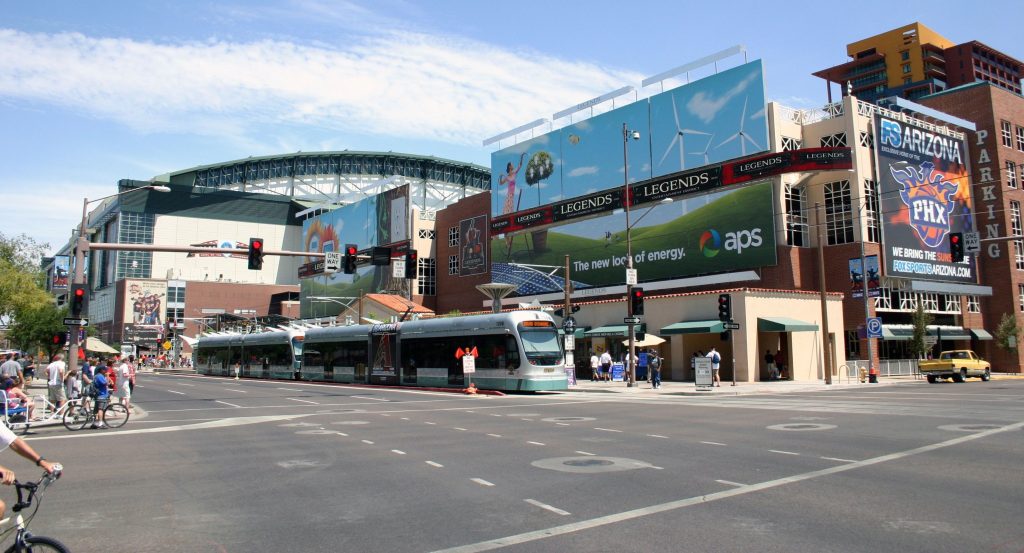
Phoenix's Proposition 104 promises to extend light-rail and bus service, as well as make street improvements. Everyone who wishes the city well should vote for it.

Now that's out of the way, let's examine some lesser-explored aspects of the issue. I say "issue," because the debate has been won. WBIYB. Phoenix light rail is highly successful, as I predicted when advocating it — and getting death threats from the Bs in the latter B of WBIYB — as a columnist at the Arizona Republic.

A quick note on costs. With the $2 billion the state wants to flush down the toilet on the South Mountain Freeway, we could more than double the original 20 miles of light rail. That Arizona is still building freeways shows this racket for what it is: a way to keep spec construction going and enriching the Real Estate Industrial Complex.

Costs? Freeways destroy cities and farmland, spread pollution and emit enormous amounts of carbon into the global commons called the atmosphere. That these costs are hidden "externalities" does not mean they don't exist. Transit is a bargain. Enough said about the "light rail costs too much" Big Lie.

Progressive Arizona

Progressive Arizona

President_Taft_signing_Arizona_Statehood_Bill

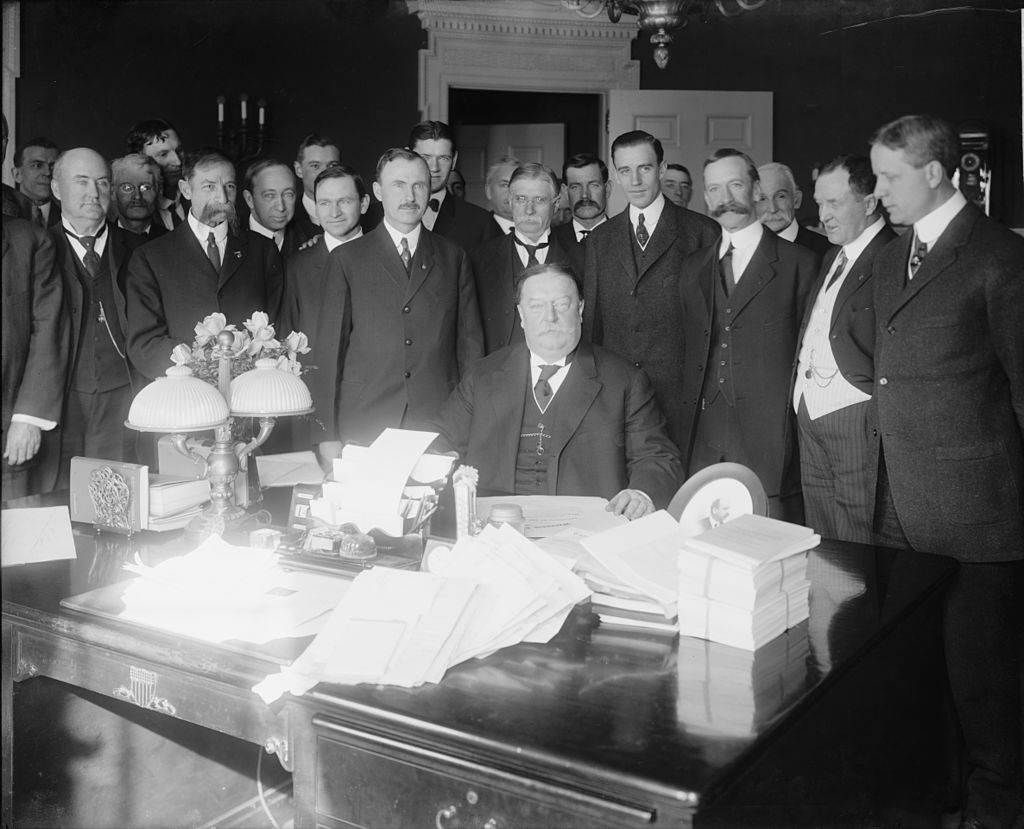
President William Howard Taft signs the bill admitting Arizona as the 48th state in 1912.

If our advanced high-speed rail system backward dependence on overcrowded airliners works, I'll be on a panel next Friday at the national convention of Netroots Nation in Phoenix. The topic: How Progressive Arizona Became Tea Party Arizona.

Because panelists never get to say as much as they'd like, I'll set the table here.

Arizona indeed began as a capital-P Progressive state. This included a weak, almost figurehead of a governor and a strong Legislature, as well as the initiative and referendum where the people could essentially legislate on their own. Statewide officials were required to stand for re-election every two years. They could also be recalled.

Importantly for a state where mining interests and railroads exercised enormous power, the state constitution created a Corporation Commission with wide-ranging regulatory power over the capitalists.

All these were hallmarks of the Progressive Era, which developed as a response to the robber barons and inequality of the Gilded Age of the 1880s and 1890s.

Theodore Roosevelt busted the trusts and more vigorously applied tools that had been passed by Congress earlier, such as the Sherman Antitrust Act and Interstate Commerce Commission. He signed the Pure Food and Drug Act, which, like many Progressive measures, was a result of horrors exposed by muckraking journalists

Had TR won in 1912, he would have gone much further, enacting reforms that had to wait for his cousin, Franklin.

The rise of Margaret Hance

The rise of Margaret Hance

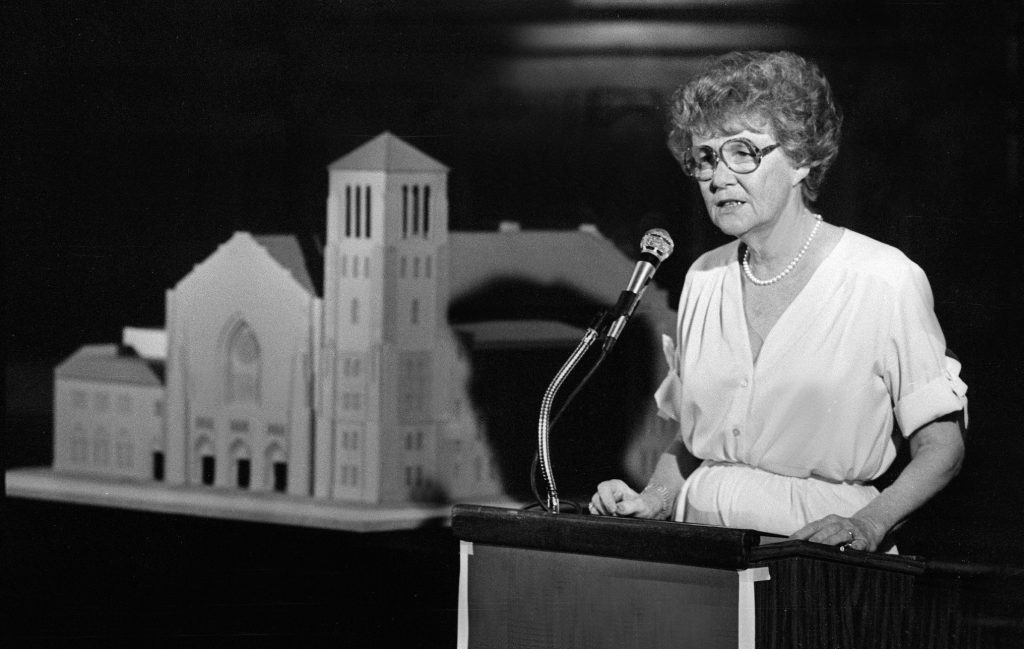
Margaret Hance (Ging photo)

(Michael Ging photo)

When Margaret Hance was elected mayor of Phoenix in November 1975, she was not, as is often claimed, the first woman to lead a major city. That marker goes to Bertha Knight Landes, elected mayor of Seattle in 1926. Patience Latting was elected mayor or Oklahoma City in 1971. Hance was third.

Hance's tenure was far more consequential, as we shall see. Still, she and Landes are twined in dissonances.

Landes, who ran advocating "municipal housecleaning," has been "honored" by Seattle naming its misbegotten tunnel boring machine after her. Hance is memorialized by a park in the heart of the city, a place she did little to help and much to harm.

Margaret Taylor Hance was almost a native, being brought from Iowa to Mesa at age three, in 1926. Her father went to work for Valley Bank, where became an executive vice president. Despite the onset of the Depression, the family moved to what is now Willo. (I am told they lived in the same house on Cypress Street in the 1930s where I grew up in the 1960s. In the '30s, unlike the '60s, it was a high-end neighborhood on the streetcar.)

Although she attended the University of Arizona, she transferred to the elite Scripps College in Claremont, Calif., from whence she graduated. In 1945, she married Robert Hance, who had trained as an Army Air Forces pilot in the Valley during World War II. Her brother, Glen Taylor, went on to become news editor at the Phoenix Gazette, retiring as assistant managing editor in 1983.

She settled into the comfortable and predictable life of an upper-middle-class Republican Phoenix woman. Robert went to work for Valley National Insurance and rose. The couple had three children. Margaret — known as Marge or Margie — volunteered for numerous organizations and joined the Junior League.

Phoenix 101: Birth of crazy

Phoenix 101: Birth of crazy

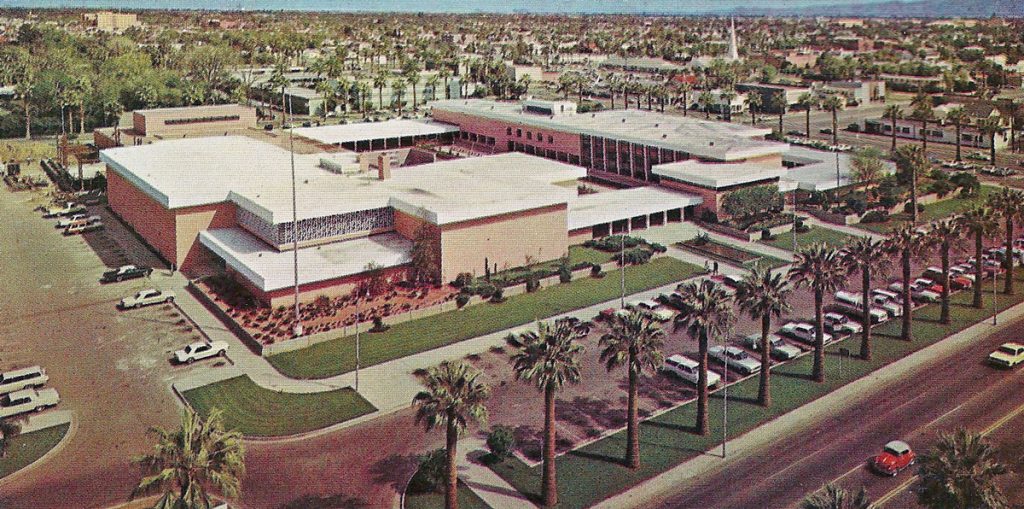
Civic_PlazaThe Phoenix Civic Center, built with the support of Councilman Barry Goldwater, was seen as an example of profligacy by hardcore right-wingers. This side of the center faces Central. Today most of the site is the Phoenix Art Museum.

It is tempting to see the likes of Diane Douglas, John Huppenthal, Tom Horne-y, "Better Call Sal" DiCiccio and the entire Kookocracy as a recent phenomenon in Arizona. It's certainly comforting to us natives.

Barry Goldwater wasn't raving mad, we will tell you (the "lobbing one into the men's room of the Kremlin" was a joke). He came to regret his early opposition to federal civil rights laws, and was instrumental in helping desegregate Phoenix's schools. He desegregated Goldwater's Department Store, as well as promoting minority managers. As a city councilman, Goldwater supported public improvements, including bonds for the 1950 Civic Center (and he backed every Phoenix bond measure thereafter). In the 1980s and 1990s, Arizona's new conservatives repudiated him.

The truth is that Arizona was always a conservative state, in a narrow definition of the term. But for decades most citizens understood it wouldn't have existed without enormous federal largesse. No wonder majorities voted for FDR all four times he stood for the presidency. Sen. Carl Hayden was a progressive and New Deal Democrat. His fellow Democratic Senator, Ernest McFarland was the father of the GI Bill.

But the Kookocracy has roots that reach back more than half a century in Phoenix, to a forgotten City Council election.

The hard way

The hard way

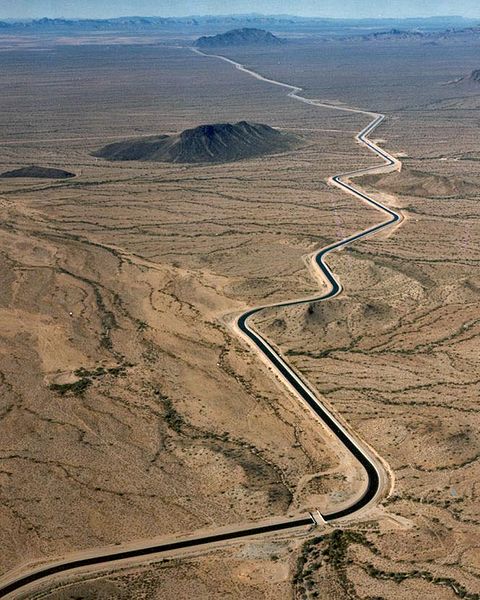
480px-Arizona_cap_canal
It was only a matter of time before the national media figured out that California is not the only place at risk from historic drought and the dwindling Colorado River.

Here is Slate, wrong from the first paragraph. And the Washington Post, which doesn't seem to have a clue about the dreary reality of Arizona's economy.

As a counterweight, I promoted this 2013 column on Twitter and Facebook — and traffic on this site exploded. It is important that the media elites understand the complex water issues facing Arizona. I urge you to read or re-read it.

Can Arizona and Phoenix survive the drought caused by man-made climate change? Probably. The question is whether it will be the easy way or the hard way.

But here's an easy back-of-the-bar-napkin calculus. The population of Maricopa County, mostly metro Phoenix, was 1.5 million in 1980, before the completion of the Central Arizona Project canal and the proliferation of sprawl that preceded it and was anticipating it.

Today, the population is more than 4 million. So in the long run, metropolitan Phoenix's sustainable population — in any pleasantly liveable way — is that 1980 figure. Two-and-a-half million people need to leave, head back to the Midwest and the East.

Reform and extremism

Reform and extremism

Arizona_State_Capitol_DSC_2701_ad
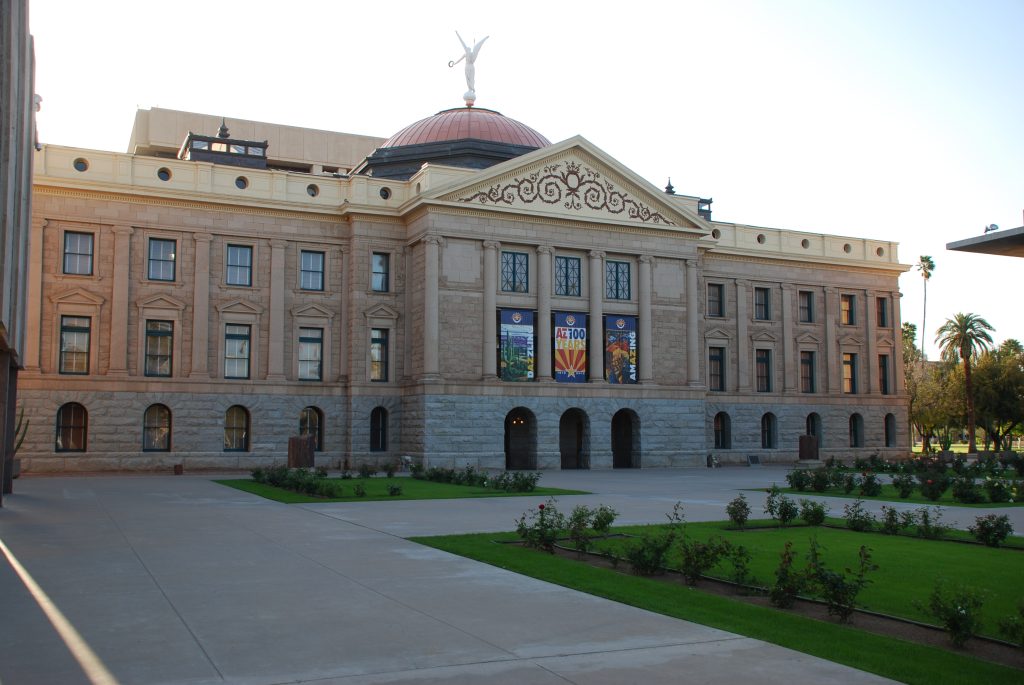
One of the curiosities of Arizona politics is how widely supported efforts to make government cleaner — the approval of term limits in 1992 and so-called clean elections public financing of candidates in 1998 — coincided with the rise and now dominance of the extreme right.

Term limits were a fad in the early 1990s, ostensibly meant to eliminate a permanent political class. Although never implemented on a national level, they gained traction in many state and local government. "Clean elections" was intended to take big money out of politics, especially in the aftermath of the bribe-ridden AzScam scandal.

Under the new rules, a Burton Barr, who ruled the Legislature as House majority leader from 1966 to 1986 would have been impossible. Barr's time, working with such Democratic leaders as Alfredo Gutierrez and Art Hamilton, also was the high-water mark of legislative achievement for Arizona.

Had term limits been enacted nationally, we never would have had a Carl Hayden, who served in the Senate for 42 years, or a John J. Rhodes, who served in the House for 30 years. And thus, no Central Arizona Project, which demanded such longevity from lawmakers from what was then a small and politically weak state challenging mighty California.

Raul Castro, an appreciation

Raul Castro, an appreciation

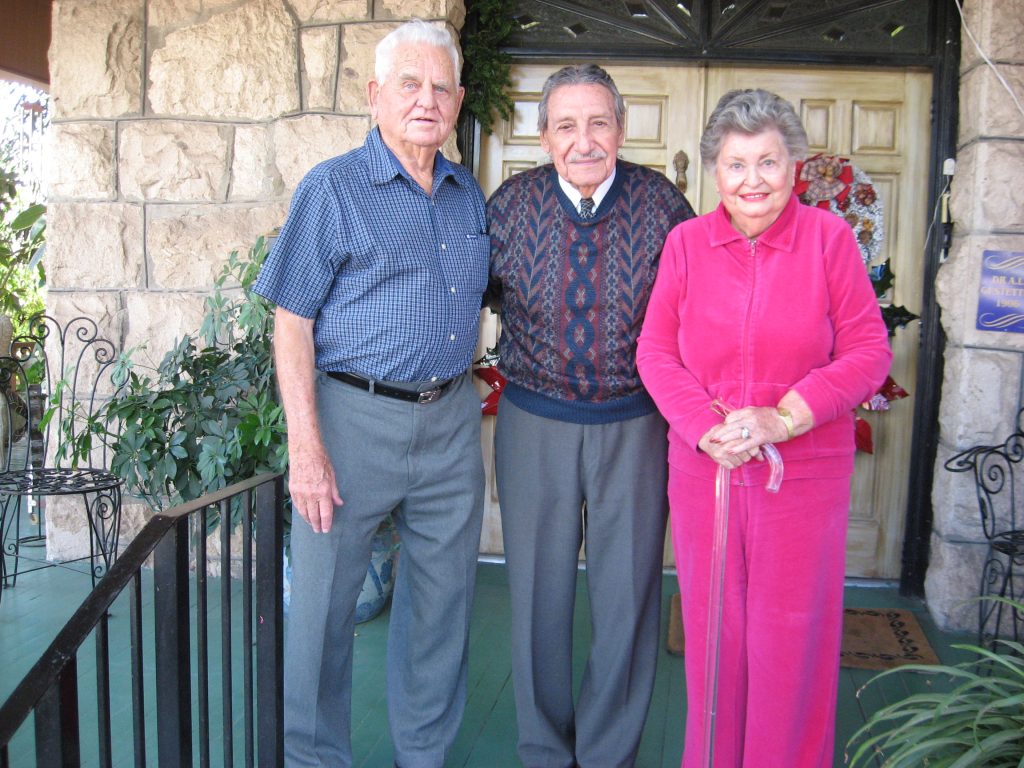
Raul_Castro_2008Raul Castro, center, along with his wife Pat and longtime law partner and friend Henry Zipf at the Castros' home in Nogales, Ariz., circa 2008.


By Jack August Jr.
, Guest Rogue

In 2007, then-91 year-old Raul Castro addressed a packed auditorium at the Arizona Historical Foundation’s annual Goldwater Lecture Series at Arizona State University.  At the time, I served as Executive Director of the foundation, which, among other things, maintained the personal and political papers of Sen. Barry Goldwater. 

Two hundred mostly conservative and arguably skeptical supporters of the legendary Arizona senator were curious to see what the former Democratic governor, judge, and ambassador had to say.  

After introducing him, I sat down and watched Castro stride to the podium; he had no notes. He launched into a one-hour presentation that seemed like ten minutes, telling his life story, touching upon the role that education played in his life, his years as a “hobo” riding the rails, his undefeated professional boxing career, and his countless experiences of prejudice and adversity. 

But the overarching theme in his talk was the promise that America held for all its citizens. When he finished the audience exploded in applause and stood on their feet clapping for several minutes. It was a stunning performance.

The distinguished professional career of Castro, who died last week, stood in stark contrast to the adversity inherent in his humble beginnings, which only hardened his resolve and strengthened his determination.

Foreigner

The biggest kick in the head on this trip back home came when I drove past Kenilworth School, where I went from first through eighth grade. Other alumni include Senators Barry Goldwater and Paul Fannin.

When I was there in the 1960s, the stately building was surrounded by grass and trees (watered by flood irrigation), including the mature palms that lined Third Avenue. Teachers could park on the streets, although a number of them walked because they lived nearby. The houses were all landscaped with lawns, trees, flowers, and hedges. In addition to making the neighborhood attractive and walkable, this helped cool it. We went back to school without air conditioning in September.

Kenilworth avoided aggressive attempts to demolish it when the unnecessary Papago Freeway inner loop was rammed through the neighborhood in the 1980s. It also survived the curving of Third Avenue, which destroyed the grid designed to give the neighborhood a pleasing aspect. And the mammoth widening of Seventh Avenue to feed the freeway.

Now a bunch of rocks have been thrown down in front of the school. A driveway and even larger parking lot have been added where the grassy playground once stood. Where we would lie on the cool ground, watch jet contrails, and dream the dreams of youth. The dissonance is painful. The classical revival building set amid all this ugliness is similar to a diamond lying in a pile of manure.

The trouble is that I am one of the few people who would even notice. Like Carson McCullers, "I must go home periodically to renew my sense of horror." But I am increasingly a foreigner here.

School’s out completely

Whatever the final numbers, the outlook for education in Arizona is grim. Blame the Kookocracy. Blame the governor, wealthy Republican Douglas A. Roscoe Jr. aka "Doug Ducey." Or credit them. A majority of Arizonans voted them in.

Education Week's respected Quality Counts report ranks Arizona 47th overall. The state has been down in the basement with Mississippi in per-pupil funding for years. By no measure has funding kept up with student population or dealt with inequalities among districts.

Similarly, higher education has received ever-decreasing portions of the state general fund. The slash-and-burn cuts that are imposed every few years are never restored.

The new regime intends to double down: at least $104 million in cuts to universities, elimination of all state support for the largest community college districts, and, despite a claim of increasing K-12 funding, a serious reduction there because the promises aren't in real dollars. Including inflation, the actual spending on K-12 will be a 13.5 percent reduction from 2005-2006.

Now, my mother said, "If you can't say something nice about a person, become a newspaper columnist." In that spirit, I can't even credit the Kooks with originality. They are merely playing out a national strategy being enacted in every state capitol where Republicans hold sway.

Even so, Arizona has suffered so many decades of such vandalism, the consequences will be more severe. Real lives will be affected, opportunities to escape poverty and climb the ladder of opportunity smothered. The damage won't stop there.

When the Legislature worked

When the Legislature worked

AZ_House
You know the Arizona Legislature. It's the bunch that reduces education money for some of the worst-funded schools in the nation, savagely cuts financing for universities, has its hands in the hustles of the Charter School Racket and Private Prison Racket. The worthy solons who sold off pieces of the Capitol area in the Great Recession.

It was the birthplace of SB 1070, the anti-immigrant (really voter suppression) law. This is only one of its creations that helped give the impression that Arizona is one of the craziest and most bigoted states. Anything forward looking, the majority opposes. Tax cuts? You bet. It is the Kookocracy.

But there was a time when Arizona had one of the most respected legislatures in the nation. Yes.

In fact, there were at least two sustained periods in the state's history when the Legislature worked.

This is no small thing because the Legislature is by far the most powerful branch of government in the state. Constitutionally, the governor was barely more than a figurehead — a status that has improved in recent years, but not by much. In other words, Arizona moves ahead, or backwards, depending on the Legislature.

Who is Diane Douglas?

Who is Diane Douglas?

History repeats itself, first as tragedy, second as farce. — Karl Marx

DianeDouglasNobody seems to be admitting to voting for Diane Douglas as Arizona Superintendent of Public Instruction. But of the 36.42 percent of registered voters who cast a ballot, a majority backed Douglas over her opponent, David Garcia. Douglas had no experience beyond a controversial stint on the Peoria school board. Garcia is a professor of education, former teacher and Army veteran.

But there you have it.

Garcia, nationally respected, ran on a solid platform of improving Arizona schools, which consistently rank at or near the bottom nationally. Douglas, rhetorically challenged, ran against what she saw as the evils of Common Core, which particularly resonates with white suburbia.

It surely helped Douglas that Garcia had a Hispanic surname. It helped her most of all that she had an R attached to her name. For the majority of state voters, no matter the self-identified "independents," are Yellow Dog Republicans. In other words, you could run a yellow dog as a Republican and they would vote for it over the most qualified Democrat.

I write all this as prologue for the latest, but far from last, Douglas stepping-in-it event. She fired two state Board of Education staff members for the Thought Crime of being allegedly "liberal." My doubt about that was confirmed when the governor, wealthy Republican Douglas A. Roscoe Jr. aka "Doug Ducey," reinstated the pair.

You can read the hilarity here, as well as her clumsy climb-down. But what did voters expect?

Sue Clark-Johnson, an appreciation

Sue Clark-Johnson, an appreciation

SCAs a young paramedic, I learned early on that we all hang by the slenderest thread. That thread snapped suddenly Wednesday for Sue Clark-Johnson, publisher of the Arizona Republic from 2000 through 2005.

She was 67, and although I had heard she had been hospitalized, the news came as a shock. The fifties and sixties are not the new thirties.

As a business editor and columnist, I have always had close relationships with publishers. Unlike other people in the newsroom, a business editor supervises the coverage of the publisher's peers and sometimes friends.

I have been blessed with good publishers such as Tom Missett at the Blade-Tribune, Brad Tillson at the Dayton Daily News, Larry Strutton at the Rocky Mountain News, Harry Whipple at the Cincinnati Enquirer and the legendary Rolfe Neill at the Charlotte Observer. They supported the tough, high-impact, sophisticated journalism that we practiced. Frank Blethen has been a consistent supporter of my columns at the Seattle Times.

Sue was my friend and protector during my years as a columnist in Phoenix. Some of the most powerful people in Arizona came to her demanding that I be fired or silenced. She turned them away. Not only that, she provided me with a larger platform as an op-ed columnist on Sunday.

Eight years of Rogue

This month marks the eighth anniversary of Rogue Columnist. That's a long time in the blog world and I couldn't do it without you — the smartest commenters (19,945 comments) on the Web and the thousands who come to read. The number of posts is 907 (!).

I tell more about why I write Rogue on top of my day job and novel-writing here. Today I want to list some of my favorite columns. The nature of column-writing is ephimeral. These stand out even after all these years. Maybe you have some you want to list in the comments field. I've opened all posts, not just the most recent, to comments.

1. Early on, I laid out some of the topics I didn't write about when I was a columnist at the Arizona Republic.

2. Speaking of newspapers, this column laid out the many less-discussed reasons for their death spiral. It holds up pretty well today.

3. Another one, close to my heart, is "Rocky Mountain Requiem," about the heartbreaking loss of the Rocky Mountain News, one of the oldest newspapers in the West and where I was fortunate to work in the great newspaper war with the Denver Post.

4. I haven't written much personal history here. One exception, and among the most popular, is "Ambulance Days," my reminiscences of my days as an EMT/paramedic in the Phoenix of the 1970s.

5. I was also blessed by the amazing fine arts program at Coronado High School, which I write about in "Friday Night Lights." And by attending Kenilworth Elementary School near downtown, which I celebrate in this column.

6. A few of the columns on national social and cultural issues have stood the test of time (cliche alert). Among them: "Rules of Engagement," "Men Don't Read," "R U Raising Stupid Children," and "A Giant Leap and Then A Long Fall."