Flipping Arizona?

Flipping Arizona?

Hillary_Clinton_by_Gage_Skidmore_3
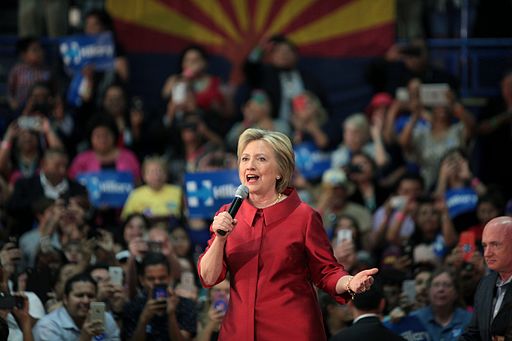
The new NBC News/Wall Street Journal/Marist poll has Hillary Clinton within one point of Donald Trump in Arizona. You read that right. This is in line with a polling average from Real Clear Politics, which even had Clinton slightly ahead during and after both parties' conventions. 

Is it possible that Hillary could flip Arizona to the Democrats? After all, her husband won the state in 1996. I am skeptical.

Bill Clinton won in a very different Arizona. The state was still competitive for Democrats and "experts" predicted that continued population growth would favor the party. Arizona's population expanded by 40 percent in that decade, but it was the "big sort," where people came seeking ideological co-religionists. It was almost entirely on the right. With the exception of the surprise election of St. Janet in 2002 and hopes for her "sensible center," Arizona politics trended ever more rightward. Today not a single statewide office is held by a Democrat.

From the 1980s on, Republicans patiently took control of school boards, municipal offices, tightened their control of the Legislature and Corporation Commission, built a massive infrastructure including fake "think tanks," the charter school racket, private prison racket, and the aid of the Real Estate Industrial Complex. The Democrats never knew what hit 'em. The best Napolitano could do was play defense.

In our Cold Civil War, with the nation more divided than any time since the eve of the Civil War, Arizona sits comfortably in the New Confederacy. I can still start a fight on Facebook by praising light rail (WBIYB).

Phoenix in the eighties

Phoenix in the eighties

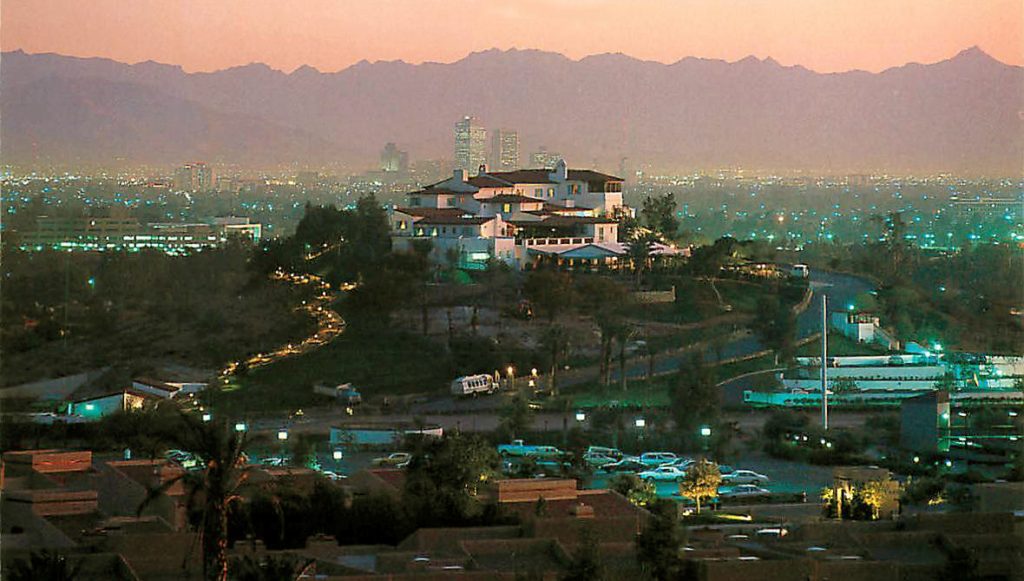
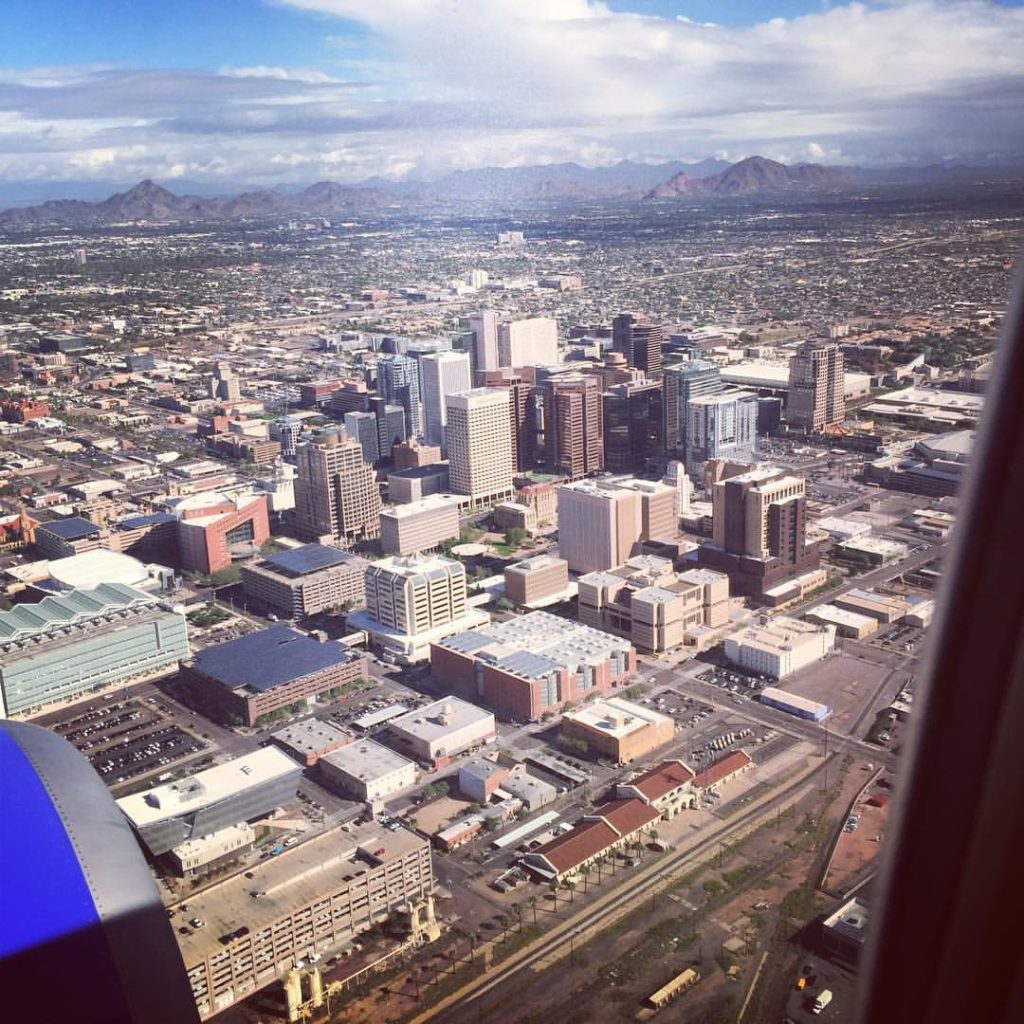
Wrigley_Mansion_looking_south_Estrellas_South_Mountain_1980sThe Wrigley looking southwest over the city in the 1980s (Photographer unknown).

On the night in 1968 after President Lyndon Johnson signed the bill authorizing construction of the Central Arizona Project., my mother took me on a long drive. We went through the citrus groves, the empty farmlands between the towns, the enchanting oasis that was Phoenix. Like many who had dedicated a good part of their lives to win the CAP, she had deep misgivings. She wanted me to see the place, burn it in my brain, and remember. "It will be gone," she said. She didn't live to see her prediction come true. But the ferocious transformation of Phoenix from my beloved old city to the nearly unrecognizable concrete desert of today largely  happened during the last two decades of the twentieth century. The big changes began in the 1980s.

In 1980, Phoenix's population was nearly 790,000, up 36 percent from 1970. The city would grow slower in the 1980s — up 25 percent. But Maricopa County grew almost 41 percent. Yesterday's small communities began to become today's mega-suburbs as sprawl took off as never before. For example, Glendale, which had grown by 168 percent in the 1970s, added another 52 percent in the eighties. It would hold nearly 148,000 people by 1990. Arrowhead Ranch, the citrus groves owned by the Goldwater and Martori families, was being developed into subdivisions, one of the largest new "master planned communities" in the state. Phoenix remained the power center of the state and county through the decade, but its hold began to slip.

In 1980, Phoenix still enjoyed a robust base of major headquarters. By most measures it was never stronger and almost all were located in the Central Corridor. Among them were the three big banks, Valley National, First National, and the Arizona Bank; Greyhound; Arizona Public Service; American Fence; Central Newspapers; Western Savings, and Del Webb Co. Karl Eller's Combined Communications had been purchased by Gannett in 1978 but Eller remained active, taking control of Circle K in 1983 and making it the nation's second-largest convenience store chain.

APS formed a holding company, Pinnacle West Capital, that was not regulated like the utility by the Corporation Commission. Among its ventures was the S&L Merabank. Taking advantage of airline deregulation, America West Airlines was formed by local investors in 1983 — it would go on to merge with USAirways and take over American Airlines. And Phelps-Dodge, which for a century controlled much of Arizona's destiny as the world's leading copper company, moved its headquarters from New York City to a new tower in Midtown Phoenix.

It can happen here

It can happen here

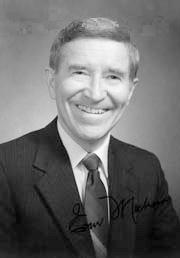
Evan_MechamClowns who say outrageous things, who are completely unqualified for office, are very capable of being elected in America. They are entertaining, underestimated, and disasters in office. The highest office reached so far has been governor — think Jesse Ventura in Minnesota and Lester Maddox in Georgia. Closer to home was Evan Mecham, the governor of Arizona from 1987 until he was impeached and removed from office less than 15 tumultuous months later.

Mecham was a clown, given to conspiracy theories and outrageous statements — his "pickanniny" comment and blaming working women for high divorce rates were only two. But he had support from the state's right wing, especially John Birchers and fellow Mormons. He was a populist, after his fashion. In Mecham's world, the government was the enemy and cause of all ills. He wanted to eliminate income taxes and turn over the public's lands to state interests. A theocrat, Mecham wanted to have prayer in public schools. Threats were everywhere, out to destroy real Americans and the real America.

The toupee'd Glendale car dealer and serially failed newspaper publisher gave Carl Hayden a scare in the 1962 U.S. Senate race. Among his issues was a demand that the United States withdraw from the United Nations. Hayden's longtime aide Roy Elson organized a campaign to "reintroduce" the senator to a state he had served in Washington since 1912, but had attracted large numbers of newcomers since 1956. Hayden won comfortably, but many old Arizonans were unsettled. That anyone could get 45 percent of the vote against the state's indispensable man in the fight for the Central Arizona Project was astounding and deeply disturbing.

Mecham ran outsider campaigns for governor again four times before winning. As in 1962, each election he explicitly ran an insurgent campaign against elites and "the establishment."

His election was a fluke. In the 1986 Republican primary, he faced the respected state House leader Burton Barr, who was supported by the establishment, from Barry Goldwater to the Pulliam press. But Barr, a legislative wizard, ran a sluggish campaign. Turnout was the lowest in 40 years. And Mecham cleverly exploited the grievances and paranoia of newcomer retirees, adding to his Bircher and LDS base — people who did vote. On the Democratic side, and back then Arizona was a competitive state, Carolyn Warner was sandbagged by apartment magnate Bill Schultz, who got out of the race only to reemerge as an independent.

It’s a dry heat

Somebody on Facebook posted a T-shirt that said, "If you can't handle Phoenix at 122 degrees, you don't deserve Phoenix at 78 degrees." OK, then. Nothing to see here, move along.

When you're forced to rip off majestic cataclysm Detroit's mordant humor ("Detroit: Where the weak are killed and eaten"), you have issues as a city. The biggest one, climate change, is getting the least attention.

As day after day was hitting record high temperatures and at least four hikers were killed by the heat in Arizona, and untold numbers needing rescue that endangered the lives of first responders (been there, done that, and no, the view doesn't offer comfort when you're lugging some tenderfoot down a mountainside in a Stokes basket), when the heat was so severe it prompted an airliner to turn back because of fears of its tires blowing out on the broiling runway at Sky Harbor, with a possible serial killer on the loose in Maryvale… Amid all this, Phoenix received an unexpected gift.

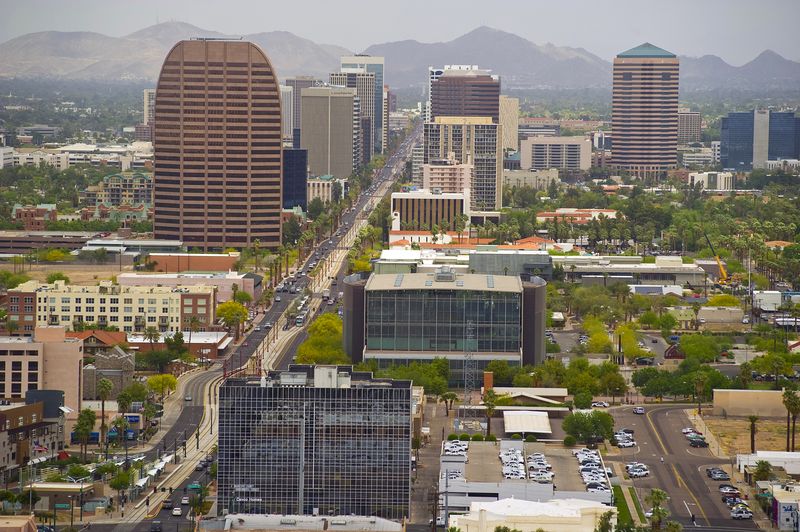
It came in the form of a New York Times story headlined, "Phoenix focuses on rebuilding its downtown, wooing Silicon Valley."

Here was a godsend that none of the usual it's a dry heat, you don't have to shovel sunshine, I hike Camelback on the hottest days (moron), championship golf local-yokel booster Pravda propaganda could never match. The Newspaper of Record gave us a (if one didn't look too closely) glowing vote of confidence. What climate change? We're gonna be a tech hotspot!

The Kooks back down (a little)

Last week, in an unprecedented move, Republicans who control the Arizona House of Representatives banned reporters from the House floor. Then they said the press would have to undergo extensive background checks. They finally relented on Tuesday, saying the floor would be open to journalists — at least for the rest of this session.

As usual, this embarrassment has a back story. Earlier this year, Hank Stephenson of the Arizona Capitol Times, revealed that House Speaker David Gowan had used a state vehicle to travel to events for his congressional campaign. Even in compromised Arizona, this action has left Gowan in deep doo-doo.

The ban was an explicit retaliation. It included a provision that if a reporter had been convicted of even a misdemeanor, he or she could be kept off the floor for a decade. Conveniently, Stephenson had pleaded guilty to misdemeanor trespassing in 2014, apparently after a bar fight in Wickenburg (my kind of reporter).

Gowan is a typical Kook mediocrity. He's connected to the extremist "Oath Keepers." A-plus rating from the NRA. As usual, he wants to perpetuate his sucking at the gub'ment teet by moving up in gub'ment. With incumbent Ann Kirkpatrick (to my mind misguidedly) challenging wealthy Republican John Sidney McCain III for the U.S. Senate, the First Congressional District seat is open.

Voter suppression

Arizona has become a bellwether in recent years. Before the Tea Party, well funded by Republican oligarchs, surprised Democrats in the 2010 elections, Arizona had led the way with the passage of SB 1070 and crazy, racist political movements. The result was a takeover of all statewide offices by right-wing extremists.

Now we have the disaster of the primary election, where voters were forced to wait for hours in lines. The number of polling places in Maricopa County was cut from 200 in 2012 to only 60. These closures fell heaviest in poor and minority areas. Details are contained in the Arizona's Continuing Crisis news vertical on this site.

Elvia Diaz of the Arizona Republic correctly writes that this was not a bureaucratic mistake by County Recorder Helen Purcell but "a well-orchestrated plan to keep … Latinos from voting." Purcell had a green light when Arizona was among the states exempted from long-standing federal oversight after Republicans dismantled the Voting Rights Act:

Advocates and academics have documented concrete examples of discrimination against minority voters since statehood to the March 22 Republican and Democratic presidential preference elections. Those in power have adeptly used cultural and language barriers as a weapon. For instance, in the early 1900s, Arizona enacted its first English literacy test.

“The literacy test was enacted to limit ‘the ignorant Mexican vote’ … As recently as the 1960s, registrars applied the test to reduce the ability of Blacks, Indians and Hispanics to register to vote,” according to historian David R. Berman.

If you think about it, little has changed throughout Arizona’s history. Conservatives have incessantly targeted minorities and typically intensify their efforts during economic recessions or political turmoil.

Indeed, future Chief Justice of the United States William Rehnquist participated in Operation Eagle Eye, a voter suppression tactic aimed at minorities in south Phoenix in the 1960s. Remember, Arizona was long as much a Southern as a Western state. So its inclusion in Justice Department oversight of voting was well deserved.

The war on cities

The war on cities

001(Michael Ging photo)

"Local control" is one of the bedrock principles of the Republican Party. But as Arizona shows, this only applies when Republicans are in control locally.

Thus, the Legislature has passed laws forbidding cities from banning plastic bags, threatening to withdraw revenue sharing from those that mandate sick leave, and retroactively prohibiting Roosevelt Row from forming a business improvement district. In each case, these were pushed by suburban lawmakers.

For Arizona, this is a retrograde move from the 1960s and 1970s. Before the Supreme Court's 1964 "one man, one vote" decision, state policy was ruled by powerful rural state senators who consistently voted against education, transportation, and other infrastructure." With a Legislature that actually represented the population, Republican leader Burton Barr in the House and Democratic leader Alfredo Gutierrez in the Senate pushed through a slew of modernizing bills.

In recent decades, it's been moving in the opposite direction, from continued funding for sprawl-producing freeways to some of the worst cuts in education funding in the nation. It has fought and sabotaged light rail (WBIYB). Land-use restrictions are non-starters. Commuter rail or passenger service between Phoenix and Tucson are pipe dreams. New "takings" laws have severely limited cities' economic development and preservation efforts.

Arizona is one of the nation's most urbanized states, with 80 percent of the population living in the Phoenix and Tucson metro areas and most of the rest in smaller metros such as Flagstaff. Almost all of the intelligent responses that Arizona needs are to urban problems. Yet the Legislature is adamantly anti-city and growing more so with each session. (And, of course, it is against any mention of climate change).

Trump country

Trump country

MM-and-SK-on-Voter-Anger--Manufacturing-Employment-Decline1

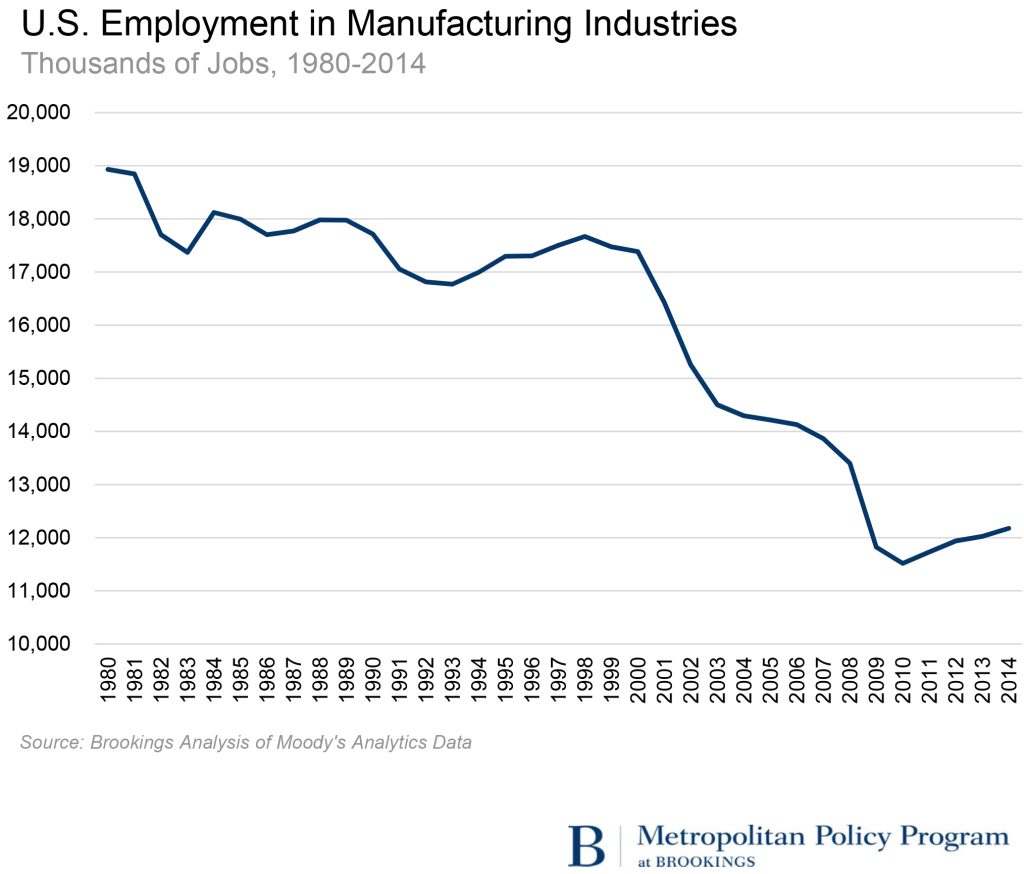
The chart above is pimped on Twitter as "Voter anger explained — in one chart."

With all due respect to my friends at Brookings, it doesn't explain the lead enjoyed in Arizona by [the real-estate developer]. The Wall Street Journal is closer to the mark in a story headlined, "Arizona Primaries to Stress Immigration."

[The real-estate developer] has made illegal immigration a centerpiece of his campaign since the day he entered the presidential race last June. He’s said many illegal immigrants from Mexico are “criminals” and “rapists.”

He’s also called for the mass deportation of all 11 million illegal immigrants currently living in the U.S. One of his top applause lines at rallies is that he will build a wall along the entire U.S.-Mexican border and force the Mexican government to pay for it. His rivals, including Texas Sen. Ted Cruz, have made similar comments.

“Border security is not just rhetoric here in Arizona,” said Christine Jones, a businesswoman and Republican activist who ran unsuccessfully for governor in 2014. “It will always be among the top issues because it’s an issue that people live” in their day to day lives in the state, said Ms. Jones, who is currently neutral in the 2016 race.

Mr. Trump has won the endorsements of the popular former governor of the state, Jan Brewer, as well as Maricopa County Sheriff Joe Arpaio, who has built a national reputation for his tough stances on undocumented immigrants and his unorthodox treatment of prisoners in his custody, including housing inmates in tents and forcing them to wear pink underwear.

Unchangeable you

I've been writing about Phoenix and Arizona for 15 years now, first as a columnist for the Arizona Republic and then in this space.

We've had some victories to be sure, and I'll take a little credit for being in the fight, often against the worst kind of civic thugs and wreckers. Among them: revitalizing central Phoenix, building the new Convention Center, winning T-Gen and making a start, albeit so slow, on the Phoenix Biomedical Campus, creating the downtown ASU campus, and light rail (WBIYB). Under Michael Crow, ASU gained stature and I was writing in support all the way.

I worked hard to provide history and context to a place rich in both, but where so many people think they don't exist — indeed, that they are dangerous. Amid the rackets, my job was not to be a cheerleader for the short hustle but to call balls and strikes.

And yet, nothing much has changed in the big picture. We keep losing.

Despite a brief moment of hope when St. Janet became governor, the extreme right has become more dominant than ever. The charter school racket. Cutting public school funding while giving tax breaks to private schools and money to rich districts. The private prison racket. The refusal to consider sustainability in the face of climate change. Continuing to depend on sprawl real estate as the main engine of growth. Further profaning the deserts and forests. It's a long list. And nothing changes. Indeed, it gets worse.

The governor from Koch

No one should be surprised that Arizona’s governor, wealthy Republican Douglas A. Roscoe Jr., aka Doug Ducey, attended yet another conference sponsored by a Koch brothers front group.

As Howard Fischer reports, in the gubernatorial election the Koch organization American Encore spent more than $750,000 on attack ads against Democrat Fred DuVal. Another $650,000 was plowed into pro-Ducey efforts.

This is chump change in the multi-decade effort by right-wing reactionary billionaires to take control of American politics and game policy to their ends. Jane Mayer of the New Yorker does an excellent job of exposing its reach in the book, Dark Money.

The Democrats, much less liberals, have nothing that can compete.

When Ducey met Cali

When Ducey met Cali

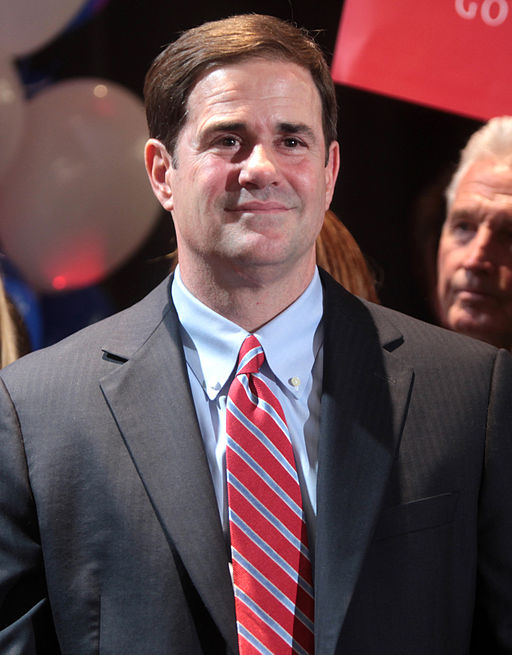
Doug_DuceyHe opened the door, so let's walk through.

He being wealthy Republican Douglas A. Roscoe Jr., aka "Doug Ducey," the governor of Arizona. In his State of the State address, he made a special point of contrasting Arizona's supposedly booming economy vs. the alleged economic disaster of the Golden State. As in, "So the goal is simple – to grow our economy, to take full advantage of our geography to better address the needs of businesses fleeing California and other states on the decline, and to ensure job creators who are already here, stay and thrive."

Let's look at the facts.

In November, the most recent month for which statistics are available, California's unemployment rate was 5.7 percent. Arizona's was 6 percent.

As of 2014, the most recent year available, Californians enjoyed a per capita personal income of $50,109; Arizonans struggled with $37,895. Median household income was $60,487 in California vs. $49,254 in Arizona. These are the "job creators," citizens with the incomes to spend and invest.

California has added 2 million new jobs over the past six years to reach a new record high. So much for companies "fleeing." Indeed, it is one of the most robust states for company formation and startups.

Arizona's gross domestic product is still below its pre-recession peak and stumbled along with 1.4 percent growth in 2014. California's GDP is at new record highs and grew more than 2.5 percent annually.

The ‘gub’ment land’ hustle

The ‘gub’ment land’ hustle

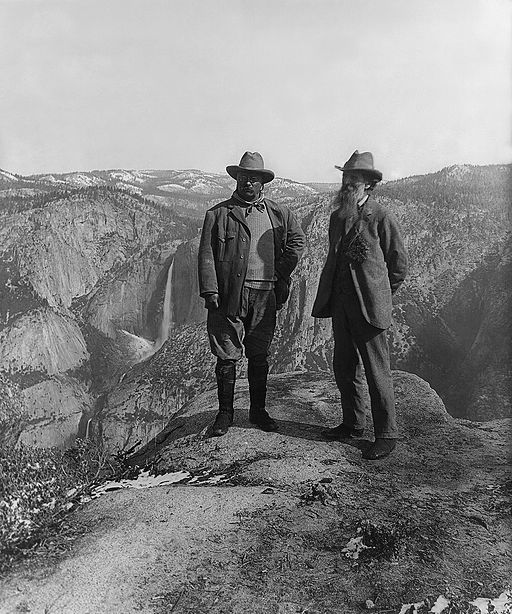
TR
Even many Republicans are distancing themselves from the Y'All Queda/Vanilla ISIS theater in Oregon. And many liberals have rightly made a contrast with the authorities' likely response if a band of armed black militants would have taken over a federal building.

Beneath it, however, is a longstanding dislike of the federal government by many Western landowners and cattlemen. They wanted the perks that came from Washington: the Homestead and Desert Land acts, conquest of native tribes, land-grant railroads and reclamation.

They eagerly exploited the favorable terms of the General Mining Act of 1872, as well as price supports and other goodies for farmers and ranchers and timberlands in the 20th century. Developers wanted federal Interstates and other highways, flood control and murky, corruption-tainted land swaps of public land. And they demand taxpayer-funded firefighting to protect their "cabins" (read exurban subdivisions where they shouldn't have been built).

Ammon Bundy, son of welfare-queen rancher Cliven and "mastermind" of the Oregon takeover, is a taker himself. He received $530,000 through a tyrannical federal loan guarantee program for his truck-repair business in…wait for it…Phoenix.

Otherwise, these rugged individualists wanted the government gone. Some of Arizona's leading statesmen opposed making a National Park at Grand Canyon.

The notion of an oppressive federal government controlling the land, and hence the destiny, of the West has been political fuel for the Republican Party since the so-called Sagebrush Rebellion of the 1970s. One of its prominent arsonists was Nevada Sen. Paul Laxalt, a friend of Ronald Reagan. Now the issue is back.

Earlier this year, Arizona Republican Congressman Paul Gosar said, "For every acre of land declared public, there is an acre of private land lost, and in Arizona, only about 18 percent of the land remaining in the state is privately held."

He's right (it's 18.2 percent), yet very misleading.

The best of Rogue 2015

The best of Rogue 2015

11113955_473971796114940_6472959220703346943_oPhoto by Eugene Scott

Phoenix should leave the Greater Phoenix Economic Council: "GPEC can't serve the special needs of Phoenix and the appetite of the sprawl boyz. Maybe a few projects to far north Phoenix. But what has GPEC done for downtown, the Central Corridor or to fill abundant empty land along the light-rail line in the city? Not much if anything."

The evolution of the press, radio, and television in Phoenix: "It is an open question of how much power "the Pulliam press" actually had in post-war Phoenix. The city was attracting large numbers of middle-class Anglos from the Midwest that already shared his larger political philosophy. Pulliam was a civic leader, but hardly the only one, and most shared a common vision of a "business friendly" low-rise city with minimal restrictions on individuals. At least on white people."

Still got Dick Nixon to kick around: "For decades, Richard Nixon has been the devil to the left. But the left isn't politically relevant anymore (Jerry Ford Republicanism is what passes for "the left" in today's broken political spectrum). What's more consequential is that Nixon is now the devil to the right, which is more powerful than ever. So in the public square today, we are relitigating not Watergate but the domestic achievements of Tricky Dick."

Ducey and the refugees

Ducey and the refugees

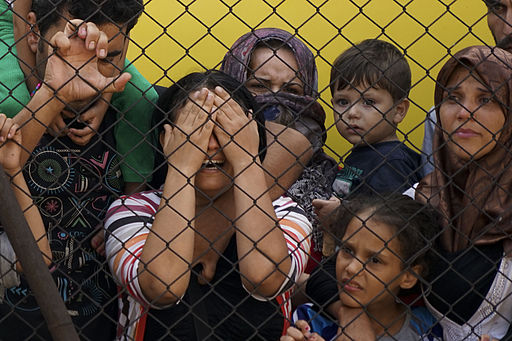
Women_and_children_among_Syrian_refugees_striking_at_the_platform_of_Budapest_Keleti_railway_station._Refugee_crisis._Budapest,_Hungary,_Central_Europe,_4_September_2015._(3)
It is low-hanging fruit to remind wealthy Republican Douglas A. Roscoe (aka "Doug Ducey"), the governor of Arizona, that one of the state's most famous families, the Bashas, came from the Laevant, specifically Lebanon.

Michel Goldwasser fled the 1848 revolutions convulsing Europe, first to London and finally to Arizona Territory. "Big Mike" changed the family name to Goldwater.

None of this would keep Gov. Roscoe from joining at least 30 other governors, almost all of them Republicans, from declaring their states would not accept Syrian refugees in the aftermath of the latest terrorist attack on Paris.

Marshall Trimble didn't teach Arizona history to high school students in Ducey's native Toledo, Ohio. So a quick primer: Anglo-Americans took what is now Arizona as spoils of the Mexican War (adding to it with the Gadsden Purchase). They took it from dozens of native tribes.

Arizona's history with refugees since then has been good, bad, and ugly.

Where Arizona fits

Where Arizona fits

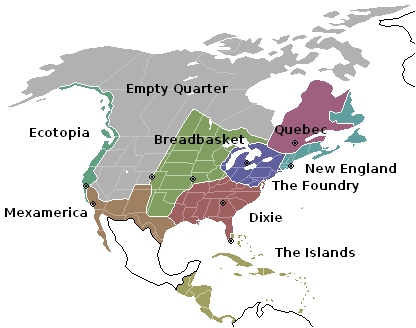
Ninenations
In 1981, Joel Garreau wrote a popular book called The Nine Nations of North America. His conceit was that state lines and even national borders were meaningless in understanding the "true regionalization" of the continent.

Arizona was split between "Meximerica" and "The Empty Quarter," with Phoenix and Tucson lying in the former. Of Meximerica, he wrote, it was "a 'booming place'…characterized by a sense of no limits."

They say that the only limit to growth is the human ability to dream. By the way, does that sound familiar? Where did our President grow up? In Los Angeles and the Southwest. Reagan’s vision of the world was formed by the way this part of the world works.

As for the Empty Quarter, "It is very dry; water is a constant preoccupation; it is very fragile…Very few people live here, and as a result it is politically powerless."

This is the last "colony" of the nine nations. The idea is that we are going to chew this up and spit it out to get us into the next century. But there is one hitch. This is also the place that has the last great stretches of wilderness and quality-one air; so, if we chew this up and spit it out, we can kiss the Rockies goodbye. And of course there is a political context to that too, because there are a lot of people who don’t want to see that wilderness despoiled.

So far, so OK. Except Arizona has little in common with Texas; Phoenix little commonality with Houston or Los Angeles. And the name Meximerica wouldn't get very far with the Kookocracy.

Now a new author wants to reorder things. Colin Woodard, according to the Washington Post, "says North America can be broken neatly into 11 separate nation-states, where dominant cultures explain our voting behaviors and attitudes toward everything from social issues to the role of government."