Whose civics?

Whose civics?

Students_examining_the_U.S._Constitution,_with_the_Declaration_of_Independence_above_them8d23118v
At first glance, one can only admire the Arizona Legislature passing, and new Gov. Doug Ducey (my first level Linked In buddy) signing into law a measure mandating that all high-school seniors take a civics class and pass a civics test.

If I remember correctly, everyone at my high school was required to take a semester of civics and another of economics. I took the new test and aced it.

Too much of our education system today is geared to producing workers, cubicle proles in the New Gilded Age, and "consumers." Anything that educates citizens about their rights and responsibilities — and capabilities — is healthy. That Arizona is said to be the first state in the union to take this step is astounding.

So perhaps I should leave it there and let the brightsiders say, "He didn't hate Arizona, for a brief shining moment! Everything's fine, with championship golf!"

Governor Ducey

Governor Ducey

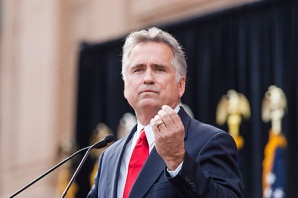
Doug_DuceyDoug Ducey was elected governor of Arizona with a 36.24 percent voter turnout, the lowest in recent history. It may seem unfair to judge him so soon. But, no. The days when a GOP office holder was independent-minded are gone, replaced by a party ruled by a nihilist ideology.

As Jonathan Rauch wrote in the New York Times, "America does not have a broken political system. It has a broken political party: the Republicans." This is what those Arizonans who vote continue to double-down on.

In his inauguration address, Ducey's explicit or implied comments were in the ALEC-Koch brothers "mainstream" of the party. Taxes must always be low or cut further. Government spending must be cut further. Get government "out of the lives of the people" (except, presumably, for the Social Security recipients and defense spending that prop up the state economy). Change regulation to support certain favored businesses ("deregulation"). And the all-important "economic freedom."

Ducey reprised the old Newt Gingrich meme of "opportunity," after their fashion:

Opportunity is not a government program planned and distributed by some expert class any more than personal freedom is a favor granted by those in public office. Opportunity is a new job or training for a better job. It’s the kind of school where every child can grow in knowledge and in character, the kind of neighborhoods where families feel protected, a state where enterprise is welcome and hard work is rewarded.

In other words, Arizona can expect more of the same, only perhaps even worse.

‘Is Arizona hopeless?’

‘Is Arizona hopeless?’

Flag_of_Arizona
This was the most frequently asked question I encountered in Phoenix recently. Admittedly, the Resistance was demoralized by the results of the election. But the query-cum-statement came from more than activists — indeed, they are more likely to be too invested in the fight to allow a crack of doubt to enter.

Those asking are natives or have lived in the state for many years or decades. They are not nostalgiacs. They are intelligent and pragmatic. Some are considering leaving, adding to the brain drain of urbanites who come to Phoenix starry eyed at a "blank slate" only to discover the many barriers to progress and depart for Portland, Denver and Vancouver, B.C.

In raising this issue, I don't want to provoke the usual denial, sunny codependency or angry defensiveness. I was surprised that so many people, unprompted, asked the question.

Is Arizona hopeless?

It certainly doesn't seem that way to the Republicans and "conservative"-leaning independents who vote. They continue to get the place they want, with the exception of such socialist outbreaks as light rail (WBIYB). Some are people with whom I went to school but remained there. They are decent, smart individuals and, against all odds of the Cold Civil War, we remain friends. Anyway, the cons have no reason to complain — but that won't stop it from manufacturing its lifeline of perpetual grievance and victimhood. They tend to be sore winners.

So the question applies to others. How many are there? It's difficult to say with precision. People keep moving to Arizona, albeit at a slower pace. A Morrison Institute poll of more than a decade ago found that a strong plurality of residents would leave the state if they could.

Who would ask such a question? Anyone to the left of today's "conservative" dogma (which would include Barry Goldwater, were he alive); liberals and progressives; people with urban values; those concerned about the destruction of the environment; those disheartened by the struggle to build and maintain civic, economic and cultural assets as befits a big city, and the ones beaten down by the struggle as Arizona has become a one-party, one-ideology state.

Is Arizona hopeless?

You know this is the wrong place to look for booster lies ("Talton hates Arizona"). And as much as I would love to write a stirring column channelling Henry V or Churchill, it is a little late for in the game for that.

So the answer partly depends partly on how one defines Arizona and how one defines hopeless.

Phoenix’s income crisis

Phoenix’s income crisis

Last week, the federal Bureau of Labor Statistics released per-capita personal income (PCPI) for metropolitan areas in 2013. For Phoenix-Mesa-Scottsdale, income grew 0.7 percent to $38.745.

This placed the sixth-most-populous city and 12th largest metro area at 285th in growth against other American metropolitan areas. It was not a good year for growth. The metro average was 2 percent. Booming Seattle ranked 223rd.

The truly troubling number is the actual income. The national average was $44,765.

Compare it to other similarly large metropolitan statistical areas: Boston (10th largest), $61,754; San Francisco-Oakland-Hayward (11),  $69,127; Detroit-Warren-Dearborn (14), $42,887; Seattle-Tacoma-Bellevue (15), $55,190; Minneapolis-St. Paul-Bloomington (16), $51,183.

Or compare metro Phoenix with smaller metros against which it competes for talent and capital: Austin, $44,760; Charlotte, $41,645; Denver, $51,946 and Portland, $46,461.

Metro Phoenix comes in lower than any other large metro with a big city in it. What's going on?

Obama and immigration

Some initial impressions on President Obama's immigration plan:

1. We have become so cynical that the talking heads, especially, can't imagine a leader doing something mostly for the decency of it. Yet this is likely Mr. Obama's prime motivation. Whites make up 75 percent of the electorate and anti-"amnesty" Anglos vote while too many potentially Democratic Hispanics don't. So it's a political loser.

2. Despite similar precedents set by Reagan and George H.W. Bush, the Republicans will try to impeach Obama or otherwise act out. They can't stop themselves.

I moderated a panel of eminent China experts last night. One of the consistent themes is how our dysfunctional government sends the message to Beijing to not take us seriously, or to make a dangerous miscalculation.

3. Mr. Obama's limited overhaul doesn't address the core problems: Our appetite for cheap labor; the way trade agreements disrupted traditional economies and drew workers el norte; bad governance in Mexico and much of central America, and the fact that too many American employers and even average Americans are satisfied with the status quo.

Six takes on Arizona’s election

Initial impressions on the Tuesday disaster:

1. Arizona is redder than ever. For decades seers have been predicting that newcomers would make politics here less conservative. Instead, the opposite has happened. Arizona has grown less competitive and more reactionary. Every major statewide office has been captured by Republicans for the second straight time (see official results here).

2. Ideology trumps logic. How does a nullity like Doug Ducey not only beat his Democratic challenger, a man with deep policy experience and good ideas, but do so by a commanding margin (nearly 54 percent to 43 percent)? The only answer I can come up with is that Ducey did the Aflac duck conservative quack and that was enough. It's not that voters are happy with conditions in Arizona. And the problems have been caused by decades of right-wing political and policy dominance. Ergo, vote for more of the same!

3. The great independent factor wasn't. Remember when the media were trumpeting the tidbit that independent voters outnumbered those of either party? But as polling research at Pew and elsewhere has shown, "independents" usually lean one direction or the other, whatever their twee affectation to independence of thought and judgment. In Arizona, most lean to the right.

4. The Hispanic wave (still) hasn't arrived. "Mexicans don't vote." Therefore, combined with gerrymandering and voter suppression, this phenomenon means Democrats will be waiting a very long time for Latino Salvation. An angry, old, white minority can rule in perpetuity. The apathy is especially startling considering how Anglo Arizona has been viciously racist against Hispanics, in a way not seen in much of Texas.

Phoenix in the seventies

Phoenix in the seventies

Central_1972Central Avenue and Van Buren in 1972. Note the full block of businesses heading north to the Westward Ho. Central was still a two-way street.

No series of events better epitomized the 1970s and the turning point they marked in Phoenix than the fight over freeways, specifically the "inner loop" of the Papago Freeway.

Most Phoenicians had a vague idea that freeways were a possibility since the Wilber Smith & Associates plan was adopted in 1960. Interstate 10 had been completed to Tucson and was abuilding from the west. By mid-decade it had reached Tonopah, requiring a long drive over largely country roads to reach. Real-estate values plummeted along the path of the inner loop. But by 1970, Phoenix's freeway "system" consisted of only the Black Canyon (Interstate 17) which curved at Durango to become the Maricopa (I-10).

HelicoilsAll this changed as the new decade opened and the plan's stark reality became clear. Specifically, the Papago would vault into the air, reaching 100 feet as it crossed Central Avenue. Traffic would enter and exit via massive "helicoils" at Third Avenue and Third Street. The freeway was promoted as being Phoenix's defining piece of architecture.

It didn't take Eugene Pulliam and the anti-freeway advocacy of the Arizona Republic and Phoenix Gazette to make most Phoenicians horrified. In 1973, voters vehemently rejected the inner loop. They only had to look 372 miles west to see the destruction wrought by freeways. They didn't want Phoenix to "become another Los Angeles."

Lies, damned lies and water

Lies, damned lies and water

Arizona_Spillway_-_Hoover_Dam,_Nv
Whiskey's for drinking and water's for fighting over
— old adage.

So Doug Ducey and Fred DuVal have laid out their plans for addressing a water shortage in Arizona. DuVal, naturally, comes off as the sanest, including asking the state Department of Water Resources "to develop a detailed analysis of the Groundwater Management Act and provide specific recommendations for improving the law."

That's good. I don't trust ADWR or have confidence that the law is being adequately enforced or monitored.

DuVal is less convincing when he told the Arizona Republic that the state needs to "go big" on new water projects, including desalination. As regular readers know, the feds aren't going to invest in more waterworks. California and the Upper Basin states would also resist them with all their might (see here and here).

Ducey comes off full kook, including his insinuation that trees are to blame for drought. The last thing Phoenix needs to do is further degrade its historic oasis. Central Phoenix, especially, needs more trees to offset the heat island and climate change.

But nobody dared wake the elephant. You know, the one in the room

The Arizona experiment

The Arizona experiment

Much has been made by "left-leaning" commentators, notably Thomas Frank, about the disaster created in Kansas by Gov. Sam Brownback's enactment of conservative policies. And yet check out this chart:

2fredgraph

And this:

3fredgraph

Not to diminish "What's the Matter With Kansas," but Arizona is in worse shape. It arguably offers the better example of what happens when orthodox right-wing policies are enacted in a state without the oil and massive federal investments enjoyed by Texas. That Arizona is a growing, highly urbanized state brings into even starker relief the complete bankruptcy of the Kookocracy's "conservative ideas."

And they own this mess. The interregnum of St. Janet saw a constitutionally weak governor playing defense and never tackling the sacred cows of land use, revenue or water. Arizona's ongoing woes are the work of the regressive right that has taken over the Republican Party.

And yet, polls show at best a dead heat between Democratic gubernatorial candidate Fred DuVal — in every way the superior contender — and Republican Doug Ducey. And no chance for Democrats to gain control of the truly powerful branch of government, the state Legislature.

While I was away

John Sperling passed on. I am mindful of Horace's de mortuis nil nisi bonum, but Sperling was a public figure of consequence, deserving an assessment. In keeping with the life he led, Sperling died in the Bay Area, not the city whose name he took for his empire of for-profit education.

The New York Times wrote, "A survivor of childhood illness, learning disability, poverty and physical abuse, he earned a doctorate from the University of Cambridge; a liberal former union organizer, he spent years battling government regulation; a longtime professor who did not enter business until his 50s, he became a spectacularly successful capitalist."

The University of Phoenix made him fabulously wealthy. His net worth in 2002 was $1.1 billion and he spent 20 years on the Forbes 400 list of richest Americans. With the troubles of parent company Apollo and its stock drop, he was below a billion in 2013.

He reveled in being quirky, combative and rebellious, especially against the education establishment and the government. And yet the GI Bill — authored by Arizona Sen. Ernest McFarland — allowed Sperling to get his bachelor's degree from Reed College in Portland, Ore. Federal student loans turned what would have once been considered a "business college" into a mighty profit engine.

Among the individuals who wrecked the commons, Sperling is right up there. Privatizing profits, socializing losses, the cost and quality of an education at the University of Phoenix and other for-profit schools deeply questionable.

Borderline personality disorder

Here's the way the media see things. "House Republican Flailing Over Border Bill Drags On," from Daily Kos. "House GOP Abandons Border Crisis Bill Amid Conservative Opposition," from Talking Points Memo. The New York Times writes:

Many Republicans worried that leaving for the break without passing any border legislation would be damaging to them politically in the midterm elections, and vowed to stay as long as was necessary to reach a compromise within their own ranks.

The House may pass some kind of bill, but the meme, among some smart journalists, rests on some questionable assumptions.

One, that Republicans want to make a constructive response to the "border crisis" of the moment. Two, that the GOP is terrified that it must address this and other immigration issues or lose the future to changing demographics. Thus, failure to "do something" is a Republican defeat. Three, that there is a split within the Republican Party that has any real meaning.

I addressed the third point in a previous post. Today, I want to explore the first two assumptions.

The 1:57 to Florence

The 1:57 to Florence

Joseph Wood III was declared fully sedated ay 1:57 p.m. in the death chamber in Florence. But because of incompetence or a bad execution drug cocktail, he wasn't pronounced dead until 3:49 p.m.

This event has brought more of the kind of national news coverage to Arizona that can only enhance its reputation as a cruel and hapless place to the talented, compassionate and those who make decisions about where to deploy capital. A sampling is here. Even John McCain, who would know, called it "torture."

On the other hand, probably a majority of Arizonans would share the comment of someone from Phoenix on Facebook: "I saw nothing wrong with it…he did NOT suffer…just slept longer." When challenged, he added, "I hope the bastard rots in hell!!!" According to the Pew Research Center, 55 percent of Americans favored the death penalty in 2013, down from a high of 78 percent in the 1980s.

Wood was convicted in 1991 for the murder of his ex-girlfriend Debra Dietz and her father, Eugene. He also pointed the gun at police, who shot him.

The Southern poverty bloc

The Southern poverty bloc

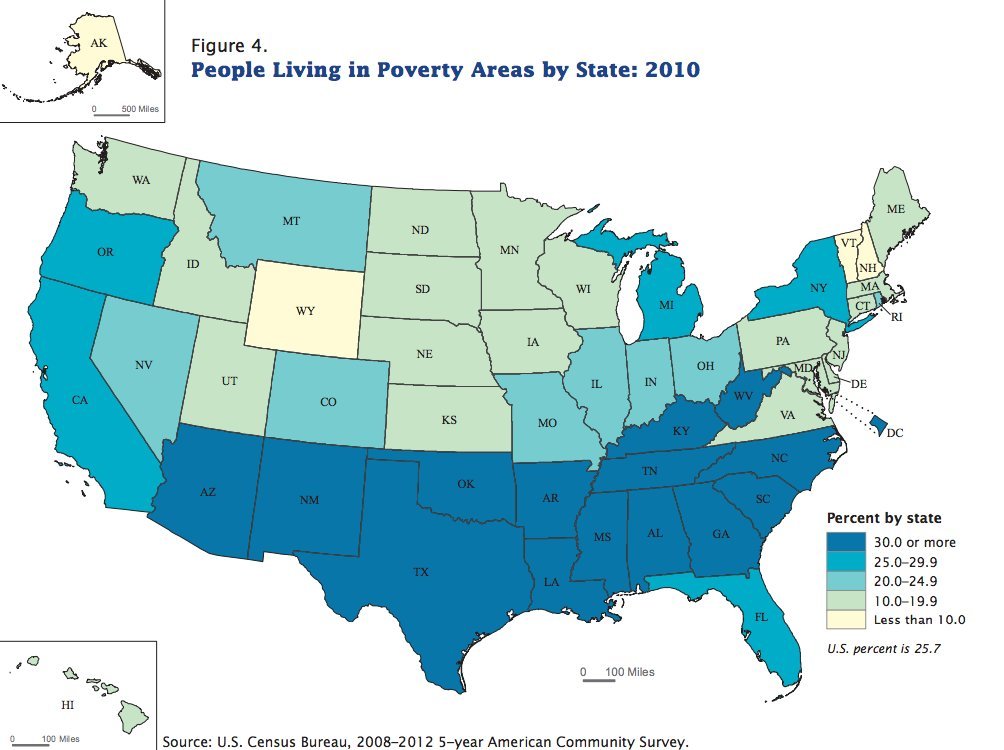
Original

I'm not sure if the cottage industry of explaining away Arizona's reality is on vacation in cooler climes or will scramble to attack this telling map that went with a story headlined: "The South is Essentially a Solid, Grim Bloc of Poverty."

Arizona Territory sent a delegate to the Confederate Congress throughout the War Between the States, so the apple doesn't fall very far from the tree.

Seriously, the data come from a new report by the Census Bureau of people living in "concentrated poverty areas." It digs down to the Census tract level, finding that more than 2 million Arizonans, or 33 percent, lived in tracts with highly concentrated poverty. That compares with 1.2 million, or 24 percent, in 2000. The comparable national averages were 25.7 percent and 18.1 percent respectively.

These areas have "higher crime rates, poor housing conditions, and fewer job opportunities." They breed a feedback loop of poverty.

It's easy to blame much or all of this on the Great Recession. Arizona's dependence on the housing sector left it in a virtual depression after the collapse. There's some truth to this, but the problems go much deeper.

The troll

The troll

HuppenthalIf you've been away on Mars thanks to the miracles of the private-sector space program that has replaced NASA, you missed John Huppenthal's star turn on the national stage. The Arizona pol was caught making anonymous posts on Internet sites under the names "Thucydides" and "Falcon9."

Among other things, he compared Planned Parenthood founder Margaret Sanger to the Nazis, called those who receive public assistance "lazy pigs," and called for stomping out Spanish-language television and newspapers. Oh, and FDR was responsible for the rise of Hitler (even though both were elected at the same time).

As you can see on Arizona's Continuing Crisis this played far beyond "the Valley," providing more of the kind of publicity that is so helpful to Arizona's reputation.

First, Huppenthal gave the standard non-apology, "I sincerely regret if my comments have offended anyone." On Thursday, the Internet pressure had grown so great that he was forced to call a tearful press conference at which he "renounced and repudiated" the posts. But he declined to resign, as some demanded, including Lisa Graham Keegan, who is now to the left of today's GOP.

Huppenthal should resign, but not over being an Internet troll.