Sky Harbor

Sky Harbor

SkyHarbor_oldtower

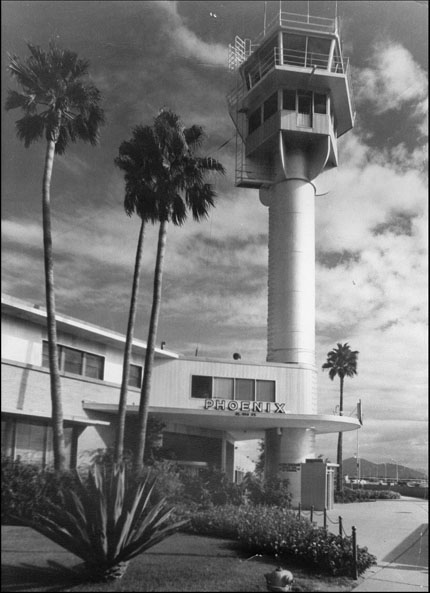
I was always a child of the railroads, so Union Station held much more magnetism for me than the airport. Still, in the 1960s, Sky Harbor was a sweet little airport. It had a romantic name. The old blond-brick West Terminal and tiny control tower hearkened back to aviation's infancy — it had only been six decades since the Wright Brothers' first powered flight.

You boarded by stairs — jetways were several years off. The new East Terminal was graced by a dramatic mural of Phoenix's founding myth and flight science above the airy modern waiting room. It also had a second-story observation deck, where one could watch the airplanes, complete with telescopes. Our Cub Scout den was given a tour of the control tower. All this was before hijackings and the rise of the present Security State.

It was a beautiful airport with a certain '50s charm. One reached it from 24th Street along grassy parkways with trees. And back then, the route into downtown was still lined with pleasant motels and "auto courts," all human scale.

Sky Harbor had two runways, which were plenty back then. On the south edge was the Air National Guard midair refueling tanker wing (Richard Nixon gave a campaign speech in the big hangar during the 1972 campaign).

On the north side, beyond the general aviation hangars, were the Southern Pacific tracks, which carried three passenger trains a day in each direction. The best airplane watching was on 40th Street, which was a two-lane affair that dipped into the riverbed and marked the east boundary of the airport. The 727s and 707s came in right overhead.

Airlines were highly regulated. Hubs were far in the future. So regional players such as Bonanza, Hughes AirWest and Western were as important as United, American and Continental. I made my first airplane flight from LA to Phoenix when I was ten (we had gone there on the Sunset Limited, by far the more enchanting journey for me). Flying was special then. People dressed up. Airlines treated you very well. There were no cattle calls or lines from LockUp.

What they want

The trajectory of the Phoenix mayor's race is perhaps already locked in. But a few other considerations should be added to my previous two posts on the issue (here and here). Some signs are telling. For example, in a television interview, Michael Bidwill, president of the Arizona Cardinals, was wearing a prominent Wes Gullett button. Gullett's old boss, John McCain, attended a reception for the candidate earlier this summer. And Peggy Neely was endorsed by Gov. Jan Brewer.

This is all you need to know about these two candidates. Bidwill refused to allow the taxpayer-funded stadium to be built in downtown Phoenix, choosing Glendale instead because of the copious opportunities for no-strings-attached adjacent development that could further benefit his family. Why does he care about the city of Phoenix, especially the central city upon which the entire city will rise or fall? As for Brewer, it's highly inappropriate for a governor to take sides in a municipal election. And Brewer is a creature of the suburbs, Phoenix's competitors and, in many cases, saboteurs. What's Neely to her or she to Neely?

Let us count the hidden agendas.

Men don’t read

Come to one of my book signings and 200 people might be in the crowd (or five people). Except for my de-facto bodyguard, maybe only a handful will be men. On a good night. Men don't read anymore. This is one of the most frightening of the many express-elevator-to-the-dark-ages changes that have happened to America in my lifetime. Of course there are outliers, on this blog for example, or the new head librarian in Seattle, a man who said he fell in love with libraries as a fourth grader. Men read technical manuals and comic books. But the well-read American male of the past is mostly gone. Although all Americans are reading less — one survey found that the typical citizen reads only four books a year and one in four reads none at all — men are the biggest drop outs. They account for only 20 percent of the fiction market.

I can't imagine living in this mental poverty. When I turned nine years old, one of the first things I did was get a card at the Phoenix Public Library (the earliest age one could qualify). Before that, the one pure joy of Kenilworth School was the well-stocked library. I grew up around readers and books. My great aunt had an especially impressive library, and it made up for otherwise dull visits to her acreage on Seventh Avenue. My childhood reading wasn't highbrow: I was especially entranced by C.B. Colby's military books (Our Space Age Navy, etc.). But I read. These included comic books, too, but by age ten or so, comics were boring (not so for people today). Books have taken me places I would otherwise never have visited, from Plato's Athens and hell with Dante, to the Battle of Berlin. Books changed my mind and made it changeable. I never intended to be a journalist or author. I just assumed that experience was one a well-rounded person should have. Books used to be sexy. Really desirable women expected well-read men, and reading to one's lover is a sensual delight.

No longer for most. Aside from the polls, anecdotal evidence comes my way constantly: My son doesn't read books…My husband never reads…I don't read books…Never did like books. Is it any wonder that this has accompanied our society's collapse into widespread anti-intellectualism and aggressive ignorance (because to understand that, one would have read, say, Richard Hofstadter).

The mayor of hell

Whomever wins the Phoenix mayoral election will get a paycheck, face time on the media, a police detail to drive him or her around and not much else. Facts are stubborn things: Phoenix is the most economically wounded among America's largest cities. The "business model" that built Phoenix for decades is irrevocably broken. When even the developer-economist Elliott Pollack, favorite of the booster rubber chicken circuit, is saying the metro-wide housing market won't come back until at least 2015, things are bad.

Reprising a little history won't hurt. The political leadership of modern Phoenix was created by the Charter Government Movement, which claimed, and largely delivered, a non-partisan, clean, business-backed, professionally run City Hall. With a relatively diverse economy, the age of inexpensive energy, a majority middle class city and major business titans setting the table, little was asked of elected leaders except to continue this status quo. It somewhat fell apart with districting and Terry Goddard's velvet revolution in the 1980s, but the spirit of Charter lived on well into the 21st century.

This is not to say mayors were irrelevant as just one vote on council in a council-manager form of government. Milt Graham, John Driggs, Margaret Hance, Goddard and Skip Rimsza were all leaders of consequence. Sometimes this was for ill: the popular Graham's antipathy to transit set Phoenix back by decades; Hance did many things to hurt the central core. Goddard, by contrast, was an inspiring and transformational mayor. But through all this two things were constant: The economy levitated on "growth" and the old consensus prevailed.

‘Entitlements’

The first modern social security program was begun by that notorious bleeding heart Otto von Bismarck in the 1880s. With it, the Iron Chancellor successfully undercut the socialists and communists, kept peace with the working class and helping Germany become a major power until he was dismissed by Kaiser Bill and the fuse was lit on the bloody 20th century. American Social Security began in the New Deal after a long fight with reactionaries and they've never let go of their dream of destroying it. Social Security is one of those "entitlements" we keep hearing about from our leaders in politics and business, as well as in the media, that must be "reformed."

I don't know about you, but I've worked full time since I was seventeen-and-a-half, paying for the Greatest Generation's Social Security. It is hardly an "entitlement," a word loaded with welfare for the undeserving. It is a social insurance program where younger generations pay for the retirement of older generations, and it's worked fine for 70 years. But no small amount of oldsters now want to break this foundation of the social compact. They got theirs. Now the dastardly baby boomers will "break the system." Well, no. Social Security is fine and needs, at best, modest modifications. Unfortunately, even President Hoover, the supposed leader of the supposed Democratic Party, accepts the premise that broad "entitlement reform" is a sine qua non of fixing America.

The new neighborhood

Download-3
It's been four years this month since we sold our 1914 house in Willo and moved to Seattle. It was not a voluntary move, but one necessitated by the Republic ending my column after years of pressure to silence me, and then my inability to find work in Phoenix. We had hoped to live in this house, located a block from where I grew up, for the rest of our lives. Things didn't work out. The new neighborhood is very different. Here's the front-porch view from the condo downtown (in Belltown) looking east to Capitol Hill:

Download
A pocket park is right below the balcony.

Tell me how this ends?

So went the famous 2003 quote from Gen. David Petraeus concerning the Iraq war. More about him later. But as the Great Disruption once again sends us further down the mountainside, it's an apt question for the American experiment in self-government, the economy, our society.

One way it doesn't end is with a great backlash against the extremism that now controls the Republican Party. Wisconsin gave its best shot with fierce protests and recall elections but failed. Reactionary Republicans still hold power in the home of Robert La Follette. When this week's recall contests were over, it was clear that corporate money will have its way. Not only that, but majorities in suburbia, which is most of the country, will vote GOP no matter whether this is in their economic or civic interests. Whatever the polls say about Republican unpopularity, not much will change in the next election. For that to happen, America would need a viable opposition party.

It doesn't end with President Hoover "finding his voice." The listless recitation of pleas for balanced approaches and bipartisanship we heard on Monday, as the stock market was panicking, is his voice. He is weak. He is passive. He is a creature of the Robert Rubin/bankster wing of the Democratic Party, which shares the dream of "reforming entitlements." He will not fight for the middle class, for jobs, for fair play. I think of the late Jeff MacNelly's brutally on-target political cartoons of Jimmy Carter, who became smaller and smaller in the presidential chair.

The last titan

It was probably fitting that John Teets died amid the worst economic depression modern Phoenix has ever experienced. The retired head of Greyhound/Dial was the last of a breed that every competitive and livable city must have: A dynamic chief executive of a major local headquarters, passionately committed to the city, able to knock heads and write checks. I'll let Soleri take it from here:

As CEO of Dial, he was one of the last corporate titans who figured prominently in local affairs. He was a headknocker and socialite who helped make Phoenix more than just a branch-office backwater. I was living near Central & Palm Lane when the Dial building was built in 1990. It was part of Teets' stewardship ethic to make a big corporate statement close to but not in downtown. The original plan was to construct two towers, with one perpendicular to the other. As with so many real-estate dreams, this one was only partly realized. The result is a free-standing mountain of a building completely out of scale to its surroundings.

Teets spent lavishly on it but the tapestries he hung in the lobby, or the exquisite garden outside couldn't quite make up for the fact that it was another ostentatious project that seemed so much like the city it was built in: Isolated and strange.

Depression 2.0

As I write, the Dow is down 350 points and the stock market has given up all its gains for the year. Never fear: The rich have already moved into safe havens — and those with some exposure are a little less rich. Everyone seems to agree that "the game is up," as one financial analyst told me. But which game? That America and Europe are "broke" and must dismantle their "lavish public sectors and entitlements"? Or that crony capitalism, imperial overstretch, failure to invest in education and job-creating infrastructure by the richest nation in history is the losing game? The former have won the argument with barely any resistance from President Hoover and the Democrats. The results will be a catastrophe. The Tea Partiers are cleverly, or stupidly, claiming this austerity doesn't go far enough. That way, when it fails, they can claim victory and demand more ideological purity, rather like the apologists for Soviet communism.

We may not be looking at another recession. We may be in a Depression. For many, if not most, Americans, the recovery was chimerical. Their troubles began in the '00s, with stagnant incomes and the worst record of job creation since the real President Hoover. When the housing bubble crashed and the stock market followed, the were financially ruined. Now 24 million are unemployed or under-employed. And that was all before the federal government embarked on an austerity plan that might please Robert Rubin but otherwise guarantees more recession.

So how will Depression 2.0 be different from the Great Depression?

Did Phoenix light rail fail?

My first experience with light rail came living in San Diego in the early 1980s. One segment linked downtown with the border crossing at San Ysidro. It was popular and uncontroversial. "I didn't think one of these could run without graffiti all over it," I heard a visitor from then dysfunctional New York exclaim of the new, bright red trainsets. As a reporter, I wrote about the Trolley, especially the ambitious expansion plans. San Diego is the most Republican of California's big cities, but the light-rail system was begun under Pete Wilson, a mediocre U.S. senator, bad California governor, but stellar San Diego mayor (he was also, along with developer Ernest Hahn, the father of the spectacularly revived downtown). Today, the San Diego Trolley extends 53 miles on three routes.

Then I lived in Denver, where the city started a segment downtown. It too, was popular and widely embraced. Now it comprises 39 miles with another 12 due in two years. I was in Charlotte for the planning of the now-operating Lynx light-rail, a relatively modest 10 miles, but more is in the works. It was the first modern light-rail system in the Old South and, again, widely supported, especially by the business leadership and developers who built hundreds of millions of dollars of projects near the line. Similar success happened in other cities, especially Dallas (!), with its 72-mile system and clammoring of suburbs to get the next line.

The story didn't play out that way in Phoenix. Yes, we built it, you bastards. But it's also time to take stock.

Go down hard

As the planet warms faster than the most fearful scientists predicted, as peak oil stares us grimly in the face, as the full faith and credit of the United States government is put at risk in order to bring down that (black) man in the White House, as the middle class craters and all the good in the America in which I grew up is looted, profaned and destroyed, McDonald's will make Happy Meals more healthy. The right moves in disciplined lock-step, seeking and winning a few large victories. The "left," such as it is, remains distracted by innumerable enthusiasms. So the health Nazis win one and gay people can marry in New York. Smokers, but not extremists, have been made second-class citizens. What does this matter compared with the real game that is taking place horrifically before our cow-like stares?

As expected, President Hoover and the corrupt/enervated Democratic Party gave away any tax increases in the debt-ceiling stand-off. The results of this "balanced approach" will be years, if not decades, of economic and social destruction. The Republicans have a partner in their cherished ambition to dismantle Social Security, the Great Society and the New Deal in the party of Franklin Delano Roosevelt. As with the 24 million un- or underemployed Americans in a nation of 301 million, the damage will begin at the margins and not be fully felt for years.

The dysfunction in Washington may be felt much sooner, if the debt ceiling is not raised. Count on the fearsome deficit and debt to go away the moment that President Romney or Bachmann is sworn in. And depend on the right to have ready-made explanations for the chaos and destruction that are now guaranteed whether we get a deal or not. Their superstition and dogma will call for even more government cuts. Unions and public workers are the problem. Business isn't hiring because of too many regulations. Climate change is a hoax. All this will be dutifully reported by the media as if it is a perfectly legitimate response.

South Phoenix

South Phoenix

JGardens
South Phoenix encompasses so much history, so many cultures and distinct districts, it deserves more than one post. Every square mile is special. Still, a start. It's not a separate city such as South Tucson, so I'll go with the style "south Phoenix." When I hear the words "urban village," I reach for my Colt Python plus Speedloaders, so forget about the city's developer-speak term "South Mountain Village."

Then there's the matter of geography. For many Anglo Phoenicians, when the city still had some cohesion, "south Phoenix" began at the Southern Pacific tracks. This was, and latently remains, a place where "the other side of the tracks" is a powerful totem (it helped do in the unfortunately named Bentley Projects, the galleries, bookstore and cafe). A subset of "south Phoenix" emerged in the 1960s, to define everything below the somber wall of the Maricopa Freeway. And true south Phoenix is south of the Salt River. All must be dealt with.*

Phoenix's relatively small Mexican-American and African-American populations were historically located south of the tracks. Well into the 1970s, the commonplace offensive term for the latter was used by whites. Schools were segregated and inferior. Poverty and injustice were severe. Corruption by city officials legendary, at least through the 1940s. Most property ownership was controlled by deed covenants that largely excluded minorities (I told you this was a Southern town). Ownership was more possible south of the river, and minorities gathered there. (Most of the city's legendary and now largely lost barrios were north of the Salt, but a few, such as the River Bottom, were in south Phoenix proper). Minorities were also heavily employed as agricultural labor. This was farm country, especially after the completion of the Highline and Western canals by 1913.

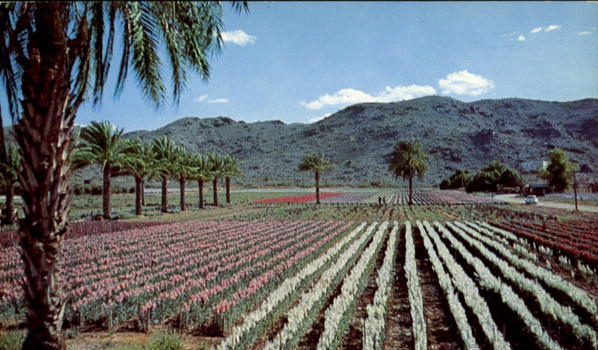
The most successful farmers were the Japanese, who arrived early in the 20th century and were able to purchase farms in the 1930s, after Arizona's anti-"Yellow Peril" law was found unconstitutional. Arizonans my age remember them for the stunning Japanese Flower Gardens that ran for miles along Baseline Road. But the Japanese were among the most innovative growers, raising a variety of crops. This also raised much jealousy among Anglo farmers, who were happy to see them, including American citizens, interned during World War II. After this shameful episode, the Japanese, including many of their sons who had fought in the U.S. Army, returned to south Phoenix and farmed again.

Eating our future

We had to struggle with the old enemies of peace—business and financial monopoly, speculation, reckless banking, class antagonism, sectionalism, war profiteering. They had begun to consider the government of the United States as a mere appendage to their own affairs. We know now that government by organized money is just as dangerous as government by organized mob. Never before in all our history have these forces been so united against one candidate as they stand today. They are unanimous in their hate for me—and I welcome their hatred. Franklin Roosevelt

It's true I give a good speech. What can I do? — Barack Obama

Words without actions are the assassins of idealism.Herbert Hoover

We do not need clairvoyance to predict the general outcome from the protracted and ugly debt-ceiling negotiations between President Hoover and the House Republicans. This is because, contrary to the the mainstream media narrative, Washington is not composed of equal parts of hardcore conservatives, hardcore liberals and centrists, with the only trick being for them to get along and "stop acting like children."

In reality, one of the two major parties has become totally captured by extremist ideology that would make William F. Buckley turnabout his sailboat and head for France. The other party, the Democrats, are leaderless, captured by corporate interests and lacking any major liberal lions. Liberalism is essentially dead in America as far as governing is concerned, a development with far-reaching and unexamined consequences. Over all this, and interlocked with the right-wing machine, is unprecedented corporate control of the government, from the statehouses to Washington, D.C. More than $50 million has been spent this year alone in lobbying Congress to further weaken regulation of Wall Street and the big banks.

Finally, President Hoover is not willing to fight, much less for liberalism or for the American middle class. He seems desperate to grasp at virtually every "deal" that floats daily before his finely chiseled face. The latest, according to Talking Points Memo, is that good ole "grand bargain" that would involve massive spending cuts "set in stone," with maybe "revenues some time in the future." Whatever the final settlement, this is the trajectory. It's time to consider how this will play out.

The recovery con

When you wonder why this blog is such a downer to some readers, consider what I must read. For example, The Phoenix Business Journal last week published a story headlined, "Phoenix Cracks Forbes' Top 10 Potential Boom Cities." I am suspicious of these kind of lists, which can be shallow and misleading, although they are wildly popular. And Forbes is not exactly without an agenda. Still, I dutifully followed the link. Imagine my non-surprise when it turned out to be a post by Joel Kotkin, the four-square apologist for Sun Belt suburbia. He claimed to have crunched data to determine which "cities are best positioned to grow and prosper in the coming decade." Austin and Raleigh led the list. He goes on:

Our other two top ten, No. 9 Phoenix, Ariz., and No. 10 Orlando, Fla., have not done well in the recession, but both still have more jobs now than in 2000. Their demographics remain surprisingly robust. Despite some anti-immigrant agitation by local politicians, immigrants still seem to be flocking to both of these states. Known better as retirement havens, their ranks of children and families have surged over the past decade. Warm weather, pro-business environments and, most critically, a large supply of affordable housing should allow these regions to grow, if not in the overheated fashion of the past, at rates both steadier and more sustainable.

Thus enlightened, I set out on the due diligence and critical thinking that should be the basics of good journalism, but are seen as "negative" in booster culture.