William Howard Taft Obama

I have reached the point where I say enough. Would Ronald Reagan be sitting here? I've reached my limit. This may bring my presidency down, but I will not yield on this.

So said the president in Tuesday's "stormy" debt-ceiling meeting with Republican leaders, according to news reports. No, Ronald Reagan wouldn't be sitting there. He would have already worked out a deal with his fellow Irishman, Democratic Speaker Tip O'Neill. The debt ceiling was raised repeatedly and uneventfully during the Gipper's deficit binge. Will Mr. Obama yield? Of course. He's already surrendered to the fraudulent assumptions of the right-wing radicals: That government "must tighten its belt" during the worst economy since the Depression, that spending and the dreaded deficit/debt are our biggest problem, even that Medicare and Social Security must be on the chopping block.

Some of you are offended when I refer to him as President Hoover, the self-made man who started as a progressive but became trapped by his gratitude of reaching the elite and his own mental limitations at a time of tectonic change. Perhaps you're right. Other examples come to mind: Jimmy Carter without the Southern Baptist sanctimony. And William Howard Taft.

All stars

Even the most skeptical auditor of Phoenix's challenges and follies must admit some pride in Major League Baseball's All-Star Game being held there. And in downtown Phoenix, not some "Valley," not in exurban "Glendale, Ariz." Considering how city leaders allowed the central city to circle the drain for decades, visitors will see some impressive efforts at revitalization: CityScape, the Phoenix Convention Center, Sheraton, biosciences campus, ASU downtown and light rail (we built it, you bastards). Oh, for big-city boutique hotels at the Westward Ho and Professional Building. The baseball stadium is ugly, a lost architectural opportunity, but at least it's downtown, an eventuality I highly doubt if it were being built today under present ownership. They can hop a train to Midtown to take in the spectacular Modern Mexican Painting exhibition at the Phoenix Art Museum, a pleasant contrast to the general, and generally deserved, reputation of intolerance and racism for the state at large. If you want to boycott, do so against the East Valley and Scottsdale (but not the Poisoned Pen bookstore), not tolerant central Phoenix.

Some quick advice to out-of-towners: It's a dry heat, but so is hell. So is a thermonuclear explosion. Stay hydrated (I freeze bottles of water to carry with me; they melt quickly but you're not left drinking hot water). Avoid much exposure to the sun. Wear light-colored clothes, especially white, and cover as much skin as possible. Keep some popsicles in the freezer at the hotel; have one to help cool down when you come in from outside. Don't do something stupid like climb Camelback Mountain or go "exploring" in the desert. God created air-conditioning for a reason — use it. A dark, cool Mexican restaurant is an especially satisfying hangout in the summer. If the media say the high will be 105, that's in the shade at Sky Harbor. The surface temp on the street is around 140. I hope to hell somebody will give them such advice, so there's not a great All-Star die-off. Too bad City Hall encouraged all that concrete, all that gravel and no shade trees.

Still, the big game is, at best, a temporary respite from the troubles of city and state.

Peak Crazy

If you missed the news, the new San Francisco-Oakland Bay Bridge is being built in China as modules to be assembled in California. Fourteen million Americans are officially unemployed and the U-6 (real) rate of unemployment in the Golden State is 22 percent. The project is, according to the New York Times, "part of China’s continual move up the global economic value chain — from cheap toys to Apple iPads to commercial jetliners — as it aims to become the world’s civil engineer." The original Bay Bridge was built during the Great Depression by Americans, employing thousands and, along with other infrastructure investments of the era, stimulating numerous American industries. We used to do these things and do them well. But no more. We buy plastic tubs from China at Wal-Mart to fill with other stuff we buy from China at Wal-Mart while working, if we're lucky, at stagnant- or low-wage jobs. We're crazy.

The last space shuttle mission is scheduled to begin Friday. After that, we cede space low-earth orbit to the Russians, who I guess won the space race after all, and more important exploration to China and India. In my lifetime, we put men on the moon, not because it was easy but because it was hard. NASA has been neglected since the Nixon administration, with the inadequate shuttles our only manned program. Now, nothing. We're told the private sector will take over. And it will do this…how? Why? Corporate America is sitting on its profits, not hiring Americans, not investing in America. I don't doubt some or another space boondoggle using federal corporate welfare, but Boeing is not going to take us to Mars. Where's the profit margin? We once did great things. Now we're crazy.

The Republicans are playing Russian roulette with a fully loaded gun on the debt ceiling. President Hoover is busy, as usual, negotiating against himself, begging for a few hundred billion in tax hikes while conceding trillions in budget cuts. These will only slow the economy at a time when the federal government should be aggressively investing in infrastructure (and not "roads and bridges"). Last I checked, Mr. Hoover has put Social Security on the table. Who needs John Boehner when the nominally Democratic president will give the social compact the coup de grace by himself. The nation sits cow-like as this transpires. The richest nation in history is "broke," we're told. Taxes can't be raised. It would hurt those precious "job creators," even though the Bush/Obama tax cuts have been an abysmal, demonstrable failure. Average Americans vote to protect the interests of the oligarchs. How else to explain it but…crazy.

Cold War memories

Cold War memories

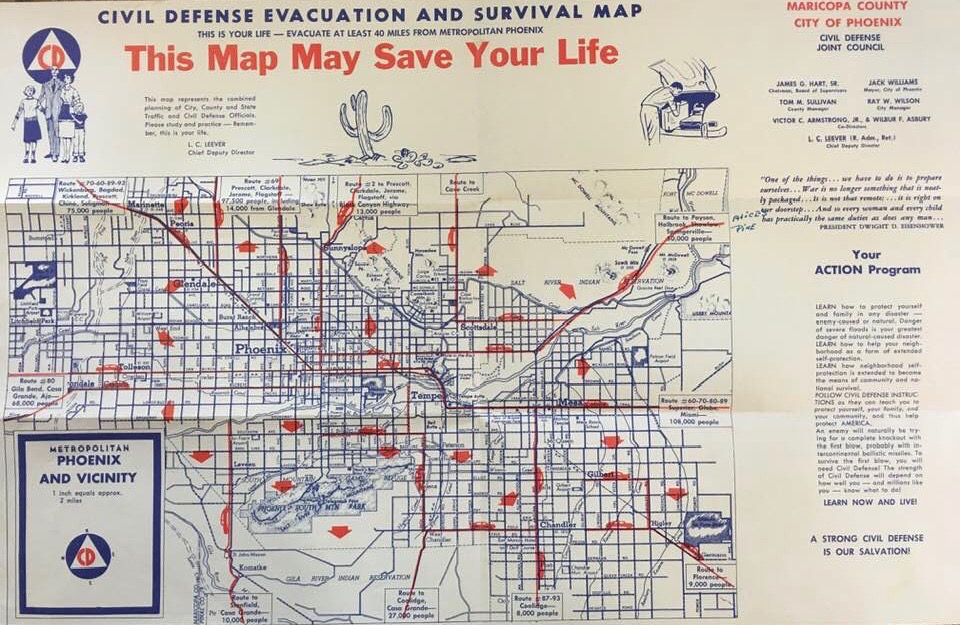
Civil Defense map (1)

In Arizona, Tucson shouldered the most dangerous part of the nuclear standoff between the United States and the Soviet Union. Some seventeen Titan II intercontinental ballistic missiles ringed the Old Pueblo from 1963 to 1982 in blast-hardened silos (one still exists as a museum near Sahuarita).

The silos wouldn't have been enough to protect the ICBMs from the many incoming nuclear warheads targeted by the USSR, especially as the Soviets gained parity with the United States in missiles and warheads. So facing a launch warning, a president would have had minutes to get the Titan IIs, which carried the largest U.S. warheads, airborne. Tucson would have been engulfed in a firestorm of hydrogen bombs. The motto of the Strategic Air Command, on display at the gates of bases such as Davis-Monthan, was "Peace is Our Profession."

Still, Phoenix was an important secondary target during much of the Cold War. In addition to two Air Force bases used primarily for fighter-jet training (Luke and Williams), the city had a relatively large set of valuable aerospace and technology plants, plus research operations. It was the state capital. And, had "the balloon gone up" in such a way that city-for-city targeting happened, Phoenix was a major population center. It was highly vulnerable. As one of my mother's water engineer friends said, "Bomb the dams and it's all over." The evacuation plans drawn up by Civil Defense for American cities in the 1950s wouldn't have worked: Where would you send half a million souls in an isolated place largely surrounded by desert?

Even in a limited nuclear exchange, Phoenix would have been vulnerable to fallout. It was badly lacking in fallout shelter space (I remember seeing a report in the early 1970s that, as I recall, claimed space for about 100,000 when the metro area held six or seven times that number). Still, the ubiquitous shelter signs were everywhere downtown: The round older ones in red-white-and-blue with CD (Civil Defense) emblazoned on them, the more spare "Fallout Shelter" black-and-gold rectangles from the '60s. (One of the old ones was on a lamp post near First Watch downtown well into the 2000s; I hope somebody preserves it).

These were mostly basements of office buildings, stocked with food and water by the feds, meant to protect against radioactive fallout. I remember one in the utility tunnels under Coronado High School; when I went down there in the '70s, the food, water and geiger counters were all neatly packed, a decade old. Yet these were not blast shelters. Few Phoenix houses had even basements. Few Phoenicians dug their own shelters.

The ambition deficit

Make no little plans. They have no magic to stir men's blood… — Daniel Burnham

Hard as it is to believe for someone my age, it's been 50 years since construction began on the Space Needle, the iconic symbol of Seattle and the centerpiece of the 1962 World's Fair. Seattle leaders elbowed out much better-known cities, including New York, to gain international accreditation of the event, which was a coming out party to the world for the Emerald City. The site is now Seattle Center, a cultural mecca in the central core right down the monorail from downtown. It was actually Seattle's second world's fair and had initially been developed to mark the 50th anniversary of the 1909 Alaska-Yukon-Pacific Exposition, whose grounds became the University of Washington campus. Another one of my adopted hometowns, San Diego, also held two world's fairs, in 1915 and 1935 — their legacy was magnificent Balboa Park.

My real hometown never did one world's fair, even though it passed the population mark to be a big city more than half a century ago. It may be just as well. Unlike Seattle or San Diego (or even Knoxville, Tenn.), Phoenix would have built something out in the middle of nowhere and, unlike Seattle lucking out with the timeless Space Needle, suffered the worst of modern architecture. Maybe the dusty streets for an empty subdivision would have been left behind. Indeed, I was approached by a group of well-meaning folks in the mid-2000s to promote a world's fair in the former gravel beds of the Salt River. That it was far from downtown never seemed to have occured to them.

Still, this is another sign of Phoenix's astounding lack of ambition. It plays in the majors. It just doesn't want to admit it. I recall hearing from someone who moved to Phoenix and tried, within his modest means, to push forward a project of civic betterment. He was taken aside and told, "People move to the Valley to be left alone. That's the way they like it. You either have to live with that or move." He moved.

His to lose?

I've tweeted Al Gore's must-read "Climate of Denial" several times. This eloquent piece goes in depth about the media's complicity in keeping climate change out of the degraded public square. Yet nobody re-tweeted it. People have stopped listening to the former vice president (even as his vile successor's policies remain in place). Yet I wonder if there's anything more important than this for progressives.

Gay marriage? A historic victory in New York, but the cultural right has been losing this one for some time. Wall Street contributions helped, and why not — gays are a very lucrative demographic. Some of Seattle's anarchists trashed Capitol Hill early Sunday, ahead of the Pride Parade, to protest the co-option of gay rights by commercial culture. So it's an easy gimme by the oligarchy, while it continues to destroy the planet. Should climate change be for the left what "tax cuts" are for the right?

President Obama is happy to let it lie. He's the best Republican president since George H.W. Bush. Yet he faces re-election in 2012 and I don't buy the meme that he's a shoe-in because of the craziness of the right.

Rules of engagement

Last night, I finished the late Alan Bullock's magnificent book, Hitler and Stalin: Parallel Lives. It's a reminder that no matter how much one has studied a topic, he or she can have vast new landscapes opened by the best historians as tour-guides. The book was completed just as the Soviet empire that Stalin built was falling apart, and the moment was marked by the greatest hope. Yet Bullock also reminded us of the bloody paths that contingency can create, particularly when broad social, economic and cultural forces and destabilization ("history from below") are harnessed by evil genius ("history from above"). The book ends with a deeply moving coda of promise. But that comes after a thousand pages examining the two greatest mass murderers in history; worse, men who could move nations to do their killing.

I think about all this as we sit seemingly becalmed, summer opening. Americans could be forgiven a moment of desire for, as Frank Fukuyama put it, the end of history after the long standoff of the Cold War. But this is not 1989-90. Now we are a nation of simpletons in denial. Thus, President Obama could make a speech about Afghanistan where the media report it as if we're actually leaving this hopeless morass. He can say, "it's time to focus on nation-building here at home" but he lacks the conviction to build even one — just one — segment of true high-speed rail. We treat Randian ravings as serious policy options and allow the cruelest policies to be passed by those who also brandish their "Christian" values at every speech. One of our two major political parties' platforms is essentially based on returning America to the 1880s, without a frontier and with more than 300 million people in a complex society.

As I write this morning, I see headlines for stories saying the United States and its allies will "release 60 million barrels of oil to offset supply disruptions caused by unrest in Libya." And presumably also to help keep gas prices down for the trip to Wal-Mart (recent acquisition: the U.S. Supreme Court). And they note oil prices fell. I want to scream, "America uses 20 million barrels of oil every day and China is fast catching up, you fools! Prices are falling because of fears of a new recession!" But, in a calmer state, I think, maybe it's me. I don't understand the new rules of engagement:

Off the edge

Yet another pipe dream has exploded in the Phoenix Depression. This time Steve Ellman's Westgate "City Center," — the Republic story pimped the development as "the flashy dining and shopping complex that anchors Glendale's football stadium and hockey arena" — is facing foreclosure.

This is time to revisit my 2010 post on Glendale's folly. It's also relevant coming directly after the popular Phoenix 101: Malls. Yet more needs to be said; not to make thin-skinned Phoenicians feel depressed, as is the usual criticism, but to learn something from these costly debacles to move the metro area forward into some kind of broad, non-heat-island-scorched uplands.

The only ones that could be surprised by the Westgate mess are those millions who drank the developer-speak Kool-Aid ("flashy dining and shopping complex" blah blah blah). Every time I was forced to go there for an event, the place was dead. It was far from anything else besides a too-narrow freeway, unless you wanted to farm some cotton or throw up the frames of subdivisions on former farm land. Nor is it flashy, aside from the sun blinding you when it hits the bumper of some jacked-up truck in the parking lot. It is off-the-shelf suburban stuff found everywhere, with the unfortunate distinction that all the asphalt and concrete, besides being ugly, adds a special hellish ambiance even when the surface temp is not 140 degrees.

How malls remade old Phoenix

How malls remade old Phoenix

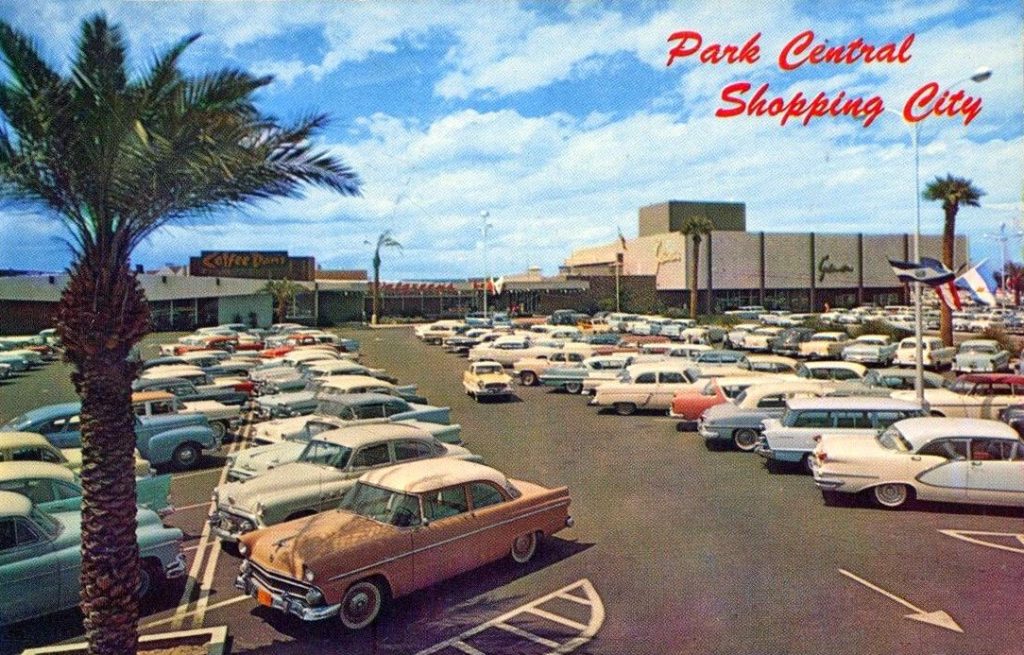
Park_Central_Shopping_City_parking_lot_1950sSing a city of malls. Actually, the first modern mall west of the Mississippi was built in Dallas and the first suburban mall was Northgate in Seattle (now closed and turning into a dense development around light rail). But it's easy to imagine Phoenix invented them. They were not good for those of us who loved shopping at the great stores downtown, and how they contributed to the central core's collapse.  But most Phoenicians loved them.

When I write "mall," I don't mean the beautiful 19th century Arcade in downtown Dayton. I mean a shopping complex built around the automobile. Park Central was Phoenix's first, developed by the Burgbacher brothers on the site of the former Central Dairy and opening in 1957. It was anchored by Diamond's, Newberry's and Goldwater's, the latter closing its downtown store two miles south and beginning the end of downtown retail.

Even so, in the early- and mid-1960s, downtown held its own as the state's busiest shopping destination — but the die was cast. Most natives don't even remember when Phoenix was more than a city of malls.

I grew up within bicycle distance of Park Central (had my bike stolen there, too). It was open air (the city was not yet devastated by the heat island), convenient and wildly popular. It anchored Midtown, along with the twin towers across the street, the taller of which sported an outside glass elevator and the shorter being home to the Playboy Club. Old Park Central was semi-urban, contiguous to the city and human-scaled.

It was followed by Biltmore Fashion Square, which until Westcor turned it into another lookalike suburban soul-killer, was also open air, with plenty of shade and in a pleasing scale. Across the street was the open-air Town and Country shopping center (which was not an empty name, for the city around it was still meshed with citrus groves and horse properties). Chris-Town became the first enclosed, air-conditioned mall in 1961 — the property has been a farm owned by the Chris family.

Prudish please, we’re Americans

Toward the end of my time on the ambulance, we got a young rookie whose last name was Weiner, pronounced like the hot dog, the vulgar grade-school slang or the congressman from New York. Into this den of testosterone, black humor and hazing landed poor EMT Weiner. As "Buford" said at the time, "If he were smart, he'd at least pronounce it VI-ner…" For all I know, EMT Weiner went on to become a Nobel physicist. And we know, dear lord, how we know, about Rep. Anthony Weiner. He was sending women online photos of himself garbed only in what my parents' generation would term his skivvies.

Paralysis in Washington as the nation hurtles toward potential default. Fourteen million unemployed and the economy slowing, again. Wars without end — indeed, a new one in Libya. Further consolidation of power by the Oligarchy, where Elizabeth Warren and a (real) Nobel laureate Fed nominee are left twisting in the wind by a cowardly President Hoover. The national security state grows unchecked, no matter that bin Laden has assumed room temperature and been tossed into the Indian Ocean. Climate change consequences before our eyes in eastern Arizona. Further warnings of the Great Disruption with OPEC owning up to the fact that it can't fill the gap between demand and output this year. Posh! It's all about Weiner's weiner.

Some might say, we can walk and chew gum at the same time, we can enjoy a mini-sex scandal involving a Washington poltroon while still addressing real issues. And that might be true for Rogue readers and a minority elsewhere. I'm not so sure about the rest of America, the place where a majority of citizens always scores so embarrassingly low on basic history and civics questions, and watches on average 34 hours of television a week. I didn't want to write about Weiner's weiner. But let me be, well, straightforward (because, as Weiner has shown again, the coverup is worse than the "crime"). The media carpet-bombing is not a coincidence. Keeping Americans ignorant and constantly distracted, preferably by sex, is an essential part of taking away our republic. With Weiner, it will help deflect voter buyer's remorse over the Republican House. Then there's the central contradiction in our national madness: A deep prudishness combined with an insatiable appetite for everything sexual.

The fire this time

As I write, the Wallow fire in eastern Arizona is at 607 square miles — larger than the city of Phoenix — and zero containment. I haven't been to Eager or Springerville in more than 30 years, but Google Earth confirms that this is still a part of the state that has not been consumed by the Growth Machine. All of Apache County has less than 72,000 people and grew only 3 percent from 2000 to 2010. It is magic country.

Unlike the Rodeo-Chedeski fire, which consumed 732 square miles along the Mogollon Rim, this doesn't appear to have the added risk of hundreds of tract houses built amid pine trees on land made private by secretive federal land swaps. It also lacks Valinda Jo Elliott, the accidental arsonist, who stalked away from a fight with her boyfriend carrying the essentials for the wilderness that every Boy Scout learns to carry: Cigarettes, a lighter, flip-flops and a towel. And be sure to light a "signal fire" in dry, windy country when you get lost. She is the perfect Arizona voter, if not member of the Legislature.

This is pure tragedy. It is also a taste of the future.

.357 to Yuma

As the world knows, five people were gunned down last Thursday in and near Yuma before the 73-year-old killer took his own life. Yet another person was left in critical condition. The mainspring of the violence was a nasty divorce, but, even though overall crime is falling, the tendency to reach for a gun is if anything on the rise. Especially in Arizona. This latest bloodbath comes a mere five months after nineteen people were shot, six fatally, during an assassination attempt on Democratic Rep. Gabrielle Giffords at a suburban Tucson shopping center.

The Arizona Republic wrote the predictable lines about the "killing spree that shocked the tight-knit farming community of Wellton, outside of Yuma" where the ex-husband killed the ex-wife. This, of course, is not true. Wellton, where the onetime northern main line of the Southern Pacific Railroad diverged for Phoenix from the southern main, was indeed once tight-knit and a farming community. The northern main has been out of commission for years because the state wouldn't help upgrade it to ensure continued Amtrak service to Phoenix and Phoenix has so few rail-bound exports now. The farming is mostly large-scale and industrial, much of it moving there after having been pushed out of the Salt River Valley. Wellton is now an extension of the Interstate 8 sprawl that trickles out from Yuma.

Yuma is rich in Arizona history; not just the territorial prison, but the 19th century steamboats that plied the Colorado River, the railhead into the territory from California, and the long political rein of state Sen. Harold Giss, one of the most powerful men in Arizona in the mid-20th century. It is also one of the bleakest locations in America outside of West Texas — near the end of a great river "tamed" to death and so hot it makes Phoenix seem like Seattle by comparison. Yet it has become a retirement magnet, especially for those with less money. Sun, it has. It is also a very poor place, close to Mexico to feed the farm economy with labor, and consistently suffers some of the worst unemployment, income levels, educational attainment and child poverty. It has about 200,000 people in a place with a carrying capacity for one-tenth that number. As elsewhere, sprawl and population growth have annihilated "tight-knit" and "community." Much less civic culture, a "we" society and the brain mechanisms that preserve the always-fragile wall between civilization and nihilism.

Rome or Weimar?

You know me: I am more of the school that sometimes history rhymes (Mark Twain) than history repeats itself. Nevertheless, as the Great Disruption continues and, as a conservative commenter wrote on my Seattle Times blog, "How's that hopey-changey thing working out for you," we are required to take stock. We face a mammoth debt and deficit, mostly because of the Bush/Obama tax cuts, the wars and the Great Recession. Speaking of which, no major criminal prosecutions have resulted from the greatest assemblage of frauds in history leading the world financial system to the brink of collapse. In fact, the banksters, hedge-fund boyz and other Wall Street playerz are doing better than ever. The 14 million "officially" unemployed, along with tens of millions of others, not so much. The middle class is imploding as the social compact is badly damaged. President Hoover, like his namesake, has surrounded himself with agents of the plutocracy — the difference being that the real Herbert Hoover never would have remained embroiled in two simultaneous wars and ruinous defense spending.

Every day the question grows louder for those paying attention: What the hell is happening to us?

Cullen Murphy, an editor at Vanity Fair, took it head on with his book, Are We Rome? As a review in Salon put it, "He argues that America, like Rome, is threatened by self-inflicted wounds — in particular our mania for privatization, our fading belief in government and the ensuing decay of civic society, our vast and unsustainable military, our ignorance of the outside world and our short-sighted attitude toward immigration and assimilation."

Palin in Scottsdale

Just when we thought the Arizona Freak Show couldn't get any more grotesque, Sarah Palin buys a $1.7 million house near Hayden Road and Dynamite "Boulevard" in north Scottsdale. Apparently the title release came through a robo-signed (fraudulent) procedure. The Kooks write better real-life material than I could invent. The New York Times did a whimsical piece on "neighborly advice for the Palins," including wear sunscreen and watch for rattlesnakes. But it made north Scottsdale sound like a real community, which it's not. In fact, she'll fit right in with the white-apartheid culture there, where people don't want to know their neighbors, fear going south of Bell Road, shout down opposing views in city council meetings and live somewhere else for most of the year. The shocker would have been if she had bought a hundred-year-old bungalow in the Phoenix historic districts.

She will find simpatico "neighbors" who believe the banking panic was caused by the socialist Community Reinvestment Act, that America is under siege from Mexican immigration, which somehow just happened despite the resistance by the God-fearing Anglos, and the Patriot Act is too politically correct. Her motorcade can take her to outer-belt chain book stores for signings. Maybe Russell Pearce can get an audience. Maybe she can get an audience with the Badged Ego. One must wonder what Sen. John McCain, R-Fox News, must think. From the authoritative reporting of the presidential campaign, it seems the two didn't get along. McCain is rarely in the state anyway. Not for nothing did daughter Meghan flee to a bachelorette pad in west Hollywood.

Will Palin run for Jon Kyl's Senate seat? She could win it, no question. She's with her base now, far more than in Alaska where her half term as governor left much bad blood. Will she use Arizona as a base from which to launch a presidential campaign for 2012? Why should we care? Alas, we must. She is able to galvanize the white-right in a way no other Republican can. The fact that she has no accomplishments and plays up her arrogant ignorance makes no difference (here's a recent example). Far from being a liability in today's America, it is an asset.

Tornado country

I taught at a small college in Oklahoma years ago, then started my journalism "career" there. One of the first things I learned is that Oklahoma, along with Singapore, has the most intense thunderstorms in the world along with their attendant tornadoes. Nearly every day in the spring and early summer, they form atop New Mexico's spookily beautiful Caprock bluffs and then move east. So many days I would see a black line along the horizon in the morning. In the middle of the day, the darkness might be so complete that the streetlights would come on. Tornado watches were routine; warnings and sirens things to dread. Drenching rain, golfball-sized hail and then violent wind were commonplace during the season. People watched carefully for the formation of a funnel — if they could see the sky in the darkness and rain. Major damage was more rare in the rolling woods of the eastern part of the state; west of I-35, watch out. The movie Twister, for all of Helen Hunt's considerable charms, doesn't even begin to capture the terrifying majesty of an Oklahoma storm.

All the old-timers had Tornado Alley lore. About pieces of straw driven through telephone poles. About the freak contingency of the storms: How one side of a street might be leveled and the other look as if nothing at all were amiss. About cars picked up and put down yet the occupants lived. And the little towns that once existed before being swept off the map. Every town has a section that is prone to get hit. Soon you learned your own storm wisdom, such as the strange color of the sky after a twister-laden front had moved past. Before coming to Arizona Territory in the late 19th century, my great-grandparents lived in Indian Territory, the eastern half of what became the state of Oklahoma. A tornado was my grandmother's earliest memory: Of being carried into a shelter before the monster leveled the little settlement, killing one of her sisters.

I think about this in the aftermath of the Joplin, Mo., tornado. The region suffers through the occasional bad year, where the most intense level of tornadoes can even destroy brick buildings. The so-called "super outbreak" of 1974 is the prime example, where 148 twisters struck 13 states on April 3 and 4. There was Terrible Tuesday in 1979, when an EF-4 — reportedly five-miles wide at one point — lethally struck the suburban edge of Wichita Falls, Texas. It was part of a storm that ravaged the Red River Valley, coming way too close to the little college town where I lived. Now we're living through another super outbreak year: Nearly 1,000 tornadoes and 500 dead. Or we're entering something different.