Centennial blues

So it has come down to this. Arizona will mark the centennial of its statehood in 2012 by leaning on schoolchildren to "shine" the territorial capitol dome (always on the cheap, Arizona never built a real state capitol building). It will do a $7 million "streetscape renovation project" on Washington between downtown and the capitol. "Plans call for that stretch of roadway to be 'transformed' with wider, more-decorative sidewalks and crosswalks, enhanced street and pedestrian lighting, benches, shade canopies, bike lanes and displays that feature historical and cultural information about Arizona's 15 counties," the Arizona Republic reported. Something will honor the indigenous tribes whose land we stole, without putting it that way, of course. I can imagine the outcome: Gravel, concrete and shadeless palo verde trees in a no-man's-land of vacant lots and soulless state office buildings. Too bad the leafy neighborhood of Victorian houses and territorial-era apartments that once stood there couldn't have been saved, and no reinvestment in this precious historic area happened. The truly historic mining museum was kicked out for some nebulous "five Cs" museum. And that's it.

The only silver lining to this cavalcade of underachievement and failure that I can find is that the state avoided some brutal piece of post-modern celebrity architecture in a new capitol building. Otherwise, how sad. And don't blame the Great Recession: Any effort to significantly commemorate Arizona's 100th birthday would have had to be started years ago, during the so-called boom. There was no more appetite for it then, either. Public virtues, community virtues, civilizational aspirations: Don't look for them here. It's not that the state lacks the means; at 6.4 million people it is the third most populous state in the West. It just lacks the interest.

Consider West Virginia, carved out of the Old Dominion by the Civil War. It finally dedicated a classic, lovely state capitol building, designed by Cass Gilbert, in 1932 during the depth of the Great Depression. This is a poor, isolated state. Are you telling me growthgasm Arizona couldn't do as well? Instead, we got the horrendous executive office tower in the mid-1970s, which visually obliterates the copper dome of the old capitol and looks very much like a jail. Perhaps that helps explain the series of legal troubles that ensnared Arizona governors. Or consider Chicago's Millennium Park, a magnificent public space. Conservative Cincinnati marked its bicentennial by beginning to reclaim its riverfront with parks and the Serpentine Wall along the Ohio River. For Arizona and Phoenix — nothing. The city lacks even one heroic or historic statue in a public space downtown (even Oklahoma City, younger than Phoenix, has at least one). This despite all the wealth and capital that poured into the state, decade after decade, going into community-destroying sprawl and little else.

The new thought police

The Kooks have caught up with me. The trolls come with the position of columnist and blogger. Still, and even after all those years at the Republic, I'm still struck by their level of vitriol. Someone is never merely misinformed, misguided, or holds a position worth debating on a complex issue. No, to these folks, one is not merely "stupid" and "ignorant," but acting in bad faith and allied with evil forces if not one himself. They learn this from talk radio and Fox "News," of course, and some right-wing organizations actually pay people to post talking-point comments. What's most arresting is that they don't merely want to disagree — they want you fired.

On a recent innocuous economy blog post, I got this comment: "I just read the rest of the comments, I'm glad I'm not the only one that has figured out that Jon Talton is a total idiot… Mr. or Mrs. Editor… This has been going on for a long time now, why is he still here??? Do you not read any of his articles??? He's as white and male as it gets you can fire him in a heartbeat and you won't even get sued…" Again, the rocks come with the farm and the trolls come with the blog. I'm not the shy and retiring kind, and newspapers once didn't want this with their columnists. Columnists run a range of opinions, including many from the right. So why would you want to take away a person's job because you disagree with him? Why would you want to do it in this economy particularly? I paid the price for antagonizing the powerful and Kooky in Phoenix, even when mine was one dissenting voice in an otherwise right-leaning, boosterish newspaper. Take his job. Shut him up. It's a fascinating phenomenon.

So I kind of feel for Newt Gingrich, former House Speaker and presidential candidate. On Meet the Press, he was asked about the Paul Ryan plan to replace Medicare with vouchers. Gingrich responded: "I don't think right-wing social engineering is any more desirable than left-wing social engineering.  I don't think imposing radical change from the right or the left is a very good way for a free society to operate." He added that the Ryan plan "is too big a jump.  I think what you want to have is a system where people voluntarily migrate to better outcomes, better solutions, better options, not one where you suddenly impose upon the — I don't want to — I'm against Obamacare, which is imposing radical change, and I would be against a conservative imposing radical change." The attacks from the right began immediately.

Why isn’t Joe Arpaio in jail?

That's the question Matt Taibbi would ask, as he did in his famous diatribe against Wall Street. For the more sober purposes of this blog, the question is, Why is Joe Arpaio still in office? The latest reason is Chief Deputy David Hendershott being forced from office with allegations of misconduct, including using the Maricopa County Sheriff's Office anti-corruption unit to smear foes and featherbedding the jobs of his friends. The deputy chief was ousted, too. (And all this from an investigation by the friendly Pinal County Sheriff Paul Babeau). As Arpaio adamantly says he will not resign, the question of his lax oversight of his chief deputy/sycophant becomes very much like one that should be directed to the banksters: Were you corrupt or stupid? Which one? There's no other answer, especially for a man who presents himself as so smart, so in charge, so much America's Toughest Sheriff.

The abuses of Arpaio go back many years. No wonder his office is under investigation by the U.S. Justice Department and a federal grand jury. Real police officers have no use for Arpaio, referring to him as the "Badged Ego." He co-opted most of the media years ago, including the Arizona Republic, where crusading is not part of the Gannett business model. Eugene C. Pulliam would have run him out of office and out of the state long ago. Still, the Republic has done a creditable job on the Hendershott investigation, if not exactly jumping on allegations that those in the law enforcement community had known about for years. Most of the media were played like a cheap fiddle with the chain gang, the tent jail, pink underwear and the "sweeps." One exception is New Times, which has fearlessly investigated Arpaio for more than 15 years. The casual violations of civil rights, cronyism, lack of attention to actually doing the job and high costs to taxpayers are not in question.

Why is Joe Arpaio still in office, particularly when voters twice had the choice of a lawman beyond reproach, Dan Sabin? It says much about the condition of today's Phoenix and Maricopa County.

Amtrak at 40

On May 1, 1971, the private railroads ceased passenger service and it was taken over by Amtrak, the government-owned National Railroad Passenger Corporation. Dozens of trains that ran on April 30th ceased to exist. Hundreds of cities lost their trains. What remained is largely the bare-bones operation, outside of the Northeast Corridor, that still exists today. This even though the nation has added 100 million people, become much more densely populated, and oil prices will make the car- and airline-based future seen as inevitable in 1971 increasingly difficult to sustain.

Amtrak was created because of a massive grassroots campaign. It was also an effort to help save the bankrupt Penn-Central and the freight railroads in general. But it was also born in sin as a deeply flawed political compromise, dependent on a federal subsidy that few lawmakers would or will admit is necessary, and a political plaything depending on who controls Congress and the White House. Something had to be done. Whether Amtrak was the answer is open to debate. America once enjoyed the best and fastest passenger rail system in the world. It was killed by automobiles and airlines that were heavily subsidized by the federal government (and continue to be), even as the private railroads were taxed and regulated heavily. Nor were the externalities priced in: Pollution, energy consumption and the resulting geopolitical instability, sprawl and its environmental consequences, etc. After spending heavily on new streamliners after World War II, railroads saw passenger business steadily fall off to this subsidized competition. Some fought on with top-notch service, notable the Santa Fe. Others couldn't wait to kill their trains, notoriously the Southern Pacific.

Both served Phoenix in the 1960s. The Santa Fe ran a classy little train from Union Station to Williams Junction, where it connected with the road's premier transcontinental streamliners, including the Super Chief, El Capitan, Chief, San Francisco Chief and Grand Canyon Limited. The SP operated three trains in each direction until the mid-1960s: the crack Sunset Limited, the Golden State and the remnant of the once grand Imperial. By 1970, only the Sunset survived, a raggedy thing that usually had a couple of coaches and a vending-machine car (a decade before, the Sunset routinely had 14 cars, including sleepers and full-service diner). Cities such as Cincinnati and St. Louis had dozens of trains, right up to the eve of Amtrak. After Amtrak, cities usually had one train, often at inconvenient hours (Phoenix had service until the mid-1990s, when the state government refused to help upgrade the northern main line of the SP).

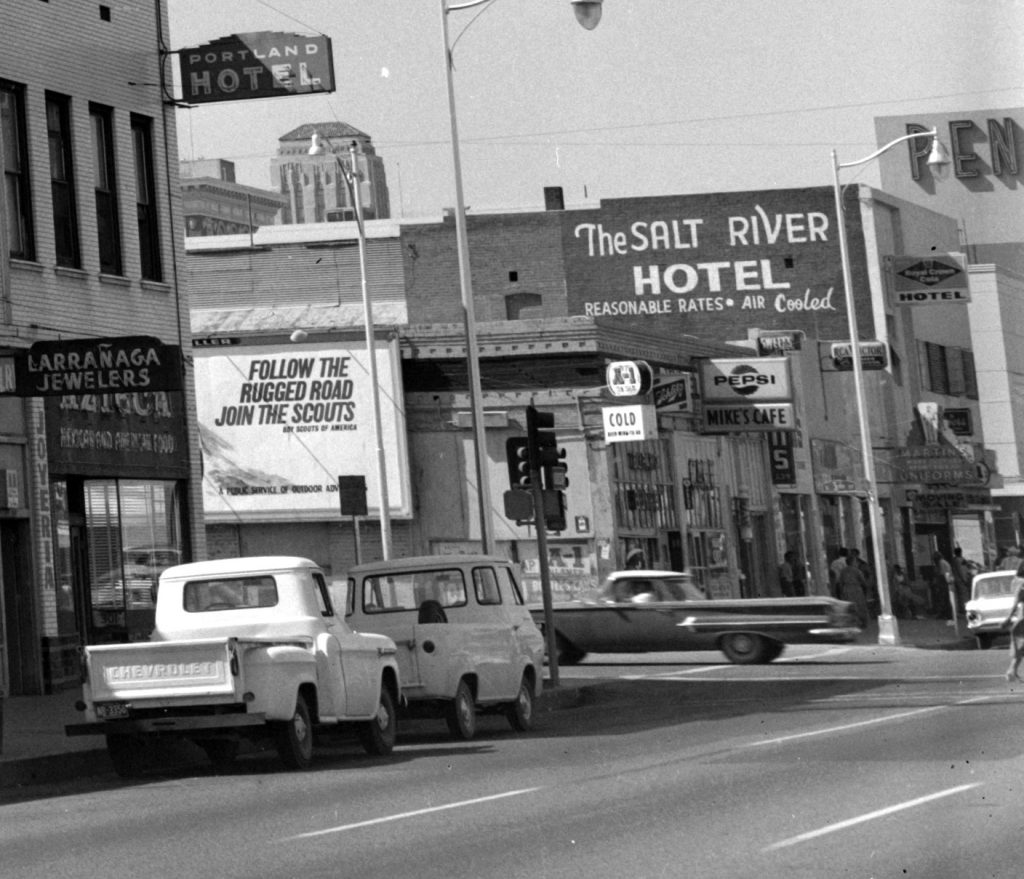
The Deuce in old Phoenix

The Deuce in old Phoenix

Mikes_Cafe_Washington_3rd_St_1966

Madison st james copyThe block of shuttered buildings (right) just west of the Suns arena was, by the 2000s, almost all that was left of the storied Deuce, Phoenix's skid row. It has since been leveled, losing two historic hotels, so team owner Robert Sarver could make another holy surface parking lot.

In its heyday, from the 1920s through the 1970s, the Deuce extended over several blocks from the Southern Pacific tracks to Van Buren, centered along Second Street. It's open to debate as to whether Second Street was the origin of the name. Or if it was a shortened version of the Produce District, the warehouses and loading docks clustered along the railroad tracks, including middle-of-the-street spur lines that ran along Jackson and Madison. Yet another interpretation: The area was Beat 2 of the Phoenix Police and the cops nicknamed it.

However it came by its moniker, the Deuce was one of the city's most colorful and storied districts. During Prohibition, it was known for its speakeasies. For decades, brothels and gambling could be found along the infamous Paris Alley, off Second Street between Jefferson and Washington.

Old downtown Phoenix was remarkably compact and walkable. The main part of the central business district ran along Central and west to Seventh Avenue. East along Washington and Jefferson were a remarkable variety of stores, including Penney's and Korrick's department stores, as well as the Fox Theater, the barber college, Dr. Pease Dentist and Dr. Hugh Ilstrip's chiropractic practice.

The Greyhound and Continental Trailways bus depots faced each other at First Street and Van Buren. East of Greyhound was the Arizona Republic/Phoenix Gazatte building, St. Mary's church and the church schools, and Phoenix Union High School. South of this, the Deuce.

It was a dense mix of single-story business buildings and two- to five-story single-room occupancy hotels, many dating back to territorial days. One could walk into this "bad part of town" by taking a few steps east of the Fox or south of St. Mary's. The small businesses there ran the gamut from bars, cafes, package-liquor shops, gospel missions and pawn shops to second-hand furniture outlets and an Army-Navy surplus store. Franco's America Bakery was at Fourth Street and Washington. It was next to a Western wear store with a lifesize horse standing on the overhang. The Matador Mexican restaurant was in the Deuce before it was relocated to a location on Adams. A few houses survived in the district, as well.

The remains of the city's Chinatown were part of the Deuce (although the Chinese, not facing the discrimination they had suffered in California, followed the Anglos out as the city sprawled). Sing High Chop Suey House, now moved a few blocks west of the Deuce, is a survivor. And then, starting at Madison, the produce operations such as Central Wholesale Terminal and United Produce.

The most famous denizen of the Deuce was Ernesto Miranda, who worked off and on at United Produce. Miranda was arrested in 1963 for kidnapping and rape, and gave a confession without having a lawyer available during the interrogation. The conviction was thrown out by the Supreme Court and police agencies were forced to routinely "Mirandize" suspects. Still, Miranda himself was convicted in a second trial, where the tainted confession was not introduced, and served time. Released in 1972, he returned to the Deuce where he sold autographed Miranda warning cards. In 1976, he was fatally knifed at La Amapola bar, located at Second Street and Madison. By that time I was working on the ambulance, but was off-duty that night; a crew from B-Shift transported Miranda to Good Samaritan Hospital where he was pronounced dead.

The Giffords test

NASA keeps putting off the final launch of space shuttle Endeavor, so who knows when it will finally lift off. It's a media event because Rep. Gabrielle Giffords, who survived a grievous injury, flew to Cape Canaveral to witness the first attempt which was scrubbed. President Obama was another guest. I'm sure she'll try to return when her husband and his crew finally make it off the pad. And America — and Arizona — have written an inspiring, inoffensive narrative of the affair: Plucky heroine fights back from adversity to see her heroic spouse fly into space. What happens next? Is she, some ask, the natural replacement for Sen. Jon Kyl when he retires?

Little of this is real, but it's a test of our collective blast-off from reality. No one but family and close friends really know how she's recovering from such a traumatic injury. There's no chance that a Democratic congresswoman from Pima County who barely secured re-election could win the statewide Senate race in an Arizona that is one of the reddest places in America.

Most horrendous in this Lifetime movie version of events is the Soviet-style airbrushing of the most important fact: Giffords was the target of an assassination attempt that grew directly out of the extreme hate- and gun-filled rhetoric of the Tea Party election season in 2009 and 2010. Almost immediately after the shooting, which claimed six lives and injured 12 others, the rewriting of history began. Why, this was just the work of a deranged individual. So what if his reading included Ayn Rand? And what possibly could be the connection between Jared Lee Loughner and, say, repeated death threats to Giffords, the widely televised gun-toters at the president's appearance at the Phoenix Convention Center, Sarah Palin's gun sights on Democratic candidates (including Giffords), lines such as "Don't retreat, reload" (Palin) and "I want people in Minnesota armed and dangerous…" (Michele Bachmann), and the weakest gun laws in the country. Nothing to see here, move along.

Phoenix 101: The East Valley

Phoenix 101: The East Valley

Chandler_neighborhood

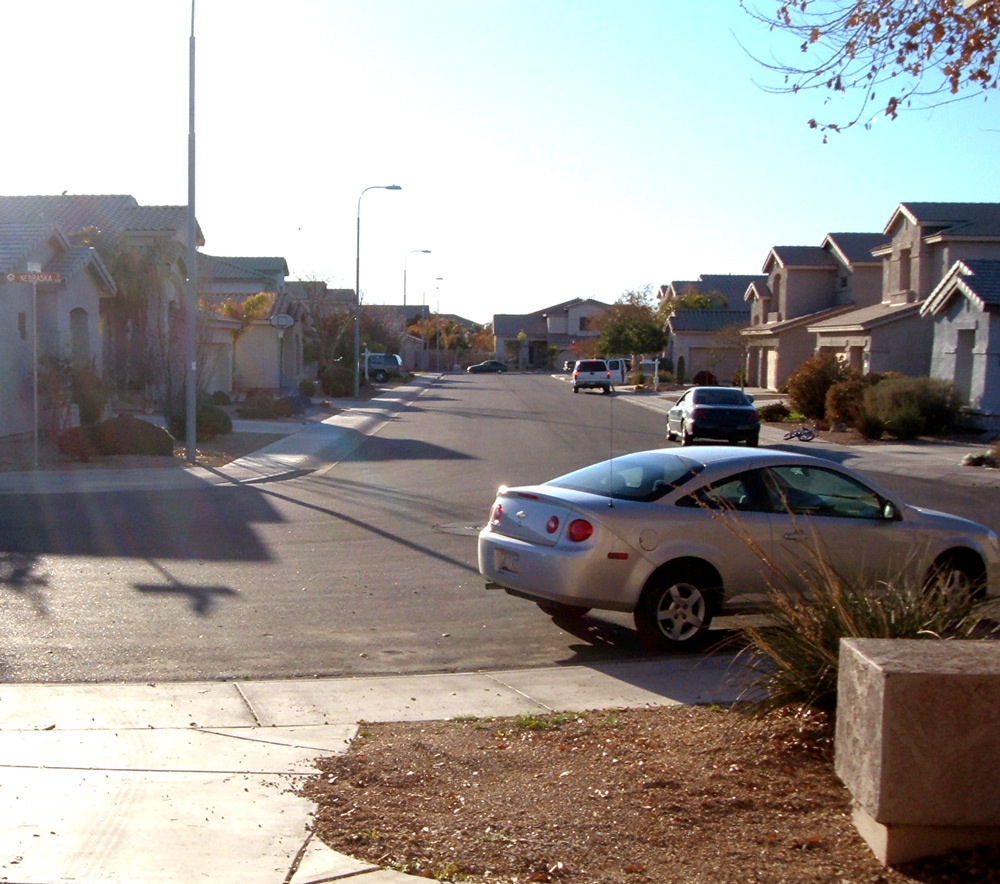
A subdivision in Chandler.

Of all the many delusional linguistic constructs in metro Phoenix meant to sell real estate and sustain the unsustainable (think, "The Sun Corridor," "the North Valley," etc.), only the East Valley has the most substance to it. Such was not always the case.

In 1960, when Phoenix's population was 439,170, Mesa clocked in at a mere 33,772. Tempe was a little college town. Scottsdale a small artist's colony/former farm town with "Western" touristy schlock. Chandler was a stop on the railroad for the San Marcos Hotel. The remainder were tiny agricultural villages. All were separated by miles of fields, groves, and history.

Mesa, for example, was distinctive for its settlement by Mormon pioneers. Tempe was the home of the normal school turned Arizona State College and just renamed a university. All the real towns supported separate newspapers. Mesa and Tempe had their own street-grid numbering systems. Guadalupe was its own unique enclave, first settled by Yaqui Indians fleeing the Mexican Revolution and was the most culturally Mexican place in the Salt River Valley.

The common denominators: Economies based on agriculture, the Southern Pacific Railroad, and (with the exception of Scottsdale) being south of the Salt River and thus part of the coalition that fought against Phoenix and north-bank farmers for water rights and allocations before and after the Newlands Act. Power in the area resided with the big growers and prosperous businessmen of Mesa, all members of the Church of Jesus Christ of Latter-day Saints.

By the late 1970s, the landscape was changing fast. Phoenix, Scottsdale, Tempe and Mesa had grown together. The Superstition Freeway was being slowly built east from I-10, reaching Dobson Road around 1977, disrupting and slowly killing the rich cluster of local businesses that lined old U.S. 60 along Mill Avenue, Apache Boulevard and Main Street.

Mesa's population was closing in on 150,000, and it was annexing miles of retiree trailer courts that ran along Main toward the Pinal County line. Samaritan Health Services, the forerunner of Banner Health, opened a new hospital, Desert Samaritan, near the new freeway. ASU had grown to be a large university and Tempe extended south with The Lakes. The first subdivisions of something called Ahwatukee were being finished. From the rise of I-10 at Baseline, the view east glittered like a jewel at night. Still, miles of citrus groves ran east of central Mesa, centered around Val Vista.

Almost everything south of central Mesa and Tempe was still agriculture. Chandler was a small town and Gilbert little more than a crossroads. Williams Air Force Base was in operation and far from everything, linked by the ubiquitous two-lane concrete roads lined on each side by irrigation ditches.

The next two decades would see startling change, and the evolution into a true separate identity within the Phoenix metropolitan area.

Bin Laden open thread

I'll open the blog up for your comments on the killing of Osama bin Laden by U.S. Special Forces. My quick take: Maybe it helps President Hoover's re-election, but nothing…

Moronistan

I've been reading too much lately about Stalin and Hitler. Nobody, least of all Marx, thought communism could succeed in such a backward country as Russia. Lenin woke up too late to Stalin's menace (not that Leninism didn't inevitably lead to mass murder), and Trotsky sulked in his tent while the Man of Steel took over. And how could the civilization that gave us Bach, Beethoven, Goethe and Mann also have voted in, and widely supported, the deranged former corporal who would shed so much blood? We look back and say, "Of, course!"

I think about all this as President Hoover, apparently under pressure from a serial failed businessman with a bad comb-over, released the long-form of his birth certificate, hoping to stop the birther "silliness." It won't. Nearly half of the members of the Party of Lincoln don't believe the president was born in the United States. Does anyone think this would have traction, much less enough to cause the president to sully the dignity of his office by addressing it, if his name were Barry O'Bama and he were white? But with any Democrat in the highest office, it would be something. When George W. Bush won the 2000 election under highly questionable circumstances, Al Gore was a class act and most Democrats went along with a radical Bush agenda despite the close division of the electorate. But with Republicans, the very idea of a Democrat as president is illegitimate, any progressive or liberal idea is accursed. Here's a Tweet from Arizona state Sen. Jack Harper, R.-Surprise: "If Jon's socialistic friends gets our guns, will they turn 2 communism 2 redistribute the wealth? #UnitedNations" No, he's wasn't kidding.

The nation that indeed brought a "new order of the ages," built the transcontinental railroad, landed men on the moon and made countless contributions to the arts and sciences now can't do anything but hope for a new housing boom and cheap gas. Our exceptionalism has devolved into ignorance, hate, denial, swindles and madness. We have made a retrograde move into television-addled peasantry, into self-inflicted serfdom. Many Americans believe things every bit as absurd, and dangerous, as The Protocols of the Elders of Zion. For them, "the stab in the back" of 1918 is illegal immigrants, taxes and people of color having babies. Who knows where this will lead? Only 25,000 Bolsheviks carried off a revolution in a nation of about 160 million. Is all we're lacking the right scheming Georgian or failed painter to take us to full darkness? Will those surviving will look back and say, "Of course"?

Four for Phoenix

In the field for Phoenix mayor, Wes Gullett must show he is more than a Republican political operative with ties to Fife Symington and John McCain, two of the more odious statewide officeholders in Arizona history. Peggy Neely seems to be the candidate of the sprawl developers and considers "standing tall against billboards" an issue of supreme importance. That leaves only two candidates worthy of serious attention: Claude Mattox and Greg Stanton.

Mattox represents Maryvale and much of west Phoenix on City Council. He has shown himself to be a man of integrity, someone who grew in office, and has represented a largely Hispanic, largely poor district well, while also understanding the importance of the Convention Center, ASU Downtown, the biosciences campus, Sheraton and light rail. He's approachable, honest and plays a mean guitar. His rugged face, like something out of a Western, and (when I knew him) sometimes casual-to-sloppy dress causes people to underestimate his intelligence and tactical skill as a politician. He claims an interesting mix of supporters, including Peggy Bilsten (who should have been mayor); Jerry Colangelo (does he care anymore since he's become a west-side sprawl developer?); Matt Salmon (?!?) and former mayor Paul Johnson. The downside? As one person close to city politics put it: "Nice guy, but where's the vision?" Indeed, the issues he's pushing are hardly inspiring: Strong neighborhoods (what does that mean, especially in a city with few real neighborhoods?); safety, and "quality schools" (out of the mayor's control). His bio also lists him as a vice president of something called National Western Vistas Real Estate, whose Web site I can't find, and could Phoenix move beyond real estate, please? Still, Phoenix could do far worse than Mattox. (Update: A reader corrects me, with the Web site here and the BBB file).

Greg Stanton is another candidate who risks being underestimated. Too polished. Too smooth. Too Mister Perfect looks. More than a touch of ambition. Very unlike Mayor Phil Gordon but still another lawyer. But beneath this and the councilman-like talk about "neighborhoods" and "safety," Stanton has an incisive intellect and a sharp understanding that, as he puts it, Phoenix is "a city at a crossroads." More than his rivals, he understands the need to make the transition into quality growth and sustainability. After representing the mostly Republican district (he's a Democrat) that includes Ahwatukee, North Central, Arcadia and Biltmore for nine years on City Council, he went to work as a deputy attorney general for Terry Goddard. Stanton was on the right side in voting against zoning east Camelback for more skyscrapers and in opposing the disastrous sprawl monster, CityNorth. Stanton would be the best choice.

Go down easy

Gonna come a time when we all gonna hafta ante up. Ante up and kick in like men. LIKE MEN! — John Rawlins (Morgan Freeman) in the movie Glory.

It may not matter that the polls are against Paul Ryan in his attempt to replace Medicare with meager vouchers. He and the Republicans in Congress are setting the terms of the debate: Roll back the Great Society. Roll back the New Deal. Weaken and eliminate the foundations of the social compact. President Hoover is a weak tribune for such a battle. What "middle ground" will he find in his journey of compromise and community organizing in the far right of center, aided by the guidance of his tax-dodging economic mandarin Jeffrey Immelt? It's astounding that any of this is even happening. Yet it is.

Want to deal with the debt and deficit? Stop the wars. Pull out of most of those 150 countries where we have a military presence. Stop the corporate welfare, especially subsidizing fossil fuel extraction. Raise taxes on individuals. Go after the tax evasion of the big corporations. Tax the gambling on Wall Street. Invest in productivity-enhancing and job-creating infrastructure, universities, research and public education. If  big business wants to get cute and threaten to leave, or hold a capital strike, fine. Play like the Chinese: Want entry to America's market (which is still the largest and richest in the world)? Play by our rules or else. Even that wouldn't be necessary if we returned to the checks and balances of healthy American capitalism. Anyway, do all this before you talk about putting your Grover Norquist drowning hands on my Social Security and Medicare (which, by the way, are not entitlements).

None of that's going to happen, for reasons we've discussed many times on this blog, including this recent post. So the question before us is, what next? What happens when the GOP gets control of the Congress and White House in 2012 or 2016 and is able to implement the Randian vision already in play in places such as New Jersey and Wisconsin?

Culture of corruption

In the history of Arizona corruption, the Fiesta Bowl affair seems like small ball. There was the bribe-fest AzScam, which rocked the Legislature in the early 1990s, part of a once-a-generation such skeleton to be kicked out of the closet on 17th Avenue. Around the same time, Phoenix was an epicenter of the savings-and-loan scandal. Don't forget all that slithered out from under rocks kicked over after the assassination of Arizona Republic investigative reporter Don Bolles in 1976. He wasn't the first or last to die as a result of Arizona's dark deeds, some leading to the most powerful men in the state before the trail was quickly erased. Bolles was a master of probing the massive land frauds that saturated Arizona, often with Mafia involvement. The Phoenix Police Department's organized-crime unit claimed many scalps, including that of a city manager, until it got too close to big power for comfort and was defanged. Old-timers remember the circa 1960 Arizona Savings collapse and scandal, which again led to the corridors of power. More recently, right-wing darling Rick Renzi lost his U.S. House seat after becoming embroiled in allegations of conspiracy, wire fraud, money laundering extortion and insurance fraud — the Bush administration fired the U.S. Attorney in Phoenix for pursuing the investigation of one of Tom DeLay's boyz.

Compared with this, some goodies for John Junker, the once lionized and now forced-out-and-shunned Fiesta Bowl boss, along with allegedly funnelling bowl money to politicians, etc., seems almost petty crime. A charge of $1,241 for a visit to a "high-end Phoenix strip club"? Junker's 50th birthday party at Pebble Beach, $33,188? This was just another day at the office, or bar, back in the day of real Phoenix scandal. That's why I can't stop wondering whether it is the tip of a desert iceberg, something beyond the high dudgeon of Sports Illustrated as something confined to policing the BCS. The question is whether the Arizona Republic, in particular, will let some fine reporters continue to follow this slimy string and pull out some others.

Corruption is supposed to go along with gritty eastern cities, Democratic pols greasing the palms of mobbed up union bosses, waterfronts and Rust Belt decay. But don't be fooled by your new house on a clean street in Anthem. The underworld runs deep here, right into your very street. No place is clean, of course. It's rather like the news stories that tell of the lurid exurban multiple homicide with the mandatory "things like this don't happen here" quote (when sub- and exurbia are actually quite prone to them). The question is why Phoenix remains such a mecca for hustles, dirty dealings and wrongdoing that reaches the top?

Phoenix 101: ‘The Valley’

Phoenix 101: ‘The Valley’

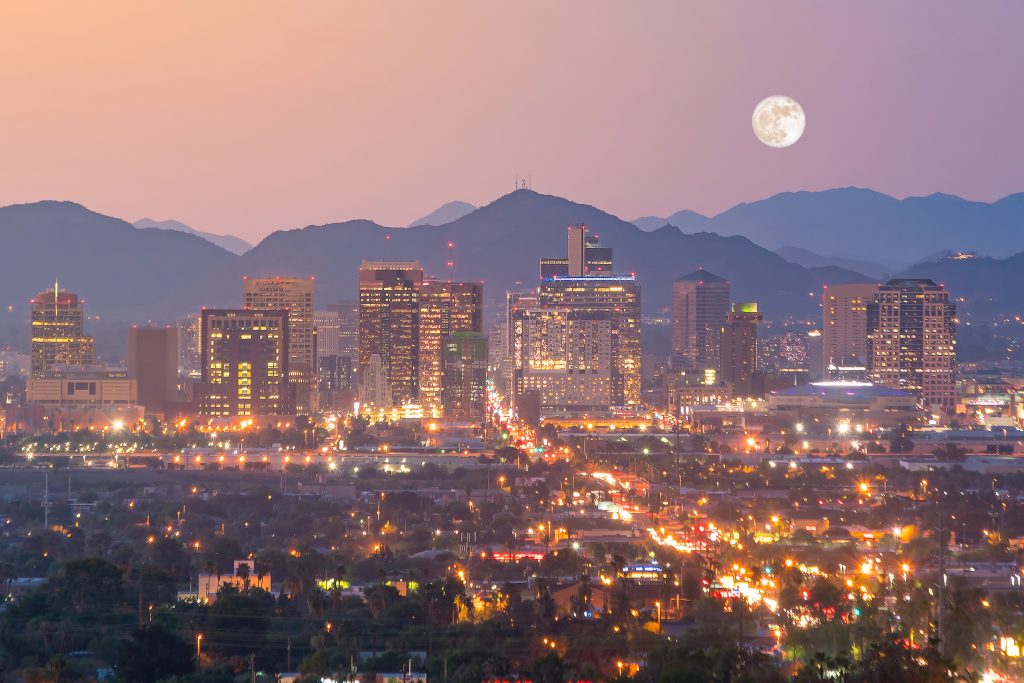
Phoenix night skyline

Growing up in the Phoenix of the 1960s, "the Valley" was a benign term. It either meant the Valley of the Sun, the touristy moniker of the booster class, or the Salt River Valley, where Phoenix was geographically centered. The city was large and powerful, both economically and politically. The suburbs were small and inconsequential, most just still farm towns or railroad sidings.

Indeed, old Phoenix, central and south Scottsdale, Tempe and old Mesa sit in a real valley. The ancient Salt River Valley dips between the South Mountains (or, on old maps, the Salt River Mountains) and the Phoenix mountains, such as Shaw Butte, North Mountain, Piestewa Peak and Camelback. One could once see this on spectacular display coming north on Interstate 10 as it crossed Baseline Road, or from Baseline and the Japanese Gardens. For much of the early decades of settlement, this posed major flood-control problems. Rains cascaded off the mountains in search of home in the meandering, fickle Salt River. Nineteenth Avenue would become a river flowing down to the capitol before construction of Cave Creek Dam. At flood stage, Indian Bend Wash cut Scottsdale in half well into the 1980s. That same river, carrying rich deposits of soil from upsteam, created one of the world's great alluvial valleys here, custom made for farming that sustained two civilizations.  So whether for tourists or as a geographical reality, "the Valley" was a widely used shorthand, harmless and endearing, often the sign of a native. It was part of the name of the most powerful bank. But there was no doubting this was Phoenix, or, as some called it, Greater Phoenix.

When I returned, the old connotations had changed. "The Valley" was widely used as the proper name of metropolitan Phoenix. This was abetted by the media, including the most influential, The Arizona Republic (the old Phoenix Gazette having been closed; too bad, imagine if it were an online newspaper with an entirely different tone and coverage focus than the big ship). This same media often didn't know where downtown Phoenix was — so many times I heard a radio or television report of some news "downtown," at, say, 24th Street and Camelback Road. I suppose it was a combination of ignorance and an effort at new-style marketing. Hence, we don't have the Phoenix Cardinals or Phoenix Diamondbacks, as most cities do, but "Arizona," which sounds like a college team. And it was an attempt to pander to suburbs that had grown to elephantine population sizes.

Inflection points

It is no secret that a faction of the Republican Party has always dreamed of rolling back the part of the New Deal that survived FDR's eventual reconciliation with big business, as well as laying waste to LBJ's Great Society. When America had two mass parties, each with real liberals, moderates and conservatives, this was not the program of Eisenhower, Nixon, Ford or George H.W. Bush. It was not even the aspiration of Ronald Reagan, who went to his dotage holding Franklin Roosevelt as his hero. But now it is in change. It sets the parameters of the debate. America is headed into truly uncharted territory and it's not going to be pretty. Last week's cowardly deal on the part of President Hoover to keep the government open is just the start. We have hit multiple inflection points that make this unavoidable. Put another way, the chickens are coming home to roost, and they're lethal.

Revenues: Thirty years of tax cutting has snowballed into disaster. Combined with two wars that have lasted longer than World War II, military deployments in more than 150 nations, corporate welfare and the cost of the Great Recession, voodoo economics has left America with a substantial deficit and debt. Tax cuts have not delivered on their promise of job creation or widespread prosperity. Quite the opposite. But the American mentality now is that taxes can only be cut. In fact, at every level of government taxes are too low. The United States has the lowest taxes among advanced nations, and in this survey only Mexico and Chile are lower, nations that are hardly analogous to America or role models. Contrary to the widespread propaganda, the deficit and debt are not an immediate emergency. Yet they are serious enough to attract attention, and become useful ammo for demagogues on the right who peddle the notion that we face disaster because of spending on poor gay union people of color seeking foreign-aid abortion earmarks. That the solemn obligations of Social Security and Medicare are the root cause. Our supposedly liberal/socialist/Islamofascist president has bought into the right-wing narrative: America has a spending problem, not a revenue problem. In reality, low tax rates are most to blame. They have finally been reduced, at every level of government, to crisis-inducing levels.

Ignorance. The condition above would not be possible without the rise of broad illiteracy in citizenship, history, economics and critical thinking. It it no coincidence, as the commies used to say, that our troubles have worsened amid the widespread death of newspapers and a shallow, "good news" focus in too many of the survivors. Indeed, fewer Americans read newspapers or anything at all. Men are especially prone to not read and fewer men go to college. Even most college graduates lack grounding in the liberal arts. Despite the right-wing pose of defending Western Civ, we have a nation of grads from business and professional silos, including from the for-profit "college" flimflam, with no sense of the obligations of citizenship or American history. Thus, the issues we discuss on this blog are either unintelligible or "depressing." They know nothing of the delicate balances and pluralism that created the best of modern America. They wants to be entertained, to be told comforting fables and, as things head south, to be fed easy (even if the wrong) villains. Too many have thus been easy pickings for the corporate media and talk radio that promulgate and pass on right-wing propaganda. Like tax revenue, this situation has been deteriorating for years. We have finally hit the wall.

Four. More. Years.

So President Hoover wants another term. I ask, why? None of the major banksters has gone to jail. The too-big-to-fail banks are even bigger and back to risky business. Nearly 14 million are unemployed, millions more underemployed or have given up looking for work. A record number of Americans are on food stamps. We have not merely two wars but three. Gitmo is still open and corporate lawyer Eric Holder made a cowardly about-face from trying Khalid Sheikh Mohammed as the criminal he is in New York. BP committed the worst environmental disaster in our history, but deepwater drilling is back. Income inequality is at record highs. I could go on, and will shortly.

Most progressives are either defending the president, still hoping he's "playing chess" and all will work out, or will hold their noses and support him for fear of a worse Republican alternative. Perhaps anticipating my antipathy, commenter Koreyel made a post a few weeks ago that deserves to be quoted at length:

You go into the future with the population you have and not the population you wish you had. Look at the population we have. We don't know much about anything. Do we? So much so, I've thought of starting a blog to capture every news item that begins  "half of all Americans don't know." Steve Allen saw it coming years ago. He gave it a name. He called it Dumbth. It's now here in the flesh and running for president in 2012. And you too can become a fan of it on Facebook.