Holding out for a hero

The New York Times on Sunday noted that Joe Arpaio's Arizona didn't become that way without some who fought back in public. It singled out Latino organizer Salvador Reza; Supervisor Mary Rose Wilcox; community organizer Lydia Guzman; videographer Dennis Gilman; state Sen. Kyrsten Sinema; ACLU Director Dan Pochoda; Phoenix Mayor Phil Gordon and New Times reporter Stephen Lemons among others. If Arpaio finally goes down in the Department of Justice civil-rights lawsuit, they can hold their heads high.

Can you imagine what Attorney General Robert Kennedy would have done to Arpaio had he gone after his brother the president with a bogus quest over his birth certificate? Bobby wasn't called mean and ruthless for nothing. Or what LBJ or Nixon would have done? Arpaio would have been given the biggest IRS proctology exam in the history of the world, seen all his federal aid cut off, and been relentlessly hounded by federal prosecutors and FBI agents. President Obama, cool and contemplative, has a corporate lawyer as his Attorney General. So my hopes are muted.

The Resistence desperately needs heroes. Unfortunately, those listed by the Times either had no power or, in the case of Gordon, were severely constrained by both events and his own second-term swoon. The reality is that good intentions divorced from power get us nowhere. Dietrich Bonhoeffer lived his convictions against the Nazis, but the only reason we are able to celebrate his martyrdom today is the brute power used by the Allies to defeat them. When Lyndon Johnson suddenly became president, he was urged to back off on civil rights, so as not to use his political capital on a seeming lost cause. This master of the use of power, in Robert Caro's telling, replied, "Well, what the hell's the presidency for?" And a hero, with titanic, heroic flaws, emerged.

Strange awaiting

Surely I'm not the only one who feels as if we're in a spooky interlude, an intermission between bad and, perhaps not worse, but much of the same bad for a very long time. Or, something… A zone of circumstance lying somewhere between an asteroid strike and the widespread sense of peace and prosperity, however misplaced, of the 1990s.

Consider that wealthy Republican Willard Milton "Mitt" Romney stands a very good chance of becoming president. Despite all the damage that should have been done by the ongoing revelations of his destructive work at Bain Capital, duplicity about his tenure at same, and refusal to release his tax returns — a potential chief executive with accounts in the Caymans and a Swiss bank account — despite all this, he barely trails in the popular vote and cannot be counted out in the Electoral College. How can this be? Is it simply because Obama has lost so much of the white vote? That the right has so rewritten the narrative of the past 12 years that millions don't actually know what the hell happened?

If you thought they were The Party That Wrecked America the first time around, just wait for the first Citizens United presidential election.

Mayberry RIP

Main_street_durant_ok

Main Street, Durant, Okla., down on its luck.

The tributes to the late Andy Griffith have been lavish. Did anybody compare his Sheriff Taylor to Joe Arpaio? I'm sure they did. Then there was Mayberry, the fictional setting of The Andy Griffith Show. As Miami Herald columnist Leonard Pitts wrote, "Mayberry was real, too — as real as the desire sometimes to escape the tyranny of What Is. It sat just outside of time, at a crossroads of nostalgia and need. There was a dirt path in the woods near town that led to a fishing hole. Sheriff Andy used to go there often with his little boy, to the whistling of a bucolic tune lifting above the North Carolina pines."

As I was preparing this column Monday, I noticed one big difference between today's reality and Mayberry: The Internet, or lack thereof. My connections were down most of the day, so no new Rogue post (much of Arizona rejoices). My jobs require me to me unusually wired, but the "tubes" of the 'Net — developed initially with federal money — are the big change in our lives. We didn't get moon colonies or manned exploration of Mars and beyond, but we got PCs, Macs and the Internet. It makes for an interesting thought experiment: Your work and personal life in even 1980 vs. today. Back then people wrote letters, typed on typewriters, filed in filing cabinets (and many more clerical workers were needed), and got their messages on those pink "While You Were Out" slips. Now I've got a Mac and an iPad for almost all of that.

One of the most ubiquitous comments about Mayberry (based on Griffith's real hometown of Mount Airy, N.C.) was the lack of African-Americans in a Southern town. That was actually possible. I lived in such a place for a few years, Durant, Oklahoma, in the "Little Dixie" southeastern region of the state. Durant had been a "Sundown Town." Blacks could work as domestics or laborers during the day, but they had to clear out to other towns at night. Old-timers told of signs at the city limits that said, "Darkie," or the N-word, "don't let the sun go down on your back."

Growthgasm!

800px-SanTan_Village_-_North_-_2009-09-20
The SanTan Village shopping center in Gilbert. 

The big news back home is that Gilbert is now among the top 100 U.S. cities in population. When I worked as a columnist at the Arizona Republic, I would term these highly-played announcements as "growthgasms," an old Arizona obsession in focusing on merely adding people. A closer look at the data show that, in the metro Phoenix depression, they are faking it. Gilbert grew by 1.7 percent in the first year after the 2010 Census. That compared with 90 percent from 2000 to 2010. Any way you slice it, population growth has slowed dramatically in a place that values it above all else.

People are moving much less today because of the bad economy. But the Austin suburb of Round Rock clocked 4.8 percent in the same year and Austin itself grew by 3.8 percent. Denver increased 3.3 percent. Phoenix, which was kicked back a notch to the nation's sixth-largest city added less than 24,000 people, keeping it 67,000 behind No. 5 Philadelphia. Houston, No. 4, added nearly 46,000 residents. Yes, Phoenix was 7th in the top ten in adding raw population, but the numbers were nothing like those seen every year in the 1990s and 2000s, and by percent are below anything seen since the early 1950s and the advent of widespread air conditioning.

Gilbert is technically a "town," allowing it a runaround from many of the responsibilities of cities in the eyes of the state government. And for those who live there, I suppose it's very pleasant: New housing built around large garages in "master planned communities," more than 81 percent white, affluent, heavily Mormon, a fakey little "Old Town," well-financed schools, endless motoring, right-wing politics, chain restaurants, a sham "downtown" (all private property) at the SanTan Village shopping center and relatively low crime. The endless walls facing even modest thoroughfares are telling.

The fourth branch of government

You might be tempted to pass on a story in Sunday's Arizona Republic with the process-y headline, "Case Asks Who Must Pay Taxes for Utility." Don't.

Ably reported by Ryan Randazzo, the article lays out a controversy in Sun Lakes. The small company that provides water for the "active living retirement community" wants a rate increase of about $6 a month from residents, the first such hike since 1994. Sounds reasonable. But it wants more: "About 40 percent of the increase would pay the utility owners' income taxes." The Residential Utility Consumer Office contends that the water company's "shareholders might have other business interests that lose money, and if they combine the tax credits of those operations with the tax liability from the water utility, they might not pay taxes at all, even though the customers would be paying a 'phantom tax.' 'When this happens, this is essentially free money for the shareholders paid by the ratepayers who receive no benefit from these payments,' RUCO wrote in a brief for the case."

This is about more than Sun Lakes. My sympathy is limited for people who want to buy houses in a leapfrogged, 98-percent white development with streets named after Michigan, Minnesota and Indiana, profaning our desert. But the case is a rare window into how power and influence work in the state. Power, especially, at what insiders call "the fourth branch of government," the Arizona Corporation Commission.

Heat wave

Hot enough for you, America? According to the federal National Oceanic and Atmospheric Administration, more than 2,000 high temperature records were reached or broken over the past week. For June, 3,200 record highs were broken.  Places where I once lived sound unrecognizable: Days of 105 degrees in Denver, 4,000 feet higher than Phoenix and a place I remember for its enchanting cool-off in the summer twilight; records broken in Charlotte, where a temp of 104 is accompanied by nearly tropical and suffocating humidity — even in the old days, the Southern heat was miserable, but this? — and of course the August-like oven in June for Phoenix. Violent storms sweep the east and devastating wildfires tear across the West. Welcome to the new normal?

Only a fool would not recognize that climate change is coming on faster and worse than expected, and that it won't be a phenomenon that only affects poor people in the Third World. We are, to be sure, a nation of fools that is more interested in the implosion of TomKat than the implosion of the planet because of human activity. There are the usual excuses: The weather's always changing! Even if it is true, nothing can be done locally (statewide, regionally, nationally) because it is a global problem. Taking action would cost jobs. Here's my in-depth analysis that climate change is a hoax or not a big deal, even though I am not a climate scientist. Wait…Did Anderson Cooper just come out as gay? Look over here at the bright, shiny object, Moronistan.

The people in charge understand that climate change is no hoax. Even Exxon Mobil, which spent heavily to fund denier "science," admits the planet is warming. The new excuse now is that the change will be manageable, people will adapt. The plutocrats adapt by having summer houses in places such as the San Juan Islands. Can't we all just bootstrap ourselves into this brave new world?

Arizona’s desert towns

Arizona’s desert towns

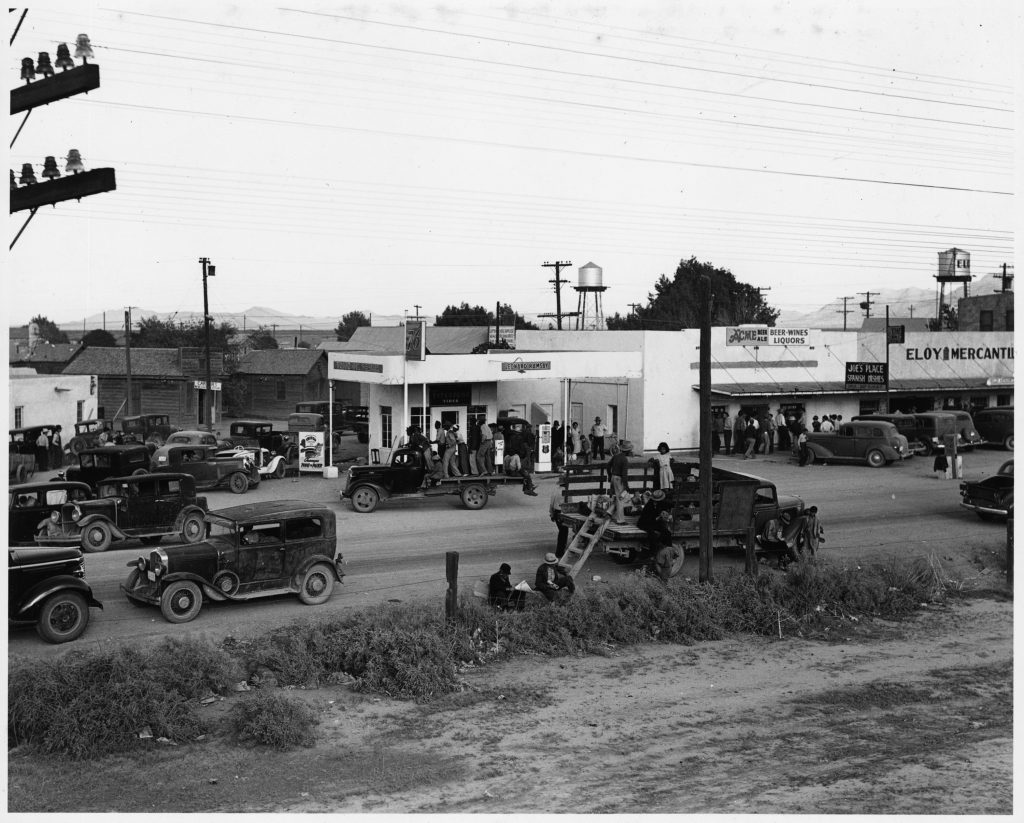
EloyLangeDorothea Lange photographed Eloy during the Great Depression.

Before interstate highways, ubiquitous McDonald's and sprawl, there was that unique creature of the American Southwest: The small desert town. It was not like Bisbee, Globe or Prescott, growing rich from mining or ranching, or Flagstaff with its sawmills, cool weather and available water.

Nor were desert towns like Phoenix, sitting in one of the great fertile river valleys of the world. Instead, these were precarious footholds of human effort to conquer, or at least exist, in a deeply hostile wilderness. I think of places such as Casa Grande, Gila Bend, Eloy and Kingman. Wickenburg almost fit the description, but it benefited from mining, then dude ranches and proximity to fast-growing Phoenix on the main highway to Los Angeles.

Nineteenth century Arizona was a badlands in which only the most visionary dreamer, swindler or madman could see much potential beyond the mining country and the old Spanish outpost of Tucson. Going west from Tucson to California was only for the toughest or most deranged immigrant. A few tribes such as the Mojave knew how to live in this parched, poor land of eerie basins, rugged bare mountains and, in the south, the fickle Gila River. The European-Americans did not, even as they disparaged the natives as "digger Indians" and sometimes set out across the alien terrain.

One famous example was the Oatman party in 1851, traveling from well to well, until an encounter with (it's speculated) Yavapais 80 miles east of Yuma went wrong and most of the party were killed; young Olive was abducted, traded to another tribe and eventually returned to the whites, living out her life with tribal tattoos on her face. This was the world into which the desert town was planted.

One dreaming pragmatist was Jefferson Davis, who as Secretary of War encouraged surveys of a southern route for a future transcontinental railroad and pushed for the Gadsden Purchase (otherwise, Mexico would begin just south of Phoenix). It was the railroad that gave these Arizona desert towns their initial life. Sometimes they had water; other times it had be brought in by rail, but the steam locomotives of the Southern Pacific Railroad subsisted on a string of water towers along its route (the same was true of Kingman on the Santa Fe). One is still standing at Red Rock north of Tucson. From the water towers came towns. A few even survived.

Dog days in Arizona

If all I knew was, as Will Rogers said, what I read in the papers, I'd be pretty depressed. This is ironic considering in Arizona their mission is to most of the time be the cheerleaders for the Everything's Fine! propaganda ministry.

Still, the sheer magnitude of the occasional story or a little bit of guerrilla journalism to slip out the truth happens. One example was an article by the Republic's excellent Gary Nelson on a recent meeting of the Maricopa Association of Governments. It was supposed to be a rah-rah-blah-blah lie-fest for the Sun Corridor, an insane brew of more sprawl and wishful thinking. But Bill Harris, the head of Science Foundation Arizona, warned that the state was headed for a Third World future without better leadership and education. This doesn't differ from what I've been writing for years or Mary Jo Waits' warning that Arizona was on track to be the "Appalachia of the 21st century," but it brought an absurd, tremulously defensive response from one of Gov. Brewer's stooges. This is how we know Harris was telling the truth.

Then, another article by Shaun McKinnon, who somehow survives to do fine reporting on the reality of climate change and Arizona. This one detailed how wildfires are bringing Arizona's majestic forests closer to collapse. "Fire has burned through one-quarter of the state's ponderosa-pine and mixed-conifer forests just in the past decade, leaving a blackened mosaic across 1 million acres. In all, nearly 4 million acres of Arizona's forests, grasslands and deserts — an area slightly larger than Connecticut — have burned since 2002." The only thing more upsetting about this is the utter lack of leadership to address it — let's have a Sun Corridor!

Thunder

Bricktown_Canal_Water_Taxis_in_Oklahoma_City

Water taxis in Bricktown, Oklahoma City's reclaimed warehouse district.

Seattle readers can, and should, stop here and read other posts.

The Oklahoma City Thunder is in the NBA Finals. I think of 1976 and the Suns and Gar Heard's Shot Heard Round the World. Even though the league has been much degraded since then, pro sports will never get sweeter for a city than this moment. Enjoy, whatever the outcome. The Thunder — the former Seattle Supersonics, moved away by a new owner in a civic wound that refuses to heal — are also the capstone of downtown Oklahoma City's remarkable comeback from the grave. This in an even redder state than Arizona.

By the late 1980s, the state's oil industry was in a depression and downtown Oklahoma City was suffering all the familiar ills of urban America: Major corporations had decamped for the suburbs or a big office row in the northwest part of the city or been shattered by the economy, and shopping had gone out to malls. As Steve Lackmeyer of the Daily Oklahoman writes, "Oklahoma City's corporate base was dying. City Hall struggled to keep up with a record number of boarded-up homes. College professors were instructing students to seek opportunities out of state." Consolidation among railroads and changes in their business had left a vast area of warehouses just east of downtown empty. The old titan/stewards were dead or dying. Even worse, a misconceived "revival" effort involving famed and overrated architect I.M. Pei had only gotten about as far as tearing down many irreplaceable historic buildings, leaving blocks and blocks of nothing. I remember this desolate downtown from when I was teaching at a college in the southeastern part of the state and later working for a newspaper in Lawton.

Like a Phoenix?

All the boosters' stories and all the boosters' flacks can't get our mythical bird out of the ashes. Five years after the biggest collapse since the Hohokam unpleasantness, Phoenix still has the character of a fallen souffle. Perhaps that's for the best without a better plan, because the worst thing that could happen is a return to mass sprawl building. The most striking feature — and tell me if I'm missing something — is the lack of anything big happening. I don't mean nonsense such as "Buckeye will have 400,000 people!" I mean nothing is seriously moving ahead to follow on the genuine pre-crash achievements: ASU Downtown, light rail (WBIYB), the expanded and attractive convention center, the beginnings of the downtown biosciences campus and, disappointing though it is, CityScape.

Instead, Mayor Stanton is off on a misguided quest to "save" the state's defense jobs. Mesa at least is running light-rail 3 miles into downtown, but otherwise real advancement on LRT, much less commuter or intercity rail, is so slow as to be meaningless. The Gaylord "resort" collapsed in exurban Mesa — good. Glendale is in hock forever to save the Coyotes hockey team/development-con-gone-bad — good (never thought I'd find myself on the same side as the "Goldwater" Institute). Scottsdale is still rich (except for those long stretches of empty car lots on McDowell) — but who cares? The west side is getting its far loop freeway — bad news. Is this it, other than to hope for another real-estate boom?

Progress faces substantial challenges, some new, some old. The congressional delegation, Ed Pastor excepted, won't do a damned thing to bring home federal money to build a quality economy. The Legislature is anti-city, anti-science, anti-education and opposed to any real economic development besides the "What is that Smell?" state Commerce Authority. Suburbs keep cannibalizing business from the city and each other. There's no focus on the biosciences campus, the one real area of promise, and the big hospitals are happy to torpedo it. The new "takings" law puts further handcuffs on urban solutions. The city lacks a serious economic-development strategy for the city. Government revenues were vaporized. And there's the weight of so much empty land, so much inefficient sprawl, a huge underclass, the massive catch-up necessary but impossible to fund. Kook politics has cost the state dearly.

The new hard times

By now you know the news that Americans' wealth dropped nearly 40 percent from 2007 to 2010. This is nearly all a function of the housing collapse, combined with the fact that the wages of average people have been stagnant or dropping for 30 years. And the data, being median wealth, probably understate the real damage. For all this, there's a very good chance that 50.1 percent of the voters will return the Party That Wrecked America to the White House, the last check on a federal government taken over by the extreme right. So if most of us are poorer now, just wait.

We're lectured that too many people have been living beyond their means, leeching off the public dole, racking up unsustainable debt. This is never you and me, mind you. It's someone else, but there are a lot of them and something drastic has got to give. David Brooks is one of the chief public scolds who also laments a loss of morality and dignity, even if he has spent his career supporting the jungle capitalism that has brought us low. Another is Thomas Friedman, prophet of world flatness. The government has spent decades giving and now it's going to have to spend the future taking back (but never from his pet projects, of course).

With Rep. Paul Ryan, lionized for his seriousness, we have federal budgets that put this wish into legislation. Never mind that they don't fix the deficit or debt, they do cut programs to the poor and lower middle-class. Social Security? Privatize it. Medicare? Give people vouchers worth a couple of thousand dollars (good for a low-end trip to the emergency room, if that). Military spending is "off the table," as are subsidies to big GOP donors such as the fossil fuels industry. So I hope you get a sense of this future barring a major course correction.

Military Keynesianism

Sometimes it's the (kind of) little things. The Hotel Palomar is open at CityScape. It's a boutique hotel run by Kimpton, which manages some wonderful places around the country, such as the Monoco in Denver, the Triton in San Francisco and the Alexis right down the street from me in Seattle. Many of the others, where I've had the pleasure of staying, are in restored historic buildings. The Palomar looks like a jail or the spawn of the ugly new county courts building. Meanwhile, the art deco headquarters of the old Valley National Bank sits vacant — it's even closer to the convention center — and the treasure of the Westward Ho is low-income housing. Across the street from CityScape? The historic Luhrs buildings look empty. The question just keeps coming back: Why can't Phoenix get its act together?

Check your defensiveness at the door, because I'm just winding up.

Phoenix Mayor Greg Stanton has assumed a leadership role in an effort by the U.S. Conference of Mayors to blunt or stop defense spending cuts. He apparently traveled to Washington, meeting with wealthy Republican John Sidney McCain III, nominally a U.S. senator representing Arizona, to discuss this issue. McCain did nothing to help secure funding for light rail (WBIYB), commuter rail, Amtrak, research, education or anything else that congressional members do for their states in such socialist havens as, say, Texas. But war? No problem, Greg. Come right in. This is a big thing.

Phoenix 101: San Diego

San_Diego_Reflecting_Pond

I never went to San Diego as a child. Nobody I knew did. Up into the 1970s, Phoenix's orientation was Los Angeles, and even that required a long drive across implacable desert. Part of this was due to geography. The Southern Pacific Railroad turned slightly northwest after crossing the Colorado River at Yuma and headed to LA. San Diego, although founded in 1769 and enjoying one of the finest natural harbors in the world, was initially bypassed by the railroads because of the imposing mountains and canyons to its east.

At the turn of the 20th century, sugar baron John Spreckels financed a railroad to connect the city with the SP at El Centro. It was one of the most difficult lines to engineer and build, including passage through Carrizo Gorge. Eventually, Spreckles was forced to sell the San Diego & Arizona to the SP, but the line never made much money. The Santa Fe Railway built south to the city from Los Angeles.

In high school, we took a couple of choir trips to San Diego. It was pleasant and sleepy, even though it was slightly more populous than Phoenix. Fast forward into the 1980s, and San Diego in the summer had become Phoenix West, with many thousands of Arizonans vacationing there, mobbing the place and not making friends. Advances in automobile technology and Interstate 8 had caused the big shift. By that time, I was living in San Diego and one of the first things I learned was not to tell anyone where I was from. One of my friends who knew the truth would derisively call me "Zonie Boy" when she wanted to get under my skin.

All fall down

We're at a very dangerous moment. The May unemployment report showed only 69,000 jobs created, all part-time, and only half of what's needed just to keep up with the natural growth of the labor force. The eurozone is headed for collapse and much of Europe is in recession. China, expected to lead world recovery, is slowing, as is India. We may never have escaped the Great Recession, but if we did we're on the edge of another downturn. Put another way: The Great Depression went on for more than a decade and had recessions embedded in it, like tornadoes in a hurricane.

Faced with this, the institutions and practices that were built up carefully to mitigate just such an event are either gone — Glass-Steagall — or in a free-fall of legitimacy. The European Union. A peaceful, strong Germany. A global system of free trade. An economy where the pursuit of profit, monopoly and plutocracy is offset by checks and balances that serve the common good. The paralyzed and compromised Federal Reserve. The "fixed" and hamstrung-by-extremists Congress. And, I am sorry to rub salt in your hopes, President Obama. Economic conditions are not as bad as they were in the Depression. Yet. Leadership is worse, at least among American politicians. Hardly any will even tell us the truth about our actual circumstances.

History offers a valuable "fund," as George F. Kennan put it, upon which we can draw to understand our present circumstances and perhaps plot prudent responses.