The capitol

The capitol

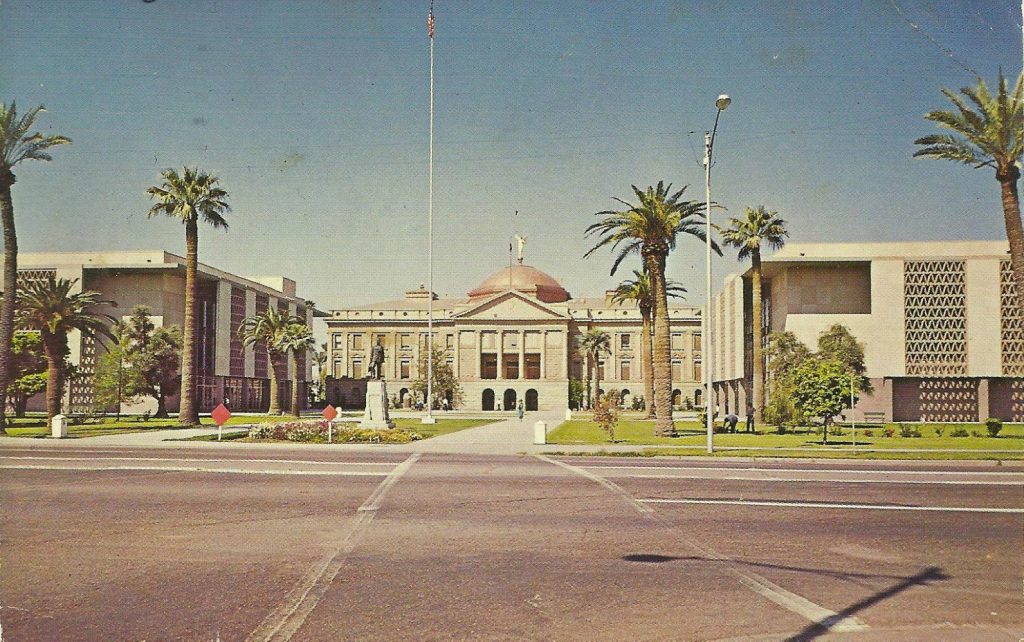
Capitol_1960s
The Capitol and legislative chambers in the 1960s, before the erection of the brutalist Executive Office Tower.

Channel 12's Brahm Resnik asked me to nominate the three most significant Arizona political events since statehood. It's a bit like wanting a cinephile to name only three favorite movies. I settled for 1) statehood, which was not a given when it happened; 2) The congressional delegation's ultimately successful decades-long pursuit of Colorado River water, and 3) SB 1070, which is a bright red marker for the hotbed of intolerance, ignorance, extremism and backwardness into which the state has descended. Other events could contend, such as Barry Goldwater's 1952 narrow victory over Sen. Ernest McFarland, marking the birth of the Republican Party's ascendancy.

One of the most telling political stories, however, doesn't concern politicians or elections, at least not directly. It's about the old capitol building. The copper-domed structure was actually built as the territorial capitol and completed in 1901. The architect was James Riely Gordon, who designed many court houses in Texas, as well as a grand one for Bergen County, N.J. Gordon set aside his usual Romanesque Revival style to create a territorial capitol made from native materials. It was originally intended to be much grander, but the territory cut back funding. Additions made in 1918 and 1938 preserved the Gordon design.

President Kennedy (perhaps apocryphally) quipped that it was the ugliest state capitol in America. This was certainly not true: The Alaska capitol resembles an insurance company office; the Ohio statehouse with its forever-incomplete dome defines homeliness and lack of proportion, and North Carolina's looks like the court house for a small, poor county. The only saving grace for New Mexico's building is that it is in Santa Fe. To me, the old Arizona capitol always held a certain modest grace, particularly when I was growing up and it dominated the vista at the foot of Washington Street. But it's also true, odd and perhaps telling that Montana, which still doesn't have 1 million people, has a much bigger, grander capitol. And otherwise poor, conservative states such as West Virginia, Arkansas and Mississippi boast majestically beautiful statehouses.

Halftime in Arizona

Note to national and international Rogue readers: As Arizona marks 100 years of statehood this month, you'll have to put up with more than the usual number of AZ- and Phoenix-centric posts.

AzSemiIn 1962, Arizona marked its 50th year as a state. It's a vivid memory for me, although I was but a child. I loved the commemorative seal with the cactus wren, so much more appealing than today's gaudy centennial emblem. Fifty years of statehood was a remarkable event for those still living who had witnessed statehood and lived in Arizona Territory, my grandmother among them. The state in 1962 had barely more than 1 million people, with Phoenix not yet at the half-million mark. Phoenix was becoming a big city with comforts unimagined 50 years before, especially air conditioning. Still, the frontier was close enough to touch, living history was all around and much of the state was still wilderness. Vast empty distances separated the settled areas and those were compact and clear in their purpose.

Prescott, for example, the onetime territorial capital, was an enchanting little town with appealing rough edges. None of today's sprawl existed. It had only recently lost its status as a division point on the Santa Fe Railway between Phoenix and Williams Jct. Mining and ranching were the economy. The highway up Yarnell Hill was notoriously treacherous. Flagstaff was a major railroad town, also depending on sawmills for the logging industry and Arizona State College. The Mogollon Rim was virtually uninhabited, just one of many parts of the state as wild as ever. The state highways were two lanes, taking you to rich history that wasn't across the street from a Wal-Mart. Even in Phoenix, you could see old cowboys, the real thing, living out their last years in the elegantly-designed-but-neglected old apartments that graced the neighborhood between Seventh Avenue and the capitol.

Central Avenue Part 2

Phoenix1

Midtown, including the Viad Tower, left, after the big boom.

The first defining event of today's Central Avenue was the real-estate boom of the late 1980s and early 1990s. With land from Fillmore Street to Camelback Road upzoned for skyscrapers and money flowing from the deregulated savings and loan industry, the city was remade by a huge real-estate boom. Stuck with the disjointed set of highrises outside the old central business district, the city tried to put planners lipstick on the pig in the 1970s by christening the area from the railroad tracks to Camelback and Seventh Avenue to Seventh Street as the Central Corridor. As I wrote in the previous post, the visionaries of the 1960s and 1970s imagined Central would become Phoenix's version of Wilshire Boulevard. That never happened. Phoenix lacked the economy, assets and ambition of Los Angeles. But it gave a big try in the '80s and '90s.

These were the years that saw the rise of the Dial Tower at Central and Palm Lane. It was the new headquarters of the old Greyhound Corp. and remains, with its distinct deodorant container shape and copper skin the only truly arresting skyscraper on Central. Two bank highrises were built just south of Osborn, along with a little World Trade Center-style tower at Virginia, displacing the Palms Theater, and a few midrises. USWest anchored one of two skyscrapers erected on the northeast corner of Central and Thomas, where the iconic Bob's Big Boy, beloved of cruisers, stood. But this was nothing compared with what was planned. Back in the 1960s, the idea of a monorail running down Central was floated. It was revived in the '80s as part of a developer's plan to build, north of Indian School, the tallest building in the country with the monorail connecting the mammoth skyscraper to Sky Harbor.

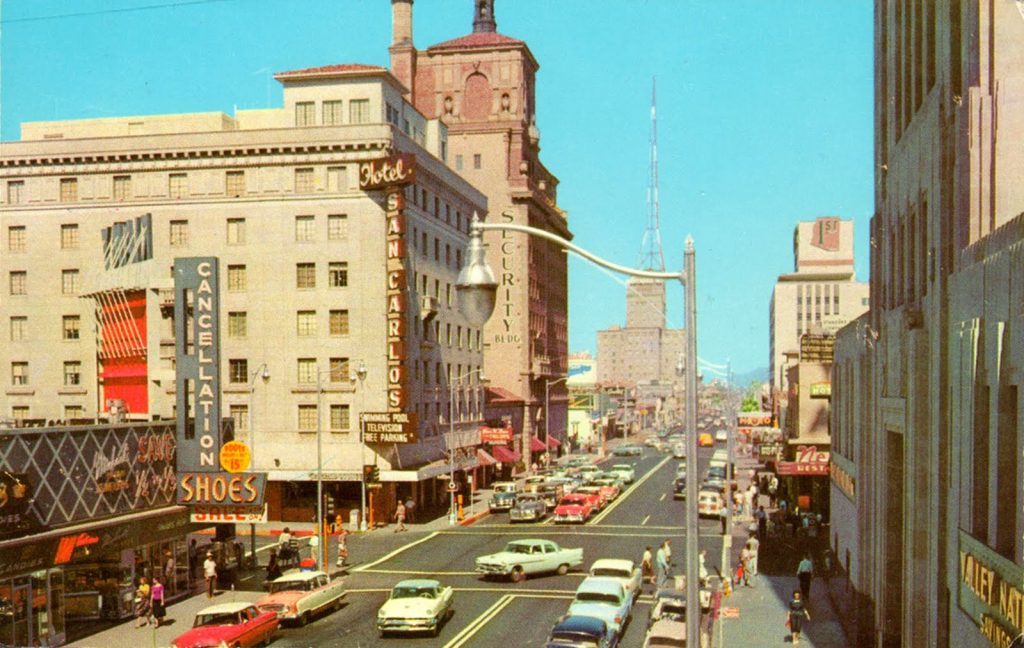
Central Avenue in old Phoenix

Central Avenue in old Phoenix

Central_ave_phoenix_AZ

Central and Monroe, around the year I was born (1956)

"The trouble with Central is that it isn't central to anything any more." So spoke a major leasing executive in 2000, over a breakfast I had been dragooned into to get my mind right about what had happened to my hometown. He was wrong. Central Avenue does much more than demarcate street numbers from east to west. It lies at the heart of a far-flung Valley metroplex. Central — original Center Street, renamed in 1910 — is the touchstone of Phoenix's history, with more stories than a hundred blog posts could tell. It remains the most interesting street in the city. And it will be the critical marker for a quality future, if the metropolitan area stands a chance of attaining one.

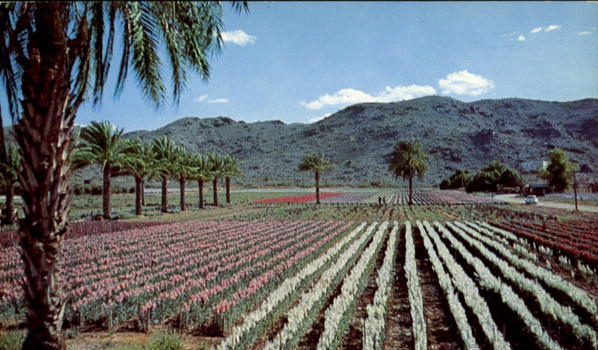
In the old city, Central connected the discrete parts that made Phoenix whole. Starting at South Mountain Park, the largest municipal park in the world, it crossed two-lane Baseline Road. In both directions spread out the enchanting Japanese Flower Gardens. Ahead were bands of farmland, pastures and citrus groves as it descended to the Salt River, with the skyline and far mountains arms-length clear in the distance.

After going through the tiny south Phoenix business district, you crossed one of two bridges over the river (Mill Avenue being the other). The 1911 Center Street Bridge ran 3,000 feet across the Salt River, included electric lamps, and was one of the town's proudest achievements. Before heading downtown, Central ran through neighborhoods and commercial strips.

For years, the colorful Central Liquidators was among the businesses south of the tracks. In the early days, both the Southern Pacific and Santa Fe railroads sited their depots on Central, before moving to the new Union Station at Fourth Avenue in the 1920s. Depression public works built an underpass that for decades held four very tight lanes. Before the overpasses at Seventh avenue and street, this was the only sure way under what were then busy rail lines. Everybody honked when they drove through the concrete tunnel.

Phoenix 101: Wallace and Ladmo

Wallace_and_ladmo

Lad Kwiatkowski, Pat McMahon and Bill Thompson.

I went to the Muppets movie over the weekend. It was all right. I never watched Sesame Street and the heyday of the Muppets television show was when I didn't even own a TV. In any event, I am a lost demographic to such benign stuff. I grew up in Phoenix, where we had Wallace and Ladmo.

Most children watched a clown show in their cities and towns. Not us. We were brought up on the very adult humor of the Wallace show, which ran from 1954 to 1989 on KPHO. The names changed, from It's Wallace? to Wallace & Company to the Wallace and Ladmo Show. What didn't change was the show's biting humor, satire and irony, along with classic slapstick and cartoons. For the rest of our lives all we could do was feel sorry for the children who were stunted by clown shows.

The regular cast featured Bill Thompson as Wallace, Lad Kwiatkowski as Ladmo and my friend Pat McMahon. Wallace, or Wall-Boy as Ladmo called him, was the host and butt of much humor. Ladmo was the everyman or everykid, full of fun and mischief. McMahon played a host of characters, many of which gave the show its bite. Among them was Gerald the brat, the nephew of the TV station's general manager; Aunt Maud, the doddering, bad driver old coot from Sun City; biker Bobby Joe Trouble; Captain Super, a parody of assorted super heroes, and Boffo the Clown, who hated children.

Election Day

UPDATE: Pearce becomes the first legislator in Arizona history recalled and Stanton is elected Phoenix mayor. Read on if you wish. Definitely join the comment thread.

I've been predicting that Russell Pearce will survive his recall election, but what will it really mean if he's defeated by Jerry Lewis? The district still ends up with a know-nothing lightweight. Yes, it will be a nice screw you to Pearce, the father of SB 1070. But it won't change either the pathology in the Legislature or in the East Valley. It was telling that Mesa Mayor Scott Smith, a conservative and Mormon but not a nut, chose not to run (he may have bigger ambitions, but could no better opposition to Pearce be found?). Whatever the outcome, the house (and Senate) that Pearce built will remain. The NRA will remain as powerful as ever. Ditto the Real Estate Industrial Complex and the private prison con. Jan Brewer will still be governor. Tell me what I'm missing. One observer predicted Pearce would run for sheriff when Joe finally retires.

The Phoenix mayoral election, on the other hand, is of major importance. Greg Stanton's internal polls, I am told, show him comfortably ahead of Wes Gullett. The danger here is that potential Stanton voters will stay home, so I am hesitant to even report this. That Gullett ever got this far is a sign that anyone with common sense had better get to the polls.

This contest has been narrowed down to the national meme of "public-sector workers bad." That's most unfortunate. There is indeed an ole-boys system in Phoenix government, but it involves the highly placed, most notoriously the double-dipping of former Police Chief Jack Harris. What's really wrong inside City Hall may be outside the ability of any mayor to fix because it's rooted in the council-manager form of government. Whoever is city manager, the Titanic keeps sailing along. One small example: Spending large sums for consultants to generate reports that could have been done better and cheaper by the city staff. That might have been different had David Krietor or Ed Zuercher (or Sheryl Sculley) been selected city manager. That they weren't tells you everything you need to know. The many interests that feed off the City Hall status quo want things to continue as before.

The periphery

When you're talking Europe, the periphery (Greece, etc.) is ailing, while the core, especially Germany and Scandinavia, is doing well. In Phoenix, the situation is reversed. To be sure, the depression has clobbered huge swaths of Phoenix suburbia, left Pinal County circling the drain and driven a stake into the dreams of Superstition Vistas and Buckeye with 400,000 poor boobs from the Midwest. Glendale is underwater on its super mortgage to hucksters and Westgate is in foreclosure. And the compromised, local-yokel professional seers have once again pushed out their prediction of "recovery," this time to 2015. Still, what little economic activity that's happening is occurring in places such as Scottsdale and Chandler.

The news for the city of Phoenix is gloomy. What few companies are coming to the metro area are setting up shop on the periphery. Banner Health, which killed a hospital on the Phoenix Biosciences Campus that would have led to a quantum leap in its synergies, has teamed up with the M.D. Anderson Cancer Center to establish a "world class" treatment facility in Gilbert. (The irony here is that Anderson is part of the Texas Medical Center in central Houston that should be the model for the Phoenix campus). ASU and the Mayo Clinic are setting up a medical school in north Scottsdale. Even as central Phoenix is clearcut with huge swaths of empty land, a big data center chose Chandler for a new operation, among the other new projects and expansions that the suburbs can boast. Even within the city, venerable law firm Fennemore Craig stabbed downtown (well, Midtown) in the back, relocating to 24th and Camelback.

As far as I can tell, this isn't even being discussed in the Phoenix mayoral race. Yet it's one of the biggest problems facing the city and metro area.

Sky Harbor

Sky Harbor

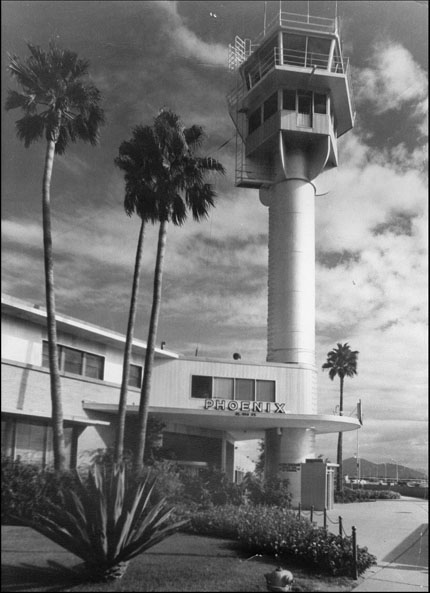
SkyHarbor_oldtower

I was always a child of the railroads, so Union Station held much more magnetism for me than the airport. Still, in the 1960s, Sky Harbor was a sweet little airport. It had a romantic name. The old blond-brick West Terminal and tiny control tower hearkened back to aviation's infancy — it had only been six decades since the Wright Brothers' first powered flight.

You boarded by stairs — jetways were several years off. The new East Terminal was graced by a dramatic mural of Phoenix's founding myth and flight science above the airy modern waiting room. It also had a second-story observation deck, where one could watch the airplanes, complete with telescopes. Our Cub Scout den was given a tour of the control tower. All this was before hijackings and the rise of the present Security State.

It was a beautiful airport with a certain '50s charm. One reached it from 24th Street along grassy parkways with trees. And back then, the route into downtown was still lined with pleasant motels and "auto courts," all human scale.

Sky Harbor had two runways, which were plenty back then. On the south edge was the Air National Guard midair refueling tanker wing (Richard Nixon gave a campaign speech in the big hangar during the 1972 campaign).

On the north side, beyond the general aviation hangars, were the Southern Pacific tracks, which carried three passenger trains a day in each direction. The best airplane watching was on 40th Street, which was a two-lane affair that dipped into the riverbed and marked the east boundary of the airport. The 727s and 707s came in right overhead.

Airlines were highly regulated. Hubs were far in the future. So regional players such as Bonanza, Hughes AirWest and Western were as important as United, American and Continental. I made my first airplane flight from LA to Phoenix when I was ten (we had gone there on the Sunset Limited, by far the more enchanting journey for me). Flying was special then. People dressed up. Airlines treated you very well. There were no cattle calls or lines from LockUp.

The mayor of hell

Whomever wins the Phoenix mayoral election will get a paycheck, face time on the media, a police detail to drive him or her around and not much else. Facts are stubborn things: Phoenix is the most economically wounded among America's largest cities. The "business model" that built Phoenix for decades is irrevocably broken. When even the developer-economist Elliott Pollack, favorite of the booster rubber chicken circuit, is saying the metro-wide housing market won't come back until at least 2015, things are bad.

Reprising a little history won't hurt. The political leadership of modern Phoenix was created by the Charter Government Movement, which claimed, and largely delivered, a non-partisan, clean, business-backed, professionally run City Hall. With a relatively diverse economy, the age of inexpensive energy, a majority middle class city and major business titans setting the table, little was asked of elected leaders except to continue this status quo. It somewhat fell apart with districting and Terry Goddard's velvet revolution in the 1980s, but the spirit of Charter lived on well into the 21st century.

This is not to say mayors were irrelevant as just one vote on council in a council-manager form of government. Milt Graham, John Driggs, Margaret Hance, Goddard and Skip Rimsza were all leaders of consequence. Sometimes this was for ill: the popular Graham's antipathy to transit set Phoenix back by decades; Hance did many things to hurt the central core. Goddard, by contrast, was an inspiring and transformational mayor. But through all this two things were constant: The economy levitated on "growth" and the old consensus prevailed.

The last titan

It was probably fitting that John Teets died amid the worst economic depression modern Phoenix has ever experienced. The retired head of Greyhound/Dial was the last of a breed that every competitive and livable city must have: A dynamic chief executive of a major local headquarters, passionately committed to the city, able to knock heads and write checks. I'll let Soleri take it from here:

As CEO of Dial, he was one of the last corporate titans who figured prominently in local affairs. He was a headknocker and socialite who helped make Phoenix more than just a branch-office backwater. I was living near Central & Palm Lane when the Dial building was built in 1990. It was part of Teets' stewardship ethic to make a big corporate statement close to but not in downtown. The original plan was to construct two towers, with one perpendicular to the other. As with so many real-estate dreams, this one was only partly realized. The result is a free-standing mountain of a building completely out of scale to its surroundings.

Teets spent lavishly on it but the tapestries he hung in the lobby, or the exquisite garden outside couldn't quite make up for the fact that it was another ostentatious project that seemed so much like the city it was built in: Isolated and strange.

Did Phoenix light rail fail?

My first experience with light rail came living in San Diego in the early 1980s. One segment linked downtown with the border crossing at San Ysidro. It was popular and uncontroversial. "I didn't think one of these could run without graffiti all over it," I heard a visitor from then dysfunctional New York exclaim of the new, bright red trainsets. As a reporter, I wrote about the Trolley, especially the ambitious expansion plans. San Diego is the most Republican of California's big cities, but the light-rail system was begun under Pete Wilson, a mediocre U.S. senator, bad California governor, but stellar San Diego mayor (he was also, along with developer Ernest Hahn, the father of the spectacularly revived downtown). Today, the San Diego Trolley extends 53 miles on three routes.

Then I lived in Denver, where the city started a segment downtown. It too, was popular and widely embraced. Now it comprises 39 miles with another 12 due in two years. I was in Charlotte for the planning of the now-operating Lynx light-rail, a relatively modest 10 miles, but more is in the works. It was the first modern light-rail system in the Old South and, again, widely supported, especially by the business leadership and developers who built hundreds of millions of dollars of projects near the line. Similar success happened in other cities, especially Dallas (!), with its 72-mile system and clammoring of suburbs to get the next line.

The story didn't play out that way in Phoenix. Yes, we built it, you bastards. But it's also time to take stock.

South Phoenix

South Phoenix

JGardens
South Phoenix encompasses so much history, so many cultures and distinct districts, it deserves more than one post. Every square mile is special. Still, a start. It's not a separate city such as South Tucson, so I'll go with the style "south Phoenix." When I hear the words "urban village," I reach for my Colt Python plus Speedloaders, so forget about the city's developer-speak term "South Mountain Village."

Then there's the matter of geography. For many Anglo Phoenicians, when the city still had some cohesion, "south Phoenix" began at the Southern Pacific tracks. This was, and latently remains, a place where "the other side of the tracks" is a powerful totem (it helped do in the unfortunately named Bentley Projects, the galleries, bookstore and cafe). A subset of "south Phoenix" emerged in the 1960s, to define everything below the somber wall of the Maricopa Freeway. And true south Phoenix is south of the Salt River. All must be dealt with.*

Phoenix's relatively small Mexican-American and African-American populations were historically located south of the tracks. Well into the 1970s, the commonplace offensive term for the latter was used by whites. Schools were segregated and inferior. Poverty and injustice were severe. Corruption by city officials legendary, at least through the 1940s. Most property ownership was controlled by deed covenants that largely excluded minorities (I told you this was a Southern town). Ownership was more possible south of the river, and minorities gathered there. (Most of the city's legendary and now largely lost barrios were north of the Salt, but a few, such as the River Bottom, were in south Phoenix proper). Minorities were also heavily employed as agricultural labor. This was farm country, especially after the completion of the Highline and Western canals by 1913.

The most successful farmers were the Japanese, who arrived early in the 20th century and were able to purchase farms in the 1930s, after Arizona's anti-"Yellow Peril" law was found unconstitutional. Arizonans my age remember them for the stunning Japanese Flower Gardens that ran for miles along Baseline Road. But the Japanese were among the most innovative growers, raising a variety of crops. This also raised much jealousy among Anglo farmers, who were happy to see them, including American citizens, interned during World War II. After this shameful episode, the Japanese, including many of their sons who had fought in the U.S. Army, returned to south Phoenix and farmed again.

All stars

Even the most skeptical auditor of Phoenix's challenges and follies must admit some pride in Major League Baseball's All-Star Game being held there. And in downtown Phoenix, not some "Valley," not in exurban "Glendale, Ariz." Considering how city leaders allowed the central city to circle the drain for decades, visitors will see some impressive efforts at revitalization: CityScape, the Phoenix Convention Center, Sheraton, biosciences campus, ASU downtown and light rail (we built it, you bastards). Oh, for big-city boutique hotels at the Westward Ho and Professional Building. The baseball stadium is ugly, a lost architectural opportunity, but at least it's downtown, an eventuality I highly doubt if it were being built today under present ownership. They can hop a train to Midtown to take in the spectacular Modern Mexican Painting exhibition at the Phoenix Art Museum, a pleasant contrast to the general, and generally deserved, reputation of intolerance and racism for the state at large. If you want to boycott, do so against the East Valley and Scottsdale (but not the Poisoned Pen bookstore), not tolerant central Phoenix.

Some quick advice to out-of-towners: It's a dry heat, but so is hell. So is a thermonuclear explosion. Stay hydrated (I freeze bottles of water to carry with me; they melt quickly but you're not left drinking hot water). Avoid much exposure to the sun. Wear light-colored clothes, especially white, and cover as much skin as possible. Keep some popsicles in the freezer at the hotel; have one to help cool down when you come in from outside. Don't do something stupid like climb Camelback Mountain or go "exploring" in the desert. God created air-conditioning for a reason — use it. A dark, cool Mexican restaurant is an especially satisfying hangout in the summer. If the media say the high will be 105, that's in the shade at Sky Harbor. The surface temp on the street is around 140. I hope to hell somebody will give them such advice, so there's not a great All-Star die-off. Too bad City Hall encouraged all that concrete, all that gravel and no shade trees.

Still, the big game is, at best, a temporary respite from the troubles of city and state.

Off the edge

Yet another pipe dream has exploded in the Phoenix Depression. This time Steve Ellman's Westgate "City Center," — the Republic story pimped the development as "the flashy dining and shopping complex that anchors Glendale's football stadium and hockey arena" — is facing foreclosure.

This is time to revisit my 2010 post on Glendale's folly. It's also relevant coming directly after the popular Phoenix 101: Malls. Yet more needs to be said; not to make thin-skinned Phoenicians feel depressed, as is the usual criticism, but to learn something from these costly debacles to move the metro area forward into some kind of broad, non-heat-island-scorched uplands.

The only ones that could be surprised by the Westgate mess are those millions who drank the developer-speak Kool-Aid ("flashy dining and shopping complex" blah blah blah). Every time I was forced to go there for an event, the place was dead. It was far from anything else besides a too-narrow freeway, unless you wanted to farm some cotton or throw up the frames of subdivisions on former farm land. Nor is it flashy, aside from the sun blinding you when it hits the bumper of some jacked-up truck in the parking lot. It is off-the-shelf suburban stuff found everywhere, with the unfortunate distinction that all the asphalt and concrete, besides being ugly, adds a special hellish ambiance even when the surface temp is not 140 degrees.