Tear-down city

It's an outrage that two of the very few remaining buildings of the Deuce, the Madison and St. James hotels, are being torn down to make a surface parking lot. Phoenix sure doesn't have enough surface parking lots. Apparently a "compromise" with the Phoenix Suns, which owns the property downtown, will "preserve" a fragment of one building. That's almost more pathetic and insulting than blading the whole thing. These commercial buildings from the early 20th century only make sense as part of a whole, i.e. a walkable block of these human-scaled, useful and historic structures, a "smile full of teeth," as it were, right up to the sidewalk. In isolation, they lose these winning features. A few pieces of rubble in a surface parking lot…is that a joke?

Team owner Robert Sarver must be sitting in his San Diego palace savoring getting some of his own back, after not being able to demolish the Sun Mercantile to build a W Hotel. According to my sources, Sarver was presented with a stunning architectural option that would have twirled the hotel tower well above the roof of the historic structure. He shot it down in favor of something more conventional and dull and destructive. Which never happened anyway. It's amazing the Sun Mercantile survives, and a credit to preservationists. Does anyone think Sarver, had be owned the Suns at the time, would have pushed for a downtown arena as Jerry Colangelo did? Just as I'm sure Ken Kendrick and pals wish Chase Field was on the rez near north Scottsdale. Seattle's looking for an NBA team. Don't assume anything with "stewards" like this.

I realize this post is coming very soon after a meditation, sparked by the fight over the Wright house, on all that Phoenix has lost. And yet the losses just keep coming. A century-old store in Higley was no match for the sacred widening of the holy wide "streets" which are the width of major highways. But the downtown calamity especially stands out.

Phoenix 101: Lost

Penn_Station1

The main waiting room of New York's Pennsylvania Station, shortly before it was demolished in 1963.

The effort to save the David and Gladys Wright House has become a cause célèbre, or as much of one that can find traction in the sprawling, just-rolled-in-from-Minnesota "civic" climate of metro Phoenix. A Facebook page has been set up. The New York Times flew in architecture critic Michael Kimmelman to write an appreciation of this Frank Lloyd Wright work, including such details omitted by the local media as the demolition company (!) being the one who realized the treasure they had been engaged to rip down and going to the city. The odds of success are long. Perhaps if this were the Joe Arpaio House and it was being torn down to create a day labor center for illegal immigrants. Otherwise, only the Resistance and minority of Resistance-minded citizens have a clue.

The modern preservation movement in America is often traced to the 1963 destruction of Pennsylvania Station, the classically-inspired masterwork of McKim, Mead and White in New York City. It was replaced by a brutalist Madison Square Garden with the railroad station in rat-passages underneath. New York has never gotten over this loss, nor should it. But it ensured that thousands of buildings nationwide were saved, including Grand Central Terminal. This never happened in Phoenix, yet it's not because we wanted for something grand like Pennsylvania Station to be destroyed by barbarians.

The Japanese Flower Gardens was one of our Pennsylvania Stations, a breathtaking Eden at the foot of the South Mountains. The gardens ran for miles along the legendary and evocatively named Baseline Road and offered staggering views of the city — and for anyone, not just the toffs. Lost. Replaced by miles of schlock subdivisions, faux stucco apartments, fast-food boxes and huge expanses of asphalt. Nothing was learned from this colossal act of vandalism. Not one change came to land-use regulations or an attempt at farmland preservation.

Blue highways

Blue highways

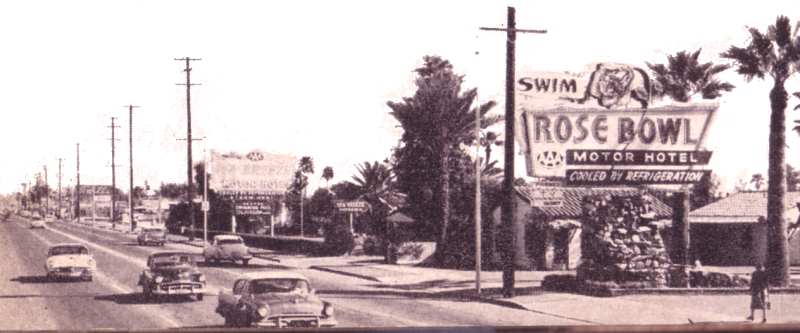
VanburenstreetVan Buren Street east of 24th Street in the 1950s. Across the street is the State Hospital.

Between the glory days of the railroads and the completion of the Interstates, most visitors and newcomers to Phoenix arrived on the United States Highway System. Not for us the legendary muse Route 66 or the Lincoln Highway, the first transcontinental improved road that became U.S. 1, 40 and 50.

When the system was created in 1925 to standardize the many named highways that existed, Phoenix probably had a population of 35,000. It was isolated and difficult to reach, with formidable mountains to the east and north and forbidding desert to the west. Phoenix's coveted agricultural produce was shipped by refrigerated railcars. What Phoenix did eventually gain were U.S. 60, 70 and 80, along with U.S. 89.

U.S. 60 evolved from the many "auto trails" and plans for highways in the early 20th century, including the Atlantic and Pacific Highway. U.S. 70 joined it on the east at Globe. U.S. 80, which gained its own folklore history elsewhere in the country, came east from San Diego to also join U.S. 60 in Phoenix. In addition, U.S. 89 came north to Phoenix from Tucson. The map looked like this in 1950:

Phoenix_map_1950

And all four U.S. highways converged on Van Buren Street, which for decades was the gateway to the city and lined with "auto courts" and motels, all set off with neon signs to lure weary travelers. The Sierra Estrellas Web site offers a detailed history of the many motels and Douglas Towne wrote an interesting meditation on Van Buren for Modern Phoenix. Another aspect of U.S. 60: It was the demarcation for the internment of Japanese-Americans during World War II. All living and farming south of U.S. 60 were interned, including those on Baseline Road.

With Van Buren being the repository of so much local highway history, two other gateways risk being forgotten: Grand Avenue and Buckeye Road. The WPA-built rail underpass on 17th Avenue south of the capitol shows the route where U.S. 80 separated from Van Buren, turned south and then west on Buckeye, which was also lined with small motels. Grand, the only diagonal in the young city's street grid, was another neon-lit boulevard carrying U.S. 60 to Los Angeles via Wickenburg and U.S. 89 to Prescott up terrifying Yarnell Hill.

Burn out?

A couple of posts ago (Dekookification), commenter Gaylord wrote:

I only read this for amusement. One of these days, Mr. Talton, I surmise
you will burn out on covering Phoenix and AZ because it's too far gone
and you have moved on in so many ways. I have done this: moved to L.A.
after having lived in PHX for 18 years. It's such a downer to think
about what the city and state could have become, if only there had been
more enlightened leadership or at least those that would listen to and
heed wise people such as yourself. All we can do now is shake our heads,
be glad we are no longer living there, and remember how much
destruction the Republicans wreak when they're given the upper hand.

It's a fair question or perhaps prediction. Soleri, whose sparkling, intelligent comments I always looked forward to, has withdrawn. On the other hand, I wonder if Gaylord really just reads for amusement. In my experience, once Phoenix gets under somebody's skin, it's a lifelong condition.

Dekookification etc.

I'm glad to see my former Arizona Republic colleague Laurie Roberts carrying on a little of my work by calling for dekookification this election. Her job should be safe as long as she doesn't go after the three great enablers of the Kookocracy: 1) The Real Estate Industrial Complex, 2) The individuals with means and major institutions (you know who you are) — the fellow travelers — that don't want to rock the boat, and 3) The Mormons.

Let me be clear about No. 3. We can thank Salt Lake City, not dekookification, for the defeat of Russell Pearce. This symbol of Arizona extremism had become an embarrassment to the Church of Jesus Christ of Latter-day Saints. His words and policies went against church teachings. So he was finally forced to walk the plank. Don't be fooled: This was a Mormon takedown, not a triumph of moderation or St. Janet's "Sensible Center." And I say, good. The LDS has a long, constructive (even bipartisan) history in Arizona. Mesa Mayor Scott Smith carries on that ethic. Still, the church has followed the GOP into ever more extreme territory and remains an enabler of the Kookocracy, especially because of its superior organizational strength in a state that has lost offsetting centers of power and is marked by civic apathy. Stating this does not make one anti-Mormon.

As for Pearce, the evil that men do lives after them (and he will no doubt be back). SB 1070, the Jim Crow, voter-suppression, keep-'em-in-their-place, anti-immigrant measure, dripping with equal measures of hate and hypocrisy, is law. It and the climate it spawned have made Arizona an international symbol of intolerance, racism, cruelty and ignorance. Mission accomplished.

Mayor Stanton’s report card

Greg_StantonEight months after assuming office, Phoenix Mayor Greg Stanton is still enjoying a honeymoon. That means he's making the honeymoon last. So much for critics who thought he was just a pretty face. The contrast with Phil Gordon, his poignantly snakebit predecessor, is striking. Stanton can routinely speak in complete sentences and articulate coherent thoughts. Becoming the 52nd mayor of Phoenix hasn't caused Stanton to shelve his appealing nature. People who talk to me about the mayor use words such as "smart," "easy going," "open" and "welcomes new ideas." He remembers people's names and what they've been working on. His human touch and emotional intelligence are genuine, not the surface happy talk of a politician.

I was concerned about the "biosciences" bone tossed to Desert Ridge when so much needs to be done for the real biosciences campus downtown, the one site that could be a real game-changer for Phoenix. But my sources involved in downtown, light rail and sustainability aren't worried, so good on Stanton. Another concern was Stanton taking the lead among mayors on backing military spending, when Phoenix needs a spokesman on so many more compelling and productive issues. But this seems to be part of his effort to make regional cooperation a priority (good luck with that).

Stepping back, probably the best way to see Stanton so far is that he's doing a good job of getting his feet under him in a race that's already moving fast and carrying huge stakes.

How annexation changed Phoenix

How annexation changed Phoenix

PHX city limits 1972

Annexation was intended to save Phoenix. It may end up badly wounding it.

The roots of growing fast by annexing land go back to the 1940s. Phoenix had grown from its original half-square-mile to 9.6 square miles in 1940, with a population of 65,414. It was surrounded by agriculture and well separated from small farm towns such as Glendale, Tempe and Mesa.

But even before the old city commission was swept away by the "reformist" Charter Government Movement, leaders looked east and worried. They knew the Salt River Valley would grow, especially once World War II ended.

They saw how cities in the Midwest and east (St. Louis, Cincinnati, Philadelphia, etc.) had become surrounded by incorporated suburbs that were already sucking away people and tax dollars. They, and all their successors, were determined not to repeat that mistake.

Like a Phoenix?

All the boosters' stories and all the boosters' flacks can't get our mythical bird out of the ashes. Five years after the biggest collapse since the Hohokam unpleasantness, Phoenix still has the character of a fallen souffle. Perhaps that's for the best without a better plan, because the worst thing that could happen is a return to mass sprawl building. The most striking feature — and tell me if I'm missing something — is the lack of anything big happening. I don't mean nonsense such as "Buckeye will have 400,000 people!" I mean nothing is seriously moving ahead to follow on the genuine pre-crash achievements: ASU Downtown, light rail (WBIYB), the expanded and attractive convention center, the beginnings of the downtown biosciences campus and, disappointing though it is, CityScape.

Instead, Mayor Stanton is off on a misguided quest to "save" the state's defense jobs. Mesa at least is running light-rail 3 miles into downtown, but otherwise real advancement on LRT, much less commuter or intercity rail, is so slow as to be meaningless. The Gaylord "resort" collapsed in exurban Mesa — good. Glendale is in hock forever to save the Coyotes hockey team/development-con-gone-bad — good (never thought I'd find myself on the same side as the "Goldwater" Institute). Scottsdale is still rich (except for those long stretches of empty car lots on McDowell) — but who cares? The west side is getting its far loop freeway — bad news. Is this it, other than to hope for another real-estate boom?

Progress faces substantial challenges, some new, some old. The congressional delegation, Ed Pastor excepted, won't do a damned thing to bring home federal money to build a quality economy. The Legislature is anti-city, anti-science, anti-education and opposed to any real economic development besides the "What is that Smell?" state Commerce Authority. Suburbs keep cannibalizing business from the city and each other. There's no focus on the biosciences campus, the one real area of promise, and the big hospitals are happy to torpedo it. The new "takings" law puts further handcuffs on urban solutions. The city lacks a serious economic-development strategy for the city. Government revenues were vaporized. And there's the weight of so much empty land, so much inefficient sprawl, a huge underclass, the massive catch-up necessary but impossible to fund. Kook politics has cost the state dearly.

Military Keynesianism

Sometimes it's the (kind of) little things. The Hotel Palomar is open at CityScape. It's a boutique hotel run by Kimpton, which manages some wonderful places around the country, such as the Monoco in Denver, the Triton in San Francisco and the Alexis right down the street from me in Seattle. Many of the others, where I've had the pleasure of staying, are in restored historic buildings. The Palomar looks like a jail or the spawn of the ugly new county courts building. Meanwhile, the art deco headquarters of the old Valley National Bank sits vacant — it's even closer to the convention center — and the treasure of the Westward Ho is low-income housing. Across the street from CityScape? The historic Luhrs buildings look empty. The question just keeps coming back: Why can't Phoenix get its act together?

Check your defensiveness at the door, because I'm just winding up.

Phoenix Mayor Greg Stanton has assumed a leadership role in an effort by the U.S. Conference of Mayors to blunt or stop defense spending cuts. He apparently traveled to Washington, meeting with wealthy Republican John Sidney McCain III, nominally a U.S. senator representing Arizona, to discuss this issue. McCain did nothing to help secure funding for light rail (WBIYB), commuter rail, Amtrak, research, education or anything else that congressional members do for their states in such socialist havens as, say, Texas. But war? No problem, Greg. Come right in. This is a big thing.

Climate, trains, downtown

Historically, May was when the temperature in Phoenix crept up to 100. Almost all week, it's been around 105 for the high. "Climate change is a hoax," as they say. The past 12 months were the warmest ever recorded, yet there is no debate, no discussion, least of all in a city likely to be heavily affected, Two days of hot wind cleared out the smoke from the wildfires, leaving only the usual smog. Better than nothing. At a book signing Tuesday night at the Arizona Biltmore, several people came up to say how much they depend on Rogue Columnist to speak truth to power, reality to the Kookocracy. It's something for me to keep in mind if some think I am just shouting the same old stuff with tiresome certitude.

Light rail seems to be doing well every time I ride it — and I depend on it (WBIYB). I can't speak for the line from Camelback to Chris Town, but otherwise it's packed-to-busy. It's curious at stations to see signs that identify trains going to Tempe and Mesa, or 19th and Montebello, but never downtown Phoenix. If you get on light rail at the Sky Harbor stop, you'd never know which way was the city center. Not smart. Tempe is trying to build a streetcar — a good sign. Otherwise, transit policy is a hash. Buses have been gutted (Your Tax Cuts at Work).

I'm not sure I understand the so-called West Link line. Is it really intended to go to Tolleson? If so, this shows how the region still doesn't get rail. Heavy commuter rail should be a priority to all the outlying suburbs, with a hub at Union Station, where passengers could connect with buses and eventually a light-rail spur as was done in San Jose. Commuter trains would provide fast service to Glendale, Peoria, Tolleson, Goodyear, Buckeye, Chandler, Gilbert, etc. The rail right-of-way is there and would require public money to expand capacity, as well as negotiations with the private railroads. But this has been done successfully around the country.

Ambulance days

Ambulance days

Ambulance_Medic79

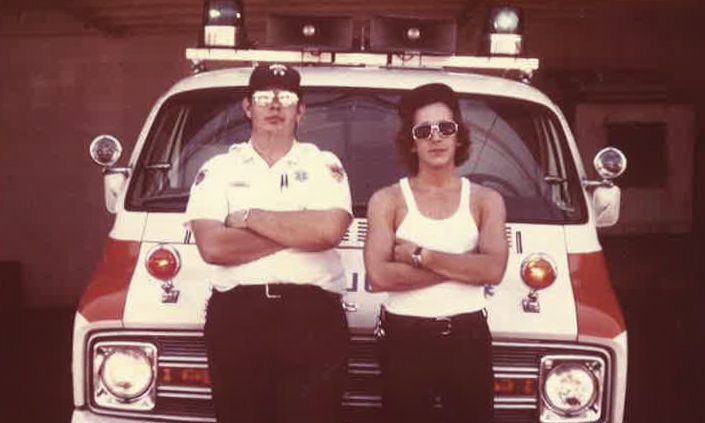
The author, left, and partner Russ Covert with Medic 79 at the downtown Phoenix ambulance station in the "hellish" July of 1976

In 1974, two months shy of 18 years old, I became the youngest registered emergency medical technician in Arizona. I started as a dispatcher at Kord's Ambulance, which had the distinction of being owned by a relative of Linda Ronstadt. Soon, however, I was gravitating to the Kord's operation in Scottsdale, where my Coronado High friend Marc Terrill was working.

There, under the leadership of the legendary Chuck West, the company had established the first advanced life support unit in the Southwest. It was a sea change from the throw-and-go days of ambulance drivers. This ambulance was equipped with IVs, EKG, telemetry, defibrillator, intubation gear, drugs — all the items seen on a modern rescue rig. An RN accompanied the two EMTs, who were trained as paramedics in a program at the old Scottsdale Memorial Hospital under Dr. Bert McDowell.

From riding along and attending classes on my days off, I wrangled a transfer to Scottsdale in the fall. I was one of "Chuck's boys" (two female medics were there, too, a major breakthrough). The ambulance itself was revolutionary: Life-saving treatments could be begun at the scene.

My early time was very difficult. The old guard was dominated by former combat medics (precursors of civilian physician assistants) who had served in Vietnam: Men who had performed surgery after rappelling into hot landing zones and no doubt they were PTSD'd to the moon. Unlike today, they had no use for the young person in their midst.

They were tough, demanding, unmindful of, and quite contemptuous of, what is now called "my self-esteem." So I had to earn it. I learned more from them in a short period of time than I ever have in my life, in any of my callings. From not even being sure of hearing a blood pressure while the siren was wailing, I learned to start IVs, intubate, triage, do CPR right, everything. I finally merited their respect. It remains one of the most thrilling accomplishments of my life, and makes me feel sad for young people today who are tossed into over-their-head jobs because they are cheap and never given proper seasoning or mentoring, whether rough or gentle.

They taught me a useful phrase and behavior from "the 'Nam" that has served me well: Run frosty.

Stanton in the Valley

I want to expand on comments I made to Steve Goldstein's Here and Now on KJZZ Wednesday about Phoenix Mayor Greg Stanton making a trip to Silicon Valley and the Bay Area to recruit businesses.

Foremost, this is a great start, something I've been advocating for more than a decade. The future to diversifying the Phoenix economy lies in California and Asia, not in Dubai. That the trip is so public is a bit puzzling; real success will come from years of quietly cultivating contacts. Phoenix needs to open offices in Southern and Northern California to recruit companies. I was also disheartened that Barry Broome of the Greater Phoenix Economic Council invited himself along. GPEC must please the suburbs at least as much as the city, and given the preference of the leasing boyz for suburbia, the organization is incapable of addressing the city's needs, particularly for jobs and capital investment in the central city.

Now, a reality check. Phoenix is not going to attract headquarters from Silicon Valley. You can't touch a fixer-up cottage in Palo Alto for less than $1.5 million and it doesn't make the economy skip a step. Workers would rather commute from Modesto than move to Chandler. This is the world's foremost technology cluster, and it happened because of all the things Phoenix lacks: World-class universities, trillions of dollars in government investment, an exceptionally high number of college graduates, attracting vast amounts of capital and a large entrepreneurial class focused on anything but real estate. It has a real downtown, in San Francisco. It is diverse and tolerant. There is no Santa Clara County Sheriff Joe. A real cluster is not a couple of semiconductor fabs in the suburbs. Phoenix can no more be "a mini-Silicon Valley" than the downtown Phoenix Public Market, and I love it, can be a mini-Pike Place Market. Cisco is not going to move from the Valley to "the Valley."

Michael Crow

Michael Crow

Michael Crow
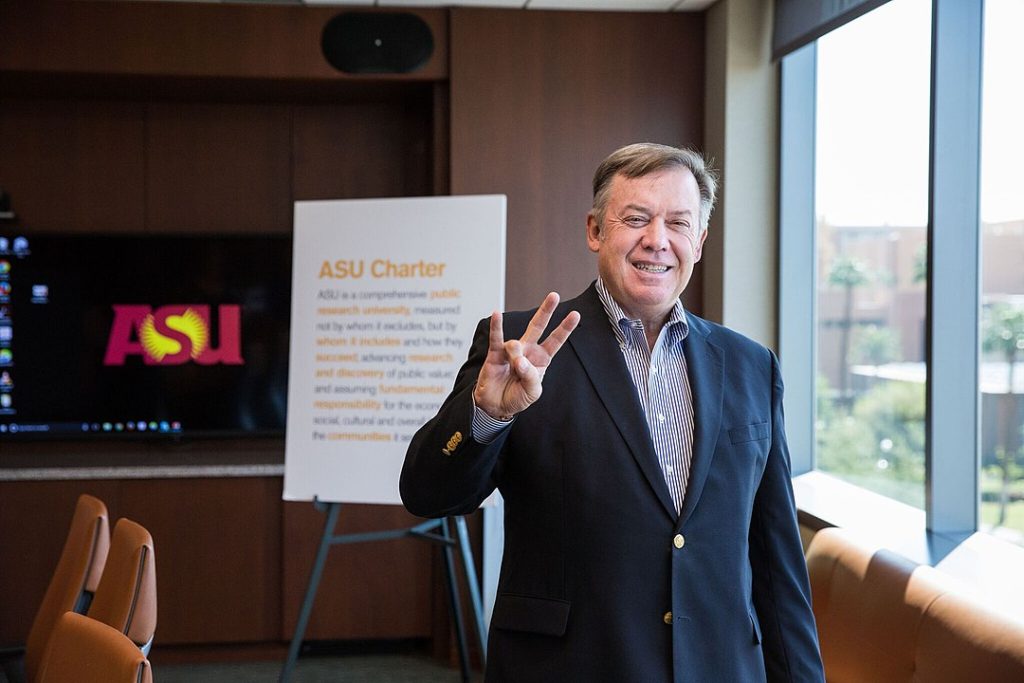
When Michael Crow became president of Arizona State University in July 2002, the watch began almost immediately: How quickly would he use ASU as a springboard to a bigger and better job? It hasn't happened.

Crow said he had a ten-year plan for "the new American university" and he has been as good as his word. Crow was one of the three people that progressive Arizonans vested their faith in during those hopeful years.

Janet Napolitano played defense against the Kookocracy, but abandoned the governor's office to become President Obama's Secretary of Homeland Security with little left behind as a legacy. Phoenix Mayor Phil Gordon suffered a lost weekend of a second term, badly downgrading any assessment of the man in full.

I always thought it was a sign of Arizona's unhealthy lack of private-sector stewards that all three stars were on the public payroll, but such was the case. Only Crow, to many the least likely, stuck and kept faith.

Crow was dealt a bad hand, if a very good salary: The Legislature had been cutting general-fund appropriations to the universities since the 1980s and was virulently anti-education. The state constitution mandated that ASU, especially, take virtually every qualified in-state student without giving it the means to pay for this obligation.

The university had grown into a gargantuan thing. It had few friends at the capitol as opposed to, say, the University of Texas at Austin, Texas A&M and the University of North Carolina at Chapel Hill. Yet even Crow's critics must admit he played this hand masterfully. It wasn't long after his arrival that the UofA, which always considered itself "the university," was enviously muttering, "We wish we had a Michael Crow."

The vision of a New American University was buttressed around finding new revenue. I learned this early, when Crow asked me how ASU could be of more help in illuminating the economy. I sent him a list of some 30 indicators that were not tracked in the echo chamber of population growth and construction permits. This ended up in the economics department where the mandate was to produce it, and find a way to sell it.

The exit interview

The urbanist Yuri Artibise left Phoenix last year, returning to Vancouver. It's part of a continuing brain drain, although to be sure such assets as ASU continue to bring in new creatives. I don't know where the tally stands, but I fear Phoenix continues to lose more than it attracts. Architect Taz Loomans recently conducted an interesting "exit interview" with Artibise. It made me realize that it's been five years since I got the first inkling that the Arizona Republic would take away my column, which would eventuate in me leaving town. So I thought I'd use Loomans' questions as a test for myself.

What do you miss most about Phoenix? My good friends. (I tried to select one "most"; for more, see my additions in the comments section).

What did Phoenix have that Seattle doesn’t? It is the repository of so much of my history, so many of my hopes. My mother and grandmother, long dead, are so alive on the streets of Willo, Roosevelt and Storey. The church where I was baptised is still going, as is my grade school, still in its inspiring, grand building, and enchanting Encanto Park. Union Station, where I spent countless hours as a child watching trains and dreaming of far-away places. The streets I worked as a paramedic, learning too much too young. The different mountain vistas that always orient me. Phoenix is the home of my heart, a place so mangled, mismanaged, raped and pillaged, but still worth fighting for. No matter how long I am gone, when I return I can drive the streets and walk the neighborhoods as if I had never left. The ghosts of the Hohokam still speak to me on winter nights when the cold wind blows from the High Country and the peculiar acoustics of the valley mingle train whistles and voices of the beloved dead.

Phoenix update

Back from a week in Phoenix, some observations:

1. The place still gives off the quality of a fallen souffle. Sure, a few projects are getting press out in some of the more affluent suburbs, but the utter collapse of four years ago still lingers. It's not for lack of trying by the Usual Suspects: Bottom has been hit, a turnaround is only (xx) years away, cheap land and sunshine will continue to be the basis of the economy, blah, blah, blah. But the old growth machine will not sputter back to life for one more run (with championship golf!). Too many crapola tract houses, too much debt, too few well-paying jobs, no speculative bubble driven by liar loans and securitized mortgages sold on a historic scale. What's Plan B? There is none.

2. A lack of seriousness pervades the state. Phoenix Mayor Greg Stanton tweets, "In Phoenix, we have a full commitment to sustainability: Sky Harbor Airport Dedicates Solar Power System." Space does not allow us to fully deconstruct these 104 characters, but we can make a start. Sky Harbor is a red giant of concrete and air pollution, contributing mightily to the heat island and dirty, unhealthy sky, and this is somehow redeemed by a "solar power system" that will power…the airport? No, the linked news story says it generates "enough to handle half the power needs of the rental car center, east economy parking lots and toll booths." Oh. (A real reporter might want to know if this includes generating electricity for the rental car center air conditioning, too, which seems unlikely, and how long the solar operation will have to run before it "repays" the fossil-fuel inputs it required and may still require).