What killed downtown, Part III

What killed downtown, Part III

Coffee_shop01

Central and Van Buren circa 1971. This once-vibrant business block is about to be replaced with Valley Center (now the Chase Tower). The old Trailways bus depot that stood at the far left has already been demolished.

Part I and Part II of "What Killed Downtown Phoenix" were the most popular posts in the history of Rogue Columnist. So much for the notion that Phoenicians don't care about the center city. Now it's time to bring the story to a conclusion.

By the mid-1970s, downtown was in a freefall, despite the construction of the Phoenix Civic Plaza, Hyatt Regency, new Hotel Adams, new Greyhound bus depot and skyscrapers housing the headquarters of the state's three big banks.

Unfortunately, in the process many historic buildings were demolished, including a priceless red sandstone multi-story building at Second Avenue and Washington. Block-long parking garages and assembly of superblocks created long, empty spaces along sidewalks where once there were dozens of shops.

Several valuable territorial-era structures were demolished to create the desolate, sunblasted Patriots Square (workers discovered an "underground city" from frontier Phoenix that had housed opium dens and gambling parlors, protected from the heat in an era before air conditioning). These and others lost were precisely the kind of buildings rehabbed in downtown Denver into Larimer Square.

FoxTheaterOne of the greatest calamities was the demolition of the Fox Theater, the finest movie palace downtown. This happened without a peep of protest. On the land, the city built a "transit center," which was little more than a Maryvale-style ranch house "station" and parking stalls for city buses. The Paramount somehow survived, running Spanish-language films (it would be reclaimed as the Orpheum). Another calamity was the Westward Ho, which closed as a hotel and only avoided the wrecking ball by being turned into Section 8 housing. The smaller San Carlos, thankfully, was saved as a historic hotel.

What killed downtown, Part II

What killed downtown, Part II

Washington_2ndSt_PHX_1958

Downtown was still busy in the late 1950s, at Third Street and Washington. Even though this was part of the Deuce, note the variety of businesses and pedestrians.

In the previous post, we left downtown Phoenix in 1940 as the vibrant business and commercial center of a small, relatively dense city, surrounded by pleasant neighborhoods, served by streetcars, and dependent on agriculture. World War II brought massive changes to the Salt River Valley. Thousands of troops were trained here. Phoenix was still a frontier town, wide open to gambling and prostitution, and governed by a shady city commission. At one point, base commanders declared the city off limits to troops. This began a reform movement that eventually led to a council-manager form of government and the decades of "businessmen's government" from the Charter movement.

The Battle of Britain and the threat of strategic bombing made a deep impression on American war planners. So in addition to wanting to move plants away from the vulnerable coasts, they also widely dispersed new war industries and Army Air Forces bases around the valley. One example was the Reynolds Aluminum extrusion plant built at 35th Avenue and Van Buren, far from the city center. Dispersal brought the first Motorola facility, but not to the central business district. This set in place a habit of decentralization that continued after the war when city fathers set out to bring new "clean industries" to the city. They failed to land a Glenn Martin Co. guided missile venture for the vacant Goodyear plant in its namesake town. But Goodyear returned in 1950, eventually building airframe components there. Garrett's AiResearch, which also had a plant outside the city during the war, returned after a vigorous Chamber of Commerce effort, to a site near Sky Harbor. No thought appears to have been given to locating the city's new industries near the core.

After the war, America embarked on a massive economic expansion and migration, both benefiting Phoenix. Demand had been pent up from both the Depression and wartime rationing. By 1950, Phoenix entered the list of the 100 most populous cities, at No. 99, with 106,818 in 17 square miles. Many servicemen who had trained here fell in love with the place and moved back as civilians. Inexpensive evaporative cooling became widely available and was installed in every house built in far-flung subdivisions.

What killed downtown, Part I

What killed downtown, Part I

Downtown_1930s

Downtown Phoenix in the 1930s, a view facing south.

When you see downtown Phoenix today, be kind. No other major city suffered the combination of bad luck, poor timing, lack of planning, vision and moneyed stewards, as well as outright civic vandalism. The only thing missing was a race riot, which happened elsewhere in the city during World War II and is not spoken about.

First, definitions. Downtown Phoenix runs from the railroad tracks to Fillmore and between Seventh Street and Seventh Avenue. Any other definition — even though much of the local media are oblivious to this — is ahistorical, inaccurate and, as my sister-in-law would say, just wrong. Twenty-fourth Street and Camelback is not downtown. Central and Clarendon is not downtown.

If one were going to site the center of Phoenix today, one would pick Arcadia, with majestic Camelback Mountain nearby. But that was not the case with the original township in the 1870s. The town was centered in the great, fertile Salt River Valley, soon to be reclaimed by revolutionary waterworks from the Newlands Act and connected by railroads to the nation. It was here that downtown grew and for decades flourished. But Phoenix was small and isolated. It did not grow from 10,000 in 1910 to more than 185,000 in 1930 like Oklahoma City. In 1930, Seattle's population was more than 386,000 and Denver nearly 288,000. Phoenix held 48,118 souls in the same year and was far from any other metropolitan area.

It's a fascinating counterfactual to wonder what might have happened in downtown Phoenix if not for the Great Depression and World War II. The decades before 1940 were the golden age of American city building, including art deco architecture and the City Beautiful movement. One can see it in such buildings as the Luhrs Tower and Luhrs Building, the Professional Building and the Orpheum Lofts (and, north of downtown, in the Portland Parkway). Conventional wisdom holds that the Depression didn't hurt Phoenix much, but this is not true. With deflation and little building happening, it stopped downtown dead. This was continued by the material shortages of World War II. By the time the economy began the long post-war expansion, downtown was facing too many obstacles and didn't have many of the grand bones of the other cities I mentioned.

Billion-dollar baby

Billion-dollar baby

Forbes reports that the number of the world's billionaires has reached a new high (1,426) representing a record $5.4 trillion in net worth. What slow recovery? If I were one of these mammals, here's what I'd do with my money:

The long empty lot on the northwest corner of Central and McDowell, in the heart of the nation's sixth largest city, would become a sculpture garden for the Phoenix Art Museum. The catch: It would have to be lushly graced with shade trees and other plants so it is an oasis in the city. A hundred grand would go to bribe the Willo Soviet, which is opposed to everything. One piece of sculpture would soar over Central as a walkway connecting the sculpture garden to PAM (or perhaps a glass gallery running under Central). The CVS drug store would go away. Working south on Central, on the east side toward the library, I would commission my friend Will Bruder to design two world-class buildings: A Phoenix Contemporary Art Museum and a (real) symphony hall.

So much for that part of Midtown. My big play would be between Thomas and north of Indian School.

Arizona bio: part II

Arizona bio: part II

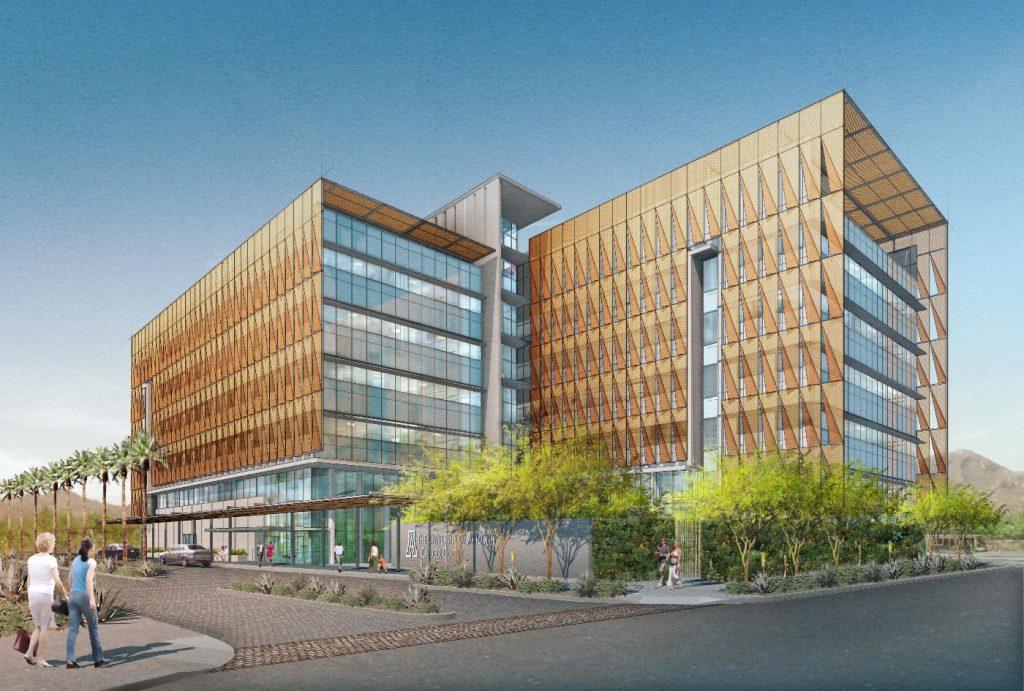
UACC

A rendering of the University of Arizona Cancer Center, set to break ground on the Phoenix Biomedical Campus.

A decade after Arizona, and especially Phoenix, embarked on an effort to build a biosciences cluster, this is how things stand. According to a report from the Battelle Institute, "Arizona’s bioscience industry continues to grow at a rapid rate.
Industry firms have increased employment by 30 percent overall since 2001 and have
even added jobs since 2007, a period which includes the deep national recession."

That said, total Arizona bioscience employment in 2010 was 21,084 vs. 62,386 in North Carolina. The state is a pygmy in research dollars and has birthed no significant bio company. Phoenix is nowhere near being one of the nation's top biotech/biosciences centers. [Updated] A 2012 Jones Lang LaSalle report ranks Boston, San Diego, the Bay Area, Raleigh-Durham, Philadelphia, Washington, D.C., New York, Los Angeles and Seattle the top "established" clusters in the Americas. The "emerging" clusters are Westchester/New Haven, Conn., Chicago, Denver, Cleveland-Columbus-Cincinnati, Salt Lake City, Dallas, southern Wisconsin, Florida,  Indianapolis, southern Michigan and Atlanta. The top players are not much changed, aside from relative ranking, from a much-discussed 2004 assessment by the Milken Institute, with one exception. Minneapolis has moved into the "established" ranks. Most of the up-and-comers are new. Arizona and Phoenix are not mentioned.

A glimpse of the competition can be found by the jaw-dropping build-out of the University of California-San Francisco's Mission Bay campus, which is dedicated to bio and went from nothing to a major contender over the same decade. And this was achieved despite California's state budget crisis. It represents one path the Phoenix Biomedical Campus could have taken but didn't. Another is Houston's amazing Texas Medical Center. This is where I center my recollections of the bio effort and what succeeded and failed.

Enough to make you sick

I had grand plans for my recent visit but spent most of my time sicker than I've been in years. Little time was left to catch up, but some observations:

The fabric of the old city continues to be torn away. The block of buildings on the southeast corner of Seventh Street and Roosevelt has been leveled with, of course, nothing to replace it. The last I recall, one building was a llantera (tire) outlet with American and Mexican flags painted on the outer wall. Now only the concrete foundation is left. A little farther south is a 1920s-era gas station, but would even this be preserved?

The demolished structures, which dated from the same era, were part of an actual city commercial streetscape that extended contiguously along Seventh Street. One saw the same on Seventh Avenue, Grand Avenue and Van Buren Street. It's almost all gone now, replaced by dreary new suburban boxes, each surrounded by Holy Surface Parking Lots. Or replaced by blighted empty lots. It is, as Jim Kunstler would say, not a landscape worth caring about and obviously nobody with money and power cared for generations. But the loss of variety, density and urban fabric on these approaches to downtown, along with the absurd widening of these streets, is a piece of astonishing civic malpractice. What a lost opportunity.

Role models

I didn't start this. An article in the Phoenix Business Journal is headlined, "Why Phoenix should be looking up to Seattle, not Austin." Behind it is the legitimate concern, written about here often, how the city is not attracting anywhere near its share of young, educated and high-skilled talent. In addition, as the article states, "The Texas capital beat out the Valley for a $300 million Apple Inc. campus last year, and General Motors is also placing a new technology center there." Naturally, it contains the obligatory, "Arizona has plenty of positive attributes in its corner: cost of living, proximity to California, business costs and nice winters."

Here are a few reasons why Phoenix can't be Seattle: No major headquarters of global corporations and non-profits; no world-class clusters in aviation and software; no civic stewards who invest heavily in the city, nurture its cultural assets and lead its continuous reinvention; no 24/7 downtown with hundreds of stores, restaurants, Pike Place Market, flagship Nordstrom, etc., and little critical mass in a dense, lively, cool center city. No diversified economy or University of Washington. No reputation for tolerance, progressive politics and long history of attracting world talent, whether for airplanes, software, biotech, world health or game development. We've covered some of this before.

Austin is sprawly, hot and has poor transit. Alas, here are a few reasons why Phoenix can't be Austin: It's not the capital of a state that puts attracting business, good jobs and huge amounts of federal money ahead of crazy ideology and revels in its power. No University of Texas. No world-famous music scene in a relatively dense quarter of downtown and tolerant "Keep Austin Weird" liberalism in the middle of a red state. No oil money. No history of largesse from LBJ (would President McCain have done anything for Phoenix? No.). No first-rate technology cluster, built up over many years, attracting top talent to the headquarters, R&D centers and labs of scores of well-known corporations.

Old Phoenix at night

Old Phoenix at night

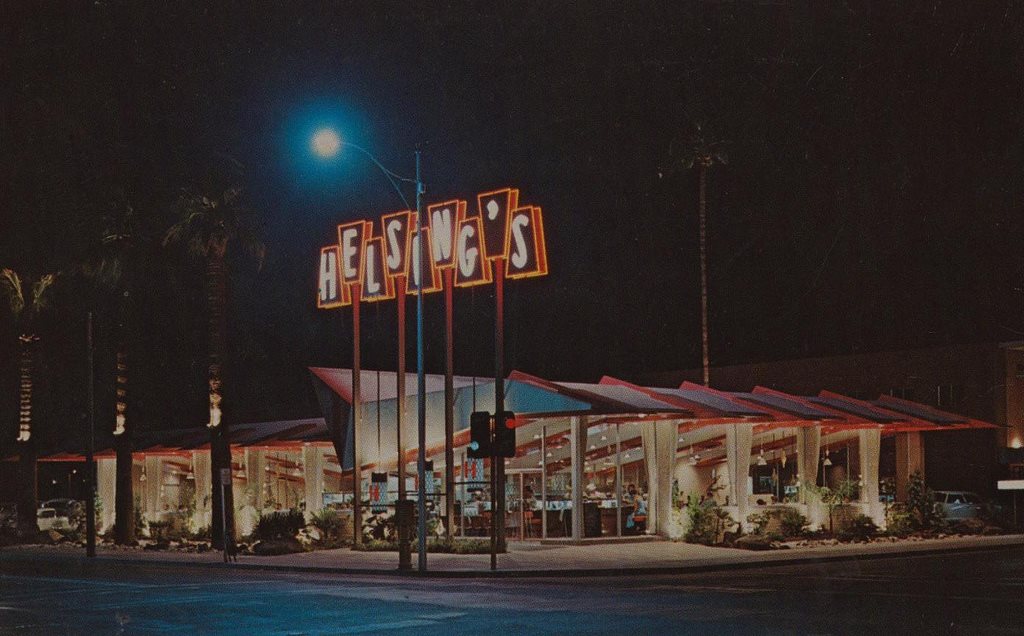
Helsings
Helsing's Restaurant, designed by architect John Sing Tang, at Central and Osborn.

Coffee_shop_24_Hr_Central_Van_Buren_1970sThe other night an Arizona Republic reporter tweeted desperately for a 24-hour coffee shop in downtown Phoenix. He was out of luck (somebody suggested a donut shop around 24th Street and Thomas, a common lack of understanding about where downtown Phoenix is located; the closest place was the IHop on Central in Midtown). This was not always the case. One (left) was located at Central and Van Buren, near the Trailways and Greyhound bus depots, with a lighted billboard on the roof. It survived until around 1970, when it was torn down for Valley Center, now the Chase Tower.

Across the street, on the northeast corner, was Jay's Coffee Shop, also 24 hours. After it was torn down in the '70s, the resulting surface parking lot was vacant for decades. Yet another favorite was the Busy Bee on Washington Street, one of the many Greek-owned establishments, which lasted until being bulldozed for Patriot's Square. These were not hipster hangouts with free wifi, but the old-fashioned coffee-shops-as-restaurants.

Beyond downtown proper, a number of center city late-night and 24-hour establishments were hopping well into the late 1970s. These included two Helsing's on Central, Village Inn at Seventh Street and Monte Vista, Shaefer's on McDowell at Seventh Street, and Denny's at Van Buren and Seventh Avenue. A bit farther west was Brookshire's at 16th Street and McDowell. They were life-savers when I worked on the ambulance and we might not get dinner until three a.m.

Bob's Big Boy anchored the corner of Central and Thomas and was the magnet for participants of weekend cruising on Central. Other popular chains were Hobo Joe's (with the hoho statue out front), Googies and Sambo's (a Sambo's building on McDowell across from the Phoenix Art Museum still stands, most recently a Thai restaurant). Helsing's and some of the others were works of art, but none still stand, unlike a few of their preserved sisters in Los Angeles.

Old Phoenix was not an all-night town. Which is not to say it wasn't a late-night town.

Arizona bio, part I

Someone important asked me to write about the biosciences in Phoenix and Arizona as the effort marks its tenth anniversary. This is fitting because I vividly remember the day I was called to the office of then Phoenix Mayor Skip Rimsza where he laid out the opportunity that the city had to lure star researcher Jeff Trent and the International Genomics Consortium. As a columnist for the Arizona Republic, I wrote dozens of articles to explain and advocate for this unique chance to leapfrog out of an economy that had become dangerously dependent on housing and population growth, and was falling behind on almost every measure of economic and social well-being. One column was an open letter to Dr. Trent — both of us are natives and this was from the heart — that he later told me played a big role in his decision to come home and establish T-Gen.

With Mary Jo Waits, then of the Morrison Institute, I worked to develop a "meds and eds" strategy to leverage biosciences and education; government, non-profits and eventually for-profit organizations, to create a major bio hub. As Waits repeatedly said, what if we could lay claim to the cure for cancer being discovered in downtown Phoenix? I mention my role for the sake of those who constantly yowl that I "hate Arizona," do nothing constructive, am a "quitter" or some guy in Seattle who spends his time picking on Phoenix.

The Flinn Foundation led the development of a strong strategic roadmap, as well as providing $50 million in funding. Gov. Janet Napolitano was supportive and the Legislature was dragged aboard a statewide push including leaders in Tucson and Flagstaff, as well as the Gila River Indian Community. At City Hall, Deputy City Manager Sheryl Sculley marshaled the bureaucracy to assemble land for the venture on the old Phoenix Union High School campus and oversee its redeployment. More land north was available for expansion; it had been set aside for the abortive attempt to win the NFL stadium that instead went to a cotton field west of Glendale. New ASU President Michael Crow instantly grasped the potential and soon the U of A was planning a medical school on the site. When ground was broken for the T-Gen building, even then Rep. J.D. Hayworth, hater of all things gub'ment, showed up to bask in what appeared to be a moment of history on par with the CAP. Hard as it is to believe now, it was a time of breathtaking hope.

The Sprawl Needle

Once again, it's left to homey to sun on the parade. People will once again conclude that I "hate Arizona."

Novawest, a "boutique real estate developer," has rolled out, let's call it an aspiration, to build a 420-foot-tall observation tower in downtown Phoenix. It is being likened to the Space Needle in Seattle, which marked its 50th anniversary in 2012. More about that in a moment. The developer has no financing. It has completed no project in Arizona. "But Novawest leaders are optimistic." The renderings — and I understand this is to be an open-air affair? — looked really hot, and I don't mean sexy. If every rendering proposed for downtown and the Central Corridor had been built, central Phoenix would resemble a five-mile slice of Manhattan. But let's give Novawest the benefit of a dreamer's doubt and get down to cases. [Jim Kunstler does, after his fashion, naming it the January Eyesore of the Month].

First, the Phoenix skyline is abysmally dull aside from the Viad Tower. But the combined power of the People's Republic of Sky Harbor and lack of capital, headquarters and civic leaders with means has thwarted anything better. Want some visionary skyscrapers? Go see my friend Will Bruder, architect of the central library. He's got some designs that would vault Phoenix's skyline to world prominence. But, again: Capital, headquarters, civic leaders with means. Without that combination, great civic acts are difficult. For example, Viad was built by the old Dial Corp. as a signature world headquarters and a gift to its city. Dial is gone as an independent headquarters, just another office in Scottsdale.

Phoenix rail: Next steps

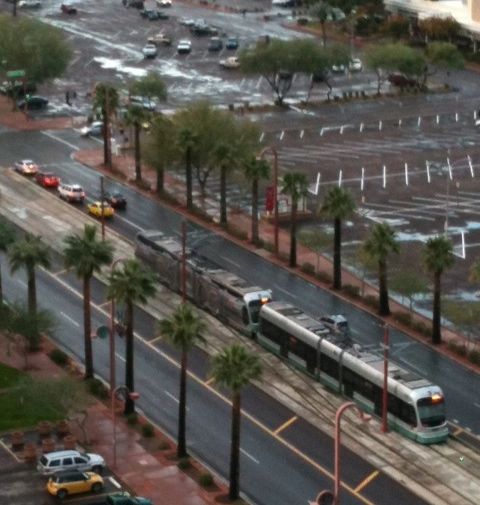
PhxLRT2

Newer readers to this blog might wonder why the parenthetical "WBIYB" is always inserted after the first reference to Phoenix light rail. It stands for: We Built It, You Bastards. A reminder of the hysterical, ignorant and too often thuggish opposition to a transportation technology that had proved successful around the country. I received death threats and demands that I be fired for columnizing in favor of light rail at the Arizona Republic. Well, you bastards, we built it and it is a big success, aside from the distortions that suppress transit-oriented development. Such a big success that Mesa (!) is building the line deeper into the city — and you can thank former Mayor Keno Hawker for having the foresight to persuade his colleagues to help fund one mile into the city; otherwise, Mesa would have been cut off from a system it now embraces.

It's a tough slog. The Legislature and governor are hostile to anything but freeways. The great crash slowed funding from Prop. 400 to a trickle, and even then most of it was going to build transportation infrastructure appropriate to the 1960s rather than today, including the misbegotten Loop 303 and South Mountain Freeway. While these will enrich a few connected developers, they are engines of sprawl, congestion, pollution and expansion of the heat island. Most Phoenicians can't imagine a lifestyle that doesn't revolve around long single-occupancy car trips.

Even so, the 20-mile starter line is expanding not only into downtown Mesa but also toward Metrocenter mall. An ambitious new line is being prepared to run west from downtown to a park-and-ride at 79th Avenue and Interstate 10. The West Line/Capitol Line is widely misunderstood in the media, but it would be an important step to creating a much more robust light-rail system.

Phoenix in the sixties

Phoenix in the sixties

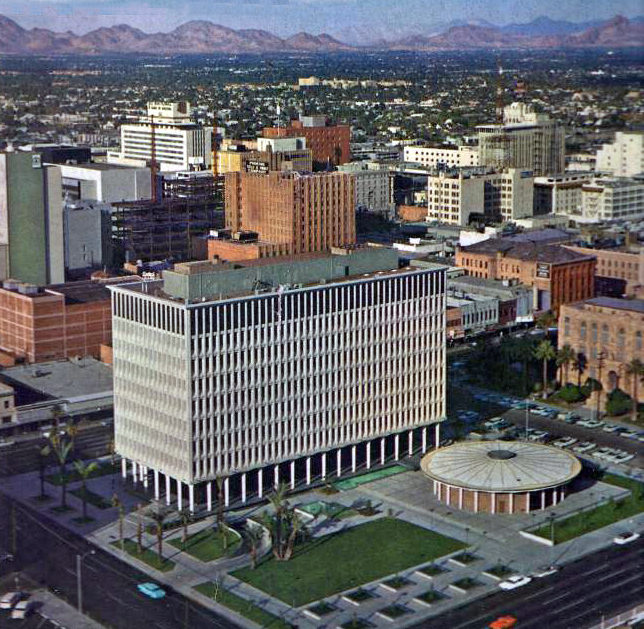
Municipal_Building_1964
Downtown in the mid-1960s, with the new Municipal Building, forefront, and the iconic rotating Valley National Bank sign in the upper right.

Decades are arbitrary things. One could make the case that "the sixties" in Phoenix ran from the late 1950s through the early 1970s. In any case, it was a most consequential time, arguably the decade when Phoenix set the pattern for what it would become, for better and for worse. In the 1960 Census, Phoenix's population was 439,170, making it the 29th largest city in America and 187 square miles within the city limits.

This was a startling jump from ten years before, ranked 99th with 106,818 people within 17.1 square miles. Phoenix had quickly become a big city, but unlike most others: single-story, spread out, car-dependent and populated by few natives. It had decisively surpassed El Paso as the dominant city of the Southwest. Yet, as it remains today, its power was like that of a small town.

Nineteen-sixty saw the unveiling of the Wilbur Smith & Associates freeway plan. Although its closest big-city neighbor was Los Angeles, Phoenix had only one baby freeway, Black Canyon. Over the decade, this would curve into the Maricopa Freeway but otherwise the Smith plan was mired in controversy. Phoenicians didn't want to become another LA. The Valley Beautiful Citizens Council worried that freeways would destroy an already ailing downtown. A hundred-foot high Papago Freeway with "helicoils" provoked more opposition. In the end, almost all of the 1960 plan was adopted. But surface streets carried most traffic during this era.

Downtown retail was slowly dying, as was the dense corridor on McDowell between 12th Street and 18th Street called "the Miracle Mile." This included the lush, stately Good Samaritan Hospital campus, replaced 20 years later by the brutal spaceship building that remains today. Malls were flourishing, including Park Central, Tower Plaza, Thomas Mall and Chris-Town, named after farmer Chris Harri on whose land it was built. Many of the downtown merchant princes were dead or ailing. Others, notably Goldwater's (sold to Associated Dry Goods in 1963), moved to the malls.

Parking lot city

Parking lot

"We like our parking lots!" lawyer and Real Estate Industrial Complex apologist Grady Gammage said a few years ago when the two of us were speaking at an event on the future of Phoenix. And how. I've read that some 43 percent of the city of Phoenix alone is empty land. It would be interesting to know how much of the city is surface parking lots.

I remember when Kenilworth School was surrounded by grass and majestic palm trees. It lost part of that to the monstrous Papago Freeway. More was taken away by parking lots. The consequences are even more telling at North High School. At one time, North boasted a beautiful campus with shade and trees — it was the probably the most attractive campus in the state. By the time I got back in 2000, most of it had been paved over. Similarly, the old city-county building, where my fictional detective David Mapstone has his office, was once an oasis of shade trees and grass. Those were ripped out for "authentic" dirt and palo verdes, and recently the parking lot on the south end of the 1929 building was…expanded.

More than aesthetics are involved. Surface parking lots are a big cause of local warming, which has increased nighttime temperatures some 10 degrees in my lifetime, causing the summers to be hotter and last longer, and turning normal monsoon storms into violent affairs when they collide with the heat being released by all these square miles of asphalt and concrete. The lots destroy the fabric of the city and make walkability and convenience much more problematic. Many sit atop former farmland, which will really matter in a future of food shortages. Take a drive, ride light rail (WBIYB) or pull up Google Earth and look at all the parking lots in Phoenix. Interestingly, most of them are largely empty most of the time.

Arizona merry-go-round

I was supposed to be on KJZZ's Here and Now with Steve Goldstein on Wednesday but we were pre-empted by POTUS. So let me run through a few Arizona observations:

As of Wednesday, the state was still counting ballots. If this were happening in a banana republic, it would be one thing…but in a supposedly advanced nation? This affront to democracy is not mere incompetence but a huge opportunity for mischief — not the virtually nonexistent vote fraud the GOP claims, but official vote suppression and disenfranchisement of "those people." Once upon a time, the Secretary of State's office was a sleepy but efficient place, presided over forever by Wes Bolin and his assistant, Rose Mofford. It has become increasingly politicized, especially in 2004 when Jan Brewer was both Secretary of State, overseeing the election, and head of the state's Bush-Cheney campaign. Ken Bennett is no less an ambitious political animal. This is a scandal crying for investigative reporting and reform. Also, how could you re-elect Joe Arpaio? No wonder Gov. Fright Mask is musing on another term.

• • •

For the first time, Arizona has no Democratic statewide officeholder. This is a profound change from what had been a majority Democrat state when I was little to a competitive state for both parties for many years. One-party rule is never healthy, but it is particularly bad when the One Party denies facts and reality. The Big Sort is at work — even progressives who read this blog talk about their plans to leave. So is the outsized organization and leverage of the LDS with no counterweights in the Latino community or elsewhere (Arizona once was a big union state, yes). The Sinema congressional win is fine, but her campaign was hardly progressive. Unless widespread Hispanic voter suppression took place and Carmona stages a win, this election confirms the worst. Arizona is a solid member of the New Confederacy.

The Goldwater Library

A few quick observations on the $30 million Barry and Peggy Goldwater Library and Archives to be built in downtown Mesa. For the city of Phoenix, it is embarrassing, ahisorical, wounding and revealing.

Embarrassing because, according to the Arizona Republic, the library trustees wanted to put the institution in downtown Phoenix and city officials dropped the ball.

Ahistorical because Barry Goldwater was born in central Phoenix, attended Kenilworth School (as did I), managed his family department store downtown and was a Phoenix City Councilman who, among other things, backed construction of the Civic Center that is still home of the Phoenix Art Museum and Phoenix Theater.