Phoenix 101: Midwesterners

The comments section has been busy with musings about the Midwest migration to Arizona and the degree to which it is to blame for the disaster facing the state and Phoenix. I've offered my assessment in previous posts (it's a great deal to blame).

That doesn't mean every midwesterner is at fault, much less that I hate the Midwest. I spent nearly a decade there, in southwest Ohio, and hold it warmly in my heart. I saw it at its best and lately I've seen it at its worst. But no discussion of Phoenix is complete without assessing this huge tide of immigrants and the things they carried.

The first Anglo settlers of Phoenix were a ragtag group of tough adventurers, everybody from "Lord" Darrell Duppa, namer of Phoenix, who was born in England (maybe France), to the father of Tempe, Charles Trumbull Hayden, a Yankee who had worked the Santa Fe trail. The Mormons settled Mesa.

But Southerners and former Confederates were arguably in the early majority, personified by founder Jack Swilling, CSA. This gave the town a peculiar Southern-Western character that persisted into the early 1960s. My family came from Indian Territory and before that the pre-Civil War Texas frontier. Midwesterners arrived in more numbers with the completion of the Santa Fe Railway and its direct connection from Chicago. Among them was Dwight Bancroft Heard, who bought the Arizona Republican in 1912. He was a major landowner and farmer, and was the driving force behind the region's cotton industry. Along with his wife, Maie Bartlett Heard, he founded the Heard Museum.

Other midwesterners of note: Kansan Eugene C. Pulliam, who built a publishing empire including the renamed Arizona Republic. Lawyer Frank Snell was from Kansas City. (His partner Mark Wilmer, the star litigator who won Arizona v. California before the Supreme Court, came from Wisconsin by way of Texas.)

Another former Chicagoan was Walter Bimson who built Valley National Bank into a powerhouse. Heard, Pulliam, Snell and Bimson were city builders. The latter three, for example, in the late 1940s and 1950s, recruited the high tech industries whose fumes the metro area still runs on. All loved Phoenix. It was their home. In every way they connected the health of the city to that of their companies.

Phoenix 101: The economy

Phoenix 101: The economy

Motorola_52nd_St_McDowell_1960s
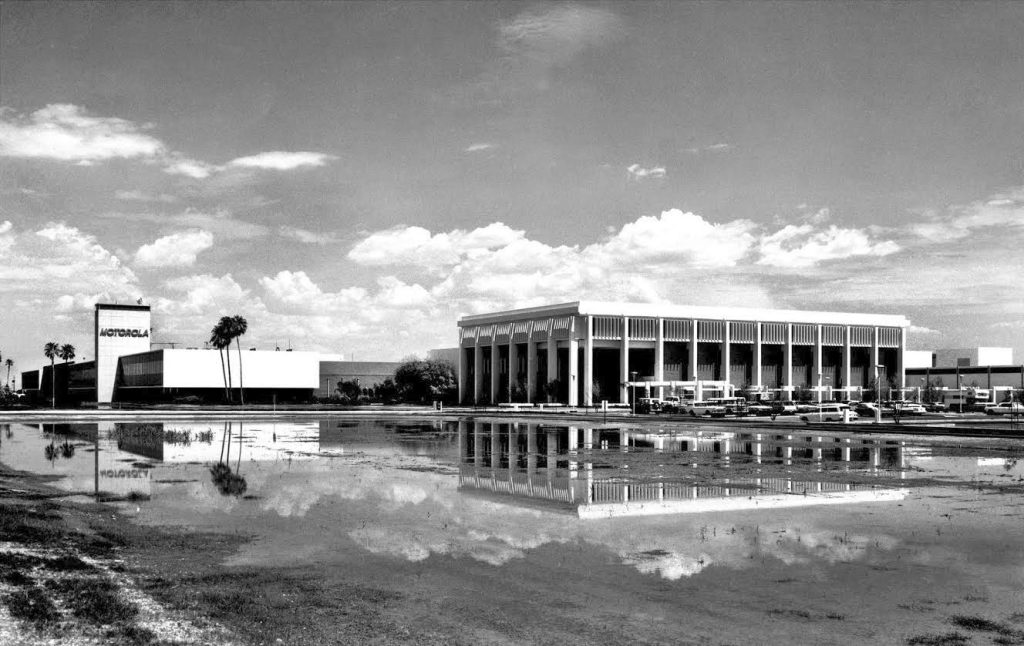
Motorola was once the backbone of technology industries recruited to Phoenix in the late 1940s and 1950s. Above is the 52nd Street and McDowell plant circa 1965.

How did Phoenix get in this mess? A mess where the economy is in an outright depression after outperforming much of the nation, by some measures, for decades. A mess where its grades in quality economic circumstances are among the worst in America, and where it may be America's fifth most populous city and 13th largest metropolitan area but underperforms its peers by an embarrassing gap.

It took a lot of work.

When I was growing up, people talked about the Four Cs of Arizona's economy: Copper, cotton, cattle and citrus. The fifth C of climate — I don't recall that, and it may have been added later to justify the machinations of the Growth Machine, although to be sure, "health" and tourism were Phoenix selling points for most of the 20th century.

For much of the territory and state's history, climate was a decided negative. In any event, even the "Cs" was an over-simplification, leaving out railroads, a wider array of mineral extraction, other agricultural sectors and the condition of the state. Arizona was a frontier state, isolated, with an unforgiving landscape and sparse population. Even in 1950, the population of the entire state was 750,000. In today's language, its carrying costs were low, its sustainability high. But as an economic player, it was dwarfed by most other states.

By the late 1950s, Flagstaff had timber and the Santa Fe Railway. Globe and the mining districts lived off copper, where Arizona was a world-class supplier. The copper industry paid 22 percent of the state tax load and provided thousands of good jobs, albeit with the downside of control by eastern capitalists. Other minerals hubs were mostly played out, often leaving ghost towns. One exception was Prescott, the onetime state capital, which was a division point on the railroad. Tucson was a major rail center on the Southern Pacific and a military base. Cattle ranches proliferated; this industry was valued at $200 million in 1962 (about $1.4 billion in today's dollars). But most of the state was wilderness. The exception, mid-century, was Phoenix.

Growing up in old Phoenix

Growing up in old Phoenix

Central_Palm_Lane_looking_south_Central_United_Methodist_Church_1960s

I grew up in a small town. Its name was Phoenix, and even though it had 439,170 people by the time I was four years old, in 1960, it still seemed like a place I could wrap my arms around and carry with me, just like the little towns in the movies. We lived near Cypress Street and Third Avenue, about a mile from the border of downtown. The houses faced the street, many had porches, the lawns were lush, the shade inviting.

My friends and I stashed fallen oranges and rolled them out into the rush-hour traffic on Third and Fifth — back then, before the Willo Soviet tried to wall off this neighborhood, these streets had three lanes each and carried substantial traffic twice a day, people going to and from work downtown. The oranges were also useful in friendly alley fights; more serious conflict escalated from dirt clods to rocks. Oh, we also ate them, because everyone had citrus trees in their yards and it was a quick drive out to the groves, where boxes of oranges could be purchased at roadside stands surrounded by the lavish bounty of the Salt River Valley. Some days we lay under the trees at Paperboys' Island, a pocket park at Third and Holly, and just stared into the cobalt sky, dreaming the dreams of young boys.

By the time I was eight, I was mobile and free, within limits. Specifically, I could ride my bike from Thomas to Roosevelt and Third Street to Fifteenth Avenue. It was an amazing landscape for a child. The library, art museum and Heard Museum were there. Soda fountains proliferated at drug stores, from the Rexall on Roosevelt and Third Avenue to Ryan-Evans at Seventh and McDowell to shops on Central. Every gas station had a drinking fountain with cold water, an essential for young desert rats. The firefighters at the old Station 4 on First Street and Moreland, as well as the Encanto/Seventh Ave. station indulged us. We bugged the people at Channel 12 and Channel 5 (Wallace & Ladmo's home!) for old reels of commercials — the apex of our ubiquitous trash picking. Encanto Park was a favorite hangout; it was where I decided I wasn't cut out to be a fisherman, but that didn't stop me from endless fishing journeys to the lagoons. The lovely moderne Palms Theater at Central and Virginia offered movies if we didn't want to hitch a ride downtown.

This part of the city was dense then with businesses. This was long before entire blocks were bulldozed or turned into dead space by parking garages. The buildings on the northeast and southeast corners of Seventh Avenue and McDowell, for example, were chock-full of small businesses. So was today's mostly empty Gold Spot — I got my hair cut there by Otis Kenilworth. Downtown was still the busiest shopping district in the state, followed by Park Central mall — both bracketing our neighborhood. I wasn't as fortunate as someone born a few years younger to sample the old city, but it was still pretty intact in the early and mid-1960s.

The big Valley Bank sign turned atop the art deco tower and other neon signaled downtown. Among the downtown landmarks was the Hotel Westward Ho, with its famed Thunderbird Room, where presidents stayed well into the 1960s. The skyscrapers going up along Central seemed signs of progress, not incoherent planning. I watched so many of them being built. My grandmother and I took the bus to shop downtown or at Park Central. This daughter of the frontier "traded," as she put it, at the small A.J. Bayless store at Central and Moreland. Just west were the shady median parks along Moreland and Portland, two of the few City Beautiful Movement touches Phoenix received. The parkways were lined by lushly landscaped apartment buildings. Every day, we drove downtown at 5 p.m. to pick up my mother at the Greater Arizona Savings Building, where the Interstate Stream Commission had its offices. It was amazing to see the crowds on the streets, just like a big city.

Phoenix 101: Myths and lies

Plato's "noble lie" is one of the foundations of his mythical republic. It also handily cements the power of the elites. So it is with our city with the name from mythology. Let's take them on one at a time:

Phoenix is a young city. This is a canard tossed out to explain every shortcoming or difficulty that can't be blamed on "the Mexicans." As in, Phoenix lacks the amenities commensurate with a big city "because it's a young city." Phoenix was founded in the late 1860s and incorporated in 1881. That's 129 years for those readers who were home-schooled or graduated from Arizona charters. It didn't become what would be considered a large American city until the late 1950s; by 1960, it was the nation's 29th largest city. That's a half century to get its act together.

Where Phoenix can legitimately claim it was shortchanged by being a younger city is that it was too small to benefit much from the golden age of American urban design and architecture, including the City Beautiful Movement. And most of what it did have was torn down in careless acts of civic vandalism from the 1960s onward.

Phoenix grew into a city in the automobile age and the ubiquity of the automobile suburb, with all the dolorous consequences that followed once that became the only mode of city "planning." Otherwise, the reliance on the "young city" excuse actually undermines itself on close inspection.

Phoenix 101: Scottsdale

Phoenix 101: Scottsdale

RFD

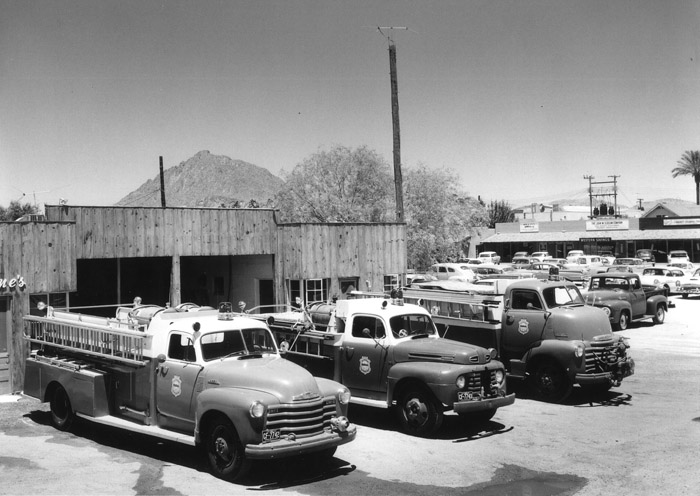
My earliest memory of Scottsdale is what would most intrigue a little boy: The fire station. The Rural Fire Department sat at Second Street and Brown. It had long outgrown its small building, so yellow-painted fire apparatus were parked all around. In the early 1960s, Scottsdale still retained much of its flavor as one of the minor farm towns that surrounded Phoenix. To that had been added "Western-style" storefronts: It was "the West's Most Western Town." With a few blocks on Fifth Avenue, Main and First Avenue, it was a tourist trap. It had a few hotels, such as the Valley Ho and the Sahara, as well as the wooden-sided stadium — continuing the playfully fake frontier theme — and a modest art colony.

We moved from Midtown Phoenix to what is now south Scottsdale in 1970. My mother had been alarmed by an incident at West High where a student had been kicked to death. Despite our modest means, she wanted me to attend the excellent Coronado High. I got to know Scottsdale very well. The neighborhoods around Coronado and Los Arcos mall were still separated from downtown Scottsdale by farm fields and vacant land. Scottsdale Road lacked curbs, gutters or sidewalks. Our house sat a block east of Scottsdale Road; one old, unoccupied house faced on Scottsdale Road across the alley, leaving a spectacular view of the Papago Buttes. It was an alley prowled by the "Refuse Wranglers" city garbage men. Closer to downtown was the YMCA, where I did a stint as a lifeguard, and the Scottsdale Daily Progress building. Then came the new Scottsdale Baptist Hospital and downtown, which still held some small-town retailers such as Lute's Pharmacy.

East of Brown, however, many of the houses were seedy, a few occupied by bikers and drug dealers. City Hall was only being planned. The police were based out of the old schoolhouse. But close to Scottsdale Road and Main Street, local businesses flourished, from Lute's Drugstore to Saba's Western Wear, along with the gas station with the iconic cowboy sign promoting community events. It was still a small town run by a local merchant class. The future giant Fashion Square was a Goldwater's department store. Newer suburbia marched ahead, of course, especially around Saguaro High. But most of Scottsdale ended just north of Camelback, where the horse ranches took over, then breathtaking empty desert. The airport was little more than a former Army airfield with a handful of newer, small buildings. Drinkwater's Liquors, a Circle K and a few other buildings sat at the crossroads with Shea "Boulevard." That was two lanes out to the Beeline Highway. On the way, you could make the long trek through nothing to reach Taliesin West. My friends and I launched model rockets in the desert southwest of Bell and Scottsdale. I got a glimpse of the plans "somebody" had for the place when the Hilton was built in the middle of nowhere on Lincoln Drive and Scottsdale Road; I worked as a bus boy at Paul Shank's, riding my bike every night along that no-shoulders, no sidewalks, no streetlights highway.

How freeways remade Phoenix

How freeways remade Phoenix

BlackCanyon1960s
The Black Canyon Freeway, Phoenix's first, in the 1960s.

Motoring around metro Phoenix today, it's difficult to comprehend that this was not always a huge agglomeration of real-estate ventures connected by freeways. In fact, Phoenix didn't want them, would have been better off without many of them, yet couldn't avoid their eventual triumph.

In 1950, when Phoenix came in as America's 100th most populous city, it occupied a mere 17 square miles, with a population density of more than 6,200 per square mile, around what you'd find in today's Seattle or Portland. In other words, a real small city: cohesive, walkable, sustainable and scalable. Remnants of the old city exist, but much has been annihilated, not least by the freeways.

By 1960, the city of Phoenix had 439,170 people and nearly 188 square miles. It was a big city of the automobile age, the old streetcars long gone, and federally subsidized sprawl under way. Around this time, the state Highway Department adopted an ambitious freeway plan prepared by Wilbur Smith & Associates, one of the nation's leading highway transportation planning firms. It envisioned much of the system eventually built. The engineers had wanted to build freeways in Phoenix since the late 1940s. One route would have gone directly in front of the Hotel Westward Ho.

But most Phoenicians were horrified. They weren't enamored with the small Black Canyon Freeway, Phoenix's first (it wound around at Durango Street to become the Maricopa Freeway, rammed through powerless barrios).

An urban legend persists that Eugene C. Pulliam single-handedly defeated the freeway plan in the early 1970s. Although the Arizona Republic and Phoenix Gazette were indeed powerful in those days and not afraid to crusade (sometimes for the right reasons, sometimes not), freeways were widely resisted.

Phoenicians then didn't want to become another Los Angeles in this bad way, and they had a chance to avoid the fate. LA had shown (and Robert Moses' New York before it) that freeways didn't solve traffic congestion — they generated it through the phenomenon called induced demand. We didn't want worse smog. We didn't want to lose our views to concrete and the citrus groves to further sprawl. Of particular alarm was the 100-foot-high Papago Freeway Inner Loop planned across central Phoenix, with monstrous "helicoils" discharging traffic onto Third Avenue and Third Street. 

Phoenix 101: Universities

Phoenix 101: Universities

PalmWalk
The Palm Walk on ASU's Tempe campus.

Looking at Arizona State University today, with the largest student body in the United States, it's difficult to imagine that it began before statehood as the territorial "normal school," or teachers college. It didn't become a university until 1958, over the intense objections of the University of Arizona, which still considers itself The University, although ASU has eclipsed it in many ways. ASU now bills itself as "one of the premier metropolitan research universities in the nation, an institution of international scope, committed to excellence in teaching, research, and public service." The reality is somewhat different and rooted in the history of the state and the Salt River Valley.

Some sixty thousand souls resided in all of Arizona Territory when the UofA and the future ASU were established. It was frontier wilderness with the settlers scratching out a hard living in mining, ranching and farming. Aside from the occasional big copper strike — Jerome, Bisbee — people were poor. The railroads were only beginning to be built across the vast expanses of deserts, mountains and forests. That territorial leaders created these schools was an act of heroic vision (aided in UofA's case by the federal land-grant program). Later the Progressive state constitution would mandate that Arizona provide a college education for every qualified citizen.

But this rough country was also generally suspicious of colleges, whether from cowboys mistrusting the utility of the endeavor, to the big mining companies wanting cheap labor. Capital was scarce outside of the mines and railroads, controlled by eastern financiers only interested in extracting profit from the land. There were no Arizona Rockefellers or Carnegies who built fortunes, however ill-gotten, that would eventually fund world-class universities. People were scarce. Just before statehood, Tempe's population was little more than 1,400, fighting to make the desert bloom, sweating through summers without air conditioning. No wonder the state's elite, such as Carl Hayden, went to college in California.

Phoenix 101: Indians

Phoenix 101: Indians

Pima

The many faces of the Pima tribe. In the center is Ira Hayes, the decorated Marine who was among the famed flag raisers on Iwo Jima during World War II.

Phoenix has the largest population of urban American Indians in the United States. It's also the only major metro area that is flanked by reservations: the Salt River Pima-Maricopa Indian Community east of Scottsdale, the Gila River Indian Community to the south and southwest, and farther to the east, the Fort McDowell Yavapai Nation. With casinos and water rights, the tribes enjoy the greatest economic power in their modern history. This is a story that's only beginning. But of course it's a very old one, too.

The city's name comes from its location atop the ruins of the Hohokam civilization. Like the mythical Phoenix bird, it rose from its ashes (and it is by far the coolest city name in America, which makes it a shame that the suburban mandarins resist using it to describe the metro, as is commonplace in every other major city in America). When the first Anglo settlers came to the Salt River Valley after the Civil War, they cleaned out some of the Hohokam canals and resumed the region's oldest human activity: agriculture. The Hohokam were the most advanced hydrological civilization north of Mesoamerica. The sophisticated dam and canal structure built for today's Phoenix is simply an extension of the Hohokam's work.

Growing up in Phoenix, I was constantly aware of the Hohokam's ghosts — but I was an odd child, enchanted by the place and its history. For most in the 1960s, American Indians were not a common sight there. The reservations were relatively far away then. The stereotype of the drunken Indian was on tragic display in the Deuce. Prejudice was common, even as we romanticized the tribes, particularly the Apache and Navajo. It had not even been a century since the Apache wars had ended. Phoenicians mostly came in contact with the tribes passing by the Phoenix Indian School, an institution now reviled by scholars for destroying native culture but one which may deserve a fresh revision someday. Today's phenomenon of an urban Indian population was very limited. We had a Navajo boy, John Rogers, in my class at Kenilworth School: he had been adopted by a Anglo family. Not to be blind to the challenges he faced, but in the crucible of cruel children he seemed to garner a special respect. After all, in playing cowboys and Indians, we all wanted to be the latter. And growing up in the center city, I drank in the magic of the Heard Museum.

Phoenix 101: Sun City

Phoenix 101: Sun City

SunCity

The curvilinear streets and golf courses of Sun City.

Fifty years ago, Del Webb began Sun City. It was just south of Grand Avenue and the Santa Fe railroad amid the flat farm fields of Maricopa County and near the tiny railroad sidings at Surprise and El Mirage. I first saw it from the train — there was no Sun City station, for this was a development built for the automobile. For most Phoenicians, it was a curiosity — or a joke. Pat McMahon's misanthropic, demented Aunt Maud character on Wallace & Ladmo was from Sun City. Photos of oldsters riding around in their golf carts provoked much mirth. When an older lady asked my grandmother if she was going to move out there, this daughter of the frontier was aghast. "Why would I want to be stuck out there with all those old people?" she asked. The older lady was shocked.

Yet Sun City would prove to be one of the most influential events in the history of modern Phoenix, setting in train a series of business, demographic and social changes that have proven to be very mixed blessings. Before Sun City, Phoenix was something like a real city. Tourism and snowbirds were part of the mix. But so was a huge agricultural economy, along with a large — for its population larger than today — and growing number of technology, aerospace and defense businesses. Resorts were limited. The artist colonies in Scottsdale and Carefree were more important than retirees. After Sun City all this would change.

Del Webb had been building in Phoenix for decades before Sun City. Go to the iconic Phoenix Towers at Cypress and Central and you'll see his name on the building, erected in 1956. Downtown sidewalks from years before had it etched in the concrete (although here Webb competed against "Frenchy" Vieux). He grew rich in the New Deal. In World War II, he built military facilities, as well as the concentration camp — there's no polite way to put it — at Poston to hold interned Japanese-American citizens and other Japanese living in America. By the time he envisioned Sun City, he was no longer "ole Del," but a very rich man, friend of celebrities, part-owner of the New York Yankees — and, among Phoenicians in-the-know, trailed by the odor of associations with organized crime and war profiteering.

:Carl Hayden

:Carl Hayden

Young_Carl_haydenThis week, Sen. Robert Byrd will surpass Arizona's Carl Hayden as the longest-serving member of Congress. As Arizona's only congressman and later its fixture of a senator, Hayden was there for 56 years. The Arizona Republic's Dan Nowicki provides a good primer on Hayden for the majority of Arizonans who have either never heard of him, or merely associate his name with a high school.

When he was alive, Hayden was the most prominent of the walking reminders of Arizona as a frontier state. He had been born when the Salt River Valley was barely settled, had chased outlaws on horseback as Maricopa County sheriff (above left), then had become the Baby State's first representative in Congress.

"Ol' Carl Hayden," as he was known by the time I was alive, will forever be associated with the Central Arizona Project. The best book on Hayden and the CAP is my friend Jack August's Vision in the Desert. It was his life's work, and as it headed toward victory, Hayden realized it would not mean the sustenance and extension of agriculture in the Salt River Valley, but rather its transformation into a megalopolis. I have heard he was ambivalent about this reality, as many who fought for the CAP came to be. Ironically, many of the sustainability issues Phoenix and the Southwest face today were made in the 1950s and 1960s by the CAP adversaries in California — although they were hardly angels.

People of color in old Phoenix

People of color in old Phoenix

George_Washington_Carver_High_School_graduates_7th_St_Grant_1948(1)The 1948 graduating class from George Washington Carver High School (McCulloch Bros. Collection/ASU Archives).

From its founding until the late 20th century, Phoenix was an overwhelmingly Anglo city. But Phoenicians of color were always here. This column tells a bit of their stories.

Phoenix was settled by many Southerners and ex-Confederates, and it kept that Southern sensibility well into the 1960s. The white Chicagoans who started coming in the 1930s brought their own racial biases that for decades tore that city apart.

Into the early 1950s many places in Phoenix were legally segregated, including schools. Phoenix Union Colored High School, later George Washington Carver High, opened in 1926. Booker T. Washington and Paul Lawrence Dunbar elementary schools were built for younger "colored" children. (Washington is now home of New Times).

Ad_Hollywood_Heights_subdivision_1913Deed covenants restricted many neighborhoods to "whites only." Minorities couldn't buy houses north of Van Buren Street well into the 1940s (and, as the 1913 advertisement shows, often couldn't buy south, either). Many stores and restaurants would not serve blacks, Mexicans, Japanese and American Indians. Swimming pools were segregated, too. Arizona had an anti-miscegenation law on the books from 1865 to 1962.

To be fair, there was no "colored waiting room" at Union Station and Encanto Park golf course accepted minority players in the 1940s. No lynching based on race is on record. Chinese-American children went to white public schools. Early minority businessmen such as Jose M. Iberri prospered. Mexicans who could "pass" for Anglos, such as the Van Harens, could move more freely. But the race and class lines were not hard to find. Phoenix always saw itself as an Anglo city (and the demographics back this up, especially after 1920), unlike old Tucson with its proud Spanish and Mexican traditions.

And consider: For decades the distance between the mansions of "Millionaires Row," Chinatown, and "the slums" were often only a few blocks. 

The Salt River Valley, of course, had once been part of Mexico. Prior to Columbus, it was the site of the most advanced irrigation-based civilization in the Americas before being abandoned by the Hohokam. By the time the cavalry forced peace on the Apaches and white families such as mine began arriving in the latter part of the 19th century, Hispanics and Pimas were living in the Valley, too.

The nature of the town was embodied in one of its founders, Jack Swilling. He had a Mexican wife, Trinidad Escalante, as well as an adopted Apache son, Guillermo.

In other words, Phoenix was never Des Moines in the desert.

Phoenix 101: Mesa

Phoenix 101: Mesa

Mesa depot 2

The Southern Pacific depot in downtown Mesa, circa 1963, when six passenger trains a day still served the station.

I got a rare treat in the mid-'60s for a poor kid from the 'hood: Getting to see Willie Mays play in a game of the Giants vs. the Dodgers. It was spring training and we drove to the little ballpark in Mesa. The game was great. Unfortunately, we were in the family 1959 Ford Galaxie, a source of never ending trouble and built, as my mother never tired of saying, during Defense Secretary Robert McNamara's tenure as Ford president. That night the only gear that would work was reverse — and we drove all the way home to Phoenix going backwards.

It's low-hanging fruit to grab this memory as a metaphor for what has happened to Arizona's third most populous city. A city so populous, indeed, that it is larger than St. Louis, Cincinnati, Minneapolis or Pittsburgh — and has nothing to show for it. No major university (an iffy branch of ASU miles from downtown doesn't count); no major corporate headquarters; no great museums; no magical neighborhoods. City Hall looks like a low-end office building. Even the area around the Arizona Temple, Mesa's one majestic asset, has been allowed to crater. The miles of enchanting citrus groves have almost all been bulldozed (and when I asked in 2006 if there was any preservation effort for the remainder, a top city official looked at me blankly).

It's a sad, and in many way surprising outcome. But operating by Arizona's rule of "when in a hole, keep digging," Mesa shows every sign of continuing the practices that got it in what is a morass even by Phoenix standards. The Cubs are playing the city for fools, threatening to leave, shopping spring training sites around the area, including some on the rez. Mesa's response could be to plan an intimate ballpark downtown on the light-rail line. It would enhance critical mass for a walkable urban space that Mesa lacks. It would be much more pleasant that the newer spring-training parks with their endless parking lagoons amid dehumanizing sprawl. It would help prepare Mesa to prosper in the higher-cost energy future.

Not surprisingly, Mesa is scouting two sites in the middle of nowhere, but on the all mighty freeway. When in a hole, keep digging.

Phoenix 101: ‘Master planned communities’

Phoenix 101: ‘Master planned communities’

South Mountain sprawl
Phoenix had perhaps the worst luck of any major American city from the standpoint of urban design and civic beauty. It came of age in a huge spurt of growth in the 1950s and beyond. The City Beautiful Movement was forgotten. Suburbia, lookalike houses, automobiles and long single-occupancy car trips moved to the center of American life.

An old city still exists — what wasn't torn down by City Hall from the '70s through the '90s — but it's not much and most Phoenicians don't even realize it exists. When I lived in Willo, it was always painfully entertaining to be picked up by the airport shuttle, already full of people from the suburbs. They were giddy over the front porches! The shade trees! The old houses and walkable neighborhood and closeness to the center of the city! I learned that their real-estate agents had never even showed them this part of the city.

Suburbia wasn't always, as Jim Kunstler would put it, a cartoon landscape not worth caring about. Willo was once a suburb on the streetcar from a compact Phoenix. In Cincinnati, there's the magical Mariemont, a leafy "planned town" from the 1920s, which accommodated the American longing to "get out of the awful city," while creating a real community and a real human space worth caring about. It was accessible by — especially by — streetcar and interurban railway to downtown Cincinnati. Now the latter two are long gone as America has embraced a life with fewer choices.

A large number of people in metro Phoenix and a majority of the Anglo middle class  live in something altogether different — a radical enterprise that has transformed civic life, urban form and even democracy: the "master planned community."

Phoenix Underworld

Phoenix Underworld

BollesCar

The scene after Arizona Republic reporter Don Bolles was fatally injured when a bomb went off in his car in 1976.

You don't have to scrape too far beneath the veneer of "a clean, new, well-run city" to understand that Phoenix is perhaps historically one of America's more corrupt, crime-run cities. It didn't get a great city in exchange for its corruption, as with Chicago. And being crime-run isn't the same as being crime-ridden, so whatever statistics the boosters pull out to show community safety are really beside the point.

It's long been this way. When I was a child, Phoenicians sniffed that Tucson was the Mafia town, with Joe Bonanno, Pete Licavoli Sr., and company. Yet the FBI estimated that in the 1960s Phoenix had more mobsters per capita than New York City. I grew up just a few blocks from the house where, in 1958, Gus Greenbaum and his wife had their throats slit in retaliation for Gus' skimming from the casino tills in Vegas (and, local lore has it, the hitmen then ate the steaks the Greenbaums had just cooked). Phoenix was full of bars (Rocky's Hideaway, the old Blue Grotto, Ivanhoe, the Clown's Den, etc.) frequented by made men and the wanna-bes.

This was not the result, as some would have it, of "the Wild West atmosphere." Rather, it was the interface between a city growing too fast with few rules or institutional checks and the migration of Midwestern gangsters to exploit the situation (or, later, to be relocated by the feds). And an establishment willing to look the other way, or join in the "business." A culture of fraud built on successive real-estate booms, or scandals such as the collapse of Arizona Savings in the early 1960s, also made the city a magnet for criminals. The most prominent figure in this was Ned Warren (aka Nathan Waxman), the Kingpin of Arizona Land Fraud. He figured in the Bolles bombing.

Phoenix 101: Vulnerabilities

Phoenix 101: Vulnerabilities

PaloVerdeNuclearGeneratingStation
The Palo Verde Nuclear Generating Station, built upwind from the nation's fifth-largest city and plagued for years by regulator's safety concerns. It is the only nuclear plant in the world not near a large body of water.

People move to Phoenix bragging about the lack of blizzards, hurricanes, tornadoes and earthquakes. True enough. Yet they are moving into a place burdened by its own special hazards. They're the ones your real estate agent didn't mention; the ones that what is left of journalism rarely covers. That nobody talks about them besides — I hope — emergency planners, does not make them any less dangerous. Indeed, a case could be made that Phoenix is one of the highest-risk metro areas in the nation. According to the Federal Emergency Management Agency (FEMA) National Risk Index, Maricopa County is rated "relatively high." Higher than "tornado alley" in Kansas and Oklahoma.

One of the most populous metropolitan areas in the nation has been built in a hostile desert. It's isolated, with limited highways, no passenger rail and surrounded by hundreds of miles of inhospitable, waterless badlands. Evacuation in an emergency would be impossible. The closest large cities — Tucson and Las Vegas — are as vulnerable as Phoenix. Gasoline must be brought in by pipelines from refineries hundreds of miles away. Water and the electricity for air conditioning depend on complex, vulnerable systems.

This harsh reality should have been brought home earlier in this decade, when, amidst brutal August heat, a gasoline pipeline broke; a year later, a mid-summer transformer fire threatened to shut down the power grid. The gas crisis was particularly frightening. Fights broke out at filling stations. People drove around in search of a tanker truck to follow. More inquisitive residents were surprised that such a large city has no refinery and is served by only two pipelines, one from the east, one from the west, built decades ago when Phoenix held a fraction of its current population.