Glendale’s gambles
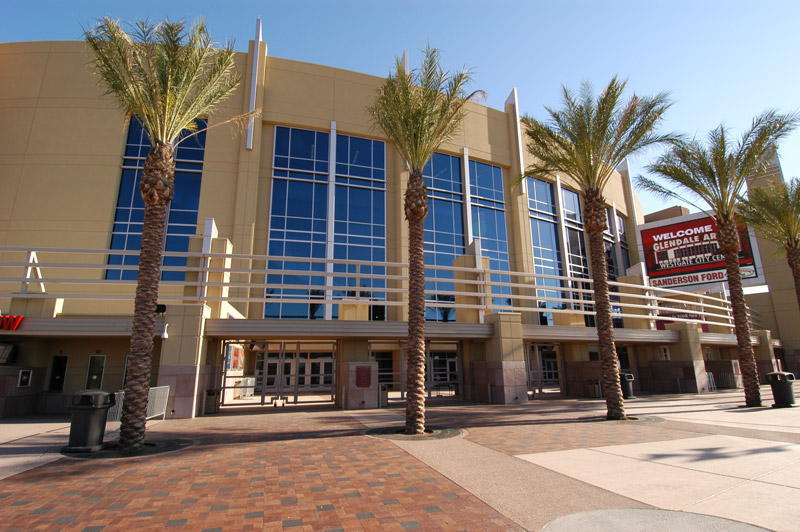
My Seattle Times colleague Geoff Baker has an insightful column about Glendale's NHL arena disaster. Sometimes one needs to be at a distance — and a distance from advertiser and fan pressure — to see things clearly.
The situation remains very much in play. Mayor Jerry Weiers may back down in the face of a lawsuit from the team formerly and rightly known as the Phoenix Coyotes. Or the courts could rule against the city's attempt to break its lease. Then the team can socialize its losses until the contract allows it to leave in three years.
But some aspects of what Baker calls "the Glendale fiasco" require Homey's distinctive local touch. Which I will proceed to attempt.
As with almost everything in Arizona today, Glendale's misery began with a real-estate hustle and taking an asset away from Phoenix, trying to make it the hole in the donut.
#tbt The ‘Town’ of Sunnyslope
Architectural disasters
In retrospect, it was foolhardy of me to promise on Facebook that I would write about Phoenix's worst architectural disasters and … could they be fixed? Then to ask for nominations by Facebook friends.
There's just too much bad architecture out there (and no, not only in Phoenix). Now it's too late, a promise is a promise, so here are my top (or bottom) three worst buildings in Phoenix.
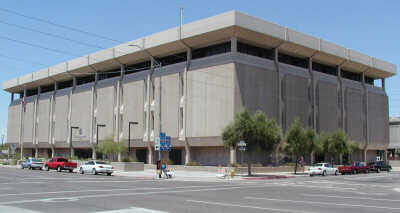
1. Phoenix Police Headquarters. Check out the seamless intertwining of Brutalist architecture, 1960s fortress mentality, and everything from the sides of the building to the abundant, heat-radiating concrete surrounding the structure screaming "bleak!"
It is an almost perfect example of sterile, dehumanizing, soul-killing, boring hack-work. It even lacks the authority projected by the 1929 City Hall/County Courthouse. Instead, the taxpayers financed a block of ugly that has stood through some 45(!) years of indifference and civic malpractice.
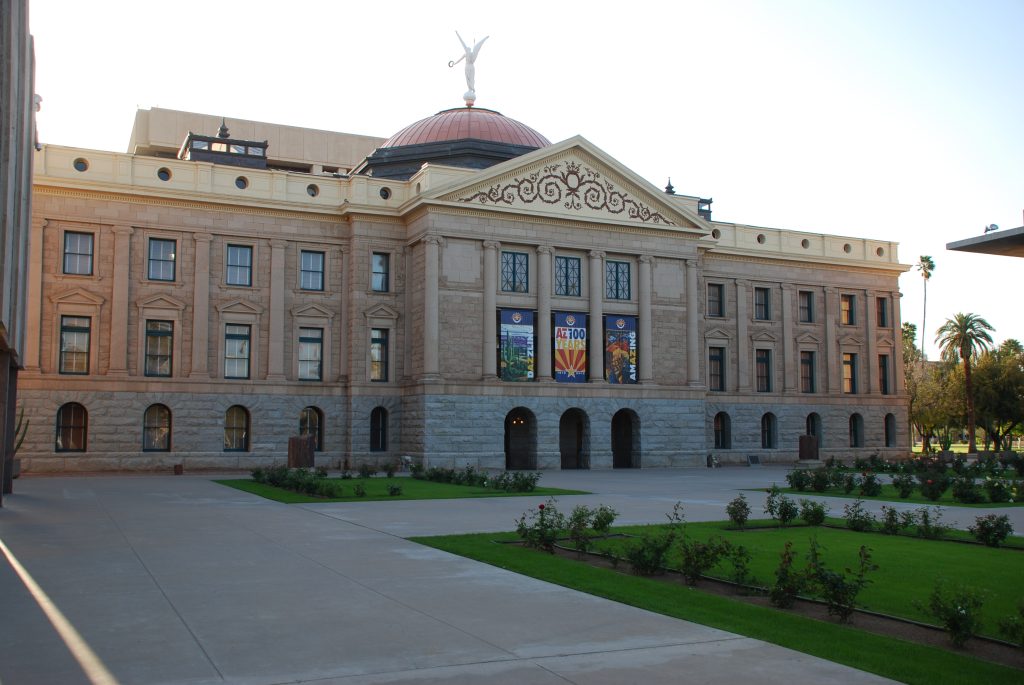
2. The Arizona Executive Office Tower. Yes, this is Gov. Roscoe's aerie.
Built in 1974, only about four years after the building above, this mishap has the same dreary "pour boiling oil on the invaders" upper-story rampart as its cousin.
Yet its transgression goes further because it is attached to the charming territorial capitol building and addition. The top of the tower overpowers the modest copper dome of the capitol. The two buildings clash like a Chevy Vega front on a Rolls Royce.
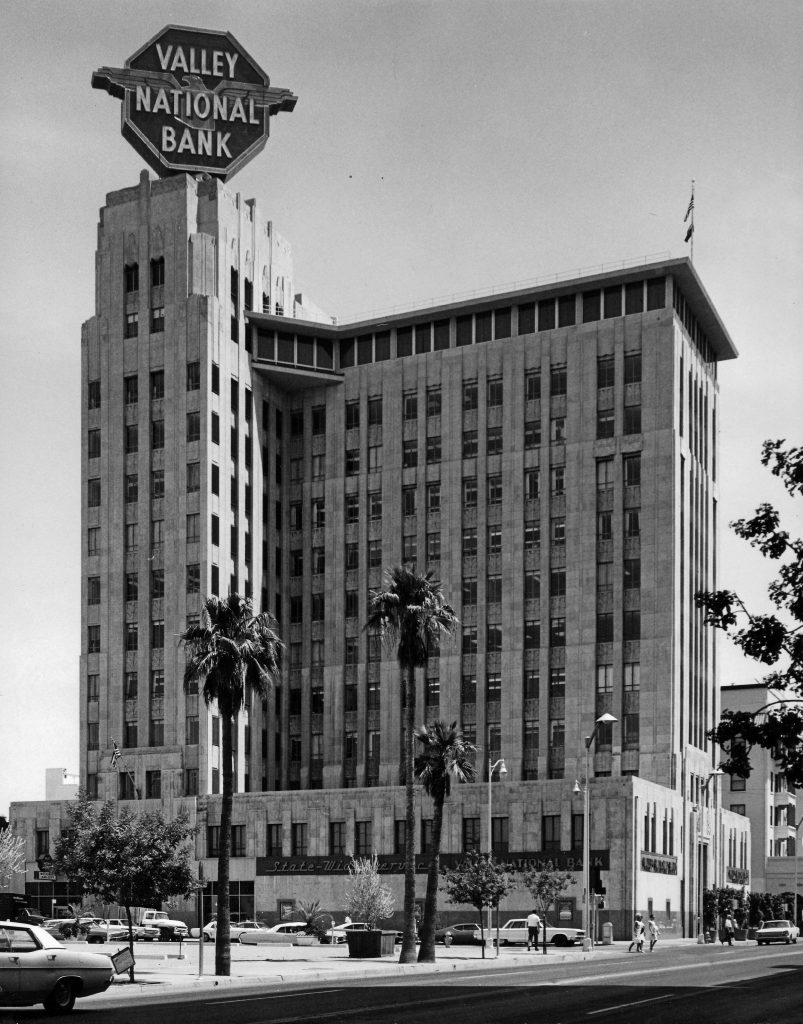
#tbt Low-rise city
AZ’s lesser depression, con’t
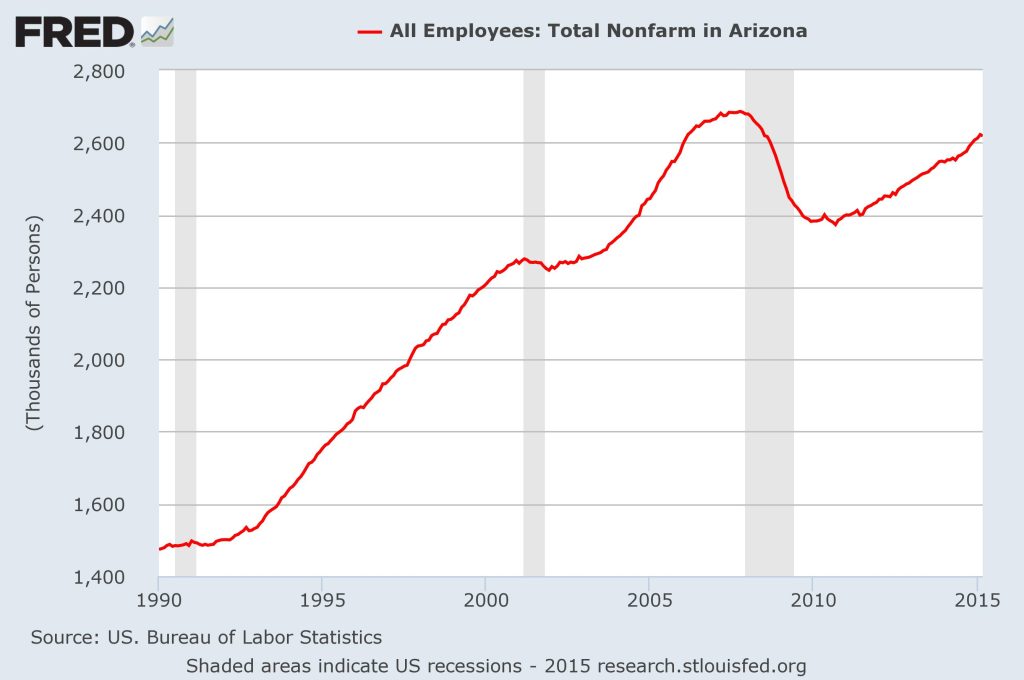
The Great Recession officially ended in June 2009. Historically, Arizona and Phoenix have bounced back quickly from downturns. Not this time.
As of April, the state had yet to recover to its pre-recession peak on non-farm employment:
More importantly, neither has metropolitan Phoenix, the economic powerhouse of the state:
This comes into more stark contrast when we add the performance of peer metros in the recovery:
Although Phoenix has a very large workforce, it is the only one among these peer Western metros that has yet to surpass its pre-recession employment in this very slow-growing economy.
#tbt Deco glory
Phoenix 101: Birth of crazy
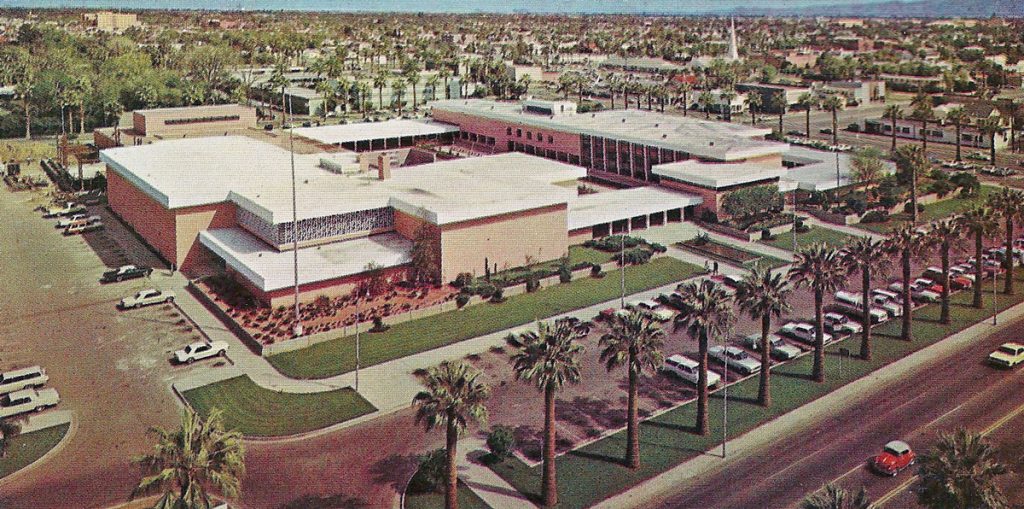
The Phoenix Civic Center, built with the support of Councilman Barry Goldwater, was seen as an example of profligacy by hardcore right-wingers. This side of the center faces Central. Today most of the site is the Phoenix Art Museum.
It is tempting to see the likes of Diane Douglas, John Huppenthal, Tom Horne-y, "Better Call Sal" DiCiccio and the entire Kookocracy as a recent phenomenon in Arizona. It's certainly comforting to us natives.
Barry Goldwater wasn't raving mad, we will tell you (the "lobbing one into the men's room of the Kremlin" was a joke). He came to regret his early opposition to federal civil rights laws, and was instrumental in helping desegregate Phoenix's schools. He desegregated Goldwater's Department Store, as well as promoting minority managers. As a city councilman, Goldwater supported public improvements, including bonds for the 1950 Civic Center (and he backed every Phoenix bond measure thereafter). In the 1980s and 1990s, Arizona's new conservatives repudiated him.
The truth is that Arizona was always a conservative state, in a narrow definition of the term. But for decades most citizens understood it wouldn't have existed without enormous federal largesse. No wonder majorities voted for FDR all four times he stood for the presidency. Sen. Carl Hayden was a progressive and New Deal Democrat. His fellow Democratic Senator, Ernest McFarland was the father of the GI Bill.
But the Kookocracy has roots that reach back more than half a century in Phoenix, to a forgotten City Council election.
The hard way

It was only a matter of time before the national media figured out that California is not the only place at risk from historic drought and the dwindling Colorado River.
Here is Slate, wrong from the first paragraph. And the Washington Post, which doesn't seem to have a clue about the dreary reality of Arizona's economy.
As a counterweight, I promoted this 2013 column on Twitter and Facebook — and traffic on this site exploded. It is important that the media elites understand the complex water issues facing Arizona. I urge you to read or re-read it.
Can Arizona and Phoenix survive the drought caused by man-made climate change? Probably. The question is whether it will be the easy way or the hard way.
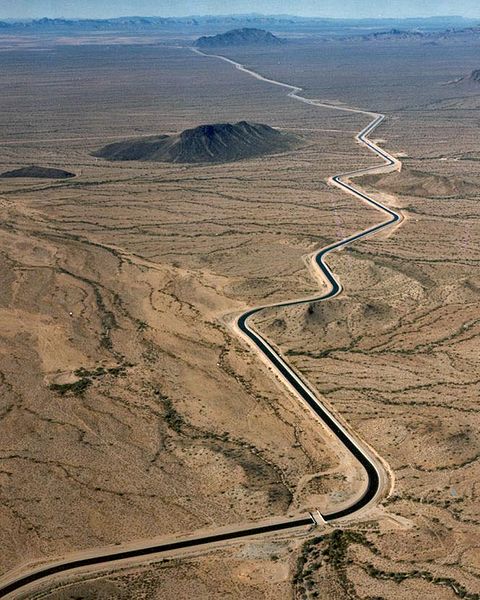
But here's an easy back-of-the-bar-napkin calculus. The population of Maricopa County, mostly metro Phoenix, was 1.5 million in 1980, before the completion of the Central Arizona Project canal and the proliferation of sprawl that preceded it and was anticipating it.
Today, the population is more than 4 million. So in the long run, metropolitan Phoenix's sustainable population — in any pleasantly liveable way — is that 1980 figure. Two-and-a-half million people need to leave, head back to the Midwest and the East.
The new red line

Redlining is the practice of, in the United States, denying, or charging more for, services such as banking, insurance, access to health care, or even supermarkets, or denying jobs to residents in particular, often racially determined, areas. — Wikipedia
The SOBs are well-known, and what an appropriate acronym. It means the north Scottsdale fatcats who refuse to go south of Bell (SOB) and measure their specialness by pronouncing the city of Phoenix as "the Mexican Detroit."
Most people with means who move to metro Phoenix don't consider it "home," as in a place to treasure and be invested in the common good. They are drunk with the resort "lifestyle" use-it-up new extraction industry. Being "exclusive" means drawing red lines to show one's superiority. To define zones that are scary and lost, whether this is true or not.
In recent years, I've become more aware of another red line within the city: Camelback Road.
Writing off the news*
So wealthy Republican Cara Carlton Sneed, aka "Carly Fiorina," is running for president. She represents everything wrong in an America run by oligarchy, including running venerable Hewlett Packard into the ground and laying off tens of thousands of people.
The two businessmen who became president were Warren G. Harding and George W. Bush. In fact, government can't and shouldn't be run like a business. A business, especially a big business today, seeks only its own growth and increasing stock price. Too many of its leaders, Fiorina included, are sociopaths with no notion of the public good. So she'll fit right with the Republican contenders.
It tells us something that this supposed titan of technology forgot to register her domain name.
Now, on to Arizona…
• I read that McDowell Road in Scottsdale is "continues (its) resurgence." With what little capital that metro Phoenix attracts clustering to the eastside — which should be a hair-on-fire issue at Phoenix City Hall — this isn't surprising. Here's what McDowell won't be: walkable, livable, or accessible to frequent transit. Make it shady, narrow it by four lanes or so, extend light rail, and plant mature shade trees and then you're talking.
• Narrowing a portion of 32nd Street is a good start in Phoenix. Unfortunately, it is outside the Salt River Project so the shade trees that would make it walkable for all but those seeking skin cancer is impossible. It is also served only by the 16 bus, not enough. So one-and-a-half cheers.
American Eden
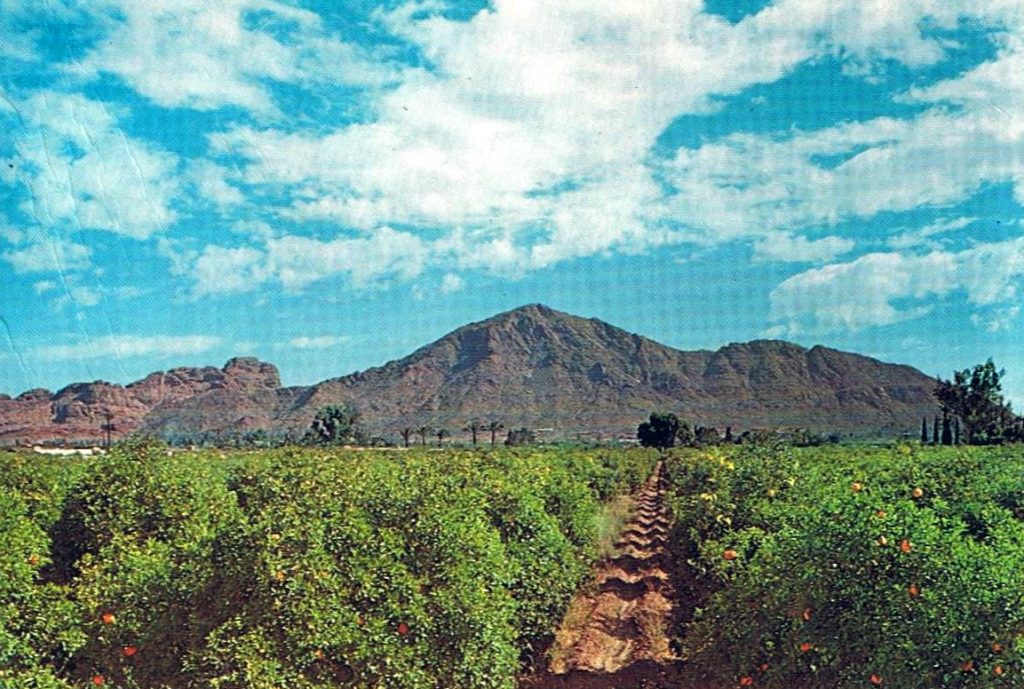
Agriculture is the oldest organized human activity in the Salt River Valley. This is why Phoenix was never a Wild West town like Tombstone or even Prescott. It was never a copper square.
For hundreds of years this sustained the Hohokam, who created the most advanced irrigation civilization in the New World. They built hundreds, perhaps thousands, of miles of canals to bring water from the Salt River to their fields. After the Hohokam left in circumstances that are still debated, the valley lay empty for 400 years. Waiting.
Jack Swilling may get too much credit among the founders of Phoenix. But one thing that's certain is this soldier of fortune immediately grasped the valley's agricultural potential when he arrived after the Civil War to help John Y.T. Smith farm hay for the Army at Fort McDowell.
He saw the Hohokam canals, the seemingly flat ground and rich earth, and knew it was farming country. In some cases, old Hohokam canals were simply cleaned out by the Swilling Irrigating Canal Co. His passion in selling what "Lord" Duppa would aptly name Phoenix attracted men from Wickenburg and Prescott. Swilling's Ditch was built in 1868 from today's 40th Street and ran west beside Van Buren Street.
No other place in the West between the 100th meridian and California and the Pacific Northwest was so hospitable to farming. Three rivers met here and the soil was alluvial and priceless. Unlike the future Dustbowl, with its shallow topsoil and dependency on fickle rainfall, the Salt River Valley alone had almost all the makings of a major agricultural empire.
By 1870, 200 Anglo settlers had arrived and laid out the townsite, land was platted from the Gila and Salt River Baseline and Meridian, and more ditches were dug. Wheat and grains were the early crops. Former Union officer William John Murphy led building of the 41-mile Arizona Canal between 1883 and 1885. In the late part of that decade, the Rev. Winfield Scott, an Army chaplain, acquired 640 acres. With his brother George, he planted the first citrus trees, along with growing dates and figs and other tree crops.
Yes, tony Scottsdale is named after this chaplain-farmer. (So is Winfield, Kan.). But other farm villages preceded it: Mesa (1878), Tempe (1879), Glendale (1887) and Peoria (1897).
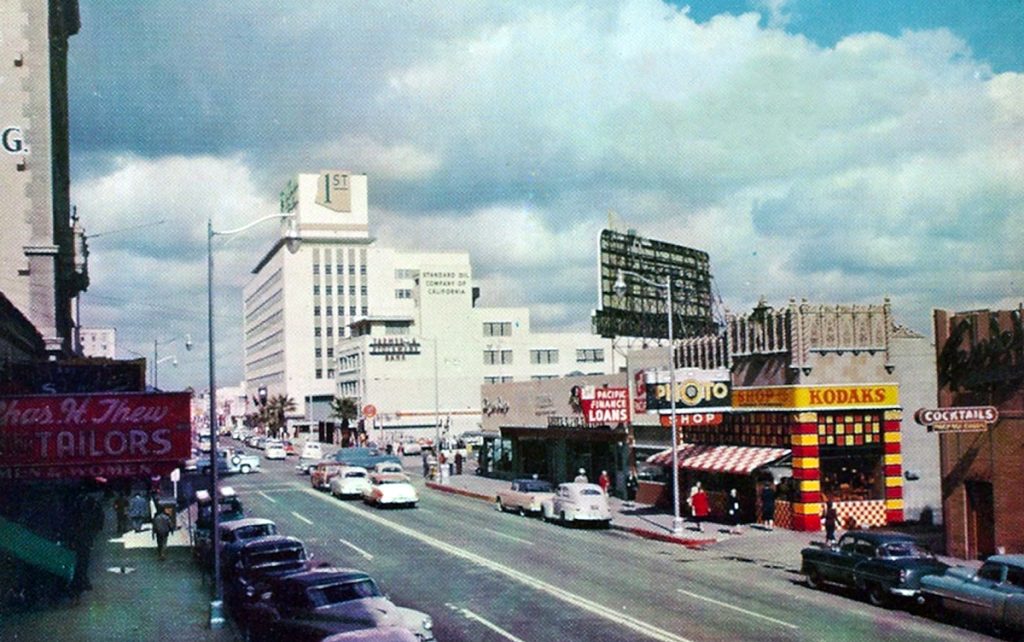
Reform and extremism

One of the curiosities of Arizona politics is how widely supported efforts to make government cleaner — the approval of term limits in 1992 and so-called clean elections public financing of candidates in 1998 — coincided with the rise and now dominance of the extreme right.
Term limits were a fad in the early 1990s, ostensibly meant to eliminate a permanent political class. Although never implemented on a national level, they gained traction in many state and local government. "Clean elections" was intended to take big money out of politics, especially in the aftermath of the bribe-ridden AzScam scandal.
Under the new rules, a Burton Barr, who ruled the Legislature as House majority leader from 1966 to 1986 would have been impossible. Barr's time, working with such Democratic leaders as Alfredo Gutierrez and Art Hamilton, also was the high-water mark of legislative achievement for Arizona.
Had term limits been enacted nationally, we never would have had a Carl Hayden, who served in the Senate for 42 years, or a John J. Rhodes, who served in the House for 30 years. And thus, no Central Arizona Project, which demanded such longevity from lawmakers from what was then a small and politically weak state challenging mighty California.
Raul Castro, an appreciation
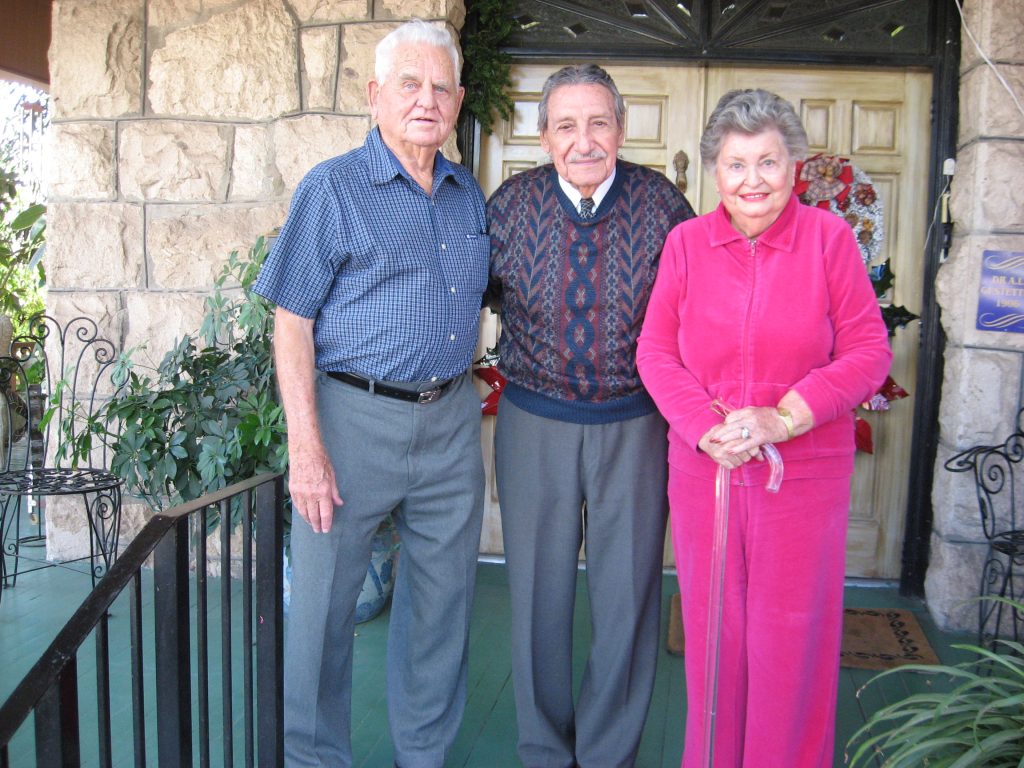
Raul Castro, center, along with his wife Pat and longtime law partner and friend Henry Zipf at the Castros' home in Nogales, Ariz., circa 2008.
By Jack August Jr., Guest Rogue
In 2007, then-91 year-old Raul Castro addressed a packed auditorium at the Arizona Historical Foundation’s annual Goldwater Lecture Series at Arizona State University. At the time, I served as Executive Director of the foundation, which, among other things, maintained the personal and political papers of Sen. Barry Goldwater.
Two hundred mostly conservative and arguably skeptical supporters of the legendary Arizona senator were curious to see what the former Democratic governor, judge, and ambassador had to say.
After introducing him, I sat down and watched Castro stride to the podium; he had no notes. He launched into a one-hour presentation that seemed like ten minutes, telling his life story, touching upon the role that education played in his life, his years as a “hobo” riding the rails, his undefeated professional boxing career, and his countless experiences of prejudice and adversity.
But the overarching theme in his talk was the promise that America held for all its citizens. When he finished the audience exploded in applause and stood on their feet clapping for several minutes. It was a stunning performance.
The distinguished professional career of Castro, who died last week, stood in stark contrast to the adversity inherent in his humble beginnings, which only hardened his resolve and strengthened his determination.
For whom the bell tolls

California, facing its worst drought in modern times, gets all the press. Arizona, confronting many of the same issues, albeit less severely so far, flies under the radar.
I'm told that the latest meme of is Phoenix 3.0 — 1.0 being an agricultural economy, 2.0 being development and 3.0, now, is moving into the broad, sunlit uplands of a technology economy.
This is only boosterwash. Data centers and profaning the desert with solar "farms" is far from being at the headwaters of the tech economy. Where the innovation happens on a global scale. Where the world talent congregates for high-paid jobs. This is almost exclusively happening in blue states, in a few "technopolises" such as Silicon Valley, San Francisco, Seattle, San Diego, Boston and New York.
The headwaters of advanced industries don't go to states defined by their extreme politics, underfunded education, and cuts to universities.
The reality is that Arizona is desperately trying to restart the growth engine for one, two, maybe three more runs — with championship golf — before the edifice finally collapses. By then, the architects of the short hustle will be living off their profits somewhere else.