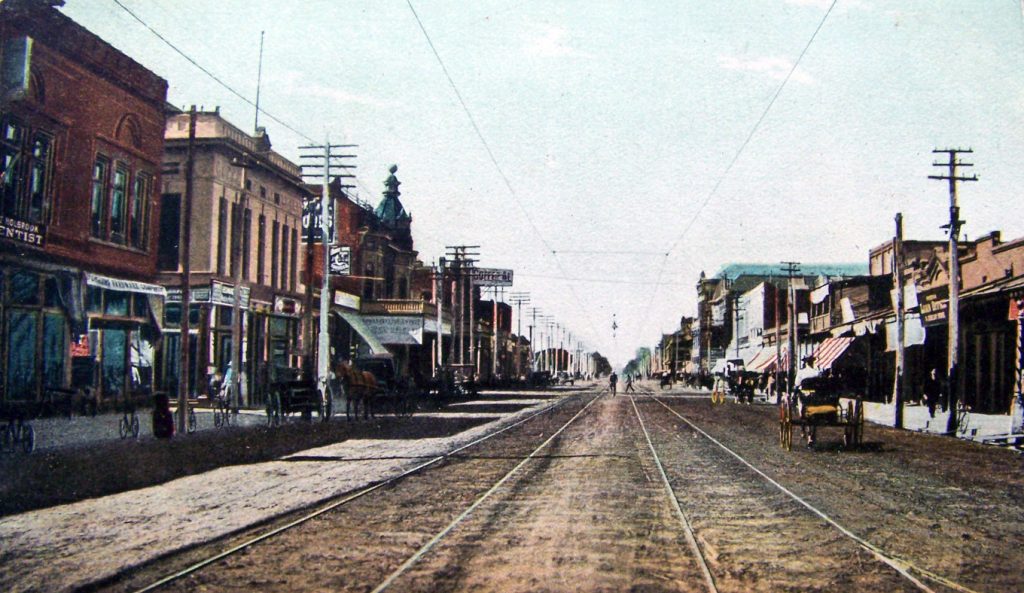
Washington Street in Phoenix, 1890. The trees and adobe buildings of 1870 were mostly gone from this view.
My grandmother, Sarah Ella Darrow, was born in 1889 in the Chickasaw Nation, Cumberland, Indian Territory. Her parents had come to I.T., as the postal address read for today's eastern Oklahoma, as Presbyterian missionaries. Then they ran a small store.
Earlier, on the Texas frontier, her mother (my great-grandmother), Emma Caroline Hulse, had been scalped as a baby during a Comanche attack after troops were withdrawn for the Civil War — she survived and went on to marry my great-grandfather, Francis Marion Darrow who hailed from the Midwest.
Indian Territory, home of the Five Civilized Tribes, was fine country for farming and timber, well watered, with growing towns and new railroads. But whites couldn't own land and that was Darrow's dream. The Chickasaw governor (chief) loved my great-grandfather and wanted to adopt him (thus putting him on "the rolls" as a tribal member), but Darrow declined. Then the store and their home were destroyed by a tornado, with one daughter killed.
They went west, to Arizona, to the Salt River Valley. They and hundreds like them came for relatively cheap land and good farming. Like much of the West, Phoenix was heavily publicized to draw settlers. One thing was even true: This was one of the world's great alluvial valleys, fanning out in mostly flat, irrigable land from a river that flowed year-round, or so it seemed.
Here the Hohokam had created the most advanced irrigation system in the New World, with at least 200 miles of canals, before that civilization faded. The Pima, likely the descendants of the Hohokam, had moved south to the Gila River and beyond, partly to escape raids by the Apache.
In the late 1850s, Charles Trumbull Hayden noticed this vast, mysterious valley with its tree-lined river while hauling freight to Tucson. He would be back. He would name his son Carl.
By the 1890s, the phoenix was stirring from the ashes. The Apache had been subdued by the U.S. Cavalry. Thousands of acres were under cultivation, especially for wheat, barley and fruit trees. Anything would grow in this soil, provided water was added. The project of clearing out and extending the old Hohokam Canals was well along by then. Phoenix as a settlement was more than 20 years old.
The first railroad had arrived on Independence Day, 1887. In 1890, the Census Bureau declared the American frontier closed. By the time my family arrived, the chance to start fresh and live the Jeffersonian dream of yeoman farmer was fading most places. Not here.
 37
37