Role models

I didn't start this. An article in the Phoenix Business Journal is headlined, "Why Phoenix should be looking up to Seattle, not Austin." Behind it is the legitimate concern, written about here often, how the city is not attracting anywhere near its share of young, educated and high-skilled talent. In addition, as the article states, "The Texas capital beat out the Valley for a $300 million Apple Inc. campus last year, and General Motors is also placing a new technology center there." Naturally, it contains the obligatory, "Arizona has plenty of positive attributes in its corner: cost of living, proximity to California, business costs and nice winters."

Here are a few reasons why Phoenix can't be Seattle: No major headquarters of global corporations and non-profits; no world-class clusters in aviation and software; no civic stewards who invest heavily in the city, nurture its cultural assets and lead its continuous reinvention; no 24/7 downtown with hundreds of stores, restaurants, Pike Place Market, flagship Nordstrom, etc., and little critical mass in a dense, lively, cool center city. No diversified economy or University of Washington. No reputation for tolerance, progressive politics and long history of attracting world talent, whether for airplanes, software, biotech, world health or game development. We've covered some of this before.

Austin is sprawly, hot and has poor transit. Alas, here are a few reasons why Phoenix can't be Austin: It's not the capital of a state that puts attracting business, good jobs and huge amounts of federal money ahead of crazy ideology and revels in its power. No University of Texas. No world-famous music scene in a relatively dense quarter of downtown and tolerant "Keep Austin Weird" liberalism in the middle of a red state. No oil money. No history of largesse from LBJ (would President McCain have done anything for Phoenix? No.). No first-rate technology cluster, built up over many years, attracting top talent to the headquarters, R&D centers and labs of scores of well-known corporations.

Immigration dreamland

A cabal that includes Sens. McCain and Flake, nominally of Arizona, has proposed "sweeping bipartisan immigration reform" in the Senate. The move for Republicans is as obvious as it is cynical: After President Obama carried 71 percent of the Hispanic vote, party bosses suddenly want to make nice with brown people.

This is an easy pivot for wealthy Republican John Sidney McCain III, who in political life has rarely let anything get in the way of his ambition. The aptly named Flake will do as told. But what about all the Anglos from the Midwest and true-red Kooks who actually believed all the heads-cut-off, reconquista Mexi-peril hysteria that has been firehosed across the Arizona public square for years? Tuning in on AzCentral, I read such comments as, "Pretty bad when our own government rewards people for breaking the law"; "Great, another amnesty for criminals"; "I'm really against them braking (sic) the laws of our country -then being rewarded"; "I fought for this great country and I am dismayed that the liberals are
trying to run it into the ground with political correctness"; "if they can't work hear (sic) or get welfare they won't come here"; "Round up the people using said documents and deport them."

Actually, the comments are way tamer than I expected, but the site is more difficult for trolls to take over than it once was. You get the point. "WHAT PART OF ILLEGAL DON'T YOU UNDERSTAND?!?!?!"

Arizona’s children

For years, the state's Child Protective Services has been an easy whipping post for the media. It's gub'ment, after all, which every right-thinking person should oppose, and gub'ment "never does anything right." It's safer to go after CPS than, say, the environmental depredations and political influence/corruption of the Real Estate Industrial Complex. CPS = bad is such a backbeat that one is tempted to not even pay attention.

Still, I saw a story on the agency's most recent report — more reports of child abuse and neglect than ever, but an increase after three years in foster homes — and became curious. The first thing to seem odd is that the Kooks have buried CPS in the Department of Economic Security. Yeah, the unemployment agency. Washington state's child-welfare agency is part of a cabinet-level Department of Social and Health Services. In Colorado, it's in the Department of Human Services. But I suppose this is the "streamlining" of government by the Kooks. Yet the obvious implication is that child welfare is not that important; the agency head is conveniently removed from the governor — unless something goes wrong.

CPS has been more than buried. It has endured years of budget cuts even as population grew and, after the housing depression, the need for social services to working-poor families increased. Some $300 million was cut from these programs over four years by a Legislature not just facing revenue shortfalls, but ideologically opposed to government assistance to the needy. Not surprisingly, children needing foster care rose dramatically. Huge new cuts were being readied last month.

Old Phoenix at night

Old Phoenix at night

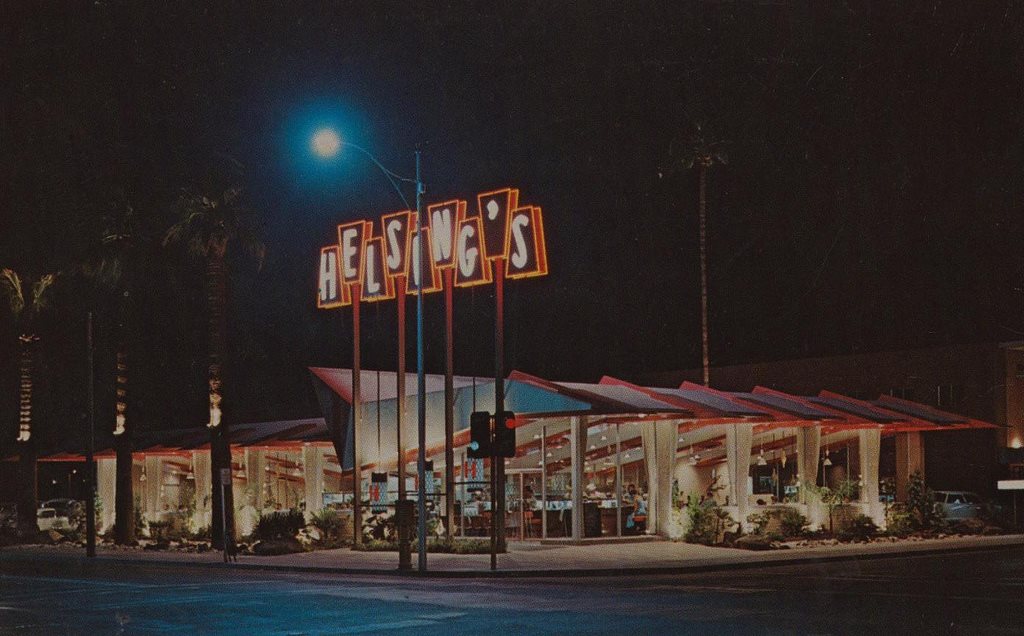
Helsings
Helsing's Restaurant, designed by architect John Sing Tang, at Central and Osborn.

Coffee_shop_24_Hr_Central_Van_Buren_1970sThe other night an Arizona Republic reporter tweeted desperately for a 24-hour coffee shop in downtown Phoenix. He was out of luck (somebody suggested a donut shop around 24th Street and Thomas, a common lack of understanding about where downtown Phoenix is located; the closest place was the IHop on Central in Midtown). This was not always the case. One (left) was located at Central and Van Buren, near the Trailways and Greyhound bus depots, with a lighted billboard on the roof. It survived until around 1970, when it was torn down for Valley Center, now the Chase Tower.

Across the street, on the northeast corner, was Jay's Coffee Shop, also 24 hours. After it was torn down in the '70s, the resulting surface parking lot was vacant for decades. Yet another favorite was the Busy Bee on Washington Street, one of the many Greek-owned establishments, which lasted until being bulldozed for Patriot's Square. These were not hipster hangouts with free wifi, but the old-fashioned coffee-shops-as-restaurants.

Beyond downtown proper, a number of center city late-night and 24-hour establishments were hopping well into the late 1970s. These included two Helsing's on Central, Village Inn at Seventh Street and Monte Vista, Shaefer's on McDowell at Seventh Street, and Denny's at Van Buren and Seventh Avenue. A bit farther west was Brookshire's at 16th Street and McDowell. They were life-savers when I worked on the ambulance and we might not get dinner until three a.m.

Bob's Big Boy anchored the corner of Central and Thomas and was the magnet for participants of weekend cruising on Central. Other popular chains were Hobo Joe's (with the hoho statue out front), Googies and Sambo's (a Sambo's building on McDowell across from the Phoenix Art Museum still stands, most recently a Thai restaurant). Helsing's and some of the others were works of art, but none still stand, unlike a few of their preserved sisters in Los Angeles.

Old Phoenix was not an all-night town. Which is not to say it wasn't a late-night town.

Arizona bio, part I

Someone important asked me to write about the biosciences in Phoenix and Arizona as the effort marks its tenth anniversary. This is fitting because I vividly remember the day I was called to the office of then Phoenix Mayor Skip Rimsza where he laid out the opportunity that the city had to lure star researcher Jeff Trent and the International Genomics Consortium. As a columnist for the Arizona Republic, I wrote dozens of articles to explain and advocate for this unique chance to leapfrog out of an economy that had become dangerously dependent on housing and population growth, and was falling behind on almost every measure of economic and social well-being. One column was an open letter to Dr. Trent — both of us are natives and this was from the heart — that he later told me played a big role in his decision to come home and establish T-Gen.

With Mary Jo Waits, then of the Morrison Institute, I worked to develop a "meds and eds" strategy to leverage biosciences and education; government, non-profits and eventually for-profit organizations, to create a major bio hub. As Waits repeatedly said, what if we could lay claim to the cure for cancer being discovered in downtown Phoenix? I mention my role for the sake of those who constantly yowl that I "hate Arizona," do nothing constructive, am a "quitter" or some guy in Seattle who spends his time picking on Phoenix.

The Flinn Foundation led the development of a strong strategic roadmap, as well as providing $50 million in funding. Gov. Janet Napolitano was supportive and the Legislature was dragged aboard a statewide push including leaders in Tucson and Flagstaff, as well as the Gila River Indian Community. At City Hall, Deputy City Manager Sheryl Sculley marshaled the bureaucracy to assemble land for the venture on the old Phoenix Union High School campus and oversee its redeployment. More land north was available for expansion; it had been set aside for the abortive attempt to win the NFL stadium that instead went to a cotton field west of Glendale. New ASU President Michael Crow instantly grasped the potential and soon the U of A was planning a medical school on the site. When ground was broken for the T-Gen building, even then Rep. J.D. Hayworth, hater of all things gub'ment, showed up to bask in what appeared to be a moment of history on par with the CAP. Hard as it is to believe now, it was a time of breathtaking hope.

World-class city

Sackcloth was donned and teeth were gnashed on Facebook with the news that Taz Loomans was decamping from Phoenix for Portland. Loomans described herself as "an architect, a writer and an advocate for sustainable building
practices and community-oriented design in Phoenix. I love living in
Central Phoenix and taking part in the coming of age of this city." She was one of the people who gave hope to the Resistance. Now, however, she writes:

During this emotionally turbulent year, I have had the privilege to
travel quite a bit. In fact, as I write this, I am in the Bay Area on a
new years trip. I visited some world class cities this year such as Barcelona, Chicago, Portland New York and now San Francisco.

These trips have also changed me and the way I look at the world. Whereas before I was happy to help build Phoenix into a world-class city, I now want to find out what it feels like to live
in a world-class city. Before, I wanted to help bring bike lanes, urban
gardens, community and walkability to Phoenix. Now I want to live a
life where those things are a part of the culture and are woven into the
fabric of the city. In my travels, particularly this year, I’ve found
that there are quite a few places in the country, and no doubt in the
world, where this is true.

I’m moving not so much because I’ve lost faith in Phoenix, but rather
because different things are important to me as I go through a personal
evolution…But it’s still a tough place to build on previous progress and get to
the next level. The city’s penchant to tear down old buildings and build
new ones in their place is a perfect metaphor to how Phoenix always
seems to be starting from scratch (apropos, perhaps, because of it’s
name), and just can’t seem to build enough sustained momentum to become a
world class city.

The Sprawl Needle

Once again, it's left to homey to sun on the parade. People will once again conclude that I "hate Arizona."

Novawest, a "boutique real estate developer," has rolled out, let's call it an aspiration, to build a 420-foot-tall observation tower in downtown Phoenix. It is being likened to the Space Needle in Seattle, which marked its 50th anniversary in 2012. More about that in a moment. The developer has no financing. It has completed no project in Arizona. "But Novawest leaders are optimistic." The renderings — and I understand this is to be an open-air affair? — looked really hot, and I don't mean sexy. If every rendering proposed for downtown and the Central Corridor had been built, central Phoenix would resemble a five-mile slice of Manhattan. But let's give Novawest the benefit of a dreamer's doubt and get down to cases. [Jim Kunstler does, after his fashion, naming it the January Eyesore of the Month].

First, the Phoenix skyline is abysmally dull aside from the Viad Tower. But the combined power of the People's Republic of Sky Harbor and lack of capital, headquarters and civic leaders with means has thwarted anything better. Want some visionary skyscrapers? Go see my friend Will Bruder, architect of the central library. He's got some designs that would vault Phoenix's skyline to world prominence. But, again: Capital, headquarters, civic leaders with means. Without that combination, great civic acts are difficult. For example, Viad was built by the old Dial Corp. as a signature world headquarters and a gift to its city. Dial is gone as an independent headquarters, just another office in Scottsdale.

Phoenix rail: Next steps

PhxLRT2

Newer readers to this blog might wonder why the parenthetical "WBIYB" is always inserted after the first reference to Phoenix light rail. It stands for: We Built It, You Bastards. A reminder of the hysterical, ignorant and too often thuggish opposition to a transportation technology that had proved successful around the country. I received death threats and demands that I be fired for columnizing in favor of light rail at the Arizona Republic. Well, you bastards, we built it and it is a big success, aside from the distortions that suppress transit-oriented development. Such a big success that Mesa (!) is building the line deeper into the city — and you can thank former Mayor Keno Hawker for having the foresight to persuade his colleagues to help fund one mile into the city; otherwise, Mesa would have been cut off from a system it now embraces.

It's a tough slog. The Legislature and governor are hostile to anything but freeways. The great crash slowed funding from Prop. 400 to a trickle, and even then most of it was going to build transportation infrastructure appropriate to the 1960s rather than today, including the misbegotten Loop 303 and South Mountain Freeway. While these will enrich a few connected developers, they are engines of sprawl, congestion, pollution and expansion of the heat island. Most Phoenicians can't imagine a lifestyle that doesn't revolve around long single-occupancy car trips.

Even so, the 20-mile starter line is expanding not only into downtown Mesa but also toward Metrocenter mall. An ambitious new line is being prepared to run west from downtown to a park-and-ride at 79th Avenue and Interstate 10. The West Line/Capitol Line is widely misunderstood in the media, but it would be an important step to creating a much more robust light-rail system.

Phoenix in the sixties

Phoenix in the sixties

Municipal_Building_1964
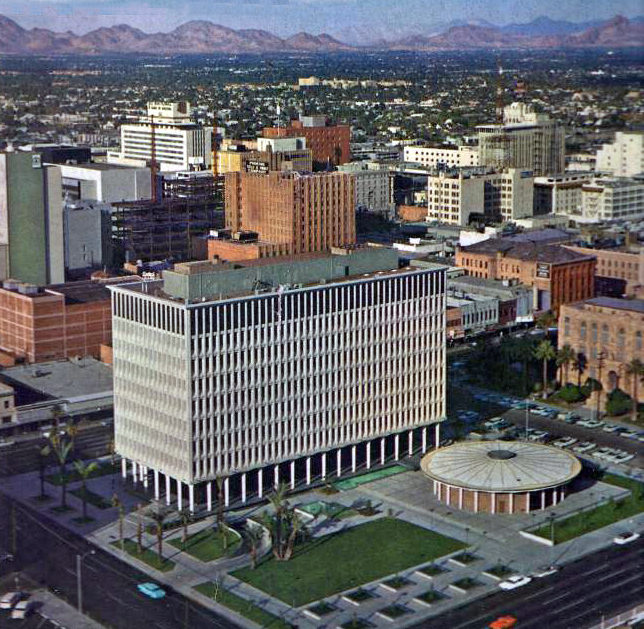
Downtown in the mid-1960s, with the new Municipal Building, forefront, and the iconic rotating Valley National Bank sign in the upper right.

Decades are arbitrary things. One could make the case that "the sixties" in Phoenix ran from the late 1950s through the early 1970s. In any case, it was a most consequential time, arguably the decade when Phoenix set the pattern for what it would become, for better and for worse. In the 1960 Census, Phoenix's population was 439,170, making it the 29th largest city in America and 187 square miles within the city limits.

This was a startling jump from ten years before, ranked 99th with 106,818 people within 17.1 square miles. Phoenix had quickly become a big city, but unlike most others: single-story, spread out, car-dependent and populated by few natives. It had decisively surpassed El Paso as the dominant city of the Southwest. Yet, as it remains today, its power was like that of a small town.

Nineteen-sixty saw the unveiling of the Wilbur Smith & Associates freeway plan. Although its closest big-city neighbor was Los Angeles, Phoenix had only one baby freeway, Black Canyon. Over the decade, this would curve into the Maricopa Freeway but otherwise the Smith plan was mired in controversy. Phoenicians didn't want to become another LA. The Valley Beautiful Citizens Council worried that freeways would destroy an already ailing downtown. A hundred-foot high Papago Freeway with "helicoils" provoked more opposition. In the end, almost all of the 1960 plan was adopted. But surface streets carried most traffic during this era.

Downtown retail was slowly dying, as was the dense corridor on McDowell between 12th Street and 18th Street called "the Miracle Mile." This included the lush, stately Good Samaritan Hospital campus, replaced 20 years later by the brutal spaceship building that remains today. Malls were flourishing, including Park Central, Tower Plaza, Thomas Mall and Chris-Town, named after farmer Chris Harri on whose land it was built. Many of the downtown merchant princes were dead or ailing. Others, notably Goldwater's (sold to Associated Dry Goods in 1963), moved to the malls.

Thinking about water

Arizona_cap_canal
The Central Arizona Project canal snakes through the desert.

The Arizona Republic's Shaun McKinnon did a fine job of using the breach in the CAP canal to provide a primer on the system and some of its challenges (here, here and here). This blog has written extensively on water and Arizona, but while a few people are paying attention, let me make a few essential points:

• The Colorado River is over-subscribed. There are, as the water geeks say, too many straws sucking from the river. When the Colorado River Compact was first sealed in 1922 (with Arizona disputing the allotments, chiefly because it believed it was due more because the Gila and its in-state tributaries flow into the Colorado), the Southwest was largely unpopulated and even Los Angeles' population in the most recent Census was less than 600,000. The river was to be "tamed" for reclamation. Nobody ever imagined Las Vegas, a tiny stop on the Union Pacific Railroad, would become a major metropolis. Critically, the river levels used to make the allotments were around 500-year highs. Now there's simply not enough water to go around. The Upper Basin states, especially the state of Colorado, always felt defrauded by the deal and the subsequent settlement of Arizona v. California. They will be much more jealous of their water resources now. Mexico was shortchanged, as well, with catastrophic destruction of the Colorado delta resulting.

• Climate change will transform all assumptions about water in the Southwest, especially its effect on snowmelt, both in the Rockies feeding the Colorado River, and the Arizona mountains whose snow charges the lakes of the Salt River Project. There will be less water and higher temperatures. We have no historical roadmap for what this will mean, especially because, as Ed Abbey would say, one has established a city where no city should be.

Parking lot city

Parking lot

"We like our parking lots!" lawyer and Real Estate Industrial Complex apologist Grady Gammage said a few years ago when the two of us were speaking at an event on the future of Phoenix. And how. I've read that some 43 percent of the city of Phoenix alone is empty land. It would be interesting to know how much of the city is surface parking lots.

I remember when Kenilworth School was surrounded by grass and majestic palm trees. It lost part of that to the monstrous Papago Freeway. More was taken away by parking lots. The consequences are even more telling at North High School. At one time, North boasted a beautiful campus with shade and trees — it was the probably the most attractive campus in the state. By the time I got back in 2000, most of it had been paved over. Similarly, the old city-county building, where my fictional detective David Mapstone has his office, was once an oasis of shade trees and grass. Those were ripped out for "authentic" dirt and palo verdes, and recently the parking lot on the south end of the 1929 building was…expanded.

More than aesthetics are involved. Surface parking lots are a big cause of local warming, which has increased nighttime temperatures some 10 degrees in my lifetime, causing the summers to be hotter and last longer, and turning normal monsoon storms into violent affairs when they collide with the heat being released by all these square miles of asphalt and concrete. The lots destroy the fabric of the city and make walkability and convenience much more problematic. Many sit atop former farmland, which will really matter in a future of food shortages. Take a drive, ride light rail (WBIYB) or pull up Google Earth and look at all the parking lots in Phoenix. Interestingly, most of them are largely empty most of the time.

Arizona merry-go-round

I was supposed to be on KJZZ's Here and Now with Steve Goldstein on Wednesday but we were pre-empted by POTUS. So let me run through a few Arizona observations:

As of Wednesday, the state was still counting ballots. If this were happening in a banana republic, it would be one thing…but in a supposedly advanced nation? This affront to democracy is not mere incompetence but a huge opportunity for mischief — not the virtually nonexistent vote fraud the GOP claims, but official vote suppression and disenfranchisement of "those people." Once upon a time, the Secretary of State's office was a sleepy but efficient place, presided over forever by Wes Bolin and his assistant, Rose Mofford. It has become increasingly politicized, especially in 2004 when Jan Brewer was both Secretary of State, overseeing the election, and head of the state's Bush-Cheney campaign. Ken Bennett is no less an ambitious political animal. This is a scandal crying for investigative reporting and reform. Also, how could you re-elect Joe Arpaio? No wonder Gov. Fright Mask is musing on another term.

• • •

For the first time, Arizona has no Democratic statewide officeholder. This is a profound change from what had been a majority Democrat state when I was little to a competitive state for both parties for many years. One-party rule is never healthy, but it is particularly bad when the One Party denies facts and reality. The Big Sort is at work — even progressives who read this blog talk about their plans to leave. So is the outsized organization and leverage of the LDS with no counterweights in the Latino community or elsewhere (Arizona once was a big union state, yes). The Sinema congressional win is fine, but her campaign was hardly progressive. Unless widespread Hispanic voter suppression took place and Carmona stages a win, this election confirms the worst. Arizona is a solid member of the New Confederacy.

The Goldwater Library

A few quick observations on the $30 million Barry and Peggy Goldwater Library and Archives to be built in downtown Mesa. For the city of Phoenix, it is embarrassing, ahisorical, wounding and revealing.

Embarrassing because, according to the Arizona Republic, the library trustees wanted to put the institution in downtown Phoenix and city officials dropped the ball.

Ahistorical because Barry Goldwater was born in central Phoenix, attended Kenilworth School (as did I), managed his family department store downtown and was a Phoenix City Councilman who, among other things, backed construction of the Civic Center that is still home of the Phoenix Art Museum and Phoenix Theater.

Tear-down city

It's an outrage that two of the very few remaining buildings of the Deuce, the Madison and St. James hotels, are being torn down to make a surface parking lot. Phoenix sure doesn't have enough surface parking lots. Apparently a "compromise" with the Phoenix Suns, which owns the property downtown, will "preserve" a fragment of one building. That's almost more pathetic and insulting than blading the whole thing. These commercial buildings from the early 20th century only make sense as part of a whole, i.e. a walkable block of these human-scaled, useful and historic structures, a "smile full of teeth," as it were, right up to the sidewalk. In isolation, they lose these winning features. A few pieces of rubble in a surface parking lot…is that a joke?

Team owner Robert Sarver must be sitting in his San Diego palace savoring getting some of his own back, after not being able to demolish the Sun Mercantile to build a W Hotel. According to my sources, Sarver was presented with a stunning architectural option that would have twirled the hotel tower well above the roof of the historic structure. He shot it down in favor of something more conventional and dull and destructive. Which never happened anyway. It's amazing the Sun Mercantile survives, and a credit to preservationists. Does anyone think Sarver, had be owned the Suns at the time, would have pushed for a downtown arena as Jerry Colangelo did? Just as I'm sure Ken Kendrick and pals wish Chase Field was on the rez near north Scottsdale. Seattle's looking for an NBA team. Don't assume anything with "stewards" like this.

I realize this post is coming very soon after a meditation, sparked by the fight over the Wright house, on all that Phoenix has lost. And yet the losses just keep coming. A century-old store in Higley was no match for the sacred widening of the holy wide "streets" which are the width of major highways. But the downtown calamity especially stands out.

Phoenix 101: Lost

Penn_Station1

The main waiting room of New York's Pennsylvania Station, shortly before it was demolished in 1963.

The effort to save the David and Gladys Wright House has become a cause célèbre, or as much of one that can find traction in the sprawling, just-rolled-in-from-Minnesota "civic" climate of metro Phoenix. A Facebook page has been set up. The New York Times flew in architecture critic Michael Kimmelman to write an appreciation of this Frank Lloyd Wright work, including such details omitted by the local media as the demolition company (!) being the one who realized the treasure they had been engaged to rip down and going to the city. The odds of success are long. Perhaps if this were the Joe Arpaio House and it was being torn down to create a day labor center for illegal immigrants. Otherwise, only the Resistance and minority of Resistance-minded citizens have a clue.

The modern preservation movement in America is often traced to the 1963 destruction of Pennsylvania Station, the classically-inspired masterwork of McKim, Mead and White in New York City. It was replaced by a brutalist Madison Square Garden with the railroad station in rat-passages underneath. New York has never gotten over this loss, nor should it. But it ensured that thousands of buildings nationwide were saved, including Grand Central Terminal. This never happened in Phoenix, yet it's not because we wanted for something grand like Pennsylvania Station to be destroyed by barbarians.

The Japanese Flower Gardens was one of our Pennsylvania Stations, a breathtaking Eden at the foot of the South Mountains. The gardens ran for miles along the legendary and evocatively named Baseline Road and offered staggering views of the city — and for anyone, not just the toffs. Lost. Replaced by miles of schlock subdivisions, faux stucco apartments, fast-food boxes and huge expanses of asphalt. Nothing was learned from this colossal act of vandalism. Not one change came to land-use regulations or an attempt at farmland preservation.