The conversation

Several weeks ago, ASU President Michael Crow spoke before the Chandler Chamber of Commerce. His comments, as reported by the Arizona Republic, are instructive:

Let me start with something that’s really been on my mind the last
few months. People say to me, “What is the economic development
challenge of Arizona? It’s really kind of strange. It really isn’t what people think it is. The economic development challenge for Arizona, in my view, is our
inability to express the creativity, the adaptability, the successful
way of doing business, the free-enterprise spirit and the things that go
on here. It’s our inability to project positively.

Crow goes on to list a number of "positives," including that "there are very few communities with the assets Chandler has been able to amass. It is unbelievable! But you would think none of this is true." And, "If you took nothing but the newspaper and the political rhetoric spoken
now, you would think the United States is a failure. You would think
Arizona is a backwater, cornpone hangout….If we do not work on projecting the image of what this place is, we are fools. Fools!" Crow is no fool, and this could easily be dismissed as just saying something nice for the chamber types, but it was also picked up as a rallying cry in an editorial.

Nullification redux

Andrew_jackson_headAs every schoolchild once learned, at least before standardized testing, South Carolina precipitated the nullification crisis in 1832 by passing a law that said it could, essentially, pick and choose which federal laws would apply within the state. The immediate complaint was the tariff, but of course the deeper issues were slavery and state rights. And, as the child once learned, Old Hickory forced the South Carolina firebrands to back down, preserving the union.

What is less discussed is Andrew Jackson's situational approach to the rule of law. Indian Removal, one of the few national issues about which the Old Hero was specific and passionate, broke numerous solemn treaties and enacted theft and ethnic cleansing against the Five Civilized Tribes. When the Supreme Court finally found in favor of the Cherokee Nation, Jackson simply ignored it. Georgia and other Southern states wanted that improved and cultivated Indian land for plantations and the spread of slavery. Jackson was a slaveholder himself. He was also happy to allow South Carolina and other Southern states to ignore federal law when it furthered white supremacy. What he wouldn't countenance was secession, and hence the object lesson on nullification (and the tariff was modified anyway).

Which brings us to 21st century Arizona, the Crazy State. Prop. 120 asks voters to approve the following: "The State of Arizona declares its sovereign and exclusive authority and jurisdiction over the air, water, public lands, minerals, wildlife and other natural resources within its boundaries…" Exceptions are made for Indian reservations and federal land that had been "ceded" in a way, I suppose, Arizona decided was Constitutional. I am not making this up.

Blue highways

Blue highways

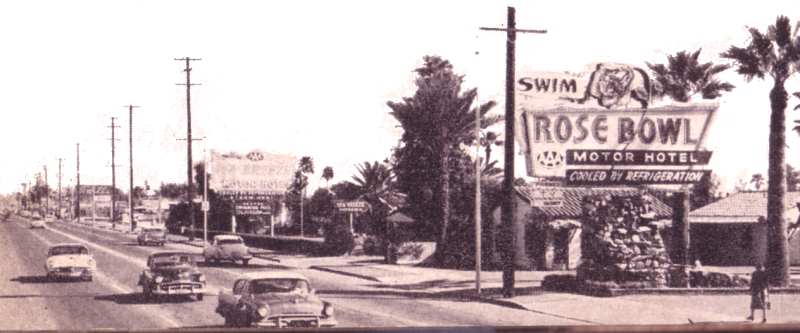
VanburenstreetVan Buren Street east of 24th Street in the 1950s. Across the street is the State Hospital.

Between the glory days of the railroads and the completion of the Interstates, most visitors and newcomers to Phoenix arrived on the United States Highway System. Not for us the legendary muse Route 66 or the Lincoln Highway, the first transcontinental improved road that became U.S. 1, 40 and 50.

When the system was created in 1925 to standardize the many named highways that existed, Phoenix probably had a population of 35,000. It was isolated and difficult to reach, with formidable mountains to the east and north and forbidding desert to the west. Phoenix's coveted agricultural produce was shipped by refrigerated railcars. What Phoenix did eventually gain were U.S. 60, 70 and 80, along with U.S. 89.

U.S. 60 evolved from the many "auto trails" and plans for highways in the early 20th century, including the Atlantic and Pacific Highway. U.S. 70 joined it on the east at Globe. U.S. 80, which gained its own folklore history elsewhere in the country, came east from San Diego to also join U.S. 60 in Phoenix. In addition, U.S. 89 came north to Phoenix from Tucson. The map looked like this in 1950:

Phoenix_map_1950

And all four U.S. highways converged on Van Buren Street, which for decades was the gateway to the city and lined with "auto courts" and motels, all set off with neon signs to lure weary travelers. The Sierra Estrellas Web site offers a detailed history of the many motels and Douglas Towne wrote an interesting meditation on Van Buren for Modern Phoenix. Another aspect of U.S. 60: It was the demarcation for the internment of Japanese-Americans during World War II. All living and farming south of U.S. 60 were interned, including those on Baseline Road.

With Van Buren being the repository of so much local highway history, two other gateways risk being forgotten: Grand Avenue and Buckeye Road. The WPA-built rail underpass on 17th Avenue south of the capitol shows the route where U.S. 80 separated from Van Buren, turned south and then west on Buckeye, which was also lined with small motels. Grand, the only diagonal in the young city's street grid, was another neon-lit boulevard carrying U.S. 60 to Los Angeles via Wickenburg and U.S. 89 to Prescott up terrifying Yarnell Hill.

Burn out?

A couple of posts ago (Dekookification), commenter Gaylord wrote:

I only read this for amusement. One of these days, Mr. Talton, I surmise
you will burn out on covering Phoenix and AZ because it's too far gone
and you have moved on in so many ways. I have done this: moved to L.A.
after having lived in PHX for 18 years. It's such a downer to think
about what the city and state could have become, if only there had been
more enlightened leadership or at least those that would listen to and
heed wise people such as yourself. All we can do now is shake our heads,
be glad we are no longer living there, and remember how much
destruction the Republicans wreak when they're given the upper hand.

It's a fair question or perhaps prediction. Soleri, whose sparkling, intelligent comments I always looked forward to, has withdrawn. On the other hand, I wonder if Gaylord really just reads for amusement. In my experience, once Phoenix gets under somebody's skin, it's a lifelong condition.

SB 1070 deconstructed

I received an email from a friend, or perhaps a lost friend, over my most recent post. I urge you to read it in full because it represents a viewpoint widely held by suburban Anglos. Here it is:

Jon: check your facts. Russell  Pearce was the
sponsor of SB 1070. Most of the text for SB 1070 was written by Kris
Kobach, a law professor and important figurehead with the Federation of American
Immigration Reform.  Russell Pearce was not voted out of office by the
Mormons. He was voted out of office by the Hispanics who know he
sponsored SB 1070. SB 1070 was written after James Krentz, a rancher
in southern Arizona was killed on his own ranch by illegals.

All of the Arizonans I know are not against immigration. They
are against illegal immigration. Big difference. As you know I grew up in South America, specifically Venezuela, Brazil, and Argentina. I did not come back to the States until I was a teenager and I can report first hand that immigration laws in all of the other countries I have been in are very tough compared to the U.S.

Dekookification etc.

I'm glad to see my former Arizona Republic colleague Laurie Roberts carrying on a little of my work by calling for dekookification this election. Her job should be safe as long as she doesn't go after the three great enablers of the Kookocracy: 1) The Real Estate Industrial Complex, 2) The individuals with means and major institutions (you know who you are) — the fellow travelers — that don't want to rock the boat, and 3) The Mormons.

Let me be clear about No. 3. We can thank Salt Lake City, not dekookification, for the defeat of Russell Pearce. This symbol of Arizona extremism had become an embarrassment to the Church of Jesus Christ of Latter-day Saints. His words and policies went against church teachings. So he was finally forced to walk the plank. Don't be fooled: This was a Mormon takedown, not a triumph of moderation or St. Janet's "Sensible Center." And I say, good. The LDS has a long, constructive (even bipartisan) history in Arizona. Mesa Mayor Scott Smith carries on that ethic. Still, the church has followed the GOP into ever more extreme territory and remains an enabler of the Kookocracy, especially because of its superior organizational strength in a state that has lost offsetting centers of power and is marked by civic apathy. Stating this does not make one anti-Mormon.

As for Pearce, the evil that men do lives after them (and he will no doubt be back). SB 1070, the Jim Crow, voter-suppression, keep-'em-in-their-place, anti-immigrant measure, dripping with equal measures of hate and hypocrisy, is law. It and the climate it spawned have made Arizona an international symbol of intolerance, racism, cruelty and ignorance. Mission accomplished.

Mayor Stanton’s report card

Greg_StantonEight months after assuming office, Phoenix Mayor Greg Stanton is still enjoying a honeymoon. That means he's making the honeymoon last. So much for critics who thought he was just a pretty face. The contrast with Phil Gordon, his poignantly snakebit predecessor, is striking. Stanton can routinely speak in complete sentences and articulate coherent thoughts. Becoming the 52nd mayor of Phoenix hasn't caused Stanton to shelve his appealing nature. People who talk to me about the mayor use words such as "smart," "easy going," "open" and "welcomes new ideas." He remembers people's names and what they've been working on. His human touch and emotional intelligence are genuine, not the surface happy talk of a politician.

I was concerned about the "biosciences" bone tossed to Desert Ridge when so much needs to be done for the real biosciences campus downtown, the one site that could be a real game-changer for Phoenix. But my sources involved in downtown, light rail and sustainability aren't worried, so good on Stanton. Another concern was Stanton taking the lead among mayors on backing military spending, when Phoenix needs a spokesman on so many more compelling and productive issues. But this seems to be part of his effort to make regional cooperation a priority (good luck with that).

Stepping back, probably the best way to see Stanton so far is that he's doing a good job of getting his feet under him in a race that's already moving fast and carrying huge stakes.

New life for Luke?

Luke_AFB_Sign_Close-up_Night_View_1995

Much celebration has accompanied the announcement that Luke Air Force Base will be the training base for the new F-35 Lightning II fighter. If I read the news story correctly, the claims include 1,000 "permanent direct and indirect jobs," and the program will "bolster" the base's economic impact of $2.2 billion (from 2005). Winning the F-35 gives Luke a future as F-16 pilot training winds down over the next 11 years. Republic editorialists strained to tell how about how this West Valley "coup" was good for the East Valley. Mesa Mayor Scott Smith wrote how this enhances the region's dream of being an aerospace hub. On the other side of town, it seemed necessary to celebrate the benefits for Little League and dry cleaners.

As usual, it's left to Homey to sun on the parade.

Despite all the professed love for Luke, the Real Estate Industrial Complex has been encroaching for years on a base that was once separated by many miles from the urban area. The difficult route that pilots must fly, especially when armed for exercises on the Goldwater range, and the danger to nearby subdivisions is one of the many unexplored local stories. As for the new house-owners who find out just how loud a fighter jet is…suckers. By the mid-2000s, land brokers were feverishly assembling parcels even closer to Luke for new tract houses and some very powerful land-owners were, er, tepid in their support of continued Air Force operations. This was a quiet but fierce clash that went on even as the Pentagon wondered whether it was safe and economical to continue such a large training base so close to residential development.

Let’s help the Times

A few years ago, when it seemed that Phoenix had become the nation's fifth most-populous city, the New York Times decided to post a reporter to this unknown land somewhere on the other side of Jersey. Recently, the job has been handed off to Fernanda Santos. Lately, the Newspaper of Record has uncovered that it's hotter than hell in the un-air-conditioned atrium of the Sandra Day O'Connor Federal Courthouse (a plan which I remain convinced starchitect Richard Meier just pulled off the shelf from his student days, although others say he was enamored by the misters at a restaurant at Arizona Center). Santos has also revealed for the Times' influential readership the tortilla factory at the Ranch Market on Roosevelt at 16th Street.

Then came the topper: A story this week on the excessive heat that never mentioned the worsening urban heat island because of the loss of agriculture and sprawl, much less climate change and its dire potential consequences for a big city where, to paraphrase Ed Abbey, one should not be. The conclusion of this bastion of sophisticated journalism: It's very hot in Phoenix in August.

To be fair, Santos was said to looking for a house in the historic districts, according to sources who wished to remain anonymous because they wished to remain anonymous, as the Times might put it. Good for her. She has done some (reactive) lifting on the Badged Ego's legal troubles and immigration. And one never knows the misguidance being given by editors. But Phoenix desperately needs all the real enterprise journalism it can get, however much it discomfits the local-yokels. Let's help out the Old Gray Lady.

Corrupt or stupid?

I don't mean to be harsh, but what is it with Arizona's climate-change denial? Sure, it's not as bad as North Carolina, which is trying to outlaw using climate science to estimate the rise in sea level. But Arizona is the focus of this blog, the home state I love (no matter what you believe) and fight for, even if it must be at a distance. Aside from the Republic's indispensable Shaun McKinnon, I am unaware of any public figures who are discussing a subject they should be screaming from the rooftops: The clear and present danger that climate change specifically presents to Arizona.

Of course, the Kooks (I coined the term, you're welcome) will be deniers. But consider the congressional primary race among Democrats Kyrsten Sinema, Andrei Cherny and David Schapira. I'm not sure the survivor from this circular firing squad will prevail in a new district that includes Chandler and Mesa. But one would think, especially given the talent and brains of the two candidates I know (Cherny and Sinema), that this could be a time for truth telling. Yet — and forgive me if I missed it — I can't find a mention of it on their campaign Web sites, much less in the "send money" push emails from Cherny and chirpy-happy-everything's-great-in-Arizona tweets from Sinema.

How annexation changed Phoenix

How annexation changed Phoenix

PHX city limits 1972

Annexation was intended to save Phoenix. It may end up badly wounding it.

The roots of growing fast by annexing land go back to the 1940s. Phoenix had grown from its original half-square-mile to 9.6 square miles in 1940, with a population of 65,414. It was surrounded by agriculture and well separated from small farm towns such as Glendale, Tempe and Mesa.

But even before the old city commission was swept away by the "reformist" Charter Government Movement, leaders looked east and worried. They knew the Salt River Valley would grow, especially once World War II ended.

They saw how cities in the Midwest and east (St. Louis, Cincinnati, Philadelphia, etc.) had become surrounded by incorporated suburbs that were already sucking away people and tax dollars. They, and all their successors, were determined not to repeat that mistake.

Holding out for a hero

The New York Times on Sunday noted that Joe Arpaio's Arizona didn't become that way without some who fought back in public. It singled out Latino organizer Salvador Reza; Supervisor Mary Rose Wilcox; community organizer Lydia Guzman; videographer Dennis Gilman; state Sen. Kyrsten Sinema; ACLU Director Dan Pochoda; Phoenix Mayor Phil Gordon and New Times reporter Stephen Lemons among others. If Arpaio finally goes down in the Department of Justice civil-rights lawsuit, they can hold their heads high.

Can you imagine what Attorney General Robert Kennedy would have done to Arpaio had he gone after his brother the president with a bogus quest over his birth certificate? Bobby wasn't called mean and ruthless for nothing. Or what LBJ or Nixon would have done? Arpaio would have been given the biggest IRS proctology exam in the history of the world, seen all his federal aid cut off, and been relentlessly hounded by federal prosecutors and FBI agents. President Obama, cool and contemplative, has a corporate lawyer as his Attorney General. So my hopes are muted.

The Resistence desperately needs heroes. Unfortunately, those listed by the Times either had no power or, in the case of Gordon, were severely constrained by both events and his own second-term swoon. The reality is that good intentions divorced from power get us nowhere. Dietrich Bonhoeffer lived his convictions against the Nazis, but the only reason we are able to celebrate his martyrdom today is the brute power used by the Allies to defeat them. When Lyndon Johnson suddenly became president, he was urged to back off on civil rights, so as not to use his political capital on a seeming lost cause. This master of the use of power, in Robert Caro's telling, replied, "Well, what the hell's the presidency for?" And a hero, with titanic, heroic flaws, emerged.

Growthgasm!

800px-SanTan_Village_-_North_-_2009-09-20
The SanTan Village shopping center in Gilbert. 

The big news back home is that Gilbert is now among the top 100 U.S. cities in population. When I worked as a columnist at the Arizona Republic, I would term these highly-played announcements as "growthgasms," an old Arizona obsession in focusing on merely adding people. A closer look at the data show that, in the metro Phoenix depression, they are faking it. Gilbert grew by 1.7 percent in the first year after the 2010 Census. That compared with 90 percent from 2000 to 2010. Any way you slice it, population growth has slowed dramatically in a place that values it above all else.

People are moving much less today because of the bad economy. But the Austin suburb of Round Rock clocked 4.8 percent in the same year and Austin itself grew by 3.8 percent. Denver increased 3.3 percent. Phoenix, which was kicked back a notch to the nation's sixth-largest city added less than 24,000 people, keeping it 67,000 behind No. 5 Philadelphia. Houston, No. 4, added nearly 46,000 residents. Yes, Phoenix was 7th in the top ten in adding raw population, but the numbers were nothing like those seen every year in the 1990s and 2000s, and by percent are below anything seen since the early 1950s and the advent of widespread air conditioning.

Gilbert is technically a "town," allowing it a runaround from many of the responsibilities of cities in the eyes of the state government. And for those who live there, I suppose it's very pleasant: New housing built around large garages in "master planned communities," more than 81 percent white, affluent, heavily Mormon, a fakey little "Old Town," well-financed schools, endless motoring, right-wing politics, chain restaurants, a sham "downtown" (all private property) at the SanTan Village shopping center and relatively low crime. The endless walls facing even modest thoroughfares are telling.

The fourth branch of government

You might be tempted to pass on a story in Sunday's Arizona Republic with the process-y headline, "Case Asks Who Must Pay Taxes for Utility." Don't.

Ably reported by Ryan Randazzo, the article lays out a controversy in Sun Lakes. The small company that provides water for the "active living retirement community" wants a rate increase of about $6 a month from residents, the first such hike since 1994. Sounds reasonable. But it wants more: "About 40 percent of the increase would pay the utility owners' income taxes." The Residential Utility Consumer Office contends that the water company's "shareholders might have other business interests that lose money, and if they combine the tax credits of those operations with the tax liability from the water utility, they might not pay taxes at all, even though the customers would be paying a 'phantom tax.' 'When this happens, this is essentially free money for the shareholders paid by the ratepayers who receive no benefit from these payments,' RUCO wrote in a brief for the case."

This is about more than Sun Lakes. My sympathy is limited for people who want to buy houses in a leapfrogged, 98-percent white development with streets named after Michigan, Minnesota and Indiana, profaning our desert. But the case is a rare window into how power and influence work in the state. Power, especially, at what insiders call "the fourth branch of government," the Arizona Corporation Commission.

Arizona’s desert towns

Arizona’s desert towns

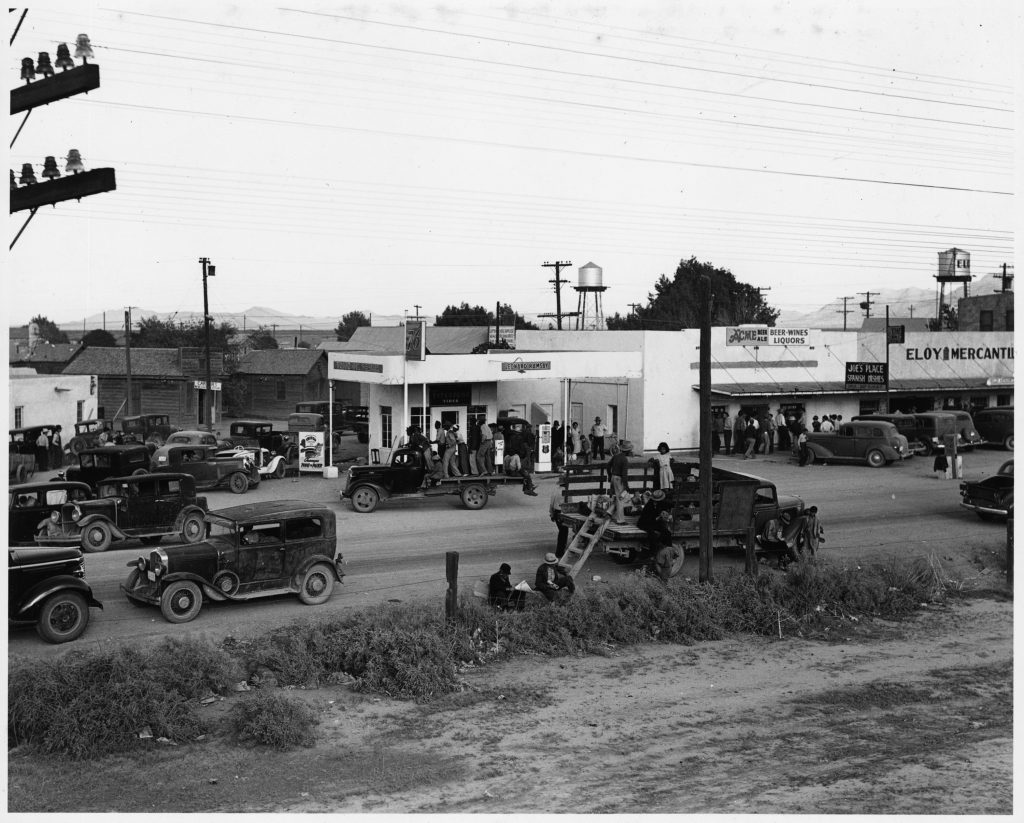
EloyLangeDorothea Lange photographed Eloy during the Great Depression.

Before interstate highways, ubiquitous McDonald's and sprawl, there was that unique creature of the American Southwest: The small desert town. It was not like Bisbee, Globe or Prescott, growing rich from mining or ranching, or Flagstaff with its sawmills, cool weather and available water.

Nor were desert towns like Phoenix, sitting in one of the great fertile river valleys of the world. Instead, these were precarious footholds of human effort to conquer, or at least exist, in a deeply hostile wilderness. I think of places such as Casa Grande, Gila Bend, Eloy and Kingman. Wickenburg almost fit the description, but it benefited from mining, then dude ranches and proximity to fast-growing Phoenix on the main highway to Los Angeles.

Nineteenth century Arizona was a badlands in which only the most visionary dreamer, swindler or madman could see much potential beyond the mining country and the old Spanish outpost of Tucson. Going west from Tucson to California was only for the toughest or most deranged immigrant. A few tribes such as the Mojave knew how to live in this parched, poor land of eerie basins, rugged bare mountains and, in the south, the fickle Gila River. The European-Americans did not, even as they disparaged the natives as "digger Indians" and sometimes set out across the alien terrain.

One famous example was the Oatman party in 1851, traveling from well to well, until an encounter with (it's speculated) Yavapais 80 miles east of Yuma went wrong and most of the party were killed; young Olive was abducted, traded to another tribe and eventually returned to the whites, living out her life with tribal tattoos on her face. This was the world into which the desert town was planted.

One dreaming pragmatist was Jefferson Davis, who as Secretary of War encouraged surveys of a southern route for a future transcontinental railroad and pushed for the Gadsden Purchase (otherwise, Mexico would begin just south of Phoenix). It was the railroad that gave these Arizona desert towns their initial life. Sometimes they had water; other times it had be brought in by rail, but the steam locomotives of the Southern Pacific Railroad subsisted on a string of water towers along its route (the same was true of Kingman on the Santa Fe). One is still standing at Red Rock north of Tucson. From the water towers came towns. A few even survived.