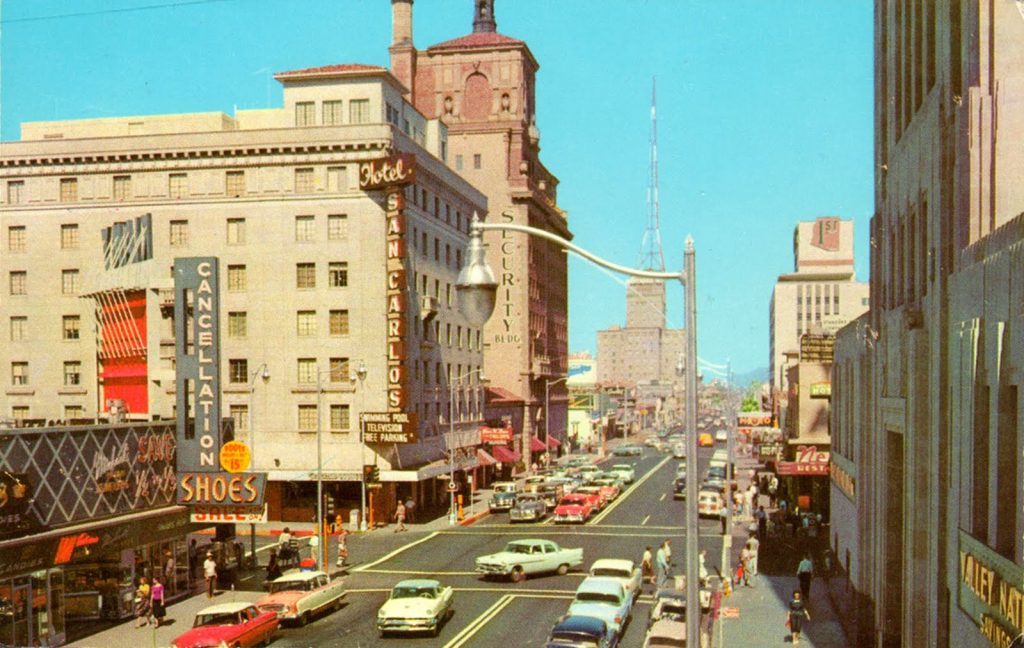
Green shoots in the desert?

Some old timers still blame a December 1988 Barron's article ("Phoenix Descending") for the collapse of the city's real-estate boom. This is fantasy, of course: The market caved in on its own, pulled down by too many hustles, too much overbuilding and the savings and loan scandal driven by local steward Charles H Keating and his pet senators. Now Rupert Murdoch's Dow Jones has tried to make amends with a Wall Street Journal story about Phoenix's "nascent real-estate rebound." Indeed, it "holds lessons for the rest of the country." Another fantasy?

The Journal continues:

Phoenix has found a viable formula. Low prices are igniting demand from first-time buyers and investors who are converting the homes to rentals. The local economy is on the upswing with several big employers like Amazon.com Inc. and Intel Corp. hiring again, which is further increasing demand for housing. And the region is benefiting from a surge of buyers from Canada who are using their favorable exchange rate to scoop up bargains in the desert.

Could this be true? Has long-suffering Phoenix "found a bottom" and is beginning a rebound? As Zhou Enlai may have said when asked about the significance of the French Revolution: It is too soon to say. What it means about the metropolitan area's real competitiveness and future is murkier still.

Mesa stirring?

Downtown_Mesa_Arizona
Something is happening in Mesa. Light rail is being extended three miles along Main Street from Sycamore to Mesa Drive, reaching downtown and putting it within walking distance, on a decent day, of the Arizona Temple. A brewery is coming to Main Street. Pioneer Park might get a botanical garden, pushed by a citizens committee that also proposes extending light-rail to Gateway airport. (Building an inspiring city hall would be nice, too). Officials brought in 50 developers to show off potential downtown sites. Council members actually expressed hesitation about some senior housing projects, worried they would get in the way of efforts to attract market-rate, transit-oriented residential development downtown.

The "city with wide streets and narrow minds" is actually attracting higher education: the A.T. Still University branch offers osteopathic medicine, dentistry and health care; Benedictine University is expected to open a campus downtown. This is on top of the downtown branch of Mesa Community College and ASU Polytechnic. When metro Phoenix saw itself in the running for a new Apple campus, which not surprisingly went to Austin instead, it's no secret the company was looking most at Mesa. The Mesa Arts Center has stopped trying to compete with Phoenix and is doing well with, among other things, community festivals.

Could this be Mesa, Arizona? A city more populous than Cincinnati, Pittsburgh, St. Louis, Minneapolis, etc. with nothing to show for it? Something seems to have changed.

Phoenix 101: Pinal County

Phoenix 101: Pinal County

738px-Coolidge_Arizona

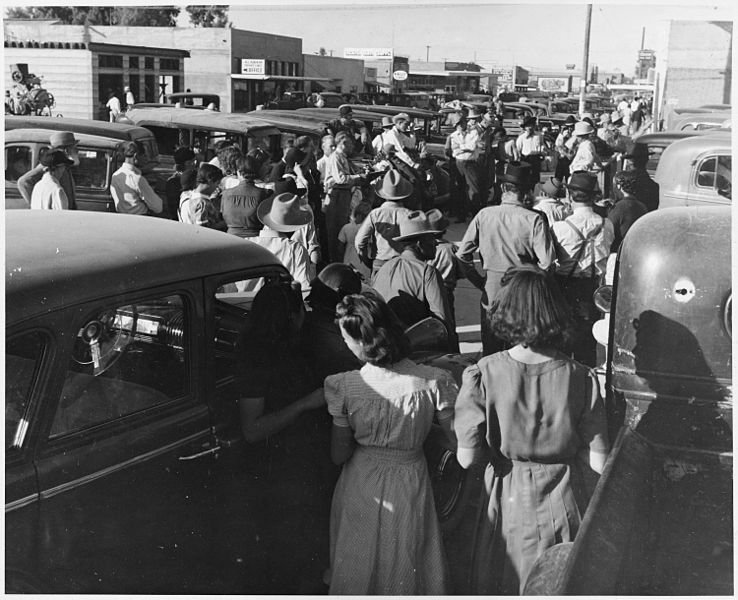
Dorothea Lange captures Coolidge on cotton harvest day, during the Depression.

Pinal County today is known for many things, mostly appalling. It was mauled by the housing crash of the Great Recession, a "bedroom community" to Phoenix with cheap, shoddy tract houses and miserable commutes, the place whose lack of planning or sense of decency allowed subdivisions to profane one of the most glorious mountains in the West. This lack of any respect extends to consenting to a Super Wal-Mart right next to the Casa Grande Ruins National Monument. Pinal boasts one of the ugliest drives in America, on Interstate 10 between Phoenix and Tucson.

And, of course, it was where Paul Babeu was sheriff. Babeu was disgraced, not because of his department's racial profiling, whoppers about beheadings, anti-immigrant hysteria or allegations that Babeu threatened to have his Mexican ex-lover deported. No, this once rising star in the Arizona Republican Party was forced to admit he's gay, torpedoing his hopes of being elected to Congress.

Yet these 5,365 square miles — five times the size of Rhode Island — contain so much Arizona history. Personal history, too: I attended kindergarten in Coolidge. We lived there for a year, for reasons too complicated to deserve a detour, but ultimately coming down to Arizona's fight against California for Colorado River water — what else?

The exit interview

The urbanist Yuri Artibise left Phoenix last year, returning to Vancouver. It's part of a continuing brain drain, although to be sure such assets as ASU continue to bring in new creatives. I don't know where the tally stands, but I fear Phoenix continues to lose more than it attracts. Architect Taz Loomans recently conducted an interesting "exit interview" with Artibise. It made me realize that it's been five years since I got the first inkling that the Arizona Republic would take away my column, which would eventuate in me leaving town. So I thought I'd use Loomans' questions as a test for myself.

What do you miss most about Phoenix? My good friends. (I tried to select one "most"; for more, see my additions in the comments section).

What did Phoenix have that Seattle doesn’t? It is the repository of so much of my history, so many of my hopes. My mother and grandmother, long dead, are so alive on the streets of Willo, Roosevelt and Storey. The church where I was baptised is still going, as is my grade school, still in its inspiring, grand building, and enchanting Encanto Park. Union Station, where I spent countless hours as a child watching trains and dreaming of far-away places. The streets I worked as a paramedic, learning too much too young. The different mountain vistas that always orient me. Phoenix is the home of my heart, a place so mangled, mismanaged, raped and pillaged, but still worth fighting for. No matter how long I am gone, when I return I can drive the streets and walk the neighborhoods as if I had never left. The ghosts of the Hohokam still speak to me on winter nights when the cold wind blows from the High Country and the peculiar acoustics of the valley mingle train whistles and voices of the beloved dead.

Phoenix update

Back from a week in Phoenix, some observations:

1. The place still gives off the quality of a fallen souffle. Sure, a few projects are getting press out in some of the more affluent suburbs, but the utter collapse of four years ago still lingers. It's not for lack of trying by the Usual Suspects: Bottom has been hit, a turnaround is only (xx) years away, cheap land and sunshine will continue to be the basis of the economy, blah, blah, blah. But the old growth machine will not sputter back to life for one more run (with championship golf!). Too many crapola tract houses, too much debt, too few well-paying jobs, no speculative bubble driven by liar loans and securitized mortgages sold on a historic scale. What's Plan B? There is none.

2. A lack of seriousness pervades the state. Phoenix Mayor Greg Stanton tweets, "In Phoenix, we have a full commitment to sustainability: Sky Harbor Airport Dedicates Solar Power System." Space does not allow us to fully deconstruct these 104 characters, but we can make a start. Sky Harbor is a red giant of concrete and air pollution, contributing mightily to the heat island and dirty, unhealthy sky, and this is somehow redeemed by a "solar power system" that will power…the airport? No, the linked news story says it generates "enough to handle half the power needs of the rental car center, east economy parking lots and toll booths." Oh. (A real reporter might want to know if this includes generating electricity for the rental car center air conditioning, too, which seems unlikely, and how long the solar operation will have to run before it "repays" the fossil-fuel inputs it required and may still require).

The capitol

The capitol

Capitol_1960s
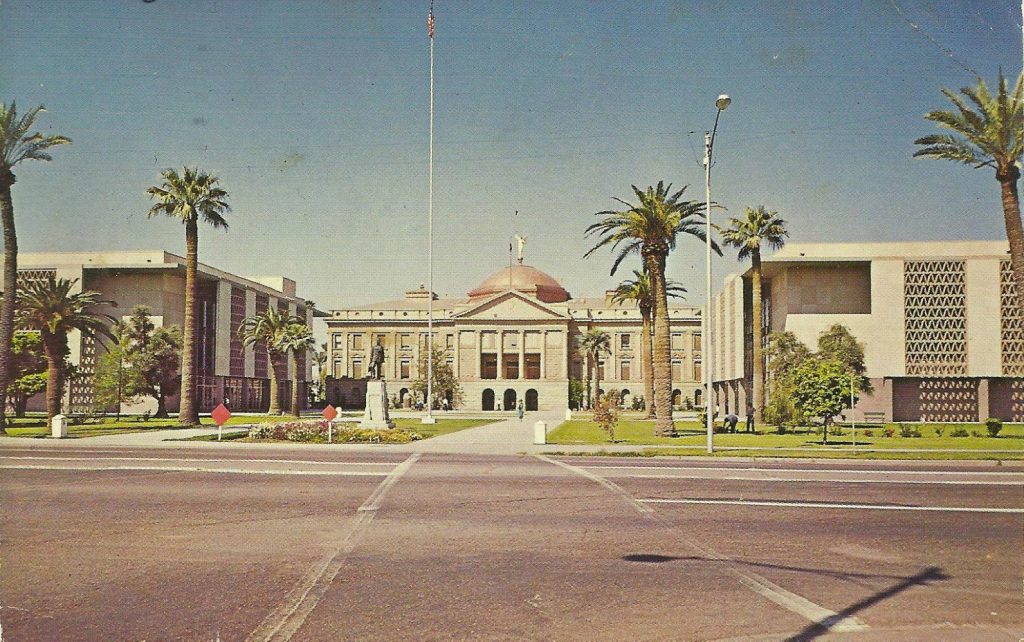
The Capitol and legislative chambers in the 1960s, before the erection of the brutalist Executive Office Tower.

Channel 12's Brahm Resnik asked me to nominate the three most significant Arizona political events since statehood. It's a bit like wanting a cinephile to name only three favorite movies. I settled for 1) statehood, which was not a given when it happened; 2) The congressional delegation's ultimately successful decades-long pursuit of Colorado River water, and 3) SB 1070, which is a bright red marker for the hotbed of intolerance, ignorance, extremism and backwardness into which the state has descended. Other events could contend, such as Barry Goldwater's 1952 narrow victory over Sen. Ernest McFarland, marking the birth of the Republican Party's ascendancy.

One of the most telling political stories, however, doesn't concern politicians or elections, at least not directly. It's about the old capitol building. The copper-domed structure was actually built as the territorial capitol and completed in 1901. The architect was James Riely Gordon, who designed many court houses in Texas, as well as a grand one for Bergen County, N.J. Gordon set aside his usual Romanesque Revival style to create a territorial capitol made from native materials. It was originally intended to be much grander, but the territory cut back funding. Additions made in 1918 and 1938 preserved the Gordon design.

President Kennedy (perhaps apocryphally) quipped that it was the ugliest state capitol in America. This was certainly not true: The Alaska capitol resembles an insurance company office; the Ohio statehouse with its forever-incomplete dome defines homeliness and lack of proportion, and North Carolina's looks like the court house for a small, poor county. The only saving grace for New Mexico's building is that it is in Santa Fe. To me, the old Arizona capitol always held a certain modest grace, particularly when I was growing up and it dominated the vista at the foot of Washington Street. But it's also true, odd and perhaps telling that Montana, which still doesn't have 1 million people, has a much bigger, grander capitol. And otherwise poor, conservative states such as West Virginia, Arkansas and Mississippi boast majestically beautiful statehouses.

Halftime in Arizona

Note to national and international Rogue readers: As Arizona marks 100 years of statehood this month, you'll have to put up with more than the usual number of AZ- and Phoenix-centric posts.

AzSemiIn 1962, Arizona marked its 50th year as a state. It's a vivid memory for me, although I was but a child. I loved the commemorative seal with the cactus wren, so much more appealing than today's gaudy centennial emblem. Fifty years of statehood was a remarkable event for those still living who had witnessed statehood and lived in Arizona Territory, my grandmother among them. The state in 1962 had barely more than 1 million people, with Phoenix not yet at the half-million mark. Phoenix was becoming a big city with comforts unimagined 50 years before, especially air conditioning. Still, the frontier was close enough to touch, living history was all around and much of the state was still wilderness. Vast empty distances separated the settled areas and those were compact and clear in their purpose.

Prescott, for example, the onetime territorial capital, was an enchanting little town with appealing rough edges. None of today's sprawl existed. It had only recently lost its status as a division point on the Santa Fe Railway between Phoenix and Williams Jct. Mining and ranching were the economy. The highway up Yarnell Hill was notoriously treacherous. Flagstaff was a major railroad town, also depending on sawmills for the logging industry and Arizona State College. The Mogollon Rim was virtually uninhabited, just one of many parts of the state as wild as ever. The state highways were two lanes, taking you to rich history that wasn't across the street from a Wal-Mart. Even in Phoenix, you could see old cowboys, the real thing, living out their last years in the elegantly-designed-but-neglected old apartments that graced the neighborhood between Seventh Avenue and the capitol.

Sunny delusions

I climbed out of my funk that was half cabin fever from the rare Seattle snow (thank God, I'm downtown and not out in the suburbs) and part brain damage from the GOP debates. So far my nomination for the most under-covered Arizona story of the year goes to the abrupt resignation of Don Cardon as head of the state Commerce Authority. The Phoenix Business Journal carried the story. Then Betty Beard of the Republic wrote something more in depth:

Cardon, 51, said he believes it is a good time to leave because the commerce authority gives the state a good foundation for job recruitment, the Legislature has enacted more laws to help lure businesses and because there is improved cooperation among business and political leaders.

Cardon said he is especially pleased that the state recently attracted Silicon Valley Bank, which plans to build an operations center in Tempe, because it is a major venture-capital firm. All in all, he said, economic development efforts have come together faster than he expected.

Yet the "why" of old-school journalism remains largely unanswered.

Phoenix loses spring training

The Oakland As have accelerated negotiations begun in November with Mesa to move spring training from Phoenix Municipal Stadium to Hohokam Stadium in 2015. The Chicago Cubs, the biggest draw in the Cactus League, are leaving Hohokam for the new Riverview development at Dobson and the Loop 202 in 2014. New Phoenix Mayor Greg Stanton dryly told Channel 12's Brahm Resnik that he had "inherited" the situation — (and these are my words) one of many messes left behind by the lost weekend that was Phil Gordon's second term. Stanton promised to do "anything reasonable" to keep the As, but "we have to be fiscally responsible." Meanwhile, the Milwaukee Brewers' contract at the stadium in Maryvale (to me the most pleasant spring training venue, but one that lacks the splash and comfort of north Scottsdale) expires this year and it's unclear if they will renew.

Spring training in Arizona was once a sweet, simple thing. After World War II, the then New York Giants started play at the old Municipal Stadium, while the Cleveland Indians built Hi Corbett Field in Tucson. In 1951, the Cubs came to the old Rendezvous Park Stadium in Mesa. The teams traveled by train and their arrival at Union Station was always a big event. For years, the Cactus League had eight teams (although they came and went). When I was a child, tickets were cheap, even star players were close and the atmosphere was easy-going and small town. This persists today at some spring training facilities, but it's become big business, and like much else in our society, cities are played off against each other to surrender the most tax dollars to further enrich the already rich.

The question is whether Phoenix should do much, if anything, to keep spring training in the city?

Heywood and Giffords

Heywood and Giffords

Ad_Music_Men_KTAR_Bill_Heywood_1971
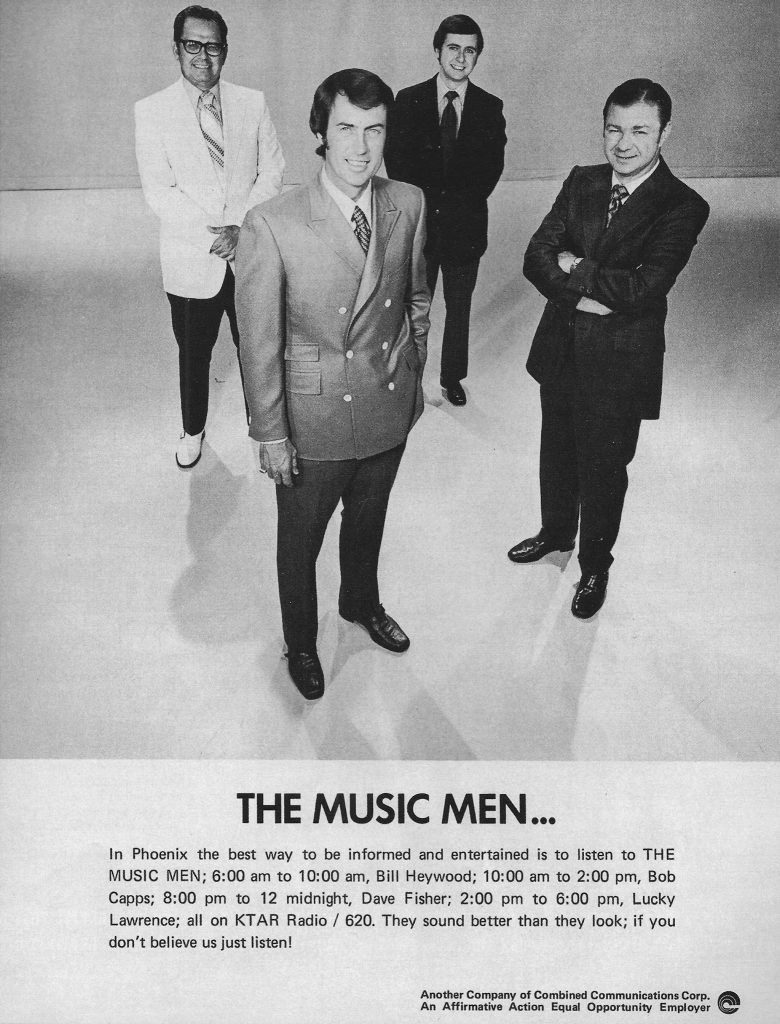
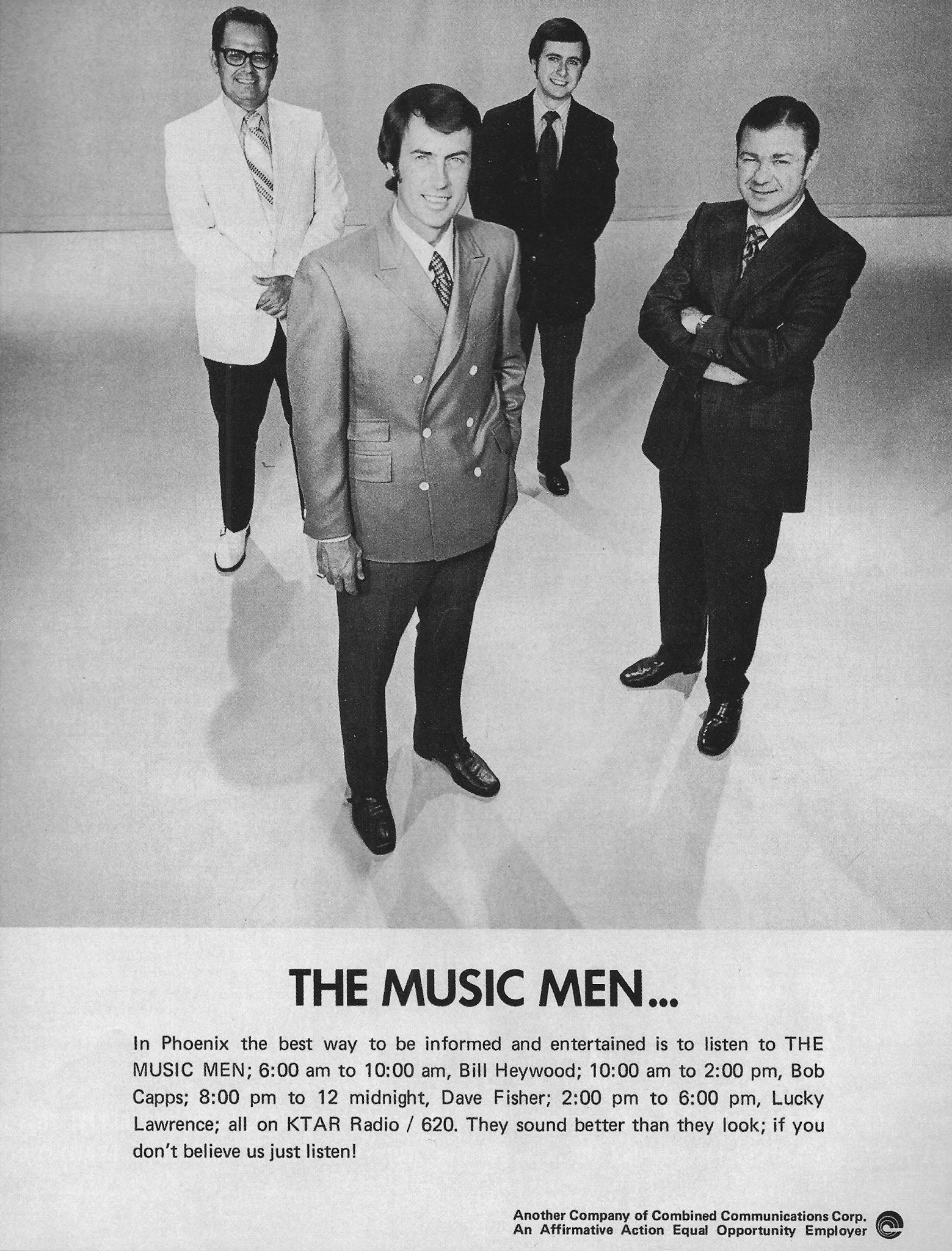
The suicide death of Bill Heywood and his wife, Susan, hit many long-time Phoenicians hard. This is the hour of lead, remembered if outlived, as Emily Dickinson wrote. I heard from so many friends and acquaintances, some of whom hadn't been in touch for years. The Republic did a creditable job telling the story, although it's revealing that the article was closed to comments. Revealing about our age of thugs and haters, not about the Heywoods. I only ran into him twice, long after he had been a giant in radio. But he was a friend to thousands of us, "the bright good morning voice," as Harry Chapin sings in the poignant W.O.L.D.

Long before broadcasting was consolidated, roboticized and ruled by shock-jocks, talk-show screamers or anodyne one-size-fits-all national "easy listening" formulas, local radio was a very big deal in Phoenix. Radio antennas topped the skyline. Jack Williams, who served eight years as governor, started his career in radio. His trademark: "It's another beautiful day in Arizona. Leave us all enjoy it." Barry Goldwater was another radio guy. Older readers can tell those stories, but by the time I came along nobody was bigger than Bill Heywood. He was the morning drive-time man on KOY, historically at 550 on the a.m. dial, the oldest station in Arizona. His voice, as others have said, was velvet. His humor was witty, subtle and gentle. And he spun the popular playlist of the day. His afternoon counterpart, Alan Chilcoat, "sang" the weather. Corporate monopolists such as Clear Channel would never allow such un-focus-group-tested fun today.

Phoenix radio in the 1970s featured "mainstream" rock on KRIZ, KRUX and KUPD. The upstart KDKB played entire albums, was fiercely independent, counter-culture and fighting every Top 40 convention. I recall an easy-listening station but not its letters (KBUZ?); it did have some fairly cool promos, keying off locations in the city and ending with "and you've got the mellow sound of…). Speaking of which, a "mellow rock" station broadcast from the old Ramada downtown, including one of the era's few female jocks. Of course, the stalwarts such as KTAR and KOOL were there, too, as well as a classical station.

Central Avenue Part 2

Phoenix1

Midtown, including the Viad Tower, left, after the big boom.

The first defining event of today's Central Avenue was the real-estate boom of the late 1980s and early 1990s. With land from Fillmore Street to Camelback Road upzoned for skyscrapers and money flowing from the deregulated savings and loan industry, the city was remade by a huge real-estate boom. Stuck with the disjointed set of highrises outside the old central business district, the city tried to put planners lipstick on the pig in the 1970s by christening the area from the railroad tracks to Camelback and Seventh Avenue to Seventh Street as the Central Corridor. As I wrote in the previous post, the visionaries of the 1960s and 1970s imagined Central would become Phoenix's version of Wilshire Boulevard. That never happened. Phoenix lacked the economy, assets and ambition of Los Angeles. But it gave a big try in the '80s and '90s.

These were the years that saw the rise of the Dial Tower at Central and Palm Lane. It was the new headquarters of the old Greyhound Corp. and remains, with its distinct deodorant container shape and copper skin the only truly arresting skyscraper on Central. Two bank highrises were built just south of Osborn, along with a little World Trade Center-style tower at Virginia, displacing the Palms Theater, and a few midrises. USWest anchored one of two skyscrapers erected on the northeast corner of Central and Thomas, where the iconic Bob's Big Boy, beloved of cruisers, stood. But this was nothing compared with what was planned. Back in the 1960s, the idea of a monorail running down Central was floated. It was revived in the '80s as part of a developer's plan to build, north of Indian School, the tallest building in the country with the monorail connecting the mammoth skyscraper to Sky Harbor.

Central Avenue in old Phoenix

Central Avenue in old Phoenix

Central_ave_phoenix_AZ

Central and Monroe, around the year I was born (1956)

"The trouble with Central is that it isn't central to anything any more." So spoke a major leasing executive in 2000, over a breakfast I had been dragooned into to get my mind right about what had happened to my hometown. He was wrong. Central Avenue does much more than demarcate street numbers from east to west. It lies at the heart of a far-flung Valley metroplex. Central — original Center Street, renamed in 1910 — is the touchstone of Phoenix's history, with more stories than a hundred blog posts could tell. It remains the most interesting street in the city. And it will be the critical marker for a quality future, if the metropolitan area stands a chance of attaining one.

In the old city, Central connected the discrete parts that made Phoenix whole. Starting at South Mountain Park, the largest municipal park in the world, it crossed two-lane Baseline Road. In both directions spread out the enchanting Japanese Flower Gardens. Ahead were bands of farmland, pastures and citrus groves as it descended to the Salt River, with the skyline and far mountains arms-length clear in the distance.

After going through the tiny south Phoenix business district, you crossed one of two bridges over the river (Mill Avenue being the other). The 1911 Center Street Bridge ran 3,000 feet across the Salt River, included electric lamps, and was one of the town's proudest achievements. Before heading downtown, Central ran through neighborhoods and commercial strips.

For years, the colorful Central Liquidators was among the businesses south of the tracks. In the early days, both the Southern Pacific and Santa Fe railroads sited their depots on Central, before moving to the new Union Station at Fourth Avenue in the 1920s. Depression public works built an underpass that for decades held four very tight lanes. Before the overpasses at Seventh avenue and street, this was the only sure way under what were then busy rail lines. Everybody honked when they drove through the concrete tunnel.

Phoenix rising?

By Emil Pulsifer, Guest Rogue

Rogue Columnist readers may be surprised to learn than reading Robert Robb, editorial columnist of the Arizona Republic, is a guilty pleasure of mine. As often as I disagree with him, his arguments have a specious plausibility and level of detail that makes them worth refuting. I always learn a lot about a subject in deconstructing one of his columns — though not usually from Robb himself.

His column of December 7th, "Phoenix-area Recovery Better Than You Think" is a case in point. Not only does it elaborate Robb's longstanding thesis that "Phoenix doesn't have an economy dependent on real estate," it also argues that Phoenix's post-recession economy is doing better than that of most big cities.

This is astonishing. Even local-booster superstars like developer/economist Elliott Pollack, whose firm "currently serves as the economic department for Maricopa County" according to his company bio, and who also wrote the "Blue Chip Economic Forecast" for Phoenix appearing at ASU's W.P. Carey School of Business website, admits that "…the local economy cannot have much of a recovery without a significant increase in construction activity." Either Robb is a genius or else he's standing on his head.

America’s racist sheriff

The big news is the release of a report, three years coming, about the racial profiling in the Maricopa County Sheriff's Office. You can download the entire report at AzCentral, Talking Points Memo and many other sites. It confirms what we already know: "America's toughest sheriff" is also America's most racist sheriff. The department has engaged in systemic racial profiling against Hispanics and "brown skinned people." This should be another nail in Joe Arpaio's coffin, but I suspect many of his constituents will merely go "Yaaaay!!"

This is only the tip of a very big iceberg. There's the hundreds of botched sex-crimes investigations, along with the many instances of abuse in the jail system. Honest police officers talk about fumbled investigations by the MCSO, including probable homicides that were tossed off as suicides. Much of the command staff has already been forced out in scandals. Does anyone doubt that the tone for this behavior was set from the top, in other words Arpaio himself? This is a department that runs by a cult of personality. As I asked in a previous post, Why isn't Joe Arpaio in jail? Yet he survives.

To be sure, departments nationwide face such probes. The Seattle Police are the target of a Justice Department investigation into excessive-force complaints. But the MCSO is different, with a longstanding pattern of bad behavior.