Phoenix 101: Wallace and Ladmo

Wallace_and_ladmo

Lad Kwiatkowski, Pat McMahon and Bill Thompson.

I went to the Muppets movie over the weekend. It was all right. I never watched Sesame Street and the heyday of the Muppets television show was when I didn't even own a TV. In any event, I am a lost demographic to such benign stuff. I grew up in Phoenix, where we had Wallace and Ladmo.

Most children watched a clown show in their cities and towns. Not us. We were brought up on the very adult humor of the Wallace show, which ran from 1954 to 1989 on KPHO. The names changed, from It's Wallace? to Wallace & Company to the Wallace and Ladmo Show. What didn't change was the show's biting humor, satire and irony, along with classic slapstick and cartoons. For the rest of our lives all we could do was feel sorry for the children who were stunted by clown shows.

The regular cast featured Bill Thompson as Wallace, Lad Kwiatkowski as Ladmo and my friend Pat McMahon. Wallace, or Wall-Boy as Ladmo called him, was the host and butt of much humor. Ladmo was the everyman or everykid, full of fun and mischief. McMahon played a host of characters, many of which gave the show its bite. Among them was Gerald the brat, the nephew of the TV station's general manager; Aunt Maud, the doddering, bad driver old coot from Sun City; biker Bobby Joe Trouble; Captain Super, a parody of assorted super heroes, and Boffo the Clown, who hated children.

Love hurts

A friend passed along a blog essay entitled "Has the Arizona Republic gone rogue?" It goes on to catalogue a variety of "negative" news stories, concluding: "It is time for a leadership change at the Republic; Publisher John Zidich of Fiesta Bowl board fame and his executive editor Randy Lovely need to go.  Let’s get someone in over there who knows and loves Arizona and wants us to become the state we are destined to become. We don’t need a daily rag of negativism and half assed reporting; I can get that from any blog out there.  We deserve better.  The Republic has gone rogue and it needs correcting."

The writer is one Charles Coughlin, who, in addition to sharing the name of the infamous demagogue "radio priest" of the Depression era, is a flack for the Real Estate Industrial Complex, the right and all-things status quo. See, reporting on such as Gov. Jan Brewer's shameful attempt to sack the head of the independent redistricting commission because it didn't skew politics even further to the right is "not loving Arizona." Payback is indeed a bitch. I was run out of the Republic by Zidich and Lovely because the paper could no longer stand the seven years of heat it had taken because my column didn't "love" Arizona enough. (When someone else talked about offering me a job, another big intervened: "Talton hates Arizona.") Now the same thugs are after Lovely and Zidich. (Funny, Father Coughlin doesn't offer his appreciation to the newspaper for unearthing the Fiesta Board scandal, which didn't really involve Zidich aside from his sitting on boards, which publishers should not do.)

Let it be said that the state's largest newspaper soft-pedals most of the pressing issues, from water resources to the economic calamity, climate change, white-right extremism, the depredations of the Badged Ego and thoroughgoing political corruption, much of which traces back to the Real Estate Industrial Complex. It pulls its punches and seeks out "positive news about the community." The editorial page is reliably right wing, with the only columnist being the "Goldwater" Institute's boy, Robert Robb (or William Bill, as he is known here). But even committing real journalism part-time, accidentally or when, well, news happens is enough that heads must roll. Imagine the fantods he would get if the state had some real kick-ass newspapers. Here is Phoenix and Arizona's pathology in a nutshell.

Mayor Stanton

I'll admit to being an optimist who worries. Surely Wes Gullett, tool of the right wing extremists, couldn't win the Phoenix mayor's race… Yet, Phoenix and Arizona have fallen into too many tragic improbabilities for me to count and things had been taking a severe downbound course lately. In the end, a record turnout put Greg Stanton emphatically in office. Thank God. This is unalloyed "positive news," for those of you who think I have no bright side. Stanton could be a transformative mayor at a time when the city most needs one.

Now, to the serious stuff. Most of the issues that dominated the campaign and the media's attention are small ball. Phoenix is a well-run big city, with a few exceptions such as the Jack Harris-type backscratching. All of these can be addressed with a functioning  City Council. The one that requires reflection is water rates. The older parts of Phoenix need no further push to let shade trees die and throw down gravel. Indeed, they need an incentive to keep the oases that are critical protection against the heat island. In addition, city staff should roll back their demand for gravel and palo verdes on nearly every city property. This is only adding to the unlivability of Phoenix. A discussion on the investment of water for shade oases is critical.

Stanton's biggest challenge, as he well knows from his days on City Council, will be building majorities for the critical policies he wants enacted. Phoenix's mayor is more powerful than any of his peers in the state, but the city remains (foolishly, to my mind) a council-manager form of government. The mayor is "just one vote," as an intelligent, ambitious councilman told me years ago. Stanton is well-suited to the task: Amiable, emotionally intelligent, willing to listen, politically street smart and wearing hig policy wonkishness lightly. But without a majority, he'll get nowhere. It may shift from issue to issue, but it is the mayor's majority that Skip Rimsza wielded with such effectiveness. It will be interesting to see if Mayor Stanton has a "Councilman Stanton," an effective do-the-right-thing ally on big stuff. This was a role that Stanton played on the biosciences campus and ASU downtown to Mayor Phil Gordon, even though their overall relationship was always a wary one.

A new day in AZ?

The evil that men do lives after them. — Shakespeare

I don't mean to sun on the parade. I really don't. Nobody is happier to be wrong about Russell Pearce's recall election than me. He becomes the first legislator in Arizona history to be successfully recalled. But what does it mean? In the flush of victory Tuesday night, state Sen. Kyrsten Sinema, who was my legislator when I lived in Willo and is the smartest person at the capitol, tweeted, "Voters sent a message tonight: focus on practical, common sense solutions to our state's challenges. Stop the ultra-partisan nonsense." What does that mean? My common-sense solutions include commuter rail, passenger rail between Phoenix and Tucson (and LA), land-use reform to focus on the existing urban footprints, a serious economic-development strategy, raising the revenue needed to support a populous, urbanized state, funding universities and K-12 education, etc. To much of Arizona, common-sense solutions mean more guns and less taxes.

When I asked Sinema if the election of Jerry Lewis would mean he might be more moderate and work across the aisle, her response was more pragmatic: "We're not sure yet. One must be judged by performance not campaign speeches. Here's hoping Rs moderate instead of 'double down'! ". Indeed.

Pearce may be gone, but the edifice he created lives on: SB 1070, Jan Brewer as governor who's formed a political action committee to "fight against illegal immigration and the new federal health care law nationwide," an extreme state Legislature owned by the NRA and the Real Estate Industrial Complex, and copycat laws nationwide, including the most extreme on in Alabama. Will any of that change with Pearce's recall? Or will he just be back again, running for another office, whether it's the state Senate or Maricopa County Sheriff when the Badged Ego decides to step down. Oh, yeah, in the "new Arizona" on the morning after, Joe Arpaio remains more popular than ever. Jon Kyl is blocking any progress in the "super Congress." Wealthy Republican John Sidney McCain III keeps his incoherent/bought-and-paid for blather. Terry Goddard is still defeated in the governor's race, an election season of madness that turned on the fulcrum of hatred built by Russell Pearce.

Election Day

UPDATE: Pearce becomes the first legislator in Arizona history recalled and Stanton is elected Phoenix mayor. Read on if you wish. Definitely join the comment thread.

I've been predicting that Russell Pearce will survive his recall election, but what will it really mean if he's defeated by Jerry Lewis? The district still ends up with a know-nothing lightweight. Yes, it will be a nice screw you to Pearce, the father of SB 1070. But it won't change either the pathology in the Legislature or in the East Valley. It was telling that Mesa Mayor Scott Smith, a conservative and Mormon but not a nut, chose not to run (he may have bigger ambitions, but could no better opposition to Pearce be found?). Whatever the outcome, the house (and Senate) that Pearce built will remain. The NRA will remain as powerful as ever. Ditto the Real Estate Industrial Complex and the private prison con. Jan Brewer will still be governor. Tell me what I'm missing. One observer predicted Pearce would run for sheriff when Joe finally retires.

The Phoenix mayoral election, on the other hand, is of major importance. Greg Stanton's internal polls, I am told, show him comfortably ahead of Wes Gullett. The danger here is that potential Stanton voters will stay home, so I am hesitant to even report this. That Gullett ever got this far is a sign that anyone with common sense had better get to the polls.

This contest has been narrowed down to the national meme of "public-sector workers bad." That's most unfortunate. There is indeed an ole-boys system in Phoenix government, but it involves the highly placed, most notoriously the double-dipping of former Police Chief Jack Harris. What's really wrong inside City Hall may be outside the ability of any mayor to fix because it's rooted in the council-manager form of government. Whoever is city manager, the Titanic keeps sailing along. One small example: Spending large sums for consultants to generate reports that could have been done better and cheaper by the city staff. That might have been different had David Krietor or Ed Zuercher (or Sheryl Sculley) been selected city manager. That they weren't tells you everything you need to know. The many interests that feed off the City Hall status quo want things to continue as before.

The shameless state

Corrected version

I keep waiting for Arizonans to experience their Joseph Welch moment. For those of you too young to remember, Welch was the man who finally, publicly stood up to Sen. Joseph McCarthy. It was another time of national madness, when the alcoholic senator from Wisconsin  was accusing everybody and his brother of being a communist. Finally, in a 1954 hearing, Welch, the chief counsel for the Army, which was being investigated for alleged red penetration, listened to McCarthy smear one of his law partners. Welch said:

Until this moment, Senator, I think I have never really gauged your cruelty or your recklessness. Fred Fisher is a young man who went to the Harvard Law School and came into my firm and is starting what looks to be a brilliant career with us. Little did I dream you could be so reckless and so cruel as to do an injury to that lad. It is true that he will continue to be with Hale and Dorr. It is, I regret to say, equally true that I fear he shall always bear a scar needlessly inflicted by you. If it were in my power to forgive you for your reckless cruelty I would do so. I like to think that I am a gentle man but your forgiveness will have to come from someone other than me.

When McCarthy tried to interrupt, Welch made his famous statement: "Senator, may we not drop this? We know he belonged to the Lawyers Guild. Let us not assassinate this lad further, Senator. You've done enough. Have you no sense of decency, sir? At long last, have you left no sense of decency?" Along with Dwight Eisenhower's quiet but lethal behind the scenes moves in a sane Republican Party, this destroyed Tailgunner Joe. The moment of national insanity snapped like the breaking of an evil spell.

Graveyard of sprawl dreams

Just in time for Halloween, the Arizona Republic published a story headlined, "Massive West Valley development to launch." It reads in part: "Two Phoenix-area developers, John F. Long Properties and the Alter Group, are planning a massive mixed-use commercial development in the West Valley that will span Phoenix, Avondale and Glendale. The project is made up of three separate parcels totaling 1,500 acres and likely will take decades to complete, the developers said." It went on to promise 3 million square feet of "employment space," 10,000 jobs and represent an investment of half-a-billion dollars.

The immediate "deliverable" is much more modest: A 60,000-square-foot medical office building at Thomas and the 101, for an unnamed client (guesses whether it is one stolen from elsewhere in the region?). Long and partners have been assembling and hanging onto this land for decades — that's part of the back story not mentioned in this article. Another is that many of these plans were rolled out in the mid-2000s before the roof fell in. Unanswered is who would finance such a massive project in one of the worst real-estate markets in the country, or how it could be filled with so much unoccupied space already sitting on the market where such deals as exist are filching clients from existing buildings rather than growing the economic pie.

The reality confronting the Phoenix real-estate economy is far different from the closed loop of local-yokel zombie boosterism.

Here and Now and gone

As I reported exclusively last week, KJZZ will soon be ending its weekly local Here and Now with Steve Goldstein. With it goes the only locally produced public affairs radio program in the nation's sixth most populous city. With this move the incredibly narrow media spectrum in Phoenix becomes even more narrow. It's a terrible loss to discourse, journalism and democracy.

Goldstein had me on over the years, even after I was shown the door by the Republic for having the temerity to warn of the housing depression that now lays heavy on the land. He was unfailingly gracious, a class act. But more than that, his program was wide-ranging and fair to a fault, a forum for the Krackpots as well as for the sane elements in the state. He's a talented, intelligent broadcaster who could be a star in any major market. My sources say he'll stay on as a news announcer. One said plans call for "nine-minute daily segments," whatever that means. It can't replace an hour of thoughtful information, give-and-take and smart conversation about Arizona's most pressing issues.

My warning signals went up. Here was a program that couldn't fail to irritate the Real Estate Industrial Complex and the Kookocracy. But one source says its demise is more prosaic: internal politics.

How the West was…

Phoenix once boasted two Cinerama movie houses: the Cine Capri and the Kachina in Scottsdale. Both were bulldozed. In Seattle, thanks to the stewardship of Paul Allen, the Cinerama theater downtown was saved and renovated. It just completed a three-week festival of movies originally filmed in 70 millimeter, which even with all the technology available to Hollywood today is something worth experiencing. Despite facing the terrible commute and traffic of going one block, I went anyway yesterday to see How the West Was Won, the 1962 epic.

At the risk of provoking readers, I must confess that I was deeply moved. Yes. The film has more than one historical inaccuracy. The cognoscenti will always condemn it as a celebration of genocidal Manifest Destiny, although for the era it shows a much more nuanced portrait of Western expansion. Still, with a grand old-time movie score, a battalion of big stars, surprisingly good dialogue and the scenery on that wide, curved screen, it was hard to resist. (An added treat: One of the card sharks was a dead ringer for JPMorgan Chase CEO Jamie Dimon). At the end, the packed house of Seattle lefties gave long applause.

I was moved partly because the story, which follows four generations of a family from 1839 to 1889, could have been about my family, too. The migration routes were somewhat different and my kin fought on both sides of the Civil War, literally brother against brother, but in both cases the family ended up in Arizona. Yes, in hindsight we were part of the problem, but I can't imagine any nation just walling off settlement beyond the Alleghenies. It wasn't going to happen. But this personal connection wasn't all that provoked strong emotions.

What, us worry?

I had dinner last night with a friend from Phoenix. It was a beautiful night in downtown Seattle and our table had a great view of Elliott Bay with the ferries coming and going. But the news from home was uniformly bleak, from the ongoing housing depression to the normality of crazy politics. Neither of us think there's a chance that the odious Russell Pearce will be recalled. It makes me wonder for the thousandth time: Why did the East Valley get stuck with the nihilist Mormons? By contrast, Salt Lake just opened yet another light-rail line, along with its commuter rail service. None of that would have happened without support from the church.

A story in the paper about the real-estate situation quoted Elliott Pollack as an authoritative "Arizona economist." Pollack is a developer and a relentless shill for the Real Estate Industrial Complex. He's a pleasant guy and our relations were cordial. But why does he have any cred left, having completely missed or dismissed the state and metro's dangerous dependency on housing and usually sugar-coating the reality after things blew up. Must be a nice gig. As is the case in so much of America, there's no price to be paid, no accountability, as long as you hang with the right crowd and stay on message. And to be fair, this blindness/denial was true of all the "experts" as Arizona ran up to the edge and jumped off.

But everything's really fine, right? We just need more optimism. The boosters are still promoting the so-called Sun Corridor, a "megapolitan" area stretching from Tucson to Prescott and containing 10 million people, or 9 million, or 8 million by 2030 or 2040. Whatever. It's going to be big, and essentially the model that propelled Phoenix during the age of cheap gas and abundant water can go on for ever. The only concession by the boosters now seems to be that this thing will bring in a few less people.

The periphery

When you're talking Europe, the periphery (Greece, etc.) is ailing, while the core, especially Germany and Scandinavia, is doing well. In Phoenix, the situation is reversed. To be sure, the depression has clobbered huge swaths of Phoenix suburbia, left Pinal County circling the drain and driven a stake into the dreams of Superstition Vistas and Buckeye with 400,000 poor boobs from the Midwest. Glendale is underwater on its super mortgage to hucksters and Westgate is in foreclosure. And the compromised, local-yokel professional seers have once again pushed out their prediction of "recovery," this time to 2015. Still, what little economic activity that's happening is occurring in places such as Scottsdale and Chandler.

The news for the city of Phoenix is gloomy. What few companies are coming to the metro area are setting up shop on the periphery. Banner Health, which killed a hospital on the Phoenix Biosciences Campus that would have led to a quantum leap in its synergies, has teamed up with the M.D. Anderson Cancer Center to establish a "world class" treatment facility in Gilbert. (The irony here is that Anderson is part of the Texas Medical Center in central Houston that should be the model for the Phoenix campus). ASU and the Mayo Clinic are setting up a medical school in north Scottsdale. Even as central Phoenix is clearcut with huge swaths of empty land, a big data center chose Chandler for a new operation, among the other new projects and expansions that the suburbs can boast. Even within the city, venerable law firm Fennemore Craig stabbed downtown (well, Midtown) in the back, relocating to 24th and Camelback.

As far as I can tell, this isn't even being discussed in the Phoenix mayoral race. Yet it's one of the biggest problems facing the city and metro area.

Sky Harbor

Sky Harbor

SkyHarbor_oldtower

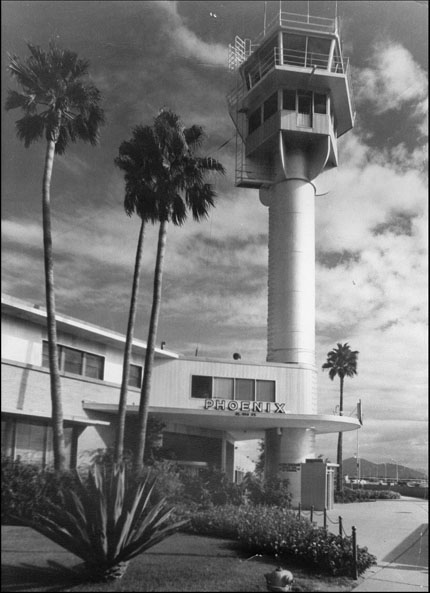
I was always a child of the railroads, so Union Station held much more magnetism for me than the airport. Still, in the 1960s, Sky Harbor was a sweet little airport. It had a romantic name. The old blond-brick West Terminal and tiny control tower hearkened back to aviation's infancy — it had only been six decades since the Wright Brothers' first powered flight.

You boarded by stairs — jetways were several years off. The new East Terminal was graced by a dramatic mural of Phoenix's founding myth and flight science above the airy modern waiting room. It also had a second-story observation deck, where one could watch the airplanes, complete with telescopes. Our Cub Scout den was given a tour of the control tower. All this was before hijackings and the rise of the present Security State.

It was a beautiful airport with a certain '50s charm. One reached it from 24th Street along grassy parkways with trees. And back then, the route into downtown was still lined with pleasant motels and "auto courts," all human scale.

Sky Harbor had two runways, which were plenty back then. On the south edge was the Air National Guard midair refueling tanker wing (Richard Nixon gave a campaign speech in the big hangar during the 1972 campaign).

On the north side, beyond the general aviation hangars, were the Southern Pacific tracks, which carried three passenger trains a day in each direction. The best airplane watching was on 40th Street, which was a two-lane affair that dipped into the riverbed and marked the east boundary of the airport. The 727s and 707s came in right overhead.

Airlines were highly regulated. Hubs were far in the future. So regional players such as Bonanza, Hughes AirWest and Western were as important as United, American and Continental. I made my first airplane flight from LA to Phoenix when I was ten (we had gone there on the Sunset Limited, by far the more enchanting journey for me). Flying was special then. People dressed up. Airlines treated you very well. There were no cattle calls or lines from LockUp.

What they want

The trajectory of the Phoenix mayor's race is perhaps already locked in. But a few other considerations should be added to my previous two posts on the issue (here and here). Some signs are telling. For example, in a television interview, Michael Bidwill, president of the Arizona Cardinals, was wearing a prominent Wes Gullett button. Gullett's old boss, John McCain, attended a reception for the candidate earlier this summer. And Peggy Neely was endorsed by Gov. Jan Brewer.

This is all you need to know about these two candidates. Bidwill refused to allow the taxpayer-funded stadium to be built in downtown Phoenix, choosing Glendale instead because of the copious opportunities for no-strings-attached adjacent development that could further benefit his family. Why does he care about the city of Phoenix, especially the central city upon which the entire city will rise or fall? As for Brewer, it's highly inappropriate for a governor to take sides in a municipal election. And Brewer is a creature of the suburbs, Phoenix's competitors and, in many cases, saboteurs. What's Neely to her or she to Neely?

Let us count the hidden agendas.

The mayor of hell

Whomever wins the Phoenix mayoral election will get a paycheck, face time on the media, a police detail to drive him or her around and not much else. Facts are stubborn things: Phoenix is the most economically wounded among America's largest cities. The "business model" that built Phoenix for decades is irrevocably broken. When even the developer-economist Elliott Pollack, favorite of the booster rubber chicken circuit, is saying the metro-wide housing market won't come back until at least 2015, things are bad.

Reprising a little history won't hurt. The political leadership of modern Phoenix was created by the Charter Government Movement, which claimed, and largely delivered, a non-partisan, clean, business-backed, professionally run City Hall. With a relatively diverse economy, the age of inexpensive energy, a majority middle class city and major business titans setting the table, little was asked of elected leaders except to continue this status quo. It somewhat fell apart with districting and Terry Goddard's velvet revolution in the 1980s, but the spirit of Charter lived on well into the 21st century.

This is not to say mayors were irrelevant as just one vote on council in a council-manager form of government. Milt Graham, John Driggs, Margaret Hance, Goddard and Skip Rimsza were all leaders of consequence. Sometimes this was for ill: the popular Graham's antipathy to transit set Phoenix back by decades; Hance did many things to hurt the central core. Goddard, by contrast, was an inspiring and transformational mayor. But through all this two things were constant: The economy levitated on "growth" and the old consensus prevailed.