South Phoenix encompasses so much history, so many cultures and distinct districts, it deserves more than one post. Every square mile is special. Still, a start. It's not a separate city such as South Tucson, so I'll go with the style "south Phoenix." When I hear the words "urban village," I reach for my Colt Python plus Speedloaders, so forget about the city's developer-speak term "South Mountain Village."
Then there's the matter of geography. For many Anglo Phoenicians, when the city still had some cohesion, "south Phoenix" began at the Southern Pacific tracks. This was, and latently remains, a place where "the other side of the tracks" is a powerful totem (it helped do in the unfortunately named Bentley Projects, the galleries, bookstore and cafe). A subset of "south Phoenix" emerged in the 1960s, to define everything below the somber wall of the Maricopa Freeway. And true south Phoenix is south of the Salt River. All must be dealt with.*
Phoenix's relatively small Mexican-American and African-American populations were historically located south of the tracks. Well into the 1970s, the commonplace offensive term for the latter was used by whites. Schools were segregated and inferior. Poverty and injustice were severe. Corruption by city officials legendary, at least through the 1940s. Most property ownership was controlled by deed covenants that largely excluded minorities (I told you this was a Southern town). Ownership was more possible south of the river, and minorities gathered there. (Most of the city's legendary and now largely lost barrios were north of the Salt, but a few, such as the River Bottom, were in south Phoenix proper). Minorities were also heavily employed as agricultural labor. This was farm country, especially after the completion of the Highline and Western canals by 1913.
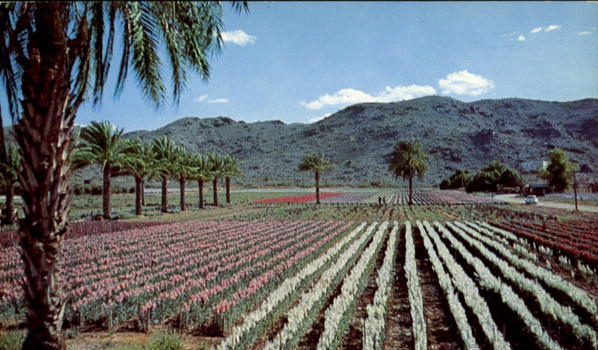
The most successful farmers were the Japanese, who arrived early in the 20th century and were able to purchase farms in the 1930s, after Arizona's anti-"Yellow Peril" law was found unconstitutional. Arizonans my age remember them for the stunning Japanese Flower Gardens that ran for miles along Baseline Road. But the Japanese were among the most innovative growers, raising a variety of crops. This also raised much jealousy among Anglo farmers, who were happy to see them, including American citizens, interned during World War II. After this shameful episode, the Japanese, including many of their sons who had fought in the U.S. Army, returned to south Phoenix and farmed again.
 34
34