More Phoenix in the 1920s

More Phoenix in the 1920s

Here are photographs of Phoenix from 100 years ago — I wrote about the decade in this column. Click on the image for a larger view. Enjoy!

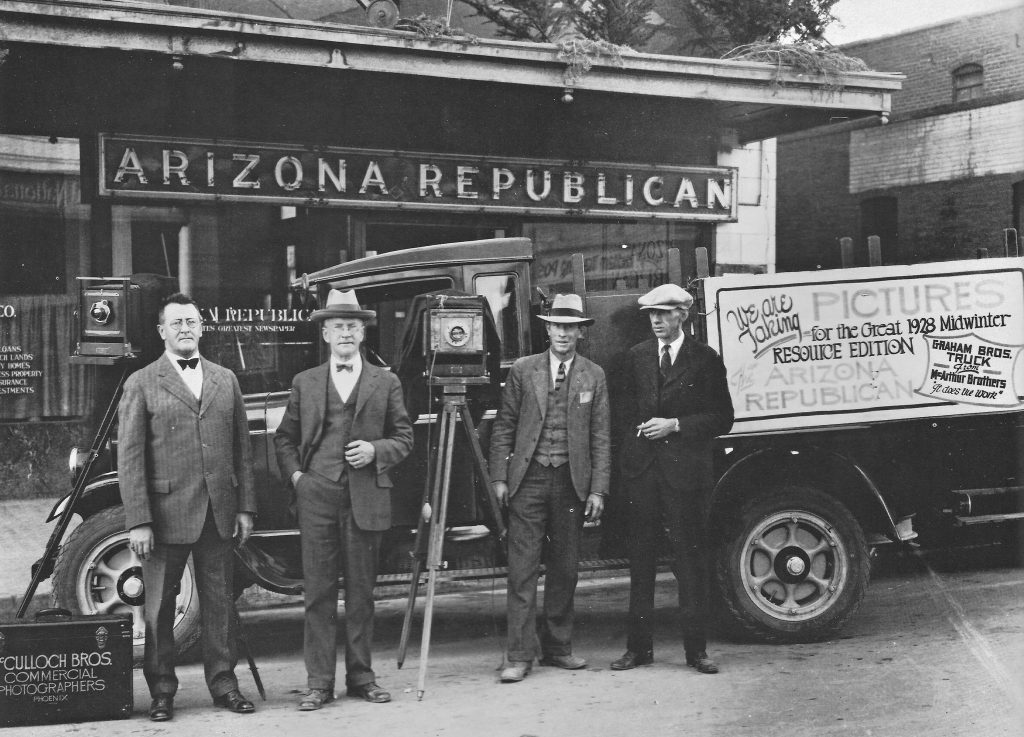
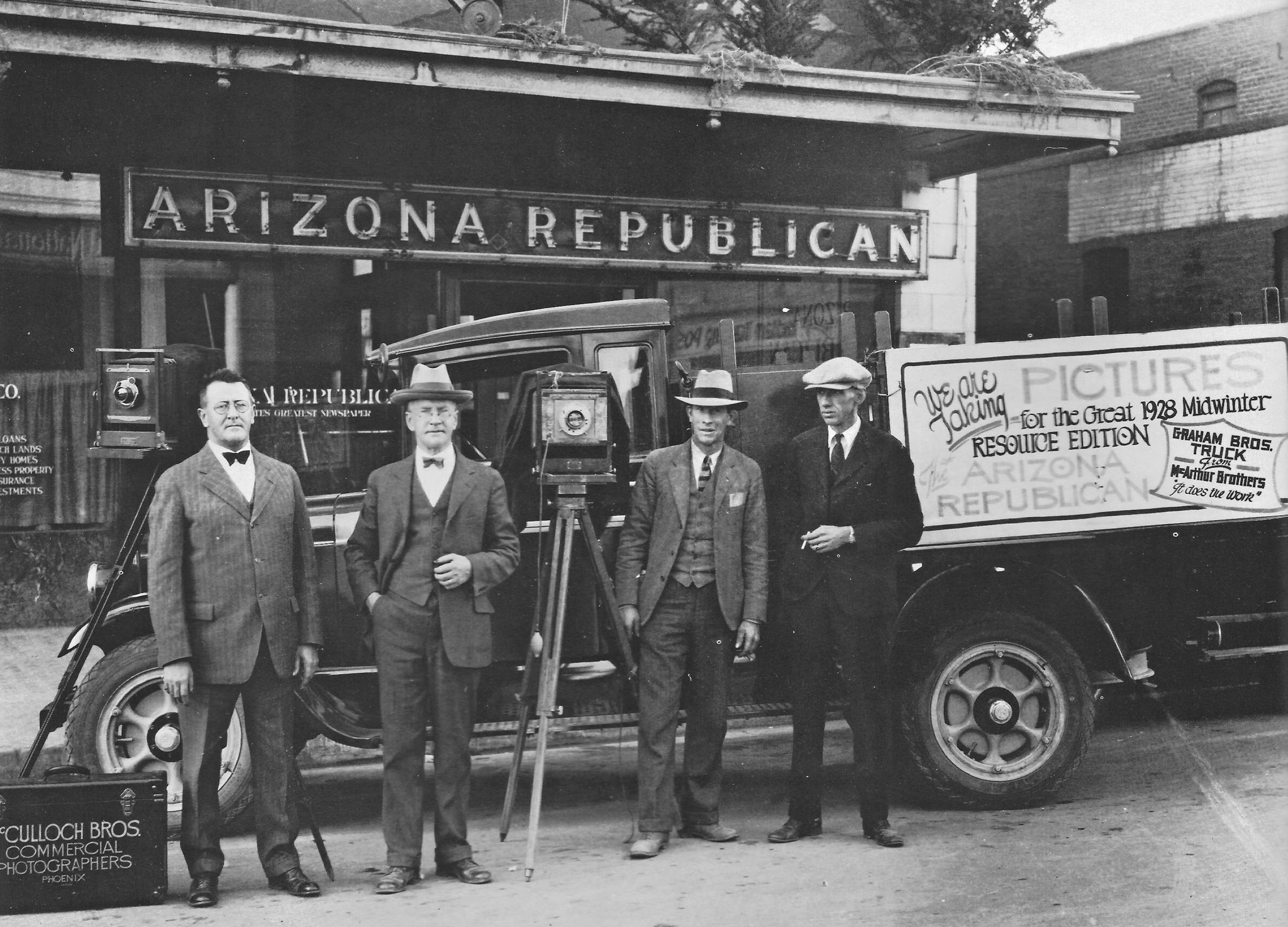
McCulloch_Brothers_Commercial_Photographers_1928The McCulloch Brothers Commercial Photographers posing in 1928 outside the Arizona Republican offices. ASU preserves the McCulloch archive as an essential resource for images from 1884 to 1947.

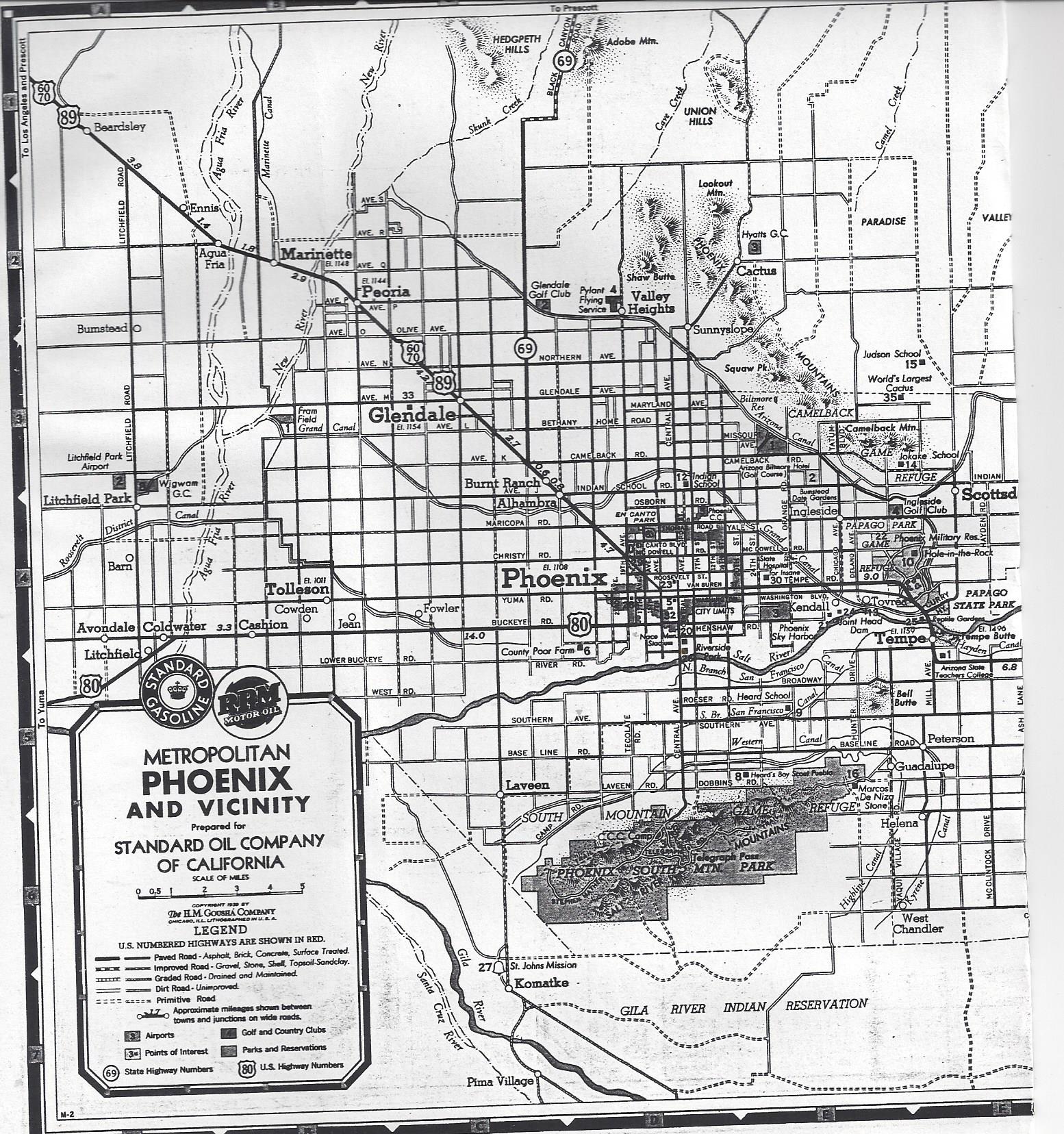
Phoenix map 1920s

A Standard Oil roadmap of Phoenix and vicinity, circa 1925.

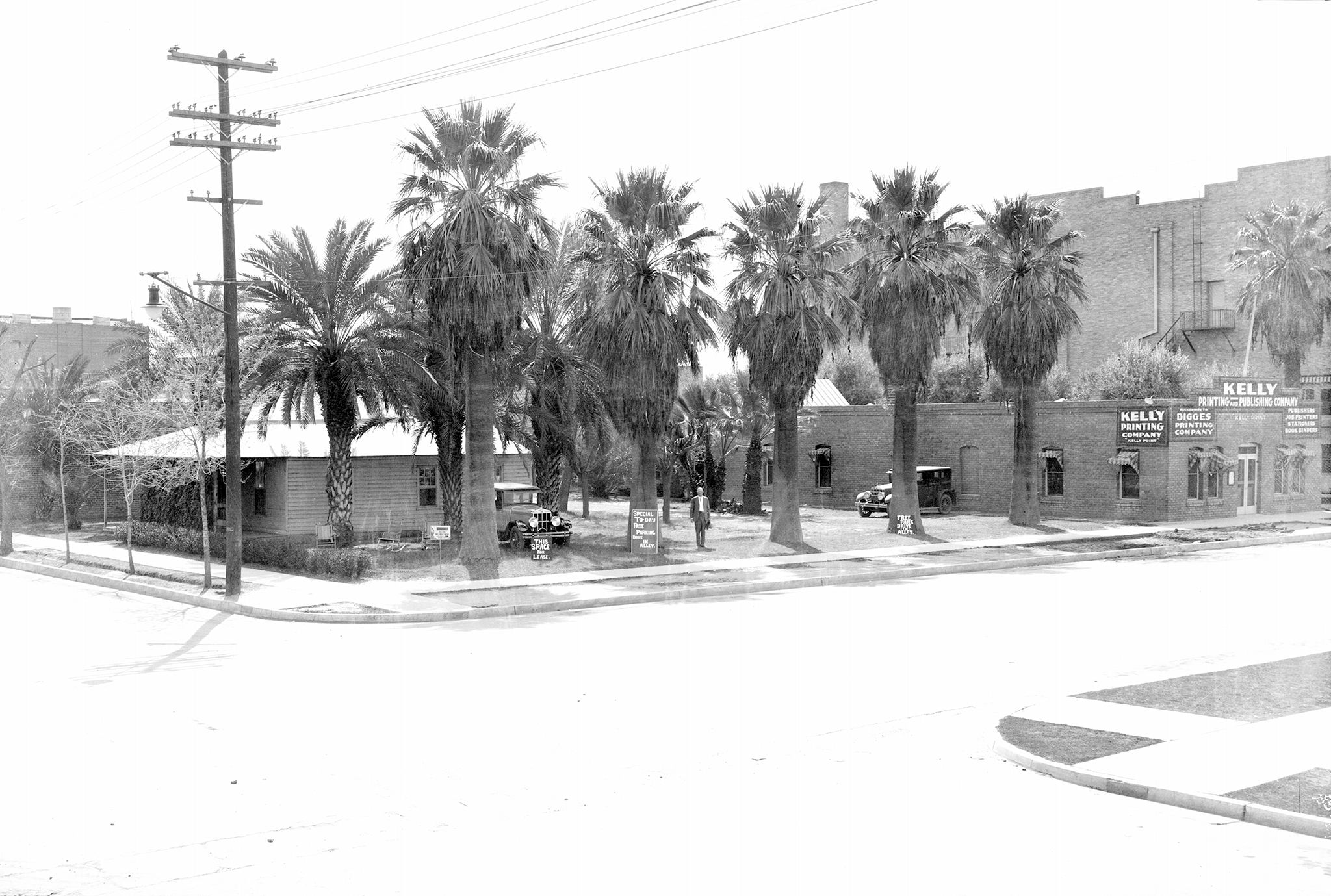
3rd_Ave_Monroe_looking_southwest_Kelly_Printing_1928(1)

Kelly Printing at Third Avenue and Monroe Street, 1928. 

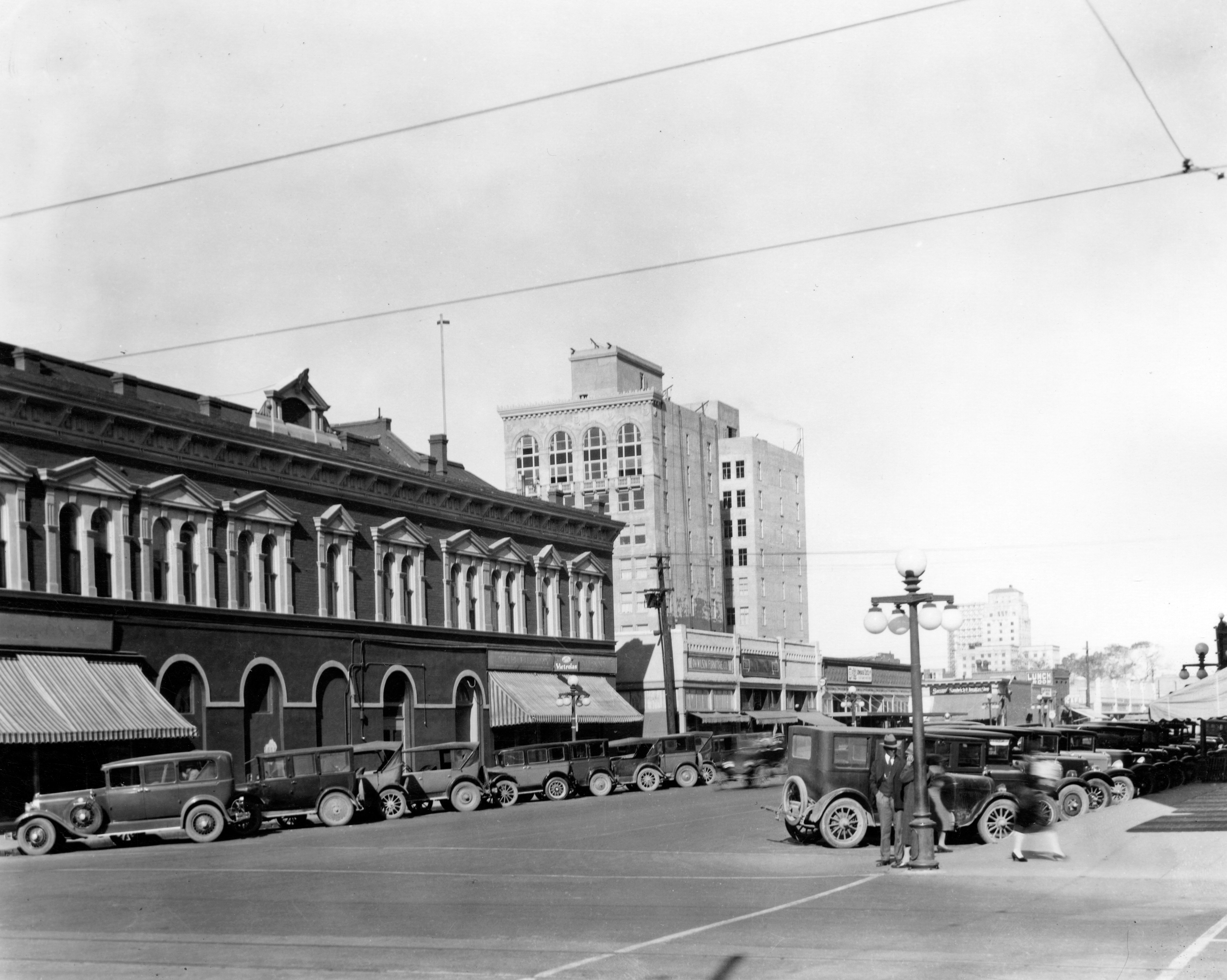
1st_Street_Washington_looking_north_Anderson_building_1928First Street and Washington looking north with the Anderson Building on the left in 1928.

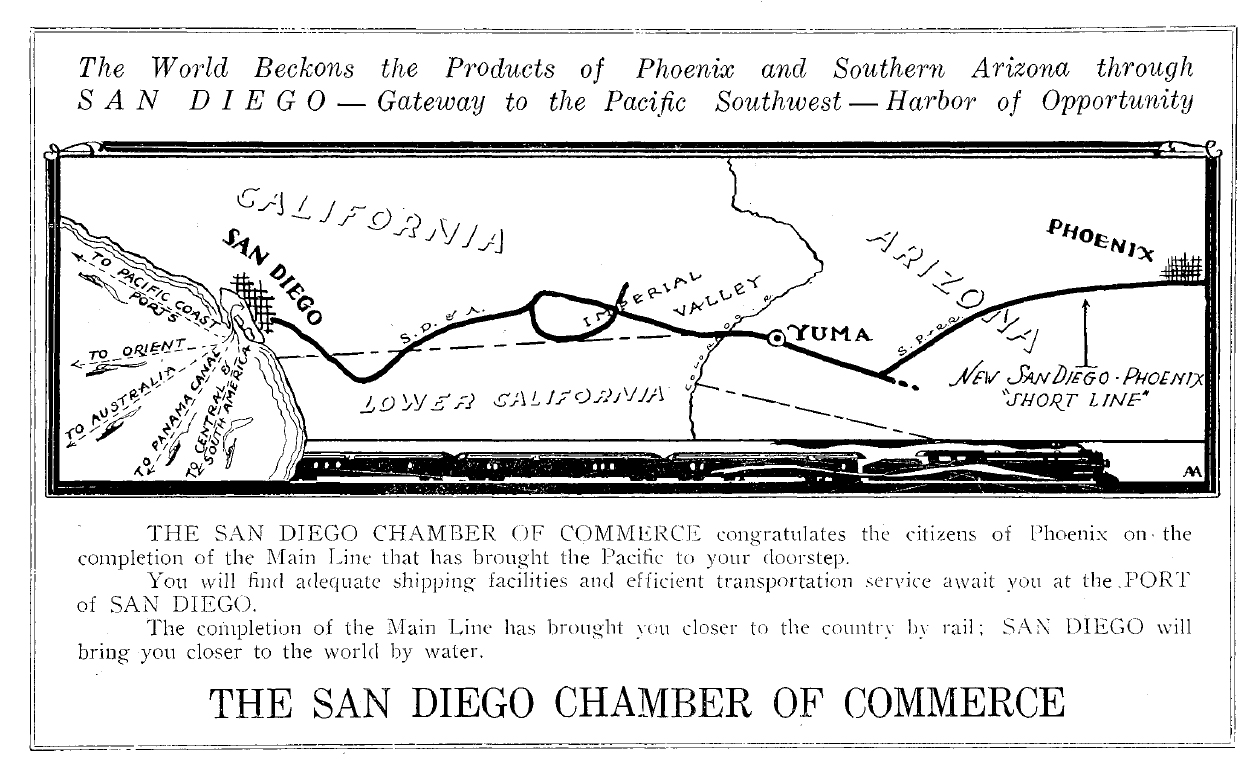
Ad_Main_Line_San_Diego_1926In 1926, Phoenix gained the northern main line of the Southern Pacific Railroad and most of its passenger trains at new Phoenix Union Station. This San Diego Chamber ad promotes a direct route between the two cities on the SP's challenging Carrizo Gorge route. That segment was originally begun by sugar magnate John Spreckels.

Arizona ends and odds

Arizona ends and odds

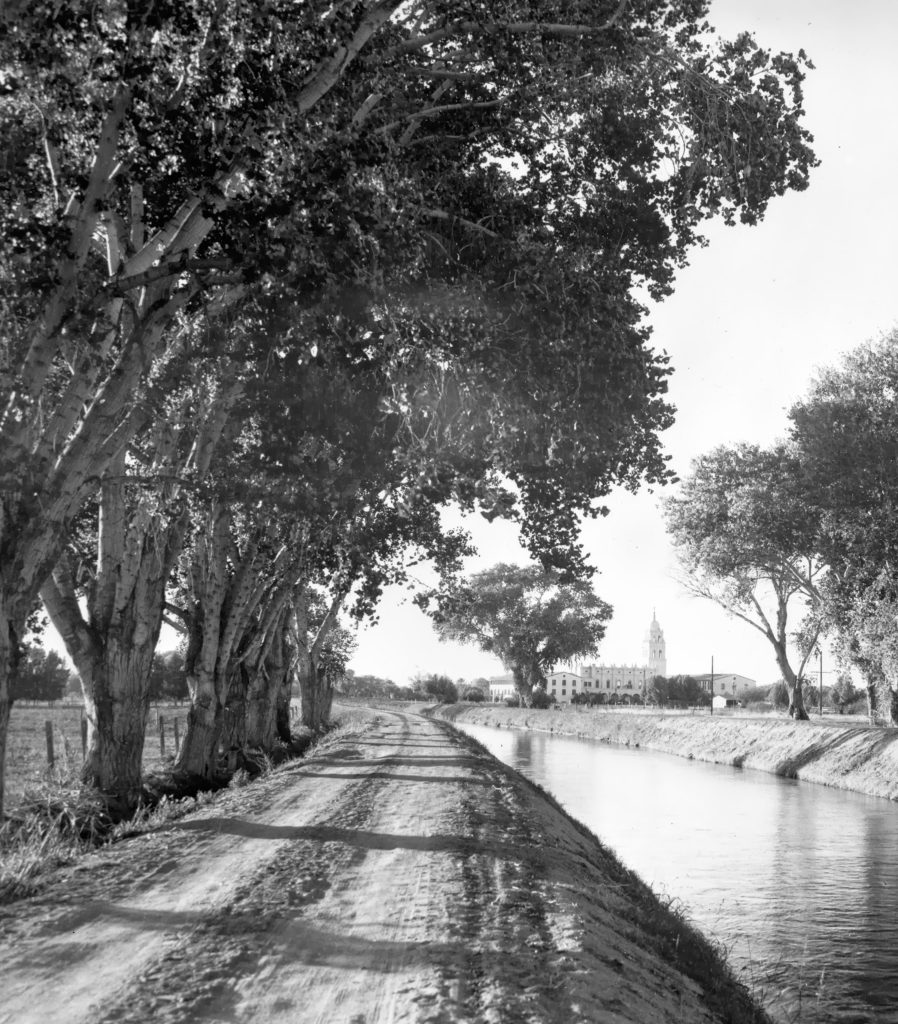
Grand_Canal_looking_towards_Brophy_School_1937
The Arizona Republic continues to tiptoe around the water issue. Most recent is a story about the uneven water availability for cities in metropolitan Phoenix. A day before, the paper ran a piece headlined "Buckeye is the nation's fastest growing city. But it doesn't have the water to keep it up."

Where to begin? First, Buckeye is not a city except on legalistic paper. It is a far-flung collection of real-estate ventures ("master-planned communities") connected by wide highways. Buckeye has an astounding 393 square miles of area for 74,000 people. As James Howard Kunstler puts it, "the matrix of single-family home subdivisions, arterial highways and freeways, chain stores, junk food dispensaries, and the ubiquitous wilderness of free parking — the last of these implying just one insidious side-effect of this template for living: mandatory motoring."

By contrast, the city of Phoenix consists of 519 square miles and 1.7 million people — that's a city. Buckeye, once tiny stop on the Southern Pacific Railroad was never meant to be a "city."

But the big enchilada is that Arizona doesn't have the water to continue unlimited sprawl. Who will tell the people? Who will stop the Real-Estate Industrial Complex?

• Phoenix opened the "Grand Canalscape" trail along 12 miles of the Grand Canal from Interstate 17 to Tempe. Mayor Kate Gallego said, “People are surprised when I tell them that Phoenix has more canal miles than Venice or Amsterdam. Today we are integrating the canals into our communities to improve neighborhood access, add new public art spaces and contribute to a healthier Phoenix by introducing them as a recreational amenity."

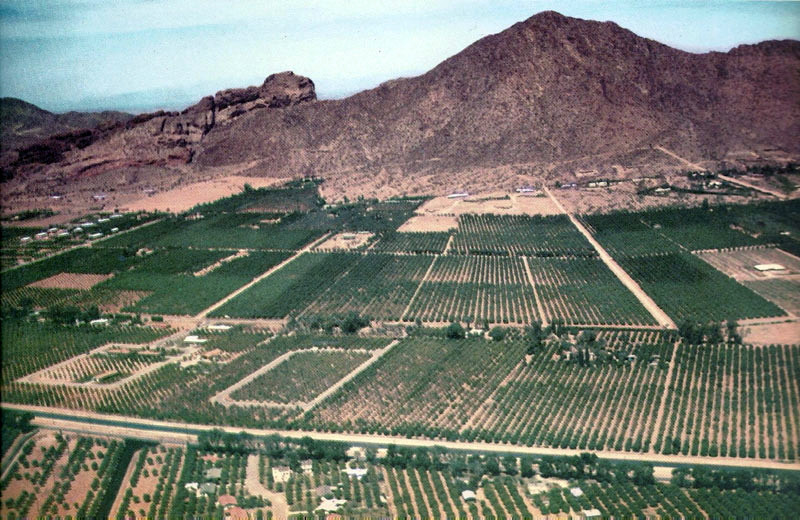
The Grand Canal, one of the original legacies of the Hohokam, once looked like the photo above. The new "safe, convenient route for bicyclists and pedestrians" is a sun-blasted emptiness. Phoenicians don't even know what they lost. Aside from road-widening, the ministrations of the Salt River Project is the biggest killer of Phoenix's once-abundant canopy of shade trees. And more sprawl is not worth the destruction of even one of those trees, much less tens of thousands. In the meantime, enjoy your skin cancer and heat exhaustion. It's heartbreaking to imagine a shaded canal, even in stretches. But, no.

Affordable housing

Affordable housing

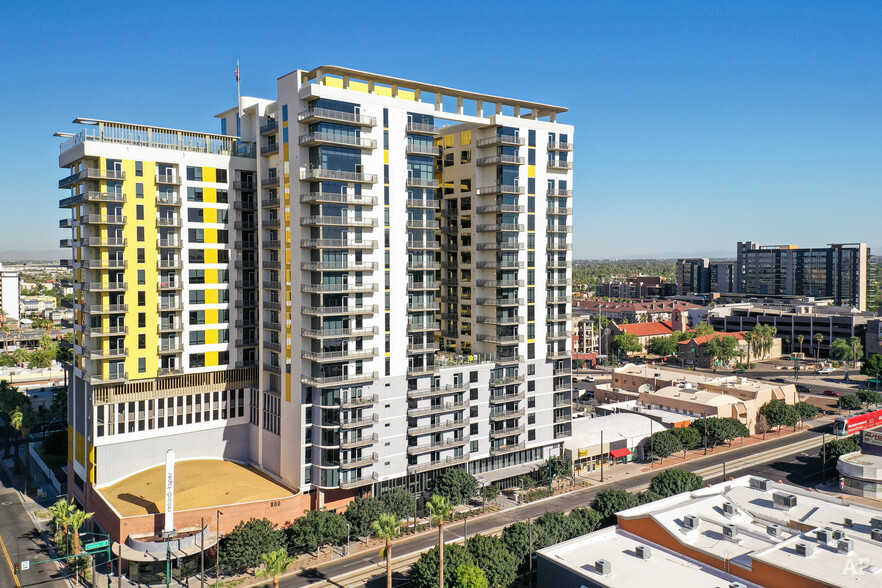
The Stewart
This is one of those weaponized words whose meaning is made murky by activists. It often means low-income housing. It doesn't mean I am entitled to afford a place on Sunset Cliffs in San Diego making low pay in "sunshine dollars." This is complicated issue.

So first, some definitions. According to the federal Department of Housing and Urban Development (HUD), "Families who pay more than 30 percent of their income for housing are considered cost burdened and may have difficulty affording necessities such as food, clothing, transportation and medical care. An estimated 12 million renter and homeowner households now pay more than 50 percent of their annual incomes for housing. A family with one full-time worker earning the minimum wage cannot afford the local fair-market rent for a two-bedroom apartment anywhere in the United States."

A more comprehensive view comes from the Center for Neighborhood Technology's H+T Index, which captures housing plus transportation affordability. Metro Phoenix's H+T costs average 49%, vs. a 68% national average and 46% in pricey Seattle and 55% in San Diego. The research center states, "The traditional measure of affordability recommends that housing cost no more than 30% of household income…However, that benchmark fails to take into account transportation costs, which are typically a household’s second-largest expenditure. When transportation costs are factored into the equation, the number of affordable neighborhoods drops to 26% (nationally).

The National Low Income Housing Coalition's annual Out of Reach report drills deeper. For example, to afford central Phoenix's 85003 ZIP Code requires an average hourly wage of $20.38 for a two-bedroom apartment. Maryvale takes $17.69 an hour (working full time). The once middle-class south Scottsdale's 85257 takes $23.08.

Now we're getting close to the problem in metro Phoenix.

Phoenix in the ‘teens’

Phoenix in the ‘teens’

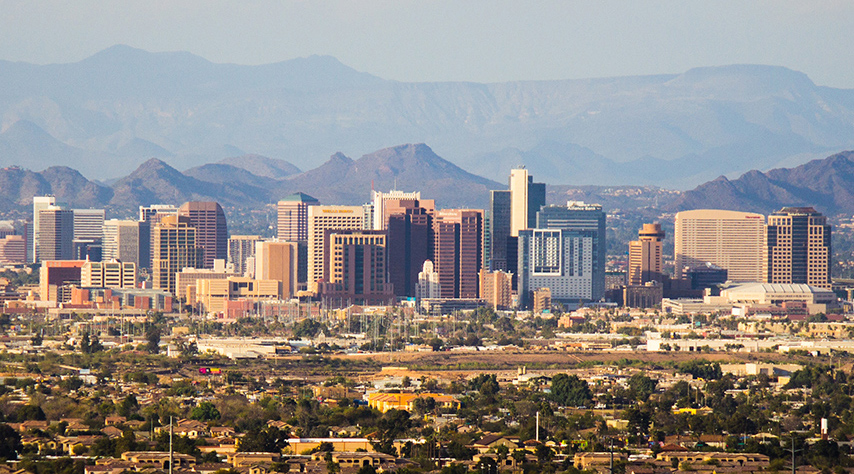
Phoenix circa 2010s
In 2010, Phoenix and Arizona were stuck in the worst (by most measures) bust since the Great Depression. Unemployment peaked at 10.9% in January statewide and 10.2% in metro Phoenix. Single-family housing starts in the metro area plunged from a monthly peak of 6,000 in 2004 to 854. Construction jobs fell from 183,000 in June 2006 to 81,000 in the summer of 2010. Phoenix was a national epicenter of the housing crash.

It was an eerie time. Freeways that had been clogged with tradesmen's pickup trucks were noticeably empty.

Now, nearly a decade later, the economy has recovered. Metro Phoenix joblessness was 4.1% in October, higher than the 3.6% nationally but still a marked improvement. Building permits clawed out of the 2009 trough but are still at levels of the early 1990s.

Population — the holy of holies worshipped by the local-yokel boosters — bounced back. After falling from 2008 to 2010, it rose by 653,000 by 2018 in the metro area. A much ballyhooed snapshot had the city itself the fastest-growing in the United States from 2017 to 2018. But the percentage rate of change looks to be slower this decade than the 2000s or the record 1990s.

True, the decade doesn't officially end until a year from now. But the "twenties" begin in the popular imagination this New Year's. So let's take stock of the "teens":

Spreading tech innovation

Spreading tech innovation

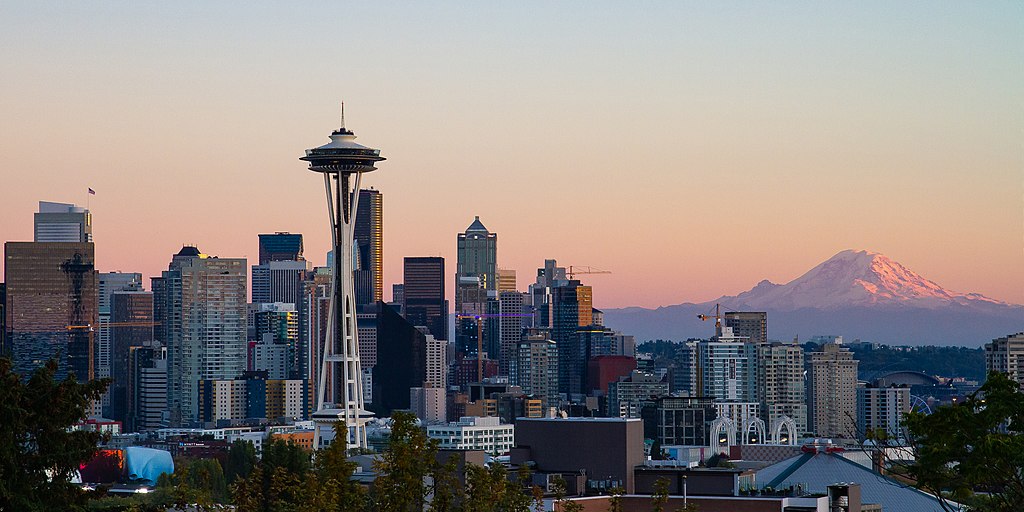
1024px-Seattle_Kerry_Park_Skyline
A new report from the Brookings Institution highlights how "Superstar Cities" — Boston, Seattle, San Diego, San Francisco and Silicon Valley — captured nine out of 10 jobs at the headwaters of advanced industries from 2005 to 2017. (See the coverage here and here). And it offers an ambitious plan to spread tech centers to "loser cities" in what is mostly considered flyover country.

An interesting footnote: One of the authors of the Brookings study is my friend Mark Muro, who worked at the Morrison Institute at ASU in the early 2000s.

One can't argue with this reality, particularly set against rising inequality and four decades of mergers that took away the economic crown jewels of hundreds of American cities. But some context is also necessary. In addition to these headwinds, many of the "loser cities" made their own fate.

And I'm not talking about Detroit or Cleveland. A better example can be found in Phoenix. Despite being the nation's fifth-largest city and 13th largest metropolitan area, Phoenix punches well below its weight. And no outside force has done this to Phoenix as much as Phoenix has done it to itself.

Into the wild

Into the wild

28026687999_a9c7db585e_cWhen I was about three, my family was driving from Tucson to Phoenix in those pre-Interstate times. I have three vivid memories. The first is the restaurant where we ate breakfast; it had ancient double doors with windows behind ancient double screens. The second is the fierce rainstorm that cut visibility severely, almost the desert version of a whiteout. We headed out of Coolidge, my mother behind the wheel, me between her and my grandmother. No other cars were on the two-lane road.

My third memory is of a vast torrent of fast-moving latte-colored water that suddenly appeared in front of us.

I'm sure it wasn't as wide or as biblical as I recall it. I had never seen water in a river before! But what was undeniable is that the bridge had washed out — perhaps at the Gila River — and only my mother's caution, slow speed, and fighter-pilot reflexes prevented our deaths.

As I write now, searchers are still trying to find six-year-old Willa Rawlings, lost when her father's "military-like truck" was swept away in flooding Tonto Creek. The bodies of her brother and cousin, both five, were found Saturday. Only Willa's shoe has been recovered. Her parents escaped.

The Republic's Laurie Roberts hit the right notes of sympathy and bafflement — that the driver would try to cross the flooded creek, and that the Legislature in its low-tax religion has failed to build a bridge. Yet I suspect little will change. Especially on the common-sense front, for bridges can be overwhelmed as anyone knows who remembers Scottsdale's comic attempts to span Indian Bend Wash in the 1970s.

‘Solutions’ annotated

‘Solutions’ annotated

1440px-Colorado_River_above_Hoover_Dam_-_panoramio
From the Arizona Republic on Nov. 17th. My annotations are in black.

Headline: ‘We need to act fast’: Statewide forum focuses on climate solutions for Arizona. Journalists are pushed to seek solutions to largely insoluble problems. Steve Jobs was more on the mark when he critiqued Fox News to Rupert Murdoch: "The axis today is not liberal and conservative, the axis is constructive-destructive, and you’ve cast your lot with the destructive people. Fox has become an incredibly destructive force in our society."

Lede: With climate change cranking up the heat and intensifying droughts, more than 400 people from across Arizona gathered Friday and Saturday to brainstorm solutions for reducing planet-warming pollution and preparing for a hotter, drier future. What people? Doug Ducey? Developers? Republicans who have held control over the Legislature for decades? Elliott Pollack? Grady Gammage. No…

Second graf: Among them were young activists who see climate change as the defining issue for their generation. The time to act is now, they said. You bet. But what power do they have? Do they vote? Did they drive to the conference, adding to climate-causing emissions (rhetorical question)?

Next grafs: “This is rapid change and we should do something about it before it’s too late,” said Alicia Rose Clouser, a 13-year-old eighth-grade student from Sinagua Middle School in Flagstaff and a member of the Navajo Nation.

“My people will be suffering for generations on if we don’t do something,” she said. Mandatory inclusion of a woman and "marginalized person" but otherwise empty information calories.

Next: The two-day conference at Northern Arizona University in Flagstaff brought together the students and teenage activists along with academics, health officials, tribal representatives, environmentalists, representatives of farming businesses, urban planners and city officials, and people from the community who said they wanted to be part of the discussion. Now we finally get the "who" — none of whom have the power to enact policies that would address climate change.
St. Luke’s memories

St. Luke’s memories

St_Lukes_Hospital_Fillmore_18th_Street_looking_east_1960s
Town DitchSt. Luke's Hospital was built on the ruins of the dense Hohokam village called La Ciudad. It tilts at an angle because it had to fit against the original canal dug by Jack Swilling and his gang from Wickenburg. The Town Ditch or Swilling's Ditch was covered in the 1920s but Villa Street preserved the angle. Today's St. Luke's extends all the way to Van Buren Street with a ghastly spread of rocks and gravel. Yet the hospital you see above was built in the shady Montezuma Heights barrio
of houses and public housing projects south of Edison Park. No gravel.

In my time on the ambulance, I spent a good amount of time at the emergency room of St. Luke's (or, as we called it with our dark humor, St. Puke's). In the New Testament, Luke the Evangelist was referred to as a physician.

Once, we heard an explosion outside and went to check what had happened. A patient had thrown himself off an upper floor and was well beyond our ministrations. On a happier note, we regularly had lunch (Code 7) at nearby Sevilla's (before it moved to McDowell), a family-owned Mexican restaurant surrounded by the 'Jects. The homeboys kept watched over our units so they wouldn't be broken into for drugs or stolen.

Off duty, I would visit my mother there, in her twice-annual stays as a patient, being treated for the emphysema that would kill her within a few years. The care was good.

I write all this because, after a century at this location, St. Luke's is closing.

Pushing the Pinal envelope

Pushing the Pinal envelope

MaricopaI attended kindergarten in Coolidge. Back then it was a compact town of 5,000 people. It boasted a charming little Spanish-style railroad depot on the Southern Pacific, with six passenger trains and many freight trains a day. My uncle showed me how to place a penny on the tracks to be mashed under a passing train.

Pinal County was home to about 63,000 people, most working in agriculture. Florence, the county seat, had a population of about 2,100, Casa Grande, another compact desert town on the SP, held 8,300, Eloy 4,900, and the remote crossroads of Maricopa a few hundred. Even then, Pinal County had a water problem: It was almost exclusively dependent on pumping groundwater. Coolidge Dam in neighboring Gila County wasn't enough for Pinal County's water needs even in 1960.

Fast forward to today. Pinal County holds an astonishing 447,000 people — more than the city of Phoenix in 1960. Maricopa alone (above) had an estimated population of more than 50,000 as of last year. This once-rural, once-distant county has become a Phoenix bedroom community — except the passenger trains are long gone. And, contrary to one of the key goals of the Central Arizona Project and Arizona Groundwater Management Act of 1980, it's still dependent on pumping from ever-diminishing aquifers.

Paving Arizona

Paving Arizona

South Mtn Freeway Estrella Drive roundout
Seattle recently completed demolition of the double-deck 1950s-era Alaskan Way Viaduct, which ran for more than 2 miles along the waterfront downtown. Now the traffic is in a tunnel and the city is preparing to enjoy unencumbered access to Elliott Bay. An even more ambitious goal is to put a long lid on Interstate 5 downtown, which is already covered by a park for a few blocks.

Meanwhile, in Southern California, the $8 billion, 63-mile High Desert Corridor freeway has been canceled. It would have been the first new freeway in LA County in a quarter century. According to Streetsblog, the project "would have spanned two counties connecting the north L.A. County cities of Palmdale and Lancaster with San Bernardino County cities of Victorville, Apple Valley, and Adelanto. The route would have gone through a patchwork of privately-owned undeveloped wild lands populated by Joshua Trees." The PIRG Education Fund named it one of the worst highway boondoggles in the nation.

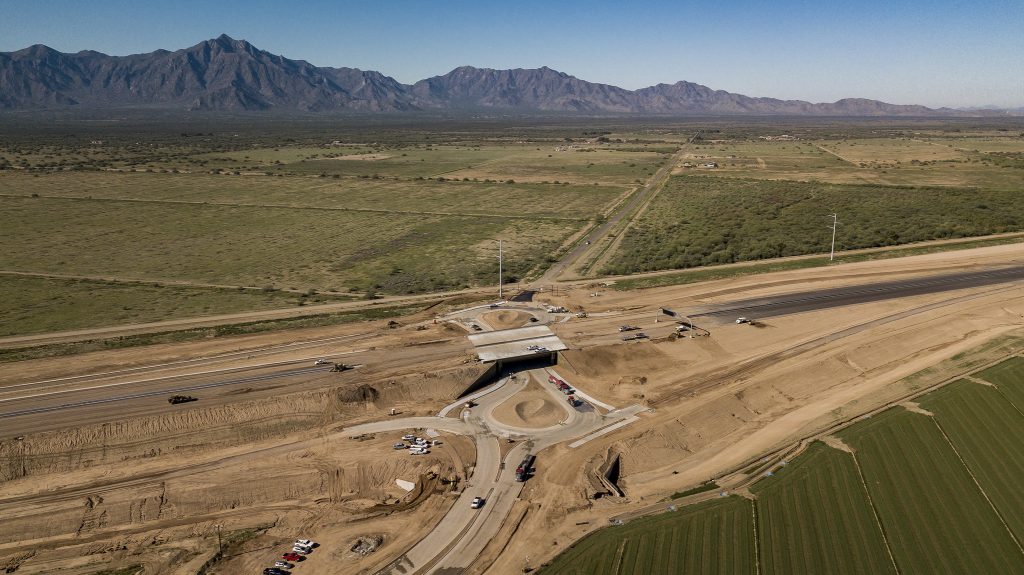
But that's not how we roll in central Arizona. In addition to the unneeded South Mountain Freeway (pictured above), the state Department of Transportation is planning a $55-mile freeway running from Apache Junction to Eloy. There it would connect with Interstate 10. When in a hole, keep digging.

Library late fees fade away

Library late fees fade away

Library_1950s
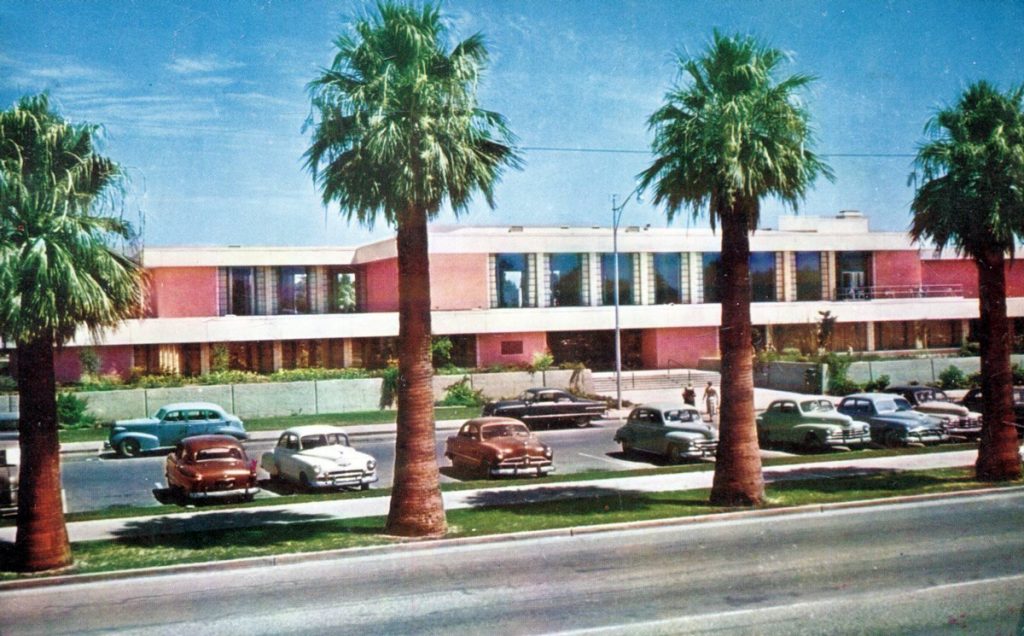
When I was nine years old, I went to the main branch of the Phoenix Public Library (a short bike ride from home) and applied for my youth library card (nine was the youngest one could apply). It was the most prized occupant of my wallet. It was also an important passage into growing up.

Kenilworth School had a well-stocked library. That was unlike today, where underfunded schools often lack what was once considered a basic. Along with the charter school racket, which operates out of anywhere without resources or much oversight (the better to siphon public money to the owners), the now rely on the city libraries. This is a shocking change from when I attended Arizona public schools.

1950 library interiorAnyway, my school library wasn't enough for this young bibliophile or for many of my friends. I wanted to wander inside the big coral-colored building at Central and McDowell (Barry Goldwater's name was on the plaque, from when he was a city councilman). The Arizona Room, stocked with history, beguiled me from the moment I walked in. I wanted to have borrowing privileges. Of course if one was late returning a book, a fine was attached. But I never got a fine (and we were broke, often hovering on the edge of financial catastrophe). I took my responsibility as a card holder seriously. Being a library-card holder was a privilege, not a right. I'm still a card-holder of the Phoenix Public Library, as I have been in the many cities and towns in which I lived. Even in little Payson, when I spent the summer of 1967, had a library and I got a card.

Turns out this is very 20th century/last millennium thinking.

The war on shade

The war on shade

Arizona Ash 1

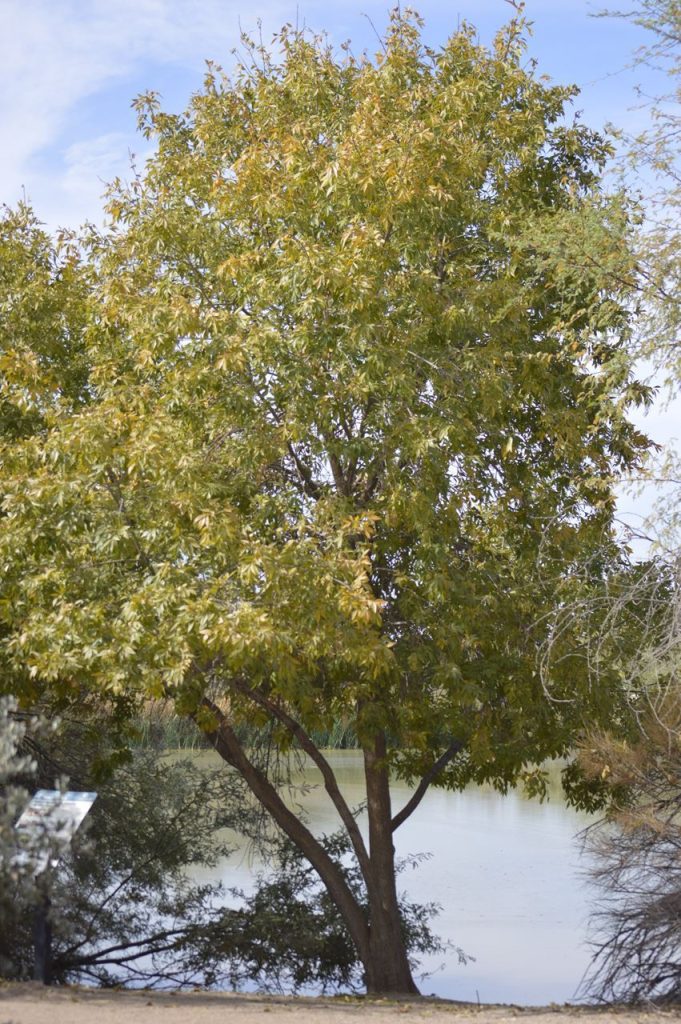
Behold the lovely Arizona ash tree in the photo above (thanks to Aimee Esposito, executive director of Trees Matter). Elsewhere, mature pine trees will soon be demolished if a plan is approved for Shepherd of the Valley Lutheran Church to use half its land in the Alhambra district for single-family houses in a gated property. WWJD?

Like the newspaper business, mainline Protestant churches are in such a catastrophic decline, much of it self-inflicted, that their most valuable earthly possessions are their property. But this latest abomination, reported by New Times, is part of an ongoing catastrophe that is going to help make Phoenix uninhabitable in the future — and is helping raise local temperatures now, not to mention making most of it remarkably ugly.

Most Phoenicians today likely have no memory of the old city, a lush Eden of trees, grass, hedges, flowers, citrus groves, farms, and the priceless Japanese gardens. This was made possible now only because of our federally funded water projects, but also because the heart of the Salt River Valley is a natural oasis, near the confluence of five rivers and sitting on some of the most fertile alluvial soil on earth. Growing up, I never saw one palo verde, most varieties of which provide zero shade, outside of going into the desert.

Today, Phoenix is ever more a paved monstrosity of asphalt, concrete, and grass, with the occasional "shade structure" which doesn't actually provide shade. Not surprisingly, overnight temperatures have risen 10 degrees in my lifetime. Losing the regular frosts once commonplace, West Nile virus is a new scourge, carried by mosquitoes that were once killed off in winter. And this is before the rising dangers of climate change.

Musing about the future

Musing about the future

1024px-Typewriter_Underwood_1945
Most of our best commenters — people who made these columns worth writing and reading — have absented themselves in recent months. Traffic continues to rise modestly and I get nice emails from readers, for which I'm grateful. And I totally understand potential reasons the commenting A Team is gone. For example, ruminating over our situation is exhausting and perhaps toxic.

The outcome on the light rail vote (WBIYB) was a rare win. And I'm happy that the central core continues to fill in. Both these are longtime concerns of this column and, before that, when I wrote for the Arizona Republic. Otherwise, we keep losing. Phoenix and Arizona keep sprawling out, heedless of the cost and inefficiency of thinning out population; keep the "business model" of population growth and a low-end economy; keep extremist politics; keep throwing down gravel and ignoring the desperate need for shade trees in the city, etc.

When I started this blog in 2008, it was pro-bono work offering commentary, context, and history that wasn't being written elsewhere. That remains the case; if anything, institutional knowledge has declined sharply. But I have my day job at the Seattle Times and my novels, as well as feelers to write more history books. Without being anointed and becoming a best-seller, I would be content never to see my name in print again. But, as I've written before, I always felt I owed. That Phoenix was built on achieving impossible deeds — we made the desert bloom! — and it was my duty to carry the tradition on. I was raised that way. What a quaint concept today.

Camelback through the years

Camelback through the years

Camelback_Mountain_1956
No physical landmark says "Phoenix" more than Camelback Mountain. It's also a geological oddity. The camel's hump was formed in the Precambrian era, from 2 billion years ago (in Arizona) to 600 million years ago. But the camel's head came from the Tertiary period, as recently as 66 million old — it was created around the time as the Papago Buttes.

As Halka Chronic writes in Roadside Geology of Arizona, "The whole sequence of Paleozoic and Mesozoic rocks that should come between the Tertiary head and the Precambrian hump is missing!" It's also the only faulted mountain in the Salt River Valley, the hump caused by the earth being lifted upward rather than volcanic activity.

President Rutherford B. Hayes included Camelback in the Pima and Maricopa Indian reservation, a move reversed by the Territorial Legislature six months later. The 1956 photo above shows the mountain was still pristine, the same iconic image seen by the Hohokam, to whom it was sacred, and the first pioneers. But preservation was tardy and by this time private interests owned the entire mountain.

By the early 1960s, houses were marching up the side, with plans to go all the way to a resort on the top. I write about the ultimately successful effort to save the mountains elsewhere. It is true that Barry Goldwater took on the cause of Camelback after his unsuccessful 1964 presidential bid. We schoolchildren collected coins for the effort. But it ultimately took federal money, thanks to Interior Secretary Stewart Udall, to save the upper reaches of Camelback.

Phoenix extended Arcadia Drive north of the mountain's namesake avenue to serve the luxury homes clinging to the side. Who doesn't remember their first kiss from Valle Vista Road with the city lights reaching to the horizon. Unfortunately, recent years have also seen enormous numbers of hikers, especially tenderfoots attempting the ascent of this wilderness in the hottest weather. Their rescues put first-responders at risk and cost city money.

Let's take a visual tour of this magical mountain through the years (Click on a photo for a larger image).:

Snakebit

Snakebit

1024px-Chase_Field_-_2013-05-24_-_Section_118
I've spent a good part of my career advocating public funding for stadiums as a necessary evil to protect important civic assets. For example, I supported new stadiums for the legendary Reds and the perpetually disappointing Bengals ("Bungles”) when I was in Cincinnati. These new venues kept pro teams that would have otherwise decamped for larger markets.

I did it again most recently with the Phoenix Suns arena, arguing in November that allowing the NBA team to leave downtown would be a terrible blow to the central city:

Kate Gallego, facing Daniel Valenzuela in a March mayoral runoff, said, “it is not in Phoenix’s best interest to invest in an arena.” Arizona Republic columnist Laurie Roberts wrote, "taxpayers are about to get hosed if this deal goes through."

Here's the real deal: If Phoenix doesn't invest in the arena, Sarver — who has none of Jerry Colangelo's civic spirit — will move the team to the Rez, renaming it the Arizona Suns, no doubt, or even to Seattle, which is hungry to replace its lost Supersonics. The damage to downtown and light-rail (WBIYB) would be catastrophic. Talk about hosed.

Now come the Diamondbacks, demanding further pro-team welfare. The team can leave Chase Field as early as 2022 and has been sending ominous threats: Exploring use of the Cardinals stadium in Glendale for while, flirting with the Las Vegas area, fielding feelers from other cities. The most comfort officials would give is that the D-backs "are highly likely to remain in Arizona."

And I'm starting to think: Git. Let. Them. Leave.