The wrecking crew

The wrecking crew

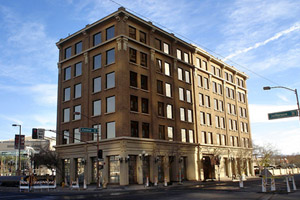
HotelJeffersonI was stunned to read this story about the future of the historic Barrister Place in downtown Phoenix. The 1915 Hotel Jefferson, now city-owned, is one of the few remaining of what were once scores of beautiful old structures downtown.

The Republic's Dustin Gardiner writes, "The hotel, which featured 150 rooms, was decked out in mahogany, marble and expensive colonial furniture. It featured a coffee shop, a cigar stand, private suites and a rooftop garden with palm trees and a fountain."

As an EMT-Paramedic, I saw it in harder times, when it was an SRO which frequently required visits from emergency responders. Amid the human tragedy and shabbiness, it still retained good bones. Unfortunately the interior was later gutted. Now the city is looking for a buyer.

Here's what stunned me: "Councilman Jim Waring…questioned whether the city could get more money for the lot, in the heart of downtown Phoenix, if a buyer could demolish the building and start from scratch."

Fortunately, he didn't prevail. But behold what your city council risks becoming, Phoenix.

Questions for Arizona in 2014

So many myths, so little time or brain cells. I suppose that is why malign falsehoods carry us forward. The latest was a story I read where a UofA professor is having a loud growthgasm over Arizona's spectacular income growth and how 2014 will be even better.

I don't mean to be unfair or pick on people, but when these ideas enter the public square through the most powerful media outlets they reinforce the "everything's fine" lie that keeps Arizona backward.

To be sure, "staying positive" on the party line is a good way to keep one's job. I am proof of what happens to dissidents.

About income: Unless something radical has changed, Arizona is an underperformer and will remain so. The snapshots of "growth" are statistical noise caused by the large population churn. A certain right-wing columnist has ridden this for years to say, in essence, "Arizona does not suck, Talton!" — even though reality is quite different.

WWBIYB, to south Phoenix

WWBIYB, to south Phoenix

LRT1Considering the divisions within Phoenix City Council, it is significant that light rail to south Phoenix passed this week by 8-to-1. The five-mile route would mostly be along Central to Baseline Road.

For newcomers to this blog, WBIYB is shorthand for "We Built It, You Bastards." It is my response to the thugs, trolls and hysteriacs that opposed light rail in Phoenix. We built it, the world didn't come to an end, and it is a great success. Light rail is the most hopeful achievement so far for Phoenix to have a quality future.

Now light rail connects to the Sky Train at Sky Harbor. New lines are moving ahead, deeper into Mesa, extensions north and west, and now to south Phoenix. We Will Built It, You Bastards.

Here's an important adjustment that's needed: Run the new line over to Third Avenue and south to Lincoln and then back to First Avenue/Central. That way it can connect with future commuter trains and Phoenix-Tucson rail passenger service that should use a restored Union Station as their hub. It won't cost much more and the benefit will be exponential.

We Will Build It, You Bastards. But the time line is too long — up to a decade. And with Republican austerity ruling in D.C., one hopes the essential federal money will be available. God knows, we subsidize roads and freeways way too much, with enormous damage to the environment. Phoenix should fast-track this.

Enemies of the good enough

Enemies of the good enough

In and near downtown Phoenix, three developments are worth examining.

2_Aerial-1900

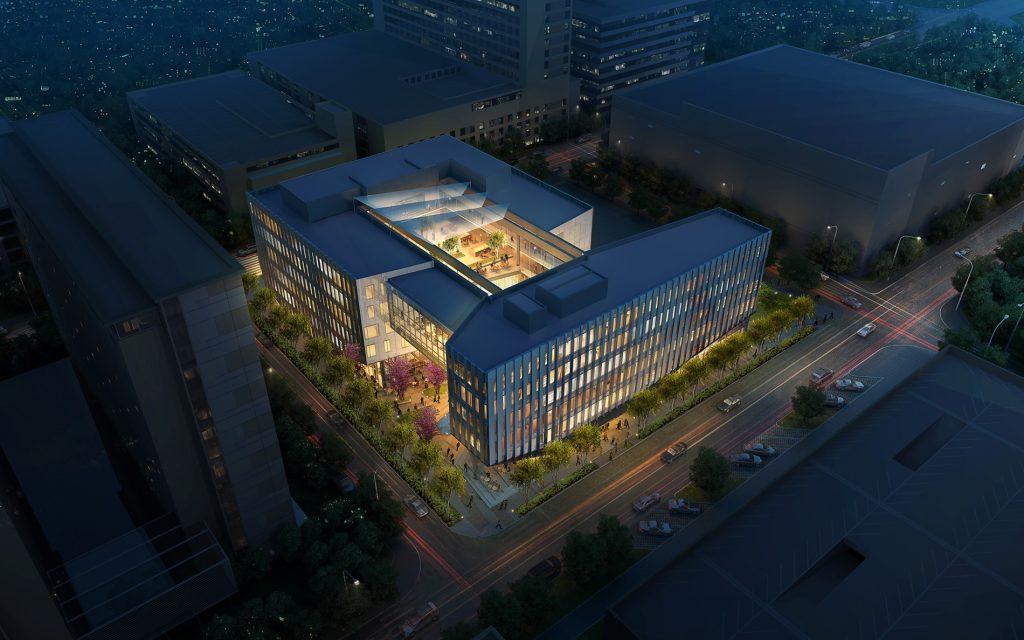
Renderings have been made public of the proposed Sandra Day O'Connor College of Law building for the downtown ASU campus (above and below). Someone told me it requires "seven variances" in the city code. And this code has given us a lovely cityscape? For god's sake build it, before somebody — ASU, the regents — changes his mind.

1_NW Corner-1900

Would I have preferred a Mission-revival or other human-scale style to get away from the deadening modernism that makes downtown less interesting? Sure. Has the design been improved from its original rollout in response to community feedback. Yes, to some extent. But the perfect shouldn't be the enemy of the good. And bringing the law school downtown will be a substantial coup. Now people need to demand that the block have real shade trees (and grass!), not palo verde skeletons and gravel.

The building would go on the block between First Street and Second Street, Taylor and Polk, the site of the old Ramada Inn (Sahara). There is still bad blood with preservationists that ASU demolished this mid-century building rather than opting for reuse.

• Then we face the question of what is "good enough" or a good start. Many have been wondering how the city would use land it bought in and near the Evans-Churchill neighborhood just north of downtown since most of it was assembled for the abortive Cardinals stadium.

Now we have an indication, and it is disappointing to risk understatement.

Phoenix in the fifties

Phoenix in the fifties

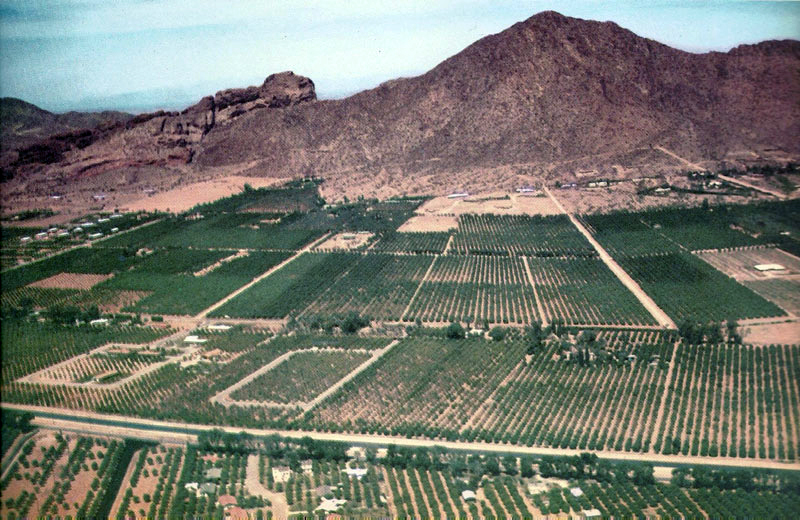
Camelback_Mountain_1956Ask almost anyone who recalls Phoenix during this time and the fifties were indeed nifty. For most, it was the best time to have lived here.

This was also among the city's most sweeping eras of change. It saw the emergence of many of the trends that later turned unfortunate or worse. Below the gleam of Eisenhower peace and prosperity, much of the town was troubled.

To begin, however, it is easy to see why these years are remembered with fondness, and not merely with lazy nostalgia.

The fifties were the last decade when much of the city's life revolved around such sweet, small-town reveries as the Masque of the Yellow Moon, held annually at Phoenix Union High School's giant Montgomery Stadium. Although the Jaycees Rodeo of Rodeos would soldier on into the 1990s, it reached its pinnacle then, too. School let out for the rodeo parade day. Phoenix was not far removed from its roots of planting and cowboying.

They were the last time when some of the larger canals were still lined with trees, doubling as widely patronized swimming holes, and water-skiing behind cars was winked at by the Salt River Project. When most of the Project's footprint was citrus groves, the Japanese flower gardens and fields, not subdivisions. When this enchanting oasis was sheltered by shade and green, and beyond it was largely pristine desert and High Country. When mining, cattle and logging were the industries in the sparsely populated state.

Phoenix was the city. Every other town in the Salt River Valley was small and separated from Phoenix by groves, fields and desert.

No wonder the overnight lows were ten degrees lower than now and summers were shorter and less severe.

District 4

[UPDATE: As of 9:30 p.m. MST Tuesday, Pastor held a 498 vote lead over Johnson and counting may continue until Friday]

The race for Phoenix City Council District 4 might seem like small ball for this blog, but it tells us much about where Phoenix stands and where it is going.

One candidate is Laura Pastor, daughter of Rep. Ed Pastor, without whose efforts we would not have a popular light-rail system (WBIYB*). The other is Justin Johnson, son of former Mayor Paul Johnson. (Another race pits Kate Widland Gallego against the Rev. Warren Stewart, but for simplicity's sake, I will focus on District 4).

The contest has been distinguished by mudslinging, with Pastor, for example, being compared with Paris Hilton — and a remarkable lack of substance.

Phoenix 101: What went wrong

Phoenix 101: What went wrong

If you think "everything's fine" or that Phoenix has no troubles that aren't common to other cities, this is not your post. Spoiler alert: Everything is not fine.

City_of_phoenix_logoWe discuss problems and challenges, as well as intelligent responses, frequently in this space. A previous column sought to debunk the excuses, myths and lies about the place. But reading the comments on the most recent post made me wonder: Is Phoenix uniquely troubled? If so, how and why?

Sprawl doesn't explain it. What Kunstler calls "cartoon architecture" has befouled the nation from sea to sea. Good civic design was lost everywhere. The best cities in the country are surrounded by soul-killing suburbs, office "parks," malls, shopping strips, parking lagoons and laced up with freeways.

Car culture, per se, isn't the answer, either. Oklahoma City ranks lowest in non-vehicle commuting, yet the entire metro has long backed a levy that has impressively rebuilt downtown. Freeway-mad Dallas also boasts the nation's largest light-rail system.

The First Street challenge

The First Street challenge

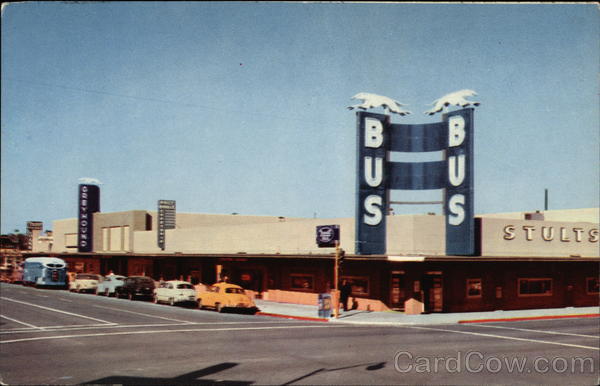
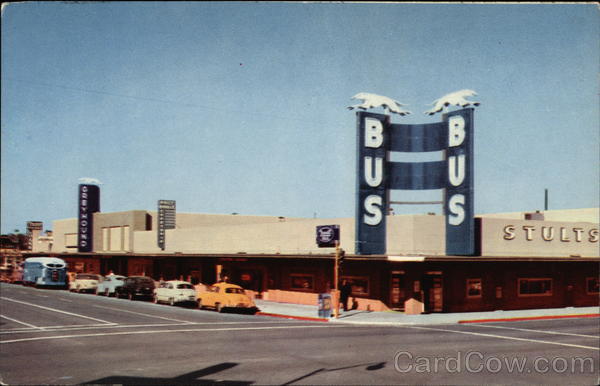
GrayhouseDepot  The Greyhound bus depot at First Street and Van Buren, one of the many destinations along First Street in old Phoenix.

It's nice to read that the city of Phoenix is spending $560,000 on a facelift for First Street, including "street improvements, decorative sidewalks, new trees and pedestrian-friendly upgrades."

Unfortunately, my first reaction is that City Hall is about 50 years too late.

Into the 1960s, First Street, like much of downtown, was a thriving commercial avenue. Essential to this was affordable space for shops and a streetscape that meant every few feet you landed at the door to another business.

Let me give you an example. In 1956, between Washington and Monroe streets, two blocks, First was home to Russell Stover Candies, David's Shoes, Goldwater's, Hanny's, Dorris Hayman, Montgomery Ward, Porter Mercantile, Barney's Garage, Cole Home Supply, Morris Athletic Supply, Richards Dean Jewelery, Tony's Shoe Shop, The Normandie Hotel, Thompson's Indian Shop and Phoenix Stamp and Coin. All in two blocks.

That delightful commercial density was killed by "improvements" since then: Brutalist parking structures, hulking hotels that open onto other streets, teardowns and the Valley Center (Chase Tower) skyscraper. These destroyed literally scores of human-scale buildings and helped run retail out of downtown.

Phoenix: The oasis city

Phoenix: The oasis city

Oasis_CityCountyBldg
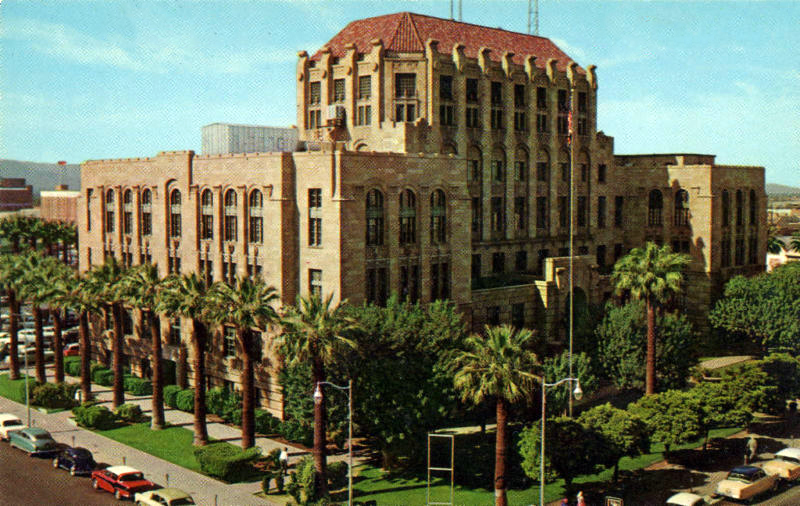
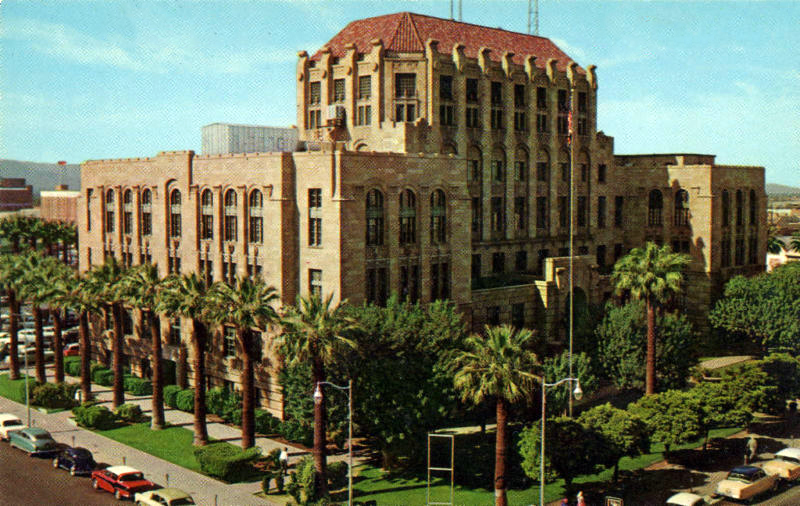
The 1929 Maricopa County Courthouse and Phoenix City Hall when it was surrounded by shade trees and manicured lawns (Photographer unknown).

Alone among the cities of the American Southwest, Phoenix is the oasis. It has always been so, but whether it remains an oasis city is starting to come into doubt. A common narrative is that Phoenix attracted Midwesterners who wanted to recreate the landscape from which they came.

This is untrue. In fact, the early Anglo residents were from many regions, especially the South. And the oasis predates American settlement. The archeology of the region is in flux, but it appears that "plant husbandry" was being performed by prehistoric tribes as early as 3,000 or 1,500 B.C. (or BCE if you are trapped in the politically correct precincts of academia). By the first millennium A.D., the most advanced irrigation in the New World was being perfected by the Hohokam.

The Salt River Valley was an ideal location, with rich alluvial soil that would grow anything — just add water. The altitude and weather in the modern climate era allow for two or more growing seasons depending on the crop. Maize was imported from Mesoamerica. Cottonwoods, willows and other native shade trees grew along the riverbank and its subsidiary creeks. I have no doubt that Hohokam dwellings were well-shaded. The new settlers merely took it to a higher level.

The photo above captures the oasis city at its zenith, in the 1960s. Note the inviting public space provided by shade and grass surrounding an inspiring art deco building. This was the Phoenix I grew up in. At 10,000 feet, you would have seen a green city surrounded by bands of citrus groves, farm fields and horse pastures. And then: The majestic, largely untrammeled Sonoran Desert. What a place to live. The older neighborhoods were graced by mature trees and parking lawns, a grassy area between the curb and sidewalk. Encanto Park was an oasis within an oasis. Central, as you see below, was lined with palm trees. North of Camelback were shady acreages, often along streets with an abundant shade canopy, set back behind irrigation "laterals." My great aunt lived in one: It was a wonder of shade and tranquility behind oleander hedges on Seventh Avenue. Well into her eighties, this daughter of the frontier would walk out every Sunday evening to turn the valve and "take her water," the flood irrigation from the Salt River Project.

In our neighborhood, what is now Willo, few families had pools but most put in winter lawns to give the sweet season its magical green. Even driveways had grass between two narrow concrete strips. This was not the Midwest. It wasn't LA, although the parking lawns were imported from there. Instead, Phoenix created its own unique urban aesthetic. It wasn't planned. This Eden just happened. If you missed it, you have my deepest sympathy. Many areas of oasis beauty remain. If you want a sense of the practical benefit, drive south from Osborn on Fifteenth Avenue some summer evening with the windows down. When you cross Thomas into Encanto Park, the temperature will drop by ten degrees or more.
Midtown blues

Midtown Phoenix runs from Fillmore Street north to Indian School and from Seventh Avenue to Seventh Street. It's a big, diverse district that contains some of the city's finest assets: The Roosevelt, Willo and Alvarado historic districts; central library, Phoenix Art Museum and Heard Museum; the deck park and the boundary with Steele Indian School Park; a dozen skyscrapers, and the spine of the Metro light rail. And much of it is in trouble.

The Phoenix Corporate Center is facing foreclosure after its anchor tenant, Fennemore Craig, left for new space at 24th Street and Camelback. It was originally the Mayer Central Plaza, then the First Federal Savings Building, the tallest in the city when it opened in the early 1960s and featuring an outside elevator. The Midtown office vacancy rate at the end of last year was 28 percent vs. downtown's 15 percent. Most of the towers are now considered less-desirable B-class and C-class office space. Like much of the Central Corridor, it also suffers from large blighted empty lots, such as the northwest corner of McDowell and Central and the east side of Central north of the punch card building and south of McDonald's. Only the mile between McDowell and Thomas is filled in, and shows it as an appealing urban space. What should be a prime location, the northwest corner of Central and Thomas, is a billboard behind which the homeless camp (much like the astoundingly empty space on the southwest corner of Central and Camelback).

This is not just another story of the ongoing linear slum-ization of the nation's sixth-largest city. For one thing, it's happening in the heart of the city. Second, it is the prime example of the failure of light rail transit-oriented development. Finally, it shows how City Hall is not paying attention to jobs and private investment, both of which are moving to the suburbs.

More vines, please

More vines, please

The physician can bury his mistakes, but the architect can only advise his clients to plant vines. — Frank Lloyd Wright

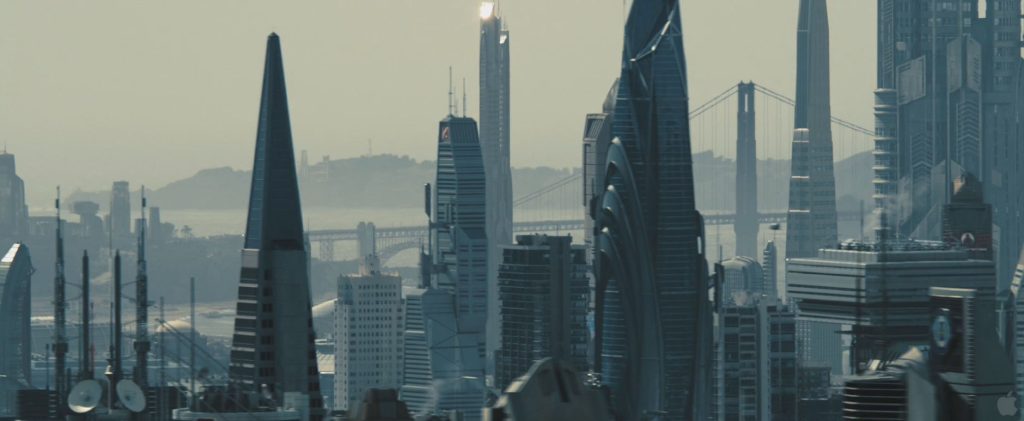
STThe most depressing part of Star Trek Into Darkness is not the many liberties that the filmmaker takes with some of the foundational conceits and tropes of the franchise. Only trekkers will notice (for example, a starship is not built to enter a planet's atmosphere, much less hide in the ocean, etc. etc.). No, what really bummed me out was the architecture. I mean, this is the 23rd century and we're stuck with taller versions of the insipid buildings of today? At least Blade Runner has some variety and gigantic Japanese-style electronic billboards in its vision of the future. We've got interstellar travel, transporters, phasers — and civilization is stuck with the progeny of John Portman, David Childs and Cesar Pelli. And that's if we're lucky. No art deco revival? No reinterpretations of the Chicago school? Gah! If this is the future, no wonder they want to leave the planet.

That's just movie fantasy. In the real world, there's no shortage of lists of the world's ugliest buildings (see here and here), along with Jim Kunstler's cringeworthy-but-must-see Eyesore of the Month. And to be sure, I'm treading into matters of taste, where many valid viewpoints must be considered. Still, architecture matters a great deal. It is the most important physical testimony about a civilization and its trajectory. It constitutes the built environment that at its best informs, inspires or defines so much of our lives. At its worst, it is, as Kunstler says, a landscape not worth caring about. And unfortunately a stupendous amount of our total buildings have been put up in recent decades, with most exercises in copycat banality or starchitect sculptures with little to offer humans or the surrounding streetscape.

Field notes

Catching up from my recent visit "back home…"

• Many people asked me why Gov. Jan Brewer was backing a Medicaid expansion in apparent defiance of GOP orthodoxy. Has she finally shown a conscience? No. The major calculus is that what remains of the business leadership in Arizona leaned on her to accept the Obamacare/Romneycare deal, where the feds will pay for most of the expansion anyway. The biggest employers in Arizona provide no or minimal health-care coverage, so they offload (socialize) those costs to the public through AHCCCS. Among the big employers are health companies that profit from the system, and would make even more under an expansion.

Most of the New Confederacy is not participating, a calculated move to sabotage the Affordable Care Act. So why is Brewer different? My suspicion is the composition of the economy. The other populous, urbanized states have plenty of corporate headquarters and well-paid jobs (and in the case of Texas, oil and big government spending). So it's easy to say, "devil take the hindmost." In Arizona, the hindmost is the economy — Wal-Mart is the largest employer. That and health care. Of course, Brewer might simply be playing a game, knowing the Legislature will prevent Arizona's participation. But I think she's sincere. If she goes "Full Kook," the business interests might do an Ev Mecham on her.

Questions for Phoenix candidates

I received a query from a group called Democracy for America-Maricopa County asking me to suggest questions for Phoenix City Council candidates. I always try to be obliging, and this issue is of special importance.

It seems as if Council has lost its consensus and focus, virtues that were essential to the progress made with T-Gen, ASU's downtown campus, the Phoenix Convention Center and light rail (WBIYB). Nothing could be worse for the city than a right-wing takeover or blocking minority on Council. And members who think civic greatness is filling potholes and collecting trash ("listening to the neighborhoods) are not much better. Phoenix is at a critical tipping point. Here are the questions I suggested:

1. Please detail your connections to the real-estate
industry: Properties you own; do you work in the industry and if so,
doing what?; have you served on boards that make recommendations on land
use?; have you profited from land-use decisions made by public bodies,
including the approval and siting of freeways?

Reinventing Hance Park

I'm in Phoenix this week for my new novel, The Night Detectives (you can find a schedule of signings on my author Web site). One remarkable thing is how the conversations I have with friends never really change much when it comes to the topic of Phoenix and Arizona. Searching for something new…an effort is under way to produce a "new master plan" for Margaret Hance Park.

The site irritates me at the outset by claiming Hance Park is located "in the heart of down downtown Phoenix," whatever that means. It is in Midtown, a deck sitting atop the Papago Freeway from Third Street to Third Avenue. All together now: Downtown runs from the railroad tracks to Fillmore and from Seventh Avenue to Seventh Street. One could be very liberal and extend it to Roosevelt — no farther. You outlanders would be offended if I said the Loop in Chicago extended to Winnetka; you don't get to rewrite the geography of my hometown.

In any event, the deck park was the compromise when Interstate 10 was rammed through the heart of Phoenix, resulting in the demolition of 3,000 houses, many of them irreplaceable historic homes, as well as the shady Moreland Parkway. Originally, the Wilbur Smith plan called for the freeway to soar 100 feet over Central Avenue and traffic to exit by "helicoils" winding down to Third Avenue and Third Street. So things could have been much worse

Phoenix’s new normal

Let's take a random walk through the "news from home." Much rejoicing must have come to the Real Estate Industrial Complex from the recent BusinessWeek story headlined, "A Phoenix housing boom forms in hint of U.S. recovery." Maybe it's even real and Homey was wrong when he predicted that the old growth machine — with championship golf! — isn't coming back. If so, a new housing boom would be the worst possible event in the long run. Any chance to learn the lessons of the crash will be lost, along with the opportunity to reset for a more sustainable future.

I suspect the bluster of a "boom" cloaks a recovery from a very deep bottom, so naturally the percentage gains will look impressive. In addition, we don't have the research to indicate the subdivisions that are being abandoned to "investors" — or just abandoned — as qualified buyers snap up the new stuff from the likes of Pulte. Population has increased, but not at the rates of the 1990s and 2000s. Also, the labor force for the metropolitan area is only slightly larger than it was in 2006, hardly the spectacular growth seen in the previous decades.

Some macro realities will not go away: most Americans are much poorer after the recession; wages are stagnant and have been falling on average for years; unemployment remains high and many may never find work again; "consumers" are still carrying more debt than historic norms; changing tastes and demographics, with talented young people and many boomers preferring real cities, not Sun City; Phoenix still has a low-wage economy. All these factors will be headwinds against the triumphal return of the Growth Machine.