Stick it to Phoenix

Stick it to Phoenix

USAirwaysCenterNight
I was going to write about Ferguson but the reaction I provoked on Facebook yesterday over the name change for the Suns' home made me switch gears. I wrote, "Talking Stick Resort Arena. That pretty much says it all about Phoenix's inability to be a big city."

So far, 50 people have "liked" it. Much debate came in the comments. Aside from a small number of the usual why-are-you-picking-on-Phoenix notes, there was "Pitiful," "We have no visionary leadership in this city," "This all just makes me want to cry," and "Wait'll they move both teams to Talking Stick neighborhood. …..$10 says that is in the works."

On the other hand, I made some fans (so they said) mad for allegedly being unfair to Phoenix. Still others thought it wasn't a big deal. But they took the time to comment. Someone made the excuse that Phoenix is a "young city," a canard I have tried to knock down before. A couple of comments gave the whiff of, "he doesn't just hate Phoenix, he tortures kittens for sport (and from Seattle, which doesn't even have an NBA team!)".

It started as an offhand comment. Then it became clear I had run sandpaper over a very raw nerve.

Let's stipulate that pro sports are one of the many cesspools in our evermore corrupt and venal society. This is true everywhere. Naming rights always struck me as odd. Who chooses to do business with an outfit because their moniker is stuck on a sports arena? Maybe it's like penis enlargement spam. Somebody must be responding or it would go away.

All over the country, team owners have not been content to extort palaces from the taxpayers under threat of leaving. They also want to milk more cash from naming rights. Only a few places — Wrigley Field, Yankee Stadium, Fenway Park — have avoided the sellout. It's one more way to suck income upwards while also destroying the history and even poetry of many former sports venue names.

Phoenix in the seventies

Phoenix in the seventies

Central_1972Central Avenue and Van Buren in 1972. Note the full block of businesses heading north to the Westward Ho. Central was still a two-way street.

No series of events better epitomized the 1970s and the turning point they marked in Phoenix than the fight over freeways, specifically the "inner loop" of the Papago Freeway.

Most Phoenicians had a vague idea that freeways were a possibility since the Wilber Smith & Associates plan was adopted in 1960. Interstate 10 had been completed to Tucson and was abuilding from the west. By mid-decade it had reached Tonopah, requiring a long drive over largely country roads to reach. Real-estate values plummeted along the path of the inner loop. But by 1970, Phoenix's freeway "system" consisted of only the Black Canyon (Interstate 17) which curved at Durango to become the Maricopa (I-10).

HelicoilsAll this changed as the new decade opened and the plan's stark reality became clear. Specifically, the Papago would vault into the air, reaching 100 feet as it crossed Central Avenue. Traffic would enter and exit via massive "helicoils" at Third Avenue and Third Street. The freeway was promoted as being Phoenix's defining piece of architecture.

It didn't take Eugene Pulliam and the anti-freeway advocacy of the Arizona Republic and Phoenix Gazette to make most Phoenicians horrified. In 1973, voters vehemently rejected the inner loop. They only had to look 372 miles west to see the destruction wrought by freeways. They didn't want Phoenix to "become another Los Angeles."

Better than nothing?

Better than nothing?

Central_Station_Tower_rendering

A rendering of Phoenix Central Station, the oval-shaped tower that would be built at Central and Van Buren.

This year, Seattle's core has seen 100 buildings permitted, under construction or recently completed. In central Phoenix, by my count, there's the proposed skyscraper above, the University of Arizona's 10-story research building on the Phoenix Biosciences Campus, the ASU college of law, and a 368-unit Lennar apartment complex in lower Midtown.

It's better than nothing, right?

Phoenix Central Station by Smith Partners would be the most interesting, rising 34 stories with 475 apartments, 30,000 square feet of commercial space and, of course, a parking garage.

The tower would rise above the homely central transit station, which nobody will miss, but retain the use as a transit hub. It has its virtues: more apartments for downtown residents, close proximity to ASU and a shape that would provide a bit of variety from the mostly dreary boxes that make up the skyline of the nation's sixth-largest city.

Young Phoenix

An interesting report, The Young and Restless and the Nation's Cities, came out recently from the City Observatory think tank. The premise is straight-forward:

The young and restless — 25 to 34-year-olds with a bachelor's degree or higher of education, are increasingly moving to the close-in neighborhoods of the nation's large metropolitan areas. This migration is fueling economic growth and urban revitalization…. Businesses are increasingly locating in or near urban centers to better tap into the growing pool of well-educated workers and because these center city locations enable firms to better compete for talent locally and recruit talent from elsewhere.

The top gainers of this coveted demographic from 2000 to 2012 are what you would expect: Washington, D.C., San Francisco, Boston, Silicon Valley, New York, the Research Triangle and Seattle.

But some among the leaders are cities against which Phoenix should benchmark itself and ought to be able to compete with: Denver, Austin, the Twin Cities and Columbus.

Instead, by a critical metric metropolitan Phoenix comes in 45th. Behind Orlando, Birmingham, Rochester and Indianapolis, hardly cities one would associate with urban cool.

The death of authentic Phoenix

The death of authentic Phoenix

Durants

Authentic Phoenix can still be found at Durant's.

The impending closure of Baker Nursery and Mary Coyle's raises an issue beyond losing beloved businesses or even the extreme struggle faced by locally owned firms in Phoenix. It cuts to something essential to a real city even if it is difficult to define: authenticity.

Critics may dismiss this as nostalgia, a cheap emotion for a golden past that never was (this is one way Very Serious People invalidate my arguments now). Or some academic fad of the latte-quaffing creative class elitists. Instead, it is critical to a city's success.

"Authentic" in connection with a city involves historic roots, local ownership, places that are valued, human scale and encouraging human interaction, aesthetics, a distinctive vibe ("cool"), and a strong degree of critical mass and density. The asteroid belts of suburbia with their chain restaurants and malls are not authentic — they annihilate it. No wonder educated young people, many empty nest boomers and world talent want to move to authentic cities.

As these losses continue (and Mary Coyle's had been dead to some since it left its 15th Ave. and Thomas location to flee north of Camelback), it's more than the city cratering or looking like Everyplace America. It is the death of a tangable part of the civilization, a concept beyond the MBAs that run the country or the real-estate grifters that run Phoenix.  A point comes where too much driving is required to reach this or that "iconic" survivor.

Air war over Phoenix

Air war over Phoenix

PHX_tower_with_downtown
Friends in my old 'hood, the historic districts north of downtown Phoenix, have asked me to write about a change in the approach paths to Sky Harbor International Airport that is bringing airplanes lower and louder over these neighborhoods.

Coverage has not been lacking (see here and here). But I won't pile on repetitively because my initial reaction is to be…torn.

When I lived in Ocean Beach in San Diego, everybody knew when it was 6 a.m. That's because flight operations were commencing at Lindbergh Field whose one runway took outbound planes directly over our neighborhood. I lived a block-and-a-half from the beach, in a cool district the tourists usually missed — but the airplane noise came with the bargain.

Cities are noisy. As I write from the 10th floor of my downtown Seattle condo, I hear traffic, sirens, people yelling and, yes, airplanes approaching Sea-Tac (albeit from a higher altitude). During the daytime there is construction noise from one of the scores of new skyscrapers going up. The sounds are one of the energizing things about living in the heart of a city.

Central Phoenix, by contrast, is uncommonly quiet. There's the hum of the Papago Freeway. At night, the Santa Fe train whistles that remind me of my boyhood (one hardly hears the Union Pacific now compared to when it was the Southern Pacific years ago and Phoenix was a major point on its main line). Otherwise, especially if you are a block in from a major arterial, it is perhaps the quietest place in the metro area. It is much quieter than when I was a boy and central Phoenix was vibrant.

Bones

Bones

96524005_d2552555fc

The other night I was in a Twitter discussion with economist and blogger Noah Smith about the implosion of Las Vegas' hopes to create a vibrant "real" downtown (see the links on the City Desk). It's a sad moment, but I remarked that Vegas didn't have good bones. Smith asked a logical question for anyone not among the urbanophiles: What are good bones?

Since I now have more than 140 characters, let me answer more clearly. "Good bones" are a variety of architectural styles, especially pre-World War II — Art Deco, Beaux-Arts, Spanish Colonial Revival, Gothic Revival, Chicago School, Victorian, etc.

Good bones are dense downtowns and human-scaled neighborhood retail districts right up to the sidewalk. Parks designed by the likes of Frederick Law Olmsted or Adolph Strauch. Inspiring public spaces. Narrow streets and real boulevards. Palatial theaters and concert halls. Grand bridges. Infrastructure such as subways and magnificent railway terminals. Stately public buildings. Packed row houses. Downtown retail (especially a hat store). These are all good bones.

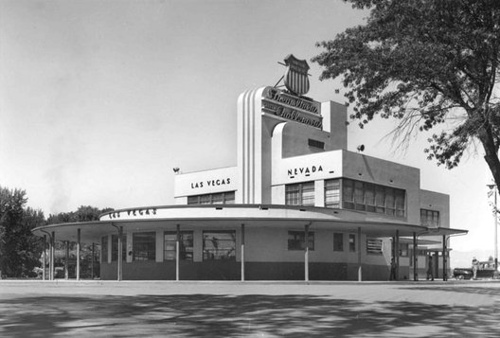
Here, Las Vegas is in an even worse position than Phoenix. In 1940, the end of the Art Deco era, its population was 8,422. The only architectural asset it gained was the lovely streamline moderne Union Pacific Railroad station above — demolished for a garish hotel in the 1960s.

While I was away

John Sperling passed on. I am mindful of Horace's de mortuis nil nisi bonum, but Sperling was a public figure of consequence, deserving an assessment. In keeping with the life he led, Sperling died in the Bay Area, not the city whose name he took for his empire of for-profit education.

The New York Times wrote, "A survivor of childhood illness, learning disability, poverty and physical abuse, he earned a doctorate from the University of Cambridge; a liberal former union organizer, he spent years battling government regulation; a longtime professor who did not enter business until his 50s, he became a spectacularly successful capitalist."

The University of Phoenix made him fabulously wealthy. His net worth in 2002 was $1.1 billion and he spent 20 years on the Forbes 400 list of richest Americans. With the troubles of parent company Apollo and its stock drop, he was below a billion in 2013.

He reveled in being quirky, combative and rebellious, especially against the education establishment and the government. And yet the GI Bill — authored by Arizona Sen. Ernest McFarland — allowed Sperling to get his bachelor's degree from Reed College in Portland, Ore. Federal student loans turned what would have once been considered a "business college" into a mighty profit engine.

Among the individuals who wrecked the commons, Sperling is right up there. Privatizing profits, socializing losses, the cost and quality of an education at the University of Phoenix and other for-profit schools deeply questionable.

What’s downtown Phoenix, what’s not

What’s downtown Phoenix, what’s not

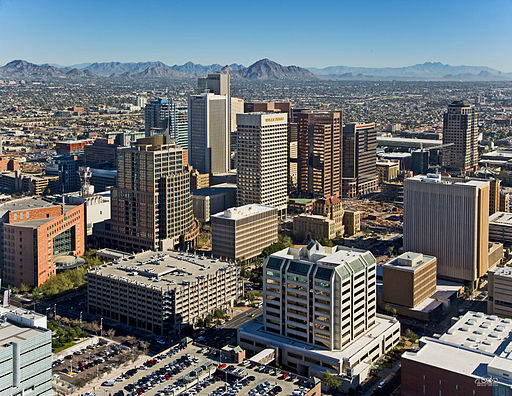
This is downtown — pre CityScape (photographer unknown):

512px-Downtown_Phoenix_Aerial_Looking_Northeast

Downtown 2020

Above is downtown 2020 (photographer unknown).

This isn't downtown (it's Midtown):

Phoenix-skyline

This isn't downtown, either. It's 24th Street and Camelback (photographer unknown):

Esplanade_Place_October_6_2013_Phoenix_Arizona_2816x2112

I wouldn't dare move to Chicago and claim that Hyde Park is the Loop. Nor could I say Hawthorne is downtown Minneapolis. Cincinnatians would quickly set me straight if I said Over the Rhine is downtown — downtown begins at Central Parkway. The natives in all these cities wouldn't let me get away with it. Nor would the transplants who felt a convert's zeal to protect the geographical integrity of their cities.

Yet people in "the Valley" (Silicon? Red River — of the north or of the south? San Joaquin? San Fernando? Of the Jolly Ho Ho Ho Green Giant?), many of them from these very cities, get away with this transgression every day in Phoenix.

Downtown Phoenix runs from Seventh Avenue to Seventh Street, and from the railroad tracks to Fillmore, or perhaps Roosevelt. It includes the original townsite and some additions. City Hall's definition taking the northern boundary to McDowell is ahistorical.

Walkable Phoenix

Walkable Phoenix

Central_Avenue_Willetta_1917

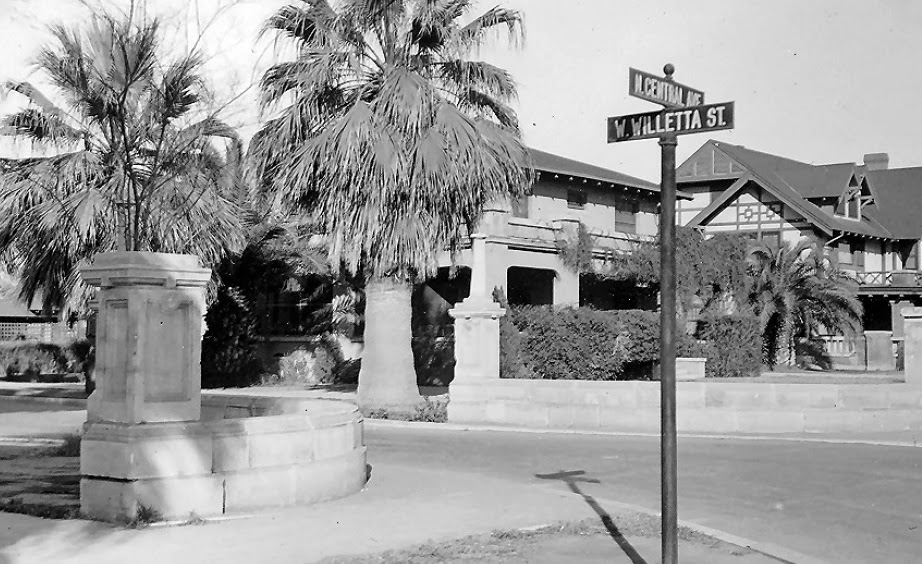
This beautiful scene in central Phoenix is from 1917. It makes you want to step into the picture and stroll. Not bad for a small, isolated city in a brand new state. More about that later. Alas, today the same location is a blighted vacant lot south of two once-graceful houses that have been turned into the Old Spaghetti Factory, the lawns replaced by asphalt.

I write because of an article in one of the online nooks of Fast Company headlined, "Phoenix is Pulling Off an Urban Miracle: Transforming into a Walkable City." Read and decide for yourself. On Facebook, someone said it came off like a press release. The kindest interpretation is that it represents an aspiration. To make it real, a little history might help.

Although Phoenix's growth is closely connected to the automobile age, the city was actually once highly walkable.

Let's define our terms. By "walkable," I don't mean you can drive your car to a canal bank or a desert "preserve" and hike. Not even the enchantingly shady, last time I checked, Murphy's Bridle Path. I mean the arrangements I enjoy in Seattle, where almost everything — shopping, restaurants, grocery stores, culture, health care, transportation hubs — is a quick walk or bus/bike ride away. One doesn't need a car.

Prior to the mid-1950s, when sprawl took off and never looked back, Phoenix offered such a "lifestyle." For anyone who grew up in the actual town prior to World War II, it was taken for granted.

Even the G-men…

Even the G-men…

Dear Diary,

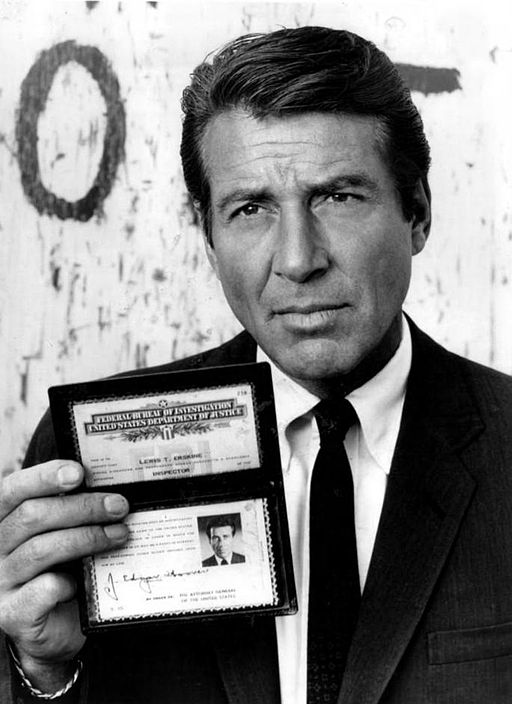
Efrem_Zimbalist_Jr._Lewis_Erskine_displays_FBI_credentials_1969It seems that I cannot escape the toxic blob that Phoenix has become even when working on the new David Mapstone Mystery. I learn that the FBI's Phoenix Field Office decamped its Midtown fortress in 2010 for leased offices at Seventh Street and Deer Valley Road.

The FBI has a long history in Midtown, once being located on the second floor of a modest office still standing on the northeast corner of Third Avenue and Osborn. Back in the hardly innocent 1960s, it was labeled with "FBI" right on the outside wall. By the time I returned in the 2000s, the bureau was in a hulking, anonymous and heavily guarded midrise around Second Street and Indianola, with a motor pool a block away. If you tried to stop your car on the street to drink the Diet Coke you had purchased from the (now closed) nearby McDonald's, a uniformed federal officer appeared and told you to move on, no questions answered.

Now it is in a 210,202 square foot building built and owned by the Ryan Cos., meant to be home to the field office "for the next 20 years." News reports tell me the building won a LEED Silver design award, which shows the moronic/mendacious nature of these greenwash labels. The office is about 17 miles away from the most common destination for the feds, the Sandra Day "I Gave You The Presidency of George W. Bush" O'Connor Federal Courthouse downtown. It is located far from the urban footprint. How can this possibly be considered a green building?

Ballinger’s masterpiece

Ballinger’s masterpiece

Jim Ballinger 2007When the pink-and-white Civic Center opened at Central and McDowell in 1950, it included a "little theater" but the art museum didn't come along for another nine years. Both were considered small confections to the main course: the public library. Things were not much different in 1974, when a young University of Kansas graduate named Jim Ballinger joined the museum's staff as curator of collections.

That the Phoenix Art Museum today enjoys national stature and draws prestigious international exhibitions — and has grown to take up most of the former Civic Center block — is mostly because of Ballinger, who announced Thursday that he will retire after 40 years with PAM. He became director in 1982. No other single figure has done more for the city's cultural landscape — to create, grow and sustain one — than Ballinger.

The reader should know that Ballinger and I are friends. We also were neighbors on Holly Street in Willo. But he first sought me out when I started as a columnist at the Arizona Republic, writing on such issues as the city and state's economic narrowness, lack of civic engagement, poor educational outcomes and difficulty in retaining talent. In our first conversation, he showed his incisive grasp of how such challenges would affect the future viability of cultural institutions.

Park it

Before getting to the preliminary plan for the remake of the deck park, I want to linger over the most important recent story you may not have read.

According to the Phoenix Business Journal, the Department of Justice has sued Barron Collier Co. over $66.5 million the government claims it is owed for parcels the giant land owner and developer has along Central Avenue north of Indian School Road.

You should read the story and try to make sense of it, but this gets at one of the most curious and outrageous events: Breaking up the old Phoenix Indian School and conveying the most attractive parcels of this public property to a private entity for private gain.

And make no mistake, there has been gain. Despite the company leaving the land a barren waste and claiming it is "not economically viable" to pay its obligations to the feds, this property has no doubt been quietly adding paper value like all the banked land in Midtown Phoenix.