The park Phoenix almost lost

The park Phoenix almost lost

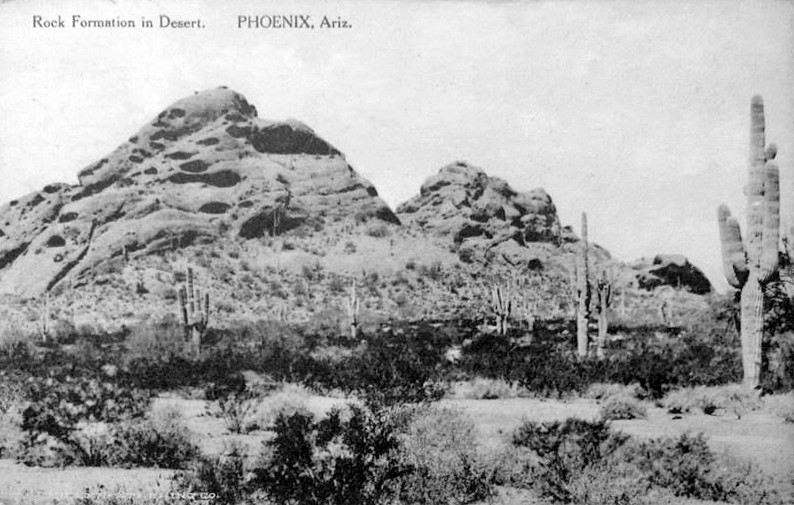
Rock_Formation_in_Desert_Papago_Park_1917
Today's Papago Park is full of delights and history, from the Desert Botanical Garden to the Phoenix Zoo, Hole-in-the-Rock, hiking, baseball, and Hunt's Tomb. As the official website says, "Its massive, otherworldly sandstone buttes set Papago Park apart, even in a city and state filled with world-class natural attractions."

But Papago Park almost didn't happen.

For those of you who don't venture south of Bell, north of "south Chandler," or are out-of-town readers, I'm writing about land that sits in east Phoenix and north Tempe. Technically, the boundaries run from McDowell on the north to Tempe Town Lake on the south, and 52nd Street and the Crosscut Canal/College Avenue to the west and east respectively. The park could have been much larger.

These magical uplands were five-and-a-half miles from the original Phoenix townsite when they were included in the reservation for the Pima and Maricopa tribes by President Rutherford B. Hayes. This was 1879, when the biggest concerns of the hardscrabble settlements of Phoenix and Tempe were reclaiming the Hohokam canals for agriculture. The National Park Service claims the Hohokam used Hole-in-the-Rock to mark the solstice. Early American settlers also appreciated the beauty of the ancient rock formations, including Carl Hayden (born in 1877) growing up across the river in Tempe.

Later in the 19th century, the reservation was contracted to the present-day borders of the Salt River Pima-Maricopa Indian Community. Some desultory mining activity took place around the buttes and they became more popular as exotic destinations for visitors. In 1914, a grown up Hayden, the new state's only representative in the U.S. House lobbied his friend, President Woodrow Wilson, to make the area a National Park. Wilson declined, but using the presidential powers of the Antiquities Act, declared it the Papago Saguaro National Monument. At the time, it stretched from the Salt River to Thomas Road.

Tunneling into the new boom

Tunneling into the new boom

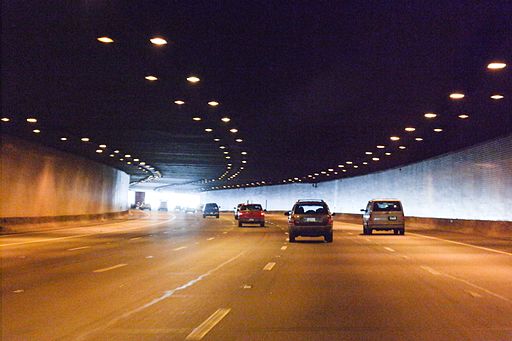
Papago_Freeway_Tunnel
While I was in Phoenix last week, the Census Bureau released news showing the biggest annual jump in median household income since 1967 and poverty falling the most in 50 years. Nationally, incomes jumped 5.2 percent from 2014 to last year, to $56,516. The numbers are adjusted for inflation. Thanks, Obama.

The data are more complicated for Phoenix and low-tax/light-regulation Arizona. Income statewide rose 2.8 percent to $51,492. Yet it was down 9.7 percent compared with 2007. Metropolitan Phoenix median household income increased 3.9 percent to $55,547.

In other words, the state and metro area trailed a nation that includes Alabama, Mississippi, and West Virginia. Phoenix was No. 25 among the largest metros, with Nashville and Birmingham in the lead in percentage increase.

Drilling down to the city level is even more sobering. Seattle, which is undertaking numerous progressive policies that would supposedly kill business, led the nation with a total increase of $9,374 to $80,349. Blue Portland jumped $6,268 to $60,892. Denver, another blue city, saw incomes rise $3,062 to $58,003. And Phoenix? Its income struggled up $523 to $48,452. (No, that's not a misprint).

If any comfort can be had, San Diego's median household income rose a mere $72 to $67,871. But metro Phoenix's underperforming is a serious problem. The city's poor showing is even more troubling, the "hole in the doughnut" effect. More than 23 percent of the city's residents are below the federal poverty line, compared with 13.5 percent nationally and 17.4 percent for Arizona. The state's poverty rate fell 0.9 percent from 2014 to 2015, but had risen 3.2 percent since 2007.

No, purchasing power doesn't cut it as an excuse. The conservative Tax Foundation used federal Bureau of Economic Analysis stats to calculate the real value of $100 in each state. Statewide in Arizona you get $103.73, but that's not much, and I wonder how much it translates to more expensive metro Phoenix. The bottom line is that Arizona's conservative policies have not yielded a strong economy, especially one required for such a populous state.

Silicon Valley in Phoenix?

Silicon Valley in Phoenix?

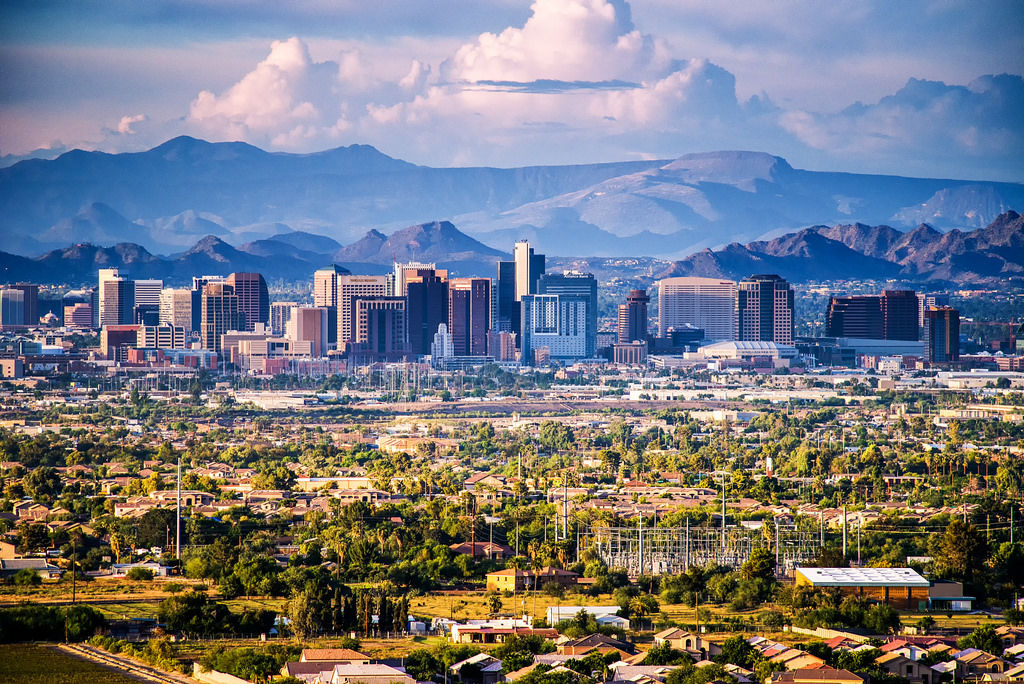
Phx_skyline_2010
Earlier this month, the New York Times published a story, most of which could have been written by the chamber of commerce, under the headline, "Bay Area Start-Ups Find Low-Cost Outposts in Arizona."

It rubbed me the wrong way from the start, because the story is not about Show Low or Why, Kingman, or even Tucson, but metropolitan Phoenix. I will never understand why one of the most magical city names in America is banished for the amorphous and sometimes inaccurate "Arizona." Anyway, riding with that burr under my saddle, I tried to approach the article with an open mind.

Unfortunately, it had all of the weaknesses of "parachute journalism." The writer, based in the Bay Area, parachutes into a little-known burg with an angle, assembles a few anecdotes, talks to a local economic development expert, adds some data from Moody's, widens the lens a bit to make the story about a broader trend, and presto! This is not easy stuff, particularly if you're not armed with history and skepticism. The only good parachute journalist I ever personally knew was Leah Beth Ward, my colleague from the Cincinnati Enquirer and Charlotte Observer.

It's not that I don't want success for Phoenix. Far from it. I was the Arizona Republic columnist who wiped out forests and digital space writing about Michael Crow and ASU, Jeff Trent and T-Gen, and Bill Harris and Science Foundation Arizona, the efforts to elevate the economy under Gov. Janet Napolitano and Phoenix Mayors Skip Rimsza, Phil Gordon, and Greg Stanton. I rarely felt that the brightsiders had my back. It is about time to see some payoff.

The story had none of this context and lacked much more. The reporter did not even avail himself of the readily available journalism about Arizona's crippling problems. Which is too bad for those of us who want to know the real score. So Homey did some digging.

Dog days of summer

Dog days of summer

After three weeks of commenting on national politics, it's time to return to Phoenix. This was once the time of year to stay inside with the air conditioning and wait for the oven to ease up in September. Now it's snake removal calls in north Scottsdale, idiots hiking in the middle of the day and often putting first responders at risk to rescue them, and an oven that doesn't shut off until close to Thanksgiving. But…"everything's fine!," with championship golf!

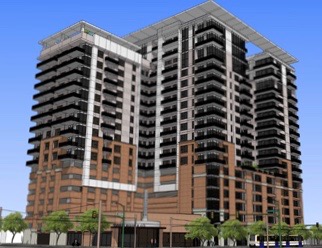
CirclesOfCentral• Phoenix rejected a tax break for a developer that partially demolished the historic Circles Records building under the pretext of erecting a 19-story residential tower. The Resistance, which was sandbagged by the tear-down, reacted by a range of "Hell, no!" to quiet negotiations with crisis-management duo Jordan and Jason Rose, brought in to salvage the deal.

Unfortunately, I fear the result will be complete demolition and another surface parking lot to the flipped and reflipped until the day, decades hence, when the property ends up on the books of a REIT in Tel Aviv. It's unclear that the developer ever really had the capitalization to do the mid-rise, and lack of tax incentives makes it even more unlikely. State law gives enormous protection to property owners. So defeating the tax break doesn't mean saving what's left of the former Stewart Motors at McKinley and Central (technically just north of downtown).

It can't be said enough: Downtown Phoenix needs more than ASU, government, and a few modest headquarters. It needs a robust and diverse economy — very much at odds with the spec sprawl model at work elsewhere in "the Valley." Until then, Phoenix will be the only major city in the nation missing out on the "back to downtown" phenomenon you can read about here. It is an astonishing, heartbreaking failure, and saying that downtown Phoenix is better than 20 years ago doesn't cut it.

It can happen here

It can happen here

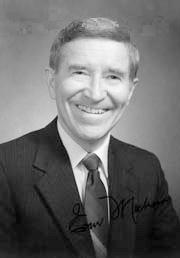
Evan_MechamClowns who say outrageous things, who are completely unqualified for office, are very capable of being elected in America. They are entertaining, underestimated, and disasters in office. The highest office reached so far has been governor — think Jesse Ventura in Minnesota and Lester Maddox in Georgia. Closer to home was Evan Mecham, the governor of Arizona from 1987 until he was impeached and removed from office less than 15 tumultuous months later.

Mecham was a clown, given to conspiracy theories and outrageous statements — his "pickanniny" comment and blaming working women for high divorce rates were only two. But he had support from the state's right wing, especially John Birchers and fellow Mormons. He was a populist, after his fashion. In Mecham's world, the government was the enemy and cause of all ills. He wanted to eliminate income taxes and turn over the public's lands to state interests. A theocrat, Mecham wanted to have prayer in public schools. Threats were everywhere, out to destroy real Americans and the real America.

The toupee'd Glendale car dealer and serially failed newspaper publisher gave Carl Hayden a scare in the 1962 U.S. Senate race. Among his issues was a demand that the United States withdraw from the United Nations. Hayden's longtime aide Roy Elson organized a campaign to "reintroduce" the senator to a state he had served in Washington since 1912, but had attracted large numbers of newcomers since 1956. Hayden won comfortably, but many old Arizonans were unsettled. That anyone could get 45 percent of the vote against the state's indispensable man in the fight for the Central Arizona Project was astounding and deeply disturbing.

Mecham ran outsider campaigns for governor again four times before winning. As in 1962, each election he explicitly ran an insurgent campaign against elites and "the establishment."

His election was a fluke. In the 1986 Republican primary, he faced the respected state House leader Burton Barr, who was supported by the establishment, from Barry Goldwater to the Pulliam press. But Barr, a legislative wizard, ran a sluggish campaign. Turnout was the lowest in 40 years. And Mecham cleverly exploited the grievances and paranoia of newcomer retirees, adding to his Bircher and LDS base — people who did vote. On the Democratic side, and back then Arizona was a competitive state, Carolyn Warner was sandbagged by apartment magnate Bill Schultz, who got out of the race only to reemerge as an independent.

How’s real estate (really) doing?

How’s real estate (really) doing?

For the Sunday Seattle Times, I wrote on whether Seattle's smokin' hot real-estate sector is in a bubble. My answer is, not yet. It seemed like a good time to check in on Phoenix, using gold-standard metrics instead of the local-yoken cheerleading. Here we go:

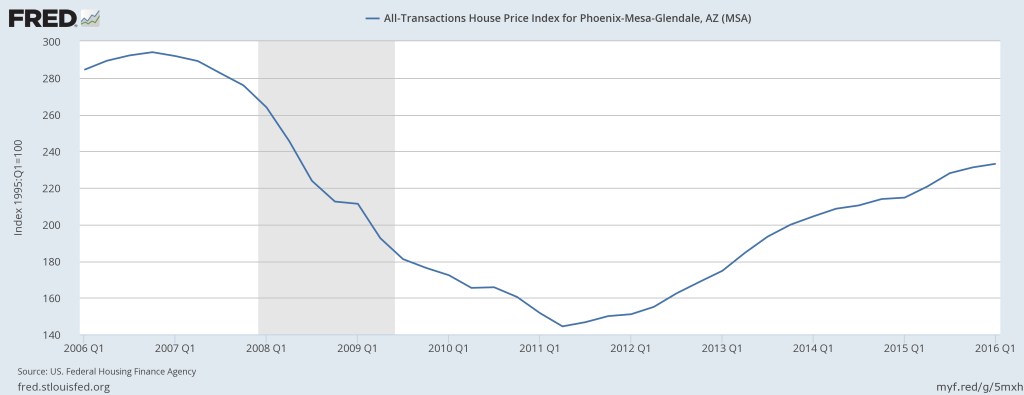
Prices are definitely up. They're not in 2000s territory and that's a good thing:

Aprices

However, permits for single-family houses are still way down by historic standards. This is especially true so far (seven years) into a recovery. While good news for the environment and understandable with such a huge inventory from the bubble, it undercuts the prime mover of the metro area's economy:

Apermits

As a result, construction employment is depressed. Not only has it not returned to 2000s levels, but it is lower than in the late 1990s, when the metro population was far smaller:

Aemployees

Interstate regrets

Interstate regrets

 Black_Canyon_Freeway_under_construction_1961 copy
Interstate 17, the Black Canyon Freeway, under construction in Phoenix in 1961.

Sixty years ago last month, President Dwight Eisenhower signed the Federal Highway Act of 1956. It marked the beginning of the Interstate Highway System, which now bear's Ike's name. It was completed 35 years later and now totals 47,835 miles. The cost: more than $506 billion in today's dollars.

In this era of austerity and gridlock, the Interstate System is like Project Apollo, the discoveries out of Bell Labs, the infrastructure built by the New Deal, and victory ensured by the Arsenal of Democracy and American armies and fleets triumphing in World War II. It was a model of what we could do together, before we became a venal and wicked people, paralyzed by greed, bigotry, and right-wing extremism.

But the Interstates came with a cost, some of it known at the time by a few forward or skeptical thinkers, more of it obvious today.

Walmart is often cast as the force that destroyed Main Street. But before the Beast of Bentonville were the Interstates. By taking traffic out of small towns, they deprived merchants of much-needed customers. As a result, those towns were dying long before Sam Walton's store became a monopolistic empire. You don't have to look far to see the consequences. Downtown Mesa was thriving before U.S. 60 diverted traffic to the Superstition Freeway. Although not officially part of the Interstate system, this showed the results. Mesa is still trying to recover the dense, authentic downtown that once existed. Downtown Kingman, Williams, and Winslow were all dealt death blows by Interstate 40. Flagstaff was a rare exception. Why did Prescott and Wickenburg keep lively, diverse cores? The lack of Interstates, and for many years even multi-lane highways.

Interstates, and freeways in general, did nothing but destroy big cities. In Seattle, for example, Interstate 5 severed Capitol Hill from downtown, causing hundreds of historic buildings to be demolished. As with cities across the country, it made flight from the city to new suburbs easy. The damage from the unnecessary Papago Freeway Inner Loop, Interstate 10, to central Phoenix has been well-documented in these columns. More often than not, these urban freeways became congestion generators — every widening only made traffic worse.

It’s a dry heat

Somebody on Facebook posted a T-shirt that said, "If you can't handle Phoenix at 122 degrees, you don't deserve Phoenix at 78 degrees." OK, then. Nothing to see here, move along.

When you're forced to rip off majestic cataclysm Detroit's mordant humor ("Detroit: Where the weak are killed and eaten"), you have issues as a city. The biggest one, climate change, is getting the least attention.

As day after day was hitting record high temperatures and at least four hikers were killed by the heat in Arizona, and untold numbers needing rescue that endangered the lives of first responders (been there, done that, and no, the view doesn't offer comfort when you're lugging some tenderfoot down a mountainside in a Stokes basket), when the heat was so severe it prompted an airliner to turn back because of fears of its tires blowing out on the broiling runway at Sky Harbor, with a possible serial killer on the loose in Maryvale… Amid all this, Phoenix received an unexpected gift.

It came in the form of a New York Times story headlined, "Phoenix focuses on rebuilding its downtown, wooing Silicon Valley."

Here was a godsend that none of the usual it's a dry heat, you don't have to shovel sunshine, I hike Camelback on the hottest days (moron), championship golf local-yokel booster Pravda propaganda could never match. The Newspaper of Record gave us a (if one didn't look too closely) glowing vote of confidence. What climate change? We're gonna be a tech hotspot!

No, tax cuts don’t help Arizona

No, tax cuts don’t help Arizona

My policy is to never make sport of a person's religion, however fanciful I may find it. So to the extent that Arizona's Republican leaders and their mouthpieces believe, as an article of faith, that tax cuts have made the state economy stronger…as Pope Francis would say, who am I to judge?

Now, if we're going to move beyond religion to facts, the story is different. The Arizona Republic reported that two decades of tax cuts will cost the state's general fund $4 billion this year. This comes from economists at ASU's W.P. Carey School of Business, hardly a hotbed of socialism or "you hate Arizona!"

This is a useful departure point to a deeper examination. Have tax cuts been good for Arizona's economy? Have they been good for Arizona?

In general, the most authoritative study yet, published late last year by William Gale, Kim Rueben, and Aaron Krupkin at the Tax Policy Center, found no connection between cutting top income-tax rates and state growth.

The three researchers hone in on Kansas Gov. Sam Brownback's "real life experiment" in supply side economics for the Milken Institute. The Brownback cuts, enacted four years ago, have been a template for other Republican governors. But they have been a disaster and Kansas' economy is suffering. These GOP cuts also typically result in regressive sales taxes that fall heaviest on the working poor, widening inequality.

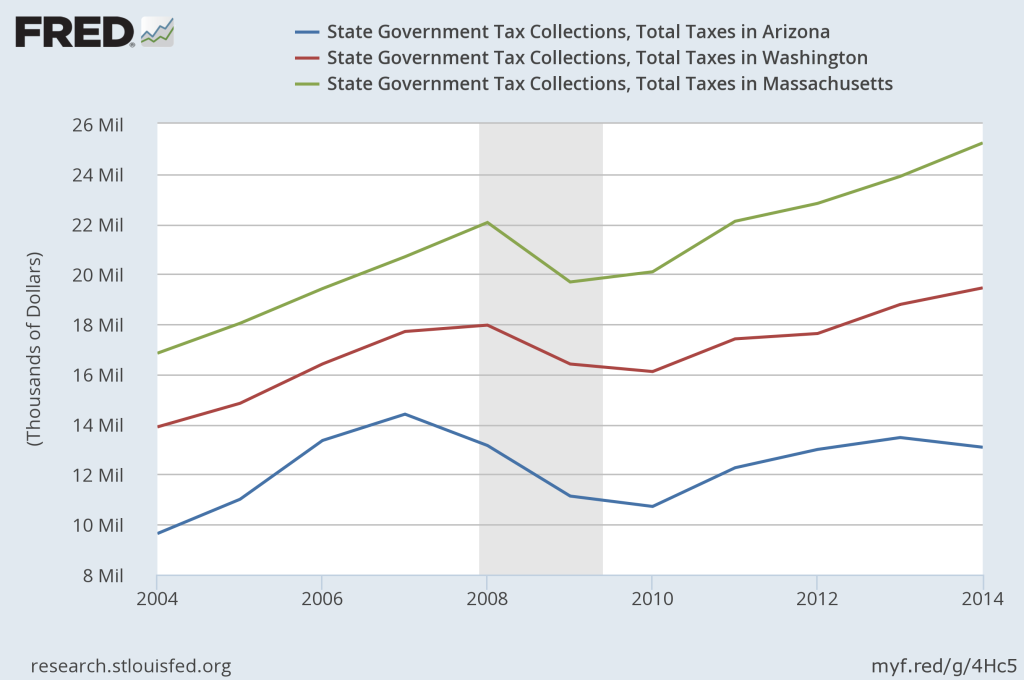
Now let's look at Arizona specifically:

Light rail to Union Station

Light rail to Union Station

PhoenixTrainStation

"Roads? Where we're going we don't need roads."

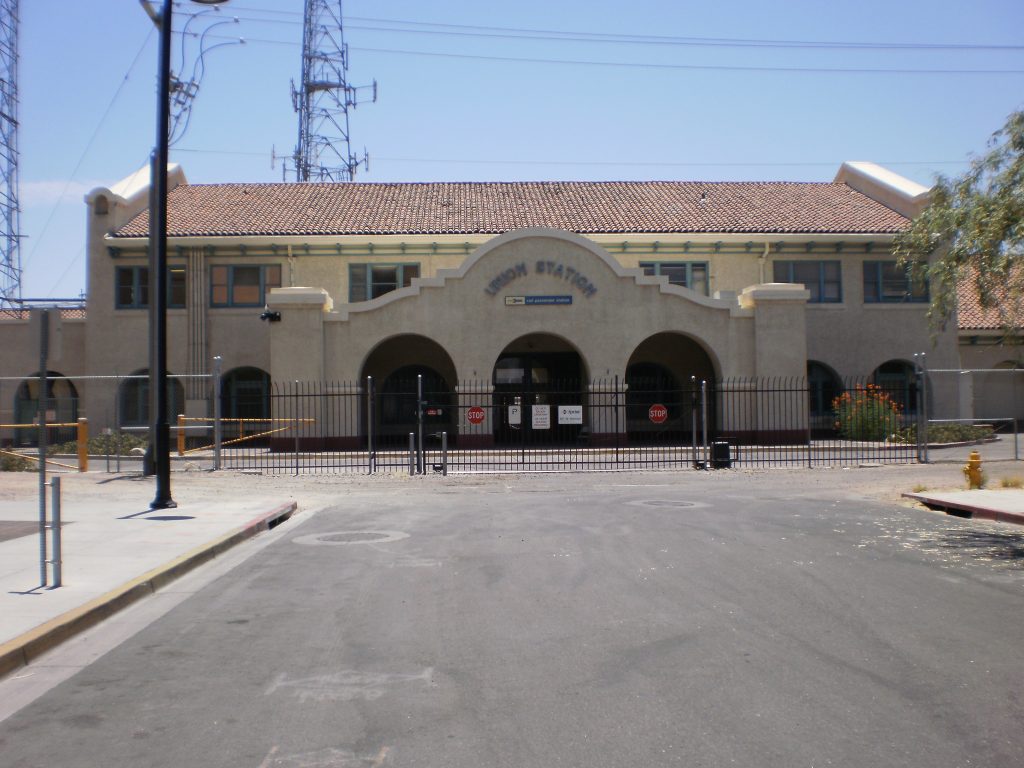
The South Central line is one of the most promising additions to the Phoenix light-rail system (WBIYB). City Council has approved a plan to fast-track the five-mile extension to Baseline Road by 2023. But a crucial piece of the project isn't on the table, and as far as I know nobody is discussing it.

This line needs a slight rerouting: It needs to jog over the Third Avenue on Washington, then run south to Lincoln Street before moving back to Central for the journey south. This would provide two big benefits, one immediate and the other long term.

By shifting west, it would pick up large numbers of riders at the government centers of the city and county. But the big enchilada is that the line would pass just to the east of Union Station, which was Phoenix's intercity passenger rail depot until the 1990s.

Light rail might need a tunnel under the current Union Pacific line, but it would be worth it. The payoff would be connecting light rail with a reborn Union Station as the hub for a region-wide commuter train system as well as the return of Amtrak to Tucson and Los Angeles.

If Phoenix fails to do this, it will be a blunder to be regretted for decades to come.

Bolles: a players guide

Bolles: a players guide

Bolles_paper


"They finally got me…Mafia, Emprise, Adamson…find John Adamson…"
— Don Bolles

On June 2, 1976, a bomb detonated under the car of Arizona Republic reporter Don Bolles in Midtown Phoenix. He survived an agonizing 11 days before he died. A recent article by Bolles' colleague John Winters lays out the basics. I've written about the case before here, as well as the Phoenix underworld. The closest assassins went to prison. Yet full justice was never served. The real puppetmasters got away with it. Many in high positions wanted it to go away.

But what exactly was it? The case has been extensively covered over the years, from the Arizona Project of Investigative Reporters and Editors (IRE) and contemporary, dogged reporting, by Republic and Phoenix Gazette reporters, including Al Sitter, Paul Dean, and Charles Kelly. New Times ran the IRE series and kept digging over the following decades, especially with Jana Bommersbach, John Dougherty, Tom Fitzpatrick and Paul Rubin. The Republic continues with retrospectives. Don Devereux, who worked for the Scottsdale Progress, still writes a blog about the case. A fascinating new book by Dave Wagner, an R&G city editor, The Politics of Murder: Organized Crime in Barry Goldwater's Arizona, makes an important contribution.

With so much having been written, so many characters and theories, one danger is becoming lost in a house of mirrors. The Bolles case would be the ultimate test of a mystery writer, were he foolish enough to try to make it into popular crime fiction. That's because in real life, the case was complex and shaded. It involved journalism and supposition, not all of the latter ultimately true. Carl Bernstein said that good journalism is the best available truth at that moment. But journalists write on history's leading edge and history is an argument without end. Law enforcement continues to debate the case, too. Files were lost or misplaced, perhaps deliberately. Among them, Phoenix Police file No. 851. In addition to the missing file, index cards for the files were also removed from the records room. Did it contain inconvenient information about Adamson, Emprise and Kemper Marley? Or more? Self-serving narratives, hidden agendas, and bad memories further blur the trail. Many questions remain. 

So my modest attempt for the 40th anniversary of the bombing is a list of the actual major players and their connection with the most notorious assassination of a reporter on American soil:

John Adamson: Don Bolles left his post covering the state Legislature to meet Adamson at the Clarendon House Hotel on June 2nd. Adamson promised a juicy tip on a land fraud involving Barry Goldwater, Harry Rosenzweig, Sam Steiger, and Kemper Marley. In reality, while Bolles waited for him in the lobby, Adamson planted the dynamite device under the driver's side of Bolles' new Datsun 710. After giving up on the meeting, Bolles returned to the parking lot, started his car, and pulled out when the bomb went off.

Usually portrayed as a small-time but menacing hood, Adamson hung out on the Central Avenue bars and the dog track. But he actually had worked his way up to being chief enforcer for land-fraud kingpin Ned Warren and had been retained by associates of Barry Goldwater for dirty business in a Navajo power struggle. He also worked as a confidential informant for someone in the Phoenix Police. Bolles identified Adamson in his famous last words. In exchange for cooperation, Adamson was given a 20-year sentence. When convictions from his testimony were thrown out, prosecutors charged him with first-degree murder. This conviction didn't stick. So after serving 20 years, Adamson entered federal witness protection, then voluntarily left it, dying in 2002. Some retired cops and journalists suspect that Adamson protected the true source of the death warrant on Bolles. In a jailhouse interview with Bommersbach and Rubin, Adamson said chillingly, "I didn't kill him for a story he'd written. I killed him for a story he was going to write."

Phoenix in the forties

Phoenix in the forties

Central Avenue 1940s
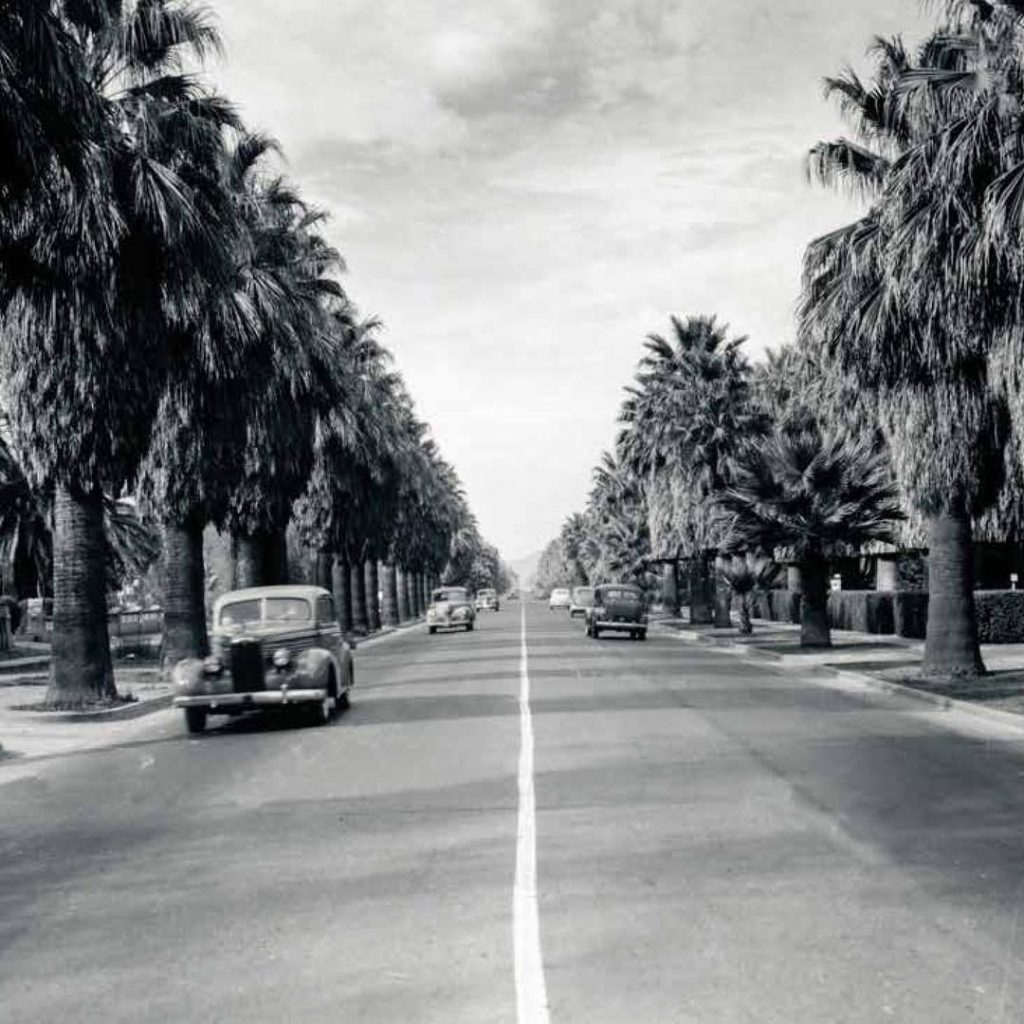
In 1941, Arthur Horton, a professor at Arizona State Teachers College, the precursor of ASU, published a remarkable Survey of Phoenix and the Valley of the Sun. What makes it still valuable is that it provides us with the most authoritative examination of Phoenix in that decade, or at any time until perhaps the 1960s.

The exhaustive report is also helpful in understanding a decade that meant far more than American involvement in World War II and its effects on Phoenix (which I wrote about here). That lasted less than four years out of 10. Much more was going on.

The decade began with a strong local economy, almost entirely thanks to the New Deal’s enormous largesse toward Phoenix and Arizona. The stimulus spending worked and helped pull Phoenix out of the Great Depression. By 1940, Americans were doing better and traveling, including visiting the mostly new resorts including the Arizona Biltmore, Camelback Inn, Jokake Inn, Adobe House, Ingleside Inn, Wigwam Guest Ranch and San Marcos at Chandler, as well as Phoenix’s premier hotels. The “Valley of the Sun” tourist promotion launched by the Chamber of Commerce and the railroads was paying off. To be sure, not everyone was doing better: 10,000 in the county (population 186,000) were on relief.

Agriculture remained the mainstay of the Salt River Valley’s economy. According to Horton, Arizona had 1.1 million grapefruit trees, 625,000 orange trees; 17,000 lemon trees; 5,000 tangerine trees, and 2,675 lime trees. Most of these were in the American Eden in and around Phoenix.

Next on the chopping block: Macayo’s Central

Next on the chopping block: Macayo’s Central

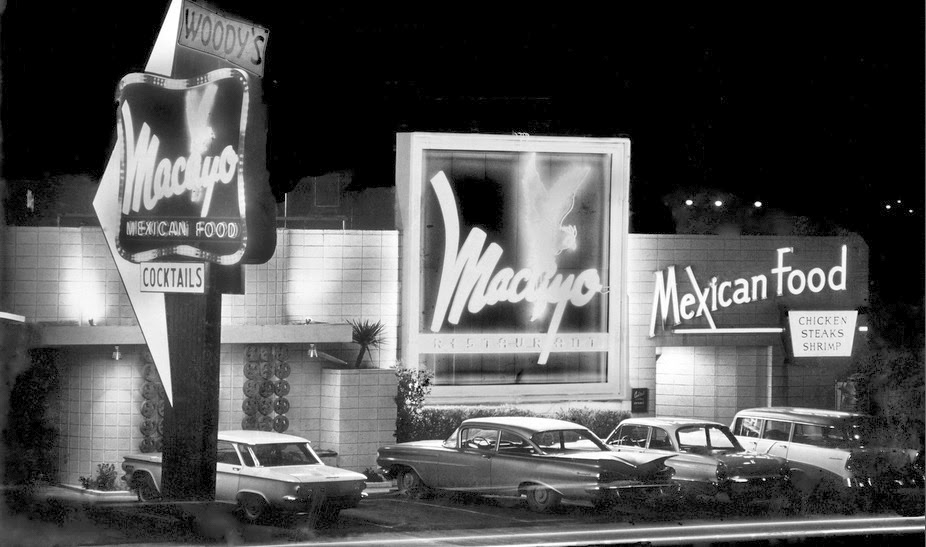
Woodys_Macayo_4001_N_Central_1960s
With Circles partially demolished and tagged and being held hostage by the developer comes news of another Central Avenue icon facing the bulldozer. 

The Macayo's restaurant that has stood for decades at Central and Indianola is facing demolition. In its place would be some 225 "residential units" in 65-foot building (this being Phoenix, of course, that is a big maybe). The developer is requesting a zoning change to "walkable urban."

One astounding thing is that "walkable urban" would require "only" 256 parking spaces (!). But the developer wants 369. "Free" parking is never free and Phoenix has way too much of it. Real urbanism would take down the number of spaces substantially. But, hey, WBIYB and the project (if it really happens) would be on light rail.

The really good news is that Macayo's intends to move to the south and stay in business.

What’s in a name?

What’s in a name?

GoodSam_1940s
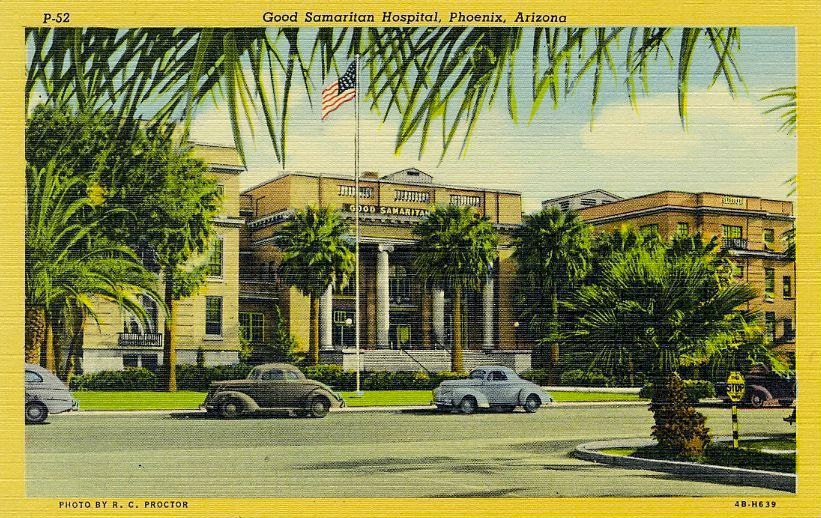
I don't want to be too hard on Banner Health considering the outfit placed its headquarters in a Midtown skyscraper. But a year after it changed the nearly century-old name of Good Samaritan Hospital to Banner-University Medical Center Phoenix, I am still thinking, huh?

There's no university there on east McDowell. Indeed, it was Banner and CEO Peter Fine that torpedoed plans to relocate the county hospital to a new building on the Phoenix Biomedical Campus, with the medical and nursing schools, where the "bench-to-bedside" vision of T-Gen's Jeff Trent could have been realized. This action in the 2000s showed Banner at its very worst.

The "university" part comes from Banner's $1 billion takeover of the University of Arizona's medical center and a satellite clinic in Tucson. More about that in a moment. 

To be sure, names change. The old Scottsdale Baptist Hospital changed its affiliation and became Scottsdale Memorial Hospital in the 1970s. It was where I trained to be a paramedic. When I returned in 2000, it was something called Scottsdale Healthcare Osborn, sounding more like a doctor's office than a hospital, much less a Level 1 trauma center. Now it's HonorHealth Scottsdale Osborn Medical Center (how much did some consultant get paid to slam the two words together?).

St. Joe's has somehow kept its original, historic name even if it was excommunicated by the bishop, so to speak. Smaller St. Luke's is still there, too, under control of the unfortunately named IASIS Healthcare (when acronyms go bad!). John C. Lincoln Hospital also has the HonorHealth mashup in front of its name but at least kept its identity.