Phoenix 101: Birth of crazy
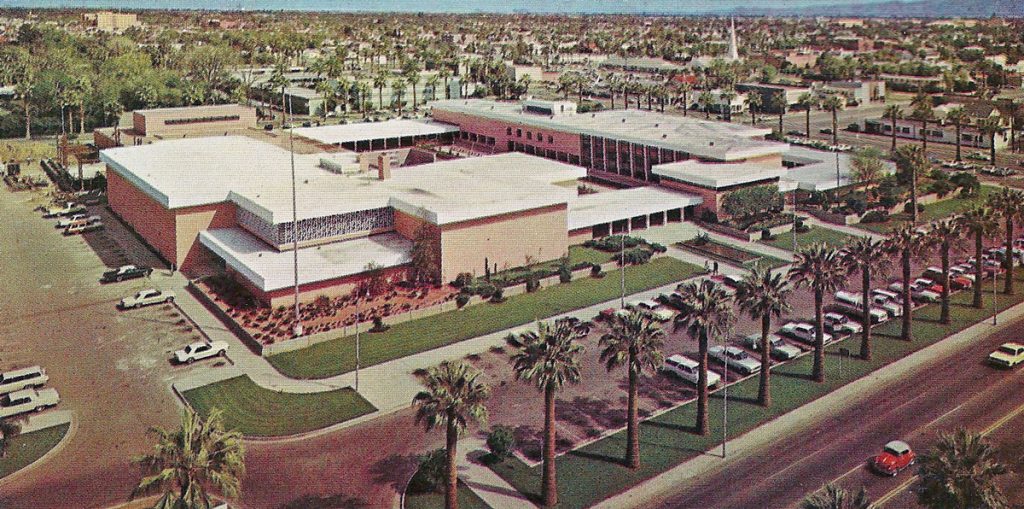
The Phoenix Civic Center, built with the support of Councilman Barry Goldwater, was seen as an example of profligacy by hardcore right-wingers. This side of the center faces Central. Today most of the site is the Phoenix Art Museum.
It is tempting to see the likes of Diane Douglas, John Huppenthal, Tom Horne-y, "Better Call Sal" DiCiccio and the entire Kookocracy as a recent phenomenon in Arizona. It's certainly comforting to us natives.
Barry Goldwater wasn't raving mad, we will tell you (the "lobbing one into the men's room of the Kremlin" was a joke). He came to regret his early opposition to federal civil rights laws, and was instrumental in helping desegregate Phoenix's schools. He desegregated Goldwater's Department Store, as well as promoting minority managers. As a city councilman, Goldwater supported public improvements, including bonds for the 1950 Civic Center (and he backed every Phoenix bond measure thereafter). In the 1980s and 1990s, Arizona's new conservatives repudiated him.
The truth is that Arizona was always a conservative state, in a narrow definition of the term. But for decades most citizens understood it wouldn't have existed without enormous federal largesse. No wonder majorities voted for FDR all four times he stood for the presidency. Sen. Carl Hayden was a progressive and New Deal Democrat. His fellow Democratic Senator, Ernest McFarland was the father of the GI Bill.
But the Kookocracy has roots that reach back more than half a century in Phoenix, to a forgotten City Council election.
American Eden
Agriculture is the oldest organized human activity in the Salt River Valley. This is why Phoenix was never a Wild West town like Tombstone or even Prescott. It was never a copper square.
For hundreds of years this sustained the Hohokam, who created the most advanced irrigation civilization in the New World. They built hundreds, perhaps thousands, of miles of canals to bring water from the Salt River to their fields. After the Hohokam left in circumstances that are still debated, the valley lay empty for 400 years. Waiting.
Jack Swilling may get too much credit among the founders of Phoenix. But one thing that's certain is this soldier of fortune immediately grasped the valley's agricultural potential when he arrived after the Civil War to help John Y.T. Smith farm hay for the Army at Fort McDowell.
He saw the Hohokam canals, the seemingly flat ground and rich earth, and knew it was farming country. In some cases, old Hohokam canals were simply cleaned out by the Swilling Irrigating Canal Co. His passion in selling what "Lord" Duppa would aptly name Phoenix attracted men from Wickenburg and Prescott. Swilling's Ditch was built in 1868 from today's 40th Street and ran west beside Van Buren Street.
No other place in the West between the 100th meridian and California and the Pacific Northwest was so hospitable to farming. Three rivers met here and the soil was alluvial and priceless. Unlike the future Dustbowl, with its shallow topsoil and dependency on fickle rainfall, the Salt River Valley alone had almost all the makings of a major agricultural empire.
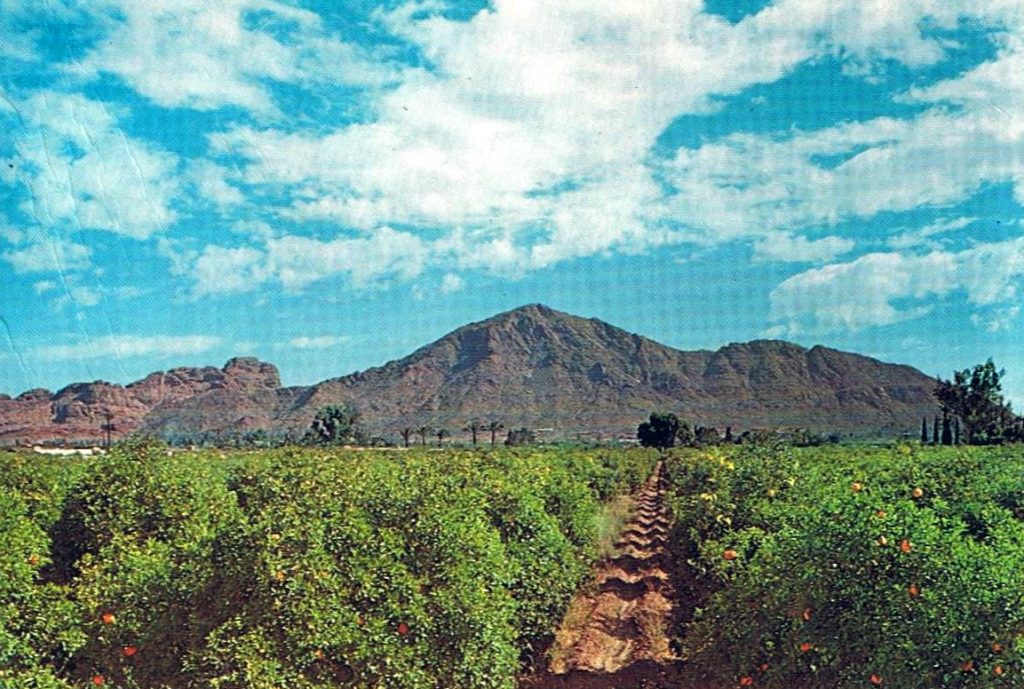
By 1870, 200 Anglo settlers had arrived and laid out the townsite, land was platted from the Gila and Salt River Baseline and Meridian, and more ditches were dug. Wheat and grains were the early crops. Former Union officer William John Murphy led building of the 41-mile Arizona Canal between 1883 and 1885. In the late part of that decade, the Rev. Winfield Scott, an Army chaplain, acquired 640 acres. With his brother George, he planted the first citrus trees, along with growing dates and figs and other tree crops.
Yes, tony Scottsdale is named after this chaplain-farmer. (So is Winfield, Kan.). But other farm villages preceded it: Mesa (1878), Tempe (1879), Glendale (1887) and Peoria (1897).
Raul Castro, an appreciation
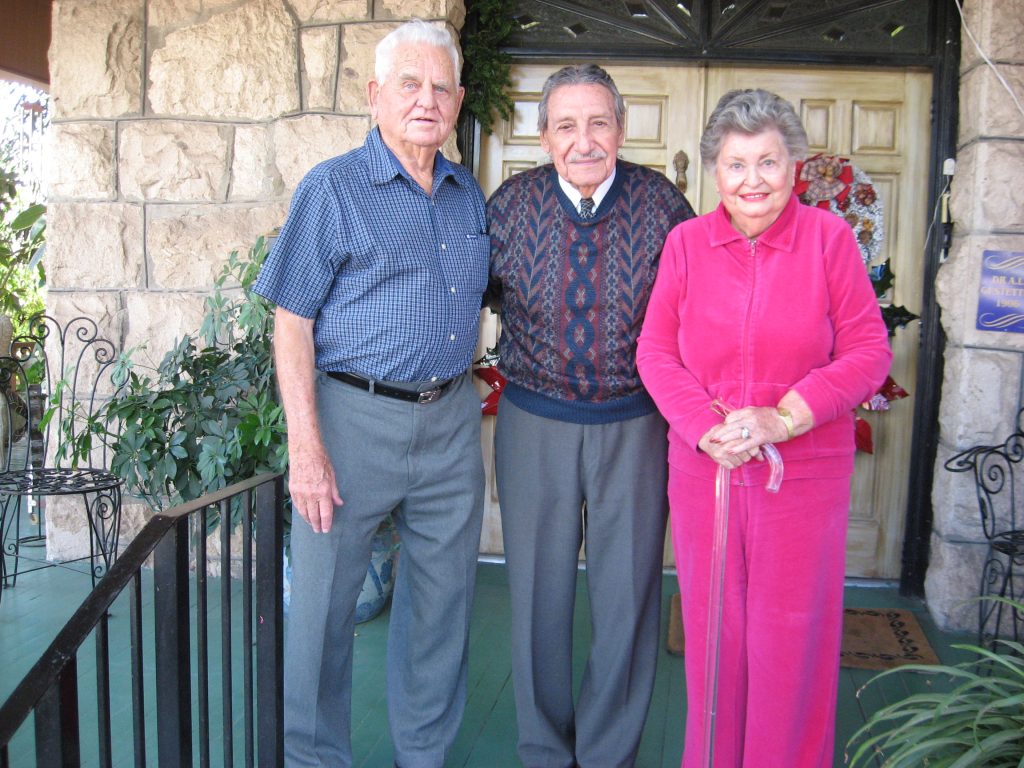
Raul Castro, center, along with his wife Pat and longtime law partner and friend Henry Zipf at the Castros' home in Nogales, Ariz., circa 2008.
By Jack August Jr., Guest Rogue
In 2007, then-91 year-old Raul Castro addressed a packed auditorium at the Arizona Historical Foundation’s annual Goldwater Lecture Series at Arizona State University. At the time, I served as Executive Director of the foundation, which, among other things, maintained the personal and political papers of Sen. Barry Goldwater.
Two hundred mostly conservative and arguably skeptical supporters of the legendary Arizona senator were curious to see what the former Democratic governor, judge, and ambassador had to say.
After introducing him, I sat down and watched Castro stride to the podium; he had no notes. He launched into a one-hour presentation that seemed like ten minutes, telling his life story, touching upon the role that education played in his life, his years as a “hobo” riding the rails, his undefeated professional boxing career, and his countless experiences of prejudice and adversity.
But the overarching theme in his talk was the promise that America held for all its citizens. When he finished the audience exploded in applause and stood on their feet clapping for several minutes. It was a stunning performance.
The distinguished professional career of Castro, who died last week, stood in stark contrast to the adversity inherent in his humble beginnings, which only hardened his resolve and strengthened his determination.
Bringing forth fruit

I first met Kit Danley in 2001 when she asked me to visit Neighborhood Ministries at its new home, hard against the railroad yards on Fillmore Street west of 19th Avenue.
It was a place that held fond memories for me. As a child, I had spent many hours train watching at the nearby Mobest Yard of the Santa Fe Railway. In those days, Fillmore ran through to 19th Avenue, and this end of the yard featured a cleaning facility for passenger cars (when Phoenix had passenger trains) and the locomotive turntable. South was the busy and (to my young eyes) imposing Valley Feed and Seed, where railcars were switched against the warehouse for loading and unloading.
Valley Feed and Seed looked very different in 2001: abandoned, decomposing, the grounds full of debris, silos that once provided seeds for this great agricultural valley now empty, eight acres of sadness. It was a graveyard that extended to Van Buren Street. Fillmore had been closed to a cul-de-sac when the yard was moved south (to lessen the train delays on McDowell). The surrounding area was known for crime now, not commerce.
But this was the site that Neighborhood Ministries had purchased in 1998 for an ambitious campus that would increase its outreach to the poor. By the time of my first visit, the organization had raised $2.2 million to begin renovations.
I liked Danley immediately. She was a near-native, went to Scottsdale High (I went to Coronado), and had chosen to make a stand in the wounded heart of Phoenix, founding Neighborhood Ministries in 1982. She was the polar opposite of the city of the short hustle, the state where hate was peddled for political profit.
And she would be frustrated that I appear to be making this column about her (it's not; read on). Like her spiritual forebear in Phoenix, Father Emmett McLoughlin, she felt called by Christ to minister here to the least and the lost, to the stranger and the wanderer, and find Christ in them.
Driving Phoenix history
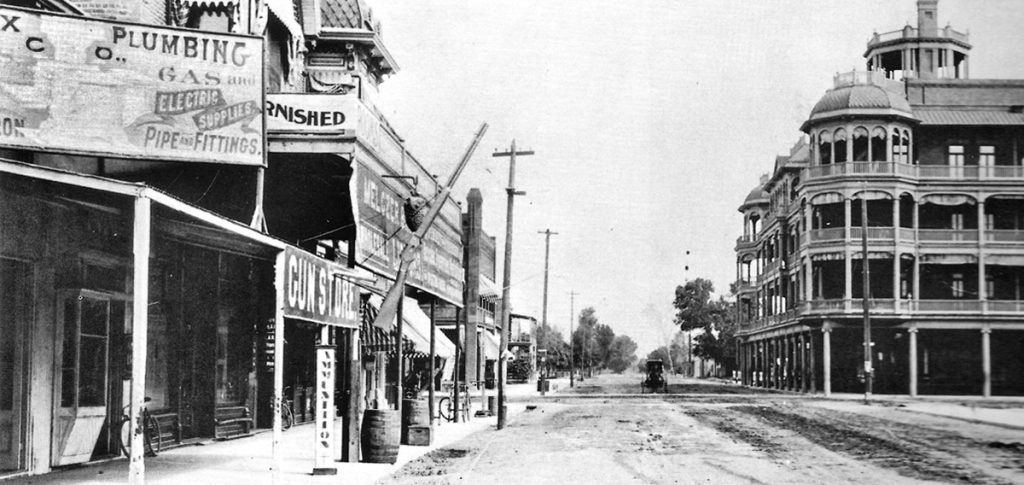
Central Avenue and Adams Street in 1909. The original Hotel Adams, later lost to fire, is to the right. Before it was Central, the main drag of Phoenix was Center Street.
Even with light rail (WBIYB), most Phoenicians spend vast amounts of time in their cars. But you can't avoid history, if you're paying attention.
Most people know the east-west grid of the original city has streets named after presidents, from Grant to the south to Roosevelt at the north (named after Theodore). The least deserving president is James Buchanan but there he is, right by the railroad tracks.
With so many streets in 1,500-square-miles of urban space, there's also plenty of asphalt to give faux Spanish names, or the names of developer's wives and daughters (Cheryl, Susan, Linda, Pamela, Sharon, Cindy, etc.). But the next time you're racing along in your SUV, consider:
McDowell Road, which was the wagon road to Fort McDowell, the supplying of hay to the cavalry being one of early Phoenix's raisons d'etre. Irwin McDowell was in command of union forced defeated at First Bull Run in the Civil War.
Thomas Road was named after William Thomas, a rancher and Maricopa County recorder at the turn of the 20th century.
Earll Drive takes its name from E.A. Earll, who platted the Earll Place homes. The origin of nearby Cheery Lynn is unknown (at least to me).
Osborn Road does not honor the state's seventh governor, Sidney Preston Osborn, who served from 1941 to 1948. Instead, it was named after homesteader John Preston Osborn, Sidney Osborn's grandfather.
When the Legislature worked

You know the Arizona Legislature. It's the bunch that reduces education money for some of the worst-funded schools in the nation, savagely cuts financing for universities, has its hands in the hustles of the Charter School Racket and Private Prison Racket. The worthy solons who sold off pieces of the Capitol area in the Great Recession.
It was the birthplace of SB 1070, the anti-immigrant (really voter suppression) law. This is only one of its creations that helped give the impression that Arizona is one of the craziest and most bigoted states. Anything forward looking, the majority opposes. Tax cuts? You bet. It is the Kookocracy.
But there was a time when Arizona had one of the most respected legislatures in the nation. Yes.
In fact, there were at least two sustained periods in the state's history when the Legislature worked.
This is no small thing because the Legislature is by far the most powerful branch of government in the state. Constitutionally, the governor was barely more than a figurehead — a status that has improved in recent years, but not by much. In other words, Arizona moves ahead, or backwards, depending on the Legislature.
Phoenix 101: The weather

This is the time of year when we see smug pieces in Phoenix media trumpeting the fine weather and making fun of the blizzard or snow in the Midwest or Northeast.
It's an old con going back a century or more — although it was typically the subject of advertising (as seen in the above promotion from the 1950s) rather than of "news" stories.
How can I be so cynical as to call it a con? Two reasons.
First, America had a long tradition of the West being misrepresented as the land of milk and honey by railroads and land barons. In most cases, the reality was disappointing, sometimes disastrously so. In reality, the land was unforgiving, "civilization" was primitive, fraud and lawlessness were common, and many immigrants were ruined.
Second, Phoenix historically had about seven decent-to-nice months and five hellish ones. I say "historically" because that ratio is starting to invert, about which more later. But many snowy places have five rough months and seven that range from livable to quite pleasant. Summer in Minnesota is lovely. So it the Phoenix braggadocio about its "superior" weather has always baffled me.
It is true that many people seek the sun almost pathologically, like the doomed space crew in the 2007 film Sunshine. "You don't have to shovel sunshine!" is a motto that resonates, at least with the 4 million people who seem to be willing to put up with almost anything in Phoenix as long as they get hot weather. I admit my blind spot: As a Phoenician, nothing makes me more depressed than endless sunny days.
Sue Clark-Johnson, an appreciation
As a young paramedic, I learned early on that we all hang by the slenderest thread. That thread snapped suddenly Wednesday for Sue Clark-Johnson, publisher of the Arizona Republic from 2000 through 2005.
She was 67, and although I had heard she had been hospitalized, the news came as a shock. The fifties and sixties are not the new thirties.
As a business editor and columnist, I have always had close relationships with publishers. Unlike other people in the newsroom, a business editor supervises the coverage of the publisher's peers and sometimes friends.
I have been blessed with good publishers such as Tom Missett at the Blade-Tribune, Brad Tillson at the Dayton Daily News, Larry Strutton at the Rocky Mountain News, Harry Whipple at the Cincinnati Enquirer and the legendary Rolfe Neill at the Charlotte Observer. They supported the tough, high-impact, sophisticated journalism that we practiced. Frank Blethen has been a consistent supporter of my columns at the Seattle Times.
Sue was my friend and protector during my years as a columnist in Phoenix. Some of the most powerful people in Arizona came to her demanding that I be fired or silenced. She turned them away. Not only that, she provided me with a larger platform as an op-ed columnist on Sunday.
Media in old Phoenix
A crowd "watches" the World Series covered by the Arizona Republican outside the Heard Building in 1921. In these pre-radio days, news wire services transmitted each at-bat and inning, which were placed on the scoreboard.
If you grew up in Phoenix in the 1960s and 1970s, the media landscape looked like this:
The Arizona Republic was the morning newspaper. The afternoon paper was The Phoenix Gazette. Although both were owned by the Pulliam family, their newsrooms competed fiercely. The Republic was the statewide newspaper while the Gazette focused on the city. Publisher Eugene C. Pulliam was known for his conservative views and occasional front-page editorials. Pulitzer Prize-winning editorial cartoonist Reg Manning's signature included a cactus. Well into the 1960s, news hawkers in green aprons shouted headlines from downtown sidewalks, ready to sell you a paper.
Surrounding towns had their newspapers, too. Among them, The Mesa Tribune, Tempe Daily News, Chandler Arizonan, and Scottsdale Daily Progress. The city gained an alternative weekly with New Times, founded in 1970 by a group of ASU students. Phoenix Magazine was started in the 1966 by the Welch family.
Television meant the local affiliates of the three networks: KOOL (CBS), KTAR (NBC) and KTVK (ABC). Phoenix had one independent station, KPHO, which was the home of Wallace and Ladmo. Radio ran from easy listening to top 40 (KRIZ, KRUX and KUPD). By the 1970s, newcomer KDKB played album-oriented rock with a hippie laid-back style (The staff is shown at the Mesa Southern Pacific depot in 1973, above right). Broadcast towers topped the Hotel Westward Ho and Greater Arizona Savings Building (Heard Building) downtown.
You knew personalities such as bola-tie-wearing Bill Close, the Walter Cronkite of Phoenix, on KOOL (promoted on the billboard, right). Mary Jo West became one of Phoenix's first female anchors in 1976, joining Close (a crusty guy who was not happy to work with a woman at first). In 1982, Close would be at the center of a famous hostage situation, where a gunman took over the studio and demanded to read a statement on the air. On KOY radio, Bill Heywood presided over the morning drive time, while Alan Chilcoat did afternoons and "sang the weather." Johnny McKinney at KUPD was one of the many popular rock DJs.
Overall, what would come to be called "media" was pretty bland in Phoenix of this era. There were exceptions, and not merely when New Times started to shake things up. The Republic and Gazette was capable of excellent investigative reporting and exposed land fraud and crooked pols, along with plenty of boosterism. Glendale Pontiac dealer, and future governor, Evan Mecham published a short-lived Evening American because he thought Pulliam was too liberal. But most Phoenicians felt a deep connection to these publishers and broadcasters.
A Phoenix 101 revised and updated
Phoenix in the seventies
Central Avenue and Van Buren in 1972. Note the full block of businesses heading north to the Westward Ho. Central was still a two-way street.
No series of events better epitomized the 1970s and the turning point they marked in Phoenix than the fight over freeways, specifically the "inner loop" of the Papago Freeway.
Most Phoenicians had a vague idea that freeways were a possibility since the Wilber Smith & Associates plan was adopted in 1960. Interstate 10 had been completed to Tucson and was abuilding from the west. By mid-decade it had reached Tonopah, requiring a long drive over largely country roads to reach. Real-estate values plummeted along the path of the inner loop. But by 1970, Phoenix's freeway "system" consisted of only the Black Canyon (Interstate 17) which curved at Durango to become the Maricopa (I-10).
All this changed as the new decade opened and the plan's stark reality became clear. Specifically, the Papago would vault into the air, reaching 100 feet as it crossed Central Avenue. Traffic would enter and exit via massive "helicoils" at Third Avenue and Third Street. The freeway was promoted as being Phoenix's defining piece of architecture.
It didn't take Eugene Pulliam and the anti-freeway advocacy of the Arizona Republic and Phoenix Gazette to make most Phoenicians horrified. In 1973, voters vehemently rejected the inner loop. They only had to look 372 miles west to see the destruction wrought by freeways. They didn't want Phoenix to "become another Los Angeles."
Baker Nursery RIP

National readers of this blog will have to indulge me in writing again on sorrowful "news from home." Baker Nursery will be closing after 46 years in operation. Businesses come and go, we grow to love some of them, the verities of the marketplace don't care.
But this is a punch in the gut.
Baker's is a remnant of old Phoenix, the magical oasis, a garden city where people took special pride in bringing the bounty out of this timeless alluvial soil, where even the simplest apartments were lovingly landscaped. It is a remnant of the distinctive eastern part of the city that includes Arcadia but so much more. A remnant of when Phoenix was a very middle-class city, before the stark division of rich and poor, before the miles of linear slums.
What could have been more important for the garden city that once flourished here than nurseries? Phoenix once supported many, but Baker's was the best.
My mother was a Baker's customer from the start. Later, as a young man, I would take her to the nursery. She would select plants while I, well, admired the attractive Baker daughters.
Phoenix in The Great War
Phoenix-born air ace Frank Luke Jr., Arizona's most famous hero from World War I, with his thirteenth official kill.
Arizona had been a state for little more than two years when the cataclysm broke out in Europe a century ago. When the United States finally entered the conflict in 1917, doughboys and sailors fought under the new flag bearing the perfectly symmetrical 48 stars created with the entry of the "Baby State." While the Great War was not as transformative here as its continuation in World War II, it still brought big changes to Phoenix.
When the guns of August 1914 commenced, Phoenix's population had clocked in at 11,314 in the Census four years before. By 1920, it would be more than 29,000. Although it was the state capital (and home of the "lunatic asylum," which in those days was separate from the Legislature), it was still smaller than Tucson. But downtown had become a thriving commercial center with multistory buildings.
The streetcar "suburb" of craftsman bungalows was taking shape in what are now the Roosevelt and F.Q. Story historic districts and the southeast corner of Willo. The city was tightly bound to the old township, with additions running out to the capitol, north above McDowell, south of Grant and east to around 16th Street. By 1917, bungalows were being built in the Bella Vista addition northeast of Osborn and Central. The Santa Fe and Southern Pacific had completed branch lines to the town, but civic leaders were lobbying hard for a mainline railroad.
In 1914, Phoenix adopted the reformist commissioner-manager form of government. It was meant to tame the corruption of the wide-open Western town. Soon, it was back to business as usual with compromised commissioners. It would be after World War II that meaningful reform would come to City Hall.
Arizona, with 204,354 in the 1910 Census, was still a wild place. It had been only 28 years since the surrender of Geronimo. The state's economy was based on mining, ranching and, in the Salt River Valley, a farming cornucopia.
Floods in old Phoenix

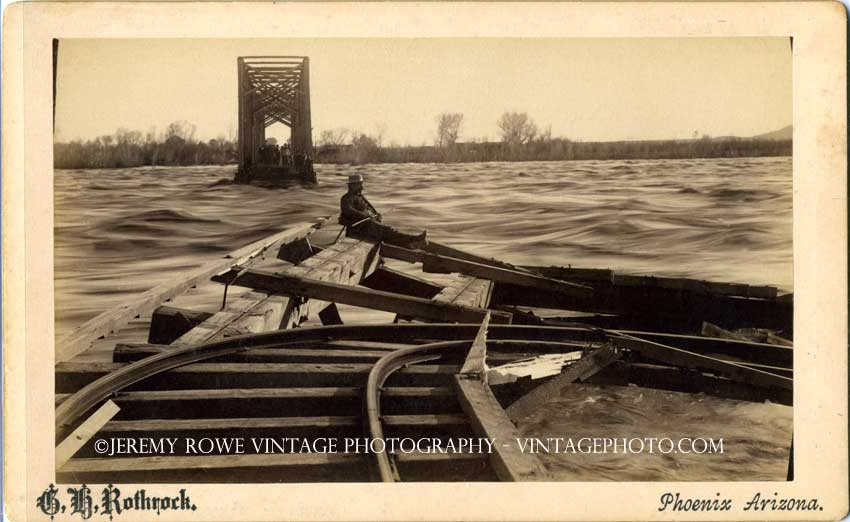
The rampaging Salt River destroyed the railroad bridge at Tempe in 1891, the river's worst flood on record.
Downpours in Phoenix often flood social media. The combination of so many new residents because of the metropolitan area's extreme population churn, sprawl built out in flood plains and the on-the-cheap engineering of freeways makes many believe this is a shocking and rare event. In fact, flooding is commonplace in Phoenix.
As a child in 1965, my mother took me to see the Salt River running wild over its banks. The snowpack was especially heavy that year and as it melted it filled the lakes northwest of the city, causing the Salt River Project to release water from its dams. My grandmother told stories about the floods in the early 1900s, including two that destroyed the Southern Pacific bridge just north of downtown Tempe. In one case, a passenger car was hanging over the edge. "You might not see this again in your lifetime," my mother said.
In high school in south Scottsdale, Indian Bend Wash flooded regularly, dividing the town in half and disrupting classes. The city built bridges but neglected to raise the approaches, so the wash merely went around them. It took years to engineer decent bridges and create the green belt along the Indian Bend.
The 1980 flood (one of ten that hit between 1967 and that year) cut off Tempe, Mesa and Chandler. Amtrak ran a special train (the Hattie B., named after first lady Hattie Babbitt) from those cities to Union Station. Ominously, officials worried Stewart Mountain Dam might fail. And when I returned in the 2000s, the Salt ran rampant again.