Phoenix Confidential: OCB

Phoenix Confidential: OCB

The_Untouchables_cast_1961
The Organized Crime Bureau of the Phoenix Police Department was created in the 1974 when Chief Larry Wetzel sent Detective Sgt, Oscar Long to clean up the old Intelligence Bureau, full of place-holders and shady types compromised by the mob. His goal: Replace the old "subversive surveillance squad" with top investigating officers to dig into organized and white collar crime for prosecution purposes. The old squad just gathered names to put in the intelligence files. The new one intended to put made men and corrupt pols on the defensive in one of America's gangland playgrounds. Lt. Glenn Sparks requested a federal grant to fund the OCB and it was approved in a very short time.

OCB attracted some of the most gifted detectives and supervisors in the department, indeed in the nation, including Long, Sparks, Lonzo McCracken, Jim Kidd, Cal Lash and A.J. Edmondson. I leave out some names at the request of the detectives — safety is still an issue. Over the next several decades, the OCB was involved in the most important investigations in the state, from the murder of Arizona Republic reporter Don Bolles to corruption of high city officials and the depredations of the New Mexican Mafia (New Eme). Lash went on to serve as Administrative Sergeant for two police chiefs.

In a city where, as the blurb for my new novel goes, "gangsters rubbed elbows with the city’s elite amid crosscurrents of corrupt cops, political payoffs, gambling, prostitution, and murder cloaked by the sunshine of a resort city," the Organized Crime Bureau was Phoenix's Untouchables. And this was real, not fiction.

Bruno

Bruno

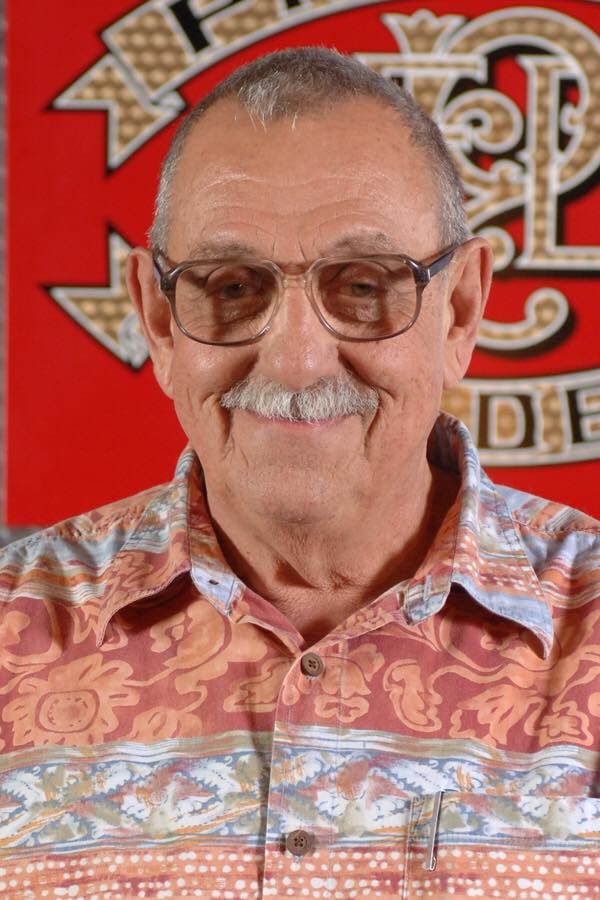
Bruno2Everyone who was blessed to know Alan Brunacini, who passed away in October at age 80, has a Bruno story. I'll tell two about Phoenix's long-serving Fire Chief.

At the 2005 going-away party for Sheryl Sculley, the deputy city manager who was leaving for the top job in San Antonio, I was talking to Bruno when a man walked up. He was a promoter on the make and wanted me to write about his project. I stepped a quarter turn and said, "Do you know Alan Brunacini?" The guy instantly (thought he) assessed the short, unprepossessing man in the Hawaiian shirt, said, "Howya doin', Alan," and rudely turned to face to me.

I thought: You just turned your back on the most powerful man in the city of Phoenix. Needless to say, his project never happened. His lack of discernment about Bruno was a tell. On the other hand, Bruno was accustomed to such reactions from those not in the know. "Most people think Bob Khan is the fire chief," he told me once with a broad grin, speaking of his ubiquitous public affairs officer (and successor). Bruno had little ego in the game. I suspect he also understood the advantage in being underestimated, especially in the perilous landscape of municipal politics. 

Years later, after he retired and I left the Republic, Bruno and I were enjoying one of our periodic meet-ups in the shady inner courtyard of Fair Trade coffee. A gifted raconteur, he told me about a pivotal moment in his early career.

Assessing Greg Stanton

Assessing Greg Stanton

1024px-Greg_Stanton_(35674107711)
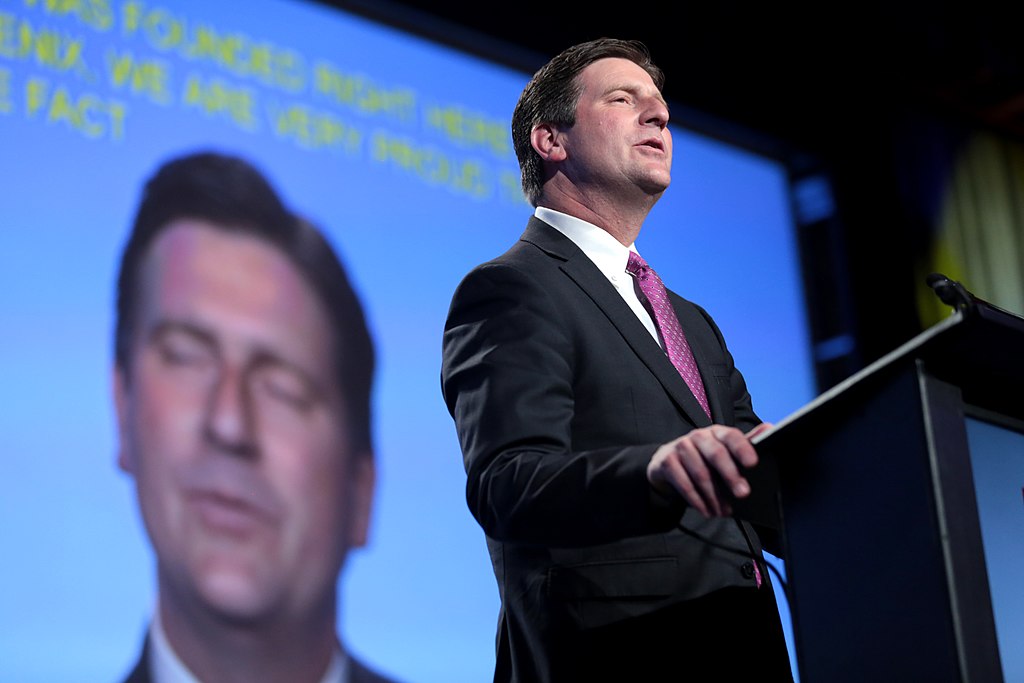
Now that he's announced he will resign as Phoenix mayor to run for Congress, it's not too early to at least make a preliminary evaluation of Greg Stanton's tenure.

Whether they like it not, all Phoenix mayors since the mid-1980s have been judged on what we could call the Goddard Scale. Terry Goddard was a transformational Phoenix leader who swept away the last of the CharterMargaret Hance status quo, led the change to a district system of council representation, saved the historic districts, and began to salvage downtown. He was bold! He was visionary! He got cities and had a clear-eyed view of Phoenix's situation!

And this is actually true. But even Terry Goddard wasn't Terry Goddard at first, or how he would mature as a leader and urban thinker after he left office (it was a terrible loss for Arizona that he didn't become governor). So on the Goddard scale, even Terry wasn't a 10. Let's say 9.1. Give Paul Johnson a 6.5 — Goddard was a hard act to follow, and Johnson faced the worst recession in decades here, up to that point. Skip Rimsza, who served from 1994 to 2004, gets a solid 8 in my book, although some would disagree. The same for Phil Gordon, especially his more productive first term.

And Stanton, who assumed office in 2012? I'd also give him an 8. Phoenix has been fortunate in its mayors.

The Chinese Cultural Center

The Chinese Cultural Center

ChineseCulturalCenter
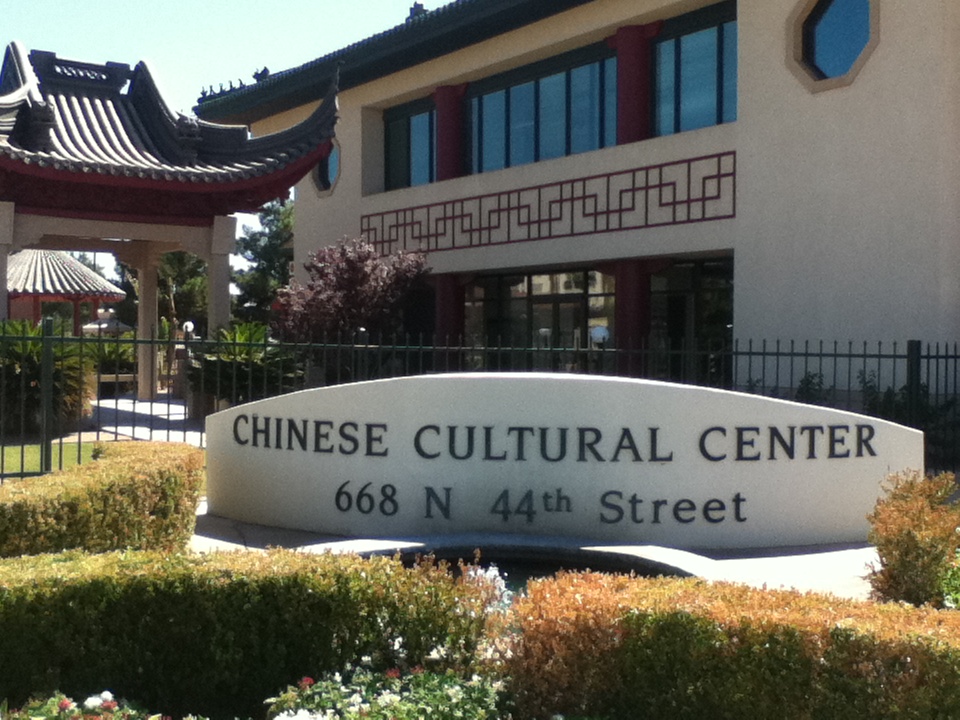
In the late 1990s, a couple of years before my fateful and in retrospect foolish decision to come home and write a column for the Arizona Republic, I noticed a freeway sign for the "Chinese Cultural Center" and took the exit.

The location, on 44th Street, was strange. It was far from the original locations of Phoenix's Chinatown in downtown. The central core was dead then and the only memory of Chinatown was the Sing Hi Cafe, relocated to west Madison Street from its original site in the Deuce. There was also the Sun Mercantile building, a former warehouse, beside the basketball arena. Land was plentiful and more of the warehouse district was intact. Why not put a Chinese Cultural Center here?

But, no. And although the sign was one of the brown historic markers that usually went with something public such as the Desert Botanical Gardens, the Cultural Center appeared to be a private, mixed-use real-estate development. Yes, it had some Chinese-influenced architectural features, garden, restaurants, and Asian market, but it wasn't really a museum or cultural center. Wikipedia says it was developed by the Chinese state-owned COFCO group, but I don't know if this is accurate.

Lately, the center has been in the news because of the building's purchase by a Scottsdale private-equity outfit which intends to redo it as a corporate headquarters. Most of the center is emptied out and it's surrounded by a chain-link fence. Protests from the Chinese community brought a temporary restraining order protecting the garden statues and roof — but it runs out Nov. 3rd. Then a new hearing will be held and demolition could begin. The Republic and New Times have slightly different takes on the state of play.

In all, it is so Phoenix: Disregard for history, car-dependent far from light rail (WBIYB) or the central core, and ultimately just another a real-estate play.

Big Town

Big Town

Cartoon_illustration_Phoenix_1950s
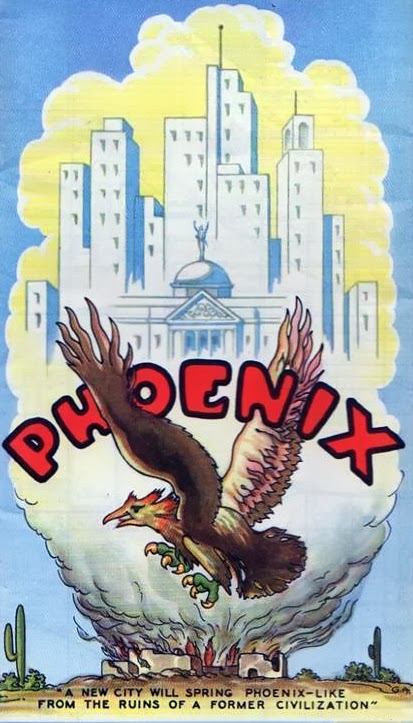
Big Town was a brand of melons and vegetables shipped by MBM Farms and Zeitman Produce from the Salt River Valley in its days as American Eden. One of scores of colorful labels on wooden crates, it had a stylized version of the Phoenix skyline in the background.

But I can't help wondering if it also caught a bit of the moment in 1950, when Phoenix entered the ranks of America's 100 largest cities. It was No. 99, with 106,818 people in 17 square miles. Phoenix landed 62 people ahead of No. 100 Allentown, Pa. But it was behind Scranton, Wichita, Tulsa, Dayton — not to mention its Southwest rival El Paso, No. 76.

In 1950, the nation's fifth most populous city was Detroit. According to new Census data, Phoenix has once again surpassed Philadelphia to claim the No. 5 spot it had by estimates in 2006 but lost in the 2010 count. I'll have more to write about this later.

For now, I want to linger on that moment when the Census Bureau made it official: Phoenix had crossed 100,000. The big town was definitely a city now, if not a big one (Even now, Phoenix has many characteristics of a small town, especially in power and power relationships).

As you can tell from the geographic size of the city, this Phoenix was convenient and walkable, with a true urban fabric. At 6,714 people per square mile, it was much more dense than today's 2,798. Surrounding it were citrus groves, farms, and small towns mostly dependent on agriculture (Tempe 7,684, Mesa, 16,790, Glendale 8,179, Gilbert 1,114, Scottsdale 2,032, and Buckeye 1,932). Arizona's total population was 756,000. Phoenix boasted an abundant shade canopy from the narrow streets to the enchanting canal banks. Downtown was the busiest central business district between El Paso and Los Angeles. As many as 10 passenger trains served Union Station in the golden age of streamliners.

Maryvale begins

Maryvale begins

039
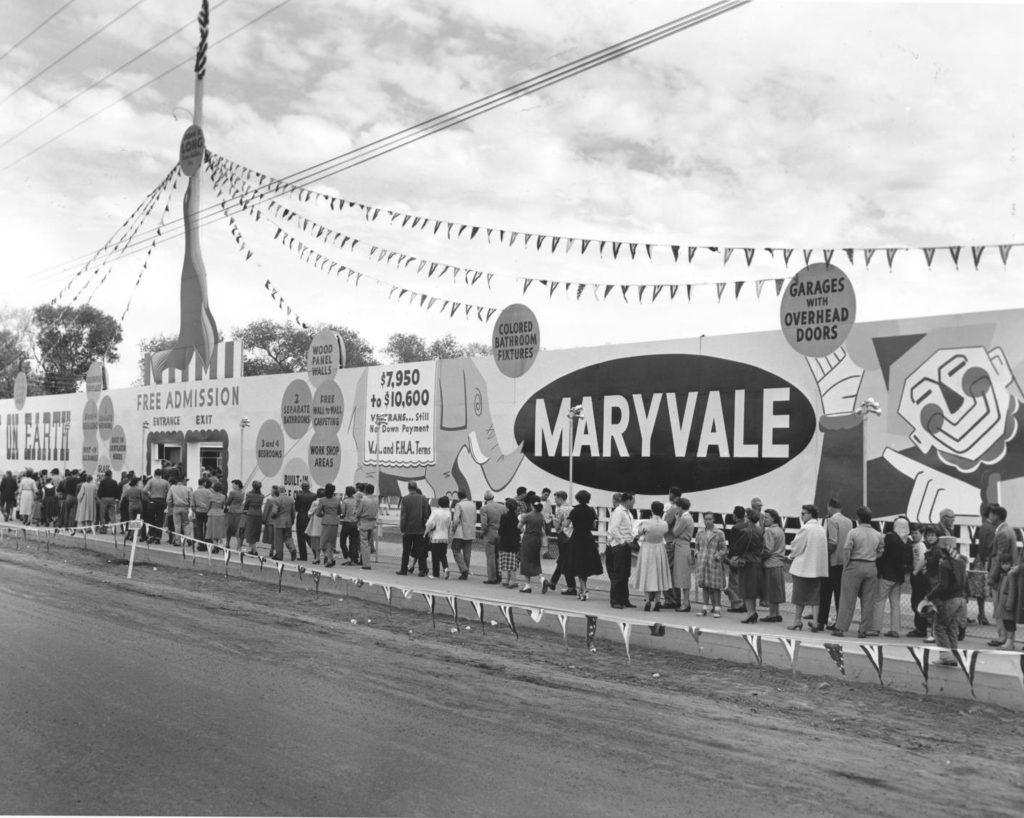
Through the first decades of Phoenix's history, housing was built on an almost artisanal level. Sometimes one at a time. Other times a dozen or two. Along with such fashions as the bungalow and period revival style, this is what gives the historic districts north of downtown their unique quality. It took decades, for example, for today's Willo to be filled with homes.

After World War II, heavy demand for housing — hardly any had been built during the Depression and World War II — and federal loan guarantees sparked a nationwide residential building boom. This was especially true with new suburbs, built on the Levittown mass-production model. With builders such as Ralph Staggs and John Hall in the lead, subdivisions just outside the 17 square miles of the city began to grow. By the mid-1950s, subdivisions averaged 180 houses, according to historian Philip VanderMeer.

In 1954, John Frederick Long began quietly buying nearly 70 farms west of Phoenix. A Phoenix native, Long worked on the family farm, spent four years in the Army Air Forces during World War II, and came home to several failures as an aspiring businessman. In 1947, he married Mary Tolmachoff, who also grew up on a farm in the Valley. With a GI loan and some savings, they built a house on a lot on north 23rd Avenue.

Before even moving in, the Longs received an offer to sell the house for almost double the cost of $4,200 in materials. This launched him as a homebuilder, first on a very small scale. But with Phoenix growing — a sharp post-war recession had been reversed by the infusion of Cold War defense spending — Long had a vision for something much bigger.

The architects

The architects

Gammage
One of the troubles with Phoenix is that most of the metropolitan area has been built up over the past two decades or so. The result is a deadening sameness of off-the-shelf architecture for house-builders and retailers, the boxes you'd find in newer parts of anywhere, with some faux Spanish-Tuscan crap attached. This is added to plenty of boring cookie-cutter buildings erected from 1960 through the 1980s. And Phoenix has more than its share of prominent architectural disasters.

That's too bad because Phoenix was once known for its great architecture, from office and government buildings to the magical period-revival homes of the historic districts, and especially its effervescence as a capital of Mid-Century Modernism.

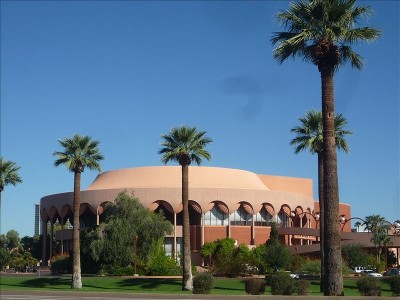
Frank Lloyd Wright (1867-1959) established his Taliesin West architecture school and home far out of town in 1937. A few Wright houses are left here, although contrary to popular myth he didn't design the Arizona Biltmore. The great Wright commission executed here was intended as the Baghdad opera house. You know it as Grady Gammage Auditorium (above), built after Wright's death.

But many more applied their calling here. This is an incomplete list, and I'm sure our smart commenters will have more:

The Deco masters and classicists:

Royal Lescher (1882-1957) and Leslie Mahoney (1892-1985) are responsible for some of Phoenix's most majestic public buildings, especially the 1929 Art Deco Phoenix City Hall (Edward Neild of Shreveport worked with them on the Maricopa County Courthouse portion). Lescher & Mahoney also designed the Orpheum Theater, Brophy College Chapel, the U.S. Post Office at Central and Fillmore, El Zariba Shrine Auditorium (former home to the Arizona Mining and Mineral Museum), the Phoenix Title and Trust Building (today's Orpheum Lofts), Hanny's, St. Joseph's Hospital, the Phoenix Civic Center, Veterans Memorial Coliseum, the tragically lost Palms Theater and many schools and landmarks.

Lee Mason Fitzhugh (1877-1937) and Lester Byron (1889-1963). The firm of Fitzhugh & Byron was the architects behind such landmarks as First Baptist Church (finally being renovated), First Church of Christ, Scientist, George Washington Carver High School, and the Lois Grunow Memorial Clinic.

Albert Chase McArthur (1881-1951), a protege of Frank Lloyd Wright, moved his practice from Chicago to Phoenix in 1925. Here he designed his most famous work, the Arizona Biltmore. Less well known is that McArthur also was the architect for several houses in the Phoenix Country Club estates and elsewhere.

Phoenix’s historic streetcars

Phoenix’s historic streetcars

Streetcars_1945
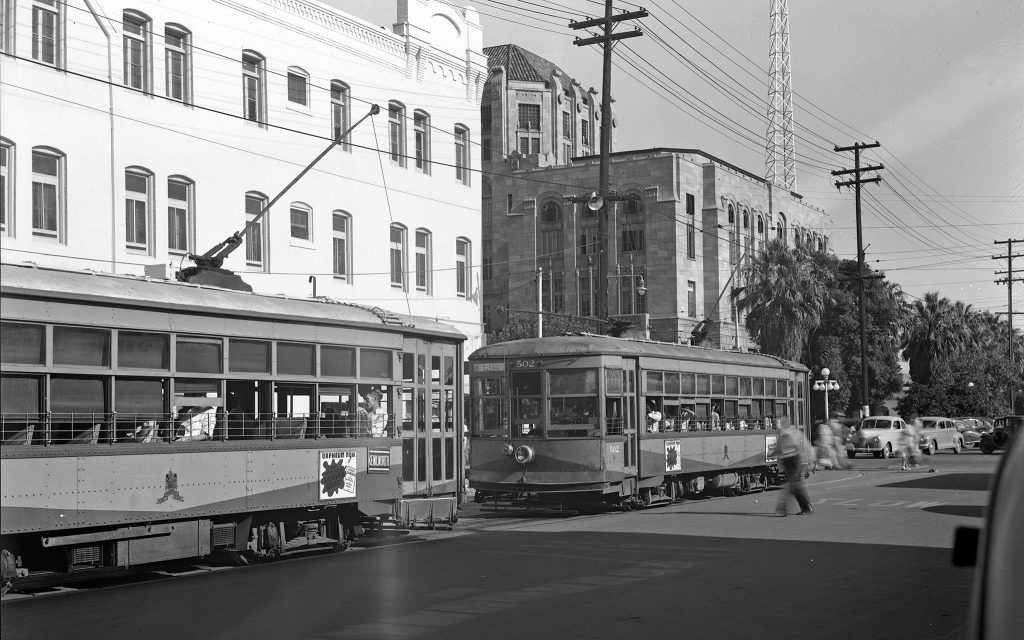
Moses Hazeltine Sherman was a teacher from Vermont who made his way to Arizona Territory in 1874. While teaching, he also made money in land and mining. Later, he would move to Los Angeles and become a millionaire. But before that, he and M.E. Collins founded the Phoenix Street Railway in 1887.

Originally the streetcars were pulled by mules. But electric cars took over in 1893. The new Territorial capital had a little more than 3,000 people. By 1925, the system boasted nearly 34 miles of track on six lines. It had two major spines. One ran west to the Capitol and on to 22nd Avenue, and east to the State Hospital along Washington Street. The other operated north and south from downtown to the Phoenix Indian School.

A long addition ran east from the Indian School to 12th Street, then cut north and west, eventually terminating in Glendale. Other routes went to the Fairgrounds; north through the new Kenilworth district to Encanto Boulevard, and over to the east side ending at 10th Street and Sheridan. Most of the streetcar lines ran down the middle of the streets.

Through the middle of the 20th century, most American cities and large towns had extensive streetcar networks. Numerous electrified interurban railways were also build, competing with the steam railroads of the time. They carried freight in addition to passengers on larger cars. The largest system was in Los Angeles, the Pacific Electric, known for its iconic red cars. Owned by the Southern Pacific Railroad, it operated more than a thousand miles of track in the LA basin.

Jack August, an appreciation

Jack August, an appreciation

Jack_August

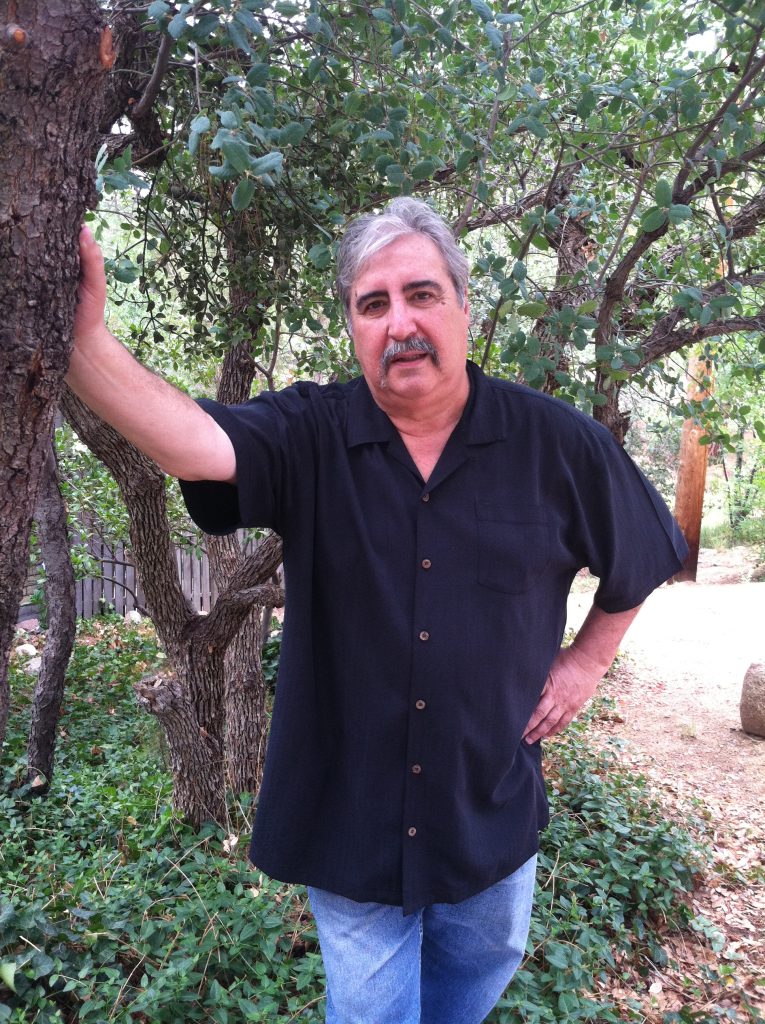
Historian Jack August in the Arizona wilderness he so loved (Photographer unknown).

When I was a popular columnist at the Arizona Republic, it felt as if everyone outside of the Kookocracy (I coined the term), including many of the most prominent people in Phoenix, became my friend. "I never thought I'd read this in the Republic!" they would say about my writing, truth-telling about the Ponzi-scheme economy, the crash to come, the lost beauty, policy blunders, and Phoenix's forgotten and ignored past. "Don't worry, you'll have a place with us" if you get fired, some promised. I was not fooled.

When the pressure became too much and the Republic kicked me out as a columnist, they almost all melted away. Instantly. Like drops of water on a high-summer sidewalk. I was not only dropped but shunned. Later, some would resurface if they needed something, but that's human nature not friendship. I can count the genuine friends who stuck with me on two hands. Jack August stuck. He was that kind of man. Crisis reveals character.

His death at age 63 is a staggering loss for Arizona, for all who knew him. He was a towering figure as a historian of a state that suppresses its past, where so many newcomers keep the home of their heart in the Midwest and crow, "There's no history here." He was an irreplaceable counterweight to these toxins. He was a mensch who gave full measure to the term "a gentleman and a scholar."

I first ran across Jack long before, in an appropriate way, pulling one of his books out of the shelves at Flagstaff's sadly lost McGaugh's bookstore and newsstand downtown. This was on a visit, showing my girlfriend my home state with no expectation I would ever live here again. A title caught my eye, Vision in the Desert, by Jack L. August Jr. The book chronicled Carl Hayden's leading role in the long fight for the Central Arizona Project. Susan bought it for me and I read it on the plane as we crossed the country.

My mother had spent a decade working on the Arizona v. California lawsuit and the CAP, mostly for the Arizona Interstate Stream Commission but also for the lead attorneys, Mark Wilmer and Charlie Reed. I knew my water history. One of my dreams was to write a history of Arizona's fight for the Colorado River, especially the outsized personalities, back stories, and intense days-and-nights of work fueled by uppers and booze as David took down Goliath. Vision was impressive and I wondered: Who is this Jack August?

Phoenix’s Roaring Twenties

Phoenix’s Roaring Twenties

Central_Ave_looking_south_from_Monroe_1920s

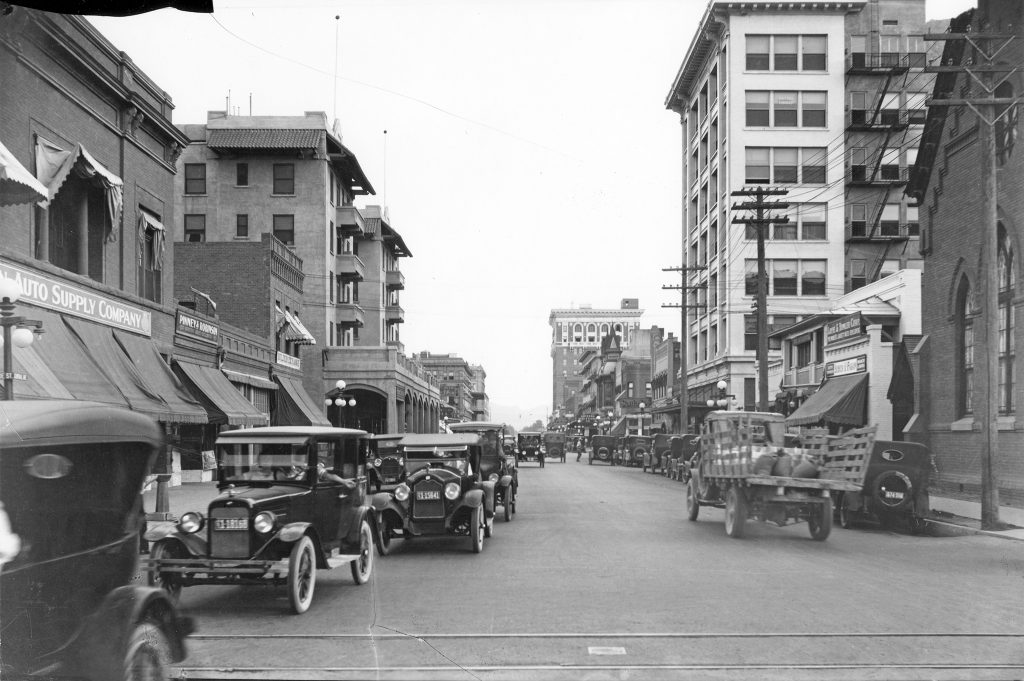
If this photo shows a busy little city from the Roaring Twenties, that's exactly what you found in Phoenix during this transformative decade. Town to city, horses to cars, less Wild West and more sophistication — Phoenix had been moving this way for years. But in the 1920s, they became solidly entrenched — even Town Ditch was covered. The first "skyscraper," the seven-story Heard Building, right, opened in 1920. By the end of the decade, it had several taller and more impressive siblings that remain some of the city's most treasured and beautiful buildings. Central Methodist Church (ME South) on the near right would move to a handsome new structure at Central and Pierce.

The nation entered the decade with Woodrow Wilson as president. But he was incapacitated by a stroke and his wife, Edith, was protecting him from most visitors and essentially carrying out most of his executive duties. America was disillusioned by the outcome of the Great War, the Palmer Raids and the "Red Scare," what was seen as Wilson's overreaching, and two decades of the Progressive Era. Voters (including women, for the first time) eagerly embraced Ohio's Warren G. Harding as the next president. He promised a "return to normalcy," forever wrecking the correct word "normality." Harding freed the Socialist Eugene Debs, who Wilson had imprisoned for opposing American involvement in the war.

The Great War had brought changes to the Salt River Valley, especially with the booming demand for cotton. By 1920, it had turned into a bust and Phoenix was suffering through the national recession. Things would soon turn around as the economy expanded and America embarked on, as F. Scott Fitzgerald put it, "the greatest, gaudiest spree in history." It was the Jazz Age, with the experiment of Prohibition sidestepped with speakeasies. Prohibition was hardly observed at all in the non-Mormon towns of the West. In Phoenix, bars, borthels, and gambling dens operated in the open, sometimes making payoffs to the city. This wide-open environment soon attracted the Mafia, including Al Capone.

The Phoenix of the 1920s was expanding out of the half-mile footprint of the original township. In the previous decade, the city had surpassed Tucson to become the most populous place in Arizona. With more than 29,000 people in 1920, Phoenix would grow nearly 66 percent over the next 10 years. Residential neighborhoods expanded a half mile north of McDowell, west of the Santa Fe tracks at 19th Avenue, and east as far as 16th Street. These were gradually incorporated into the city limits, which expanded from five square miles in 1920 to 6.5 square miles a decade later.

The mansions of "Millionaire's Row" still graced Monroe Street, but the central business district was moving north. Elegant bungalows lined the streets north of Van Buren into the fancy new Kenilworth District north of Roosevelt Street and eventually the Period Revival neighborhoods just beyond McDowell, including Palmcroft. Many of these were reachable by the streetcars.

Air conditioning and Phoenix

Air conditioning and Phoenix

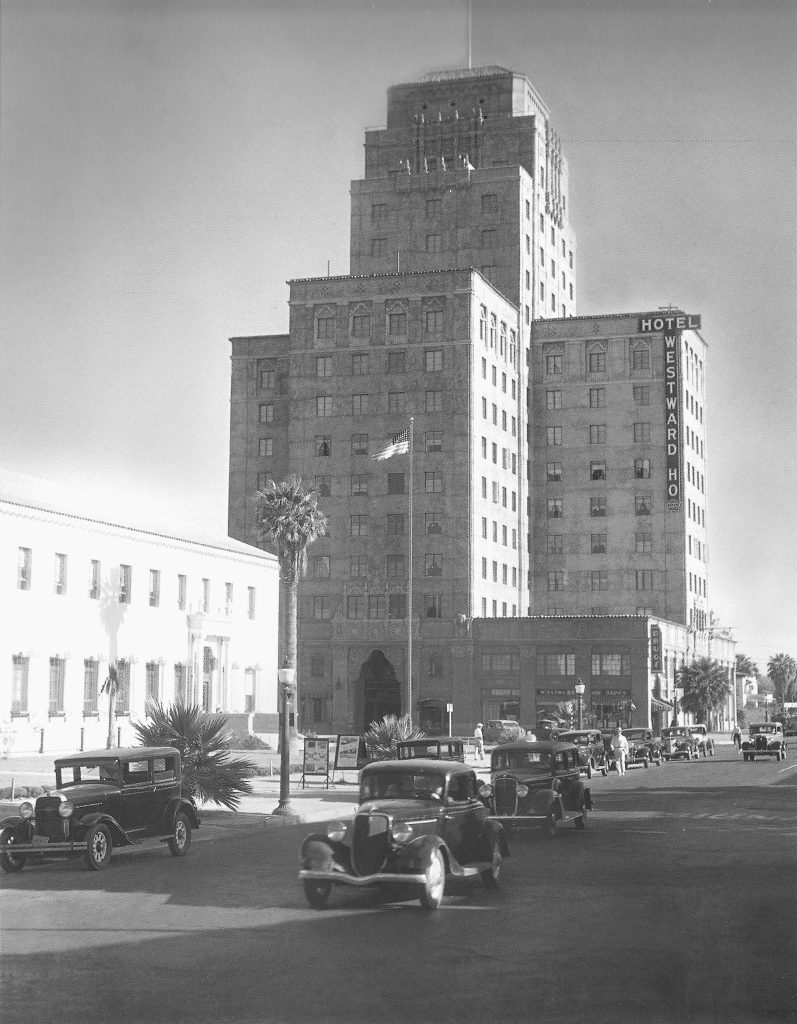
Westward_Ho_Hotel_Post_Office_Central_Fillmore_1937The first air-conditioned building in Phoenix was the Hotel Westward Ho, in 1929.

The common narrative is that Phoenix's spectacular growth was made possible by air conditioning. But that's only partly true.

Some of the hottest places in America held big cities in 1930, when air-conditioning units were large and expensive, confined to the largest buildings with money to spend. Among them were New Orleans (458,762), Dallas (269,475) Houston (292,352), and Atlanta (270,366). These cities suffered not only very hot, but also humid, summers. Phoenix, by contrast, had a population of only a little more than 48,000 that year. Even El Paso, the city that Phoenix leaders aspired to surpass as the business capital of the Southwest, held 102,421 people.

Before the beginning of the great post-war migration to the yet-to-be-named Sunbelt, the Intermountain West was lightly populated and a magical place unknown to most Americans outside of movies. The entire state of Arizona had a population of fewer than 436,000. The Intermountain West population was about 3.7 million out of a total U.S. population of 123 million. In other words, those seven states had fewer people than today's metropolitan Phoenix.

The great impediment to Phoenix's growth was not as much heat — note the cities above — as isolation. Cut off from the east and north by nearly impenetrable mountains, and from the west by forbidding desert, Phoenix was far from natural routes of commerce or travel. This began to change as branch lines of the Santa Fe and Southern Pacific railroads reached the emerging agricultural empire of the Salt River Valley in the late 19th century (the railroads' main lines had been built through northern and southern Arizona). This changed dramatically with the completion of SP northern main line through the city in 1926. Along with new highways, this forever broke through Phoenix's seclusion.

A dozen historic elections

A dozen historic elections

Bryan_in_1900
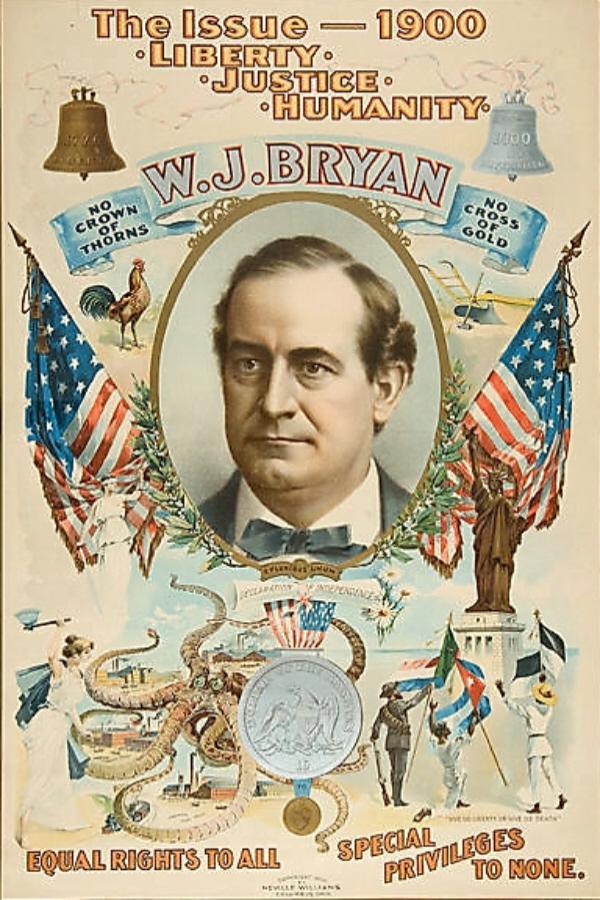
With Donald Trump, the most extreme and unqualified candidate of a major party, in striking distance of winning the presidency, we stand on the edge of the abyss. This election shouldn't be this close. You can use the comments section as an open thread as the next few days unspool. For my contribution, here are a dozen of the most consequential elections, nationally and in Arizona. At the least, they show that elections do indeed matter.

1828: John Quincy Adams vs. Andrew Jackson. Adams, the sitting Whig president, was defeated by war hero Jackson. The Whigs stood for the "American System" of internal improvements (infrastructure), a national bank and limiting the spread of slavery. Jackson was just the opposite. Jackson's victory led to the breaking of solemn treaties with the Five Civilized Tribes and their brutal relocation west (denounced by Adams) to open land for slaveholders, among many other ills.

1844: James K. Polk vs. Henry Clay. The defeat of "Harry of the West" not only doomed the American System but eliminated the last chance that the Civil War might have been postponed or avoided. One reason was the familiar partisan circular firing squad. Clay lost votes in New York and Pennsylvania to the abolitionist Liberty Party. It was the death of the Whigs.

With Polk, the nation again had a Southerner determined to extend slavery, including by prosecuting the highly unpopular Mexican War. At one point, Polk considered demanding all the territory to Tampico, but didn't want so many Mexicans brought into the union (they automatically became U.S. citizens with the Treaty of Guadalupe Hidalgo, which ended the war). On the other hand, in settling the Oregon Country dispute with Great Britain, he would have settled for the Columbia River as the northern border (in other words, Seattle would be in British Columbia). With Polk, the Civil War became inevitable.

The park Phoenix almost lost

The park Phoenix almost lost

Rock_Formation_in_Desert_Papago_Park_1917
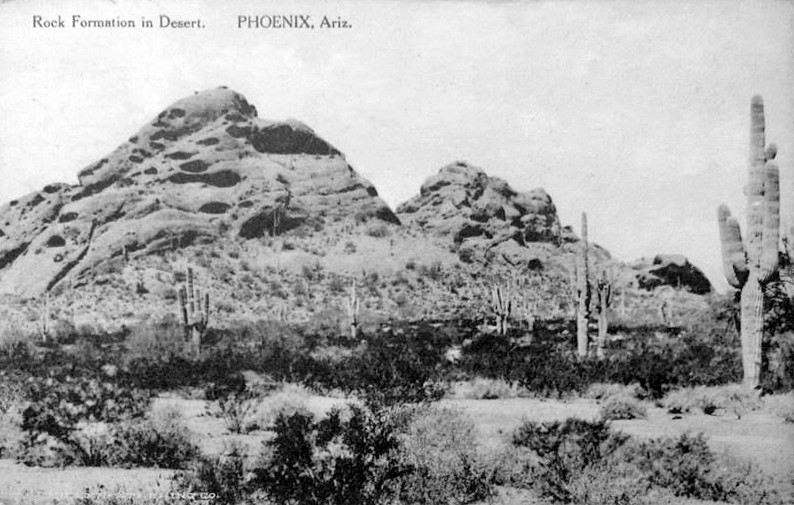
Today's Papago Park is full of delights and history, from the Desert Botanical Garden to the Phoenix Zoo, Hole-in-the-Rock, hiking, baseball, and Hunt's Tomb. As the official website says, "Its massive, otherworldly sandstone buttes set Papago Park apart, even in a city and state filled with world-class natural attractions."

But Papago Park almost didn't happen.

For those of you who don't venture south of Bell, north of "south Chandler," or are out-of-town readers, I'm writing about land that sits in east Phoenix and north Tempe. Technically, the boundaries run from McDowell on the north to Tempe Town Lake on the south, and 52nd Street and the Crosscut Canal/College Avenue to the west and east respectively. The park could have been much larger.

These magical uplands were five-and-a-half miles from the original Phoenix townsite when they were included in the reservation for the Pima and Maricopa tribes by President Rutherford B. Hayes. This was 1879, when the biggest concerns of the hardscrabble settlements of Phoenix and Tempe were reclaiming the Hohokam canals for agriculture. The National Park Service claims the Hohokam used Hole-in-the-Rock to mark the solstice. Early American settlers also appreciated the beauty of the ancient rock formations, including Carl Hayden (born in 1877) growing up across the river in Tempe.

Later in the 19th century, the reservation was contracted to the present-day borders of the Salt River Pima-Maricopa Indian Community. Some desultory mining activity took place around the buttes and they became more popular as exotic destinations for visitors. In 1914, a grown up Hayden, the new state's only representative in the U.S. House lobbied his friend, President Woodrow Wilson, to make the area a National Park. Wilson declined, but using the presidential powers of the Antiquities Act, declared it the Papago Saguaro National Monument. At the time, it stretched from the Salt River to Thomas Road.

Phoenix in the eighties

Phoenix in the eighties

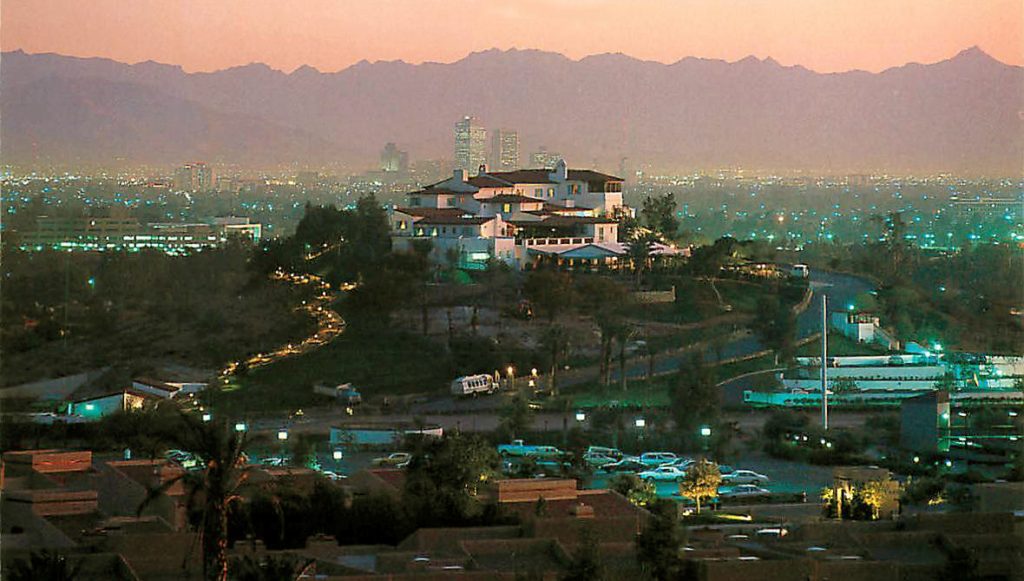
Wrigley_Mansion_looking_south_Estrellas_South_Mountain_1980sThe Wrigley looking southwest over the city in the 1980s (Photographer unknown).

On the night in 1968 after President Lyndon Johnson signed the bill authorizing construction of the Central Arizona Project., my mother took me on a long drive. We went through the citrus groves, the empty farmlands between the towns, the enchanting oasis that was Phoenix. Like many who had dedicated a good part of their lives to win the CAP, she had deep misgivings. She wanted me to see the place, burn it in my brain, and remember. "It will be gone," she said. She didn't live to see her prediction come true. But the ferocious transformation of Phoenix from my beloved old city to the nearly unrecognizable concrete desert of today largely  happened during the last two decades of the twentieth century. The big changes began in the 1980s.

In 1980, Phoenix's population was nearly 790,000, up 36 percent from 1970. The city would grow slower in the 1980s — up 25 percent. But Maricopa County grew almost 41 percent. Yesterday's small communities began to become today's mega-suburbs as sprawl took off as never before. For example, Glendale, which had grown by 168 percent in the 1970s, added another 52 percent in the eighties. It would hold nearly 148,000 people by 1990. Arrowhead Ranch, the citrus groves owned by the Goldwater and Martori families, was being developed into subdivisions, one of the largest new "master planned communities" in the state. Phoenix remained the power center of the state and county through the decade, but its hold began to slip.

In 1980, Phoenix still enjoyed a robust base of major headquarters. By most measures it was never stronger and almost all were located in the Central Corridor. Among them were the three big banks, Valley National, First National, and the Arizona Bank; Greyhound; Arizona Public Service; American Fence; Central Newspapers; Western Savings, and Del Webb Co. Karl Eller's Combined Communications had been purchased by Gannett in 1978 but Eller remained active, taking control of Circle K in 1983 and making it the nation's second-largest convenience store chain.

APS formed a holding company, Pinnacle West Capital, that was not regulated like the utility by the Corporation Commission. Among its ventures was the S&L Merabank. Taking advantage of airline deregulation, America West Airlines was formed by local investors in 1983 — it would go on to merge with USAirways and take over American Airlines. And Phelps-Dodge, which for a century controlled much of Arizona's destiny as the world's leading copper company, moved its headquarters from New York City to a new tower in Midtown Phoenix.